University of Windsor University of Windsor
Scholarship at UWindsor
Scholarship at UWindsor
Electronic Theses and Dissertations Theses, Dissertations, and Major Papers
2009
Joint Multi-item Storage Location Assignment Capacitated Lot
Joint Multi-item Storage Location Assignment Capacitated Lot
Sizing Problem
Sizing Problem
Sarina Turner University of Windsor
Follow this and additional works at: https://scholar.uwindsor.ca/etd
Recommended Citation Recommended Citation
Turner, Sarina, "Joint Multi-item Storage Location Assignment Capacitated Lot Sizing Problem" (2009). Electronic Theses and Dissertations. 161.
https://scholar.uwindsor.ca/etd/161
This online database contains the full-text of PhD dissertations and Masters’ theses of University of Windsor students from 1954 forward. These documents are made available for personal study and research purposes only, in accordance with the Canadian Copyright Act and the Creative Commons license—CC BY-NC-ND (Attribution, Non-Commercial, No Derivative Works). Under this license, works must always be attributed to the copyright holder (original author), cannot be used for any commercial purposes, and may not be altered. Any other use would require the permission of the copyright holder. Students may inquire about withdrawing their dissertation and/or thesis from this database. For additional inquiries, please contact the repository administrator via email
Joint Multi-item Storage Location Assignment Capacitated Lot Sizing Problem
by Sarina Turner
A Thesis
Submitted to the Faculty of Graduate Studies
through Industrial and Manufacturing Systems Engineering in Partial Fulfillment of the Requirements for
the Degree of Master of Applied Science at the University of Windsor
Windsor, Ontario, Canada 2009
iv
Author’s Declaration of Originality
I hereby certify that I am the sole author of this thesis and that no part of this thesis has been published or submitted for publication.
I certify that, to the best of my knowledge, my thesis does not infringe upon anyone‟s copyright nor violate any proprietary rights and that any ideas, techniques, quotations, or any other material from the work of other people included in my thesis, published or otherwise, are fully acknowledged in accordance with the standard referencing practices. Furthermore, to the extent that I have included copyrighted material that surpasses the bounds of fair dealing within the meaning of the Canada Copyright Act, I certify that I have obtained a written permission from the copyright owner(s) to include such material(s) in my thesis and have included copies of such copyright clearances to my appendix.
v
Abstract
This research develops and solves a mathematical model that combines a dynamic storage location assignment problem with a multi-item capacitated lot sizing problem. The joint multi-item storage location assignment and capacitated lot sizing problem aims to model a production warehouse coordinating production with warehouse layout. It examines when to produce an item and how much to produce, then once the item is produced where to place the item in the warehouse. This problem was formulated as a mixed integer program and the objective function was to minimize the costs of
vi
Dedication
To my Mom, Sebastien Jean Michel, my family, and friends
vii
Acknowledgements
I would like to extend my sincerest thanks to my supervisor, Dr. Guoqing Zhang for the extensive knowledge, guidance, suggestions, and encouragement he provided during my Master‟s Studies. Your help and support was greatly appreciated and this would not have been a success without you.
A special thanks to my committee members Dr. Michael Wang and Dr. Kevin Li for your input and valuable advice given. Thank you for your time and effort. Thanks to Dr. Reza Lashkari for being able to sit as the chair for my defence and your guidance. Special thanks and my gratitude to Dainty Foods and the office staff for their help and support with the project. A warm thanks to Ms. Brenda Schreiber, Ms. Jacquie Mummery, Mr. Terry Henderson, and Ms. Cheryl Hallman for all of your help and advice.
Special thanks to my mom, Andria Turner, thank you for all your support, guidance, wisdom, love, encouragement and good parenting. None of this would be possible without you. Special thanks to Sebastien Jean Michel, thank you for your help, support and love throughout my Master‟s.
Thank you to all of my family and friends for their continuous support and
encouragement, thank you for believing in me and supporting me in so many ways.
viii
Table of Contents
Author‟s Declaration of Originality ... iii
Abstract ... v
Dedication ... vi
Acknowledgements ... vii
List of Tables ... x
List of Figures ... xi
List of Abbreviations ... xii
Chapter 1: Introduction ... 1
1.1 Background/General Overview ... 1
1.2 Research Motivation ... 3
1.3 Proposed Research ... 6
1.3.1 Research Topic ... 6
1.3.2 Research Objective ... 7
1.3.3 Research Methodology ... 8
1.4 Organization of Thesis ... 10
Chapter 2: Literature Review ... 11
2.1 Warehousing and Warehouse Operations ... 11
2.2 Storage Assignment... 13
2.2.1 Storage Assignment Policies ... 15
2.2.2 Cube-per-order Index (COI) ... 23
2.2.3 Order Picking ... 25
2.2.4 Highly Related Model: Class based storage location assignment ... 26
2.3 Storage Assignment with Inventory Models ... 28
2.3.1 Highly Related Model: Joint storage assignment and order quantity problem 32 2.4 Production Planning ... 34
2.4.1 Uncapacitated Lot Sizing Problem ... 35
2.4.2 Capacitated Lot Sizing Problem (CLSP) ... 36
2.4.3 Highly Related Model: Capacitated Multi-Item Lot Sizing Problem (CLSP) . 39 2.5 Review of Literature Conclusion ... 41
ix
3.1 Background and problem definition ... 45
3.2 Joint multi-item storage location assignment and capacitated lot sizing problem .. 50
3.2.1 Model Assumptions ... 50
3.2.2 Index Description ... 51
3.2.3 Parameter and variable description ... 52
3.2.4 Formulation ... 53
Chapter 4: Solution Approach and Test Parameters ... 59
4.1 Background on Optimization Software ... 59
4.2 Verification of Model using GAMS/Cplex ... 61
4.3 Test Parameters ... 64
4.3.1 Small Scale Test Parameters... 66
4.3.2 Medium Scale Test Parameters ... 81
4.3.3 Large Scale Test Parameters ... 81
Chapter 5: Computational Results and Analysis ... 85
5.1 Small Scale Test Results ... 85
5.2 Medium Scale Test Results ... 103
5.3 Large Scale Test Results ... 112
5.4 Sensitivity Analysis ... 115
5.5 Remarks ... 120
Chapter 6: Conclusions and Recommendations ... 122
6.1 Conclusions ... 122
6.2Contribution ... 123
6.3 Recommendations for Future Work ... 124
Appendix A: Input Parameters ... 126
Appendix B: Results of Medium and Large Scale Test Instances ... 157
Bibliography ... 174
x
List of Tables
Table 2.1 Storage Assignment Policy Definitions ... 16
Table 2.2: Advantages and Disadvantages of Storage Assignment Policies ... 18
Table 2.3 Summary of Literature Review ... 43
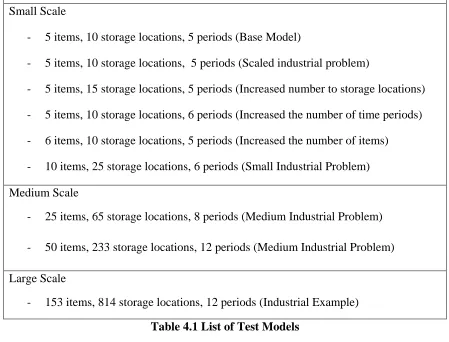
Table 4.1 List of Test Models ... 65
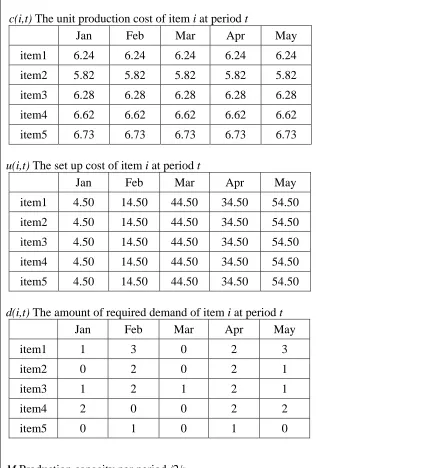
Table 4.2: Tests Parameters 5items, 10 storage locations and 5 periods ... 68
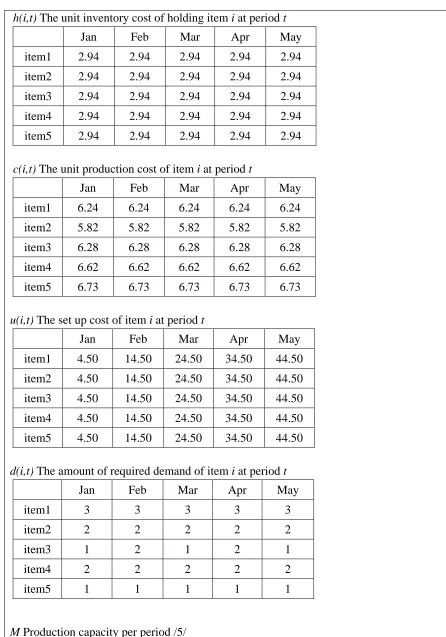
Table 4.3: Tests Parameters 5items, 10 locations and 5 periods with forced inventory ... 70
Table 4.4: Test Parameters 5 items, 15 storage locations, and 5 time periods ... 72
Table 4.5: Test Parameters 5 items, 15 storage locations, and 5 time periods ... 75
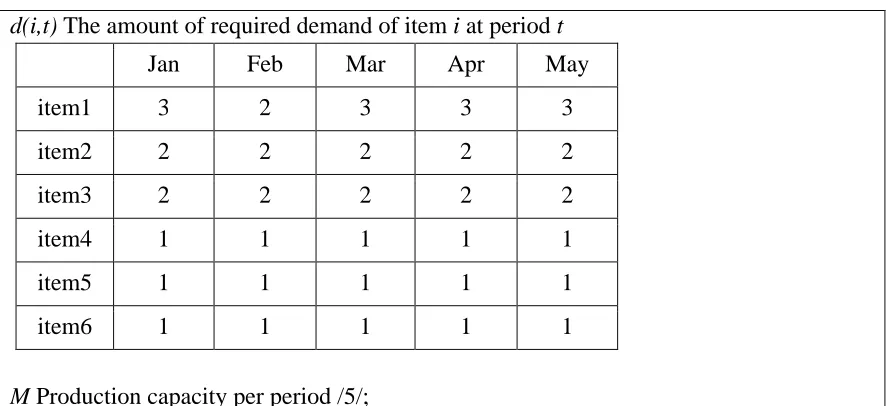
Table 4.6: Test Parameters for 6 items, 10 storage locations, 5 periods ... 77
Table 4.7: 10 items, 25 storage locations, and 6 time periods ... 80
Table 5.1 Small Scale Test Instances ... 85
Table 5.2 Results of test problem with 5 items, 10 storage locations, and 5 periods ... 88
Table 5.3 Results for test problem with 5 items, 10 storage locations, 5 periods with forced inventory ... 91
Table 5.4 Results for test problem with 5 items, 15 storage locations, 5 periods ... 95
Table 5.5 Results for test problem with 5 items, 10 storage locations, 6 time periods .... 97
Table 5.6 Results for test problem with 6 items, 10 storage locations, 5 time periods .. 100
Table 5.7 Results for test problem with 10 items, 25 locations, 6 time periods ... 102
Table 5.8 Medium Scale Test Instances ... 103
Table 5.9 Results of 25 items, 65 storage locations, 8 periods ... 106
Table 5.10 Results of 25 items, 65 storage locations, 8 periods (1 hour time limit) ... 110
Table 5.11 Results 50 items, 233 storage locations, 12 periods with 1 hour time limit . 112 Table 5.12 Results of Large Industrial Test Problem. ... 113
Table 5.13 Summarized Results of Test Instances ... 116
xi
List of Figures
xii
List of Abbreviations
CLSP : Capacitated Lot Sizing Problem
COI : Cube per Order Index
Cplex : Commercial LP, MIP, QP solver from ILOG Inc.
EOQ : Economic Order Quantity
GAMS : General Algebraic Modeling System
MIP : Mixed Integer Program
SKU : Stock Keeping Unit
SLAP : Storage Location Assignment Problem
SKU : Stock Keeping Unit
1
Chapter 1: Introduction
1.1 Background/General Overview
A warehouse is a place where goods are stored, buffered and protected in between points of origin and consumption. At a warehouse products are received from a source, stored until they are needed, and then are moved when they are requested. The
warehouse can also provide value added services such as fulfilment of individual customer orders, packaging of goods after sales services, repairs, testing, inspection and assembly. (De Koster et al. 2007, Heragu et al. 2005, Larson et al. 1997)
The idea of warehousing has been around for centuries starting with “granaries to store food” during the time of famines. Warehousing was initially used for storage in preparation for future events, there were no initial specifications, and the warehouse was just used as storage containers to hold grains.
Today warehouses are used in a variety of industries and serve as a physical location that receives goods and products for the eventual distribution to customers or other business. (Kirkwood, H.P. Jr., viewed April 2009). These warehouses “must be flexible structures to provide quality, efficiency and effectiveness of the logistics operations in a very demanding, competitive and uncertain market” (Geraldes et al. 2008).
2 growing need for warehouses in the supply chain the topic of how to better manage these facilities has become a popular area of research.
There are many areas that can be managed within the warehouse; however the focus for this thesis will be on production planning, order picking, and storage location
assignment. Production planning deals with the control of inventory to meet customer demand. In industrial problems production is often capacitated by time, resources and available warehouse space. General costs associated with production planning are the setup of the production line, inventory holding and the cost of producing goods. However since one of the main functions of production planning is to meet customer demand we also have to account for production and storage constraints that might hinder the product from making it to the customer. That is why once the items are produced, there has to be thought put into to where the items should be stored.
Storage location assignment is the set of rules which are used to assign incoming products to storage locations in storage departments/zones (De Koster et al. 2007, Gu et al. 2007). Storage location assignment is used to better assign warehouse space to products for familiarity and to increase the space utilization within a warehouse. Several policies on how to assign the warehouse space are described in the literature review found in Chapter 2. Another benefit of storage location assignment is its reduction in order picking costs.
3 are picked up and moved to an I/O point to be shipped to customers. These operations were observed during a research internship carried out in the warehouse of a Canadian food processing company.
This project was supported through an industry and government funded internship
and was the motivation of this thesis and will be discussed in the next section.
1.2 Research Motivation
A project was conducted at Dainty foods to reorganize their warehouse and determine if they had enough space to store each product to meet customer demand, keep up with current company operations, and future growth. While conducting this project many different operations observed in a production warehouse were the motivation for this thesis.
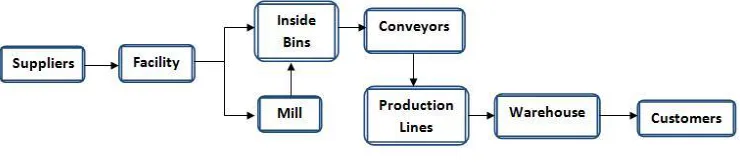
The company consists of a mill, production packaging lines, processing machines and a production warehouse. Products were shipped and received at the facility by railcar or trucks then the products were cleaned before they were sent to production. Form production the products were stored in the warehouse, and from the warehouse the
4
Figure 1: Material and Product Process Flow
There were ten production packaging lines. A production packaging line consists of packaging equipment that takes different product types and places them into either plastic or cardboard containers of different sizes and then palletizes the product. The packaging lines were assigned distinct names based on the machines that package the product. Each production packaging line produced different SKUs. The different SKUs were determined based on the product type, the packaging material used to package the product, the size in weight of the product, and the type of process that the product underwent. These different production lines produced over 150 different SKUs. All of these SKUs when produced had to be stored in the warehouse at the facility before they were shipped out to the different customers.
5 There was not an assignment policy for the warehouse space in place; warehouse management was unknowingly using a random storage policy because of the advantage of the shared storage space. When the warehouse conditions were full, even though the segmented areas were meant to be kept separate raw materials, finished goods, and packaging were intertwined. So retrieving the products became harder and handling costs went up.
Costs were associated with the storage and handling of products within the warehouse. Storage costs considered the costs associated with the storage of one pallet within the warehouse, this cost was calculated based on the amount of space in the warehouse, and the costs associated with operating the facility such as property taxes, hydro and electricity (Overhead costs). Handling costs considered the costs associated with moving the product from the I/O point to each storage location within the plant. This cost was based on distance travelled in feet, and was a combination of the cost of moving product (operator cost), labelling, shrink wrapping, and order processing per pallet.
Based on the above information the warehouse space at Dainty was reorganized through a heuristic that used a class based storage assignment policy, where classes were assigned space within the warehouse using the cube per order index rule (Heskett 1963). This project formed the basis for the research found within this thesis, based on the observation of the interrelationship between storage assignment, handling and production planning. These topics were applied and examined within this thesis and will be
6
1.3 Proposed Research
1.3.1 Research Topic
Warehousing is a multi faceted area of research; there are several methods and techniques to make improvements within a warehouse facility. However there are many variables that contribute to modeling all the warehouse operations that take place. Some warehouses have unique situations that are hard to model, or that add an extension to current research. The objective of this thesis research was to develop and solve a
mathematical model that had industrial application to the production warehouse at Dainty Foods.
In the production warehouse at Dainty Foods it was observed that production planning, and storage location assignment with the consideration of order picking all happened simultaneously. A model was formulated to integrate a storage assignment policy with the capacitated lot sizing problem for multiple items. This model minimized the cost of moving product, based on operator handling costs and the cost of production, machine set up, and holding inventory.
The storage location assignment problem considered how to assign products based on a dedicated storage policy to reduce order picking costs. The dedicated storage
assignment policy was selected to take advantage of the fixed storage locations within the warehouse to create familiarity. The order picking costs were proportional to the
7 planning of items in the warehouse and was limited by the amount of available
warehouse storage locations and production constraints.
While the storage location assignment and the capacitated lot sizing problem have been studied extensively in research it is believed that they have not been considered together in a mathematical model. Various authors have combined the storage location assignment problem with other inventory models such as the Economic Order Quantity EOQ model (Wilson 1977; Malmborg and Deutsch 1988) and the replenishment policy model (Hassani 2008; Kulturel 1999). It should be noted that all previous combinations, combined the storage assignment problem with static inventory models; the model presented in this thesis combined a storage location assignment problem with a dynamic inventory model.
It was believed that the dynamic joint multi-item storage location assignment and capacitated lot sizing problem has not been considered in research. And this was the topic for this thesis.
1.3.2 Research Objective
This research, formulated a mathematical model that combined a dedicated storage location assignment policy with a multi-item capacitated lot sizing problem. The
8
1.3.3 Research Methodology
Observe a system:
An internship was conducted between the summer and fall of 2008 at a food processing company, with specific focus on the production warehouse at the facility. It was observed that there needed to be more communication in regard to what was being produced and where the items that were produced should be placed in the warehouse. It was also observed that a randomized storage policy was in place, based strictly on the forklift operators and where they decided to place the items. Machine reliability and a large number of item types packaged on the same production line created the need for inventory levels of products to be kept for a couple of weeks to meet customer demand. Lastly, the operators who put away the product from the production line were different from the operators that picked the orders and loaded them on the trucks.
Identify the Problems, and Establish a Theoretical Hypothesis to Solve the Problem:
The production warehouse was faced with the following problems:
- Items were produced without taking into consideration the available space, which
caused item overflow in the warehouse. No policy was in place to coordinate product assignment to storage locations and inventory levels.
- A randomized storage policy led to products being misplaced, lost and overlooked
due to the lack of visibility of the products.
- The reliability of some of the production lines varied and required large
9
- The warehouse space was not large enough to keep up with the levels of inventory
that management wanted to keep on hand.
- Long production cycles for each production line, created high levels of inventory.
A large number of different SKUs were produced on each packaging line, so high levels of inventory had to be kept on hand, due to the fear the product would not be produced again before the SKU was needed.
- The operator responsible for the placement of items in the warehouse was not the
same operator who retrieved the items, this caused operators to have to spend time looking for products.
- Warehouse congestion due to large volumes of forklift traffic during item storage
and retrieval operations.
Several problems were identified; however specific focus was placed on the problem of coordinating production with warehouse layout, and taking into consideration the travel done by the forklift operators in the production and warehousing departments. Not all variables in the industrial problem were modeled; however the model attempted to account for the most important variables; storage location assignment, production planning, and the placement and retrieval of items during and order picking.
A mathematical model was developed to attempt to optimize the utilization of the current warehouse space, control the inventory levels and costs, and reduce the distance travelled during product placement/retrieval and order picking.
Literature Review:
10 review focused on warehousing, the storage location assignment problem (SLAP), storage policies, order picking, and production planning (the lot sizing problem). The literature review can be found in chapter 2 of the thesis.
Model Development:
A mathematical model had been developed and is further explained in Chapter 3 of this thesis.
Simulation:
This model had been formulated as a mixed integer program and test instances were solved using GAMS/Cplex optimization software.
Results:
Numerical results were provided to justify the model in Chapters 3 to 5, and the model, input parameters, and results were discussed.
1.4 Organization of Thesis
This thesis is divided as follows: Chapter two is the compilation of recent and relevant literature in the areas of storage location assignment, storage assignment
11
Chapter 2: Literature Review
There has been extensive research in the area of warehousing, warehouse operations, order picking, storage, and production planning. With the ever changing management of warehouses, the introduction of new technologies, and the unique warehouse operations of specific warehouses, new areas of research are opened for application to real world industrial problems.
The following chapter is comprised of four main areas of discussion: warehousing and warehouse operations, storage assignment and policies, the joint storage assignment and inventory models, production planning, the lot sizing problem. This discussion is followed by highly related models, a summary matrix of the literature review, and conclusions.
2.1 Warehousing and Warehouse Operations
Extensive literature has been conducted on warehouse design and operations examined the different operations, components and areas of improvement in
warehousing. Several studies had been aimed at examining the operations in the warehouse and developing procedures on how to solve general issues faced by warehousing facilities.
12 Products are received from production lines, suppliers, customer returns, etc and can be shipped through different forms of transportation methods. Depending on how product is stored, what product is to be stored, and owner of the product being stored warehouses are distinguished.
Van den Berg and Zijm (1999) examined three different types of warehouses;
distribution, production, and contract warehouses. “A distribution warehouse is a
warehouse in which products from different suppliers are collected (and sometimes
assembled) for delivery to a number of customers. A production warehouse is used for
the storage of raw materials, semi-finished products and finished products. A contract
warehouse is a facility that performs the warehousing operation on behalf of one or more customers.” The identification of types of warehouses helps clarify the specific
operations and processes that can be expected in a warehouse. Depending on the different operations performed and internal and external expectations, specific layouts and designs are found in the warehouse.
Hausman et al. (1976) identified three components to optimal warehouse design;
pallet assignment, storage assignment and interleaving. Pallet assignment is concerned
with the assignment of multiple items to the same pallet. Storage assignment assigns
pallet loads to storage locations and interleaving are rules for sequencing storage and
retrieval requests.
13 accumulation/ sortation, cross-docking, and shipping. Warehouses are broken into areas based on the activities that are performed. Heragu et al. (2005) and Rouwenhorst et al. (2000) defined these areas as forward and reserved areas. The reserved area is the basic storage locations where product is kept for longer periods of time. This is the area where products are picked before they are placed in the forward area. The forward area is where products are stored for short periods of time before they are ready to be loaded at the I/O points and shipped to customers.
Gu et al. (2007) discussed the importance of warehouses and explained the major roles of the warehouses in the supply chain. The major roles included “buffering the material flow along the supply chain to accommodate variability caused by factors such as product seasonality and/or batching in production and transportation; consolidation of products from various suppliers for combined delivery to customers; and value-added-processing such as kitting, pricing, labelling, and product customization.” This paper also explained what storage in a warehouse entailed and how storage is a major warehouse function and that it is shaped by three fundamental decisions; how much inventory should be kept, inventory replenishment, and where SKUS should be stored and moved within the warehouse. Because of the importance, special attention is given to the area of warehousing and warehouse operations.
2.2 Storage Assignment
The storage location assignment problem (SLAP) is the set of rules which can be used to assign incoming products to storage locations in storage departments/zones. The SLAP helps in the reduction of material handling and the improvement of space
14 Gu et al. (2007) in a literature review on warehouse operations formally define a SLAP as follows:
Given:
1. Information on the storage area, including its physical configuration and storage
layout.
2. Information on the storage locations, including their availability, physical
dimensions, and location.
3. Information on the set of items to be stored, including their physical dimensions,
demand, quantity, arrival and departure times.
Determine:
The physical location where arriving items will be stored.
Subject to performance criteria and constraints such as:
1. Storage capacity and efficiency.
2. Picker capacity and efficiency based on the picker cycle time.
3. Response time.
4. Compatibility between products and storage locations and the compatibility
between products.
5. Item retrieval policy such as FIFO (first-in, first-out), LIFO (last-in, first-out),
15 The rules that are used for the assignment of items to storage locations are defined in the following subsections.
2.2.1 Storage Assignment Policies
Several papers in literature have studied and compared storage assignment policies in various environments. This section defines storage assignment policies, examining the advantages and disadvantages, compares the policies and their application in different warehouse situations.
According to Goetschalckx and Ratliff (1990) a storage assignment policy is a set of rules which determine where the unit loads of different products will be located in the warehouse finding the optimal (best) locations to minimize the average travel time
required. Storage assignment policies designate a location to store and retrieve a unit load while satisfying the various constraints placed upon the system.
Kallina and Lynn (1976) came up with a set of rules for the assignment of products in the warehouse. These rules were not called a storage assignment policy however they are the basis of all the storage assignment policies. In their paper Kallina
and Lynn (1976) identifiedfour major determinants when arranging items: compatibility,
complementarity, popularity and space. Compatibility refers to items stored next to each
other without fear of contamination or other damage. Items that are considered
incompatible must be stored innonadjacent locations. Complementary items are those
frequently demanded simultaneously by a customer on the same order and should be
located close toeach other. Popular items in terms of the average number ofpicks per
day should be placed closest to the order shipping area, sincethese items demand the
16 the least amount of warehouse space and that those items are placed closest to the order
shippingarea. According to Kallina and Lynn (1976) popularity is the most commonly
recommendedfor stock location in a warehouse.
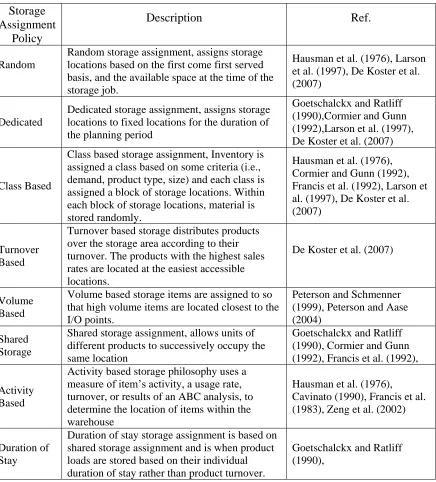
The table below summarizes the majority of the storage assignment policies that are most frequently used in warehouses.
Storage Assignment
Policy
Description Ref.
Random
Random storage assignment, assigns storage locations based on the first come first served basis, and the available space at the time of the storage job.
Hausman et al. (1976), Larson et al. (1997), De Koster et al. (2007)
Dedicated
Dedicated storage assignment, assigns storage locations to fixed locations for the duration of the planning period
Goetschalckx and Ratliff (1990),Cormier and Gunn (1992),Larson et al. (1997), De Koster et al. (2007)
Class Based
Class based storage assignment, Inventory is assigned a class based on some criteria (i.e., demand, product type, size) and each class is assigned a block of storage locations. Within each block of storage locations, material is stored randomly.
Hausman et al. (1976), Cormier and Gunn (1992), Francis et al. (1992), Larson et al. (1997), De Koster et al. (2007)
Turnover Based
Turnover based storage distributes products over the storage area according to their turnover. The products with the highest sales rates are located at the easiest accessible locations.
De Koster et al. (2007)
Volume Based
Volume based storage items are assigned to so that high volume items are located closest to the I/O points.
Peterson and Schmenner (1999), Peterson and Aase (2004)
Shared Storage
Shared storage assignment, allows units of different products to successively occupy the same location
Goetschalckx and Ratliff (1990), Cormier and Gunn (1992), Francis et al. (1992),
Activity Based
Activity based storage philosophy uses a measure of item‟s activity, a usage rate, turnover, or results of an ABC analysis, to determine the location of items within the warehouse
Hausman et al. (1976), Cavinato (1990), Francis et al. (1983), Zeng et al. (2002)
Duration of Stay
Duration of stay storage assignment is based on shared storage assignment and is when product loads are stored based on their individual duration of stay rather than product turnover.
Goetschalckx and Ratliff (1990),
17 Each of the storage assignment policies found in table 2.1 has advantages and disadvantages which can be found in table 2.2. Different types of warehouses perform different operations and a storage assignment policy is selected to meet the individual needs of each warehouse on a case by case basis. Some disadvantages are overlooked because the benefit of implementing the storage assignment policy. Several topics in literature address when specific storage assignment policies are optimal, and when they are best to be used.
Storage Assignment
Policy
Advantages/Disadvantages Ref.
Random
Advantages:
- The random assignment method results in a high space utilization (or low space requirement) Disadvantages:
- Increased travel distance over other policies - Will only work in a computer controlled
environment.
- Material handling cost is often greater because there is no effort to store faster moving material in the most desirable storage locations
Larson et al. (1997), De Koster et al. (2007)
Dedicated
Advantages:
- Order pickers become familiar with product locations
- Typically reduces the material handling costs Disadvantages:
- The location is reserved even for products that are out of stock,
- Space utilization is the lowest For every product sufficient space has to be reserved such that the maximum inventory level can be stored
Goetschalckx and Ratliff (1990), Larson et al. (1997), De Koster et al. (2007)
Class Based, and Turnover Based
Advantages:
- Uses the benefits of both random and dedicated storage
Disadvantage:
- Demand rates vary constantly and the product assortment changes frequently, each change would require a new ordering of products in the
warehouse resulting in a large amount of reshuffling of stock.
18 Storage
Assignment Policy
Advantages/Disadvantages Ref.
Volume Based
Advantages:
- Reduction in travel time and distance
- Significantly less picker travel than random storage Disadvantages:
- Aisle congestion
- Unbalanced utilization of the warehouse
Peterson and Aase (2004),Peterson and Schmenner, (1999)
Shared storage policy
Advantages:
- Items are able to share storage locations Disadvantage:
- total storage requirements vary over time
depending on how the material input andoutput are distributed over time
Goetschalckx and Ratliff (1990)
Duration of Stay (DOS)
Advantages:
- Takes advantage of class based storage assignment; classes are based on duration of stay.
Disadvantages:
- Only optimal under the assumption that the inputs and outputs balance perfectly
Goetschalckx and Ratliff (1990)
Table 2.2: Advantages and Disadvantages of Storage Assignment Policies
Storage assignment policies have been used in a number of different warehouses under different conditions. Different storage assignment policies are found to be optimal under different circumstances and are chosen accordingly.
19 Larson et al. (1997) examined a warehouse layout, where the method was targeted at practitioners of single command lift truck pallet storage and retrieval. The aim was to achieve the effective use of floor space maximizing the space utilization, by minimizing the travel time/travel distance, and being robust enough to fluctuate to change in the inventory levels and demand. The aisle layout and dimensions for the warehouse were found, the storage medium was chosen, and honeycombing and stacking height were also considered. A class based storage policy was used to allocate floor space to classes based on the storage medium, required number of storage locations and throughput. Each class was assigned to a storage region; however, within the storage region material was stored randomly. Random storage within the region provided flexibility to accommodate variations in inventory levels for materials assigned to the class. Thus, the proposed class-based storage policy increased the floor space utilization and flexibility, by decreasing the material handling cost.
Zeng et Al. (2002) examined a short term and long term plan to show different alternatives for reducing the time spent filling customer orders. For the short term plan they used an activity based storage philosophy. A problem of an industrial distributor in a case study was addressed by identifying fast moving items based on ABC analysis. This helped the company store products in the appropriate places and the two attributes used to separate inventories into groups were “(1) the percentage of part numbers and (2) the percentage of inventory value”, these values were determined by the demand quantity per period and the cost per unit. To address the short term objective of the industrial
20 was the optimal choice. This paper demonstrated how the time frame of a project was a determining factor as to what storage assignment policies were used.
Malmborg and Altassan (1998) examined a less than unit load warehousing system and developed models to compare dedicated storage using the cube per order index to place the items, and randomized storage using closest open location to place the items. These storage assignment policies were compared with respect to the total item space requirements, order picking cycle times and system responsiveness. Randomized storage only achieved a 65% space utilization compared with 100% space utilization of dedicated storage. However randomized storage had a higher percentage of available spaced used. Dedicated spaces were left empty if there was no product to fill the space. This paper examined the difficulty of modeling large less than unit load storage
assignment policies, and contributed the unit load as a factor when determining the optimal storage assignment policy.
21 Peterson and Aase (2004) examined static random storage, volume-based storage, and class-based storage policies, and used a simulation model to compare the policies in a warehouse environment. It was shown that when orders increased the percentage of savings for using each policy decreased. It was also concluded that “within-aisle volume-based and class-volume-based storage required significantly less picker travel than random
storage. However, a random storage policy generally utilized the entire picking area more evenly and reduced worker congestion.” This paper pinpointed tradeoffs (ex. space utilization, travel time, etc) of using different storage assignment policies, showing that when the picking region changed so did the optimal storage policy.
Muppani and Adil (2008) came up with an optimal solution procedure to model static storage class formation considering area reduction, storage space and handling costs. This model compared class-based storage to dedicated storage. Muppani and Adil (2008) concluded that if classes are formed considering only handling costs that a dedicated storage assignment policy would produce the lowest costs, and if classes were formed based on space costs, that a completely randomized storage assignment policy yielded the lowest cost solution. However they pointed out that when handling costs and space costs are considered together a class based storage assignment policy was optimal. Here Muppani and Adil (2008) used handling and storage cost as the factors for
determining the storage assignment policy used.
After examining several articles it can be noted that the different factors can affect the selection and optimality of a storage assignment policy. Below is a summary of the factors found in the literature reviewed:
22
- Floor space utilization, material handling cost, and flexibility (Larson et al. 1997)
- Whether the plan is for the short term or long term (Zeng et al. 2002)
- Less than unit loads (Malmborg and Altassan 1998)
- Storage equipment and the time required (Hausman et al. 1976)
- Picking region (Peterson and Aase 2004)
- Handling and storage costs (Muppani and Adil 2008)
All of these papers show that depending on the objective, different storage
assignment policies can be used and will be optimal. Different criteria can be used when implementing storage assignment policies and assigning items to locations.
In a literature review by Gu et al. (2007) various papers were examined and it was concluded that “different criteria can be used to assign a product (class) to storage locations. The three most frequently used criteria (see also Frazelle, 2002) are:
(1) Popularity (defined as the number of storage/retrieval operations per unit time period). For the popularity policy, product classes are ranked by decreasing popularity and the classes with the highest popularity are assigned the most desirable locations.
(2) Maximum inventory (defined as the maximum warehouse space allocated to a product class).For the maximum inventory policy, product classes are ranked by increasing maximum inventory and the classes with the lowest maximum inventory are assigned the most desirable locations.
23 requirement. Product classes are ranked by increasing COI value and the classes with the lowest COI are stored in the most desirable locations.”
“The COI policy has been extensively studied in the literature and is considered as more effective than the other two policies.” The next subsection contains a review of the Cube-per-order Index (COI) rule.
2.2.2 Cube-per-order Index (COI)
There is a large amount of research on storage assignment in regard to order picking. The cube-per-order index (COI) rule is one result of those studies (Heskett 1963, Kallina and Lynn 1976, Wilson 1977, Hodgson and Lowe 1982, Malmborg and Deutsch 1988). Under the COI rule, items are assigned to locations in an increasing order of COI value.
The cube-per-order index (COI) rule of Heskett (1963) is defined as the ratio of the item's total space requirement to number of trips required based on the items demand. The original heuristic consisted of locating the items with the lowest COI value closest to the input/output points, putting items that combined a high turnover frequency with a low space requirement in the best storage locations in the warehouse. Items were then
assigned to locations progressively farther away from the I/O point by increasing COI. The COI rule was proved optimal by several authors under various conditions. Francis (1967) provided a proof that the COI procedure minimizes single command travel under certain assumptions and Harmatuck (1976) modeled the COI rule as a linear
24 Harmatuck (1976) proved the optimality of the COI rule for the assignment of products to storage locations to minimize travel distance during storage/retrieval.
Kallina and Lynn (1976) discussed practical application when apply the cube per order index (COI) rule, and examined the key physical assumptions necessary for the implementation of the rule. The main sources for this examination were articles by Heskett in 1963 and 1964 that used the COI rule for minimizing order-picking costs in the staging area. Kallina and Lynn (1976) gave a better explanation how the COI rule presented by Heskett (1963) can be used; the assumptions required for the heuristic to be optimal and used a linear program again to prove the optimality of the COI with
application to an actual case.
Malmborg and Krishnakumar (1989) extended the COI to a multiple command warehouse operation environment and proved that under Euclidean distance the COI rule produces the shortest travelling cycle-time. The COI rule had been found optimal when assigning products where the objective was to reduce travel costs. Under changing conditions the COI rule did not always stand, other authors have pointed out the short fails of the COI, which are further noted by Lee (1992) and Caron et al. (1998).
25 Caron et al. (1998) evaluated and compared the expected travel distance for transversal and return routing policies in picker to part systems. In the paper items were assigned to storage locations based on the cube per order index (COI). It was found that COI based policy required that item locations be constantly reviewed in order to maintain the rule of assigned storage locations on the basis of the ratio of the required space to the order frequency.
This being said the COI rule is still a highly used rule in literature. Muppani and Adil (2008) used the COI to form classes, when reducing storage and handling costs and their paper had industrial applications. The model was useful for warehouse managers in the following ways it (1) provided proof that there is significant savings in using class based storage policies and (2) considered storage space costs and order picking costs.
Overall the COI rule is most frequently used to reduce the amount of travel that takes place during order picking. The next section will further describe the tasks involved with order picking.
2.2.3 Order Picking
26 locations, in response to customer demand. (Goetscalckx and Ashayeri 1989; Tompkins et al., 2003; Jane and Laih 2005).
It is estimated that order picking can be attributed to on average 65% of the total operating costs of common warehouses (Coyle et al. 1996). Reducing the amount of travel performed during order picking can have a significant effect on the total warehouse operations and aisle congestion. This has made order picking a high priority for
warehouse management and researchers.
The reduction of order picking time and travel distance has been address through several potential solutions. Researchers have examined the following areas to address the reduction of order picking time and costs: zoning, batching, routing policies, and storage policies to name a few.
For an extensive literature review on order picking refer to De Koster et al. (2007).
2.2.4 Highly Related Model: Class based storage location assignment
27 assignment method that was used to formulate the assignment of items to storage
locations, and the ease of calculating handling costs. The formulation and parameter details of this model are shown below the handling costs and the assignment rules that will be modified and implemented within this thesis are outlined:
Minimize𝑧 = 𝑓 ∙ 𝑎𝑙 𝑙∙ 𝑦𝑙𝑐 + 2 ∙ ℎ 𝑎𝑙 𝑙∙𝑑𝑙∙𝑦𝑙𝑐
𝑎𝑙 𝑙∙𝑦𝑙𝑐 ∗ 𝐷𝑝 𝑝 ∙ 𝑥𝑝𝑐
𝑐 𝑐
Subject to:
𝐶𝑂𝐼𝑝 ∙ 𝑥𝑝𝑐 ≤ 𝐶𝑂𝐼𝑝′ ∙ 𝑥𝑝′𝑐′ ∀𝑝 ≠ 𝑝′𝑎𝑛𝑑 𝑐 < 𝑐′
𝑙 ∙ 𝑦𝑙𝑐 ≤ 𝑙′ ∙ 𝑦𝑙′𝑐′ ∀𝑙 ≠ 𝑙 𝑎𝑛𝑑 𝑐 < 𝑐′
𝑦𝑙𝑐 ≤ 1
𝑐
∀𝑙
𝑥𝑝𝑐 = 1
𝑐
∀𝑝
𝐼𝑝𝑡 ∙ 𝑓𝑝∙ 𝑥𝑝𝑐 ≤ 𝑎𝑙∙ 𝑦𝑙𝑐 𝑙
𝑝
∀𝑐, 𝑡
𝑥𝑝𝑐 ∈ 0,1 ∀𝑝, 𝑐
𝑦𝑙𝑐 ∈ 0,1 ∀𝑙, 𝑐
Index, parameters, and decision variables description The following are the index:
c and c‟ (c,c‟= 1,2,3,...,C) for classes
l and l‟ (l, l‟=1,2,3,...,L) for storage locations p and p‟ (p, p‟=1,2,3,...,P) for products t (t=1,2,3,...,T) for time periods
28
COIp – cube-per-order index for product p
dl – distance of location l from the input and output point
Dp – total number of picks (in unit loads) for product p in the planning period
f – Space cost in $ per square foot
fp – footprint density, that is, footprint area required to store one unit load of product p
considering the stacking height
h – Order picking/handling cost in $ per foot
Itp – storage level in unit loads planned for product p during period t
The following are the decision variables:
xpc – {1, if product p is assigned to class c; 0, otherwise
ylc – {1, if location l is assigned to class c; 0, otherwise
2.3 Storage Assignment with Inventory Models
van den Berg and Zijm (1999) presented models on inventory management and storage location assignment separately and how they can be used to make performance improvements within a warehouse by reducing costs in relation to ordering picking and storage and handling costs. The importance of these two areas have been addressed individually and need to be combined to minimize order picking, storage and handling costs at the same time, since all of these operations occur simultaneously within a
warehouse. Kim (1993) stated that order sizes not only affect inventory- related costs but also determine space requirements, and that it is reasonable to integrate the decisions on order sizes and location assignment of stock.
29 an Economic Order Quantity (EOQ) inventory model to find the optimal reorder point and carrying costs of inventory.
Wilson (1977) was the first in academic literature to demonstrate the reorder quantity and the storage location of products together in a mathematical model to minimize order picking costs and inventory costs. The objective of the paper was to minimize the man hours required to pick orders and transport them to the shipping area, while considering the order quantity. Wilson (1977) recognized the importance of considering the costs of production, set up and holding inventory as well as handling costs. This paper also noted that the COI rule was an appropriate procedure for
warehouse layout when the cost of retrieval of a product was determined solely by the location of the product. While this model was ground breaking it was a single stage problem and did not take into consideration that storage and retrieval transactions could be interleaved to optimize travel time.
Hodgson and Lowe (1982) also examined a joint storage assignment and reorder quantity problem. They treated the assignment problem as a continuous layout problem to take advantage of the ability to tackle problems that have a large number of products in a small amount of computational time. An algorithm was used to find the locally optimal solution. While this model presented a similar idea to Wilson (1977) by combining the storage location assignment model with the EOQ inventory model the COI rule was not used to minimize handling costs, handling costs were minimized by the algorithm.
30 costs between storage and retrieval locations, the costs from the retrieval locations to the I/O point, and inventory costs, . They did not consider the use of the COI rule to assign products to storage locations within the mathematical model. The mathematical model only attempted to minimize the order picking costs and inventory costs, and was
constrained by the capacity of individual pallet positions not the entire warehouse. In the heuristic the COI rule was examined and the primary focus was on the warehouse layout. The results presented a trade-off between the total costs of the mathematical model and the space utilization of the warehouse.
Daellenbach (1977) focused on the storage assignment of products to tanks taking
into consideration inventory stocking and a (s, S) replenishment policy. While this problem was not used to consider warehouse layout the concepts was similar in the sense that it considered the assignment of a product to tanks while considering the cost of the producing and holding the product in inventory. Daellenbach (1977) addressed the
problem of finding the assignment of m products to n tanks where there are more
products than tanks. The objective was to minimize production set-up costs, inventory holding and storage costs, and handling costs. This problem is solved by tackling the problem in phases; however the problem was only solved for a small case and does not consider any larger scale models. The objective function was modelled using
31 Kulturel et al. (1999) combined duration of stay and turnover based storage assignment policies with a continuous review, order quantity reorder point (Q, r)
inventory model. The authors state that using the (Q, r) inventory policy is advantageous compared to using arbitrary order quantities even when the differences among individual order quantities were ignored. They used simulation and evaluated the model using factors and performance measures to determine the effectiveness of each policy, along with the inventory policy. This model possessed strong ideas for the combination of storage assignment with inventory control but never formulated a mathematical model with cost savings, but only looked at performance measures.
Malmborg (1996) developed a model that has been successfully applied to evaluate alternative storage layout policies based on item retrieval costs but generally assumed fixed replenishment levels for the items in the retrieval area. The model in the paper characterized the cost relationship associated with item stock policies, aggregate space allocation and storage layout. It is assumed that a distribution system procures product in economic lot sizes of items, stores the items at the point of distribution, and distributes unit quantities based on demand. It is assumed that each order is retrieved individually in response to transactions demand when the item is placed on an
32 where the number of items was less than the number of storage spaces. The paper
presented deterministic and stochastic models for allocating storage space in a time constrained environment. The replenishment policy used was a (Qi, si) policy examining available space and the amount of product that could fit into the space. Replenishment was to occur as soon as the products inventory was depleted. The model proved to be effective when the objective was to minimize system interruptions due to replenishment and replenishment was costly, and to maximize inter-replenishment times. The results showed that the proportion of space assigned to a product was not necessarily equal to its demand frequency. In the next subsection is a highly related model.
2.3.1 Highly Related Model: Joint storage assignment and order quantity problem
The model developed by Wilson (1977) considered a joint storage assignment and reorder quantity problem, where warehouse layout was examined simultaneously with the reorder quantities for SKUs. The model was formulated with a similar objective to the model of Harmatuck (1976) with the addition of an Economic Order Quantity (EOQ) model. Linear constraints were placed on the model in terms of storage capacity, number of products assigned to a location, and a non negativity constraint. The product
33 𝑍 = 𝑂𝐷𝑗 𝐶𝑂𝑆𝑇𝑖 ∙ 𝑋𝑖𝑗
𝑚
𝑖=1
/ 𝑋𝑖𝑗 𝑚
𝑖=1 𝑛
𝑗 =1
+ 𝐶𝑜 ∙ 𝐷𝑗 𝑚 𝑋𝑖𝑗
𝑖=1
+ (𝐶𝑚 ∙ 𝑉𝑗/2 𝑋𝑖𝑗
𝑚
𝑖=1 𝑛
𝑗 =1
Subject to:
𝐶𝑈𝑗 ∙ 𝑋𝑖𝑗 ≤ 𝐶𝐴𝑃𝑖
𝑛
𝑗 =1
𝑖 = 1,2, … , 𝑚
𝑋𝑖𝑗 ≥ 0 𝑖 = 1,2, … , 𝑚; 𝑗 = 1,2, … , 𝑛
This model possessed the idea of a joint storage assignment and inventory model. The idea of combining storage location assignment problem with the inventory costs will be used, along with idea of assigning a cost to retrieving an item from a specific location. Index, parameters and decision variable description
The following are the index:
i: Denotes the number of storage locations
j: Denotes the number of items
The following are the parameters in the model:
DDj: The number of periods‟ demand for item j for which space must be allocated (time);
CUj: The volume of space required by a unit of item j (length 3 /unit);
AOSj: The average order size for item j (units);
ODj: The number of orders per period for item j (time-1);
CAPi: The volume capacity of location i (length3);
COSTi: The cost of moving an order of any item from location i to the shipping area
34 The following is the decision variable:
Xij: The number of units of item j assigned to location i, for each i and j
In the next section another inventory model is examined that could be combined with the storage location assignment problem; the capacitated lot sizing problem will be discussed.
2.4 Production Planning
Production planning determines the quantity and the timing for several products in a finite number of periods, so as to satisfy a known demand in each period and minimize the sum of the set-up, production and inventory costs without incurring backlogs (Chen and Thizy 1990).
Production planning has two primary goals, to meet customer demand and have the lowest costs. When meeting customer demand that is controlled under the limit of inventory capacity, we can say this situation is limited or bounded inventory capacity. In production planning there are two primary limiting factors; production capacity and inventory capacity. However in industries such as food processing inventory capacity is usually the limiting factor (Liu and Tu 2008).
In literature four families of models have been investigated in additions to the simple production planning, they are as follows (Chu and Chu 2008; Liu and Tu 2008):
1) Models without backlogging. Each demand much be entirely delivered at period t
2) Models with backlogging. Each demand much be entirely delivered at a time
period later than t at the expense of backlogging cost.
35
4) Outsourcing models. Each demand must be entirely delivered in a period t at the
expense of an outsourcing cost.
For a more detailed review on these families of models refer to (Chu and Chu 2008; Liu and Tu 2008).
Jans and Degraeve (2008) have modeled various industrial extensions of the lot sizing problem but not the solution approaches. They examine the models in several ways, looking at production process, inventory, set up, demand and the rolling horizon, and they also model the lot sizing problem from the tactical and strategic perspective with distribution and supplier selection considered. In the next subsections models were examined that considered the uncapacitated and capacitated lot sizing problems with focus on production planning when the inventory and production are capacitated.
2.4.1 Uncapacitated Lot Sizing Problem
Wagner and Whitin (1958) performed the first study on the uncapacitated lot
sizing problem with backorder. They proposed an O (T2) algorithm for the problem based
on a zero inventory policy with constant production and holding costs. Zangwill (1966) generalized the work of Wagner and Whitin (1958) by proposing a polynomial algorithm to solve the production planning problem when backorders are allowed. Zoller and Robrade (1988) examined heuristics for the dynamic lot sizing model, they proposed an algorithm which enhanced the performance when solving the model under the condition of erratic demand.
36
2.4.2 Capacitated Lot Sizing Problem (CLSP)
The capacitated lot sizing problem (CLSP) is one of the most important and most difficult problems in production planning (Karimi et al. 2003). The capacitated lot sizing problem was considered to be NP hard by Florian and Klein (1971) and Bitran and Yanesse (1982). While the CLSP has been considered NP hard several algorithms and other solution methods have been developed to address the production planning problem. For example Chen and Thizy (1990) prove that lagrangian relaxation can be used to solve the problem. They also formulated and solve the multi-item capacitated lot size problem
using the shortest path formulation. Since then several algorithms have been developed
to solve the problem in less time. Karimi et al. (2003) have performed an extensive literature review of the models and algorithms related to the CLSP and should be referred to for further explanation of the models and algorithms.
The CLSP has been considered with bounded inventories with direction application to the warehouse environment. Love (1972) was the first to examine an inventory bounded problem. In the paper a single product facility dynamic lot size
problem with bounded inventory levels was examined and an algorithm was developed to solve the problem.
Page and Paul (1976) considered the problem of maintaining inventory for
37 CLSP, they applied the idea of bounded inventory to the warehouse setting using the EOQ production planning model.
Gutierrez et al. (2002) examined a relevant class of production inventory systems when the inventory levels were bounded. They solved a dynamic lot size problem in which the order quantities were restricted by the warehouse capacity. Demand was known, shortages were not permitted, and inventory levels could exceed storage capacity. The model was previously solved by Love (1973), however they different algorithm to solve the problem, which reduced the amount of required computational time.
Sedeno-Noda et al. (2004) examined a dynamic lot sizing problem in which the inventory levels were restricted by the warehouse capacities. It was assumed that the demand was known and shortages were not allowed. An O (TlogT) algorithm was used to solve the model.
Chu and Chu (2008) examined the single item dynamic lot sizing model with bounded inventory and outsourcing, where production capacity was assumed to be unlimited. The inventory was bounded by the storage capacity of the warehouse. Their model with the addition of the bounded inventory and outsourcing had industrial
application; they used a strongly polynomial algorithm to optimally solve the problem. Lui and Tu (2008) examined a production planning problem where the inventory capacity was the limiting factor. The problem was further complicated by the inventory capacity being constantly bounded, not allowing backlogging, and stating that production and stock out costs were not decreasing. They formulated the model and developed an
38 Minner (2009) analyzed the replenishment of multiple products to satisfy dynamic demand when the warehouse capacity or the available inventory budget was limited. A savings based heuristic was suggested for the warehouse scheduling problem and three simple approaches to the replenishment of multiple products with dynamic demand and limited warehouse capacity. These results were also compared with a mixed integer programming solver.
The capacitated lot sizing problem with bounded inventory has also been extended to include multiple products. Absi and Kedad-Sidhoum (2008) examined the multi-item capacitated lot sizing problem with setup time and shortages. The problem was to minimize demand shortages, the setup, the inventory and the production costs. The formulation was an extension of the CLSP with the addition of parameters and variables to minimize setup times and shortages costs. This model was also capacitated by bounded inventory.
Hariga and Jackson (1996) presented the warehouse scheduling problem (WSP) which was a multi-item warehouse problem that was limited by the floor space within the warehouse. The focus of the paper was to optimize space utilization, through order sizes and delivery scheduling. A cyclic schedule was made that minimized the long run average inventory and order costs per unit time without violating a warehouse space capacity constraint.
39 that the problem was considered NP hard. However it has been found in literature that the problem can be formed and solved as a Mixed Integer Program (MIP).
Rizk et al. (2006) examined a multi-item lot sizing problem with dynamic demand and formulated it as a mixed integer program to plan the supply of a family of items under piecewise linear resource costs. The problem was decomposed using lagrangian relaxation and a lagrangian heuristic was used to solve the problem.
Pochet and Wolsey (1991) solved the multi-item lot sizing problem as a mixed integer program. The paper aimed to show some slow but significant progress in solving a variety of multi-item lot sizing problems. They examined the capacitated and
uncapacitated problem and solution approaches for each. They concluded that the problem with both individual and joint production capacity constraints as well as problems with machine start up costs can be solved efficiently as mixed integer programs.
Pochet and Wolsey (2006) later went on to write a book on production planning by mixed integer programming where they explain how to formulate the uncapacitated and capacitated lot sizing problem as a mixed integer program and described
computational software, and algorithms that can solve these models.
2.4.3 Highly Related Model: Capacitated Multi-Item Lot Sizing Problem (CLSP)
40 planning part of the model with this thesis. Below is the general formulation of the CLSP as found in the model by Jans and Degraeve (2008).
Minimize
𝑠𝑐𝑖𝑡𝑦𝑖𝑡 + 𝑣𝑐𝑖𝑡𝑥𝑖𝑡 + ℎ𝑐𝑖𝑡𝑠𝑖𝑡
𝑖∈𝑇 𝑖∈𝑃
Subject to:
𝑠𝑖,𝑡−1+ 𝑥𝑖𝑡 = 𝑑𝑖𝑡 + 𝑠𝑖𝑡 ∀𝑖 ∈ 𝑃, ∀𝑡 ∈ 𝑇
𝑥𝑖𝑡 ≤ 𝑀𝑦𝑖𝑡 ∀𝑖 ∈ 𝑃, ∀𝑡 ∈ 𝑇
𝑣𝑡𝑖
𝑖∈𝑃
𝑥𝑖𝑡 ≤ 𝑐𝑎𝑝𝑡 ∀𝑡 ∈ 𝑇
𝑥𝑖𝑡, 𝑠𝑖𝑡 ≥ 0 ∀𝑖 ∈ 𝑃, ∀𝑡 ∈ 𝑇
𝑦𝑖𝑡 ∈ 0,1 ∀𝑖 ∈ 𝑃, ∀𝑡 ∈ 𝑇
The „big M‟ is usually set equal to min {capt/vti, sditm}, so such the production is now
limited by both the capacity and remaining demand. sditm is the cumulative demand for
item i at period t until m. However in the model for thesis we will let M represent a scalar value, which may represent any important constraining factor.
Index, parameters, and decision variables description The following are the index:
i – item i=1,...,P
t – periods t=1,...,m
The following are the parameters:
xit – the production level of item i in period t
yit – the set up decision of item i in period t
41
scit – set up cost of item i in period t
vcit – the variable production cost of item i in period t
hcit – holding cost of item i in period t
dit – demand of item i for each period t
sditm – cumulative demand of item i for period t until m
capt – limited production capacity
Note: Producing one unit of product i consumes vti units of capacity
2.5 Review of Literature Conclusion
In this literature review the major areas involved for a production warehousing system were examined. All of this literature is summarized into the following chart identifying all the areas of research that have been covered and highlighting gaps in previous research. Author SLA P Stor age Assi gn Po li cy re du ci ng trave l ti me re du ci ng trave l costs Inventory Models Stat ic Dynamic Simulat io n M at he mati cal M odel
EOQ (S,s
)
ULS
P
CLSP
Absi and Kedad-Sidhoum
(2008) √ √ Bitran, G.R., Yanesse,
H.H., (1982) √ √ Caron, F., Marchet, G.,
Perego, A., (1998) √ √ √ Cavinato, J., (1990) √ Chen and Thizy (1990) √ √ Chu, F., Chu, C., (2008) √ √ Cormier, G., Gunn, E.A.,
(1992) √ Daellenbach, H., (1977) √ √ √ √ de Koster, R., Le-Duc, T.,
Roodbergen, K.J., (2007) √ √ √ √
42 Author SLA P Stor age Assi gn Po li cy Re du ci ng Trav el Time Re du ci ng Trav el C os
ts Inventory Models
Stat ic Dynamic Simulat io n M at he mati cal M odel
EOQ (S,s
)
ULS
P
CL
SP
Florian, M., Klein, M.
(1971) √ √ Francis, R.L., (1967) √ Francis, R.L., McGinnis,
Jr., While, J.A., (1983) √ Francis, R.L., McGinnis,
Jr., While, J.A., (1992) √ Frazelle, E.H., (2002) √ Goetschalckx, M., Ratliff,
D., (1990) √ Gu, J., Goetschalckx, M.,
McGinnis, L.F., (2007) √ √ Gutierrez, J.,
Sedeno-Noda, A., Colebrook, M.,
Sicilia, J., (2002) √ √
Harmatuck, D.J., (1976) √ √ Hassini, E., (2008) √ √ √ Hausman, W.H., Schwarz,
L.B., Graves, S.C., (1976) √ √ √ Heskett, J.L., (1963) √ Heskett, J.L., (1964) √ Hodgson, T.J., Lowe, T.J.,
(1982) √ √ √ √ √ Jans, R., Degraeve, Z.,
(2008) √ √ Kallina, C., Lynn, J.,
(1976) √ √ Karimi,., B., Fatemi
Ghomi, S.M.T., Wilson, J.M., (2003)
√ √
Kim, K.H., (1993) √ √ Kulturel, S., Ozdemirel,
N.E., Sepil, C., Bozkurt, Z. (1999)
√ √ √ √ Larson, T.N., March, H.,
Kusiak, A., (1997) √ √ √
Lee, M.K., (1992) √ √ Liu, C.M., and Tu, Y.,
(2008) √