Copyright to IJIRSET www.ijirset.com 78
STUDY ON APPLICATION OF GENETIC
ALGORITHM IN CONSTRUCTION
RESOURCE LEVELLING
N.Satheesh Kumar1,R.Raj Kumar2
PG Student, Department of Civil Engineering, Kongu Engineering College, Perundurai, Tamilnadu,India1
Assistant professor, Department of Civil Engineering, Kongu Engineering College, Perundurai, Tamilnadu,India 2
ABSTRACT: Resource management ensures that a project is to be completed on time, at cost, and its quality is as
previously defined; nevertheless, the scarcity of resources is a usual reason for project delays.Traditional analytical
and heuristic approaches are inefficient and inflexible when solving construction resource levelling problems. The proposed algorithm can effectively provide the optimal or near-optimal combination of construction resources by the
starting and finishing dates of activities subjected to the objective of resource levelling.In the proposed method the
activity to be selected first for shifting is based on the largest value of resource rate. The process is repeated for all the remaining activities for possible shifting of resources by searching the fittest solution by the Genetic Algorithm. The GA procedure searches for optimum results in set of tasks and priorities that produce shorter project duration and better using MS Excel Evolver software.
KEYWORDS: Genetic Algorithm(GA), Resource Levelling, MS Excel Evolver.
1.INTRODUCTION
Since the late 1950s, the Critical Path Method CPM and the Program Evaluation and Review Technique PERT have been intensively used by practitioners for planning and controlling large-scale projects in the construction industry. In a traditional CPM and PERT analysis, every activity is assumed to start as soon as possible. In a real construction project, activities other than those on critical paths may shift along available floating times so as to have more even resource profiles. Resource levelling problems have been studied intensively in the construction and manufacturing industries because of their practical applications. A number of resource levelling models and algorithms have been developed to reduce the level of fluctuations in resource utilization and their negative impact on construction productivity and cost. Available resource levelling models are designed to minimize resource fluctuations by shifting noncritical activities within their available floats to keep the project duration of the original early schedule unchanged.A new approach, employing the use of genetic algorithms GAs., overcomes these drawbacks.
2.GENETIC ALGORITHM
Copyright to IJIRSET www.ijirset.com 79
A genetic algorithm is a search technique used in computing to find exact or approximate solutions to optimization and search problems. Genetic algorithms are categorized as global search heuristics. Genetic algorithms are a particular class of evolutionary algorithms (EA) that use techniques inspired by evolutionary biology such as inheritance, mutation, selection, and crossover. Genetic algorithms fall under the heading of evolutionary algorithm. Evolutionary algorithms are used to solve problems that do not already have a well defined efficient solution. Genetic algorithm have been used to solve optimization problems (scheduling, shortest path, etc), and in modelling systems where randomness is involved (e.g. the stock market).
Figure 2.1 Flowchart Showing Genetic Algorithm Process
3.0 RESOURCES
Resources may be renewable or non-renewable. Renewable resources are available each period without being depleted. Examples of renewable resources include labour and many types of equipment. Non-renewable resources are depleted as they are used. Examples of non-renewable resources include capital and raw materials. Note that the distinction between renewable and non-renewable resources may be tenuous. In some cases, renewable resources may become non-renewable Resources, in others, non-renewable resources may be considered renewable.
Copyright to IJIRSET www.ijirset.com 80 3.1 Resource Levelling
Resource levelling is a technique in project management that overlooks resource allocation and resolves possible conflict arising from over-allocation. When project managers undertake a project, they need to plan their resources accordingly .This will benefit the organization without having to face conflicts and not being able to deliver on time. Resource levelling is considered one of the key elements to resource management in the organization.
An organization starts to face problems if resources are not allocated properly i.e., some resource may be over-allocated whilst others will be under-over-allocated. Both will bring about a financial risk to the organization.
3.2 Resource Levelling By Genetic Algorithm
Resource levelling is needed in construction to avoid the difficulties associated with the large variations in resource usage. There are two basic categories of scheduling resources: fixed-limits resource scheduling and resource levelling. The fixed-limits resource scheduling arises when there are definite limitations on the amount of resources available. The scheduling objective is to extend the project duration as little as possible beyond the original critical path length such that the resource constraints are met. In this process, both critical and noncritical activities are shifted. Many heuristic and optimization methods have been developed for fixed-limits resource scheduling and can be found in the preceding references.
The resource levelling problem arises when there are sufficient resources available and it is necessary to reduce the fluctuations in the pattern of resource usage. These fluctuations are very undesirable because they often present labour, utilization, and financial difficulties for the contractor. The scheduling objective is to make the resource requirements as uniform as possible, or in some cases to make them match desirable non uniform resource levels. In resource levelling, there are no resource limits and the process is accomplished by shifting only the non critical activities within their available floats; the project duration of the original critical path remains fixed. For the optimization of resources, genetic algorithm is used , by the operators of GA to find the fittest value in the non
critical activities by changing their schedules and combining the resource usage in activities.The method of solving
resource constraint problem using the software Evolver which uses GA optimization technique is presented in this paper. Evolver is a powerful software solution for optimization problems which utilizes genetic algorithm methodology. Evolver includes an Excel Add-In which allows the user to run for an optimization problem from Microsoft Excel, as well as a Dynamic Link Library of genetic algorithm functions that may be called from programming languages such as Microsoft Visual Basic or C.
EVOLVER’S EXCEL INTERFACE
Copyright to IJIRSET www.ijirset.com 81
even hundreds of "generations," a population eventually emerges wherein the individuals will solve the problem very well. In fact, the fit individual will be an optimum or close to optimum solution.
4. RESULT AND DISCUSSION
Analyzing the quality of resource constrained scheduling of project management software, by evaluating two widely used software packages , Primavera and Microsoft Project 2007. Furthermore, the paper compares the results with the previous versions of these software packages, e.g. Primavera Project Planner, Microsoft Project. Project management software packages usually use priority rule-based heuristic algorithms for the resource levelling, but they donot offer other information about the details of the algorithm. For the comparison of results with the MS Excel Evolver for finding the better optimum solution with the various generations of results are compared and concluded.
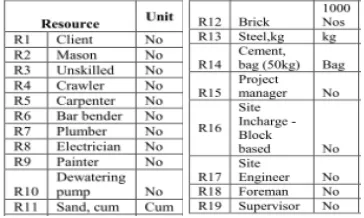
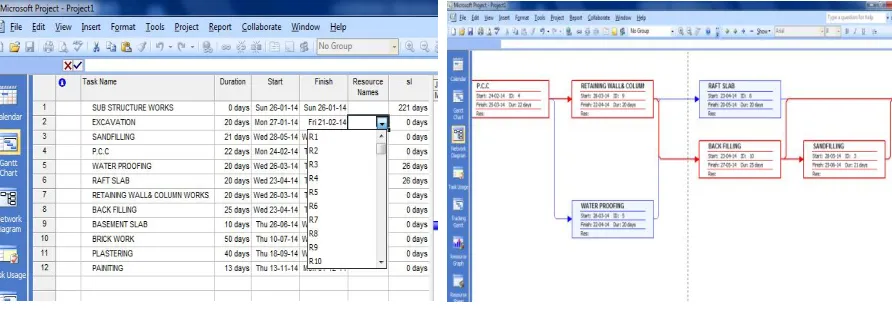
Figure 4.1 Resource Allocating to the Figure 4.2 Shifting of Non Critical Activity
Required Activities Resources by Their Floats
4.1 Evolver Solution
Copyright to IJIRSET www.ijirset.com 82
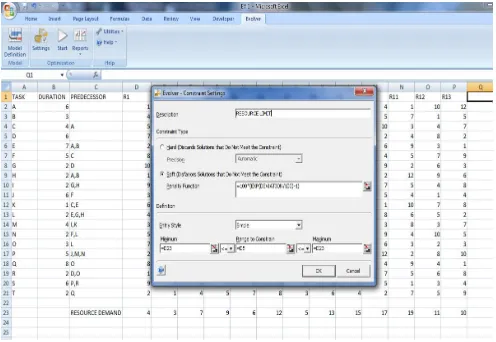
Figure 4.3 Constraints setting in MS Excel Evolver Figure 4.4 Evolver solution
5.CONCLUSION
CPM is inappropriate for scheduling resource constrained projects, and project managers should not rely only on this method when dealing with limited resources. Project management software packages should incorporate other more
efficient methods for resource constrained scheduling and should try to illuminate some drawbacks. An
implementation of the GA developed model for project scheduling of resources for levelled use has resulted in optimized output with reduced cost. A real time project solved using shows that best converging result can be obtained. By this optimization software shows the best result in problem solving in real time.
REFERENCES
1) Ahuja.V, V. Thiruvengadam, Project scheduling and monitoring: current research status, Construction Innovation 4 (2004) 19–31. 2) Chassiakos.A.P., S.P. Sakellaropoulos, Time-cost optimization of construction projects with generalized activity constraints, Journal of
Construction Engineering and Management 131 (10) (2005) 1115–1124.
3) Chen.P.H, Integration of cost and schedule using extensive matrix method and spreadsheets, Automation in Construction 18 (1) (2008) 32– 4.
4) Chen.P.H, H.J. Weng, A two-phase GA model for resource-constrained project scheduling, Automation in Construction 18 (2009) 485–498. 5) Chiraphadhanakul, S., Dangprasert, P (1997) Genetic algorithms in demand forecasting, Proceedings: IEEE International
Conference,116-121.
6) Ebrahimi.L, G.A. BaranI, AND H. Ebrahimi. Optimization of Reservoir Operation Using Combined Genetic Algorithm and Wavelet Transform Method, American Journal of Agricultural and Biological Sciences 2 (3): 153-158, 2007.
7) Goldberg, David E. (1989). Genetic Algorithms in Search Optimization and Machine Learning. Addison Wesley. p. 41.ISBN 0-201-15767-5.
8) Hegazy.T, Optimization of resource allocation and leveling using genetic algorithms, Journal of Construction Engineering and Management 125 (3) (1999) 167–175.
9) Jose Luis Ponz-Tienda, Víctor Yepes,Eugenio Pellicer,Joaquin Moreno-Flores,The Resource Leveling Problem With Multiple Resources Using An Adaptive Genetic Algorithm.Automation in Construction,2012.
10) Jose Luis Ponz-Tienda, Víctor Yepes,Eugenio Pellicer,Joaquin Moreno-Flores,The Resource Leveling Problem With Multiple Resources Using An Adaptive Genetic Algorithm.Automation in Construction,2012.
11) Jian-Wen Huang, Xing-Xia Wang And Rui Chen,Genetic Algorithms for Optimization of Resource Allocation in Large Scale Construction Project Management,Journal Of Computers, Vol. 5, No. 12, 2010.
Copyright to IJIRSET www.ijirset.com 83 13) Seyed Ahmad Sheibatolhamdy, Mostafa Samady And Ardeshir Shaaban,Solving Scheduling Problem By Multi-index Genetic
Algorithm,African Journal of Business Management Vol. 6(22) , 2012.
14) Sou-Sen Leu, Chung-Huei Yang, Jiun-Ching Huang,Resource Leveling In Construction By Genetic Algorithm-based Optimization And Its Decision Support System Application,Automation in Construction, 1999.