INHERITANCE STUDIES I N PISUM. V. THE INHERITANCE OF SCIMITAR POD'
ORLAND E. WHITE
Brooklyn Botanic Garden, Brooklyn, New York Received December 19. 1924
TABLE O F CONTENTS
P A G E
INTRODUCTION. ... 197
The types used.. ... 198
Experimental work. ... 199
The behavior of the parent strains.. ... 199
The behavior of the crosses.. ... 200
Wachs Schwert (32) XGraue Riesen Schnabel (87). ... 200
Acacia (38) XGraue Riesen Schnabel (87). ... 201
Juno (70) XGraue Riesen Schnabel (87). ... 202
Nero (81) XGraue Riesen Schnabel (87). ... 204
Gram Riesen Schnabel (87) Xsegregate (5). ... 205
Graue Riesen Schnabe' (87) XMammut (82). ... 207
Brown Abyssinian (157)XGraue Riesen Schnabel(87). ... 207
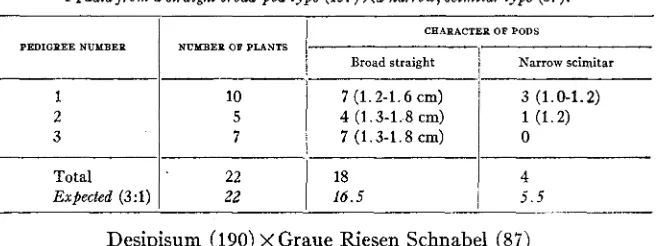
Desipisum (190) XGraue Riesen Schnabel (87). ... 208
Combined results.. ... 208
DISCUSS -ON AND INTERPRETATION. ... 209
SWARY.. ... 2 10 LITERAT~RECIT ED ... 210
INTRODUCTION
Certain varieties of field peas, Pisum arzlense L., or P. sativum var. urvense of some authors, are characterized by a long, comparatively narrow, string-bean-shaped pod, curved in varying degrees in scimitar fashion, and terminating in an acute apex. These varieties vary in both length and width of pod, but in each case the dimensions show the same proportional relation to each other, so that although a variety may have very small pods, the length-width relation gives a long, narrow, string- bean-shaped pod. The experimental work reported in succeeding pages records the results of crossing a variety with the scimitar character with six varieties of peas characterized by broad, straight pods, and 2 varieties with broad pods, very slightly curved. These experiments involve a total
of over 2290 F1, Fz, Fa and F4 plants.
BROOKLYN BOTANIC GARDEN Contributions No. 43. These studies on the genetics of Pisum were carried on in collaboration with the Office of Forage Crop Investigations and the Office of Horticultural and Pomological Investigations, U. S. DEPARTMENT OF AGRICULTURE.
198 ORLAND E. WHITE
THE TYPES USED
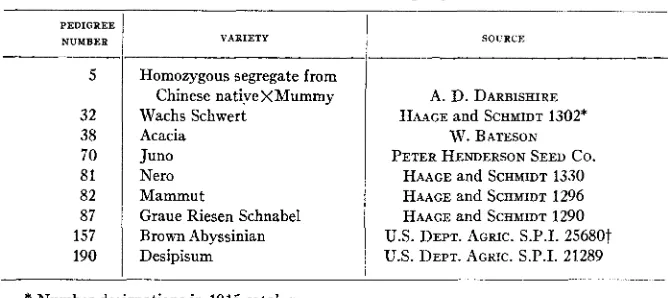
The varieties used, together with the source from which they were obtained and the numbers by which they are designated in my records are listed in table 1.
TABLE 1
List of varieties w e d , with source and pedigree number.
P E D I G R E E NUMBER 5 32 38 70 81 82 87 157 190 VARIETY
Homozygous segregate from Chinese nativeXMummy Wachs Schwert Acacia Juno Nero Mammut
Graue Riesen Schnabel Brown Abyssinian Desipisum
SOURCE
”
A. D. DARBISHIRE HAACE and SCHMIDT 1302*
W. BATESON PETER HENDERSON SEED Co.
HAACE and SCHMIDT 1330 HAAGE and SCHMIDT 1296
US. DEPT. AGRIC. S.P.I. 256801
US. DEPT. AGRIC. S.P.I. 21289 HAAGE and SCHMIDT 1290
- * Number designations in 1915 catalog.
t Office of Seed and Plant Introduction.
Table 2 gives a crude measure of the pod-dimension characters of each variety, accurate enough for the present study. The pods were measured in both the green mature and dry mature states. The pods of each plant of a given variety vary within the ranges indicated? the smaller pods representing the end of the bearing season. Numbers 32 and 82 had non-parchmented pods, hence the green-pod dimensions give a more accurate concept of their relative length-width dimensions? as they
TABLE 2
Pod lesidth and length i n the varieties used.
P E D I G R E E R A N G E O F W I D T H P E R P L A N T I N C E N T I M E T E R S
1
RANGE OF POD LENGTA PER PLANT I K C E N T I X E T E R S N U M B E RGreen
1
”_ ”
Dry
”_.
i
Dry5 32 38 70 81 82 87 157 190 1.5-2.0 . . . . . . 1.5-1.8 2.0-2.6 1.2-1.4 ... ... 1.3-1.5
1.3-1.7 (mode 1.4) 1.2-1.5
1.5-1.8 1.5-1.8
1.7-2.2 (mode 2.0) 1.1-1.4 (mode 1.1) 1.2-1.3
0.8-1.0
16.0-9.0
. . .4.5- 6 . 5 6 5-12.5 6.0-10.0
. . . . . .
4.0- 6 . 0
3.5- 9.0 (mode 8.0) 4.0- 6 . 5
INHERITANCE OF SCIMITAR POD IN PISUM 199
shrink considerably on maturing, while shrinkage is relatively slight in the parchmented types.
EXPERIMENTAL WORK
The behavior of the parent strains
All the varieties used were inbred for two years or more and doubtless had been inbred for a large number of generations, since the flowers of nearly all varieties known to me are nearly always self-pollinated in the bud stage before the flowers open. The literature on cross-pollination in peas is summarized in a previous publication (WHITE 1917), together with
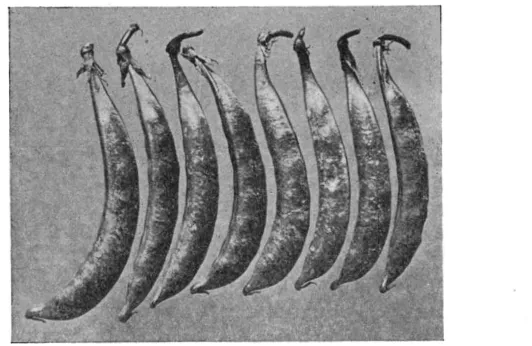
FIGURE 1.-Random sample of pods, one from a single plant, showing the narrow scimitar
shape of the pods of the variety Graue Riesen Schnabel (87).
data on cross-pollination in field cultures a t the BROOKLYN BOTANIC GARDEN. Numbers 38, 70, 81, 82, 157 and 190 bred true for straight broad pods. The pods of number 82, as can be seen from table 2, are greatest in both length and breadth, while those of number 190 are smallest in these dimensions. From a width-length standpoint, all these types are to be classed as broad-podded. Numbers 5 and 32 bred true to broad-poddedness, but are slightly curved, though this curvature
200 ORLAND E. WHITE
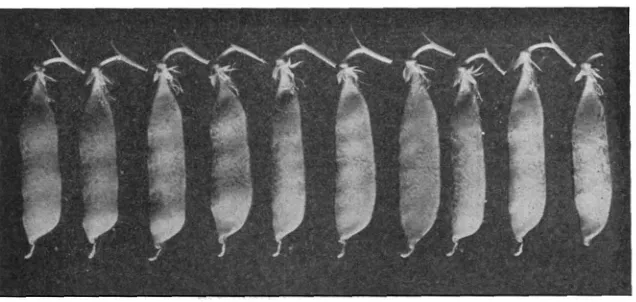
differences. Figure 1 is a random sample of pods, one from each plant, typical of the variety number 87. Figure 2 shows a similar sample of pods, one from each plant, of the broad straight-pod type, as found in number 38.
FIGURE 2.-Random sample of pods, one from a single plant, showing the broad, straight-
pod type as illustrated by the variety Acacia (38).
The behavior of the crosses
Wachs Schwert (32) X Graue Riesen Schnabel (87)
Four F1-generation plants of this cross were grown, giving rise to
4 F,-generation families, totaling 55 plants. A summary of the F1 and
Ft results is given in table 3. The ranges of the pod widths are in paren-
thesis.
Tmm 3
F1 and A dot0 front crosshg a v d t y with broad, slightly curved ) o h (32) with a variety
with nuwow, scimitar eods (87).
C E " n O N
AND NUYBEP OF PLANTS PEUIGPEE -El
F1 4
F r l 14
F t 2
F A
13 FZ-3
15
13
Total F1 55
Expwkd (3 : 1) 55
CHAMCTEPOFPODS
Broad, slightly curved
S(1.2-1.5 cm) 9(1.9-2.2 cm)
0
4( 1.7-2.0 cm wide)
Narrow, scimitar
9(1.9-2.2 cm) 6(1.0-1.4 cm) ll(1.5-2.Ocm) 2(0.7-1.3 cm) l l ( 1 . 8 2 . 1 cm) 2(1.2-1.3 cm)
40 15
INHERITANCE OF SCIMITAR POD IN PISUM 201 Forty-three of the 55
F2
plants gave rise to 43 F3 families, totaling 385 plants, each family consisting in the great majority of cases of from5 to 15 or more plants. I n a few cases, the family consisted of only 3 or
4 individuals, but these were families derived from the scimitar segregates and consisted wholly of scimitars. Thirty-three of the 43 F2 plants tested by their F3 progeny were broad-pod, the remaining 10 being scimi- tar. Fifteen of the broad-pod F2 plants gave only broad-pod F3 progeny,
while 18 broad-pod F2 plants were heterozygous, giving both broad-pod and scimitar segregates’ in Ff. The total number of plants in the F3
heterozygous families was 153, divided into 102 broad-pod: 51 scimitar. This is exactly a 2: 1 ratio, whereas the theoretically expected ratio, as judged by the F2 results, should approximate 3 : 1. The F3 generation was field grown and many of the plants died from disease before reaching the pod-bearing stage, whereas the F2 generation was greenhouse grown and gave 100 percent germination and 100 percent plants reaching maturity.
Acacia (38) X Graue Riesen Schnabel (87)
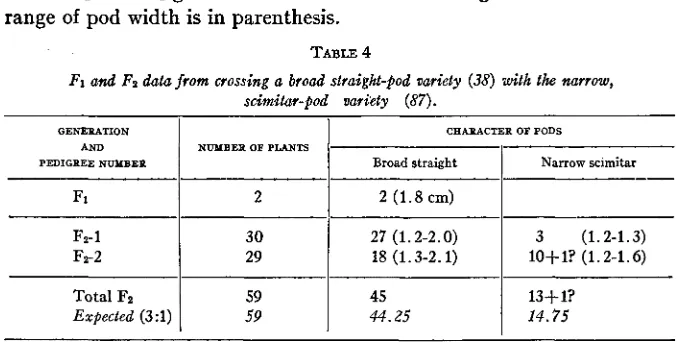
The FI- and F2-generation data on this cross are given in table 4. The range of pod width is in parenthesis.
TABLE 4
F1 and F2 data from crossing a broad straight-pod variety (38) with the narrow, scimitar-pod uari’ety (87).
GENEBATION CHARACTER OF PODS
PEDIGREE NUMBER
AND NUMBER OF P U N T S
Broad straight
1
Narrow scimitarFI
I
2I
2 (1.8cm)I
F2- 1
14.75 44.25 59
Expected (3:l)
13+ l ? 45
59 Total Fa
10+l? (1.2-1.6) 18 (1.3-2.1)
29 Fa2
3 (1.2-1.3) 27 (1.2-2.0)
30
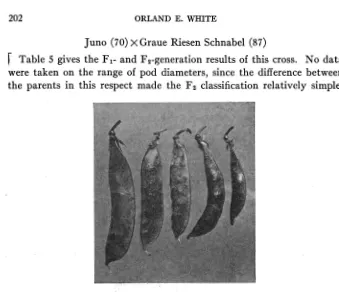
I n F3 6 F2 broad, straight-pod segregates gave 4 families homozygous for broad straight pods and 2 heterozygous families, while 3 Fz scimitar segregates in FS bred true to scimitar. Figure 3 shows 5 pods from 5 different F3 plants of a heterozygous family, the first of which, beginning
at the left, illustrates the type of pods on heterozygous plants. Pods 2 and 3 show the character of pods on the segregates homozygous for broad straight pods. Pods 4 and 5 are pods from F3 segregate scimitar plants. The character of the pods of the pure broad straight-pod parent (number 38) is shown in figure 2.
202 ORLAND E. WHITE
Juno (70) XGraue Riesen Schnabel (87)
1
Table 5 gives the FI- and F*-generation results of this cross. No data were taken on the range of pod diameters, since the difference between the parents in this respect made the Fa classification relatively simple... ,.
.
d
E
FIGURE 3.-A single pod from each of 5 Fs plants of a heterozygous family of NO. 38XNo. 87,
showing the segregate t v s SS. and SA.
TABLE 5
F1 and Fa doro from crossing a broad straight-pod variety (70) with the mwowJ scimitar-pod type (87).
G-TION
A N D -ER O? PLANTS
CHAPACTEROFPODS
PEDIGREE NUMBEX Broad straight Narrow scimitnr
FI 4 4(1.&2.0cm)
...
F r l 12
6
22+ l ?
29
F A
7 28
35 FX-3
3 12 15
Fa-2
2 10
Total Fa 91 72+1?
.
18Expected (3:l) 91 68.25 22.75
Eight Fa broad-pod segregates when tested in Fs showed that 6 were heterozygous and 2 homozygous. The 6 heterozygotes gave a ratio of 62 : 23, the theoretically expected being 63.75 broad-pod straight: 21.25
narrow scimitar. Four F2 scimitars gave all scimitar progeny in Fa.
INHERITANCE OF SCIMITAR POD IN PISUM 203
in a heterozygous F*' family of this cross. Fifteen Segregate plants are represented, one typical pod from each. Beginning at the left, the lirst 9
illustrate the homozygous broad straight pod and the heterozygous types,
FIG- 4 . 4 n e pod from each of 15 plants of an Fa heterozygous family (No. 70XNo. 87),
showing segregation of broad straight or slightly CUNNI (the first 9) and narrow scimitar (the last
6).
while the remaining six pods are from 6 scimitar Fa segregates. Figure 5
shows pods from 10 F3 plants derived from an Fa scimitar segregate. All are:uniformly scimitar. For illustration of the scimitar parent, see figure 1.
FIG- 5.-A single pod from each of 10 plants of an Fa family (No. 7OXNo. 87) homozygous
for scimitar.
204 ORLAND E. WRITE
Nero (81) XGraue Riesen Schnabel (87)
Four
F1
plants of this cross were grown, and all had broad straight pods averaging 1.8 cm in diameter. Table 6 gives the data for the 4 FI families.TABLE 6
F, data from broad straight pad (81) Xnonmu s c i m i k pad (87).
F r l
2 15
17 F A
6 8
14 F t 3
2 9
11
Fr2
4 19
23
Total 65 51 14
Exbeckd (3:l) 65 48.75 16.25
Forty-five FS families were grown, thirty-five of which were derived from F e broad, straight-pod segregates and ten from Ft scimitar parents. Ten of the F e broad-pod segregates bred true, giving only Fa progeny with broad, straight pods, while 25
Fe
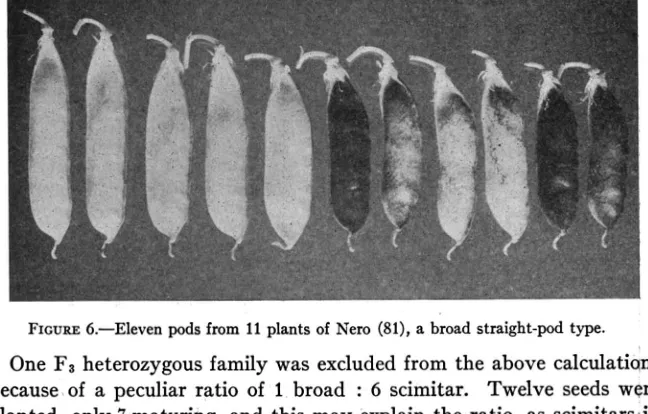
broad-pod segregates were hetero- zygous, giving a total ratio of 135 broad straight-pod : 59 scimitar, the theoretically expected ratio being 145.5 : 48.5.FIGURE 6.-Eleven pods from 11 plants of Nero (81), a broad straight-pod type.
INHERITANCE OF SCIMITAR POD IN PISUM 205
6 illustrates the character of the pods from the straight broad-pod type (number 81).
Graue Riesen Schnabel (87) Xsegregate (5)
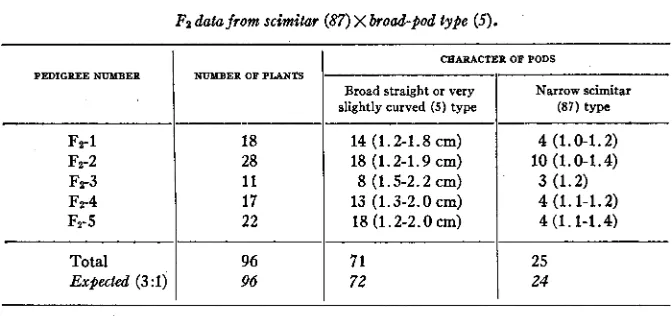
Five F1 plants of this cross were grown and all had broad, slightly curved pods such as the parent type (5) had. The range of pod diameter was 1.6 to 1.8 cm, The Fz data from the progeny of these FI's are given
in table 7, with the pod widths in parenthesis.
TABLE 7
FS data from scimilar ( 8 7 ) X broad-pod type (5).
PEDIGREE NUMBEP
Total
Expected (3 :l)
C H A U C T E R O F P O D S NUMBER OF P U N T S
-
Broad straight or very Narrow scimitar slightly curved ( 5 ) type (87) type
18 28 11 17 22
14 (1.2-1.8 cm)
10 (1.0-1.4) 18 (1.2-1.9 cm)
4 (1.0-1.2)
4 (1.1-1.4) 18 (1.2-2.Ocm)
4 (1.1-1.2) 13 (1.3-2.Ocm)
. 3 (1.2)
8 (1.5-2.2 cm)
96
96
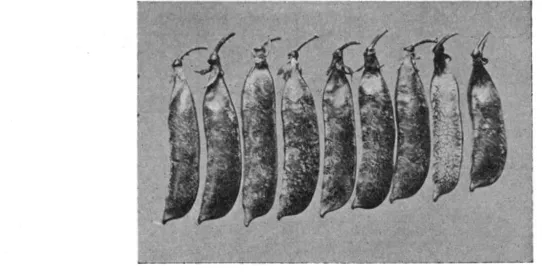
Figure 1 shows the pod character of the scimitar parent (87) while figures 7, 8 and 9, although photographed from Fa-generation progeny, illustrate the character of the F2 segregate pods. The broad-pod segre- gates were of 2 types, straight broad or slightly curved and broad, like the pods of the pollen parent (number 5), illustrated by figure 10. F1 hetero- zygotes in all these crosses of straight or slightly curved broad-pod types with the narrow scimitar type, are very slightly curved, but this difference is often so slight that separate classification is difficult, so they are grouped with the homozygous broad pods.
Thirty Fa families of this cross were grown, 17 from F2 broad-pod segregates and 13 from F2 scimitar segregates. The .latter bred true, giving only F3 families of scimitar-pod plants. Three of the broad-pod F2 segregates were homozygous, giving only broad-pod plants in Fa, while
14 such F2 plants were heterozygous and gave Fa families with a combined total ratio of 283 broad : 89 scimitar, the theoretically expected ratio, on the assumption of a one-factor difference, being 279 broad : 93 scimitar.
206 ORLAND E. WHITE
r* FIGURES 7,8 and 9.-The pod character of the three different classes of segregates in one
INHERITANCE. OF,WCIYI&IR.POD IN PISUM ,. 207
Graue Riesen Schnabel (87) XMammut (82)
Seven F1 plants of this cross were grown and all had broad slightly curved pods, ranging from 1.7 to 2.5 cm in width. The
Fz
data are pre- sented in table 8, with range of pod width in parenthesis.1
FIGURE 10.-Nine pods from 9 plants of the variety designated “segregate (S),” showing the broad, slightly curved pod character.
TABLE 8
Ft d a l a f r m mwm,
~ciinit~-w
typG (87) X TO&+& t r p ~ (82).CHAPACTER O? PODS
PEDIGREE -ER -ER Broad, sliihtly curved Narrow scimitar (82) type (87) type
’ F r l
2 (1.3-1.4) 3 (2.0-2.4 cm)
5
Fz- la
4 (1.3-1.5) 19 (1.8-2.4cm)
23 Fr3
5 (1.2-1.5) 11 (2.0-2.4 cm)
16
Fr3a 13 8 (2.0-2.5 cm) 5
Fr4a
20 60
80 Expected (3 :l)
20 60
80
,
Total
3 (1.2-1.3) 8 (1.7-2.5 cm)
11
F¶-% 12 11 (1.8-2.4cm) l(1.4)
Nine
FS
families were grown. Three of these were of F2 scimitar parent- age and bred true inFs,
while 6 were derived from F2 broad-pod segre- gates. Three of the families were all broad-pod, while 3 of them were heterozygous and when combined had 24 broad-pod : 9 scimitar, the expected on a 3 : 1 basis being 24.75 : 8.25.Brown Abyssinian (157) XGraue Riesen Schnabel (87)
208 ORLAND E. WHITE
1 . 7 ~ m. Table 9 gives the F2 data with the pod widths in parenthesis.
No F3 generation was grown.
TABLE 9
F2 datafrom a straight broad-pod type (157) X a narrow, scimitar type (87).
PEDIGREE NUMBER NUMBER OF PLANTS
CHARACTER OF PODS
Broad straight
1
Narrow scimitar 12 3
Total
Expected (3 : 1)
10
0
7 (1.3-1.8 cm) 7
l(1.2) 4 (1.3-1.8 cm)
5
3 (1.0-1.2)
7 (1.2-1.6 cm)
22
5 . 5 16.5
22
4
18
Desipisum (190) X Graue Riesen Schnabel (87)
The 4 F1 plants of this cross had slightly curved, broad pods (from a
length-breadth standpoint) with a range in width from 1.2 to 1.5 cm. Only 1 F2 family of 15 plants was grown, these giving a ratio of 10 broad- pod (0.9 to 1.5 cm) : 5 scimitar (0.9 to 1.1 cm). Two of the Fz scimitars gave in F3 all scimitar progeny (22 plants).
COMBINED RESULTS
I n the preceding pages, detailed data on the F1, Fz and F3 generations together with their parents have been presented. Eight series of crosses were made, each one involving, as one parent, the field-pea variety, Graue Riesen Schnabel(87) with narrow scimitar-shaped pods, and as the other parent, any one of eight different pea varieties, each of which bred true to broad straight or to broad, slightly curved pods.
The F1 generation in each cross had slightly curved, broad pods, so that the ordinary or wild type is not absolutely dominant, though almost so. Reciprocal crosses gave the same results. Altogether, 33 F1 plants were grown.
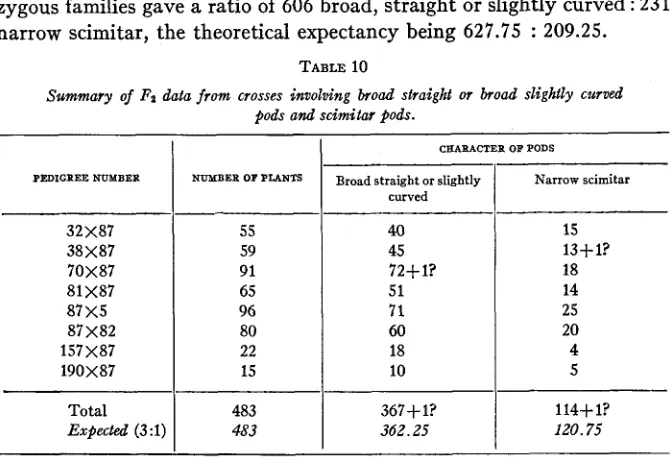
The F2 generation data are summarized in table 10. I n all but a very few individuals, no difficulty was experienced in separating and properly classifying the segregates. I n these few cases, the difficulty was due not to the pod diameter, but to the extent of pod curvature. I n these excep- tional cases, the pods were not curved as much as in the majority of the
Fz scimitar segregates.
A total of 105 F2 segregates with broad, straight or slightly curved pods,
INHERITANCE OF SCIMITAR POD IN PISUM 209
zygous families gave a ratio of 606 broad, straight or slightly curved : 231 narrow scimitar, the theoretical expectancy being 627.75 : 209.25.
TABLE 10
summary of F2 data from crosses involving broad straight or broad dightly curved pods and scimitar pods.
CBABACTZB OF PODS
PEDIGBEE NUMBEX NUMBE= 01 P U N T S Broad straight or slightly Narrow scimitar curved
32x87 55
5 10 15 190x87 4 18 22 157x87 20 60 80 87x82 25 71 96 87 X 5
14 51 65 81x87 18 72+1? 91 70x87 13+1? 45 59 38x87 15 40 " . . - Total 120.75 362.25 483 Expected (3:l)
114+ l?
367
+
l? 483Forty-five F2 scimitar segregates, when tested by their Fa progeny, bred true to scimitar. Combining the Fz and Fa data from heterozygous families gives a total of 1320 plants, in the ratio of 973+1? broad-pod: 345 + l ? scimitar, 990 broad-pod : 330 being the theoretical expectancy on a 3 : 1 basis.
DISCUSSION AND INTERPRETATION
The facts as described in previous pages are most simply interpreted on the basis of a one-factor difference between the varieties with broad, straight, or broad, slightly curved pods and the scimitar-pod type, Graue Riesen Schnabel (number 87). Designating this factor as S,, the variety Graue Riesen Schnabel is SJ,, while the broad-pod varieties each are
SS, in respect to the allelomorph of scimitar, since the broad-pod char- acter in the sense in which it has been used here, most nearly approaches the character of the pods of the wild-pea types. The nomenclature followed is in accordance with the suggestions of the Committee on Genetic Form and Nomenclature of the AMERICAN SOCIETY OF NATURALISTS (LITTLE 1921). The F1 plants have the formula
SJ,,
while the F2 consists of 2 visibly different classes-broad-pod and scimitar, since the hetero- zygous class could not be accurately differentiated from the homozygous broad-pod segregates. These two classes occur in a ratio of 3 broad-pod : 1210 ORLAND E. WHITE
expected on a monohybrid interpretation. The recessive scimitars breed true, while the F2 broad-pod segregates give F3 homozygous and hetero-
zygous families in a ratio approximating 1 : 2.
There is no intention to imply here that only one pair of factors is involved in determining the inheritance of pod shape and width in the crosses described. As the data in table 2 show, between the various broad- pod varieties used there is a wide diversity in pod diameters characteristic of each type, and these divergencies are doubtless due to other factorial differences. Each of the broad-pod varieties used, however, carries the
S, allelomorph of scimitar. The scimitar type, so far as I know, represents the extreme divergence in this direction, from the wild type.
SUMMARY
1. The F1-, F2- and F3-generation results of crosses between 8 different
varieties of peas, breeding true to broad, straight, or broad slightly curved pods, and a single variety, Graue Riesen Schnabel, with narrow scimitar-curved pods, are described in detail, as respects the inheritance of the scimitar character.
2. I n F, the broad-pod character is nearly dominant. I n F$, 2 segregate classes are easily distinguishable,-broad, straight, or broad, slightly curved-pod types and narrow scimitar-pod types,-in a ratio approxi- mating 3 : 1. The F3-generation data give the usually expected results where a monohybrid F2 ratio is involved.
3. The gene for scimitar is designated S,, while its normal allelomorph
broad-pod, etc., is S,.
LITERATURE CITED
LITTLE, C. C., 1921 Report of the committee on genetic form and nomenclature. Amer. Nat.
WHITE, ORLAND E., 1917 Studies of inheritance in Pisum. 11. The present state of knowledge of 55: 175-178.