Modern Institute of Engineering and Technology, Bandel, Hooghly-712123, West Bengal, India
Meta Search Engine using Multi-Objective
Partial Rank Aggregation: Application in
Ranking WebPages
Sheuli Maity
Assistant Professor, Department of CSE, Modern Institute of Engineering & Technology, Bandel, West Bengal, India
ABSTRACT: Although there are hundreds of search engines no single search engine can satisfy all web users and can be considered broadly acceptable that Sufficiently comprehensive in its coverage of the web moreover they consist the “spam pages” when a web page gets an undeservedly high rank.Therefore, a robust technique for Meta Search Engine is required that can effectively combat “spam pages”, a serious problem in Web searches. When some top ranked WebPages are extracted from different Search Engines, they differ each other, and the problem become more difficult to aggregate them. In this article a multi objective genetic algorithm based rank aggregation method has been proposed where some partial rankings are integrated in an unbiased way. The total distance from the reference ranking to the input rankings is minimized as the first objective. For distance calculation the scaled footrule distance is used. The standard deviation between those distances is minimized as the second objective in order to avoid biasness toward a particular input ranking. The proposed method has been applied on some most-usable Search Engines. Thereafter, the resultant ranking is compared with the other rank aggregation methods to check how much it is applicable to reduce the spam pages.
KEYWORDS:Partial list, Scaled Footrule Distance, Pareto optimal Front, Rank aggregation, Spam Page Reduction.
I.INTRODUCTION
Since today there are hundreds of general purpose search engines as well as special purpose search engines. But The fact that so many choices cannot satisfy all web users yet and hence can be considered broadly acceptable that sufficiently inclusive in its coverage of the web. The very first question arises for the spam pages [16] when a web page gets an undeservedly high rank Sometimes it is seen that some webpages are not workable but occupy a good rank in some search engines [3] [6]. Same webpages can be noticed to occupy more than 3 spaces in the first 50 ranks. Thus our first motivation is to find robust techniques for meta-search to provide users a certain degree of robustness of search to clarify various shortcomings and biases.
Secondly users must have the protection against the biases of individual Search engines [1] because the world is governed by commercial interests. The first reason is more challenging in doing meta-search as all the search engines will be capable of ranking the entire collection of pages on the Web, which is growing day to day. Secondly, Search Engines routinely limit access to about the first few hundreds of pages in their rank-ordering to ensure the confidentiality of their ranking algorithm and the efficiency. The issue of efficiency is also a serious bottleneck in performing rank aggregation for multi-criteria selection and word association queries [16].
Modern Institute of Engineering and Technology, Bandel, Hooghly-712123, West Bengal, India
[16] produces a set of solutions that contains a number of Pareto-optimal solutions. Moreover multi-objective optimization problem has been modelled by GA in which fitness comparison takes Pareto dominance into account and non-dominated solutions are stored in an archive to approximate the Pareto front. The first objective is to minimize the total distance of the reference ranking (encoded in a chromosome of GA) from the input rankings. The other objective is to minimize standard deviation between those distances to avoid the biasness to a particular input ranking. For calculating the distances between two rankings Scaled Footrule distance measure [13] has been used. The proposed method has been applied on some most-usable Search Engines. Thereafter, the resultant ranking is compared with the other rank aggregation methods to check how much it is applicable to reduce the spam pages.
II.MULTI-OBJECTIVEOPTIMIZATION
When multiple goals or objectives are optimized simultaneously then the problem is referred as multi-objective optimization (MOO). MOO may estimate different aspects of solutions which are partially or wholly in conflict. Find the vector ⃗∗= ( ∗, ∗, … , ∗) of decision variables which satisfies m inequality constraints:
(⃗)≥0, = 1,2, … , (1) P equality constraints
ℎ(⃗) = 0, = 1,2, … , (2) And optimizes the vector function
ℱ⃗(⃗) = [ (⃗), (⃗), … , (⃗)] (3)
Here, ℱ denotes the feasible region of the problem (i.e., where the constraints are satisfied). Any solution outside this region is unacceptable though it oversteps one or more constraints. The vector ⃗∗ denotes an optimal solution in ℱ. A
Multi-objective searching concept is clearly described in [17]. More than one solution can be obtained in Pareto optimal set as there exist different ‘trade-off’ solutions to the problem. The set of solutions contained by Pareto optimal set are called non-dominated solutions and they create the Pareto front. Specifically MOO is a process of generating the whole Pareto front or an approximation to it.
III.CALCULATINGTHEDISTANCE
Generally, all ranking schemes are aggregated to make a consensus among them [2]. Aggregating a partial list of ranks having unequal numbers of features, i.e. where all the features are not present, is more challenging than full list. Induced Footrule Distance and Scaled Footrule Distance [13], [18] are mostly used in case of partial lists. Here we have used Scaled Footrule Distance (SFD). If is a full list and is partial list then the distance ( , , , … , ) can be calculated as in Eq. 4. For normalizing the distance we just divide the SFD by| |.
( , , , … , ) = | | | |
| | (4)
IV.GENERATINGINPUTRANKINGS
Modern Institute of Engineering and Technology, Bandel, Hooghly-712123, West Bengal, India
FIG. 1. : PARTIAL INPUT RANKINGS ARE CONVERTED INTO FULL LISTS
V.MULTI-OBJECTIVEGENETICALGORITHM(MO-GA)BASEDRANKAGGREGATION
MO-GA is a procedure of multiple criteria optimal decision making in the presence of trade-offs between different conflicting objectives. Sometimes, a single solution is not enough to optimize each objective functions simultaneously, rather, a set of non-dominated solution i.e. pareto optimal front must be generated. Here two fitness functions are used to get an unbiased aggregated ranking. In each generation, total distance from reference ranking to input rankings along with the standard deviation between them are minimized.
1. ENCODING SCHEME & POPULATION INITIALIZATION
A population in genetic algorithm consists of P chromosome and each chromosome represents a reference ranking. If there are N unique WebPages in input ranking, then the size of a chromosome is N. As ranks must be integer, so integer encoded chromosome are used. Figure 2 illustrates the encoding scheme for the above input rankings described in section IV. As in the example 14 unique WebPages are present, so the length of the chromosome is 14. Firstly, randomly generated integer numbers encodes a chromosome, and gradually it improves with respect to fitness in each iteration.
Fig. 2 Encoding Scheme
2. FITNESS CALCULATION
Accuracy depends on unbiased selection. That can be assured by considering the standard deviation among the distances. Two fitness functions have been considered here for multi objective optimization. Along with minimizing the total distance, standard deviation has also been minimized. Scaled Footrule distance measure has been chosen here for distance calculation. First, the distances from the reference ranking to the input rankings have been calculated using Eq. 4 and then mean distance is computed in Eq. 5. Here N is number of input rankings and R is the reference ranking. SFD is the Scaled Footrule Distance between two rankings. Secondly, the Standard Deviation between these distances has been calculated in Eq. 6.
Modern Institute of Engineering and Technology, Bandel, Hooghly-712123, West Bengal, India
3. SELECTION, CROSSOVER & MUTATION
Binary tournament selection [17] is chosen for selection procedure. Figure 3 describes an example of single-point crossover where cross point is 3. Firstly, the positions are calculated for each chromosome, as they represent the rank orders, but the crossover should be done against the WebPages. Secondly, from random selection, if a number is greater than the crossover probability, can be chosen for cross point. From parent1 sequence, the first fragment i.e. before the crossover point is directly copied to child1 i.e., [W2,W4,W1]. Then the set difference from parent1 [W2,W4,W1,W5,W3,W6] and first fragment of child1 [W2,W4,W1] is calculated as [W5,W3,W6] and let this set is denoted as S. Then the order of the set S are checked against in parent2 [W3,W1,W6,W4,W2,W5] for order. Now the set S in this order [W3,W6,W5] is put into the next part i.e. after crossover point of the child1. For the child2 this steps are repeated in vice versa. Again, the positions are calculated for each chromosome for the rank orders. For the mutation, 2 random numbers are selected and swapping has been done between the values of those indices (Fig. 4). Crossover probability, Mutation Probability is chosen as 0.9 and 0.1 respectively here.
Fig. 3. : Crossover procedure Fig. 4. : Mutation procedure
VI.RESULTSANDDISCUSSIONS
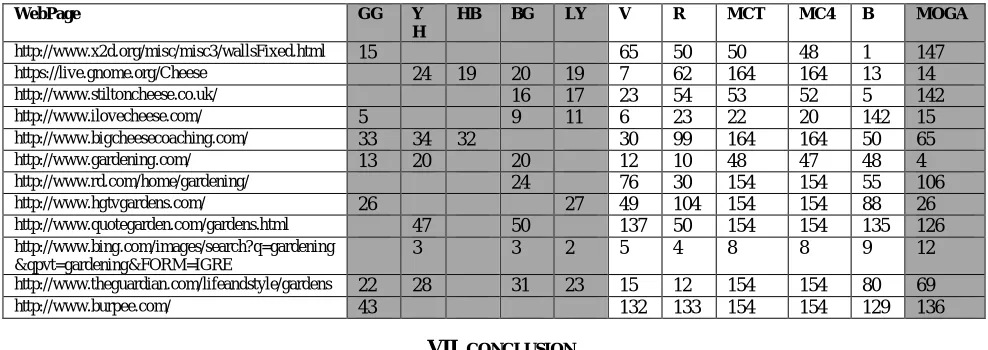
Here first 50 ranked pages are collected from google(GG), yahoo(YH), hotbot(HB), bing(BG), lycos(LY) against some specific word search like ‘cheese’, ‘gardening’, ‘education’. An appropriate rank is employed to them and converted into full list. The proposed method is compared with that of Voting (V), Robust ranking (R), Borda method (B) and two Markov Chain based approach MCT, MC4. They are compared to check how they reduce the spam pages in Search Engines.
Modern Institute of Engineering and Technology, Bandel, Hooghly-712123, West Bengal, India TABLE I.
COMPARISON BETWEEN THE RANKINGS OF SOME WEBPAGES AMONG THE PROPOSED AND EXISTING METHODS
WebPage GG Y
H
HB BG LY V R MCT MC4 B MOGA
http://www.x2d.org/misc/misc3/wallsFixed.html 15 65 50 50 48 1 147
https://live.gnome.org/Cheese 24 19 20 19 7 62 164 164 13 14
http://www.stiltoncheese.co.uk/ 16 17 23 54 53 52 5 142
http://www.ilovecheese.com/ 5 9 11 6 23 22 20 142 15
http://www.bigcheesecoaching.com/ 33 34 32 30 99 164 164 50 65
http://www.gardening.com/ 13 20 20 12 10 48 47 48 4
http://www.rd.com/home/gardening/ 24 76 30 154 154 55 106
http://www.hgtvgardens.com/ 26 27 49 104 154 154 88 26
http://www.quotegarden.com/gardens.html 47 50 137 50 154 154 135 126
http://www.bing.com/images/search?q=gardening &qpvt=gardening&FORM=IGRE
3 3 2 5 4 8 8 9 12
http://www.theguardian.com/lifeandstyle/gardens 22 28 31 23 15 12 154 154 80 69
http://www.burpee.com/ 43 132 133 154 154 129 136
VII. CONCLUSION
In this article, rank aggregation method using multi-objective genetic algorithm has been projected to aggregate some partial rank lists of WebPages. The first intention is to minimize the total distance from the reference ranking to the input rankings and for distance calculation; the Scaled Footrule Distance is used. The second objective is to minimize the standard deviation between those distances to avoid biasness towards any particular input ranking. The proposed method has been applied on some most-usable Search Engines. Thereafter, the resultant ranking is compared with the other rank aggregation methods to check how much it is applicable to reduce the spam pages. Undoubtedly, the projected method performs well all over the Search Engines for reducing spam. We would like to extend our work in word association queries in web application in future.
REFERENCES
[1] D. E. Critchlow. “Metric Methods for Analyzing Partially Ranked Data”, Lecture Notes in Statistics 34, Springer-Verlag, 1985. [2] J. I. Marden. “Analyzing and Modeling Rank Data. Monographs on Statistics and Applied Probability”, No 64, Chapman & Hall, 1995. [3] M. Truchon. “An extension of the Condorcet criterion and Kemeny orders”. cahier 98-15 du Centre de Recherche en Economie et Finance Appliquees, 1998.
[4] H. P. Young. “An axiomatization of Borda's rule”. Journal of Economic Theory, 9:43--52, 1974. [5] H. P. Young. “Condorcet's theory of Voting”. American Political Science Review, 82:1231--1244, 1988.
[6] H. P. Young and A. Levenglick. “A consistent extension of Condorcet's election principle”. SIAM J. on App.Mathematics, 35(2):285-300, 1978. [7] R. Prati, “Combining feature ranking algorithms through rank aggregation,” in 2012 International Joint Conference on Neural Networks,2012. [8] Y.-T. Liu, T.-Y. Liu, T. Qin, Z.-M. Ma, and H. Li, “Supervised rank aggregation,” International World Wide Web Conference Committee
(IW3C2)., 2007.
[9] Q. Fang, J. Feng, and W. Ng, “Identifying differentially expressed genes via weighted rank aggregation,” in IEEE International Conference on Data Mining, 2011.
[10] A. Veloso, M. A. Goncalves, and W. M. Jr., “Competence-conscious associative rank aggregation,” Journal of Information and Data Management, vol. 2, no. 3, pp. 337–352, 2011.
[11] R. Kolde, S. Laur, P. Adler, and J. Vilo, “Robust rank aggregation for gene list integration and meta-analysis”, Bioinformatics., 2012.
[12] R. P. DeConde, S. Hawley, S. Falcon, and et al., “Combining results of microarray experiments: A rank aggregation approach,” Stat Appl Genet Mol Biol, vol. 5, no. 1, 2006.
[13] C. Dwork, R. Kumar, M. Naor, and D. Sivakumar, “Rank aggregation methods for the web,” in Proceedings of the 10th international conference on World Wide Web, 2001.
[14] K. Deb, A. Pratap, S. Agrawal, and T. Meyarivan, “A fast and elitist multi-objective genetic algorithm: NSGA-II,” IEEE Transactions on Evolutionary Computation, vol. 6, pp. 182–197, 2002.
[15] K. C. Mondal, A. Mukhopadhyay, U. Maulik, S. Bandhyapadhyay, and N. Pasquier, “Simultaneous clustering and gene ranking: A multi-objective genetic approach,” in Proceedings of CIBB Palermo : Italy (2010), 2010.
[16] K. Deb, Multi-objective Optimization Using Evolutionary Algorithms. England: John Wiley and Sons, Ltd, 2001.
[17] C. A. C. Coello, “A comprehensive survey of evolutionary-based multi-objective optimization techniques,” Knowledge and Information Systems, vol. 1, no. 3, pp. 129–156, 1999.