
ABSTRACT
PARLE, APOORV. Heuristics Assisted Set Based Data Dependence Profiling. (Under the direction of Dr. James Tuck.)
Speculative optimizations unlock performance by relaxing conservative constraints
which restrict various optimizations. Data dependence profiling enables such speculative
optimizations by providing the runtime dependence profile, but most of the profilers suffer
from very large performance overhead. Recent work on set-based profiling with software
signatures has demonstrated potential to achieve low performance overhead for profiling.
But this technique suffers from very poor accuracy in some of the evaluated benchmarks,
and has scope for improvement in accuracy as well as performance overhead.
First some heuristics are introduced to predict load-store relations which are expected never to happen. These heuristics are pruned from the list of load-store relations that are
profiled, thus reducing the performance overhead by 10% on average (geometric mean).
Moreover, owing to the simplicity of the heuristics, the relations are predicted much more
accurately, than as profiled by a software signature based profiler. This results in improved
accuracy as the Normalized Average Euclidean Distance (NAED), with respect to perfect
profiler, reduces from 0.09 to 0.06 on average across all benchmarks.
Next we introduce an alternative range based set representation, as a high-speed albeit
approximate mechanism. This set representation is combined with software signatures to
create a hybrid set representation, for a highly accurate profile. In addition, short-circuit optimization is built into the hybrid set reducing the performance overhead in some
bench-marks. Combining this with the heuristics yields the most accurate profile so far, with the
average NAED of 0.04 in comparison to the perfect profiler. The combined effect of the
two also reduces the performance overhead of the profiler by 17%, on average (geometric
© Copyright 2016 by Apoorv Parle
Heuristics Assisted Set Based Data Dependence Profiling
by Apoorv Parle
A thesis submitted to the Graduate Faculty of North Carolina State University
in partial fulfillment of the requirements for the Degree of
Master of Science
Computer Engineering
Raleigh, North Carolina
2016
APPROVED BY:
Dr. Gregory Byrd Dr. Huiyang Zhou
Dr. James Tuck
DEDICATION
BIOGRAPHY
The author pursued his Bachelor’s degree in College of Engineering, Pune, majoring in
Electronics and Telecommunication. After completing his undergraduate degree, he joined
Texas Instruments Inc. as a design engineer, and worked there for 3 years. Subsequently, he
started his Master’s degree in Computer Engineering at North Carolina State University in
ACKNOWLEDGEMENTS
I would like to thank my advisor for all the indispensible guidance and help, without which
this work would not have been possible. Also, I would like to thank all my professors who
have taught me various courses, and thus enabled me to do this research. Lastly, I’ll also
acknowledge my friends and family who supported me directly or indirectly, along the
journey of M.S.
This material is based upon work supported by the National Science Foundation under
TABLE OF CONTENTS
LIST OF TABLES . . . vii
LIST OF FIGURES. . . viii
Chapter 1 Introduction. . . 1
1.1 Data Dependence Problem . . . 1
1.1.1 Data Dependence . . . 1
1.1.2 How it limits optimizations . . . 2
1.2 Data Dependence Profiling . . . 3
1.3 Background . . . 4
1.3.1 Shadow Memory based Profiling . . . 4
1.3.2 Pattern-driven Profiling . . . 5
1.3.3 Offloading Profiling for Efficiency . . . 5
1.3.4 Set-based Profiling . . . 5
1.4 Profiling Cost . . . 6
1.5 DDP Design Trade-offs . . . 6
1.5.1 Object Granularity . . . 6
1.5.2 Code Region Granularity . . . 7
1.5.3 Flow Sensitivity . . . 7
1.5.4 Call Graph Sensitivity . . . 7
1.5.5 Memory vs. Compute . . . 8
1.5.6 Coverage . . . 8
Chapter 2 Set Profiling . . . 10
2.1 How it works . . . 11
2.1.1 Query Identification . . . 11
2.1.2 Set Assignment . . . 11
2.1.3 Instrumentation . . . 11
2.2 Bloom Filter Sets . . . 13
2.2.1 Bloom Filter Design Trade-offs . . . 15
2.3 Fast Set Profiling . . . 15
2.3.1 Static Alias Analysis . . . 15
2.3.2 Diverging Control Paths . . . 16
Chapter 3 Infrastructure and Evaluation . . . 18
3.1 Set Implementation . . . 20
3.1.1 Signature Configurations . . . 20
3.2 Accuracy . . . 22
3.2.2 Normalized Average Euclidean Distance . . . 22
3.3 Experimental Setup . . . 23
3.4 Evaluation . . . 23
Chapter 4 How to Improve . . . 28
4.1 What to profile . . . 28
4.2 Set Representation . . . 29
Chapter 5 Heuristic Pruning . . . 30
5.1 Heuristics . . . 31
5.1.1 Constant Data Space . . . 31
5.1.2 Structure Type Mismatch . . . 31
5.1.3 Structure Index Mismatch . . . 33
5.1.4 Local Variables vs. Unknown Aggregates . . . 33
5.1.5 Local Structures vs. Function Arguments . . . 34
5.1.6 Local Variables with No Pointers . . . 35
5.2 Evaluation . . . 37
Chapter 6 Range Sets and Hybrid Sets . . . 44
6.1 Range Set . . . 44
6.2 Hybrid Set . . . 46
6.3 Evaluation . . . 47
Chapter 7 Conclusion . . . 51
7.1 Future Work . . . 53
LIST OF TABLES
Table 3.1 Design choices taken in our implementation . . . 21 Table 3.2 Signature Configurations . . . 21
LIST OF FIGURES
Figure 2.1 A simple bloom filter with 8 bits, and two hash functions. . . 14
Figure 2.2 Control graph with diverging paths . . . 16
Figure 3.1 Work Flow for set profiling and feedback directed optimizations . . . 19
Figure 3.2 Accuracy of the profiler with different signature configurations.[lower is better] . . . 24
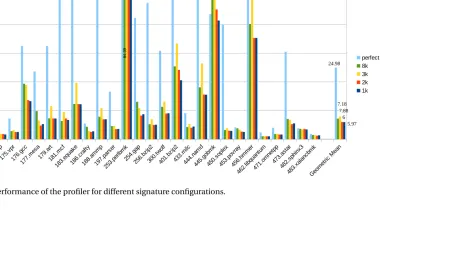
Figure 3.3 Performance of the profiler for different signature configurations. . . 26
Figure 5.1 Distribution of different heuristics on each benchmark, as a percent-age of total queries. . . 38
Figure 5.2 Accuracy observed with Signatures on only those queries which can be statically predicted with the heuristics.[lower is better] . . . 39
Figure 5.3 Accuracy for various benchmarks with and without the heuristics. [lower is better] . . . 41
Figure 5.4 Performance overhead on various benchmarks with and without the heuristics. . . 42
Figure 6.1 Operation of the range set: “a)” to “c)” show insertion and “d)” shows membership check. . . 45
Figure 6.2 Accuracy of Range and Hybrid Sets.[lower is better] . . . 48
Figure 6.3 Performance of Range and Hybrid Sets . . . 49
CHAPTER
1
INTRODUCTION
Moore’s law is slowing down, while the programs are getting bigger and bigger, increasing
the importance of optimizing softwares for good performance. In software or compiler
optimizations, only a limited amount of information is available at compile-time, limiting
the scope of optimizations. Prior works have shown that leveraging runtime information
speculatively can provide significant performance boost. One of the key factors for both
compile-time optimizations and parallelization is the ability to distinguish independent
memory references, or memory disambiguation.
Data Dependence Problem
Data Dependence
When a particular instruction depends on the result of a sequence of instructions, it is
1.1. DATA DEPENDENCE PROBLEM CHAPTER 1. INTRODUCTION
be tricky when the dependence flows through the memory.
Code Snippet 1.1Simple Data Dependence
1 R1 = R2 + 3
2 STORE R1 ,@[R3] 3 R4 = LOAD @[R3]
In Code Snippet 1.1 there is a data dependence from R2 to R1. Also, there is a dependence
from R1 to R4 which flows through memory. Because the address being used here is exactly
the same, the dependence relation is straightforward.
Code Snippet 1.2Ambiguous Memory Dependence
1 R1 = R2 + 3
2 R3 = R1 + 2
3 R4 = R1 + 3
4 STORE R6 ,@[R3 + 1] 5 R7 = LOAD @[R4]
In Code Snippet 1.2, there is a data dependence from R6 to R7. But here, the dependence relation cannot be obtained without the prior knowledge of R3 and R4. As programs get
more complicated, the relations between the memory addresses become too complex or
completely impossible to track.
How it limits optimizations
If we can clearly prove that two memory operations are independent, it gives us the freedom
to move them independently in the code. Not only the specific two instructions but all their
dependent instructions may be considered for restructuring.
Code Snippet 1.3Potential LICM opportunity
1 i n t myfunc (i n t ∗a , i n t ∗b , i n t ∗c ) {
2 i n t tmp ;
3 f o r(i n t i=0; i<1000000; i++) {
1.2. DATA DEPENDENCE PROFILING CHAPTER 1. INTRODUCTION
5 ∗b += (∗a ) + c[ i]∗tmp ;
6 }
7 }
Code Snippet 1.3 presents a typical Loop Invariant Code Motion (LICM) opportunity. Here,
if we can prove thataandbboth point to different memory locations, the calculation of
tmpcan be done outside the loop. But since this information is unavailable, the compiler will conservatively generate a code wheretmpwill be calculated for each iteration, even if
the exact same value, decreasing the performance significantly.
Data Dependence Profiling
In order to disambiguate such cases, runtime information has to be captured through
pro-filing. Profiling is the technique of inserting extra code to capture the required information.
Code Snippet 1.4 shows the profiled version of the Code Snippet 1.2.
Code Snippet 1.4Simple Profiling
1 R1 = R2 + 3
2 R3 = R1 + 2
3 R4 = R1 + 3
4 PROFILE_STORE ( R3+1 , ID1 ) 5 STORE R6 ,@[R3 + 1]
6 PROFILE_LOAD ( R4 , ID2 ) 7 R7 = LOAD @[R4]
Each memory operation is tagged with an unique identifier – represented here by ID1 and
ID2. The identifier is passed to the PROFILE_LOAD or PROFILE_STORE function along with
the address obtained at runtime. These functions are typically library calls which update
the data structure used to track various dependence relations. Since this snippet can be a
part of a loop, the touched memory locations can be quite large, and hence they have to be
maintained in a large data structure. Because loads and stores are common events and at each of these events such large data structures are being manipulated, data dependence
1.3. BACKGROUND CHAPTER 1. INTRODUCTION
Background
Quite a lot of work has gone into profiling data dependences[Bru00; Che04; Fax08; Kim10; VT12; Wu08; YL12b; Zha09]. At a high level, the approaches taken to track these memory locations can be classified as follows:
Shadow Memory based Profiling
This is the traditional approach, best described in[Che04], and used in many prior works [SM98; Liu06; Udu11]. The aim is to locate the closest prior instruction(s) which the current instruction depends on. As illustrated by Chen et al., a single data structure which is a
representative of the whole memory space is used to keep track of the edges. Each location
in the shadow memory, keeps track of the memory operations that have accessed it. Profiling
operations corresponding to each load and store update this shadow memory with their unique IDs (assigned statically for all memory operations). Every new operation thus forms
a link in the chain, and replaces the old value as the head in the shadow memory.
The shadow memory can be implemented as a virtually unlimited hash-table (limited by
the size of the main memory), keeping track of all previous operations. Alternatively, to limit
the size of shadow memory, a fixed width hash-table can also be used, which maintains
fixed number of prior accesses per memory location. New entries replace old entries as
they occur, while edges are recorded separately for later usage.
Irrespective of the number of operations tracked per address, the length of the
hash-table has to be limited to a fixed length. This causes multiple addresses to alias in the shadow memory, creating false dependence edges between completely independent instructions.
The biggest downside of such an approach is that if a handful number of memory
operations inside a loop access a very large number of addresses, they end up polluting the
whole hash-table. Now, completely unrelated memory operations also cannot be separated
out, resulting in very poor accuracy of profiling. And even with a fixed length hash-table,
each access and update involves a high operational overhead per memory operation.
1.3. BACKGROUND CHAPTER 1. INTRODUCTION
Pattern-driven Profiling
Pattern driven profilers[Bru00; Kim10]focus on very specific dependences in loops, looking for access patterns like strides or inter-iteration dependences. They trade-off the coverage
of the whole program with high-resolution tracking of fewer memory operations inside
hot loops. Rather than just detecting simple presence of edges, such techniques try to
determine which iteration such dependences will occur in, and which iterations can be parallelized. Owing to the high-resolution tracking of load-store pairs, such mechanisms
are very expensive.[Kim10]suggests parallelizing the profiling tasks to bring down the overhead to only 10-20x slowdown with the help of 32 cores. Due to its high-resolution,
such a technique is compelling, but the cost of required hardware resources limits its
proliferation to broader applications.
Offloading Profiling for Efficiency
A variety of prior works[Kim10; YL12b]try to offload the profiling tasks for efficient program analysis, relying on parallelism to make the profiling cheap. Various techniques like slicing [YL12a; YL12b]and novel parallel algorithms[Kim10]have been proposed. Because the memory access pattern within a program’s dynamic execution sequence is rarely balanced,
it becomes a challenge to balance the workload across different threads, for best efficiency. Moreover, dedicating large amount of resources just for profiling is not practical for many
developers.
Set-based Profiling
In this approach, each memory operation or a group of memory operations use a separate
data structure, called a set, to keep track of the addresses visited. This ensures that unrelated
memory operations do not cause any interference with each other. The expectation here
is that individual memory operations will not visit a lot of memory locations, and hence
1.4. PROFILING COST CHAPTER 1. INTRODUCTION
Profiling Cost
At a high level, with any approach, the cost of profiling can be divided into following
components:
1. Initialization: The cost of initializing the data structure(s) used to detect edges, as
well as the data structure(s) which track the profiled edges.
2. Profile Operation: The actual cost of profile operation, which includes searching
and updating the associated data structure. This is usually the main source of the
performance overhead. It also includes the cost of updating the dependence edge
counters with the recognized edges.
3. Destruction: The cost of post-processing the data structure, recording all the final
results to file/database, and de-constructing the data structure.
4. Indirect Effects: Profiling can affect the existing program execution indirectly in many
ways like cache pollution, branch predictor pollution, core IPC performance due to
data structure updates etc.
All these costs have to be accounted for when building a profiling mechanism.
DDP Design Trade-offs
In addition to the above-mentioned costs, following trade-offs also have to be considered.
The corresponding design choices taken in our implementation are presented Table 3.1 in
chapter 3.
Object Granularity
Profiling, similar to Alias Analysis, can be designed to track memory objects at various
granularities – just as bytes, simple data types or even complex structures. Usually, memory
addresses are tracked, while data type granularity is augmented statically. But with this
1.5. DDP DESIGN TRADE-OFFS CHAPTER 1. INTRODUCTION
profiling a load to store relation with addresses can suggest whether they access the same
location or not. But if the addressed location is a structure, just tracking the addresses is
not sufficient to determine if a portion of object has been updated, as that portion can
have a different address (offset by few bytes). In order to track relations at the granularity of
aggregates, the size of the access and its nesting inside an aggregate data structure has to
be tracked along with the address (which can be complicated).
Code Region Granularity
It is essential to track the edges only in relevant regions of the code. Memory operations corresponding to a loop iterator are relevant only inside the loop. In a nested loop, the inner
loop iterator will start afresh with each iteration of the outer loop, and edges corresponding
to the inner iterator seen across iterations of the outer loop can be misleading. Similarly,
edges corresponding to local variables inside a function might not be relevant when seen
across different calls to same function.
Flow Sensitivity
The flow pattern of an edge can be an essential design choice for a profiler, as it affects
what optimizations can use this data. Various options include, just the presence of an
edge, probability of the edge, or even high resolution data like stride of the inter-iteration
dependence. Different optimization rely on different profiles: LICM will utilize just the presence of the edge, while other loop optimizations like loop vectorization can utilize the
probability of the edges as well the stride of the inter-iteration dependence.
Call Graph Sensitivity
Profiling the data dependences separately for each call context can be useful to track
variation caused due to differences in inputs at various call sites. This information is highly
relevant for optimizations which specialize functions for various call sites. But this involves
tracking multiple call contexts as well as separate data structures to store edge data per
1.5. DDP DESIGN TRADE-OFFS CHAPTER 1. INTRODUCTION
Memory vs. Compute
The amount of memory used by the profiler vs. the amount of computations that have to be
performed per memory operation is a choice directly affecting the performance overhead.
The computations per profiling operation directly add to the performance overhead. The
memory usage on the other hand does not directly add to the overhead, but can be limiting
factor for a memory intensive applications. Additionally it also contributes to the overhead in the form of allocation, initialization and access (which translates to cache pollution).
Coverage
Which memory operations to profile is a design choice dependent on the optimization
passes that consume the profile data. Profiling memory operations only relevant to specific
optimization reduces the amount of profiling required, but the obtained profile is useless
anywhere else but that optimization. On the other hand, profiling all the memory operations
ensures that the obtained profile is useful for all the optimizations. How often to profile
is another aspect of coverage that needs to be considered. Sampling[Che04]is a method where not all dynamic instances of a memory operation are profiled; a profile is taken
everyn executions of the code region. Higher the frequency of sampling, better will be
the accuracy of the results, but higher will be the overhead – thus a classic accuracy vs. performance trade-off.
Many prior works[Du04; BF02; CW03; Udu11; Xek09; Wu08; Fah05; PO05; Kel09; Opl99; Kre00; Per00; Luk95; Con97; Joh04; Qui05; Liu06; BS06; Lin06; Tuc08; Bru00; Din07; Li05;
Lin03; SM98; Hwu93]have highlighted the importance of data dependence profiling, to achieve efficient optimizations or parallelization on novel high performance architectures.
Unlike edge profiling, which has been widely used due to simplicity, data dependence
pro-filing has been severely limited due to its high cost. This in turn has limited the research and
progress in the area of application specific optimization as well as speculative architecture design. Improvements in this area will translate to near term advancements like speculative
optimizations in compilers, as well enable research on novel speculative hardware designs
1.5. DDP DESIGN TRADE-OFFS CHAPTER 1. INTRODUCTION
In this dissertation, the existing technique of set based profiling has been extended, to
improve the accuracy while either maintaining or improving the performance overhead.
Next chapter will explain set based profiling and its evaluation. Subsequent chapters will
talk about different optimizations on top of set profiling, to improve its performance as
CHAPTER
2
SET PROFILING
As described in the previous chapter, conventional approach to dependence profiling
utilizes a single global structure which is a representative of the memory space. Vanka &
Tuck propose set profiling in[VT12], which creates small sets per instruction (or group of instructions), to track their memory references. These sets can be visualized as simple
mathematical sets where each element is a memory address. Any new address, visited by
the instructions corresponding to the set, is “inserted” into the set, and any instruction
which needs to be disambiguated, is “checked for membership” in that set. Sets have two
main advantages:
1. No interference from one set to another, irrespective of how many addresses are
inserted in one set.
2. Since the number of addresses inserted will be relatively small, accessing the data
2.1. HOW IT WORKS CHAPTER 2. SET PROFILING
How it works
The Set Profiler has three main stages:
Query Identification
The basic unit of granularity in a set profiler is a query, similar to querying a typical Alias
Analysis pass. When two memory operations need to be disambiguated against each other,
they form a query, which is then assigned a unique reference identifier (refid). The LHS and
RHS of the query can be arbitrary memory operations, but our implementation forms a
query with a load instruction as LHS and store instruction as RHS. All such queries which
need to be resolved, are collected for the program under consideration.
Set Assignment
Once all queries have been gathered, each of them is assigned a set, allowing the freedom
to group multiple queries into a single set. A simple grouping policy assigns all queries with
same RHS (or alternatively LHS) to a single set. Multiple RHS (or LHS) can also be grouped together arbitrarily to reduce the number of sets, but at the cost of interference from each
other. Various grouping policies can be explored in order to combine queries, such that
they will cause least interference with each other.
Instrumentation
Once all sets are obtained, the code is instrumented to perform the following:
1. Initialize all the sets as empty, at the beginning of the regions of the code where they
are used. In our implementation we do this at function boundaries by initializing the
sets on a stack.
2. Perform set insertions at all the instructions corresponding to each set.
3. Perform set membership checks to disambiguate the instructions corresponding to
2.1. HOW IT WORKS CHAPTER 2. SET PROFILING
4. Update dependence edge counters whenever an edge is detected.
Here is an example that illustrates this. Code Snippet 2.1 shows a function that needs to
be profiled. Irrelevant details of the function have been skipped for the sake of illustration.
Code Snippet 2.1Unprofiled code (written in LLVM Intermediate Representation[Llv])
1 d e f i n e i 3 2 @myfunc ( ) #0 { 2 . . .
3 BasicBlock3 : 4 . . .
5 s t o r e i 3 2 %6, i 3 2∗ %someAddress , a l i g n 4 6 . . .
7 %20 = load i 3 2∗ %unknown , a l i g n 4 8 . . .
9 . . . 10 }
Code Snippet 2.2Same code with set profiling (written in LLVM Intermediate Representation
[Llv])
1 d e f i n e i 3 2 @myfunc ( ) #0 { 2 %s e t = c a l l i 8∗ @ a l l o c a t e S e t ( ) 3 %dependence = a l l o c a i32 , a l i g n 4
4 s t o r e i 3 2 0 , i 3 2∗ %dependenceCounter , a l i g n 4 5
6 . . .
7 BasicBlock3 : 8 . . .
9 c a l l void @ i n s e r t (% s e t , %someAddress ) 10 s t o r e i 3 2 %6, i 3 2∗ %someAddress , a l i g n 4 11 . . .
12 %dep = c a l l i 3 2 @membershipCheck(% s e t , %anotherAddress ) 13 %old = load i 3 2∗ %dependence , a l i g n 4
2.2. BLOOM FILTER SETS CHAPTER 2. SET PROFILING
15 s t o r e i 3 2 %new , i 3 2∗ %dependence , a l i g n 4 16 %20 = load i 3 2∗ %anotherAddress , a l i g n 4 17 . . .
18 . . .
19 ; 123456 i s the r e f i d o f the query
20 c a l l void @storeQueryResults ( i 3 2 123456 , %dependence ) 21 c a l l void @deleteSet (% s e t )
22 }
Code Snippet 2.2 shows the profiled version of the function shown in Code Snippet 2.1.
For the load and store instruction that need to be disambiguated, a set has been allocated at
the very beginning of the function. Next a dependence tracking variable has been allocated
and initialized to zero. Whenever the store instruction executes, the address is inserted
into the set. Whenever the load instruction executes, the particular address is checked for
membership in the set, and the dependence tracking variable is updated accordingly. It does
not matter whether the profiling is performed before or after the load or store instruction. For the sake of consistency, we’ve chosen to always do it before the instruction. Finally
when the function completes, the dependence results are stored, and the set is deallocated.
The next section will cover how to efficiently represent sets and perform operations on
them.
Bloom Filter Sets
In order to maintain a low cost of profiling, the set operations – allocation, insertion,
mem-bership checks and deallocation have to be fast. Moreover, since there can be a lot of sets
in a program, each set should have a small memory footprint. Vanka & Tuck have proposed
bloom filter based “software signatures”[VT12]to achieve this. A bloom filter[Blo70]is a probabilistic representation of large amount of data into a much smaller space. It is a simple
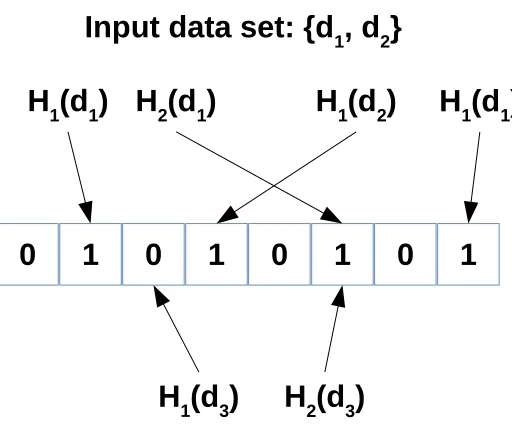
array of bits which is indexed using hash functions. Figure 2.1 shows an example bloom
filter with 8 bits. The input data set has two elementsd1andd2which need to be inserted.
2.2. BLOOM FILTER SETS CHAPTER 2. SET PROFILING
0
1
0
1
0
1
0
1
Input data set: {d
1, d
2}
H
1(d
1) H
2(d
1)
H
1(d
2)
H
1(d
1)
Membership Check (d
3) = False
H
1(d
3)
H
2(d
3)
Figure 2.1A simple bloom filter with 8 bits, and two hash functions.
index into the bit array, and the corresponding bits are set. For a membership check, again
the hash functions are used to calculate the index, but now the bits are checked whether
they are set. If even one of the bits is not set, the membership check is deemed false. In
the current example, ford3, the bit corresponding toH1is not set, and hence it fails the
membership check.
An alternate design is to use banked bloom filters. Here the bit array is split into banks,
and a different hash function is used for each bank. This simplifies the design as each hash
function accesses a much smaller range of bits, and each bank is accessed by only one
hash function. Further, because only one hash function can access each bank, there is no interference between different hash functions. Such a design would be referred to as
2.3. FAST SET PROFILING CHAPTER 2. SET PROFILING
Bloom Filter Design Trade-offs
In order to use bloom filters for set profiling, following factors have to be taken into
consid-eration:
1. Larger the size of the bloom filter, better is the accuracy. But the size of the bloom
filter corresponds to the amount of extra memory needed for the profiling, which
translates to following cost
• Larger the memory has to be cleared during initialization.
• Since the set operations are interleaved with actual application execution, the
cache locality of the original application is affected.
2. The hash functions cannot be too complex since they have to sequentially execute on
the CPU and they have to be computed for every memory operation. Furthermore, the
input data to a typical set does not follow a purely random distribution, but instead,
a very localized distribution dependent on the application being profiled. This has to
be taken into account while tuning the hash functions.
3. The number of banks in the bloom filter (or additional hash functions) provide
addi-tional accuracy. But they also directly correspond to the amount of work that needs
to be performed per set operation.
Fast Set Profiling
The set based profiling approach allows us the freedom to selectively profile portions of the
program. This opens up some opportunities to reduce the profiling work.
Static Alias Analysis
Compilers perform Static Alias Analysis, which broadly classifies queries into MustAlias,
MayAlias and NoAlias. The MustAlias and NoAlias relations are definite relations that can
2.3. FAST SET PROFILING CHAPTER 2. SET PROFILING
the queries which can be proven statically, and only profile queries which have a MayAlias
relation.
Diverging Control Paths
A program presents many different control paths, and a lot of paths are mutually exclusive.
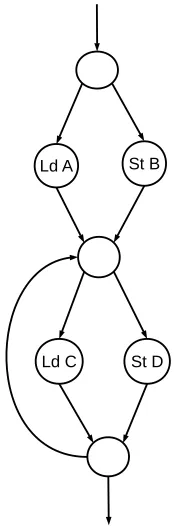
Figure 2.2 shows an example control graph of a program. Here the instructions “Ld A”
Ld A
Ld C St D St B
Figure 2.2Control graph with diverging paths
and “St B” are present on different control paths. They can both never occur during single
instance of execution, and hence need not be profiled. The instructions “Ld C” and “St D”
are also present on different control paths, but they are present inside a loop. Even though they can never occur in the same iteration of the loop, they may have data dependence
2.3. FAST SET PROFILING CHAPTER 2. SET PROFILING
The next chapter will discuss the implementation of the set profiling infrastructure and
CHAPTER
3
INFRASTRUCTURE AND EVALUATION
The memory dependence profiling can be performed at three stages:
1. ISA/Binary Instructions
2. Intermediate Representation
3. High Level Language
Profiling at the level of a high level language has a downside that we’ll profile potentially
unnecessary information. As the program passes through optimizations, many memory operations will be promoted to register operations based on statically available information.
On the other extreme, profiling the binary instructions is again a waste as almost all the
high-level information is lost. And any subsequent information needed by the
optimiza-tions will be unavailable. Also, the registers which are spilled to memory operaoptimiza-tions are
CHAPTER 3. INFRASTRUCTURE AND EVALUATION
the optimizations are going to be performed on the IR, it is best to insert the
instrumenta-tion code at the IR level itself. Also, in order to avoid profiling unnecessary loads, it is best
to profile the IR which has already gone through most of the optimizations.
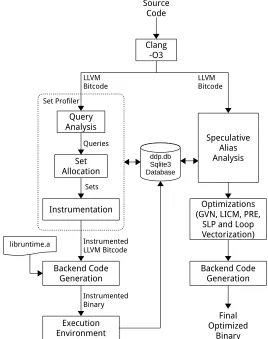
Our implementation is based on the LLVM Compiler Infrastructure. Figure 3.1 shows
Source Code Query Analysis Set Allocation Instrumentation Backend Code Generation Queries Sets Clang -O3 LLVM Bitcode Instrumented LLVM Bitcode Set Profiler ddp.db Sqlite3 Database Speculative Alias Analysis Optimizations (GVN, LICM, PRE,
SLP and Loop Vectorization) Backend Code Generation Execution Environment Instrumented Binary Final Optimized Binary LLVM Bitcode libruntime.a
Figure 3.1Work Flow for set profiling and feedback directed optimizations
the work-flow for profiling and feedback directed optimizations. We’ll focus on the portion
corresponding to Set Profiling here. The Set Profiling infrastructure is built as an LLVM tool
3.1. SET IMPLEMENTATION CHAPTER 3. INFRASTRUCTURE AND EVALUATION
analysis and set allocation are performed as an analysis pass. Each Load-Store pair (query)
which needs to be profiled is assigned a refID. As discussed earlier, at the very least all
refIDs corresponding to the same store instruction are grouped together and assigned a
set. More advanced grouping policies can be implemented. A subsequent instrumentation
pass generates the instrumentation code corresponding to all the queries and sets in the
program, function by function. In order to avoid the overhead of function calls, various variables are allocated on stack as needed, and the set operations are generated directly in
the IR. Finally module destructors are used to write the collected data to the SQLite database.
Library functions are used here to aid database access, since it is one time overhead at the
end of the program. Any storage mechanisms like files or databases can be chosen; we’ve
used SQLite database in order to simplify analysis of the data.
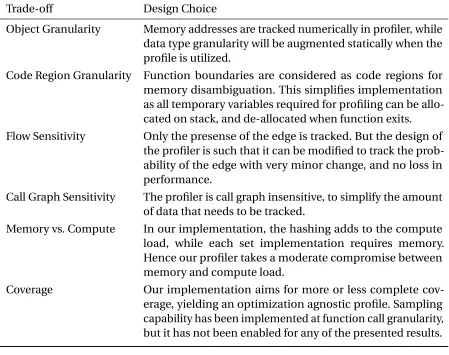
Table 3.1 presents various choices taken as per the design trade-offs explained in
chap-ter 1.
Set Implementation
Since the granularity of a 32-bit machine is 4 byte elements, we’ve used the same to build
set based bloom filters. Based on the desired size of the bit set, an array of 32-bit integers is
created. For example, to obtain a 512-bit set, an array of 16 elements can be created. Using
bit-wise operations, the index is also split into array index and bit index (to index inside 32
bits).
Signature Configurations
When implementing banked Signatures, the hashing work increases with each bank. In
order to reduce the hashing work, a single hash is computed for the whole 32-bit address,
using simple bit-wise operations. Lower two bits are discarded as most addresses are aligned on a 4 byte boundary. The next bits are used to index each bank. For example, with 512-bit
banks, the first bank will use bit 2-10 from the hashed address, the second bank will use bit
11-19 and so on. Since the hash is computed using the whole 32-bit address, information
for all the bits is utilized in the index, even though some bits of the hash are unused in
3.1. SET IMPLEMENTATION CHAPTER 3. INFRASTRUCTURE AND EVALUATION
Table 3.1Design choices taken in our implementation
Trade-off Design Choice
Object Granularity Memory addresses are tracked numerically in profiler, while data type granularity will be augmented statically when the profile is utilized.
Code Region Granularity Function boundaries are considered as code regions for memory disambiguation. This simplifies implementation as all temporary variables required for profiling can be allo-cated on stack, and de-alloallo-cated when function exits. Flow Sensitivity Only the presense of the edge is tracked. But the design of
the profiler is such that it can be modified to track the prob-ability of the edge with very minor change, and no loss in performance.
Call Graph Sensitivity The profiler is call graph insensitive, to simplify the amount of data that needs to be tracked.
Memory vs. Compute In our implementation, the hashing adds to the compute load, while each set implementation requires memory. Hence our profiler takes a moderate compromise between memory and compute load.
Coverage Our implementation aims for more or less complete cov-erage, yielding an optimization agnostic profile. Sampling capability has been implemented at function call granularity, but it has not been enabled for any of the presented results.
Table 3.2Signature Configurations
Signature Banks Bits/bank Index bits per bank Utilized bits of hash
1K 2 512 9 18
2K 2 1024 10 20
3K 3 1024 10 30
3.2. ACCURACY CHAPTER 3. INFRASTRUCTURE AND EVALUATION
exploring various options.
Accuracy
Same methodology as illustrated in[VT12]is used to evaluate the accuracy of the profiler. We use a fully accurate profiler as a comparison point.
Perfect Profiling
To evaluate the profiling accuracy, a perfect profiler is required, which has knowledge of
all the edges. Such a perfect profiler can be implemented using dynamic data structures.
The set based implementation is augmented with the STL sets in C++ [ISO14], to build a perfect profiler. STL sets allow perfect insertion and membership checks, but at the cost
of speed. Any perfect profiler has to use such dynamic data structures, which are slow to
allocate and traverse. So, this also serves as a reasonable performance comparison point.
Normalized Average Euclidean Distance
We use Normalized Average Euclidean Distance (NAED)[SS06]for our accuracy compar-isons. All the results of the profiler are placed into a vector, such that each dimension
in the vector represents a unique query (static data dependence edge). The value of this
dimension is the probability of the edge occurring as per the profiler under consideration. The probability is calculated by dividing the number of times that edge occurs, with the
number of times that code-region executes (normalization).
Once the data dependence vectors are obtained, a Euclidean distance is calculated i.e.
dis-tance between components along corresponding dimensions is calculated. Next, Average
Euclidean Distance is obtained by dividing the ED withs q r t(n)wheren is the length of the vector. This can be represented in Equation 3.1
N AE D = v tPn
i=1(p e r f e c ti−p r o f i l e ri)2
3.3. EXPERIMENTAL SETUP CHAPTER 3. INFRASTRUCTURE AND EVALUATION
Since each vector is a vector of probabilities ranging from 0 to 1, the final NAED will also
have a range of 0 to 1. This can be visualized with following examples. If a program has 100
queries, and the profiler predicts each query off by 20%, the final NAED would be 0.2. On
the other hand, if 20 of them were 100% wrong, the resulting NAED would be 0.447.
Experimental Setup
The performance evaluation of the instrumented binaries was done natively, using
equiva-lent nodes on a High Performance Computing systems. Each node sports a Intel EE5520
quad-core machine with two-way hyper-threading, paired with 24GB of memory,
run-ning a RHEL7 OS. In order to ensure that other jobs on the HPC systems do not affect the
performance evaluation, each job is executed with exclusive access to the machine.
Both integer and floating-point benchmarks from SPEC2000 and SPEC2006 benchmark
suites are used to study accuracy as well as performance. Only the benchmarks written in
C and C++are selected because LLVM/Clang frontend supports GNU toolkit compatible compilation for these two languages. Some benchmarks which exhibit too long runtimes
with perfect profiling are omitted. LLVM version 3.6.2 is used for all the evaluation.
Performance is measured as the slowdown in comparison to the -O3 optimized
non-instrumented code.
0 0.1 0.2 0.3 0.4 0.5 0.6 0.7 0.8
1k 2k 3k 8k
N
A
E
D
0.2
0.16
0.1 0.09
3.4. EVALUATION CHAPTER 3. INFRASTRUCTURE AND EVALUATION
Figure 3.2 shows the accuracy of the profiler for different benchmarks, along with the
arithmetic mean. The benchmark-configuration pairs with no bars imply a perfect
accu-racy of NAED=0. The signature based profiler provides moderate accuracy – a NAED of 0.2 with 1K bits per signature and 0.09 with 8K bits per signature on average. The size of the
signature presents the expected trend with bloom filters i.e. accuracy improves with the size
of the bloom filter. But the accuracy does not linearly increase with increased size; it rather improves suddenly depending on the benchmark. This is because the address patterns
input to the sets do not follow a random distribution, but depend on the program accesses.
Because 3K configuration uses an extra bank (and a hash) above 8K configuration,
some-times it provides higher accuracy. Depending on the sensitivity of the benchmark to the
higher order bits of the address, 3K can be more effective, as observed on 183.equake and
300.twolf. Though the average NAED is quite low, not all benchmarks have good accuracy
individually. Benchmarks like 188.ammp show a very poor or inaccurate profile at 1K; even
with the 8K configuration the NAED is 0.5, which is too large to be useful. For the
bench-marks 179.art, 181.mcf, 183.equake the inaccuracy is quite high when using low signature sizes, but it improves to some extent with higher signature sizes. For other benchmarks as
0 10 20 30 40 50 60 10 3. 66 28 3. 75 96 .6 5 91 .5 5 20 1. 07 12 5. 59 55 1. 03 84 .3 9 69 .1 9 59 .9 4 perfect 8k 3k 2k 1k S lo w d o w n 24.98 7.18 7.88 6 5.97
3.4. EVALUATION CHAPTER 3. INFRASTRUCTURE AND EVALUATION
Figure 3.3 shows the performance of various configurations with respect to the perfect
profiler, along with the geometric mean across all benchmarks. The Y axis presents the
factor of slowdown compared to the uninstrumented code. The performance overhead
of signature profiling is much lower than perfect profiling, for most of the benchmarks
– on average it has a 7x runtime while the perfect profiler has a 24x runtime. In some
cases like 253.perlbmk the performance overhead of signature based profiler is almost at par or even worse than perfect signature. A possible explanation for this is that these
benchmarks have small functions being called repeatedly, which results in initialization
costs to accumulate. Even simple operations like clearing the memory initially add up. The
perfect set implementation on the other hand allocates memory on-the-fly and hence does
not have high initialization cost. A comparison with just the memory clearing disabled in
the signatures, confirms this intuition. The generated profile however, would be garbage
and hence it is not presented as a point of comparison. The performance is highly sensitive
to the number of banks, as the amount of computation required per set operation increases
with each bank. This is visible as the overhead of 3K configuration is higher than other configurations, even 8K, due to its extra bank. The overhead does increase from 1K to 8K,
but the increase is not very significant. As the accuracy gains are much more significant
CHAPTER
4
HOW TO IMPROVE
Set based profiling achieves fast profiling with reasonable accuracy as compared to perfect
profiling. But what can be improved to achieve lower performance overhead and improve
the accuracy of the generated profile?
What to profile
One strategy to select queries is to profile every load-store edge which can’t be statically
proven. This allows the profiler to be optimization agnostic – any speculative optimizations can use this profile. This is the current policy used to select queries.
The other extreme is to build a list of edges that cause optimizations to give up, and
then only profile these edges. This strategy reduces the amount of information that needs
to be captured by the profiler, reducing its overhead. Though this may seem like a good
4.2. SET REPRESENTATION CHAPTER 4. HOW TO IMPROVE
fashion, where they give up as soon as a possible dependence is found. Even if that edge
is probabilistically dis-proven, there’s a high chance that there are more edges which will
block the optimization, and we have not profiled them yet. Moreover, this strategy makes
the obtained profile usable only with the optimization under consideration.
A reasonable middle ground would be to profile only the useful information, without
losing the generality of the profile. Many edges in the programs are relatively easy to predict statically, even though the predictions do not meet the strict correctness policy of compilers.
This information can be leveraged, to avoid profiling these edges and reduce the profiling
overhead, while still maintaining profile generality and completeness. Next chapter will
introduce few such heuristics to prune the query list for the profiler.
Set Representation
This is one of the most critical pieces for the profiler, as it directly controls the accuracy as
well as the performance per query. Bloom filters provide a relatively lightweight mechanism to capture the memory locations access, but can this information be represented in any
other form?
Subsequent chapters will introduce a simple yet effective range mechanism to represent
sets. Further this range mechanism will be combined with bloom filters to obtain high
CHAPTER
5
HEURISTIC PRUNING
The compilers and the Alias Analysis passes operate on a strict correctness principle, which
makes them pessimistic in many cases. Though a particular program pattern might be easy
to predict in most cases, due to some corner cases, it cannot be leveraged. Profilers on the
other hand are inherently probabilistic. And each memory operation being profiled can
add to the profiling overhead. Furthermore, since we are using probabilistic signatures to
profile each query, any information obtained from the profiler, can possibly be inaccurate,
depending on the population of the sets. Such program patterns available statically, can be
leveraged to predict dependence relations. And because these patterns are quite simple, they can be predicted more accurately as compared to the profile obtained from a probabilistic
profiler. In this chapter, some heuristics to prune the number of queries are proposed and
evaluated against the perfect profiler. All the code examples presented are written in LLVM
5.1. HEURISTICS CHAPTER 5. HEURISTIC PRUNING
Heuristics
Constant Data Space
An alias analysis pass being conservative, treats an unknown address as a possible conflict
with any other address. But in any correctly designed program, a load which is accessing a
constant memory space will never conflict with a store.
Code Snippet 5.1Constant Data Space Heuristic
1 @a = i n t e r n a l constant [5 x i 3 2] [i 3 2 1 , i 3 2 2 , i 3 2 3 , i 3 2 4 , i 3 2 5], a l i g n 16
2
3 d e f i n e i 3 2 @_Z6squarei ( i 3 2 %num) #2 { 4 . . .
5 %5 = g e t e l e m e n t p t r inbounds [5 x i 3 2]∗ @a , i 3 2 0 , i 6 4 %4 6 %6 = load i 3 2∗ %5, a l i g n 4
7 . . .
8 s t o r e i 3 2 %6, i 3 2∗ %unknown , a l i g n 4 9 . . .
10 }
Code Snippet 5.1 presents an example of such code pattern. The “load” instruction is
accessing a truth table which resides in a constant data space, while the memory location
accessed by the store is unknown. The only situation where this load and store can conflict,
is when the store tries to write to constant data space, in which case, program will crash due to illegal memory access. So, the profiler can avoid instrumenting all queries which
exhibit this pattern.
Structure Type Mismatch
Different structures in memory should never conflict. Even if the actual address of a
struc-ture cannot be traced, as long as they are different strucstruc-tures, they should never conflict.
5.1. HEURISTICS CHAPTER 5. HEURISTIC PRUNING
Code Snippet 5.2Structure Base Type Mismatch
1 %s t r u c t . i d l = type { i32 , double , i 6 4 }
2 %s t r u c t . uuuuu = type { i32 , i32 , i32 , i32 , i 3 2 } 3
4 d e f i n e i 3 2 @test ( i n t ) ( i 3 2 %x ) #0 { 5 . . .
6 %6 = g e t e l e m e n t p t r inbounds %s t r u c t . i d l∗ %5, i 3 2 0 , i 3 2 0 7 s t o r e i 3 2 %4, i 3 2∗ %6, a l i g n 4
8 . . .
9 %16 = g e t e l e m e n t p t r inbounds %s t r u c t . uuuuu∗ %15, i 3 2 0 , i 3 2 1 10 %17 = load i 3 2∗ %16, a l i g n 4
11 . . . 12 }
a member of the structure “%struct.idl”, while the load instruction is trying to access a
member of the structure “%struct.uuuuu”. Even though the base address of both these
structures (%5 and %15 respectively) are unknown statically, as they are different structure
types, they’ll be different locations in memory. Subsequently, the addresses accessing their
elements (%6 and %16 respectively) should be different. In LLVM IR, this is easy to track
since GetElementPtr are the only instructions which can be used to index into structures in
memory.
In most cases, this will be true, but in some corner cases this will not be true:
1. Nested Structures: In case of nested structure, the first element of the inner structure,
and the address of an inner structure as accessed from outer structure will have the
same address, even though they have different base structure types.
2. Casting: In case of equivalent structures that are casted from one type to the other,
two different structure base types may refer to the same memory location.
But as presented in the evaluation of the heuristics, such occurrences are not very common.
5.1. HEURISTICS CHAPTER 5. HEURISTIC PRUNING
Structure Index Mismatch
Different elements of any given structure should never conflict with each other, whether
they are part of the same instance or another.
Code Snippet 5.3Structure Index Mismatch
1 %s t r u c t . xyz = type { i32 , i32 , i 3 2 } 2
3 d e f i n e i 3 2 @test ( i n t ) ( i 3 2 %x ) #0 { 4 . . .
5 %6 = g e t e l e m e n t p t r inbounds %s t r u c t . xyz∗ %5, i 3 2 0 , i 3 2 2 6 s t o r e i 3 2 %4, i 3 2∗ %6, a l i g n 4
7 . . .
8 %16 = g e t e l e m e n t p t r inbounds %s t r u c t . xyz∗ %15, i 3 2 0 , i 3 2 1 9 %17 = load i 3 2∗ %16, a l i g n 4
10 . . . 11 }
Code Snippet 5.3 shows one such scenario. The “%struct.xyz” is a structure with three
elements. The store instruction accesses the last element, while the load instructions
accesses the second element of the structure. Irrespective of whether both of the elements
are a part of the same instance of that structure or a different instance, they should not
conflict.
One of the rare cases when this heuristic will not hold true is when a structure is used to
walk an array of elements. For example, a structure containing only 2 integer elements, is
used to walk an array of 1000 integers, where in each iteration, the array index is incremented
only by one integer, and casted to the structure. But this is a very rare case situation.
Local Variables vs. Unknown Aggregates
Programs allocate local variables (simple data types) on the stack, specific to functions or
regions of code. These variables are cannot conflict with any aggregates, even if unknown,
5.1. HEURISTICS CHAPTER 5. HEURISTIC PRUNING
Code Snippet 5.4Local Variables vs. Unknown Aggregates
1 %s t r u c t . xyz = type { i32 , i32 , i 3 2 } 2
3 d e f i n e i 3 2 @test ( i n t ) ( i 3 2 %x ) #0 { 4 . . .
5 %3 = a l l o c a i32 , a l i g n 4 6 . . .
7 %6 = g e t e l e m e n t p t r inbounds %s t r u c t . xyz∗ %5, i 3 2 0 , i 3 2 2 8 s t o r e i 3 2 %4, i 3 2∗ %6, a l i g n 4
9 . . . 10
11 %17 = load i 3 2∗ %3, a l i g n 4 12 . . .
13 }
Code Snippet 5.4 illustrates an example function. The load instruction can be traced back
to an alloca instruction, which allocates a variable on the stack. The store instruction on the other hand accesses an unknown memory location, but we know that it is indexing into an
aggregate of type “%struct.xyz”. This heuristic can be incorrect only when programmer is
relying on the order of the variables on the stack, or the program has an overflowing pointer,
which causes memory corruption. Various optimizations in compilers move variables
around, and sometimes even promote them to registers. So, such an access would be illegal
for a programmer to implement anyway.
Local Structures vs. Function Arguments
Programs also allocate data structures on stack, which are specific to functions or regions
of code. These data structures cannot conflict with the arguments passed through the
arguments of the function, since they are freshly allocated on the stack.
Code Snippet 5.5Local Structures vs. Function Arguments
5.1. HEURISTICS CHAPTER 5. HEURISTIC PRUNING
3 d e f i n e i 3 2 @test ( i n t ) (% s t r u c t . l i s t _ e l∗ %x ) #0 { 4 . . .
5 %2 = a l l o c a %s t r u c t . l i s t _ e l , a l i g n 4 6 . . .
7 %6 = g e t e l e m e n t p t r inbounds %s t r u c t . l i s t _ e l∗ %x , i 3 2 0 , i 3 2 0 8 s t o r e i 3 2 %4, i 3 2∗ %6, a l i g n 4
9 . . .
10 %next = g e t e l e m e n t p t r inbounds %s t r u c t . l i s t _ e l∗ %2, i 3 2 0 , i 3 2 1
11 %17 = load %s t r u c t . l i s t _ e l∗∗ %next , a l i g n 4 12 . . .
13 }
In Code Snippet 5.5, the load instruction (line number 11) is indexing into a local data
structure “%2”, and the address for the store (line number 8) can be traced back to a function
argument. These instructions will not conflict as an argument passed to the function will not conflict with the local stack. A situation where this heuristic can be incorrect is when
the caller function relies on specific memory layout of function’s local structures which
will be created in future, when the call instruction actually executes. Since optimizations
can move or promote these aggregates to individual elements, or even registers, this is an
illegal assumption. Note that the tracing is not done through a load instruction. Tracing is
performed only through pointer manipulation instructions like BitCast and GetElementPtr.
This heuristic differs from the previous one in the sense that previous one is restricted
to only simple data types, but in this heuristic even complex data types like aggregates can
be compared to function arguments.
Local Variables with No Pointers
Lastly, many of the local variables or structures allocated are only used as temporary storage
elements, specific to regions of code. No pointers are created to point at them i.e. no store
instructions store their addresses into the memory (at some other location). Since these
5.1. HEURISTICS CHAPTER 5. HEURISTIC PRUNING
structures will not conflict with other addresses.
Code Snippet 5.6Local Variables with No Pointers
1 %s t r u c t . l i s t _ e l = type { i32 , %s t r u c t . l i s t _ e l∗ } 2
3 d e f i n e i 3 2 @test ( i n t ) (% s t r u c t . l i s t _ e l∗ %x ) #0 { 4 . . .
5 %2 = a l l o c a %s t r u c t . l i s t _ e l , a l i g n 4 6 %3 = a l l o c a %s t r u c t . l i s t _ e l , a l i g n 4 7 . . .
8 %6 = g e t e l e m e n t p t r inbounds %s t r u c t . l i s t _ e l∗ %3, i 3 2 0 , i 3 2 1 9 s t o r e %s t r u c t . l i s t _ e l %x , %s t r u c t . l i s t _ e l∗∗ %6, a l i g n 4
10 . . .
11 %next = g e t e l e m e n t p t r inbounds %s t r u c t . l i s t _ e l∗ %2, i 3 2 0 , i 3 2 1
12 s t o r e %s t r u c t . l i s t _ e l %3, %s t r u c t . l i s t _ e l∗∗ %next , a l i g n 4 13 . . .
14 %20 = load %s t r u c t . l i s t _ e l∗ %unknown , a l i g n 4 15 . . .
16 }
In Code Snippet 5.6, let’s assume that all the uses of “%2” and “%3” are shown. The address “%2” is not used in a store instruction as a data operand; it is used only as the address
operand on line number 12 (traced through a GetElementPtr). So the query formed by the
store instruction on line number 12 and load instruction on line number 14, can never
form an edge. On the other hand, the address “%3” has been used as the data value in store
instructions. So, the query between the store on line number 9 and load on line number 14,
5.2. EVALUATION CHAPTER 5. HEURISTIC PRUNING
Table 5.1Queries detected by heuristics across all benchmarks
Heuristic Number of
Queries Found
Queries with Dependence
Structure Type Mismatch 68305 76
Structure Index Mismatch 27665 4
Constant Data Space 5734 0
Local Variables vs. Unknown Aggregates 17783 0
Local Variables with No Pointers 1902 0
Local Structures vs. Function Arguments 3464 0
Total 124853 80
Evaluation
These heuristics are not perfect and need to be evaluated for correctness. The perfect
profiler has the accurate data for all these edges, and can be used verify these heuristics.
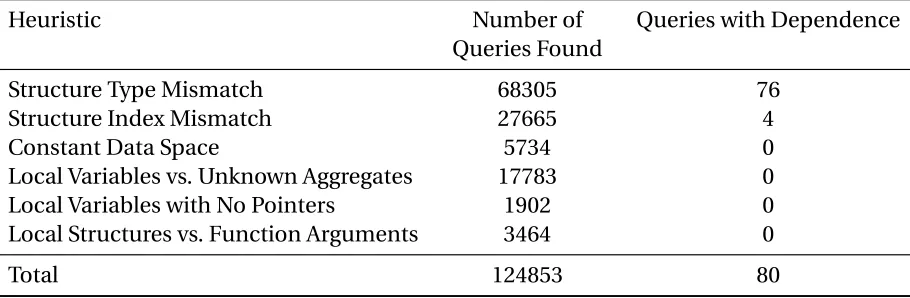
Table 5.1 shows the number of queries detected by the heuristics, and the number of
actual dependences as per the perfect profiler. These are combined numbers for all the
benchmarks. Figure 5.1 shows the distribution of each heuristic for each benchmark. The
heuristics are applied in the same order as specified in the table, each query is counted only
for one of the heuristics. As we can observe, the number of statically predictable queries is quite significant. Different heuristics are prominent on different benchmarks. TheStructure
Type MismatchandStructure Index Mismatchheuristics are most commonly observed. The inaccuracy introduced due to the heuristics is negligibly small – only 0.06% edges
are incorrectly skipped. All other edges are correctly predicted, thus eliminating the need
to profile these edges.
The 4 dependence queries found for theStructure Index Mismatchheuristic occur in
176.gcc benchmark, which has a union containing packed data structures. So it is possible
that seemingly different indices might be pointing to the same address, misleading the
heuristic. Out of the 76 failed cases for theStructure Type Mismatchheuristic, 48 queries are
5.2. EVALUATION CHAPTER 5. HEURISTIC PRUNING
these benchmarks use casting among different structures which have the same or similar
type layout, thus triggering the heuristic wrongly. Nevertheless, such occurrences are also
very rare as visible from the table, and do not affect the accuracy significantly.
0 10 20 30 40 50 60 70 80 90
Structure Base Mismatch Structure Index Mismatch Constant Data Space Alloca vs. GEP Alloca with no Pointers Alloca vs. Arguments
%
Q
ue
rie
s
D
is
ca
rd
ed
0 0.1 0.2 0.3 0.4 0.5 0.6 0.7 0.8 0.9
1k 2k 3k 8k
N
A
E
D
0.2
0.16
0.2 0.11
Figure 5.2Accuracy observed with Signatures on only those queries which can be statically predicted with the heuristics.
5.2. EVALUATION CHAPTER 5. HEURISTIC PRUNING
Figure 5.2 shows the accuracy when these queries are profiled with bloom filter based
profilers. Bloom filters perform poorly when they are highly populated, and that’s most
likely the reason behind such inaccuracy. These queries contribute to overall inaccuracy of
the profiler, especially in benchmarks like 188.ammp and 179.art. Overall it is quite clear,
0 0.1 0.2 0.3 0.4 0.5 0.6
8k
8k+Heuristics
N
A
E
D
0.09 0.06
0 10 20 30 40 50 60 70 80 90
8K
8k+heuristics
S
lo
w
d
o
w
n
7.18 6.24
5.2. EVALUATION CHAPTER 5. HEURISTIC PRUNING
Figure 5.3 shows the impact of the heuristics on overall accuracy. On an average the
NAED(w.r.t perfect profiler) is reduced by 32% as compared to the 8K configuration, which
had best accuracy till now. On specific benchmarks like 188.ammp, the difference is drastic,
as the profiler goes from being completely unusable to reasonably accurate.
Figure 5.4 shows the performance of the profiler with and without the heuristics. Only 8K
configuration has been presented here for the sake of simplicity; other configurations show a similar trend. The performance overhead is reduced by roughly 10%. The reduction in
performance overhead is not very significant, given the large number of discarded queries
as shown in Figure 5.1. This is due to the fact that performance is affected by the amount of
queries removed from the critical region, and not just any queries.
CHAPTER
6
RANGE SETS AND HYBRID SETS
In most cases, the memory is allocated for variables in a consecutive fashion, either on
stack or heap. Furthermore, most of the memory operations operate on a small range of
memory. For example, the iterator in a loop typically walks over an array. Even when objects
are allocated on heap, they are allocated in large chunks, or at least on nearby chunks. This
information can be represented in the form of a range.
Range Set
A range set is simply a set which keeps track of the range of addresses accessed by a given
instruction. The bloom filters try to hash a full 32 bit address space into a small set of bits.
In reality, the actual range of addresses accessed by any instruction in a single instance
of dynamic region of code, is usually very limited. The range set leverages this fact to
6.1. RANGE SET CHAPTER 6. RANGE SETS AND HYBRID SETS
technique is reminiscent of previous work in debugging[HL02; Zho04b; DZ09; Zho04a]. It is implemented using two variables which keep track of the minimum and maximum value
of the elements inserted into the set. Figure 6.1 shows the insertions into a range set during
Min = 0xABCD00
Max = 0xABCD00
Range Set
Min = 0xABCD00
Max = 0xABCD04
Range Set
Min = 0xABCD00 Max = 0xABCD24
Range Set
Min = 0xABCD00 Max = 0xABCD24
Range Set
MembershipCheck ( 0xABCF00 ) = False
a) 1st Iteration b) 2nd Iteration
c) 10th Iteration d) Membership Check
Figure 6.1Operation of the range set: “a)” to “c)” show insertion and “d)” shows membership check.
multiple iterations of a loop. Each insertion grows the range, if the address is outside the
6.2. HYBRID SET CHAPTER 6. RANGE SETS AND HYBRID SETS
minimum and maximum values.
This set cannot distinguish if any intermediate addresses have been accessed or not.
For example, in Figure 6.1 the address 0xABCD20 might not have been accessed at all, but a
membership check will be positive. This is the main source of inaccuracy in the range set.
The range set performs well with densely packed memory access pattern, but poorly with
sparse access patterns. This would be especially detrimental when distinguishing between elements of a structure, inside an array of structures. Inside a loop, the range set will grow
up to the size of the whole array. Any memory operations on different elements of the
structure will alias with each other as they’ll have more or less the same range. This is where
Structure Index Mismatchheuristic will help, as it will be able to statically differentiate between different elements of the structure. This difference is visible on the 188.ammp
benchmark significantly as the NAED for the range set reduces from 0.56 to 0.15 with the
heuristics applied.
Hybrid Set
Bloom filters provide a simple way to compress a very large address space into small bits,
with the down side of aliasing. Because of this, memory accesses to completely different
regions like stack and heap can also alias to the same bits, resulting in the false edges. Range
set on the other hand provides a very accurate mechanism to separate different memory
regions like stack and heap, or even chunks of memory allocated at different places in
the same region. But it cannot distinguish between sparse memory accesses in that range.
Hybrid set combines these mechanisms with following set operations.
1. Insertion: Any new entry updates the minimum and maximum, as well as the
corre-sponding bits in the bloom filter.
2. Membership Check: First the address is checked whether it falls in the minimum or
maximum range. Only if it does fall in the range, it is checked for membership inside
the bloom filter.
Since the bloom filter check is not executed all the time, the performance overhead should
6.3. EVALUATION CHAPTER 6. RANGE SETS AND HYBRID SETS
to the combined effect, the accuracy should be at least as much as the best of both, or
sometimes even better than both of them.
Evaluation
Same methodology is used for evaluation, as explained in chapter 3. For the sake of
com-parison simplicity, only the 8K signature configuration is compared. Also, all the heuristics
0.00 0.05 0.10 0.15 0.20 0.25
8k range hyb-8k
N
A
E
D
0.063 0.057
0.04
0 10 20 30 40 50 60 70 80 90
8k range hyb-8k
S
lo
w
d
o
w
n
6.24 5.94
3.46
6.3. EVALUATION CHAPTER 6. RANGE SETS AND HYBRID SETS
Figure 6.2 shows the comparison of range and hybrid sets. Range Set provides us very
good accuracy, much better than one would expect from such a simple mechanism. The
heuristics help in reducing the queries which will hit the holes in range set, improving it’s
accuracy. Many of the benchmarks like 401.bzip2, 433.milc and 473.astar show an
accu-racy much better than bloom filter, sometimes even near perfect. On others like 164.gzip,
183.equake, 188.ammp, 300.twolf, range set shows poorer accuracy in comparison to bloom filters. This suggests that both these mechanisms are suited for different set of memory
patters. The hybrid configuration combines the two, yielding best of the two techniques.
It is more accurate than both the techniques individually, and provides the best accuracy
observed so far, across all benchmarks.
The performance overhead of both the techniques is shown in Figure 6.3. Due to its
sim-plicity, the performance overhead of the range set is the least. Notably, even though hybrid
has to do additional work, it has less performance overhead than an equivalent bloom filter
configuration, except a few benchmarks. This is because most of the membership checks
fail at the range check itself, short circuiting all the work for hashing and checking the bloom filter. The overhead saved due to this, absorbs any additional overhead in insertion
and membership checks in case of actual dependencies, yielding better performance.
On an average, hybrid gives us roughly 5% lower performance overhead, and 38% more
![Figure 3.2 Accuracy of the profiler with different signature configurations. [lower is better]](https://thumb-us.123doks.com/thumbv2/123dok_us/1489440.1182230/34.612.144.672.145.457/figure-accuracy-proler-different-signature-congurations-lower-better.webp)

![Figure 5.2 Accuracy observed with Signatures on only those queries which can be statically predicted with the heuristics.[lower is better]](https://thumb-us.123doks.com/thumbv2/123dok_us/1489440.1182230/49.612.141.670.100.483/figure-accuracy-observed-signatures-queries-statically-predicted-heuristics.webp)
![Figure 5.3 Accuracy for various benchmarks with and without the heuristics. [lower is better]](https://thumb-us.123doks.com/thumbv2/123dok_us/1489440.1182230/51.612.135.667.112.487/figure-accuracy-various-benchmarks-heuristics-lower-better.webp)
