Study on Performance of Concrete Using
Hollow Glass Microsphere and Plastic Powder
E.Mohamed Najeeb1, A.Vellapandian2
Assistant Professor, Department of Civil Engineering, Government College of Engineering, Tirunelveli, Tamilnadu, India1
P.G. Student, Department of Civil Engineering, Government College of Engineering, Tirunelveli, Tamilnadu, India2
ABSTRACT: The main aim of this project is to study the behaviour of concrete with plastic and hollow glass microsphere. The recycled plastic powder have some properties like the natural aggregates but the strength is less than the natural aggregates. To overcome that hollow glass microspheres are used which have good filler material and low coefficient of thermal expansion.so replacing hollow glass microsphere and recycled waste plastic to enhance its strength and properties. Various percentage of hollow glass microsphere and recycled plastic powder are added separately and combinedly the cubes and cylinders are prepared and cured by accelerated curing from that identifying best ratio which gives better strength compared to the nominal cubes and cylinders.
KEYWORDS:Hollow glass microsphere, Recycled waste plastic, Scanning electron microscope.
I. INTRODUCTION
1.1General
Sustainable development of the cement and concrete industry requires the utilization of industrial waste components. At present, for a variety of reasons, the concrete construction industry is not sustainable. Firstly, it consumes huge quantities of virgin materials which can remain for next generations. Secondly, the lack of construction materials. So, finding a solution to substitute a practical recycled product for part of the concrete seems to be desirable for sustainable development A large number of researches have been directed towards the utilization of waste materials.. The required durability characteristics are more difficult to define than the strength characteristics, specification often use a combination of performance & prescriptive requirements, such as workability, compressive strength, Split tensile strength, flexural strength and water-cement material ratio to achieve a durable concrete. End result may be a high strength concrete
II. MATERIAL PROPERTIES
2.1 Hollow glass microsphere
Hollow Glass Microspheres (HGMs) seem to be a new and innovative product low in density, which can survive extremely high compressive forces, providing compounders and processors with new application opportunities. HGMs are being developed in various sizes which possess light weight and high strength under hydrostatic pressure.
1. Physical form = Free flowing powder 2. Color = White
2.2Recycled waste plastic
Traditionally, the application of plastic waste is used as landfill. Nowadays, the applications of recycled aggregate in construction areas are wide.
1. Specific gravity = 1.81 2. Bulk density = 980 kg/m3
III.METHODOLOGY
This deals with the details of methodology used for the study of Bacterial Concrete. The following methodology has been followed in this experimental investigation.
Literature Survey.
Collection of Required Raw Materials.
Preliminary tests on cement, fine and coarse aggregate, Hollow glass sphere and recycled plastic.
Designing of concrete M30 Grade mix as per IS 10262-2009
Setup of accelerated curing tank.
Calibration of accelerated curing tank
Casting and Curing of concrete specimens for finding out strengthcharacteristics without replacement.
Casting and Curing of concrete specimens for finding out the strength characteristics with Hollow glass sphere and plasticwith addition and replacement by weight of cement (1%, 2%,3%4%)
Casting of cylinders and carried out split tensile test.
Microstructure analysis for Hollow glass sphere replaced concrete using SEM
Comparison of strength and durability characteristics of conventional concrete and relaced concrete.
IV.ACCELERATEDCURINGTANK
Accelerated Curing Method is used to get early high compressive strength in concrete. This method is also used to find out 28 days compressive strength of concrete in 28 hours. is any method by which high early age strength is achieved in concrete. These techniques are especially useful in the prefabrication industry, wherein high early age strength enables the removal of the formwork within 24 hours, thereby reducing the cycle time, resulting in cost-saving benefits.:
The components of tanks are 1. Temperature controller 2. Heating rod
3. Heat distributor 4. Glass laminate cover
Temperature maintained on accelerated curing tank
Time(Hrs) Temperature (*C)
Calibration of accelerated curing
Type Average Compressive Strength (Mpa)
7 days 14 days 28 days 1 day accelerated curing Conventional cubes 28.5 31.14 39.60 25.10
Relation for calculating 28 days compressive strength R28 = 14.50 + Ra
R28 = 28 days compressive strength of concrete
Ra = 1 day compressive strength of concrete R28 = 14.50 + 25.10
= 39.60
IV.EXPERIMENTAL TESTS AND RESULTS
4.1 Compressive Strength
The compressive strength tests of the specimens were conducted to determine the compressive strength of specimen. From accelerated curing 28 days expected compressive strength will be calibrated.
28 days compressive strength of plastic and HGS added concrete cubes
S.No Mix Designation
(materials Added by weight of cement)
28 Days compressive strength
1 Conventional mix 39.60 2 Cement + 1% plastic 37.90 3 Cement + 1% HGS 33.70 4 Cement + 2% plastic 33.56 5 Cement + 2% HGS 28.96 6 Cement + 3% plastic 30.63 7 Cement + 3% HGS 27.29 8 Cement + 4% plastic 30.10
28
55 55
32
0 20 40 60
0 3 6 15
Te
m
p
er
at
u
re
(D
eg
re
e
)
Time (Hrs)
9 Cement + 4% HGS 24.97 10 Cement +1% HGS+ 1% plastic 30.70 11 Cement +2% HGS+ 2% plastic 28.30 12 Cement +3% HGS+ 3% plastic 25.10 13 Cement +4% HGS+ 4% plastic 23.30
Table 4.1 Compressive Strength of Conventional and Plastic & HGS added cubes
In plastic added cubes without reducing the cement content the plastic and hollow glass sphere will added by 1%,2%,3%,4% separately and both plastic and hollow glass sphere will added combindly by 1%,2%,3%..
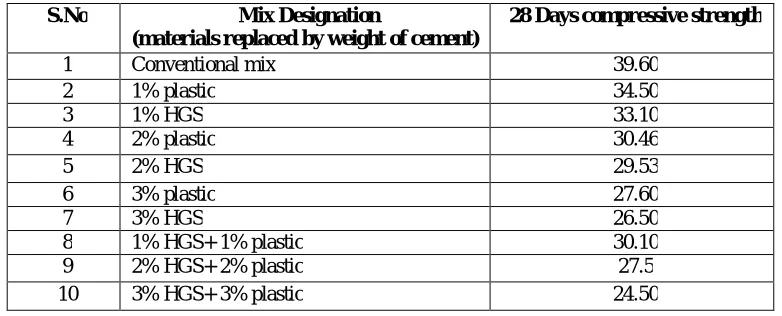
28 days compressive strength of plastic and HGS replaced concrete cubes
S.No Mix Designation
(materials replaced by weight of cement)
28 Days compressive strength
1 Conventional mix 39.60 2 1% plastic 34.50 3 1% HGS 33.10 4 2% plastic 30.46 5 2% HGS 29.53 6 3% plastic 27.60 7 3% HGS 26.50 8 1% HGS+ 1% plastic 30.10 9 2% HGS+ 2% plastic 27.5 10 3% HGS+ 3% plastic 24.50
Table 4.2 Compressive Strength of Conventional and Plastic & HGS replaced cubes
4.2 Split Tensile Test on concrete cylinders. The test was performed in accordance with IS: 516 - 1959 (Reaffirmed 1999). A standard test cylinder of 300 mm length and 150 mm diameter plain concrete cylinders was used for this study
S.No Mix Designation
(materials replaced by weight of cement)
Split Tensile Strength (Mpa)
1 Conventional mix 4.20 2 1% plastic 3.92
3 1% HGS 4.68
4 2% plastic 3.70
5 2% HGS 4.08
6 3% plastic 3.61
7 3% HGS 3.78
From the compressive and split tensile strength results the comparison graph will prepared as shown below.
5.1 Comparison chart for compressive strength test on plastic & HGS added cubes
From the above figure, shows that the compressive strength can reduce with addition of plastic and hollow glass sphere. It will gradually reduce with increase in percentage of plastic and hollow glass sphere
5.2 Comparison chart for compressive strength test on plastic & HGS replaced cubes
39.6 37.9
33.7 33.56
28.96 30.63 27.29 30.1 24.29 30.7 28.3
25.1 23.3 0 5 10 15 20 25 30 35 40 Control Mix 1% plastic 1% HGS 2% plastic 2% HGS 3% plastic 3% HGS 4% plastic 4% HGS 1% P+1% HGS 2%P +2% HGS 3% P+ 3% HGS 4%P + 4%HGS C o m p r e ss iv e s tr e n gth (M p a)
Percentage of plastic & Hollow glass Sphere addition
28 days compressive strength of plastic and HGS added concrete cubes
39.6
34.5 33.1
30.46 29.53
27.6 26.5 30.7 28.3 25.1
0 5 10 15 20 25 30 35 40 Control Mix 1% plastic
1% HGS 2% plastic
2% HGS 3% plastic
3% HGS 1% P+1% HGS 2%P +2% HGS 3% P+ 3% HGS C o m p r e ss iv e s tr e n gth (M p a)
From the above figure, shows that the compressive strength can reduce with replacement of plastic and hollow glass sphere. It will gradually reduce with increase in percentage of plastic and hollow glass sphere
5.3 Comparison chart for split tensile strength of plastic & HGS replaced cylinders
From the above figure,1% hollow glass sphere replacement may produce high split tensile strength than recycled plastic powder replacement. Remaining replacement ratios produce less split tensile strength compared to conventional mix.
VI. SEM ANALYSIS
Scanning Electron Microscope is a type of electron microscope that depicts the sample surface through the scan process by using a high-energy electrons beam in a raster scan pattern. Electron interaction with atoms of the sample helps in generating a signal that is most frequently used to study sample's surface topography, composition and other properties such as electrical conductivity. It is capable of generating high resolution images, which allow to examine the characteristics with a high magnification and detail. SEM has a large depth of field, which can focus on the more samples at a time and produce good shadow of three dimensional samples..
From SEM analysis by increasing the percentage of plastic and hollow glass sphere it will fill the gap between concrete but as a week material on compressive strength will reduce the compressive strength of entire mix.
The following images are internal structure of hollow glass sphere replaced with cement by conventional and 1%, 2%, 3% by weight of cement.
4.2 3.92
4.68
3.7 4.08 3.61 3.78
0 1 2 3 4 5 6
Control Mix 1% plastic 1% HGS 2% plastic 2% HGS 3% plastic 3% HGS
S
p
li
t
te
n
si
le
s
tr
en
gt
h
(
M
p
a
)
VII.CONCLUSION
Based on the experimental results, the following conclusions are made. 1.Compressive Strength
The plastic and hollow glass sphere added cubes
2.Each increase on 1% hollow glass sphere addition reduce the compressive strength by 13% The plastic and hollow glass sphere replaced cubes
1.Each increase on 1% plastic addition reduce the compressive strength by 12%
2.Each increase on 1% hollow glass sphere addition reduce the compressive strength by 14% 2.Split tensile strength
Hollow glass sphere 1% replaced cylinder shows 11.4% increase in split tensile strength when compared to conventional cylinder further increasing the percentage of Hollow glass sphere will reduce the strength. Plastic shows less split tensile strength when compared to the conventional and HGS replaced cylinders
3. From SEM analysis by increasing the percentage of plastic and hollow glass sphere it will fill the gap between concrete but as a week material on compressive strength will reduce the compressive strength of entire mix.
REFERENCES
[1] PurnandSavoikar October 2011 “Pulverized PET bottles as partial replacement for sand”, International journal of earths sciences and engineering ,vole 4.No 06 SPL, October 2011 ,pp.1009-1012.
[2] Zainab Z. Enas A. AL-Hashmi, “Use of waste plastic in concrete mixture as aggregate replacement”, Waste Management journal, Volume 28, Issue 11, November 2008, Pages 2041–2047.
[3] Naresh Kumar D, VenkateswaraRao T, Madhu T, Saroja P.L.N, Dr.Prasad D.S.V. (2014), ‘An expermental study of recycled concrete with polyporpylene fiber’, International Journal of Innovative Research in Advanced Engineering, Vol. 1, No. 7, pp. 1883-1892.
[4] P. Ganesh Prabhu, C. Arun Kumar, R. Pandiyaraj, P. Rajesh and L. SasiKumar.“Study on utilization of waste PET bottle fiber in concrete”, International Journal of Research in Engineering &Technology , Volume 2, Issue 5, May 2014, Pages 233-240
[5] Ms. K.Ramadevi, Ms. R. Manju “Experimental Investigation on the Properties of Concrete With Plastic PET (Bottle) Fibres as Fine Aggregates”. International Journal of Emerging Technology and Advanced Engineering (ISSN 2250-2459, Volume 2, Issue 6, June 2012). [6] Zainab Z. Enas A. AL-Hashmi, “Use of waste plastic in concrete mixture as aggregate replacement”, Waste Management journal, Volume
28, Issue 11, November 2008, Pages 2041–2047.
[7] SahilVerma, SahilArora, “Replacement of Natural Sand in Concrete by Polyethylene Bottles” Volume 2 Issue: 01, April- 2015
[8] KasibR.Malak, “use of waste plastic in concrete mixture as aggregate replacement”, International Journal of Engineering, Education and Technology (ARDIJEET), Volume 3, Issue 2, 01/04/2015