Comparative Study, Design and Analysis of
Multi Leaf Spring using FEA Tool
Rony Vargheese1, Dr Raghu Chand R2, Dinesh Kumar K3, P Azamulla4
P.G. Student, Department of Mechanical Engineering, KIT, Neerumarga, Mangalore, Karnataka, India1
HOD, Department of Mechanical Engineering, KIT, Neerumarga, Mangalore, Karnataka, India2
Assistant Professor, Department of Mechanical Engineering, KIT, Neerumarga, Mangalore, Karnataka, India3
P.G. Student, Department of Mechanical Engineering, KIT, Neerumarga, Mangalore, Karnataka, India4
ABSTRACT: Leaf spring plays major role in Automobile industries, even now many research is going on related to multi leaf spring in Indian automobile industries, very large automobile industries in India like TATA, Ashoka Leyland, Eichers India Pvt Ltd, and many other companies still preferring multi leaf spring for their heavy commercial goods vehicles, the main reason of using leaf spring is, design and manufacturing of leaf spring is easy and less expensive compared to other type of suspensions. In our project we are comparing the experimental results of multi leaf spring which is used in commercial vehicle with the analytical results with the help of FEA tool, also we are reducing the number of leaf spring from 9 to 5 and compare the results between them.
KEYWORDS:Automobile, multi leaf spring, vehicle, FEA Tool.
I. INTRODUCTION
Multi leaf spring is still in practice because of its easy of manufacturing and less expensive compared to other type of suspension system, only in India more than 1000 research works is going on, related to leaf springs in most of the reputed automobile industries, Almost all manufacturing industries are using CAE Tool for both design and analysis, in our research work we are taking standard multi leaf spring experimental results from one of the International Journals and design the same using SOLID EDGE software for the same parameters and import the model in the ANSYS software, and applied the standard load on the multi leaf spring after doing the auto mesh on multi leaf spring, as we are comparing the results which we have got from FEA results and experimental method. As the experimental result what we are referred from international journal paper was of 9 leaf spring, and our next step is to reduce the number of leaf spring from 9 to 5 without changing the standard length, so it can be used for the same vehicle.
Some of the important Function of multi leaf spring is as follows:
• Multi Leaf spring helps to observe lateral loads which is developed during motion of the vehicles.
• Due to heavy brake torque more vibration is transmitted to chassis of the vehicles so leaf spring is used to absorb them.
• If heavy loading is done to the vehicles there are the chances of chassis failure but due to the use of multi leaf springs it helps to avoid it.
• In other suspension system if any minor problem occurs the whole system will be effected, example like in air suspension system if there is any problem related to air leakage in hose pipe the entire system loses its capability of holding vehicle load, but in multi leaf springs if any one of the leaf is damaged the other leafs will hold the load for particular period of time, later than damaged leaf can be replaced.
II. LITERATURESURVEY
As we have referred many international journals to obtain some of the standard experimental values of multi leaf spring which is currently used in commercial vehicles, Kumar Krishan and Aggarwal M.L [1] conducted experiment on multi leaf spring by applying hydraulic load in laboratory and multi leaf springs of same dimension was designed in 3D CAD modelling and analysis was done using ANSYS, they compared experimental and FEA results, the percentage error was not more then 3.
Ganji Madhukar and Goroginam Santhi [2] made comparative study of using steel leaf and composite leaf spring, use of composite leaf spring will reduce the weight of the vehicles and have more flexibility, more often can be used for commercial vehicles.
Manisha Singh and Ms.Divya Chaturvedi [3] experiment of multi leaf spring with application of dampers on both the ends of leaf springs was done in laboratory, by this method more deflection is formed during the dynamic motion of the vehicles.
Syambabu Nutalapati [4] designed composite leaf spring and fabricated using glass fiber reinforced polymer and was adopted as rear leaf spring for MAHINDRA and MAHINDRA “COMMANDER 650 DI” vehicle, to reduce the weight of the suspension system.
Priyanka Kothari and Amit Patel [5] they made review on the composite leaf spring over steel leaf spring, the rate of usage of composite leaf springs is increasing in the light motor and commercial vehicles in order to increase the driving comfort, also to increase the stiffness and reduce the weight.
Sandeep Bhattacharjee, Suyog Kanitkar [6] use of fiber composite leaf springs to replace the stain less leaf spring to make system weightless which can maintain the same strength as of steel leaf spring. Lesser the weight the system, which can increase overall performance of the vehicles.
III.PROPOSEDMETHODOLOGYANDDISCUSSION
Standard values of multi leaf springs (9 leaf springs) taken from the journal paper, Kumar Krishan and Aggarwal M.L [1]. Design of multi leaf spring is done with SOLID EDGE software, with same parameters for which experiment is done in laboratory, designed model is imported to ANSYS software where auto mesh is done and load is applied to it the analysis result is mentioned in the below tabular column.
Table: 3.1 Design Parameter based on experiment.
Parameter Value
Material selected 65Si7/sup9
Young’s Modulus, E of material used 2.1×10 /
Poisson’s Ratio of material 0.267
BHN 400-424
Ultimate Tensile strength of material 1272 MPa
Yield Tensile strength of material 1160 MPa
Stiffness of the spring 221.9 N/mm
Mass of material taken 54.169 kg
Table 3.2: Design Parameters of the 9-Leaf Spring
overall length 1450
Number of full-length leaves used 02
Number of graduated length leaves used 07
Width of all leaves made 70
Thickness of all leaves considered 12
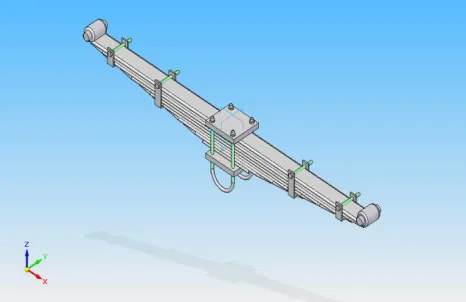
In the above tabular column the dimensions of the multi leaf spring is clearly defined and using same parameters we are designing the model of multi leaf spring using SOLID EDGE software.
Figure 3.1 Design of 9 leaf springs using SOLID EDGE
For the same CAD modelling meshing has been done, meshing helps to create the nodes and elements for the uniform distribution of the load.
After meshing the load of 35000N is applied for nine leaf spring to find the stresses and deformation, deformation and the stress formed after applying the load is shown in the below figures 3.3 and 3.4.
Fig 3.3 Deformation of 9 leaf spring
Fig 3.4 shows the Normal Stress of 9 leaf spring
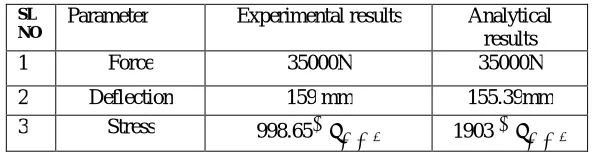
Now comparing the results of experimental values and FEA value, in below tabular column table 3.3 both experimental and FEA results has been mentioned.
Table 3.3: Experimental and Analytical Results of 9 Leaves
SL
NO Parameter Experimental results Analytical results
1 Force 35000N 35000N
Our next step is to reduce the number of leaf spring from 9 to 5, so design 5 leaf springs without changing the standard full length of first two leaf springs. And the design calculation of 5 leaf springs is done with the help of design data hand book.
1)Length of smallest leaf = × 1 + × in effective length
= × × 1 + × 0= 364 mm
2)Length of 2nd leaf = × 2 + × in effective length
= × × 2 + × 0 = 726 mm
3)Length of 3rd leaf = × 3 + × in effective length
= × × 3 + × 0= 1088 mm
4)Length of 4th leaf = × 4 + × in effective length
= × × 4 + × 0= 1450 mm
5)The stress in full length leaves σ = ( )
σ = × ×
× ×( × × )
=140.97Kgf/mm
6)The stress in the graduated leaves σ =
( )
σ = × ×
× ×( × × )
= 93.98Kgf/mm
7)The deflection of the spring y =
( )
y = × ×
× × . × ( × × )
Now base on the hand calculation result which we got with the help of design data hand book, draft the model with SOLID EDGE software, in the below figure 3.5.
Figure 3.5 Design of 5 leaf springs using SOLID EDGE
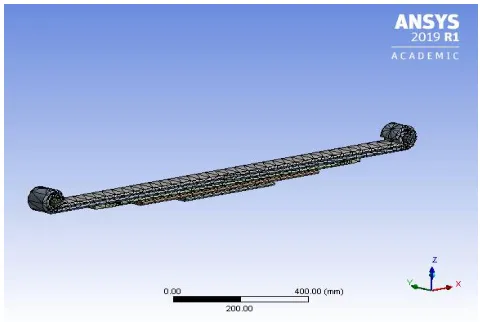
Leaf spring of 5 in number which has been drafted using SOLID EDGE software has to me meshed for uniform load distribution. Meshing of 5 leaf spring is shown in figure 3.6.
Fig 3.6 Meshing of 5 leaf spring
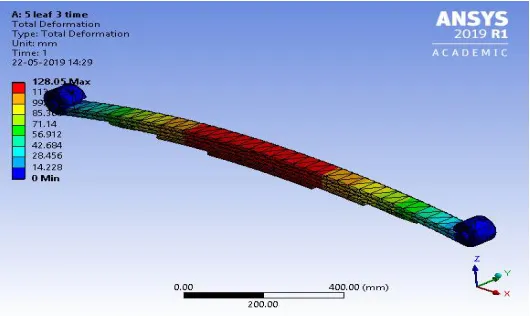
Fig 3.7 Deformation of 5 leaf spring
Fig 3.8 shows the Normal Stress of 5 leaf spring
The values of theoretical calculation, analytical result is shown in the below tabular column, that is table 3.4
Table 3.4: Comparative Results of 5 Leaf Spring
SL
NO
Parameter Theoretical results Analytical results Variation
1 Normal static load 35000 N 35000 N NILL
2 Deflection 154.30 mm 128.05 20.5%
3 Stress value 1294.64N
IV.EXPERIMENTAL RESULTS
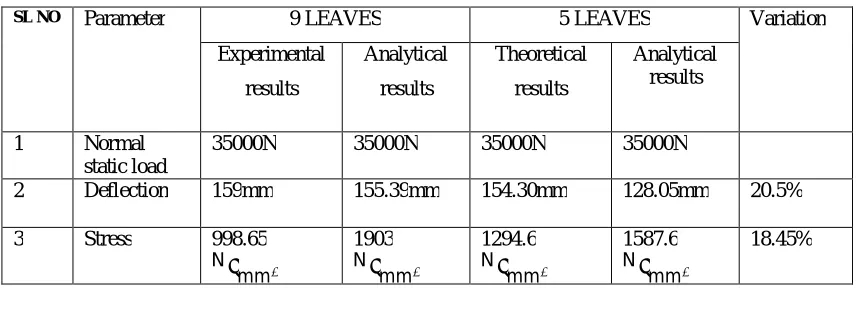
Now let us compare the results of 2 different parameter multi leaf springs that is experimental and analytical result of nine leaf spring with theoretical and analysis results of five leaf springs and in below tabular column 4.1 the results has been mentioned for full static load condition that is 35000N of load is taken as standard load.
Table 4: Comparison Results theoretical and analytical of 9 & 5 Leaf Springs
SL NO Parameter 9 LEAVES 5 LEAVES Variation
Experimental results Analytical results Theoretical results Analytical results
1 Normal static load
35000N 35000N 35000N 35000N
2 Deflection 159mm 155.39mm 154.30mm 128.05mm 20.5%
3 Stress 998.65
N mm 1903 N mm 1294.6 N mm 1587.6 N mm 18.45% V. CONCLUSION
For the full static load condition that is for 35000N of load when compared with nine and five leaf springs, percentage error of deflection is 20.5 and stress variation is 18.45.
Hence more than 5% of error, leaf springs are not safe to use, hence five leaf springs is not safe design for the full load condition of 35000N.
But when compared with experimental and analytical results of nine leaf springs the percentage error of deflection is up to 5, but there is more variation in stress, but still it can be considered as safe design.
REFERENCES
[1] Kumar Krishan and Aggarwal M.L. A Finite Element Approach for Analysis of a Multi Leaf Spring using CAE Tools Vol. 1(2), 92-96, Feb. (2012) Research Journal of Recent Sciences.
[2] Ganji Madhukar and Goroginam Santhi. Design and Analysis of Leaf Spring For Heavy Commercial Vehicle, Volume No.4, Issue No.5, August – September 2016, 4224-4228, (IJITR).
[3] Manisha Singh and Ms.Divya Chaturvedi designandanalysisofleafspringwith9platesusingdamperfor vehicle, [Singh, 3(4):April2016], Global Journal of Engineering Science and Researches.
[4] Syambabu Nutalapati, Design and Analysis of Leaf Spring by Using Composite Material for Light Vehicles, Volume 6, Issue 12, Dec 2015, pp. 36-59, Article ID: IJMET_06_12_005, (IJMET).
[5] Priyanka Kothari and Amit Patel, A Review Paper on Design & Analysis of Leaf Spring, Vol. 3 Issue 3, March – 2014, (IJERT). [6] Sandeep Bhattacharjee, Suyog Kanitkar, Composite Leaf Spring, Volume: 04 Issue: 11 | Nov -2017, (IRJET).
[7] Mohammed Hussien Rady, Computational Stress Analysis of a Composite Multi Leaf Spring, Accepted 22 Dec 2016, Available online 27 Dec 2016, Vol.6, No.6 (Dec 2016), International Journal of Current Engineering and Technology.
[8] Yogesh Sharma, and Dr. V.N. Bartaria, Comparison of Performance of Multi Leaf Springs of Automobile after Changing Its Cross Section, et al. 2015, Volume 3 Issue 6, International Journal of Science, Engineering and Technology.
[9] Vijaya Lakshmi and Satyanarayana, Static and Dynamic Analysis on Composite Leaf Spring in Heavy Vehicle, E-ISSN2249–8974, International Journal of Advanced Engineering Research and Studies.