SEATON, GERALD ARTHUR. The Lattice of Equivalence Classes of Closed
Sets and the Stone- ·Cech Compacti¯cation. (Under the direction of Dr. Gary Faulkner.)
¯X nX is the remainder of the Stone- ·Cech compacti¯cation of a locally compact space X. This paper introduces a lattice which we call L(X) that is constructed using equivalence classes of closed sets ofX. We then determine thatSt(L(X)) (the set of ultra¯lters onL(X)) is homeomorphic to ¯XnX. We subsequently give some examples. Most notably, for X = H this now provides a lattice-theoretic approach for representing ¯HnH.
CLOSED SETS AND THE STONE- ·
CECH
COMPACTIFICATION
by
Gerald Arthur Seaton
a dissertation submitted to the graduate faculty of
north carolina state university
in partial fulfillment of the
requirements for the degree of
doctor of philosophy
department of mathematics
raleigh
December 5, 2003
approved by:
Gerald Arthur Seaton grew up in Sterling, Virginia. He received a Bachelor of
Science degree in Mathematics from George Mason University in 1995. In the fall of 1995, he moved to Raleigh, North Carolina to attend graduate school at North
Car-olina State University. There he received a Master of Science degree in Mathematics in 1999. He remained at NCSU and is currently ¯nishing his doctoral work in
point-set topology under the guidance of Dr. Gary Faulkner. Gerald is looking forward to January, 2004, when he will begin his appointment as Mathematics lecturer at Mount
Olive College.
I would like to thank Dr. Gary Faulkner for all of the time, e®ort, care, and patience
he has given to me over the years that he has been my mentor. I would like to thank Dr. Richard Chandler, Dr. Kailash Misra, and Dr. Ernest Stitzinger for their wisdom
and instruction, and for their work as my advisory committee.
I would also like to thank my wonderful family and friends, each of whom I treasure.
Without the support of my parents, Arthur and Anne Seaton, none of this would
have been possible.
List of Figures v
1 PRELIMINARIES 1
1.1 DEFINITIONS { Topological . . . 1 1.2 DEFINITIONS { Lattice-theoretic . . . 3 1.3 BACKGROUND . . . 4
2 GENERAL LATTICES 9
3 L(X) 22
4 PROPERTIES OF L(X) 30
5 EXAMPLES OF L(X) 38
6 QUESTIONS 49
List of References 51
A Distributivity of Example 2.11 54
B Illustrations of Examples 59
APPENDIX B
1. Lattice from example 2.11 . . . 59
2. Lattice from example 2.19 . . . 60
PRELIMINARIES
1.1
DEFINITIONS { Topological
Knowledge of some of the basic concepts of topology (such as the separation axioms)
is assumed. General Topology by Willard [14] is a good source for topological de¯ni-tions not contained herein. Both Willard's book [14] and Extensions and Absolutes
of Hausdor® Spaces by Porter and Woods [9] are good references for the following de¯nitions.
A subset S of a topological space X is called clopen if S is both open and closed with respect to the topology onX. A space X is called 0-dimensional provided that the set of all clopen sets ofX forms a base for the open sets of X.
A collection C of sets of a spaceX is said to have the ¯nite intersection property if the intersection of any ¯nite subcollection of elements ofC is non-empty.
A spaceX is said to be compact provided that every open cover of X has a ¯nite subcover. Equivalently, X is compact if every collection of closed sets of X with the ¯nite intersection property has non-empty intersection.
A compacti¯cation®Xof a spaceX is a compact Hausdor® space that containsX as a dense subset. A space has a compacti¯cation if and only if it is Tychono®. From now on, unless otherwise noted, spaces will be assumed to be Tychono®. ®X nX denotes the remainder (i.e. the compacti¯cation ®X minus the original space X) of the compacti¯cation ®X.
A space X is said to be locally compact provided that every element of X has a compact neighborhood. The one-point compacti¯cation of X, sometimes denoted !X, is the compacti¯cation of X whose remainder consists of a single point. Locally compact, non-compact spaces are precisely those that have a one-point compacti¯ca-tion.
The maximum compacti¯cation of a space X is called the Stone- ·Cech compact-i¯cation of X, and is denoted ¯X. The Stone-·Cech compacti¯cation of X can be characterized as the unique compacti¯cation of X such that every bounded con-tinuous function on X can be extended to a continuous function on ¯X (i.e. X is C?-embedded in¯X). To see varying constructions of¯X, we recommend Chandler's
Hausdor® Compacti¯cations [1], andRings of Continuous Functionsby Gillman and
Jerison [5].
A space X is called connected if no two disjoint open sets of X cover X. If X is compact and connected, it is called a continuum.
Additionally, a subsetSof a spaceXis called aG±ifSis the countable intersection
1.2
DEFINITIONS { Lattice-theoretic
Many of the following de¯nitions can be found in Koppelberg's Handbook of Boolean
Algebras [7].
A partial order · is a binary relation that is re°exive, transitive, and antisym-metric. A partially ordered set (P;·) is a set P paired with a partial order ·. We will usually just write P instead of (P;·).
Given a partially ordered set P and elements a; b 2 P, the supremum of a and b (denoted a_b) is the least element that is greater than or equal to both a and b. The in¯mum of a and b (denoted a^b) is the greatest element that is less than or equal to both a andb. If L is a partially ordered set where a_band a^b exist for alla; b 2L, then we call L a lattice.
A lattice Lis called distributive if a^(b_c) = (a^b)_(a^c) and a_(b^c) = (a_b)^(a_c) for alla; b; c2L.
A bounded lattice is a lattice with both a greatest and a least element (usually denoted 1 and 0, respectively).
A ¯lter p on a lattice Lis a subset of Lsuch that (i). 02= p
(ii). a; b2pimplies that a^b2p
(iii). a2p andb2Lwith b¸a implies thatb2p.
An ultra¯lter is a maximal ¯lter (with respect to set inclusion).
Let a2L. Then a0 2Lis said to be the pseudocomplement of a ifa^a0 = 0 and b^a= 0)b·a0, 8b2L. A lattice Lis called pseudocomplemented if every a2L
Let a 2 L. Then ac 2 L is said to be the complement of a if a^ac = 0 and
a_ac = 1. We say "the" complement because it is unique (if it exists). A lattice B where every element of B has a complement is called a Boolean algebra. The
Handbook of Boolean Algebras[7] is an excellent reference for more background about
Boolean algebras.
The power set of !, denoted P(!), is a Boolean algebra. P(!)=f in denotes the set of subsets of ! mod the ¯nite sets (also a Boolean algebra).
If B is a Boolean algebra, then the Stone space of B, denotedSt(B), is the space formed by the set of all ultra¯lters on B. We also use this notation to describe the collection of ultra¯lters of a lattice (i.e. if L is a lattice, St(L) is the space of all ultra¯lters on L).
We use the notation CO(St(B)) to denote the set of clopen subsets of St(B).
1.3
BACKGROUND
M.H. Stone ¯rst introduced using Boolean algebras in the study of compact 0-dimensional spaces in the late 1930's. The following theorem is named for him:
Theorem 1.3.1. (Stone's Representation Theorem) Let B be a Boolean Algebra. Then:
1) St(B) is a compact, zero-dimensional space.
2) B is isomorphic to CO(St(B)) (the Boolean algebra of the clopen subsets of St(B).
A detailed treatment of Stone's theory can be found in the books of Porter and
of ¯! as the Stone space of the power set of ! (i.e. St(P(!))). Additionally, the Stone space of the Boolean algebraP(!)=finis homeomorphic to ¯!n!. In general, Stone- ·Cech compacti¯cations and their remainders could be studied using Boolean algebras { provided that they were zero-dimensional.
Also in the late 1930's, H. Wallman worked on an alternate approach to studying
compact T1-spaces, but he used lattices in general (without the additional structure
of Boolean algebras). In his paper Lattices and Topological Spaces [13], Wallman
considers the lattice L of closed sets of a T1-space R. He de¯nes the term "point"
(now referred to as "ultra¯lter") and shows that the set S of all "points" of a dis-tributive lattice is a bicompact T1-space. He also shows that R normal if and only if
S Hausdor®.
Additionally, he de¯nes in the paper a condition on the lattice L of the closed sets of R that is inspired by the closed set de¯nition of normality. Today, any lattice satisfying this condition is usually referred to as a normal lattice. This version of normality led to the de¯nition of a Wallman base (a discussion about the concept of Wallman bases can be found in Willard's book [14]):
De¯nition 1.3.2. LetB be any base for the closed sets ofX satisfying the following conditions:
a) for each closed set F and x =2 F, there is some A 2 B such that x 2 A and A\F =;,
b) B is closed under ¯nite unions and intersections,
c) if A; B 2 B are disjoint, then there exists C; D 2 B such that A ½ X nC, B ½XnD, and (XnC)\(XnD) =;.
Then B is called a Wallman base for X.
set of all B-ultra¯lters onX is called a Wallman compacti¯cation of X. It was once believed that every Hausdor® compacti¯cation might be a Wallman compacti¯cation for some Wallman base.
In the 1960's, O. Frink worked with understanding Wallman bases (which he called normal bases at the time) and the resulting Wallman compacti¯cations. For
example, he proved the following about semi-normal spaces (i.e. spaces with at least one Wallman base):
Theorem 1.3.3. A T1-space is completely regular if and only if it is semi-normal.
The proof of this theorem can be found in his 1964 paper Compacti¯cations and
Semi-Normal Spaces[4]. Also in this paper, Frink ¯rst posed the question of whether every Hausdor® compacti¯cation can be obtained by taking the Wallman
compacti-¯cation for some Wallman base.
In 1974, L.B. ·Sapiro published a paper [10] which considered this question posed by Frink. ·Sapiro broke this problem down to a set-theoretic one. He did not fully
answer the question, but his work paved the way for V.M. Ul'Janov. In Ul'Janov's 1977 paper [11] on the subject, he determined that there are in fact compacti¯cations not of Wallman type.
In the meantime, use for Stone's work had risen, thanks to the importance that
Parovi·cenko found in the space ¯! n !. In his 1963 paper [8] on the subject, Parovi·cenko proved that every compact set of weight · !1 is a continuous image
of¯!n!. Assuming the Continuum Hypothesis, he showed that¯!n! is a universal compact Hausdor® space of weight !1. This led to the de¯nition of a space called a
Parovi·cenko space:
a) X is a zero-dimensional compact space without isolated points with weight c, b) every two disjoint open F¾'s in X have disjoint closures,
c) every nonempty G± inX has nonempty interior.
Thus, Parovi·cenko showed that the Continuum Hypothesis implies that every Parovi·cenko space is homeomorphic to ¯!n!.
E.K. van Douwen and J. van Mill expanded on this work in their 1978 paper [2],
where they proved that Parovi·cenko's characterization of ¯!n! is equivalent to the Continuum Hypothesis by showing that if every Parovi·cenko space is homeomorphic
to ¯!n!, then the Continuum Hypothesis is true.
In 1991, K.P. Hart and A. Dow published a paper [6] in which they proved a similar result to that of Parovi·cenko, but this time for the space ¯H nH. They showed that every continuum of weight !1 is a continuous image of ¯HnH. This
characterization provided new motivation for the further study of¯HnH.
The characterization of¯!n!popularized the use of Boolean algebras in studying compacti¯cations (begun by Stone), as this technique allowed one to approach topo-logical problems from an algebraic angle. On the other hand, the lattice approach introduced by Wallman fell out of favor with the discovery that there are
compact-i¯cations that are not Wallman type. However, one of the overlooked advantages of
Wallman's approach is that it could (at least hypothetically) handle more topological cases, since the theory wasn't restricted to the study of 0-dimensional spaces (as the
Boolean algebra approach was).
We use this advantage in our development of the lattice that we call L(X) (see chapter 3), as we are motivated by the work of Hart and Dow to ¯nd an algebraic
GENERAL LATTICES
Suppose that Lis a lattice that is bounded (i.e. has a minimum and maximum with respect to the partial order; generally we'll refer to these as 0 and 1) and distributive (we assume all lattices are bounded and distributive unless noted otherwise). An
ultra¯lter on L is a ¯lter on L that is maximal. A ¯lter on L is said to be prime if a_b2Limplies thata 2L orb2L. With the help of the following lemma, we show that every ultra¯lter is prime.
Lemma 2.1. Let p be an ultra¯lter of a lattice L. Suppose b 2 L and 8a 2 p, a^b6= 0. Thenb2p.
Proof. Letq =fc2L:9a2p; c¸a^bg.(Show that q is a ¯lter.) (i). a^b6= 0,8a2 p, so 062q.
(ii). Let c1; c2 2 q. Then c1 ¸ a1 ^b andc2 ¸ a2 ^b for some a1; a2 2 p. Hence
c1^c2 ¸(a1^b)^(a2^b) = (a1^a2)^b. So c1^c2 2q since a1^a2 2p.
(iii). Let c1 2q andc2 ¸c1. Then c1 ¸a^b for some a 2p. Clearly c2 ¸a^b.
Hence c2 2q.
So, by (i), (ii), and (iii),q is a ¯lter. Leta 2p. Since a¸a^b, thena2q. Sopµq.
But pis an ultra¯lter, so p=q. Since for anya 2p, b¸b^a, thenb2q. Butp=q ) b2p.
Proposition 2.2. Suppose that p is a ¯lter of a lattice L. Then p is maximal ) p is prime.
Proof. Let p be a maximal ¯lter of L. Let x; y 2 L such that x _y 2 p. Then x_y 2 p ) (x_y)^a 6= 0;8a 2 p )(x^a)_(y^a) 6= 0;8a 2 p. Suppose that 9a; b 2psuch thatx^a= 0 andy^b= 0. Then (x^(a^b))_(y^(a^b)) = 0, which contradicts above sincea^b2p. So either (x^a 6= 0;8a2p) or (y^a6= 0;8a2p). So by lemma 2.1, eitherx2p ory2p.
We denote the set of all ultra¯lters onLbySt(L) (In the case of a Boolean algebra B, the set of all ultra¯lters on B is usually referred to as the Stone space of B { we'll use this notation in tribute to that. We will also occasionally refer to St(L) as the Stone space of L.). Now let's de¯ne the topology onSt(L) by considering a base for the closed sets.
Notation 2.3. Let [f] =fp2St(L) :f 2pg, for eachf 2L, and letB(St(L)) =f[f] : f 2Lg.
Obviously, B(St(L)) is a base for the closed sets of some topology on St(L) (For f1; f2 2 L, [f1][[f2] = [f1 _f2] 2 B(St(L)). Also, T[f] =; since [0] = ;). Let ¿B
be the topology that B(St(L)) is a base for the closed sets of. It will be understood thatSt(L) has this topology on it. The following are fundamental properties of these basic closed sets.
Proof. There are two parts:
(µ) Let p 2 [a][[b]. Then a 2 p or b 2 p. Since a_b¸ a and a_b ¸ b, then a_b2p. Hence p2[a_b].
(¶) Let p 2 [a_b]. Then a_b 2 p. Since p is prime, a 2 p or b 2 p. Hence p2[a][[b].
Lemma 2.5. [a]\[b] = [a^b],8a; b2L.
Proof. There are two parts:
(µ) Let p 2[a]\[b]. Then a 2 p and b2 p. Since p is a ¯lter, a^b2 p. Hence p2[a^b].
(¶) Letp 2[a^b]. Then a^b2p. Since a ¸a^b and b¸a^b, then a; b2p. Hence p2[a]\[b].
WithSt(L) de¯ned as a topological space, the obvious next step is to consider it's topological properties. We need a couple of preliminary results ¯rst, beginning with
a modi¯ed version of the Boolean prime ideal theorem, adjusted to suit our needs here. The statement of the original theorem, with proof, can be found in Handbook
of Boolean Algebras [7]. The proof I provide here, paraphrased directly from the
Handbook, is included for the sake of completeness.
Theorem 2.6. A subset E of a lattice L has the f.i.p. ) E is contained in an ultra¯lter of L.
Proof. Assume E µ L has the f.i.p. So, if p0 is the ¯lter generated by E, then p0 is
proper. LetP =fq:q¶ p0; q is a f ilter of Lg. Clearly, P is non-empty and can be
This gives us the following fundamental result about ¯lters:
Corollary 2.7. Any ¯lter p of a latticeL is contained in an ultra¯lter.
Proof. Filters have the f.i.p., thus this follows directly from theorem 2.6.
With this corollary, we prove that St(L) is compact.
Proposition 2.8. St(L) is compact.
Proof. LetC be a collection of basic closed sets ofSt(L) with the ¯nite intersection property; denote C =f[f®] :® 2¢g. Let S be the collection of all ¯nite in¯mums of
the f®'s,® 2¢. (Show thatS is a ¯lter base.)
(i). Let g 2 S. Then g = f®1 ^:::^f®n. Since C has the f.i.p., 9p 2[f®1]\:::\
[f®n])f®1; :::; f®n 2p)f®1 ^:::^f®n 2p)f®1 ^:::^f®n 6= 0 since 0 62p.
(ii). Let g1; g2 2 S. Then g1 = f®1 ^:::^ f®n and g2 = f¯1 ^:::^ f¯m. So
g1^g2 =f®1 ^:::^f®n^f¯1 ^:::^f¯m 2S.
So, by (i) and (ii),Sis a base for some ¯lterp, and thus by corollary 2.7,9an ultra¯lter p0 such that p0 ¶ p. By construction, f
® 2 p0;8® 2 ¢. Hence p0 2 [f®];8®2 ¢. So
T
C 6=;. Therefore St(L) is compact.
Next, we'll consider the following lattice property, labeled (?):
(?) If p; q 2L such thatp^q= 0, then 9a; b 2Lsuch thatp^a = 0, q^b= 0, and a_b= 1.
de¯nition of a Wallman base for a topological space (see Willard, [14], pg. 142). It is
used as an analagous condition in the setting of lattices to the condition of normality in the topological setting. Thus, the motivation for our following de¯nition:
De¯nition 2.9. A lattice L is callednormal if L has the (?) property.
The use of the word normal becomes justi¯ed when considering the result of two propositions, the ¯rst being:
Proposition 2.10. If L is normal, then St(L) is T2.
Proof. Letp; q2St(L) such that p6=q. Then9f 2p andg 2q such that f^g = 0. So by (?), 9a; b 2 L such that f ^a = 0, g^b = 0, and a_b = 1. So p 62 [a] and q62[b]. Also, by lemma 2.4, [a][[b] = [a_b] = [1] =St(L), so St(L) is T2.
Notice, however, that St(L) being T2 doesn't guarantee that L is normal, as the
following example demonstrates:
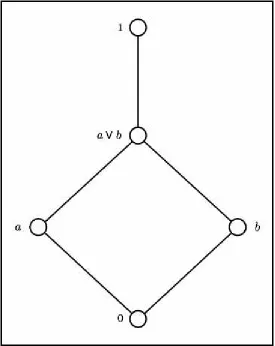
Example 2.11. LetLbe the lattice with 5 distinct elements de¯ned in the following way:
L = f0; a; b; a_ b;1g where a ^b = 0. (See appendix A for proof that L is distributive; see ¯gure B.1 in appendix B for illustration.)
L is, however, not normal. To see this, considera; b2L. By de¯nition, a^b= 0. But there doesn't exist two non-one elements in L whose supremum is 1. In other words, ifx_y= 1 then either x= 1 ory= 1. Since a^16= 0 andb^16= 0, then L clearly can't be normal.
The key distinguishing feature of the above example is the linear nature of the top part of the lattice. If we restrict ourselves to considering lattices that are di®erent
from the example in this regard, then we can prove the desired result. We introduce
the following term to describe lattices that are di®erent from our example with respect to this feature.
De¯nition 2.12. A latticeLis calledupwardly nonlinearprovided that 1 is the only element of L that is in every ultra¯lter on L.
Although we ¯rst considered this property from a purely lattice-theoretic point of view, we later noticed a connection between this property and a topological one.
This is explored in chapter 4.
For now, we use the property to prove the second of two propositions that show that our intuitive reasons for using the term normal are well-founded.
Proposition 2.13. Assume that L is upwardly nonlinear. If St(L) is T2, then L is
normal.
Proof. Suppose a; b 2 L such that a^b = 0. Then [a]\[b] = ; (i.e. they have no ultra¯lters in common). Since St(L) is T2 (by assumption) and compact (by
proposition 2.8),St(L) is normal.
9[c];[d]2B such that [a]\[c] =;, [b]\[d] =;, and [c][[d] =St(L).
Suppose a^c 6= 0. Then there exists an ultra¯lter p 2 St(L) such that a^c 2 p. But then a; c2p (since a; c¸a^c), which means thatp2[a]\[c], a contradiction. Hence a^c= 0.
Similarly, b^d = 0. Since St(L) = [c][[d] = [c_d] (by lemma 2.4), and L is assumed to be upwardly nonlinear, thenc_d= 1. Hence L is normal.
Thus, since St(L) is always compact, propositions 2.10 and 2.13 can be summed up by the following:
Corollary 2.14. LetL be upwardly nonlinear. Lnormal i® St(L) normal.
We now pause to make a few observations. Hart and Dow ([6], pg. 3) suggest that
Wallman's paperLattices and Topological Spaces[13] proves that if Lis a distributive lattice then there is a compact T1-spaceX such that X is Hausdor® i® L is normal.
However, on reconsidering the Wallman paper, it appears that Wallman did not prove this for all distributive lattices, but only for distributive lattices that are the lattice
of closed sets of some T1-space. This would leave out any distributive lattice that
is not equivalent to the lattice of closed sets of a T1-space (Note that the
Birkho®-Stone Theorem (Porter and Woods, [9], pg.104) does guarantee that every distributive
lattice has a set representation, but doesn't specify that the representation is a ring of closed sets.). The disjunction property (as Wallman called it), also mentioned by Hart and Dow [6], does appear to play a role in showing that St(L) is T2 ) L is
normal. In fact, it is noted in the Wallman paper that any lattice of closed sets of a
We now consider the disjunction property and how it relates to our upwardly
non-linear property. First let's de¯ne the disjunction property as it is given by Wallman ([13], pg. 115).
De¯nition 2.15. A lattice L has the disjunction property provided that whenever a; b 2L such thata6=b, there exists an element c2Lnf0gsuch that one ofa^cand b^c is 0 and the other is not 0.
Wallman stated that c should be taken out of L, but clearly c would never be 0, thus the reason for the modi¯cation. Wallman also stated the following theorem (as
lemma 3, [13], pg. 115) concerning the disjunction property.
Theorem 2.16. L has the disjunction property i® there is a 1-1 correspondence between the elements of L and the elements of B(St(L)) =f[f] :f 2Lg.
Assume a lattice L has the disjunction property. So by this theorem, if a; b2 L such that a6=b, then [a]6= [b]. In particular, assume a= 1. Then b2Lnf1g implies that [b]6= [1]. Since [1] =St(L), this is the same as stating that for every b2Lnf1g, there is an ultra¯lterp2St(L) such thatb =2p. In other words, 1 is the only element of L that is in every ultra¯lter on L. We have just shown the following:
Proposition 2.17. L has the disjunction property )L is upwardly nonlinear.
So if L is a lattice with the disjunction property, then no two distinct elements a and b of L can have their associated closed sets [a] and [b] equal to each other. On the other hand, ifL is an upwardly nonlinear lattice, then no two distinct elementsa andbofLcan have their associated closed sets [a] and [b] both equal to [1] { but that doesn't mean that [a] can't equal [b]. Thus, it would intuitively seem that there is an
Now, in corollary 2.7, we showed that every ¯lter on a lattice is contained in at
least one ultra¯lter. The next proposition gives a condition under which a ¯lter will be contained in exactly one ultra¯lter.
Proposition 2.18. If p is a prime ¯lter of a normal lattice L , then p is contained in a unique ultra¯lter.
Proof. Suppose L is normal. Suppose p is a prime ¯lter of L contained in distinct ultra¯lters q1 and q2 (i.e. q1 and q2 are maximal, q1 6= q2, and p µ q1 \q2). Then
9a 2q1nq2 and 9b2q2nq1 such that a^b= 0. Since L is normal,9c; d2L such
that a^c= 0, b^d= 0, and c_d = 1. Since 1 2p, then either c2 p or d2 p (by prime). Either is a contradiction (W.L.O.G. assume c2 p. Then p µ q1 ) c 2 q1,
but c2q1 and a^c= 0 contradicts that a2q1.).
In the context of Boolean algebras, if there is an embedding g between Boolean algebras B1 andB2, then the maph:St(B2)!St(B1) de¯ned byh(p) =g¡1(p) is a
surjective map. Thishis well-de¯ned becauseg¡1(p) is an ultra¯lter onB
1. Our ¯rst
thought was to mimic this construction in the lattice setting to get a similar result.
This, however, proved di±cult. Whether the inverse of a lattice embedding maps a lattice ultra¯lter to a lattice ultra¯lter is a question we have not yet been able to
answer, at least given the usual assumption that the lattices involved are distributive. The following example arose from an attempt to ¯nd a counterexample { it was later noticed that the lattice L0 (de¯ned in example 2.19) is not distributive. Subsequent
attempts to modify the example to make it distributive have been unsuccessful. It
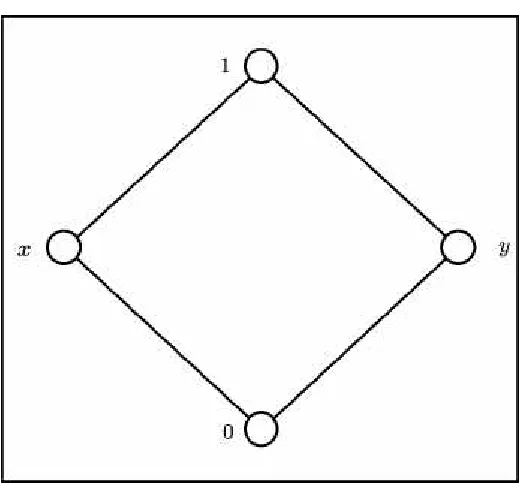
Example 2.19. LetLbe the lattice with 4 distinct elements de¯ned in the following way:
L=f0; x; y;1g where x^y= 0 and x_y= 1. (See ¯gure B.2 in appendix B for illustration.)
Note that Lis trivially normal. Now let L0 be the lattice with 5 distinct elements
de¯ned as follows:
L0 =f00; a; b; c;10gwherea^b=a^c=b^c= 00anda_b=a_c=b_c= 10.(Note that L0 is not distributive.)
De¯ne f : L ! L0 by f(0) = 00, f(1) = 10, f(x) = a, and f(y) = b. Clearly f
is well-de¯ned and 1-1. It is a little tedious, but easy, to check that f satis¯es the conditions of being a lattice homomorphism (namely that f(m_n) = f(m)_f(n) and f(m^n) =f(m)^f(n), for all m; n2L). So f is a lattice embedding.
Let p=fc;10g. Much like in example 2.11, the ¯nite setting makes it easy to see
that p is an ultra¯lter on L0. Notice, though, that f¡1(p) =f1g, which is not an
ultra¯lter onL since it is properly contained in the ultra¯lter fx;1g.
Though we are uncertain if the inverse of a lattice embedding would map lattice ultra¯lters to lattice ultra¯lters (and we suspect that, in general, it wouldn't), we can
get the following somewhat weaker result:
Proposition 2.20. Suppose that f : L! L0 is a lattice embedding and that p is a
prime ¯lter on L0. Then f¡1(p) is a prime ¯lter on L.
Proof. There are two parts:
1. f¡1(p) is a ¯lter:
(i). Suppose 0 2 f¡1(p). Then f(0) 2 p. But f(0) = 0, a contradiction. Hence
(ii). Suppose a; b 2 f¡1(p). Then f(a); f(b) 2 p. So f(a)^f(b) = f(a^b)2 p.
Hence a^b2f¡1(p).
(iii). Supposeb2L; a2f¡1(p), such that b¸a. Sinceb¸a,f(b)¸f(a) (lattice
homomorphisms preserve order). Since f(a)2p, thenf(b)2p. Hence b2f¡1(p).
2. f¡1(p) is prime: Let a_b2 f¡1(p). Then f(a_b) =f(a)_f(b)2p. Since p
is prime, f(a)2por f(b)2p. Hence a2f¡1(p) or b2f¡1(p).
Though weaker, proposition 2.20 is good enough, when used with proposition 2.18, to give us a comparable construction to the Boolean algebra case.
De¯nition 2.21. Suppose f : L! L0 is a lattice embedding and that L is normal. De¯nefD :St(L0)!St(L), theStone-dual map of f, by fD(p) =q
p, whereqp is the
unique ultra¯lter in Lcontaining f¡1(p).
If p 2 St(L0), then p is also prime (by proposition 2.2). By proposition 2.20,
f¡1(p) is a prime ¯lter on L. Since L is normal, then proposition 2.18 gives us that f¡1(p) is contained in a unique ultra¯lter onL. Thus fD is well de¯ned.
Furthermore,
Proposition 2.22. fD is onto.
Proof. Let q 2 St(L). Since f is 1-1, without loss of generality we can assume that f = idL (i.e. L µ L0). Since q 2 St(L), q has the f.i.p and is a subset of L0 . By
theorem 2.6, q can be extended to an ultra¯lter p of L0. Notice that f¡1(p) is a
prime ¯lter in L and f¡1(p) ¶ q. Since f¡1(p) is prime, it is contained in a unique
ultra¯lterqp (proposition 2.18). Soqp ¶f¡1(p)¶q. But q is maximal, soqp =q (i.e.
The following theorem also deals with the e®ects normality has on the set of
ultra¯lters of a lattice.
Proposition 2.23. SupposeLis a normal lattice with no complements,Lis upwardly nonlinear, and jLj ·!1. ThenSt(L) is:
(i). compact
(ii). connected (iii). of weight ·!1
Proof. There are three parts:
(i). St(L) is compact for anyL (doesn't need to be normal).
(ii). Suppose there existsF,Gthat are closed subsets ofSt(L) such thatF\G=; andF[G=St(L). SinceLis normal, thenSt(L) is T2. SinceSt(L) is also compact,
then St(L) is normal. So there exists basic closed sets [a]; [b] µ St(L) such that F \[a] =;, G\[b] = ;, and [a][[b] =St(L).
Since F \[a] = ; and F [G = St(L), then G ¶ [a]. But [a][[b] = St(L) and G\[b] = ;, so [a]¶G. Hence [a] =G.
Similarly, [b] =F. Therefore ;= [a]\[b] = [a^b], which implies thata^b= 0. Since St(L) = [a][[b] = [a_b], and since 1 is the only element of L in every ultra¯lter on L, then a _b = 1. This contradicts the assumption that L has no complements, hence Lis connected.
(iii). Since B =f[a] : a 2Lg is a base for the closed sets ofSt(L) and jLj · !1,
then jBj ·!1. Thus w(St(L))·!1.
Note that example 2.11 is a lattice with no complemented elements, and yet it's Stone space is disconnected (because there are two distinct ultra¯lters on the lattice).
L(X
)
This chapter will begin by de¯ning a lattice based on the closed sets of some
topo-logical space X. Ultimately the goal is to use this lattice, which we will call L(X), to characterize¯XnX.
Notation 3.1. SupposeX is a topological space and F is a closed subset ofX. Then we de¯ne: [F] =fGµX :G closed and ClX(F 4G) is compactg.
Note that the use of brackets to de¯ne the above equivalence class is standard,
however it is also standard to use brackets to de¯ne the collection of ultra¯lters containing a given element of a lattice. It should be clear in context which meaning is being used (or when both are being used).
Using the above de¯ned equivalence classes, we can construct a lattice:
De¯nition 3.2. For a topological spaceX, letL(X) =f[F] :F is closed in Xg, with the operations ^ and _de¯ned by [F1]^[F2] = [F1\F2] and [F1]_[F2] = [F1[F2].
It may not be clear thatL(X) as de¯ned is a lattice, so a partial proof is presented here:
Proposition 3.3. The operations ^ and _de¯ned above are well de¯ned.
Proof. We'll just show this for_, as the proof that^is well de¯ned is nearly identical.
Suppose that [F1]_[F2] = [F] and [F1]_[F2] = [G] (i.e. ClX(F 4(F1[F2)) and
ClX(G4(F1[F2)) are compact). We'd like to show that ClX(F 4G) is compact.
We'll start by observing that F 4G= (F nG)[(GnF)µ(F n(F1[F2))[((F1[
F2)nF)[(Gn(F1[F2))[((F1[F2)nG).
(To verify this last set containment, suppose W.L.O.G. that x 2 (F nG). Then x2F. Ifx62(Fn(F1[F2)) thenx2(F1[F2). Sincex 62G, thenx 2((F1[F2)nG).)
SoClX((FnG)[(GnF))µClX((Fn(F1[F2))[((F1[F2)nF)[(Gn(F1[F2))[((F1[
F2)nG))µClX((Fn(F1[F2))[((F1[F2)nF))[ClX((Gn(F1[F2))[((F1[F2)nG)) =
ClX(F 4(F1[F2))[ClX(G4(F1[F2)).
Since the union of two compact sets is compact, then ClX(F 4G) is a closed
subset of a compact set, and therefore compact. So [F] = [G].
Proposition 3.4. L(X) with the given operations is a bounded distributive lattice.
Proof. Since the union or the intersection of two closed sets is closed, L(X) is clearly closed under the operations. It is also clear that the operations are commutative, associative, and idempotent (i.e. [F]_[F] = [F] and [F]^[F] = [F]). Additionally, [F]<[G] is equivalent to [F]_[G] = [G] (or [F]^[G] = [F]). The lattice is bounded, as [X] and [;] are the 1 and 0 elements, respectively. The following equalities prove that L(X) is distributive:
[F]^([G]_[H]) = [F]^[G[H] = [F \(G[H)] = [(F \G)[(F \H)] = [F \G]_[F \H] = ([F]^[G])_([F]^[H])
From this point on, unless otherwise stated, we will assume that our topological
spaces are locally compact. In what follows, we will show that for any space X, ¯X nX is homeomorphic to St(L(X)). We will ¯rst introduce some notation and provide proofs of some necessary results related to ¯X nX. Then we will de¯ne the candidate for our homeomorphism, show that it's well de¯ned, and show that it is, in fact, a homeomorphism.
Notation 3.5. LetAbe a subset of X. Then the notationA¤ means (Cl¯X(A))nX.
Lemma 3.6. (F [G)¤ =F¤ [G¤.
Proof. There are two parts:
(¶) Let x 2 F¤ [G¤. Then x 2 F¤ or x 2G¤. LetU be an open neighborhood
(in ¯X) of x. Then U intersects F or U intersects G. Hence U \(F [G) 6= ;. So x2Cl¯X(F [G) and x26X, so x2(F [G)¤.
(µ) Let x 2 ¯X nX such that x 62 (F¤ [G¤) (i.e. x 62 F¤ and x 62 G¤). So
there exists an open (in ¯X) neighborhood V1 of x such that V1 \F = ; and there
exists an open (in¯X) neighborhood V2 ofx such thatV2\G=;. LetU =V1\V2.
ThenU is an open neighborhood (in¯X) ofx such thatU\(F [G) =;. Therefore x62(F [G)¤.
Lemma 3.7. (F \G)¤ =F¤ \G¤.
Proof. There are two parts:
(µ) Let x 2 (F \G)¤. Let U be an open neighborhood (in ¯X) of x. Then U intersects F \G, and thus U intersects F andU intersects G. Hence x 2 Cl¯X(F),
x2Cl¯X(G), and x62X. Therefore x2F¤\G¤.
Proposition 3.8. F =fF¤ :F closed in Xg is a base for the closed sets of¯XnX.
Proof. LetC be a closed set in ¯XnX and letx 2(¯X nX)nC. SinceX is locally compact, C is closed in¯X. LetV andW be open sets in ¯X such that x2V \W, Cl¯X(V)µW, andW \C =;. Note that V0 =V \X is open in X.
Let F = XnV0. Clearly F is closed in X. Since ¯X nX = X¤ = (V0 [F)¤ =
(V0)¤[F¤ and (V0)¤\C =; (because (V0)¤ µ (Cl¯X(V)nX)µ W), then C µF¤.
Additionally, ¯X nV is a closed set in ¯X containing F ) Cl¯X(F) µ ¯X nV )
F¤ µ¯XnV. Since x2V, thenx62F¤. Therefore F is a base for the closed sets of ¯X nX.
Notation 3.9. Let Fp =fF¤ : [F]2pg.
Proposition 3.10. For any p2St(L(X)), jTFpj= 1.
Proof. We'll present the proof in two parts:
1. For any p2St(L(X)),TFp 6=;:
Let p 2 St(L(X)). Suppose F1¤; F2¤; :::; Fn¤ 2 Fp. Then [F1];[F2]; :::;[Fn] 2 p )
[F1] ^ [F2] ^ :::^ [Fn] = [F1 \ F2 \ ::: \Fn] 2 p. Hence, F1¤ \F2¤ \ :::\ Fn¤ =
(F1 \F2 \:::\Fn)¤ 2 Fp. Therefore Fp is a family of closed sets with the ¯nite
intersection property. Since X is locally compact, ¯X nX is closed (Gillman and Jerison, [5], pg. 90) and thus compact, so TFp 6=;.
Let p 2 St(L(X)). Suppose there exists r; s 2 TFp with r 6= s. Then there
exists some basic closed set G¤ (with G closed in X) with r 2 G¤ and s 62 G¤. Then [G] 62 p because s 62 G¤. Since p is maximal, there exists a [F] 2 p such that [;] = [F]^[G] = [F \G]. Hence F \G is compact. So ; = (F \G)¤ = F¤\G¤ 
frg, a contradiction.
We are now ready to de¯ne our homeomorphism candidate.
De¯nition 3.11. Leth :St(L(X))! ¯XnX be de¯ned by h(p) =rp, where rp is
the unique point in TFp.
By proposition 3.10, it is clear that his well de¯ned. That it is a homeomorphism comes from the results that follow.
Proposition 3.12. The function h:St(L(X))! ¯XnX as de¯ned above is 1-1.
Proof. Suppose that p 6= q, and that h(p) = rp, h(q) = rq (Show that rp 6= rq).
Suppose thatrq2F¤; 8[F]2p. Let [G]2q. Thenrq 2F¤\G¤ = (F\G)¤; 8[F]2p.
SoF \Gis closed inX, but not compact,8[F]2p. This implies that [;]6= [F\G] = [F]^[G]; 8[F]2 p. Since p is maximal, [G] 2 p. Hence q µ p. Since q is maximal, q = p, a contradiction. Therefore there exists a [F] 2 p such that rq 62 F¤. So
rq 6=h(p) =rp. So h is 1-1.
Proposition 3.13. h is onto.
Proof. Let x 2 ¯X n X. Let G =fG¤ : G is closed in X and x 2 G¤g. Let
p=f[F] :F¤ 2 Gg.
1. p is a ¯lter:
(i). Since x62 ;=;¤, then ;¤ 62 G and [;]62p.
(ii). Suppose [F];[G] 2 p. So x 2 F¤ \G¤ = (F \G)¤. Since F \G is closed, (F \G)¤ 2 G. Thus [F \G]2p. But [F \G] = [F]^[G].
(iii). Suppose [F]2p and [G]2 L(X) such that [F]<[G]. So [F] = [F]^[G] = [F \G]. So ClX(F 4(F \G)) is compact) ClX((F n(F \G))[((F \G)nF)) is
compact ) ClX((F nG)[ ;) is compact ) ClX(F nG) is compact) (F nG)¤ =;.
Thus F¤ = ((F nG)[(F \G))¤ = (F nG)¤ [(F \G)¤ = (F \ G)¤ = F¤ \G¤.
Therefore F¤ µG¤ ) x2G¤ )[G]2p.
2. p is maximal:
Suppose [G]^[F]6= [;]; 8[F]2p(Show [G]2p). Since [;]6= [G]^[F] = [G\F], then 8[F] 2 p, G\F is not compact. Hence ; 6= (G\F)¤ = G¤ \F¤; 8[F] 2 p. Suppose that x 62 G. Then there exists a basic closed set of the form J¤ (with J
closed in X) such that x 2 J¤ and J¤ \G¤ = ; (because ¯X nX is regular). But
x2J¤ ) [J]2p, which contradicts that G¤\F¤ 6=;; 8[F]2p. Hence x2G¤, i.e.
[G]2p. Thus pis maximal.
Therefore by 1. and 2., p2St(L(X)) and h(p) =x, so his onto.
Notation 3.14. In the following proofs, [[F]] will be used as notation for the set of ultra¯lters on L(X) that contain [F] (i.e. [[F]] =fp 2 St(L(X)) : [F] 2 pg). Although this notation may look a bit awkward, it is consistent with the notation used in chapter 2 with ultra¯lters on a lattice. Additionally, as discussed in chapter
2, the [[F]]'s form a base for the closed sets of St(L(X)).
Proposition 3.15. h is continuous.
The following will show that h¡1(F¤) = [[F]]:
(µ) Letp2 h¡1(F¤) (so h(p)2F¤) and suppose that [F]62p. Then there exists a [G] 2 p such that [;] = [F]^[G] = [F \G] (since p is maximal). So ClX(F \G)
is compact. Hence, ;= (F \G)¤=F¤\G¤, which contradicts thath(p)2F¤\G¤.
Hence [F]2p, so p2[[F]].
(¶) Letp2[[F]]. Then [F]2p )h(p)2F¤ (by de¯nition ofh)) p2h¡1(F¤).
Therefore,h¡1(F¤) = [[F]] and since [[F]] is closed inSt(L(X)),h is continuous.
Proposition 3.16. h is closed.
Proof. Let [[F]] be a basic closed set in St(L(X)). The following will show that h([[F]]) = F¤:
(µ) Suppose r 2 h([[F]]). Then r = h(p) for some p 2 [[F]]. So since [F] 2 p, then r2F¤.
(¶) Suppose r 2 F¤ and r 62 h([[F]]). Since h is onto, 9q 2 St(L(X)) such that
h(q) =r. But r62h([[F]])) q62[[F]]) [F]62q.
However, h(q) = r ) r 2 G¤; 8[G] 2 q, and so r 2 F¤ ) ; 6= F¤ \G¤ =
(F \G)¤; 8[G] 2 q. So ClX(F \G) = F \G (since F \G is already closed in X)
is not compact, 8[G] 2 q. It follows that, for all [G]2 q, [;] 6= [F \G] = [F]^[G]. Since q is maximal, then [F]2q, a contradiction. Hence r2h([[F]]).
Therefore,h([[F]]) =F¤ and since F¤ is closed, h is closed.
So by the previous four propositions,his a homeomorphism (actually, the proposition that h is closed was unnecessary since any bijective continuous function from a com-pact space to a Hausdor® space is a homeomorphism). Thus we have the following
PROPERTIES OF
L(X
)
Here we will make various observations concerning our construction L(X). Ideally, we'd like to ¯nd properties of the space X that characterize it's associated L(X). For instance, from Faulkner and Vipera [3], we know that if a lattice L is pseudo-complemented, then St(L) is 0-dimensional. Thus it would be useful to know when a space X would have a pseudocomplemented L(X). While not a full characteriza-tion, the following will develop a condition on X that will guarantee that L(X) is pseudocomplemented. First, we'll start with some notation.
Notation 4.1. Thefrontier of F will be denoted F r(F), and is de¯ned by F r(F) = ClX(F)\ClX(XnF).
The following lemma is used in the proof of proposition 4.3.
Lemma 4.2. Suppose F is a closed subset of X. Then F \(XnFo) = ClX(F)\
ClX(XnF) (=F r(F)).
Proof. There are two parts:
(µ) Let x 2 F \(X nFo). Since x 2 F and Cl
X(F) = F, then x 2 ClX(F).
Suppose thatx 62ClX(XnF). So9 an open neighborhoodU ofxsuch thatU\(Xn
F) =; (i.e. U µF). So x2Fo, a contradiction. Hence x2Cl
X(XnF).
(¶) Let x 2 F r(F). So x 2 ClX(F) and x 2 ClX(X nF). Since F is closed,
ClX(F) =F, so x2F. Also, X nF µXnFo implies that ClX(XnF) µClX(Xn
Fo) =XnFo. So x2XnFo. Hence x2F \(XnFo).
Proposition 4.3. Suppose that [F]2L(X). F r(F) is compact () [XnFo] is the pseudocomplement of [F] (i.e. [F]0 = [XnFo]).
Proof. There are two parts:
()) Suppose thatF r(F) is compact. Then [F]^[XnFo] = [F\(XnFo)] = [F r(F)]
(by lemma 4.2) = [;]. Let [V] 2 L(X) such that [F]^[V] = [;]. Then there exists a compact K such that (V nK)\F = ;. So (V nK) µ (X nF) µ (XnFo). So
[V] = [V nK]· [XnFo]. Hence [XnFo] is the pseudocomplement of [F].
(() Suppose that [XnFo] is the pseudocomplement of [F]. Then [;] = [XnFo]^ [F] = [(XnFo)\F]. So (XnFo)\F (which isF r(F) by lemma 4.2) is compact.
The above results obviously lead to the following conclusion:
Corollary 4.4. If X is a space such that F r(F) is compact for all closed F µ X, then L(X) is a pseudocomplemented lattice.
Additionally, the topological condition speci¯ed in corollary 4.4 will also lead to
L(X) being normal, as we now show:
Proof. By corollary 4.4, if we assume that F r(F) is compact for all closed F µ X, thenL(X) is pseudocomplemented. In particular, for any [F] 2L(X), [F]0 = [XnFo]. Suppose that [F];[G] 2 L(X) such that [F]^[G] = [;]. Let's look at [F]0 and [G]0.
Suppose that [XnFo]_[XnGo]6= [X]. Since [XnFo]_[XnGo] = [(XnFo)[(XnGo)] =
[X n(Fo \Go)], then Cl
X(Fo \Go) is not compact. Also, since ClX(Fo \Go) µ
ClX(F \G), then ClX(F \G) is not compact. But [;] = [F]^[G] = [F \G] )
ClX(F\G) is compact, a contradiction. Hence [XnFo]_[XnGo] = [X]. Additionally,
[F]^[XnFo] = [;] and [G]^[XnGo] = [;] (since they are pseudocomplements), so
L(X) is normal.
So based on Faulkner and Vipera [3], and propositions 2.8 and 2.10, we know that
if X has the property that F r(F) is compact for all closed F µ X, then St(L(X)) is compact, normal, and 0-dimensional. But chapter 3 culminated with the fact that
St(L(X)) is really just the remainder of the Stone-·Cech compacti¯cation of X. So these results combine to give a way to characterize ¯X nX for the aforementioned class of spaces:
Proposition 4.6. If X is a space such that F r(F) is compact for all closed F µX, then ¯X nX is compact, normal, and 0-dimensional.
At this point, we'd like to insert a remark. Stone- ·Cech remainders that are
0-dimensional have been studied extensively using Boolean algebras (and to a lesser extent using general lattices). Every compact, Hausdor® space that is 0-dimensional
is the Stone space of some Boolean algebra (Koppelberg, [7], pg.100). However, Stone- ·Cech remainders that are not 0-dimensional cannot be studied in the parallel
generalizing Boolean algebras to general lattices, and speci¯cally, the advantage of our
constructionL(X). WithL(X), we have a lattice whose Stone space is homeomorphic to ¯X n X, regardless of the connectedness of the remainder. How connected, or disconnected, the remainder is seems to have to do with how many of the elements of
the lattice have complements or pseudocomplements (Speci¯cally, it seems that the greater the amount of complemented elements inL(X), the more disconnected¯XnX will be.). If every element ofL(X) has a complement (i.e. L(X) is a Boolean algebra), then ¯X nX is 0-dimensional. Also, as we have noted, if every element of L(X) has a pseudocomplement (i.e. L(X) is pseudocomplemented), then again ¯X nX is 0-dimensional. However, from proposition 2.23, ifL(X) is upwardly nonlinear, normal, and no element ofL(X) has a complement, then¯XnXis connected. Of course, there are a lot of possibilities in between L(X) having no complements and L(X) being pseudocomplemented. The next two propositions directly lead to corollary 4.9, which gives us a condition onX that will lead to being able to predict the disconnectedness of¯XnX. At the same time, the results will also provide more support to our theory that the more complemented elements in L(X), the more disconnected ¯X nX is.
Proposition 4.7. LetX be a topological space. Assume that C =fF1; F2; :::; Fng is
a ¯nite collection of unbounded closed subsets of X such that SC =X and Fi\Fj
is compact for all i; j ·n, i6=j. Then L(X) has at least ncomplemented elements.
Proof. By the assumptions and the de¯nition of L(X), it follows that [F1]_[F2]_
:::_[Fn] = [X] and [F1]^[F2]^:::^[Fn] = [;].
Consider [Fi] for i· n. Let [Fi]c =Wjm6=i[Fjm] for jm · n. Clearly, [Fi]_[Fi]
c =
[X]. It also follows that:
[Fi]^[Fi]c = [Fi]^([Fj1]_[Fj2]_:::_[Fjn¡1]) = ([Fi]^[Fj1])_([Fi]^[Fj2])_:::_
Thus [Fi]c is the complement of [Fi]. Hence, L(X) has at least n complemented
elements.
Though we're currently concerned with L(X), the next proposition is true for general lattices:
Proposition 4.8. Suppose that L is a lattice and S =fa1; a2; :::; ang is a ¯nite
collection of elements of L such that a1 _a2 _:::_an = 1 and ai ^aj = 0 for all
i; j ·n,i6=j. Then St(L) is disconnected with at leastncomponents.
Proof. Since ai^aj = 0 for alli; j ·n,i6=j, then no ultra¯lter onL contains more
than one element of S. Note that the element 1 is in every ultra¯lter onL and that ultra¯lters are prime (proposition 2.2). Now since a1 _a2 _:::_an = 1, then every
ultra¯lter on L must contain exactly one element ofS. Thus [a1][[a2][:::[[an] =
St(L) and [ai]\[aj] = ; for all i; j · n, i 6= j. This demonstrates that St(L) is
disconnected with at least ncomponents.
Propositions 4.7 and 4.8 (and, of course, proposition 3.17) directly lead to the following result concerning ¯X nX:
Corollary 4.9. LetX be a topological space. Assume that C =fF1; F2; :::; Fng is a
¯nite collection of unbounded closed subsets of X such that SC = X and Fi\Fj
is compact for all i; j · n, i 6= j. Then ¯X n X is disconnected with at least n components.
Proposition 4.10. Suppose X is a locally compact metric space with the property that for every unbounded U µ X, there exists a closed F µ X such that F is unbounded and F µU. Then L(X) is upwardly nonlinear.
Proof. Suppose that 9 [F] 2 L(X) such that [F] 6= [X] (= 1) and [F] is in every ultra¯lter onL(X). Then since [F]6= [X],XnF is unbounded. So by our assumption, there exists a closed unbounded GµX such that Gµ XnF.
Since G is unbounded, [G]6= 0. So there exists an ultra¯lter p such that [G]2p. Also,GµXnF implies that F \G=;. So, 0 = [F \G] = [F]^[G]. It follows that [F]2=p, a contradiction. Therefore, L(X) is upwardly nonlinear.
From this, combined with a fact about general lattices from chapter 2, we have
the following result:
Corollary 4.11. Suppose X is a locally compact metric space. Then St(L(X)) is T2 )L(X) is normal.
Proof. Since X is a locally compact metric space, then for every unbounded U µX, there exists a closed F µ X such that F is unbounded and F µU. By proposition 4.10, L(X) is upwardly nonlinear. Since we also have that St(L(X)) is T2, then by
proposition 2.13, L(X) is normal.
is complete, then with one additional assumption, we can guarantee that L(X) is normal.
Proposition 4.12. Assume thatL(X) is complete and that for every element [F]2 L(X)n f0;1g, there is some other non-zero element [G] 2 L(X)n f0g such that [F]^[G] = 0. Then L(X) is normal.
Proof. Suppose [F]^[G] = [;]. Then [[F]]\[[G]] = ; and [[F]][[[G]]µ St(L(X)). For each p® 2 [[G]], let [F®] 2 p® such that [F]^[F®] = [;]. Similarly, for each
q¯ 2[[F]], let [G¯]2q¯ such that [G]^[G¯] = [;].
LetU =St(L(X))n([[F]][[[G]]).
So for each p 2 U, neither [F] nor [G] is in p. So for each p° 2 U, there exists
[H°] 2p° such that [F]^[H°] = [;] and [G]^[H°] = [;] (this can be seen using the
following argument: Suppose there is a p 2 U such that each [H] 2 p has non-zero in¯mum with either [F] or [G]. Then [H]^([F]_[G])6= [;] for all [H] 2 p. Hence since p is maximal, [F]_[G] 2 p. But ultra¯lters are prime, so either [F] 2 p or [G]2p, a contradiction.).
So since L(X) is complete, denote [A] =W®[F®] and [B] = (W¯[G¯])_(W°[H°]).
Then,
[F]^[A] = [F]^(W®[F®]) = W®([F]^[F®]) =W®(0) = 0
[G]^[B] = [G]^ ((W¯[G¯])_(W°[H°])) = ([G]^(W¯[G¯]))_([G]^(W°[H°])) =
(W¯([G]^[G¯]))_(W°([G]^[H°])) = (W¯(0))_(W°(0)) = 0_0 = 0
[A]_[B] = (W®[F®])_(W¯[G¯])_(W°[H°])
Since every ultra¯lter inSt(L(X)) is represented by at least one element in the above expression, then ((W®[F®])_(W¯[G¯])_(W°[H°])) must be in every ultra¯lter ofL(X).
exists an element [D]2 L(X) such that [D] 6= [X] and St(L(X)) = [[D]] (i.e. [D] is in every ultra¯lter). But if such a [D] exists, then by assumption 9[E]2L(X)n f0g such that [D]^[E] = [;]. Let pbe an ultra¯lter containing [E]. Then [D]2=p, which contradicts St(L(X)) = [[D]]. Thus,
[A]_[B] = (W®[F®])_(W¯[G¯])_(W°[H°]) = [X]
EXAMPLES OF
L(X
)
Example 5.1. L(!1)
We use the standard notation of !1 to denote the sets of all countable ordinals.
In order to study the structure of the lattice L(!1) we ¯rst need to have an
under-standing of the closed sets of!1. The following proposition shows how any two closed
unbounded subsets of !1 must have a substantial intersection, with respect to how
the equivalence classes that make up our lattice are de¯ned.
Proposition 5.1.1. Assume H; K µ !1 such that H and K are both closed and
unbounded. ThenH\K is not contained in a compact set.
Proof. Suppose H and K are closed and unbounded subsets of !1 such that H \K
is contained in a compact set. This implies that H\K is bounded, so there exists some ¾ 2!1 such that H\K µ¾+ 1.
Look at the tail !1¡(¾+ 1) =f®2!1 :®¸¾+ 1g. Let H1 =H\(!1¡(¾+ 1))
and K1 =K\(!1¡(¾+ 1)). By construction, H1\K1 =;. Since !1¡(¾+ 1) is a
closed set in !1 (Gillman and Jerison, [5], pg. 73), thenH1 and K1 are closed in !1.
SinceH1 andK1 are disjoint closed subsets of !1, then one of them must be bounded
(Gillman and Jerison, [5], pg. 74). This is a contradiction since H1[(¾+ 1) ¶ H,
K1[(¾+ 1) ¶K, and both H andK were assumed to be unbounded.
With this result about the closed sets of !1, we can conclude the following about
the elements of L(!1):
Corollary 5.1.2. For any [F];[G]2L(!1)¡f[;]g, [F]^[G]6= [;].
Proof. Since [F] and [G] are each nonzero elements ofL(!1), thenF andGare closed
and noncompact. Any closed noncompact subset of !1 is unbounded, hence F \G
is not contained in a compact set (proposition 5.1.1). Thus [F \G] 6= [;]. But [F \G] = [F]^[G], hence [F]^[G]6= [;].
Note that a consequence of corollary 5.1.2 is that for any [F]2L(!1)¡f[;]g, the
pseudocomplement of [F] is 0. It turns out that lattices that have this property always
have trivial Stone spaces, as the following proposition of general lattices states.
Proposition 5.1.3. IfL is a bounded lattice such that every non-zero element of L has 0 as it's pseudocomplement, then jSt(L)j= 1.
Proof. Suppose there exists p; q 2 St(L) such that p 6= q. Then there exists f 2 p andg 2q such thatf^g = 0. Butf0 = 0 by assumption, so sinceg ·f0, then g = 0. This is a contradiction since 0 cannot be in an ultra¯lter. Hence jSt(L)j= 1.
On the surface, this says that there is only one ultra¯lter on the lattice L(!1).
When used in combination with proposition 3.17, it also determines thatj¯!1n!1j=
compacti¯cation. Of course, this is a well-known result, but we now have a
lattice-based technique of arriving at it.
Example 5.2. L(H)
LetHdenote the hal°ine [0;1) with the usual topology. We now present a couple of facts concerning the associated lattice L(H).
Proposition 5.2.1. L(H) is normal.
Proof. Let [F];[G]2L(H)n f[;];[H]g and [F]^[G] = [;] (the case where either [F] or [G] is [;] is trivial). Thus F \G is compact, which gives that F \G is bounded by someM 2H.
So look at the subset [M;1) of H and denote F1 = F \ [M;1) and G1 =
G\[M;1). SoF1\G1 µ fMg. ConsiderF1c and Gc1 (the set-theoretic complements
ofF andG, respectively). Each of these is a countable union of disjoint open intervals in [M;1). Since F1\G1 µ fMg, thenF1c[Gc1 ¶(M;1).
Also note that neither Fc
1 nor Gc1 can contain an interval of the form (a;1)
(Without loss of generality, assume (a;1) µ F1c. Then F1 is bounded by a, which
implies that F is bounded by a. Thus since F is closed and bounded in a metric space, F is compact. Therefore [F] = [;], a contradiction.). It is, however, possible that either or both Fc
1 and Gc1 will contain an interval of the form [M; b) (which is
open in [M;1) with respect to the subspace topology).
So we can writeFc
1 and Gc1 in the following way:
Fc
1 =
S
n2!Un, where each Un is of the form (a; b) (or possibly [M; b)) andUi\Uj =;
for any i; j 2!. Gc
1 =
S
m2!Um, where eachUmis of the form (a; b) (or possibly [M; b)) andUi\Uj =;
Now look at Fc
1 \Gc1. It can also be written as a countable union of disjoint open
intervals in [M;1). Again, these intervals must be of the form (a; b) (or possibly [M; b)). When indexing the open intervals that comprise Fc
1 \ Gc1, let's order the
intervals in the obvious way { namely, given m; n 2 ! with Vm = (am; bm) and
Vn = (an; bn), thenbm< an , m < n.
So let's write Fc
1 \Gc1 in the following way:
Fc
1 \Gc1 =
S
n2!Vn, where eachVn is of the form (an; bn) (or possibly V1 = [M; b1)),
Vi\Vj =;for any i; j 2!, and the Vn are ordered as described above.
For each n 2 !, let pn = (an+bn)=2. We'll use these pn's to de¯ne the closed
intervals [M; p1], [p1; p2], [p2; p3], etc. (Note that by the ordering of theVn's,fpngis a
strictly increasing sequence.). We want to next take these closed intervals and assign
each to one of two collections, F^ and G^.
First put [M; p1] in collection F^. Then, for each i ¸ 2, put the interval [pi¡1; pi] in
^
F provided that [pi¡1; pi]\F1 = ;. Put the rest of the intervals [pi¡1; pi], i ¸ 2, in
collection G^. Notice that for each interval [pi¡1; pi]2 G^, [pi¡1; pi]\G1 =;.
In other words, each [pi¡1; pi] for i ¸ 2 will be disjoint with either F1 or G1. The
following argument will prove this:
Suppose for some i ¸ 2, [pi¡1; pi] intersects both F1 and G1. Then 9p 2 F1 \
[pi¡1; pi] and 9q 2 G1\[pi¡1; pi]. We know that p6=q, because M is the only point
that F1 andG1 can possibly share and M =2[pi¡1; pi]. So, without loss of generality,
assume that p < q. Since p2 F1, then p =2F1c, and thus p =2 F1c\Gc1. So since Vi¡1
and Vi are subsets of F1c \Gc1, then p =2 Vi¡1 and p =2 Vi. Similarly, q =2 F1c \Gc1,
so q =2 Vi¡1 and q =2 Vi. In particular, using the notation Vi¡1 = (ai¡1; bi¡1) and
Also, Fc
1 [ Gc1 ¶ (M;1) implies that p 2 Gc1 and q 2 F1c. So based on the
representations of F1c and Gc1 as unions of disjoint open intervals, there exists some
np; mq 2 ! such that p 2 Unp and q 2 Umq. For ease of discussion, let's label the
endpoints of these two intervals in the following way: Unp = (ap; bp) and Umq =
(aq; bq). Let's analyze the three cases that could occur:
(i). If aq < bp, then (ap; bp)\(aq; bq) = (aq; bp) is a non-empty subset of F1c\Gc1.
As we've already observed, bi¡1 < p < q < ai and neither p nor q are in F1c \Gc1.
So p < aq < bp < q. However, there are no elements of F1c \Gc1 between bi¡1 and ai
(sinceVi¡1 and Vi are consecutive intervals in the order). So we have a contradiction.
(ii). Suppose thatbp < aq. Since (ap; bp) is one of the disjoint open intervals in our
union representation ofGc1, thenbp 2= G1c (Supposebp 2Gc1. Thenbpwould be in one of
theUmfrom the unionGc1 =
S
m2!Um, and that particularUmwould have to intersect
(ap; bp) sincebp 2Cl[M;1)((ap; bp)). This contradicts that theUm are disjoint). Hence
bp 2 F1c. So bp would be in one of the Un from the union F1c =
S
n2!Un, and
that particular Un must intersect (ap; bp) (again, because bp 2 Cl[M;1)((ap; bp))). So
; 6= Un\(ap; bp) µ F1c \Gc1. Un\(ap; bp) is another open interval, so call it (x; y).
As in case (i), since neither pnorq are in Fc
1 \Gc1, then p < x < y < q. This implies
that there are elements of Fc
1 \Gc1 betweenbi¡1 and ai, which is a contradiction.
(iii). Suppose that bp = aq. Since (ap; bp) is one of the disjoint open intervals in
our union representation ofGc1, thenbp 2= Gc1(see case (ii) for proof of this). Similarly,
since (aq; bq) is one of the disjoint open intervals in our union representation of F1c,
thenaq 2= F1c. Butbp =aq, sobp 2= F1c[Gc1, which contradicts thatF1c[Gc1 ¶(M;1).
Since all three possible cases led to contradictions, our assumption that "for some i ¸ 2, [pi¡1; pi] intersects both F1 and G1" must be false. So we have proven that
We needed the above fact so that our construction of F^ and G^ will allow us to
arrive at candidates in L(H) that will be suitable to demonstrate normality. We can now state the following facts about F^ and G^:
1. F1\(SF^ ) µ[M; p1]
2. G1\(S G^ ) =;
3. (S F^ )[ (S G^ ) = [M;1)
To conclude the proof, let
A= [0; M][(S F^ ) B = [0; M][(S G^ )
Thus A\F µ [0; p1], which is compact in H, so [A]^[F] = [;]. Also, B \G µ
[0; M], which is also compact, so [B]^[G] = [;]. Additionally, by the construction of
^
F andG^,A[B =H, hence [A]_[B] = [H]. Therefore, by using [A];[B]2L(H), we have shown that L(H) is normal.
Proposition 5.2.2. L(H) is not pseudocomplemented.
Proof. Look at the closed set C µ H given by C = [1;2][ [3;4][[5;6][::: = S
[2i¡1;2i] ; 8i 2!. Clearly C is not compact, hence [C]6= [;]. Suppose that [F] is the pseudocomplement of [C]. Then C \F is compact. Since C\F µ H, then C\F is bounded { call the upper boundM(2H). LetG=F [[a; a+ 1][S, where a is some odd integer greater than M and S is de¯ned in the following way:
For each [2i¡1;2i]µC with i >(a+ 1)=2, we know that 2i62F. So look at the sequence ((2i)n) de¯ned by (2i)n = 2i+ (1=2n). Since (2i)n ! 2i, then there exists
an m2i 2! such that (2i)m2i 62 F. Let S =f(2i)m2i :i > (a+ 1)=2g. Notice that for
Since S is closed, unbounded, and S\F = ;, then ClH(GnF) = GnF is not
compact. This implies that [G]6= [F]. SinceG¶F, then [G]>[F].
But by construction, G\C = (F [[a; a+ 1][S)\C = (F \C)[([a; a+ 1]\ C)[(S\C) = (F \C)[[a; a+ 1][ ;= (F \C)[[a; a+ 1], which is compact. Thus [G]^[C] = [;], which contradicts that [F] is the pseudocomplement of [C]. Therefore C has no pseudocomplement, and thusL(H) is not pseudocomplemented.
Notice that L(H) gives us an example of a lattice that is normal without being pseudocomplemented. Not only are there elements ofL(H) that fail to have pseudo-complements, but we can say something much stronger than that about the elements of L(H). First, we prove the following fact about closed, unbounded subsets ofH.
Proposition 5.2.3. There does not exist two closed, unbounded subsets F and G of H such thatF \G is compact and ClH(Hn(F [G)) is compact.
Proof. Assume there exists closed, unboundedF; Gµ Hsuch thatF \Gis compact andClH(Hn(F[G)) is compact. InH, compact sets are bounded. Thus there exists
M; N 2Hsuch that F \Gµ[0; M) andClH(Hn(F [G))µ[0; N).
Letx=maxfM; Ng. ConsiderF\[x;1) andG\[x;1). Clearly F\[x;1) and G\[x;1) are closed in the subspace [x;1). Since F \Gµ [0; x), then F \[x;1) andG\[x;1) are disjoint. SinceClH(Hn(F [G))µ[0; x), then (F\[x;1))[(G\
[x;1)) = [x;1). Therefore [x;1) is the disjoint union of closed sets F \[x;1) and G\[x;1), which implies that F \[x;1) and G\[x;1) are clopen in [x;1).
and h(G\[x;1)), thus h(F \[x;1)) and h(G\[x;1)) are clopen in H. This is a contradiction, asH is connected (Willard, [14], pg. 191).
Based on our de¯nition of L(X), proposition 5.2.3 gives us that the lattice L(H) has no complemented elements. Now we go about showing that L(H) is upwardly nonlinear.
Proposition 5.2.4. L(H) is upwardly nonlinear.
Proof. First we must note thatHhas the property that for every unboundedU µH, there exists a closed F µH such that F is unbounded and F µU (One way to see this is as follows: Suppose that U µ H and U is unbounded. Choose any x1 2 U.
Now considerUn[0; x1+1], and choosex2 2Un[0; x1+1]. Then considerUn[0; x2+1],
and choose x3 2U n[0; x2+ 1]. Continue this process inductively on ! to create the
sequenceF =fxn: n2!g. By construction, F µU andF is an unbounded sequence
of points where successive terms are at least one unit apart. So the complement
of F is a union of open intervals, implying that F is closed.). Since H is a locally compact metric space, we can now apply proposition 4.10 to get thatL(H) is upwardly nonlinear.
This leads to our lattice-based proof that ¯HnH is connected.
Proposition 5.2.5. ¯HnH is connected.
Proof. By propositions 5.2.1, 5.2.3, and 5.2.4, we have what is required to use
Example 5.3. L(R)
LetR denote the real line (¡1;1) with the usual topology. The following three results concerning the latticeL(R) are presented without proof; their proofs are nearly identical to the corresponding proofs involving L(H).
Proposition 5.3.1. L(R) is normal.
Proposition 5.3.2. L(R) is not pseudocomplemented.
Proposition 5.3.3. L(R) is upwardly nonlinear.
However, not everything aboutL(R) andL(H) is the same. For example, whereas L(H) has no complemented elements,L(R) certainly does. To see this, take the sub-setsF = (¡1;0] andG= [0;1) ofR. These subsets are closed noncompact subsets of R, they are almost disjoint, and their symmetric di®erence is not compact. That
means that in L(R), the corresponding elements [F] and [G] are distinct elements with the properties that [F]^[G] = [;] and [F]_[G] = [R] (sinceF [G=R). Thus [F] and [G] are complements in L(R). By corollary 4.9, we can thus conclude that ¯RnR is disconnected with at least 2 components.
So we have once again used our lattice results to provide an alternate derivation
of a fact concerning the Stone-·Cech remainder of a space. To see why ¯RnR is disconnected with exactly 2 components, consider that F = (¡1;0] and G= [0;1) are each homeomorphic to H. So ¯F nF and ¯GnG are each connected. Let S = ¯F [¯G. S is clearly a compact set containing R. Now let f 2C?(R). Thus f j
F2
C?(F), so it has an extension (f jF)¯ 2C?(¯F). Similarly, f jG2C?(G), so it has an
extension (f jG)¯ 2 C?(¯G). Let fS = (f jF)¯ [(f jG)¯ (i.e. fS(x) = (f jF)¯(x) if
x2¯F andfS(x) = (f j
G)¯(x) ifx2¯G). Notice that since (f jF)¯(0) = (f jG)¯(0),