Autonomous Robot for Crack Detection and
Mapping for Bridge Surface
Mohammad Salman
1, Vaidehi Baporikar
2M.E Student, Department of Embedded System & Computing, Nagpur Institute of Technology, Nagpur, India Assistant Professor, Department of Computer Science, Nagpur Institute of Technology, Nagpur, India
ABSTRACT: Aim of this project is to inspect and detect the cracks on the bridge surface using of autonomous robot which is equipped with android phone having high resolution camera used to transmit the images wirelessly to the laptop through local host WAMP-Server. The main purpose of this research is to create 2-dimension crack map of the inspected area. For crack detection and Mapping, MATLAB tool is utilized. Image processing is being used as the technique to detect cracks. Edge detection algorithm is used in image processing technique where different pre-processing of image is done and morphological operations are performed to detect cracks. We have used prewitt operator for edge detection along with median filter. We can control motion of mobile robot via control panel is developed in MATLAB. Prior to this Android APK is developed and installed on phone which capture images and sends via WAMP-Server to the laptop where images are received and processed in MATLAB. Finally we have trying to create two dimensional map of crack detected image which will be very helpful to engineers who inspect and points cracks on bridge manually, locating position of crack.
KEYWORDS: Edge Detection, Median Filter, Prewitt-operator, MATLAB.
I.INTRODUCTION
Timely inspection and maintenance of civil, mechanical and aerospace structures can prevent minor deficiencies, which can cause catastrophic disasters. Concrete bridges exist throughout the India of various sizes and different forms. They are integral part of highway system even though they are most neglected element of the infrastructure. From the structural point of view, maintenance plays an important role in deciding structural health of bridge. Maintenance majorly consists of inspection and detection of cracks on bridge surface. Periodic inspection can reduce extra expenses in major rehabilitation.
Bridge surface is always been an important concern in maintenance of bridges since surface of bridge carries all passing traffic also it is exposes to different wheatear conditions, so bridge surface needs regular inspection and detection of cracks on it. Currently inspection is done manually by an engineer who walks through bridge and points out the locations of cracks. This approach is having certain disadvantages since human eye visibility is limited beyond a certain limit due this minute cracks are not visualized properly also it is tedious job to inspect the bridge while passing traffic.
This manual approach is slow and is limited by different factors. Here we have developed a system which can inspect and detect cracks and tries to create 2-dimensional map of inspected area showing cracks in it. We have used mobile robot which is equipped with high resolution android phone use to send images to laptop where image processing technique is used to detect crack and creates map by combining crack detected image.
II. RELATED WORK
[1] Author has reviewed different techniques for crack detection and compares different methods which are non-destructive. Based on study of different methods used for inspection and detection of crack author have suggested image processing technique is well suited for crack detection. [2] Author has proposed a system which can detect cracks in tunnel using a mobile robot employing an illuminator. System was limited by automation in an unpredictable environment therefore they have used semi-automated algorithms. [3] Author done research on concrete bridges to identify cracks. Research consists of two modules image processing technique and crack identification algorithm. [4]Author provides research article which was based on neural network algorithm. Image processing, morphological methods and subtraction method were used. Crack recognition rate was 90% whereas non-crack recognition rate was 92%. Similar kind of work is carried out by [5] Author. System consists of mobile robot with high resolution camera which can send images in 860x640 with 26 as zooming factor. Localization algorithms were used such that the movement of robot can be realized. Mapping is also done for inspected area mapper3 software is used to create 2-Dimensional map. Monte Carlo algorithm is used for localization of robot. We can use this model with image processing technique and edge detection method along with android phone with high resolution camera to increase cracks detection rate with higher accuracy.
III.CRACK DETECTION &MAPPING SYSTEM
Crack detection and mapping system consist of two modules. A. Hardware module (Mobile Robot with Android):
B. Software module (Image processing): A. Hardware module
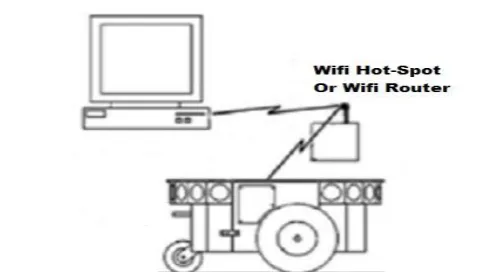
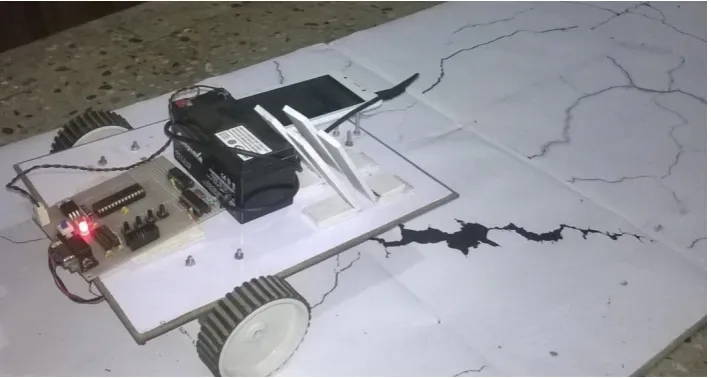
Figure 1 shows overall hardware setup which consists of:
one mobile robot
one Android phone (Lenovo Kit-Kat)
one laptop
Inside the mobile robot, there is an on-board computer with limited memory and processor power. Therefore, we utilize a laptop computer to implement complicated algorithms such as cracks detection, localization, Mapping. The mobile robot is a three-wheel drive and has Atmel®AVR® 8-bit Microcontroller. The microcontroller having Advanced RISC Architecture with 512Bytes EEPROM and 8Kbytes of In-System Self-programmable Flash program memory. The mobile robot also consist of DTMF 8870 IC which is interface with the android phone to receive commands for movement. The communication between laptop and mobile robot is based on client-server architecture.
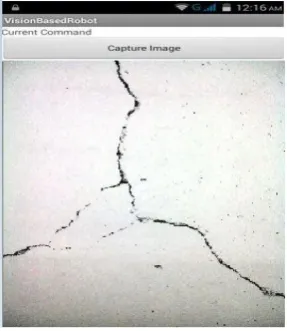
The laptop is an HP 2328TU which has a 2.13GHz Intel Core i3 Processor and 4GB DDR3 system memory also android phone is Lenovo A6000 with Quad-Core Processor and 2 GB RAM with 8Mega-Pixcel Camera. An APK is developed using ECLIPSE Software and installed on phone which can capture images and can receive command for control of robot. The laptop and the mobile robot are communicating over a Wi-Fi modem or we need to keep both android phone mounted on mobile robot and Laptop under same Wi-Fi network using a Wi-Fi hot-spot. APK captures images and sends over the network to the laptop. Since this is the Client-Server architecture, we have utilized WAMP server to host images send by APK. The images are stored at root directory of the server from where they are gathered and processed by MATLAB software.
Fig. 2. Hardware Module Consist of Sensors
B. Software Module:
Following flow chart explains crack detection process of a captured image.
For crack detection we utilized edge detection algorithm which uses the preprocessing of the image along with the morphological operations onto the image. Morphological operation performs different operations like image erosion, image closing, TOP-HAT operations etc. We also applied different filters like Median filter, Minimum Filter to remove pepper and salt noise to preserve the edges of the image. Finally we used the Prewitt operator to detect cracks into images by taking out mean of the image. For areas where lighting is not proper or for darker surfaces we can enhance brightness of the images using the code in the MATLAB. We can simply ask whether to increase brightness or not.
Following are the snapshots of image processing while crack detection.
This image is original image which is converted into gray scale for the morphological operation to which median filter and minimum filter is applied to obtain noise free and salt free image.
Above image is processed with top hat operators which reduce the round area in the image and finally sharp the image.
IV.EXPERIMENTAL RESULT
The proposed system has been tested successfully with the model. The proposed work is been tested on the different surfaces and different lightning condition. The proposed method has been implemented initially in simulation environment of MATLAB (Simulink). In the proposed system, the hardware is synchronized with MATLAB in such a way that it provides us the desired output. The main aim of the project is to create a 2-dimensional map and for the result and testing of this system we have developed a model of bridge surface with artificial cracks in it. This system then tries to develop 2-dimensional map of the bridge surface using the edge detection algorithms. Images are collected on Wamp server from where they are gathered by the MATLAB to image processing. We have developed Control Panel in MATLAB for controlling the motion of the robot which fully synchronized with android application.
Figure 4: Snap-Shoot of APK
For crack detection we utilized edge detection algorithm which uses the pre-processing of the image along with the morphological operations onto the image. Morphological operation performs different operations like image erosion, image closing, TOP-HAT operations etc. We also applied different filters like Median filter, Minimum Filter to remove pepper and salt noise to preserve the edges of the image. Finally we used the Prewitt operator to detect cracks into images by taking out mean of the image.
This image shows the crack map of bridge surface. We have tried to create 2-Dimensional map of the surface by combing the images taken by the mobile robot. The images are combined according to the motion of the robot. If we move robot in the forward direction the robot will capture image, again forwarding the robot will result into joining of new image below the previous image in the similar way it will join all the images which are captured when robot moves forward. Reverse is the case when we take robot in backward direction it will join the image to the above of previous image. New image will be captured when robot is moved right or left. Map will be saving in root directory of Wamp Server. This is demonstration model of how we can create map of the bridge surface. There is lot of opportunity to enhance the development of 2-Dimentional map.
V. CONCLUSION AND FUTURE WORK
In this research, we introduce a robotic crack inspection and mapping system to replace human inspectors for bridge deck crack inspection. The aim of this system is to create a crack map which is useful for measuring, classifying, and analysis of crack growth. The proposed system consists of mobile robot, a laptop, image processing algorithm and soft wares. All these together provide an efficient system for inspection of bridge surface which enable prevention of catastrophic consequences thereby avoid large expenses in major rehabilitation. This system can be further enhanced and can be used for different surfaces as well. We have verified the proposed framework of this system with both simulation and experimental result.
In the future work, we will improve this system. Some of the improvements are as follows:
Crack detection algorithm: We will improve the image processing techniques under different lighting conditions.
Alignment process: The purpose of this process is to minimize the misalignment of crack locations. This process will improve the accuracy of crack map.
Crack Depth Measurement: We can use Ultrasonic Concrete Crack Depth Meter to find out depth of the crack.
Crack Map: Crack map can be more enhanced using different software like Mapper3 and using lesser sensor.
Crack Map in vertical surface: We can employee such technology which can enable mobile to create map of vertical surface.
REFERENCES
1. Mohammad Salman and Vaidehi Baporikar, ”Review onImage Based Detection and Inspection of Cracks on Bridge Surface Using an Autonomous Robot”,International Journal on Recent and Innovation Trends in Computing and Communication,ISSN: 2321-8169 Volume: 3 Issue:2 023– 027
2. S. N. Yu, J. H. Jang, and C. S. Han, “Auto inspection system using a mobile robot for detecting concrete cracks in a tunnel,” Autom. Construction, vol. 16, pp. 255–261, 2007.
3. XU Xue-jun and ZHANG Xiaoning, “Crack detection of reinforced concrete bridge using video image” in Springer -Verlag Berlin Heidelberg 2013, DOI: 10.1007/s1177101317755.
4. H. Moon, and J. Kim, "Intelligent Crack Detecting Algorithm On The Concrete Crack Image Using Neural network," in Proceedings of the 28th ISARC, Pages 1461-1467, Seoul, Korea, 2011.