Design and Simulation of Control Circuit for
Single Phase Cycloconverter
Santhosh Kumar R ¹, Shree Shayana R ², Vinod Kumar P ³
Assistant Professor, Dept. of EEE, ATME College of Engineering, Mysore, Karnataka, India¹
Assistant Professor, Dept. of EEE, ATME College of Engineering, Mysore, Karnataka, India²
Assistant Professor, Dept. of EEE, ATME College of Engineering, Mysore, Karnataka, India³
ABSTRACT: The most commonly used motors in recent days are induction motors due to its simple construction and less expensive compared to DC motors. But the main drawback of induction motor compared to separately excited DC motor is that it is an constant speed motor. Hence in the past, induction motors have been used primarily in constant speed applications. Variable frequency is essential in most of the industrial applications and the recent advancement in the power electronics field makes this task easy by using the power semiconductor devices. There are many techniques used to vary the supply frequency, out of which cycloconverter is one of the commonly used technique. Among all the methods this is simple, reliable and economical. The objective of the paper is to design a control circuit to provide a proper sequence of pulses for the semiconductor switches of the cycloconverter power circuit. The control circuit is designed using the Op amps and logic gates. The designed control circuit is simulated using the OrCAD Pspice software.
KEYWORDS: Astable multivibrator; Cycloconverter; Control circuit; Frequency; Monostable multivibrator
I. INTRODUCTION
The Cycloconverter is basically ac to ac power converters where the alternating voltage at supply frequency is converted directly to a lower frequency without going through any intermediate dc power conversion stage [1]. The variable frequency has always been of great importance in the industrial applications. This is because some electrical devices need variable frequency ranging from one tenth to one third of the supply frequency. Cycloconverter helps in achieving this variable frequency. The Cycloconverter has been traditionally used only in very high power drives, usually above one megawatt. Some examples are tube mill drives above 5MW [2], Ship propulsion drives [3], induction motors used in AC traction, aircraft power supplies etc [4]. The power rating of Cycloconverter ranges from few megawatts up to many tens of megawatts and hence they are usually constructed using naturally commutated thyristors. The Cycloconverters are generally used for speed control of induction motor and synchronous motor below the rated speed. Analysis of induction motors controlled with Cycloconverter has been investigated extensively over recent years.
II. RELATED WORK
[7] Evaluates three different modelling options for the SAG mill drive. The first option considers a complete model in phase and qd0 variables of the two-stator-winding synchronous motor fed by two six-pulse cycloconverters. The second option develops a winding rotation transformation to obtain an equivalent one-stator-winding synchronous motor, which is fed by a 12-pulse cycloconverter. The third model considers the equivalent one-stator synchronous motor fed by an ideal converter that produces purely sinusoidal voltage and current waveforms. Each model is evaluated during steady state, step speed commands, and step load disturbances.[8] This paper describes the characteristics of low frequency ac transmission system using cycloconverters with three configurations. New control scheme is also provided for all operating transmission system. Cable and filter selection are also included in this paper.
[9]A De-Re-coupling uni-polarity phase-shifted control strategy is proposed. The waveform control method can achieve zero voltage switching (ZVS) of all the switches in the matrix/cycloconverter and natural commutation of the filter inductance without auxiliary circuits and commutation overlap of the matrix/cycloconverter. [10] Cycloconverter control circuitry is discussed using examples from a practical three-phase to single-phase circulating current free cycloconverter. The voltage biased cosine wave technique is used for phase control. [11] This paper presents a new control method for three-phase to single-phase cycloconverters based on pulse width modulation (PWM) technique. Due to the proposed control method, the desired output voltage can be generated even with unbalanced input voltages. The proposed control method can easily be extend to three-phase to n-phase cycloconverters.
III.SINGLE PHASE CYCLOCONVERTER
The power circuit of Single phase Cycloconverter mainly consist of two converters, positive and negative converters. The positive converters are used to get the positive half cycle of output voltage and the negative converters are used to get negative half cycle of output voltage. The control circuit should provide a correct sequence of pulses for the operation of two converters [12].The transformer is used for providing alternating output to the load .The power circuit of single phase cycloconverter is shown in Fig. 1 and the input and output voltage waveform is shown in Fig. 2.
Fig.1.The Power Circuit of Single phase Cycloconverter Fig. 2. Input and Output voltage waveform
IV.DESIGN OF CONTROL CIRCUIT
There are two groups of converters which can be defined as P and N. The P and N converters control the positive and negative half cycles of the output voltage of the desired frequency respectively. The control circuit should be designed in such a way that the P converter goes in conduction during the positive half cycle of the input signal when the Q converter remains idle. Similarly when the Q converter goes in conduction during negative half cycle of the input signal the P converter remains idle. Two blanking signals P and N determine the operation of the thyristors in each converter group according to the sequence of the gate trigger. Moreover the frequency of the output signal depends on the frequency of the P and N blanking signals [13]. The functional block diagram proposed is shown in Fig.3
Fig.3.Functional Block diagram of the proposed method
Design Considerations
A. Astable Multivibrator:
Here Astable multivibrator 1 is designed to generate a square wave of frequency equal to the frequency of output voltage and Astable multivibrator 2 is used to generate square wave of frequency twice that of output voltage. This is constructed using transistors. The on time of the square wave is slightly less than the off time.
Let us consider the output frequency which should be reduced to 12.5 Hz i.e. one fourth of 50 Hz. The time period of square wave generated by Astable multivibrator 1 should be equal to 80 msec i.e. 12.5 Hz. Let the ON time be 39.6 msec and OFF time be 40.4 msec. Square wave of higher ON time is produced and it is inverted using NOT gate. This signal is P blank signal. Therefore, T1=40.4 msec T2=39.6 msec, Let C1=C2=1uF
T1=0.693R1C1 eq. (1)
T2=0.693R2C2 eq. (2)
Solving eq. (1) and eq. (2) we get, R1=58297Ω and R2=57143Ω
The N blank signal which is phase shifted by 180º with P blank signal is generated using Astable multivibrator 2. The output frequency of Astable multivibrator 2 should be twice that of frequency of Astable multivibrator 1 i.e. 25 Hz. The time period is 40 msec, let T1=27 msec T2=13 msec. Let C1=C2=1uF
T1=0.693R1C1 eq. (3)
The output of Astable multivibrator 2 is passed through differentiator circuit to get a spike. This spike is used to trigger an Monostable multivibrator. The output of monostable multivibrator is NORed with P blank signal to get N blank signal. For synchronization between the blanking signals P and N it is required to set the charging of the capacitors of both astable multivibrators at the same instant. The basic Astable multivibrator circuit using transistors is shown in Fig.4
Fig.4.Astable multivibrator using transistors
B. Differentiator Circuit:
The thyristor should be triggered by the pulses which have the duration just greater than on time therefore the gate triggering of the thyristor by the above generated pulses is unfeasible. If the above square waveforms are used for gate triggering of the thyristor then huge power dissipation can be destructive for the thyristor and the negative pulses cause the thyristor to the false triggering. This difficulty can be eliminated by using the differentiator circuit which gives narrow spikes for thyristor gate triggering. The differentiator circuit and its output are shown in the Fig.5.
Fig.5.Differentiator circuit and its output
C. Monostable Multivibrator:
The spikes generated from differentiator circuit is used to trigger Monostable multivibrator. The circuit diagram of monostable multivibrator using transistor is shown in Fig.6.By adjusting the RC time constant of the multivibrator it is possible to obtain the output pulse (only positive) of any time period with the frequency half of the triggering spikes. The output pulse of the Monostable multivibrator is the trigger pulse, therefore the time period of the output pulse should be longer than the turn on time of the selected thyristor. Generally the turn on time of the thyristor is within the
range of 150 to 200 μsec. In this case the RC time constant is considered of 220 μsec by selecting C = .022µf, R =
10kΩ, Rf =10kΩ and RC=1kΩ and Vcc=15v. So by using the combination of the differentiator circuit and the
monostable multivibrator, the positive pulse of the duration 220 μsec is obtained. These pulses are properly
Fig.6.Monostable multivibrator using transistor circuit
D. Synchronizing signal generation:
Two comparators are used in both inverting and non inverting mode and the outputs of them are fed to the differentiator
circuit to get the Synchronizing signal. The parameters of the differentiator circuits are R= 10kΩ, C= 0.01μF and the
RC time constant is 100µsec. The differentiated signals of the differentiators are fed into the Monostable multivibrator and the parameters of the Monostable multivibrator are R= 10 kΩ, C= 0.22 μF, RC= 1 kΩ and Rf =10 kΩ. This
generates train of pulses with time period of 220µsec in both inverted and non-inverted mode. Finally the triggering pulses for thyristors are generated using the combinations of the AND gates as shown in the Fig. 3.
The expected pulse sequence output to get one fourth of the supply frequency is shown in Fig. 7.
Fig.7. Expected Pulse Sequence of control circuit
V. SIMULATION AND RESULTS
The resistance values of R1 and R2 of Astable Multivibrator 1 and 2 using eq. (1) to eq. (4) for various frequencies is
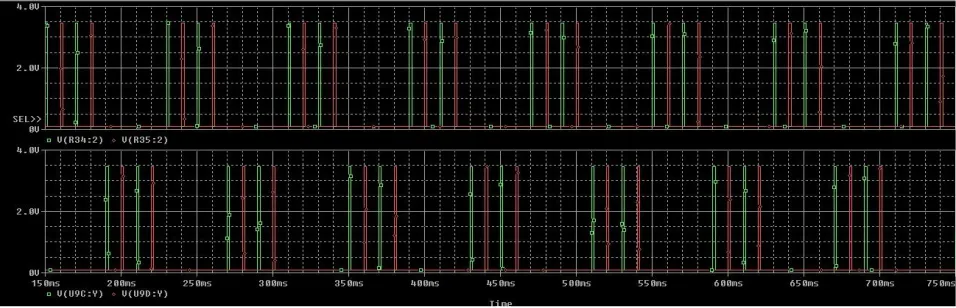
tabulated as shown in Table 1. The narrow spikes for thyristor gate triggering obtained from differentiator circuit is fed to Monostable multivibrator circuit and the time period of the output pulse longer than the turn on time of the selected thyristor is obtained. The circuit is designed and the synchronizing signal in inverting and non-inverting mode using comparators and AND gate combination is obtained to get the expected pulse sequence as shown in the Fig. 7. The ON time of the generated pulse was designed for 220µsec. The simulated pulse sequence obtained is shown in Fig. 9.The result shows pulse sequence for positive and negative converter. Here the top half of the simulation shows red pulse indicating positive converter thyristor P1 and green pulse indicating negative converter thyristor P2. Similarly the lower half of the simulation shows green pulse indicating positive converter thyristor N1 and red pulse indicating negative converter thyristor N2.The simulation result obtained matches the expected result.
Fig.8. The Detailed Circuit Diagram of Cycloconverter
Q6 Q2N2222 C3 1u C4 1u R7 500 R8 38960 R9 18760 R10 500 C9 0.22u R21 1k R22 10k 0 R23 1k Q1 Q2N2222 0 Q2 Q2N2222 Q7 Q2N2222 Q8 Q2N2222 R24 10k 0 R25 1k R11 10k C5 0.01u C6 0.022u R12 10k R13 27k R15 10k 0 Q3 Q2N2222 Q4 Q2N2222 R16 10k R17 1k 0 C7 1u C8 1u V5
FREQ = 50 VAMPL = 9
Supply Frequency (f) f=50 Hz
Astable Multivibrator 1 Astable Multivibrator 2 R1 (Ω) R2 (Ω) R1 (Ω) R2 (Ω)
f/2 29437 28283 19480 9380
f/3 43867 42713 29220 14069
f/4 58297 57143 38961 18760
f/5 72727 71572 48629 23376
Table 1. Resistance values of Astable multivibrator 1 and 2 for various frequencies
Fig.9. Simulated Output of Control Circuit of Cycloconverter
VI.CONCLUSION
As stated earlier many of the industrial applications requires variable frequency. The cycloconverter plays a pivotal role in achieving this task. This control circuit designed and simulated using Op amps and logic gated achieves the expected results. Further this technique can be extended for three phase cycloconverter. By achieving the variable frequency, in many applications the DC motors can be replaced by Induction motor.
REFERENCES
1. M. H. Rashid, “Power Electronics Circuits, Devices and Application”, 6th edition, Copy right 2009, Prentice Hall, Inc Upper Saddle River, NJ. 2. T. Salzmann, “Cycloconverters and automatic control of ring motors driving tube mills”, Siemens Rev., vol. XLV, no. 1, pp. 3-8, 1978.
3. W. A. Hill, G. Creelman, L. Mischke, “Control strategy for an icebreaker propulsion system”, IEEE Trans. Ind. Appl., Vol. 28, no. 4, pp. 887-892, 1992.
4. Rajib Baran Roy, Md. Ruhul Amin, “Design and Construction of Single Phase Cycloconverter”,International Journal of Recent Technology and Engineering, ISSN: 2277-3878, Volume-1, Issue-3, August 2012.
5. J. Millman and Taub, “Pulse, digital and switching wave forms”, 4th Edition, 2008, The McGraw Hill-Companies Inc. USA.
6. Vasquez M , Ponti J , Arrendono V,“Cycloconverter interharmonics current analysis under unbalanced load based on a real-time simulation” , IEEE International Conference on Industrial Technology (ICIT), March 2015.
7. Castro, P. Valenzuela, M.A. “Modelling and Evaluation of Cycloconverter-Fed Two-Stator-Winding SAG Mill Drive—Part I: Modelling Options” IEEE Transactions on Industry Applications, Volume:51 , Issue: 3 , December 2014.
8. Achara, P., Ise T.,“Operating phase and frequency selection of low frequency AC transmission system using cycloconverters” International Power Electronics Conference (IPEC-Hiroshima 2014 - ECCE-ASIA), IEEE 2014.
9. Zhaoyang Yan ,Shuchao Xu ,Xingyue Han ,Xiaoqiang Guo ,Chunjiang Zhang “A waveform control strategy for single-phase high-frequency link matrix inverter” 40th Annual Conference of the IEEE Industrial Electronics Society, IECON ,Nov2014
10. Hamblin, T.M. , Barton, Thomas H. “Cycloconverter Control Circuits” IEEE Transactions on Industry Applications ,Vol. 8,Issue 4, July 1972
11. Babaei E. , Tabriz Iran, Heris A.A. , “PWM-based control strategy for forced commutated cycloconverters” IEEE Symposium on Industrial Electronics & Applications, Volume 2, ISIEA 2009.
12. https://www.elprocus.com/cycloconverters-types-applications/
BIOGRAPHY
Santhosh Kumar Ris an Assistant Professor in the Department of Electrical & Electronics Engineering, ATME College of Engineering, Mysore, Karnataka, India. He received his Bachelors in Engineering in Electrical & Electronics from SJCE, Mysore in 2009. He received his Master of Technology in Power Electronics from BMSCE, Bangalore, India in 2013. His research interests are Power Electronics, Machine Design, Signal Processing.
Shree Shayana Ris an Assistant Professor in the Department of Electrical & Electronics Engineering, ATME College of Engineering, Mysore, Karnataka, India. He received his Bachelors in Engineering in Electrical & Electronics from VVIET, Mysore, India in 2010.He received his Master of Technology in Biomedical Signal Processing and Instrumentation from SJCE, Mysore, India in 2013. His research interests are Medical instrumentation, Signal Processing, Linear Circuits, Image processing, Neural Networks.