ISSN(Online): 2319-8753 ISSN (Print): 2347-6710
I
nternational
J
ournal of
I
nnovative
R
esearch in
S
cience,
E
ngineering and
T
echnology
(A High Impact Factor, Monthly, Peer Reviewed Journal)
Visit: www.ijirset.com
Vol. 7, Issue 4, April 2018
Optimizing Sports Coupe
’
s Engine by Reducing
Frictional Losses
Sourav Jandial
1, Sidhant Jandyal
2, Vinod Kumar Sharma
3, Nav Vivek Thakur
4, Sanjeev Gupta
5B.E. Student, Department of Mechanical Engineering, GCET Jammu, India1234
Head, Department of Mechanical Engineering GCET Jammu, India 5
ABSTRACT: This paper includes the methodologies to reduce one of the major concerns faced by AUTOMOTIVE
INDUSTRY – “FRICTION LOSSES” in the engine. We know that races are won and lost in the time lapse of
“milliseconds”. Major Contributing factors for time lapse are – losses due to friction in an engine. Friction converts
about 33% of the vehicle’s available mechanical energy into heat and sound. For this we benchmarked between three
sports coupe – (i) Chevrolet Camaro, (ii) Audi R8 and (iii) Ford Mustang. From the given three we chose Chevrolet Camaro. Our proposed technologies would make Chevrolet Camaro’s less prone losses due to friction ; thereby overcoming those milliseconds gap.
KEYWORDS: Sports coupe
I.INTRODUCTION
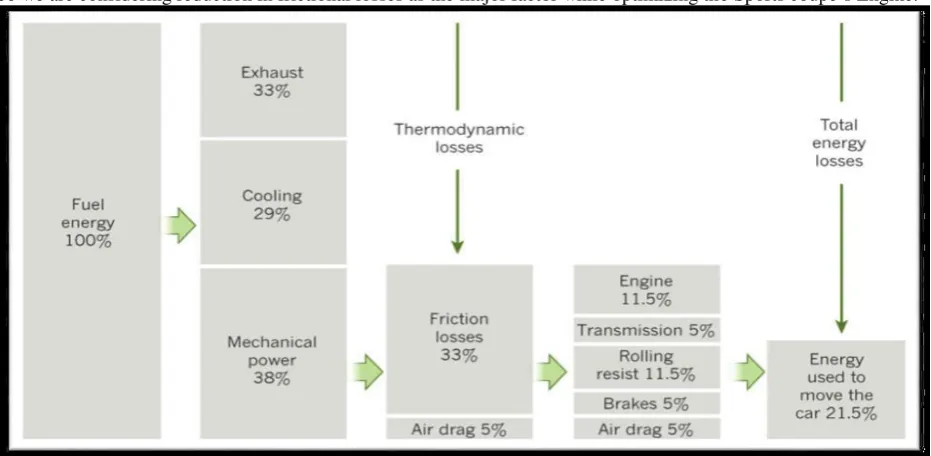
Sports Coupe is basically a sports car in a Coupe (two door car with a fixed attached roof) form. Although Sports car and sports coupe almost synonymous , but a little difference between the two is that later is bit more practical compared to former (like bit bigger in size , better knee room etc.) ; but these practical features are on the expense of “power” i.e Sports Coupe generally has slightly less power compared to Sports car. Most of the fuel energy obtained in the vehicle gets wasted and the major reason for that is friction in the engine.
So we are considering reduction in frictional losses as the major factor while optimizing the Sports coupe’s Engine.
ISSN(Online): 2319-8753 ISSN (Print): 2347-6710
I
nternational
J
ournal of
I
nnovative
R
esearch in
S
cience,
E
ngineering and
T
echnology
(A High Impact Factor, Monthly, Peer Reviewed Journal)
Visit: www.ijirset.com
Vol. 7, Issue 4, April 2018
Frictional losses is one of the most prominent factor causing downfall of sports coupe’s engine performance. Fig. 2 shows the contributing factors in frictional losses. Clearly piston – cylinder arrangement has the most percentage of
losses share.
Fig. 2: Percentage Losses Due to Friction
II.LITERATURE SURVEY
The term sports car was first coined by an English magazine “The time” in the year 1919. In USA is was first acknowledged by the Merriam Webster university in the year 1928. Sports cars became hugely popular among the elite class in 1940s. Originally they were started as open roof roadsters but later the closed coupe version became highly popular as it was more practical than the open version. The main purpose of the sports coupe is to give sheer pleasure in driving and the thrill of high speed. In the 1950s the market for sports coupe grew tremendously and there was stiff competition among many of the big brands. This Prompted engineers to make their car better than the rival’s car. The main aspect in making the car better was the engine performance. There were many factors which were considered to improve the performance. One of the many was to reduce the friction in the engine thus to increase the power output. There were many technologies proposed and implemented to reduce the friction. But in this ever-changing world they quickly became obsolete and a new and better technology was proposed. In our paper we have done the same to purpose some new methodologies to reduce the frictional losses in an engine.
ISSN(Online): 2319-8753 ISSN (Print): 2347-6710
I
nternational
J
ournal of
I
nnovative
R
esearch in
S
cience,
E
ngineering and
T
echnology
(A High Impact Factor, Monthly, Peer Reviewed Journal)
Visit: www.ijirset.com
Vol. 7, Issue 4, April 2018
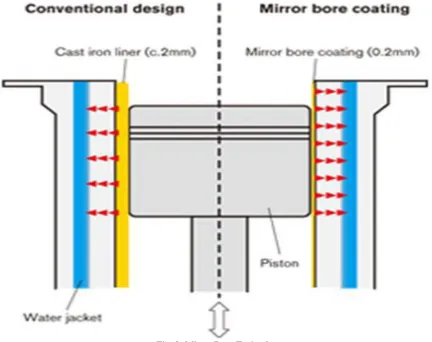
compared to the 2 mm thickness of the cylinder liner. This decrease in thickness results in better heat conduction and thus we obtain better cooling performance and less engine knocking, and the efficiency of the engine as a whole is improved. The increase in amount of freedom t move may result in better fuel economy and engine power.
Fig. 3: Mirror Bore Technology
B. REM Super finish
ISSN(Online): 2319-8753 ISSN (Print): 2347-6710
I
nternational
J
ournal of
I
nnovative
R
esearch in
S
cience,
E
ngineering and
T
echnology
(A High Impact Factor, Monthly, Peer Reviewed Journal)
Visit: www.ijirset.com
Vol. 7, Issue 4, April 2018
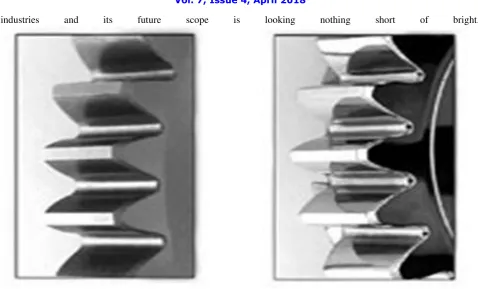
industries and its future scope is looking nothing short of bright.
Fig. 4:Before (Left), After (Right)
C. MicroBlue Coating
MicroBlue® is a coating system which can be used in the Chevrolet Camaro to reduce friction and increase the life of its moving and lubricated parts substantially. These lubricated parts include all the bearing types and any part which is reciprocating and also is in motion be it transmission system or differentials. The improvements in efficiency and life are not subtle. Whether your aim is to improve fuel economy, extend life or simply win races, there is simply no other process on the planet that can compare to the improvements MicroBlue® brings to the equation.
MicroBlue® is a state of the art technology and different from other coatings in many ways. The most significant of them all is the way it’s applied. The main reason why Microblue is so effective is that it is blasted on the surface. No he3at or binders are used. As there ar no binders it is not able to bind to itself and form build ups. And the best part is there's absolutely no size change, no adjustments needed. The other coatings which are available in the market use adhesion to remain on the surface whereas chemical bonding phenomenon is used in case of Microblue coating. That is why it is almost impossible to chip off and flake or peel. Also its ability to reduce friction does not decrease with time. The parts will move as new even after several years of use.
IV.CONCLUSION
ISSN(Online): 2319-8753 ISSN (Print): 2347-6710
I
nternational
J
ournal of
I
nnovative
R
esearch in
S
cience,
E
ngineering and
T
echnology
(A High Impact Factor, Monthly, Peer Reviewed Journal)
Visit: www.ijirset.com
Vol. 7, Issue 4, April 2018
REFERENCES
1. https://www.nissan-global.com/EN/TECHNOLOGY/OVERVIEW/mirror_bore_coating.html 2. http://blogs.youwheel.com/2014/05/30/nissans-new-engine-technology-mirror-bore-coating/s 3. http://www.remchem.com/services/isf-process/