Power Efficient Hardware Platform for
Multicontroller Environment Based on Cots
Devices
Chetan N. Choudhari1, Dr.R.A.Patil2
M.E Student, Department of Electronics and Telecommunication, G.S.Moze College of Engineering, Pune, India1
Professor, Department of Electronics and Telecommunication College of Engineering, Pune, India2
ABSTRACT: Embedded structures are for the most part essentialness constrained. Additionally, in these structures,
extended effectiveness and decreased time to market are basic for thing accomplishment. To layout complex embedded systems while lessening the progression time and cost, there is a marvelous slant to use business off-the-rack ("COTS") devices. At structure level, dynamic voltage and frequency scaling (DVFS) is a champion amongst the best frameworks for imperativeness diminish. Regardless, various by and large used COTS processors either don't have DVFS or apply DVFS just to processor focuses. An easy to-execute COTS-based evaluation stage for low-imperativeness embedded structures is shown. To achieve essentialness saving, DVFS is suited the whole microcontroller including focus, stage darted circle, memory, and I/O. Additionally, workplaces are given to attempting distinctive things with adjustment to inward disappointment methodologies. The stage is furnished with essentialness estimation and examining gear. Physical examinations exhibit that applying DVFS when all is said in done microcontroller offers up to 47% and 12% essentialness saving differentiated and the sole usage of component power organization and applying DVFS just on the inside, independently. Notwithstanding the way that the stage is planned for ARM-based introduced systems, our technique is general and can be associated with various sorts of structures.
KEYWORDS: Dynamic power management (DPM), peripheral power down, fault tolerance.
I. INTRODUCTION
Dynamic Voltage and Frequency Scaling (DVFS) describes the use of two power saving techniques (dynamic frequency scaling and dynamic voltage scaling) used to save power in embedded systems including cell phones. This type of power saving is different from what most of us generally think about like standby or hibernate power states. You can reduce the power consumed by your embedded system by lowering the frequency and/or voltage of the CPU and attached peripherals. Why save power? Well the obvious reason your device can run longer on a given
and the number and types of interactionsamong them are increasing [3], [4]. Therefore, embedded systemdesigners are always conducted at the request of designingcomplex embedded systems with several design objectives. In dealing with today’s highly competitive embedded systemsmarkets and time-to-market pressure and in order todeliver correct-the-first-time products with multiple system requirements,the use of commercial off-the-shelf (COTS) devices[3], [5]–[7] is very beneficial in designing embeddedsystems. However, instead of focusingon embedded systems, these platforms allow to functionallytest the SOC or ASIC devices to be produced. Reference [23] has presented a platform for dynamic voltageand frequency scaling (DVFS) [11] in an ARM-based processor.However, this work exploits DVFS only for the processor(and not for the other parts, e.g., phase-locked loop (PLL),memory, and I/O).
There are the five observations.
1) The high-to-low voltage scaling delay is greater than the low-to-high delay (about 45% for the processor core and PLL and about 110% for memory and I/O).
2) Voltage and frequency scaling is very effective in reducing power consumption not only for the processor core but also for the other parts of the microcontroller, including PLL, memory, and I/O.
3) Although PLL, memory, and I/O have less power consumption compared with the processor core, they have comparable energy consumption to that of the core.
4) Although PLL has a very small contribution in the total power consumption, as it is always operational, its energy consumption is comparable with that of the others.
5) Applying DVFS on the whole microcontroller results in a considerable energy savings compared with the sole use of DPM or applying DVFS only on the processor core.
II. RELATED WORK
III. HARDWARE PLATFORM DESIGN
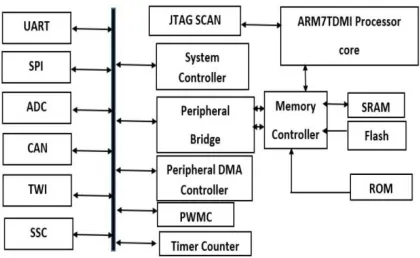
The microcontroller is composed of an ARM7 processor core, a system controller, memory elements, and peripheral devices.It is noteworthy that the computational power of ARM7 is quite sufficient for the majority of embedded applications. For example, ARM7 can easily execute all benchmarks in MiBench benchmark suite. When you are looking for the right embedded processors, with the FutureElectronics.com parametric search, you can filter the resultsby various attributes: by Clock Frequency 16 Hz, 200 MHz, 266 MHz, 400 MHz, RAM size 512 B, 4 kB, 32kB, 64 k,Data Bus Width from 16 b to 32 b. ARM7 can also execute fairly complex operating systems e.g., Real-Time Executive for Multiprocessor Systems RTEMS and Keil RTX. Nevertheless, for highly computation-intensive applications, the performance of ARM7 might not be adequate. In this case, it should be noted that our proposed platform is not inherently dependent on ARM7. Most I/O lines of the peripherals are multiplexed with the parallel I/O (PIO) controller. Each PIO line may be assigned to a peripheral or used as general purpose I/O. These features provide flexibility to designers and assure effective use of the components.
Fig 01. ARM-7 based microcontroller architecture.
A.COTS DEVISES ON EMBEDDED SYSTEM
A COTS item is normally a PC equipment or programming item customized for particular uses and made accessible to the overall population. Such items are intended to be promptly accessible and easy to understand. A run of the mill case of a COTS item is Microsoft Office or antivirus programming. A COTS item is for the most part any item accessible off-the-rack and not requiring custom advancement before establishment.
IV. PROPOSED SYSTEM MECHANISM
permit to practically test the SOC or ASIC gadgets to be created. It gives DVFS ability to the microcontrollers, including the processor centers as well as PLL, memory, and I/O Memory and I/O is entirely successful incorporates hardware too precisely and independently measure vitality/power utilization. It taking into account an ARM-based COTS microcontroller; thus, it can be utilized for an extensive variety of existing microcontroller.
Figure. No 02. Hardware platform block diagram
V. POWER MANAGEMENT TECHNIQUES
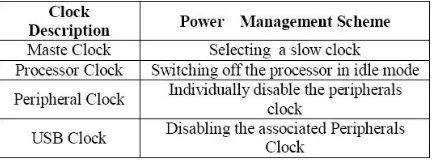
Dynamic Voltage and Frequency Scaling (DVFS) describes the use of two power saving techniques (dynamicfrequency scaling and dynamic voltage scaling) used to save power in embedded systems including cell phones. Thistype of power saving is different from what most of us generally think about like standby or hibernate power states. All of these are useful of course. You can reduce the power consumed by your embedded system by lowering the frequency and or voltage of the CPU and attached peripherals.This can be done by using several voltage and frequency scaling techniques.
1. DPM
DPM usually has only two operational states for systems components, namely active and idle. The active power consumption of a clock-enable component can be determined by its operating frequency and supply voltage, as denoted by PActive.
PActive = ILeakageV + CeffV 2f ----Eqn (1) 2. DVFS
The basic idea behind DVFS techniques is to determine the minimum frequency that satisfies all timing constraints and then to adjust the lowest possible voltage that allows this speed .Assuming a linear relationship between frequency and voltage the combined effects of voltage and frequency scaling result in decreasing the active power consumption proportional to V3 and reducing the energy consumption proportional.
Therefore, by scaling both the voltage and frequency, the energy can be significantly reduced. However, this achievement does not come for free because a tradeoff exists between speed and energy consumption. Software controlled clock generators and voltage regulators allow the system to use DVFS. This provides the possibility for the device to vary the supply voltage ratherthan using just a single fixed voltage.To provide voltage scaling capability for this device, the dc/dc converter and embedded voltage regulator in is replaced with a controllable power supply.
VI. OPPORTUNITIES OFFERED BY PARALLEL PROCESSING
Since the proposed platform has multiple processing units i.e., two ARM7-based and one AVR-based microcontrollers and since it has the facilities for energy power management i.e., DVFS and DPM, one advantage of the platform is that it can be used to research into the possible opportunities for energy management that may be offered by parallel processing. To give an insight into this issue, we provide an example to illustrate when DVFS is used in executing parallel tasks; a two-processor system consumes less energy as compared with a single-processor system.
VII. EXPERIMENTAL RESULTS
The LPC2148 provides two reduced power mode: idle mode and Power down mode. Power consumption of ARM processor.Selecting the operational modes. Also for 89C51 microcontroller, PCON is used for selecting modes. Peripheral power down can also be done by software method by using PCONP special function register. The power consumption increases with application as I/O pins consumes most of the power. At run time of application, power consumption observed in the system. The power consumption increases with application as I/O pins consumes maximum of the power.
VIII. CONCLUSION
A hardware stage that includes two ARM-based microcontrollers, each managed freely by variable voltages. This stage is amazingly sensible for evaluating embedded structures with low imperativeness use and adjustment to non-basic disappointment essentials. In this stage, we give DVFS ability to the whole microcontroller including the processor focus, PLL, memory, and I/O. Physical trials exhibit that applying DVFS all things considered microcontroller is amazingly more capable in reducing power/essentialness use differentiated and applying DVFS just on the processor focus or using close down methodologies that are at this moment used by most embedded processors. Physical examinations show that applying DVFS as a rule microcontroller offers up to 47% and 12% essentialness saving differentiated and the sole use of component power organization and applying DVFS just on the inside, exclusively. Likewise, the stage is outfitted with precise imperativeness/power estimation units, investigating ports, and workplaces for evaluating adjustment to non-basic disappointment strategies. Regardless of the way that the stage is proposed for ARM-based microcontrollers, it is general, and diverse COTS devices and embedded processors can be similarly used as a part of the diagram of the stage.
REFERENCES
[1] Mohammad Salehi and Alireza Ejlali, "A Hardware Platform for Evaluating Low-Energy Multiprocessor Embedded Systems Based on COTS Devices”, IEEE Transactions on mechanical gadgets, vol. 62 No 2, February 2015
[2] A. Ejlali, B. M. Al-Hashimi, and P. Eles, "Low-vitality standby-saving for hard continuous frameworks," IEEE Trans. Comput.- Aided Design Integr. Circuits Syst., vol. 31, no. 3, pp. 329–342, Mar. 2012.
[3] S. Aminzadeh and A. Ejlali, "A relative investigation of framework level vitality administration strategies for deficiency tolerant hard ongoing frameworks," IEEE Trans. Comput., vol. 60, no. 9, pp. 1288–1299, Sep. 2011.
[4] A. Malinowski and H. Yu, "Correlation of implanted framework plan for mechanical applications, " IEEETrans.Ind.Informat.,vol.7,no.2,pp.244– 254, May 2011. [5] J. Henkel and S. Parameswaran, Designing Embedded Processors: A Low Power Perspective. Berlin, Germany: Springer-Verlag, 2007.