3D Game Based Learning by Using Leap Motion
Ajinkya Panat1 , Saurabh Pandit2 , Omkar Inchanale3 ,Vivek Pandey4
B.E Student, Department of Computer Engineering, ARMIET, Mumbai University, India1 B.E Student, Department of Computer Engineering, ARMIET, Mumbai University, India2 B.E Student, Department of Computer Engineering, ARMIET, Mumbai University, India3 Asst. Professor, Department of Computer Engineering, ARMIET, Mumbai University, India4
ABSTRACT: The attention to computer Educational game based learning has grown as research continues to
demonstrate its effectiveness for education. Games have been proven to be a powerful tool in amplifying regular or traditional teaching methods. However, prior to the development of such educational game, in order to be effective, it is essential that such teaching skills are addressed first and implemented into the game design process. Educational games cannot be designed and established by instructional designers alone, or just by a game developer. It requires both the instructional designer and game developer to be fairly involved during the design stage. This paper presents a necessary summary of the phases involved in the Instructional Design Process and Tasks, and the Game Design Process of a game. This paper also includes a short overview of the Game approach and Design Document and consider how it can be becoming for an educational system. Teachers know little about game expansion, and the game developers know little about the science of teaching and learning. So a proper communication should be made between the two in order to build a content which plays very well and interests students but also at the same time teaches them concepts in a way that the teachers need to.
KEYWORDS: Motion Gaming, Leap Motion, Unity 3D, hand detection, sensors, infrared.
I. INTRODUCTION
In recent years, the internet, smart phones and games have become adaptable elements of our lives. Easy access to the internet through stationary or portable devices - is now playing an important part in making young people addicted to downloadable applications and games. Hence, this interest in gaming can be utilized by introducing the game based learning modules. Using emerging technology like unity engine and leap motion, this paper introduces an e-Learning game: "DUMP THE ANSWER" by using unity, an engine that can be used to develop e-learning games. the game also uses a device which senses hand motion called "leap motion" we have demonstrated the benefits of applying MOTION DETECTION technology of developing game-based application, which can be used as game-based learning tool.
II. LITERATURE SURVEY
C# is a language for professional programming. C# (pronounced C sharp) is a programming language designed for building a wide range of enterprise applications. The goal of C# is to provide a simple, safe, modern, object- oriented, high performance, robust and durable language for game development. It is the most user friendly programming language from a developer’s point of view and is highly recommended for Unity programmers.
III. INSTRUCTIONAL DESIGN PROCESS
mathematics part will involve solving problems of addition, multiplication and subtraction where multiple options will be given and only one right answer must be selected and similarly for shape and color recognition part. Instructional design process thus deals with what problems are created and solved while playing a game. This phase can be said to be focused on science of learning. The game will be in the incremental learning format. Which means all the levels will not be of the same difficulty, but there will be a step by step increase in difficulty as the player progresses. The aim of the game is to take children from the most basic of mathematical operations, colors, shapes and take them to high difficulties so that the concepts are very well cleared to the kids or students and they can get the best possible results. The aim of the game is to take children from the most basic of mathematical operations, colors, shapes and take them to high difficulties so that the concepts are very well cleared to the kids or students and they can get the best possible results.
IV. GAME DESIGN PROCESS
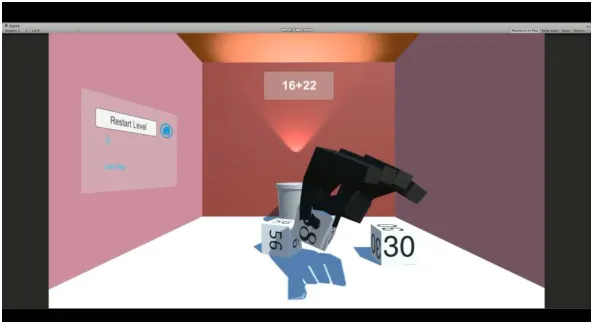
Game design process involves figuring out how the game is supposed to work, that is, the genre of game, the mechanics used in the game, the game engine, the various components that make up the game, etc. this phase involves creating the structure of the game so that later the learning process can be incorporated in the game being developed. We are using the Unity 3d Engine,which is an open source and free application to everyone around the world, to create our game .The unity Engine will be responsible for the level designing of the game along with the codes or scripts which define the rules of the game. The game we are developing uses a device that detects hand motion. This device can be used to interact with in-game objects. "DUMP THE ANSWER" involves basically multiple interactive objects like balls, boxes etc. as shown in the fig. 1 and a giant bin, the game mechanics is such that using the hand motion detector a projection of our hand is created on the screen guided by which we can pick up the balls, boxes or any other object and dump them in the bucket.
A. WORKING:
Fig. 1. Example of a Color-Based Level
V. GAME CONCEPT
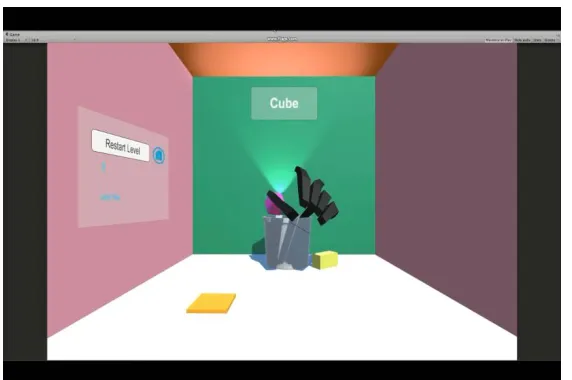
[3]The game is basically divided into 3 parts each part deals with a different part of learning process for kids i.e it involves learning about colors, math’s and shapes. The goal of the game is to grab the right object and dump it into the bin for e.g.Drop black color ball in the bucket as shown in the fig. 2.
Similarly for Math’s, a question or problem is asked to solve and the answers in the form of multiple choices are given. The player is required to grab the correct option and Dump it in the Bin. When the correct option is dumped, points are awarded and score increases as shown in Fig 3. The same goes for the “Shapes” levels. A certain shape will be asked to be dumped. The player must pick up the correct answer from available choices and Dump it. As the player completes levels, the difficulty increases along with the number of available choices. For e.g., if previously there were 3 choices, now there will be 5 and the question or problem asked will also be much difficult.
Fig. 3. Example Scene of the game showing shapes that can be interacted with.
Input Result
Move Right Successful
Move Left Successful
Move Upward Successful
Move Downward Successful
Move Diagonal Successful
Move Circular Successful
Hold Specimen Successful
Release Specimen Successful
Fig 4. Simulation with results
VI. HOW IT CAN BE ADAPTED TO THE EDUCATIONAL SYSTEM
This game concept can be integrated in schools, Educational Games for Children helping in their cognitive development as well as creating a fun learning environment. Creating interactive environments where hand gestures and hand motion can be used to interact with objects within the environment. Reducing the need to have physical equipments to teach the children by having these equipments in the game (a simulated environment) this games can also be implemented in places like summer camps so that children can learn while being entertained.
VII. CONCLUSION
REFERENCES
[1]. Aadams, E., and Rollings, A. Andrew Rollings and Ernest Adams on game design. New Riders Publishing. (2003). [2]. Adams, E. Fundamentals of Game Design. Second Edition. New Riders : Berkeley, CA (2010)
[3]. Bates, B. Game Design. (2nd ed.). Thomson Course Technology. (2004).
[4]. Brathwaite, B. & Schreiber, I. Challenges for Game Designers. Charles River Media.(2009).
[5]. Clark, D. Computer games in education and training. Presentation at LSDA seminar Learning by playing: can computer games and simulations support teaching and learning for post-16 learners in formal, workplace and informal learning contexts? Retrieved from www.bbk.ac.uk/ccs/elearn/events.html. (2003).
[6]. Dickinson, J.K., Woodard, P. R., Canas, R., Ahamed, S.S. &Lockston, D.Game-based trench safety education: development and lessons learned. Journal of Information Technology in Construction. Special Issue Use of Gaming Technology in Architecture, Engineering and Construction. Vol (16), pg. 119-134.(2011).
[7]. Garris, R., Ahlers, R., &Driskell, J. Games, motivation and learning: A research and practice model. Simulation and Gaming, 33(4), 441-467. (2002).
[8]. Gee, J. P. What Video Games Have to Teach us About Learning and Literacy? New York, NY: Palgrave Macmillan.(2003). [9]. Gustafson, K. L. & Branch, R. M.Survey of instructional development models (3rd ed.). Syracuse, N. Y.(1997).