1
ON DEVELOPMENT AND EVALUATION OF THEORIES BASED UPON
REISSNER’S MIXED VARIATIONAL THEOREM FOR DEFORMATION
AND STRESS ANALYSIS OF FGM STRUCTURES
D.K.Jha1, Tarun Kant2, R.K.Singh3
1Arch & Civil Engineering Division, Bhabha Atomic Research Centre, Trombay, Mumbai, INDIA-400085 2 Professor in Civil Engineering, Indian Institute of Technology Bombay Powai, Mumbai, INDIA -400076 3Reactor Safety Division, Bhabha Atomic Research Centre, Trombay, Mumbai, INDIA-400085
[E-mail of corresponding author: [email protected]]
ABSTRACT
This article emphasizes the use of variational principles for developing the consistent theories of deformation of structures made of functionally graded materials (FGMs). The paper overviews relevant key points that should be taken into account for an accurate description of strain and stress fields in FGM structural analysis. It is then shown that use of Reissner’s mixed variational theorem (RMVT) can fulfill such key points. Various ways in which RMVT can be used to develop beam, plate and shell theories in a systematic manner are then highlighted. An overview of available literature on RMVT applications in developing the consistent theories for structural elements, viz., beams, plates and shells considering the transverse shear deformations and transverse normal stresses is then presented. It is then concluded that RMVT should be considered as a natural choice for multilayered and functionally graded (FG) structures’ analyses.
The Euler-Bernoulli, Timoshenko, Poisson-Kirchhoff, Love, Reissner-Mindlin first order shear deformation, higher order shear deformation theories satisfy only the displacement continuity at the interface. Continuity of transverse shear and normal stresses is not achieved by these theories which is an essential requirement dictated by elasticity solutions. Due to these limitations the above theories fail to capture the correct transverse stress field through the thickness. An accurate estimation of the transverse normal stress and shear stresses is required for safe design and to prevent failure. Theory of deformations of structural elements based on RMVT for uniform & varying material properties across the thickness in which effects of transverse shear deformation and transverse normal stress are taken into account are free from such limitations.
INTRODUCTION
The variational mechanics is a powerful mathematical tool in developing the consistent theories in many branches of mathematical physics and engineering. Variational principles are found to be very useful techniques in the fields of continuum mechanics. There are two very important uses of variational principles. First it provides a suitable and easy method for the derivation of the governing equations and natural boundary conditions for complex problems of engineering. Secondly it provides the adequate mathematical ground required to produce consistent approximate theories. It is in this second purpose that variational methods have been most valuable in the theory of elasticity. In the classical theory of elasticity there are two variational principles. These are principle of minimum potential energy and the principle of minimum complementary energy. When the variations are conducted out to minimize the potential energy, the category of variations are displacements which satisfy the boundary conditions, and the appropriate stress strain relations have to be obtained separately. The Euler Lagrange equations found of the variational problem are then the equilibrium equations which are written in terms of displacements. When this particular principle is applied to obtain the approximate theories of structural elements, it yields appropriate equilibrium equations and the stress strain or strain displacement relations must be obtained independently. Likewise in the principle of minimum complementary energy, the form of applicable variations is stresses which must satisfy equilibrium everywhere as well as the stress boundary conditions. The Euler-Lagrange equations obtained from the variational problems are here compatibility equations or strain displacement relation which ensures the satisfaction of compatibility requirements. Thus when this particular principle is used in developing the approximate theories, only the strain displacement relations may be obtained and the equilibrium relations must be derived independently.
2
displacements relations as appropriate Euler equations. For the validation of Reissner’s theorem, one may refer to the reference [24]. The Euler- Lagrange equations obtained by using this variational theorem yields both the equilibrium equations and the strain-displacement relations. Applying such principle in the development of the approximate theories would satisfy both the requirements to the same degree. Such developed theories have the advantage of consistency also. Reissner variational theorem has its wide usage in the analysis of isotropic or anisotropic thin walled structures accounting for transverse shear deformation and transverse normal stress.
RMVT was first applied to multilayered structures by Murakami [15, 16] assuming two independent fields for displacement and transverse stresses variables. Toledano et al. [30, 31] showed that RMVT does not undergo any specific troubles when including transverse normal stresses in the plate theory. An elaborate discussion on the several contributions is documented in literature on the directions in which RMVT can be applied to obtain the consistent theories. A gross discussion on the several contributions that appeared in the literature has been addressed by recent thorough state-of-the-art articles. Some of them are the papers by Librescu et al [13]; Kapania [11]; Kapania et al. [12]; Noor et al [18, 19]; Reddy et al. [22]; Soldatos et al. [29]; Noor, Burton, and Bert [18,19]; and the books by Reddy [21].
REISSNER MIXED VARIATIONAL THEOREM (RMVT)
For the complete understanding of the fundaments of RMVT, one can refer to the articles by Reissner [24, 25] for an orderly inclusion of the background of Reissner’s Theorem. Here the author’s purport is to try to give a simple version of RMVT, its necessities and the applications starting from the basic concept of continuum mechanics and the statements of variational calculus [1, 21, 33]. The statement [24] is as follows:
“Among all the states of stress and displacement satisfying the boundary conditions of prescribed surface displacement, those which also satisfy the equilibrium equations and the strain displacement relations correspond to a minimum of functional Ψ defined as”
∫ − ∫
− ∫
= σ
ψ( ij,ui) VHdV VFiuidV STTiuidS
(1)
Hence, the actually occurring state of stress and displacement is determined by the variational equation:
0 ] dS u T dV u F HdV
[∫V −∫V i i −∫ST i i =
δ (1a)
Where,
F
i&
T
i are the body forces & surface tractions prescribed in the problem.u
iare the corresponding displacements at the boundaries.S
T is the portion of S on which the surface stresses are prescribed. In delivering the statement of the theorem, Reissner introduced a function ‘H’ defined in terms of twelve parameters viz.σx
,
σy
,
σz
,
τxy
,
τyz
,
τzx
,
εx
,
εy
,
εz
,
γxy
,
γyz
,
γzx
(stress and strain nomenclatures in cartesian coordinate system) by the relation,W
H
=
σ
xε
x+
σ
yε
y+σ
zε
z+
τ
xyγ
xy+
τ
yzγ
yz+
τ
zxγ
zx−
(2)
In the indicial notation it can be written as,
)
(
ij ijij
W
H
=
σ
ε
−
σ
(2a)
Where,
2
ji ijij
=
u
+
u
ε
andW
(
σ
ij)
is the complementary density function and defined askl ij ijkl
ij
C
W
σ
σ
σ
2
1
)
(
=
(3)
Where
C
ijkl is the elasticity flexibility tensor. For isotropic materials obeying Hook’s Law with the material constants E and υ in a rectangular coordinate system, complementary density function can be written as,)]
)(
1
(
2
)
(
2
[
2
1
(
2 2 2 2 2 2) x y z x y y z z x xy yz zx
ij
E
3
FUNCTIONALLY GRADED MATERIALS (FGMS)Functionally graded materials (FGMS) are composite materials in which the mechanical properties vary smoothly and continuously in preferred directions. FG materials are the latest advanced materials, which are discovered by material scientists for innovative engineering application. Since material properties vary in the preferred directions in FGM structures, the stress distribution is continuous. These novel materials were first introduced by a group of scientists in Sendai, Japan in 1984. FGMs consisting of metallic and ceramic components are well-known to improve the properties of thermal-barrier systems, because cracking or de-lamination, which are often observed in conventional two-layer systems are avoided due to the smooth transition between the properties of the components in FGMs. By varying percentage content of two or more materials spatially, FGMs can be formed which will have desired property gradation in spatial directions. Grading of mechanical properties is usually obtained by varying continuously the volume fraction of the constituents rather than abruptly changing them over an interface can resolve the problems associated with laminated composites. Graded materials are also required to bind two different materials in structures subjected to different loading environments (thermal and mechanical). The inter-laminar stresses at the free edge of a laminate induced by thermal load because of the large mismatch of property between the adjacent plies can be reduced by using the functional grading concept. It will help in smoothing out the transition between dissimilar plies. Furthermore, the gradual change of mechanical properties can be tailored to different applications and working environments. FGMs differ from composites wherein the volume fraction of the inclusion is uniform throughout the composite, these are microscopically inhomogeneous, and the mechanical Properties vary smoothly or continuously from one surface to the other. The closest analogy of FGMs is laminated composites, but the latter possess distinct interfaces across which properties change abruptly. This new concept of engineering the material’s microstructure marks the beginning of a new revolution in both the materials science and mechanics of materials areas since it allows for the first time to fully integrate both the material and the structural considerations into the final design of structural components. A listing of different applications of FGM can be found in [27].
Mathematical modeling
Although FGMs are highly heterogeneous, it will be valuable to idealize them as continua with mechanical properties changing smoothly with respect to the spatial coordinates. Two types of variations are given in the literature covering all the existing analytical models. This idealisation is useful to obtain closed-form solutions to some fundamental solid mechanics problems. It will also help in developing numerical models of FGM structures.
The exponential law, which is more common in fracture studies of FGM, is given by,
⎟⎟ ⎠ ⎞ ⎜⎜ ⎝ ⎛ = δ ⎟⎟
⎠ ⎞ ⎜⎜
⎝ ⎛
⎟ ⎠ ⎞ ⎜ ⎝ ⎛ − δ − =
b t
t P
P log 2 1 , where , h
z 2 1 exp P ) z (
P (5)
The power law, commonly used in the stress analysis studies of FGM, is given by,
( ) (
t b)
Pbn
2 1 h z P P z
P ⎟ +
⎠ ⎞ ⎜ ⎝ ⎛ + −
= (6)
Where P(z) denotes a typical material property (E, G, υ, ρ). Ptand Pb denote the properties at the topmost
and bottommost layer. Working range of n may be 1/3 to 3 depending upon design requirements.
THEORETICAL FORMULATION
4
the considered beam. ‘I’, ‘A’ are the sectional properties of the beam. The basic unknown stresses and displacements are w, ө, M, Q along the span. The governing equations are derived using RMVT for the three different cases which turn out to be the two-point boundary value problem (BVP) governed by a set of four first order ODEs.
Case-1: Beam of isotropic material in which effects of transverse shear deformation and transverse normal stress
are neglected and NOT taken into account:
θ − = dx dw EI M dx d = θ q dx dQ − =
(7)
Case-2: Beam of isotropic material in which effects of transverse shear deformation and transverse normal stress
are taken into consideration:
GA 5 Q 6 dx dw + θ − = EA 5 q 6 EI M dx
dθ= − υ
q dx dQ − = (8)
Case-3: Beam of functionally graded material (FGM) in which effects of transverse shear deformation and
transverse normal stress are taken into consideration:
Q f 2 dx dw 3 − θ − = 2 1M f
f 2 dx d − − = θ q dx dQ − =
(9)
Where,f ,1 f , 2 f are as defined as follows and they depend upon the 3 αvalue of the mathematical model of functionally graded materials (FGM).
)] 2 h 4 h ( e ) 2 h 4 h ( e [ I E 2 b
f h/2 2 2
2 2 2 / h 2 0 1 α + α − − α + α + α = −α α )} 1 2 h ( e ) 1 2 h ( e ){ 3 2 ( )} 2 h 4 h ( e ) 2 h 4 h ( e ){ h 2 [( I E 4 q 3
f h/2 h/2
2 2 2 / h 2 2 2 / h 0
2 + − α +α − − +α
α + α − − α + α + α − υ = −α α −α α )}] 24 h 12 h 3 2 h 16 h ( e ) 24 h 12 h 3 2 h 16 h ( e ){ h 3 8
( h/2 4 3 22 3 4
4 3 2 2 3 4 2 / h
3 + α+α +α +α − − α+α −α +α
α − + −α α )} 2 h 4 h ( e ) 2 h 4 h ( e ){ h 8 [( A E 4 ) 1 ( b 9 f 2 2 2 / h 2 2 2 / h 2 2 0 3 α + α − − α + α + α υ + − = −α α )}] 24 h 12 h 3 2 h 16 h ( e ) 24 h 12 h 3 2 h 16 h ( e ){ h 16 )( e e )( 1
( h/2 4 3 22 3 4
5
NUMERICAL SOLUTIONSSolution of these equations may be easily obtained for typical loading and boundary conditions. The computer programs are developed in Visual Basic 6.0 by incorporating the foregoing semi-analytical formulation of beam problem for the static analysis under mechanical load with simply supported boundary conditions. The programs are written to solve the four first order ordinary differential equations using RK Gill method for different cases as mentioned above. The program can be used to evaluate the primary variables (w, ө, M, Q) at any point along the span of the beam of isotropic material as well as FG material. The in-plane stresses are evaluated by using constitutive relations. The transverse stresses are evaluated through the use of equilibrium equations. The integration of the equilibrium equations is attempted through forward direct finite difference techniques. Numerical integration along the thickness using trapezoidal rule has been used to compute the transverse shear and normal stresses. A rectangular beam of rectangular cross sections (bxh) is considered which carries a uniformly distributed static load q=50 kN/m as shown in the figure. Material properties are considered as follows:
Case-1 & 2: Isotropic beam “material properties”: E=2.74 x 10¹⁰ N/m2; υ=0.25.
Case-3: FGM beam “material properties”: The young’s modulus of elasticity, E is assumed to follow gradation through the thickness i.e. spatial coordinate (z) in a continuous manner as E(z)=E0eαz where,
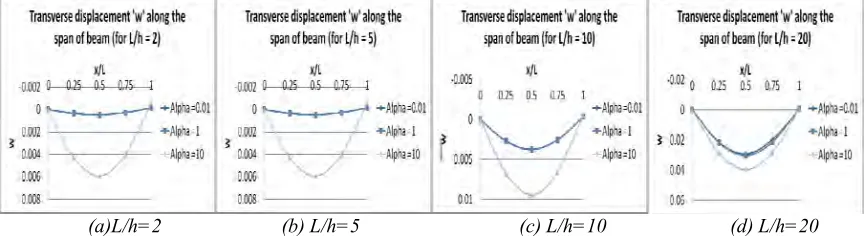
E0=2.74 x 10¹⁰ N/m2; α=0.01, 1, 5, 10, 20. Poisson ratio is assumed to be constant (υ=0.25).
Fig. 1: Transversely loaded beam of rectangular cross section
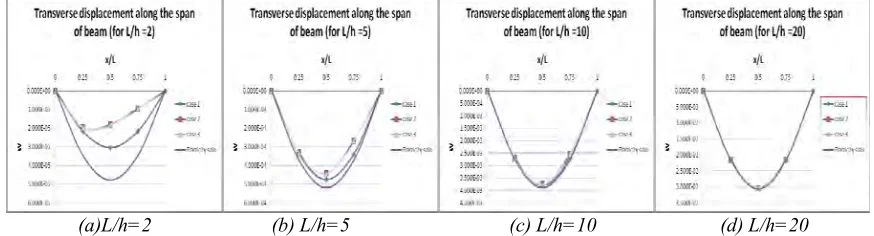
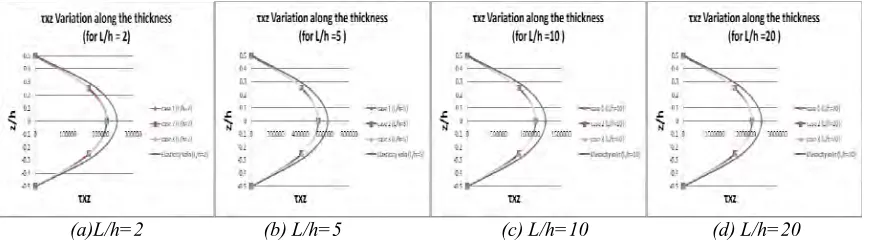
The numerical solutions of the displacements and stresses based on above mentioned formulations are obtained and presented. The solutions are compared with the available elasticity solutions.
(a)L/h=2 (b) L/h=5 (c) L/h=10 (d) L/h=20
6
(a)L/h=2 (b) L/h=5 (c) L/h=10 (d) L/h=20
Fig. 3: Axial displacements “u” near support of a simply supported beam at different points along the depth
(a)L/h=2 (b) L/h=5 (c) L/h=10 (d) L/h=20
Fig. 4: Bending stress (Maximum) along the thickness of simply supported beam for different span/depth ratio
(a)L/h=2 (b) L/h=5 (c) L/h=10 (d) L/h=20
Fig. 5: Transverse normal stress along the thickness of simply supported beam for different span/depth ratio
(a)L/h=2 (b) L/h=5 (c) L/h=10 (d) L/h=20
7
(a)L/h=2 (b) L/h=5 (c) L/h=10 (d) L/h=20
Fig. 7: Transverse displacement along the thickness of simply supported FG beam for different span/depth ratio
CONCLUDING REMARKS
The results of the numerical experimentation reveal the following facts:
• For isotropic beams, the effects of the transverse shear deformation and transverse normal stress are negligible for sufficiently large values of L/h and become important as L/h decreases to less than 10.
• The in-plane stress and transverse stresses are dependent on the step size as finite difference techniques are used to evaluate the same. The accuracy of the stresses increases for finer step sizes.
• The results obtained by RMVT show a great degree of accuracy compare to the elasticity solutions.
• Formulation of theory of static deformation of FGM beams needs in-plane stretching of the cross section to be considered while assuming the in-plane displacements as the material properties are not same across thickness.
This review article is all about the issues related with the analysis of FGM structures using RMVT. The through thickness continuity of transverse stresses in the thickness direction of structural elements may be easily introduced through RMVT. Moreover, as RMVT requires transverse stresses an anterior requirement, the post-processing procedures are not required to obtain the normal stresses. It is a tool especially very useful for layered structure analysis because as a main task RMVT requires (or permits) transverse shear and normal stress assumptions to fulfill interface continuity. The literature establishes that RMVT permits obtaining a three-dimensional description of stress and strain fields of FGM structures. Computational applications may also be evolved as far as the finite element methods and finite difference methods are concerned. RMVT is an instinctive extension of the Principle of Virtual Displacement (PVD) to multilayered and FGM structures.
REFERENCES
[1] Atluri SN, Tong P, and Murakawa H (1983), Recent studies in hybrid and mixed finite element methods in mechanics, in Hybrid and Mixed Finite Element Methods, Edited by SN Atluri RH Gallagher, and O Zienkiewicz, John Wiley and Sons, 51–71.1
[2] Bhaskar K and Varadan TK (1992), Reissner’s new mixed variational principle applied to laminated cylindrical shells, ASME J. PressureVessel Technol. 114, 115–119.
[3] Carrera E (1999d), Transverse normal stress effects in multilayered plates, ASME J. Appl. Mech. 66, 1004– 1012.
[4] Carrera E (2000a), Single-layer vs. multi-layers plate modelings on the basis of Reissner’s mixed theorem,
AIAA J. 38, 342–343.
[5] Carrera E (2000c), An assessment of mixed and classical theories for thermal stress analysis of orthotropic plates, J. Therm. Stresses 23,797–831.
[6] Jing H and Tzeng KG (1993a), On two mixed variational principles for thick laminated composite plates,
Compos. Struct.
[7] Kant, T. (1981), “A higher order general laminated shell theory”. Report No. Res. Rep.C/R/395/81, University of Wales, Swansea.
8
[9] Kant, T. and Manjunatha, B.S. (1994), “On accurate estimation of transverse stress in multilayer laminates”
Computer Structure, Vol. 50(3), pp. 351-365.
[10]Kant, T., Pendhari S. and Desai, Y.M. (2007), “A General partial discretization methodology for inter-laminar stress computation in composite laminates” International Journal of Computational Methods in Engineering Science and Mechanics, Vol. 17, no.2, pp. 351-365.
[11]Kapania RK (1989), A review on the analysis of laminated shells, J. Pressure Vessel Technol. 111, 88–96. [12]Kapania RK and Raciti S (1989), Recent advances in analysis of laminated beams and plates, AIAA J. 27, 923–
946.
[13]Librescu L and Reddy JN (1986), A critical review and generalization of transverse shear deformable anisotropic plates, Euromech Colloquium219, Kassel, Sept, 1986 Refined Dynamical Theories of Beams,Plates and Shells and their Applications, Elishakoff and Irretier (eds), Springer Verlag, Berlin, 32–43.
[14]Main A.M. and Spencer, A.J.M., Exact solutions for functionally graded and laminated elastic materials, J Mech Phys Solids46 (12) (1998), pp. 2283–2295.
[15]Murakami H (1984), A laminated beam theory with interlayer slip, ASME J. Appl. Mech. 51, 551–559.
[16]Murakami H (1986), Laminated composite plate theory with improved in-plane responses, ASME J. Appl. Mech. 53, 661–666.
[17]Murakami H, Reissner E, and Yamakawa J (1996), Anisotropic beam theories with shear deformation, ASME J. Appl. Mech. 63, 660–668.
[18]Noor AK and Burton WS (1989b), Assessment of shear deformation theories for multilayered composite plates,
Appl. Mech. Rev. 42 (1), 1–13.
[19]Noor AK and Burton WS (1990), Assessment of computational models for multilayered composite shells, Appl. Mech. Rev. 43 (4), 67–97.
[20]Pagano NJ (1969), Exact solutions for composite laminates in cylindrical bending, J. Compos. Mater. 3, 398– 411.
[21]Reddy JN (1984a), Energy and Variational Methods in Applied Mechanics, John Wiley, NY.
[22]Reddy JN and Robbins DH (1994), Theories and computational models for composite laminates, Appl. Mech. Rev. 47 (6), 147–165.
[23]Reissner E. (1945), “The effects of transverse shear deformation on bending of elastic plates” ASME Journal of Applied Mechanics, Vol 12, pp. A69-A77.
[24]Reissner E. (1950), “On a variational theorem in elasticity” J. Math. Phys. 29, 90–95.
[25]Reissner E. (1964) “On the form of variationally derived shell equations” ASME J. Appl. Mech. 31, 233–328. [26]Reissner E. (1984), “On a certain mixed variational theory and a proposed application” Int. J. Numer. Methods
Eng. 20, 1366–1368.
[27]S. Suresh, A. Mortensen, Fundamentals of Functionally Graded Materials (Institute of Materials, London, 1998), pp. 3-8.
[28]Sankar, B.V., (2001), “An elasticity solution for functionally graded beams” Composites Science and Technology, Vol 61, pp. 689-696.
[29]Soldatos KP and Timarch T (1993), A unified formulation of laminated composites, shear deformable, five-degrees-of-freedom cylindrical shell theories, Composite Structures 25, 165–171.
[30]Toledano A and Murakami H (1987a), A high-order laminated plate theory with improved in-plane responses,
Int. J. Solids Struct. 23, 111–131.
[31]Toledano A and Murakami H (1987b), A composite plate theory for arbitrary laminate configurations, ASME J. Appl. Mech. 54, 181–189.
[32]Vinson, J.R. (1974), “Structure mechanics: The behavior of plates and shells” Mc-graw Hill publication, 2nd edition, pp. 466-524.
[33]Washizu K (1968), Variational Method in Elasticity and Plasticity, Oxford, Pergamon Press.