Copyright to IJIRSET DOI:10.15680/IJIRSET.2017.0602089 1924
Design and Analysis of Fiberglass Composite
Leaf Spring Using Mono Composite
Hazari Naresh
Assistant Professor, Department of Mechanical Engineering, VNR Vignana Jyothi Institute of Engineering and
Technology Hyderabad, India
ABSTRACT: The Composite Leaf spring has passionate to utilise in automobile industries now a days, composite structures for conventional metallic structures has many advantages because of higher specificstiffness and strength of composite materials is discussed. The automobile industry has shown increased interest in the replacement of steel spring with fiberglass composite leaf spring due to high strength to weight ratio. This work deals with the replacement of conventional steel leaf spring with a Mono Composite leaf spring using E-Glass/Epoxy. The design parameters were selected and analysed with the objective of minimizing weight of the composite leaf spring as compared to the steel leaf spring. The leaf spring was modeled in Pro/E and the analysis was done using ANSYS Metaphysics software.
KEYWORDS: fiberglass composite Material, Steel Leaf Spring, Pro-E , ANSYS.
I. INTRODUCTION
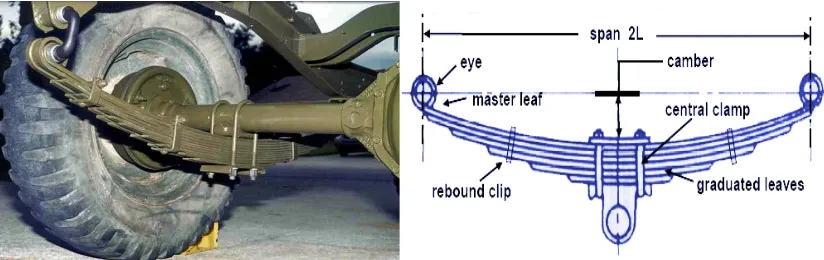
A leaf spring is a simple form of spring, commonly used for the suspension in wheeled vehicles. It is also one of the oldest forms of springing, dating back to medieval times. Sometimes referred to as a semi-elliptical spring or cart spring, it takes the form of a slender arcshaped length of spring steel of rectangular cross-section. The centre of the arc provides location for the axle, while tie holes called eyes are provided at either end for attaching to the vehicle body. For very heavy vehicles, a leaf spring can be made from several leaves stacked on top of each other in several layers, often with progressively shorter leaves.
Leaf springs can serve locating and to some extent damping as well as springing functions. A leaf spring can either be attached directly to the frame at both ends or attached directly at one end, usually the front, with the other end attached through a shackle, a short swinging arm. The shackle takes up the tendency of the leaf spring to elongate when compressed and thus makes for softer springiness.
The automotive industry is exploring composite materials for structural components construction in order to obtain the reduction of weight without decrease in vehicle quality and reliability. To conserve the natural resources and economize energy, weight reduction has been the main focus of automobile manufacturer in the present scenario. Actually, there is almost a direct proportionality between the weight of the vehicle and its fuel consumption, particularly in city driving. The advanced composite materials such as Graphite, Carbon, Kevlar and Glass with suitable resins are widely used because of their high specific strength (strength/density) and high specific modulus (modulus/density).
Advanced composite materials seem ideally suited for suspension (leaf spring) applications. Their elastic properties can be tailored to increase the strength and reduce the stresses induced during application.
II.BASISOFLEAFSPRING
Copyright to IJIRSET DOI:10.15680/IJIRSET.2017.0602089 1925
increase in cost and decrease in quality and reliability. In the design of springs, strain energy becomes the major factor. The relationship of the specific strain energy can be expressed as
U = σ 2/ ρ E
Where σ is the strength,
ρ is the density and E is the Young’s Modulus of the
spring material
It can be easily observed that material having lower modulus and density will have a greater specific strain energy capacity. The introduction of composite materials made it possible to reduce the weight of the leaf spring without reduction of load carrying capacity and stiffness due to the following factors of composite materials as compared to steel.
An upturned spring eye is used to attach the front end of semi-elliptic leaf spring to the chassis frame, and a free end with a bracket constraining vertical motion to attach the back end of semi-elliptic leaf spring to the chassis frame.
A Composite in engineering sense is any materials that have been physically assembled to form one single bulk without physical blending to foam a homogeneous material. The resulting material would still have components identifiable as the constituent of the different materials. One of the advantages of composite is that two or more materials could be combined to take advantage of the good characteristics of each.
Fig 2.a Arrangement of leaf spring in automobile Fig 2.b Parts of leaf spring
III. DESIGN OF LEAF SPRING
Considering several types of vehicles that have leaf springs and different loads on them, various kinds of composite leaf spring have been developed. In the case of multi- leaf composite leaf spring, the interleaf spring friction plays a spoil spot in damage tolerance. It has to be studied carefully.
Copyright to IJIRSET DOI:10.15680/IJIRSET.2017.0602089 1926
1. Constant thickness, constant width design
2. Constant thickness, varying width design
3. Varying width, varying width design.
Parameter Specification Material Steel(55Si2Mn90) Tensile Strength 1962N/Sq. mm Yelid Strength 1470N/Sq.mm Young's Modulus 2.1e5 N/Sq.mm Spring Weigth 16.4 Kg Thickness at the Center 12mm Thickness at extreme ends 9mm
Table 3.a Material data and specification
For steel leaf spring cross section is according to considered design and not altered. Due to manufacturing ease, a composite leaf spring with uniform rectangular cross section is considered and analyzed.
Objective of present work is to consider an existing automobile leaf spring model TATA SUMO EZRR PARABOLIC REAR and to design and analyze a composite leaf spring with upturned eye without changing stiffness in order to replace the existing steel leaf spring with a composite leaf spring.
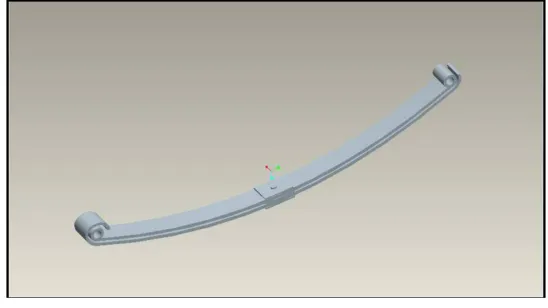
Fig 3.a Modelling of leaf spring 3D Model
Copyright to IJIRSET DOI:10.15680/IJIRSET.2017.0602089 1927
The Following Assumptions are made for this work.
1. The leaf spring has a uniform, rectangular cross section. 2. All non- linear effects are excluded
3. The stress-strain relationship for composite material is linear and elastic; hence Hooke’s law is applicable for composite materials.
4. Acoustical fluid interactions are neglected, i.e., the leaf spring is assumed to be in vacuum.
5. The load is distributed uniformly at the middle of the leaf spring.
IV.STATIC ANALYSIS OF LEAF SPRING
It was observed that the deflection in the composite leaf spring was almost equal so we can say that composite spring had the same stiffness as that of steel spring.
It was observed that the composite leaf spring weighed only 38.4% of the steel leaf spring for the analyzed stresses. Hence the weight reduction obtained
by using composite leaf spring as compared to steel was 58.23 %.
By analyzing the design, it was found that all the stresses in the leaf spring were well within the allowable limits and with good factor of safety. It was found that the longitudinal orientations of fibers in the laminate offered good strength to the leaf spring. Ride quality is generally quantified as the natural frequency of a suspension system Suspension system natural frequencies less than 1 Hz will cause motion sickness in a vehicle’s passengers, and suspension system natural frequencies greater than 2.5 Hz will provide a “harsh” ride In the present work, the 2mode shape of the composite leaf spring has a natural frequency of 1.7444Hz and 1.7496 Hz which provides for good ride quality.
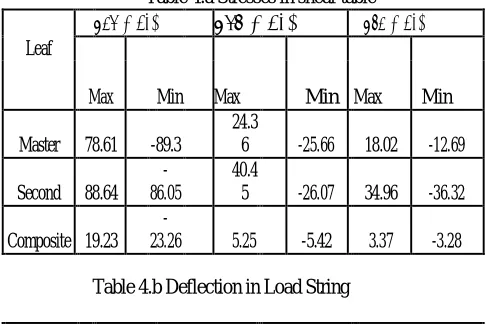
Table 4.a Stresses in shear table
Leaf
σxy(Mpa) σyz(Mpa) σzx(Mpa)
Max Min Max Min Max Min
Master 78.61 -89.3
24.3
6 -25.66 18.02 -12.69
Second 88.64 -86.05
40.4
5 -26.07 34.96 -36.32
Composite 19.23
-23.26 5.25 -5.42 3.37 -3.28
Table 4.b Deflection in Load String
Material Maximum Deflection Max. Average Total
Steel
Mater 53.22
52.7 55.21 Second 52.18
Copyright to IJIRSET DOI:10.15680/IJIRSET.2017.0602089 1928
Fig 5.a Deflection of steel master leaf spring Fig5.b X component of stress in master leaf spring
V. CONCLUSSION AND OBSERVATIONS
It was observed that the deflection in the composite leaf spring was almost equal so we can say that composite spring had the same stiffness as that of steel spring
The following are the observations
1. As comparison to steel the composite leaf spring weight reduction is possible up to 58.23 % 2. The deflection of steel observed that 53.22 mm and the same composite is 54.33mm.
3. The composite leaf spring has a natural frequency of 1.7444Hz and 1.7496 Hz which provides for good ride quality.
REFERENCES
[1] Fu-Chen Chen, “Dynamic response of spring-type operating mechanism for 69 KV SF6 gas insulated circuit breaker,” Mechanism and Machine Theory, Volume 38, 2003, Pages 119-134
[2] Chen, F. C., and Hsu, M. H., 2001, ‘‘On the Transmission Efficiency of Spring-Type Operating Mechanism for SF6 Gas Insulated Circuit Breakers,’’J. Mech. Eng. Sci., 215(10), pp. 1239–1249
[3] Georg Rill, Norbert Kessing, Olav Lange and Jan Meier: Leaf Spring Modelling for Real Time Applications In the 18th IAVSD-Symposium in Atsugi, Japan 2003, 2003
[4]acky C. Prucz, Ph.D.Samir N. Shoukry, Ph.D.Gergis W. William, Ph.D., P.E.Mark S. Shoukry, MSMELi“Lightweightjhsgshcgfsdsd Lightweight Composite Material for Heavy duty Vehicle”