Molecular and Cytological Analyses of Large Tracks of Centromeric DNA Reveal
the Structure and Evolutionary Dynamics of Maize Centromeres
Kiyotaka Nagaki,* Junqi Song,* Robert M. Stupar,* Alexander S. Parokonny,* Qiaoping Yuan,
†Shu Ouyang,
†Jia Liu,
†Joseph Hsiao,
†Kristine M. Jones,
†R. Kelly Dawe,
‡C. Robin Buell
†and Jiming Jiang*
,1*Department of Horticulture, University of Wisconsin, Madison, Wisconsin 53706,†The Institute for Genomic Research,
Rockville, Maryland 20850 and‡Department of Plant Biology, University of Georgia, Athens, Georgia 30602 Manuscript received August 5, 2002
Accepted for publication November 22, 2002
ABSTRACT
We sequenced two maize bacterial artificial chromosome (BAC) clones anchored by the centromere-specific satellite repeat CentC. The two BACs, consisting ofⵑ200 kb of cytologically defined centromeric DNA, are composed exclusively of satellite sequences and retrotransposons that can be classified as centromere specific or noncentromere specific on the basis of their distribution in the maize genome. Sequence analysis suggests that the original maize sequences were composed of CentC arrays that were expanded by retrotransposon invasions. Seven centromere-specific retrotransposons of maize (CRM) were found in BAC 16H10. The CRM elements inserted randomly into either CentC monomers or other retrotransposons. Sequence comparisons of the long terminal repeats (LTRs) of individual CRM elements indicated that these elements transposed within the last 1.22 million years. We observed that all of the previously reported centromere-specific retrotransposons in rice and barley, which belong to the same family as the CRM elements, also recently transposed with the oldest element having transposedⵑ3.8 million years ago. Highly conserved sequence motifs were found in the LTRs of the centromere-specific retrotransposons in the grass species, suggesting that the LTRs may be important for the centromere specificity of this retrotransposon family.
T
HE centromeres of eukaryotic chromosomes are DNA sequences within the genetically mapped centro-responsible for sister chromatid cohesion and serve meres were cloned and analyzed (Copenhaveret al. 1999; as the sites for kinetochore assembly and spindle fiber ArabidopsisGenomeInitiative2000; Kumekawaet al. attachment during cell division. Thus, centromeres are 2000, 2001). The most abundant DNA element in A. critical for the segregation and transmission of genetic thalianacentromeres is the pAL1 repeat, a 180-bp sat-information. In the budding yeastSaccharomyces cerevis- ellite repeat family (Martinez-Zapater et al. 1986; iae, the functional centromere is defined by aⵑ125-bp Maluszynskaand Heslop-Harrison 1991; Round et sequence (Clarke1998). However, in the majority of al. 1997). The cytological locations of the pAL1 repeat eukaryotic species, centromeres are embedded in long coincide with the centromeric H3 histone (Talbertet tracks of highly repetitive DNA sequences with satellite al. 2002). The pAL1 repeat is organized into long tan-repeats often the major DNA component of centromeres dem arrays (Jacksonet al.1998) that may be interrupted in higher eukaryotic species (CsinkandHenikoff1998). by the 106B repeat, a diverged copy of the long terminal For example, a 171-bp tandem repeat, the␣-satellite, is repeat (LTR) of the Athila retrotransposon (Franszlocated in the centromeres of all human chromosomes. et al. 2000). The Athila element, the most dominant Human artificial chromosomes have been successfully retrotransposon family inA. thaliana, and a number of assembled using either synthetic or cloned ␣-satellite other repetitive DNA elements are highly enriched in DNA as the centromere component (Harrington et pericentromeric regions of all five A. thaliana centro-al. 1997; Ikeno et al. 1998; Henninget al. 1999), sug- meres (Franszet al. 2000; Kumekawaet al. 2000, 2001). gesting that a long stretch of␣-satellite DNA can act as Two highly conserved repetitive DNA elements were a functional human centromere. reported in centromeres of grass species (Aragon -The centromeres ofArabidopsis thalianachromosomes Alcaide et al. 1996; Jiang et al. 1996). These two se-are among the most well-studied plant centromeres. quences are derived from a Ty3/gypsy class of retro-A. thalianacentromeres were mapped genetically using transposon (Milleret al. 1998a; Prestinget al. 1998; tetrad-based genetic mapping (Copenhaveret al. 1999). Langdon et al. 2000). The centromere-specific retro-transposon sequences provide excellent probes to iso-late DNA clones derived from grass centromeres. Such 1Corresponding author:Department of Horticulture, 1575 Linden Dr.,
clones have been reported in a number of plant species,
University of Wisconsin, Madison, WI 53706.
E-mail: [email protected] including rice (Donget al. 1998; Nonomuraand K
charge-coupled device (CCD) camera (Roper Scientific, Tucson,
ata 1999), barley (Presting et al. 1998), and maize
AZ) attached to an Olympus BX60 epifluorescence microscope. (Ananievet al. 1998). DNA sequences associated with
The camera control and image analysis were performed using centromeric regions have also been reported in numer- IPLab Spectrum v3.1 software (Signal Analytics, Vienna, VA). ous other plant species (Harrison and Heslop-Har- Polymerase chain reaction:To detect each subfamily of the
centromere-specific retrotransposons in maize, primers
spe-rison 1995; Miller et al. 1998b; Nagaki et al. 1998;
cific to each subfamily were designed for the 5⬘LTR and 5⬘ Francki 2001; Gindulliset al. 2001; Hudakovaet al.
untranslated region (UTR). Primers include CRM1a-U (5⬘-2001; Kishiiet al. 2001; Saundersand Houben2001). ACACCAGCAGCACCTTCTCCAG-3⬘), CRM1a-L (5⬘-AGTTC Maize has become an important model for plant cen- TTATCCGTTCTTACCAA-3⬘), CRM2a-U (5⬘-GCTCGTCAAC tromere research. Alfenitoand Birchler(1993) iso- TCAACCATCAGG-3⬘), and CRM2a-L (5⬘-GCCCCATCTTTT CATTCGTCAC-3⬘). Two primers were designed to amplify the lated a repetitive DNA element that is specific to the
77-bp repeat discovered in BAC 15C5: ZMA77-U (5⬘-TTT centromeres of maize B chromosomes. This repeat is
TGCACGGATAGTCTTCG-3⬘) and ZMA77-L (5⬘-TCCGTGCAA present in all significantly rearranged B centromeres
AAGTCGCCTAA-3⬘). The specific regions were amplified from (KaszasandBirchler1996, 1998), suggesting that it the genomic DNA of Mo17 by 30 cycles of polymerase chain is essential for B centromere function. A repetitive DNA reaction (PCR) with the following conditions: 94⬚for 30 sec,
52⬚for 30 sec, and 72⬚for 2 min. element was recently isolated from the centromere of
DNA sequencing: The sequences of the two maize BAC
maize chromosome 4 on the basis of its partial sequence
clones, 15C5 and 16H10, were determined essentially as de-homology with the B centromeric repeat (Page et al.
scribed byYuanet al. (2002). For 15C5, a 2- to 3-kb and a 10-2001). Cosmid clones derived from the centromeric to 15-kb shotgun library were constructed and these libraries region of maize chromosome 9 were identified in a were sequenced to provide a total ofⵑ14⫻sequence coverage. For 16H10, a 2- to 3-kb and a 4- to 8-kb shotgun library were library constructed from an oat-maize chromosome 9
constructed and sequenced to provide⬎10⫻sequence cover-addition line (Ananiev et al. 1998). A 156-bp satellite
age. Shotgun sequences for each BAC were assembled using repeat, CentC, was discovered from these cosmid clones.
TIGR assembler (Suttonet al.1995). Closure reactions were CentC is found only at maize centromeres, but the performed on the BACs using a combination of resequencing, amount of CentC repeat is highly variable among the alternative chemistries, transposon-based sequencing, and primer walking. Some of the assemblies could be ordered on 10 maize centromeres (Ananievet al. 1998).
the basis of clone mate pairs and the presence of the BAC Although several DNA elements have been isolated
vector. The sequences have been submitted to GenBank with from the maize centromeres, the large-scale
organiza-accession nos. AC116034 (BAC 16H10) and AC116033 (BAC tion of maize centromeric DNA, especially in the A 15C5).
chromosomes, is not known. In this study, we isolated Sequence analysis:DNA sequences similar to the BAC as-semblies were searched in the GenBank database using and sequenced two maize bacterial artificial chromosome
BLASTN. DNA elements in the sequences were analyzed by (BAC) clones derived from the centromeric regions. We
MegAlign software (DNASTAR, Madison, WI). The ages of found that the CentC satellite and retrotransposons, both
the retrotransposons discovered in the two maize BACs were centromere specific and noncentromere specific, are the estimated by sequence comparison between the two LTRs of primary DNA components of maize centromeres. Mo- the elements. The LTRs were first aligned by CLUSTAL X lecular and cytological analyses of the centromere-spe- v1.81 software (Thompson et al. 1997). Kimura’s distance (Kimura1980) of the two LTRs of individual retrotransposons cific retrotransposons in maize and other cereal species
was estimated by the maximum-likelihood method using the revealed the structural diversity and evolutionary
dy-baseml program with the K80 model in the PAML 3.11 PPC namics of this special retrotransposon family that may package (Yang1997). The reported substitution rate per syn-play an important role in grass centromere evolution. onymous site per year in maize and Kimura’s distances were then used to estimate the age of the elements (Gaut et al. 1996). The phylogeny of the retrotransposons in the BACs was analyzed by the neighbor-joining method with CLUSTAL MATERIALS AND METHODS
X v1.81 software (Saitou and Nei 1987; Thompson et al. 1997).
BAC library construction and screening:A BAC library was
constructed from maize inbred line Mo17 according toSong et al. (2000). TheBamHI cloning site of vector pBeloBAC11
(Shizuyaet al. 1992) was used for library construction. The RESULTS 9216 clones were placed on 24 384-well plates. Filter
prepara-tion and library screening were according to published proto- Isolation of centromeric BACs for sequencing: We cols (Nizeticet al. 1990). DNA sequences homologous to the constructed a BAC library of maize inbred line Mo17, maize centromeric repeats CentC and CentA (Ananievet al.
which consists of 9216 clones with an average insert 1998) were amplified from maize genomic DNA and cloned
size of 120 kb. Two plasmid clones, pCentA-int and into plasmid vectors. Two plasmid clones, pCentA-int and
pCentC-1, were used to screen the BAC library. pCentC-1, were used as probes to identify centromeric
Fluorescentin situ hybridization:Maize inbred line Mo17 clones from the BAC library. Probe pCentC-1 contains
was used for cytological analysis. The fluorescencein situhy- a 156-bp satellite DNA element CentC that is specific bridization (FISH) procedures on metaphase chromosomes
to the centromeres of maize chromosomes (Ananievet and individual BAC molecules were essentially the same as
al. 1998). Probe pCentA-int is derived from a portion previously published protocols ( Jianget al. 1995;Jacksonet
Figure 1.—FISH map-ping of centromeric BACs 16H10 (A–C) and 15C5 (D– F) on somatic metaphase chromosomes of maize in-bred Mo17. (A and D) So-matic metaphase chromo-somes; (B and E) FISH sig-nals; (C and F) merged im-ages. Chromosomes are stained by 4⬘,6-diamidino-2-phenylindole (DAPI) and presented by a pseudo-red color. Bars, 5m.
CentA that is almost exclusively located in the centro- in Figure 3 is determined on the basis of structure and locations of specific retroelements within the BAC insert meric regions of maize chromosomes (Ananiev et al.
1998). BAC library screening using these two probes and the presence of the BAC vector. Both large contigs (ASM 37376, 34,079 bp; and ASM 37375, 21,043 bp) identified a total of 96 positive clones, including 18
specific to CentA, 64 specific to CentC, and 14 identified and 4 of the 8 small contigs could be placed within the BAC insert using this approach (ASM 37379, 9438 bp; by both probes.
Two BAC clones, 16H10 and 15C5, were selected for ASM 37381, 4686 bp; ASM 37378, 3066 bp; and ASM 37606, 981 bp; Figure 3).
further analysis. BACs 16H10 and 15C5 contain inserts
of 95 and 100 kb, respectively, based on fingerprint Four CentC tracts were found in 16H10 and were named as CentC tracts A1, A2, B, and C, respectively analyses using both NotI and BamHI digestions (data
not shown). FISH analysis on maize metaphase chromo- (Figure 3). The total length of CentC tracts A1 and tract A2, including the gap separating these two tracts, was somes showed that the signals derived from 16H10 were
almost exclusively localized in the centromeres (Figure determined to beⵑ25 kb by restriction digestions fol-lowed by Southern hybridization (data not shown), sug-1, A–C). Major FISH signals from 15C5 were also located
in the centromeres. However, faint signals uniformly gesting anⵑ12-kb gap separating ASM 37375 and ASM 37379 (Figure 3). Nine retrotransposons were found in covered the entire length of all maize chromosomes
(Figure 1, D–F). The amount and location of the CentC 16H10, including seven elements homologous to the sequences in the two BAC clones were determined by
FISH mapping on individual BAC molecules as de-scribed by Jacksonet al. (1999). The average sizes of the CentC tracts were calculated from 10 FISH images. BAC 16H10 contains three CentC tracts, and the sizes of the tracts are 18.0, 2.4, and 1.8% of the BAC molecule (including the vector), respectively (Figure 2, A and C). BAC 15C5 also contains three CentC tracts, and sizes of the tracts are 6.1, 1.5, and 1.7% of the BAC molecule, respectively (Figure 2, B and D).
Sequence analysis of BAC clone 16H10:BAC 16H10 was sequenced to⬎10⫻sequence coverage (see mate-rials and methods). The sequences generated from 16H10 were assembled into two large contigs (34,079 and 21,043 bp, respectively) and eight small contigs (9438, 4686, 3066, 2491, 2143, 1904, 1494, and 981 bp, respectively). The total length of these 10 contigs is 81,325 bp, slightly smaller than the 95 kb estimated by fingerprint analysis, suggesting that a portion of the highly conserved repetitive sequences within the BAC
Figure2.—Structure of maize BACs 16H10 and 15C5 re-were collapsed within the contigs. However, a
substan-vealed by fiber-FISH mapping. DNA from BACs 16H10 (A) tial portion of the 81-kb assembled sequence (74.8 kb)
and 15C5 (B) was labeled as green and pCentC-1 was labeled was correctly assembled as determined by inspection of as red (bars, 5m). The amount and locations of the CentC clone mates and use of transposon-based sequencing of sequences within the BAC inserts were revealed by this method
Figure3.—Sequence organization of maize centromeric BACs 16H10 and 15C5. The order of the sequence contigs in 16H10 was determined on the basis of the sequence information of specific retroelements within the BAC insert and the presence of the BAC vector. Each retrotransposon is marked by a different color. The name, LTRs, and polyprotein of the same element are in the same color to facilitate the identification of interrupted retrotransposons.
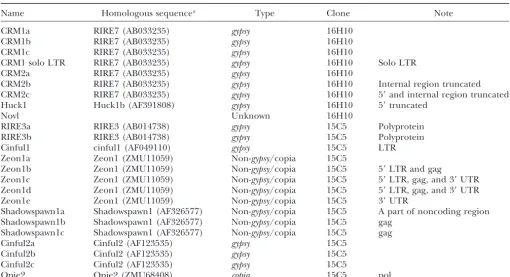
centromericretrotransposon ofrice (CRR; Chenget al. and a nonautonomous retroelement that is novel and different from any published maize retrotransposon 2002) element (Table 1 and Figure 3). The CRR-like
ele-ments in maize were namedcentromericretrotransposon families. We named this a Novl element. A shotgun clone containing sequences derived from the Novl ele-ofmaize (CRM) thereafter. Six CRM elements,
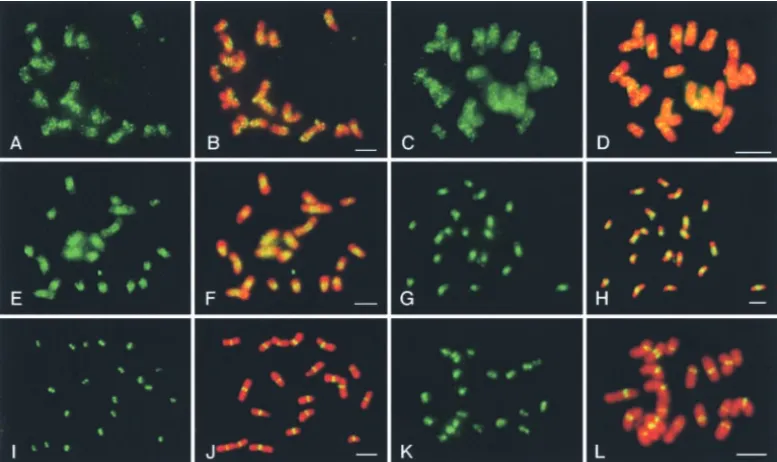
includ-ing CRM1a, CRM1b, CRM1c, CRM2a, CRM2b, and ment was used as a probe for FISH analysis (Figure 4, A and B). Dispersed signals were observed from the CRM2c, are complete or near-complete elements. The
seventh CRM element is a solo LTR inserted in the probe, indicating that the Novl element is not specific to the centromeres. The last CRM element, CRM2c, is middle of CentC tract C (Figure 3).
TABLE 1
Retrotransposons in the two sequenced centromeric BACs of maize
Name Homologous sequencea Type Clone Note
CRM1a RIRE7 (AB033235) gypsy 16H10
CRM1b RIRE7 (AB033235) gypsy 16H10
CRM1c RIRE7 (AB033235) gypsy 16H10
CRM1 solo LTR RIRE7 (AB033235) gypsy 16H10 Solo LTR
CRM2a RIRE7 (AB033235) gypsy 16H10
CRM2b RIRE7 (AB033235) gypsy 16H10 Internal region truncated
CRM2c RIRE7 (AB033235) gypsy 16H10 5⬘and internal region truncated
Huck1 Huck1b (AF391808) gypsy 16H10 5⬘truncated
Novl Unknown 16H10
RIRE3a RIRE3 (AB014738) gypsy 15C5 Polyprotein
RIRE3b RIRE3 (AB014738) gypsy 15C5 Polyprotein
Cinful1 cinful1 (AF049110) gypsy 15C5 LTR
Zeon1a Zeon1 (ZMU11059) Non-gypsy/copia 15C5
Zeon1b Zeon1 (ZMU11059) Non-gypsy/copia 15C5 5⬘LTR and gag
Zeon1c Zeon1 (ZMU11059) Non-gypsy/copia 15C5 5⬘LTR, gag, and 3⬘UTR
Zeon1d Zeon1 (ZMU11059) Non-gypsy/copia 15C5 5⬘LTR, gag, and 3⬘UTR
Zeon1e Zeon1 (ZMU11059) Non-gypsy/copia 15C5 3⬘UTR
Shadowspawn1a Shadowspawn1 (AF326577) Non-gypsy/copia 15C5 A part of noncoding region
Shadowspawn1b Shadowspawn1 (AF326577) Non-gypsy/copia 15C5 gag
Shadowspawn1c Shadowspawn1 (AF326577) Non-gypsy/copia 15C5 gag
Cinful2a Cinful2 (AF123535) gypsy 15C5
Cinful2b Cinful2 (AF123535) gypsy 15C5
Cinful2c Cinful2 (AF123535) gypsy 15C5
Opie2 Opie2 (ZMU68408) copia 15C5 pol
aGenBank accession numbers are in parentheses.
solo LTR, which is most likely derived from a different novel sequence is composed of degenerated retro-transposons.
CRM element, is found in the middle of CentC track
C (Figure 3). Phylogenic analysis of the centromere-specific retro-transposons:Ty3/gypsy-type retrotransposons similar to Sequence analysis of BAC clone 15C5:The sequences
generated from 15C5 were assembled into a single contig those in the CRM family have been found in the centro-meric regions of all grass chromosomes (Milleret al. with a length of 99,979 bp, which is consistent with the
estimated size of 100 kb based on fingerprint analyses. 1998a;Prestinget al. 1998;Langdonet al. 2000). These centromeric retrotransposons in grass species (referred Three CentC tracts, named D, E, and F, were found
in 15C5. A total of 15 retrotransposons were discovered to as CR elements) can be divided into “autonomous” and “nonautonomous” subfamilies (Langdon et al. in 15C5 (Table 1 and Figure 3), including two complete
Cinful2-like elements and one complete Zeon1 element. 2000). The autonomous CR elements are full-size ele-ments. The nonautonomous CR elements have an inter-The remaining 12 retrotransposons have significantly
decayed and their structures were difficult to determine. nal deletion leading to the loss of all enzymatic func-tions, resulting in the retrotransposons having only A novel 77-bp tandem repeat was found in BAC 15C5
(Figure 3). Two primers, ZMA77-U and ZMA77-L (see LTRs, a 5⬘ UTR, and a gag structural gene fragment, truncated before the canonical RNA-binding motif
materials and methods), were designed to amplify
this repeat from maize genomic DNA and the PCR prod- (Langdonet al. 2000).
A number of CR elements from rice, maize, and barley uct was labeled as a probe for FISH analysis. Dispersed
FISH signals were observed on maize metaphase chro- were used in phylogenic analysis. These CR elements were described in previous reports or were directly de-mosomes, indicating that this repeat is not specific to
maize centromeres (Figure 4, C and D). posited in GenBank (Table 2). The polyprotein regions from autonomous CR elements and two typical Ty3/ Several regions within BAC 15C5 did not show any
homology with known repeats or transposons within gypsy retrotransposons of rice (RIRE3) and maize (Huck2) were analyzed by the neighbor-joining method GenBank. Shotgun clones derived from these regions
were used as FISH probes, and they all generated dis- (Figure 5A). Consistent with previous data (Langdon
et al. 2000) we found that the CR elements formed a persed signals that are enriched in the pericentromeric
Figure 4.—FISH analysis using shotgun plasmid clones from maize BACs 16H10 and 15C5. The locations of plas-mids within the BAC inserts are marked in Figure 3. (A and B) FISH pattern of plas-mid ZMACL26 derived from retrotransposon Novl. (C and D) Chromosomal locations of the ZMA77bp tandem re-peat. This repeat was ampli-fied from maize genomic DNA using primers ZMA-77-U and ZMA77-L (see ma-terials and methods). The PCR product was labeled as a FISH probe that hybridized almost uniformly to the chro-mosomes although enhanc-ed pericentromeric signals were observed in some chro-mosomes. (E and F) FISH-pattern of plasmid ZMABC19 derived from possibly decayed retrotransposon sequences in BAC 15C5. (G and H) FISH pattern of plasmid ZMABC91 derived from possibly decayed retrotransposon sequences in BAC 15C5. (I and J) FISH pattern of plasmid ZMACD69 derived from CRM1c. (K and L) FISH pattern of plasmid ZMACD68 derived from CRM2a. Chromosomes are stained by DAPI and presented by a pseudo-red color. Bars, 5m.
elements (Figure 5A). This CR cluster can be divided UTR (data not shown) and LTR regions (Figure 5B). Three nonautonomous CR elements were included in into five species-specific subclusters. The maize
se-quences fall into two of these subclusters. CRM1a, -1b, the LTR-based phylogenic tree, including the CentA element (Ananievet al. 1998), a CRR element in RCB11 and -1c fall into one subcluster, while the second maize
subcluster, including CRM2a, -2b, and -2c, is more (RCB11-1; Nonomuraand Kurata1999; Langdonet al. 2000), and the CRR4.4kb element in rice BAC 17p22 closely related to one of the two rice subclusters (Figure
5A). Our FISH data showed that the elements in both (Chenget al. 2002). These nonautonomous elements made independent clusters from the full-size elements subclusters are centromere specific (Figure 4, I–L).
Similar phylogenic results were obtained from the 5⬘ in both rice and maize (Figure 5B).
TABLE 2
CR elements used in phylogenic analysis
Element Type GenBank accession Species Reference
CRR AP003054 Autonomous AP003054 Rice
CRR AP003562 Autonomous AP003562 Rice
CRR AC022352 Autonomous AC022352 Rice
CRR AC079634 Autonomous AC079634 Rice
CRR AC090441 Autonomous AC090441 Rice
CRR AC092749 Autonomous AC092749 Rice
CRR9.2kb Autonomous AY101510 Rice Chenget al. (2002)
RIRE7 Autonomous AB033235 Rice
CentA-targeta Autonomous AF078917 Maize Ananievet al. 1998; Langdonet al. (2000)
Cereba Autonomous AF078801 Barley Prestinget al. (1998)
cereba-1 Autonomous AY040832 Barley Hudakovaet al. (2001)
cereba-2 Autonomous AY040832 Barley Hudakovaet al. (2001)
CentA Nonautonomous AF078917 Maize Ananievet al. (1998)
RCB11-1 Nonautonomous AB013613 Rice NonomuraandKurata(1999)
CRR4.4kb Nonautonomous AY101510 Rice Chenget al. (2002)
aThe CentA repeat is a nonautonomous CR element (Langdon et al. 2000). The CentA element reported byAnanievet al.
Figure5.—Phylogenic analysis of the CR elements from barley, rice, and maize. Bootstrap values in 1000 tests are indicated on the branches. (A) Phylogenic tree constructed from the gag-pol polyprotein genes. For CRM2b, the polyprotein region in ASM 37378 (Figure 3) was used in the phylogenic analysis. (B) Phylogenic tree constructed from the LTRs. For CRM2b, the 3⬘ LTR in ASM 37376 (Figure 3) was used in the phylogenic analysis.
Four conserved domains were observed in the LTRs Phylogenic studies revealed that the full-size CR ele-ments in rice and maize can be grouped into two distinct of the CR elements from different species (Figure 6).
These highly conserved DNA motifs were found in both subfamilies (Figure 5, A and B). We analyzed the se-quence similarity between the two subfamilies in maize autonomous and nonautonomous CR elements despite
the fact that these elements fall in different clusters in and rice using the MegAlign program in DNASTAR and found that the LTRs and 5⬘UTRs are significantly more the phylogenic tree (Figure 5B), suggesting that these
motifs may be important for the targeting of the CR diverged than the pol and gag regions (data not shown). To reveal potential differences in the distribution of elements in centromeric regions.
Figure7.—Chromosomal localization of the PCR prod-ucts amplified from the CRM-1a and CRM2a subfamilies. (A) Signals derived from the PCR products amplified from CRM2a. (B) Signals derived from the PCR products am-plified from CRM1a. (C) The FISH signals were merged with the metaphase chromo-somes. Chromosomes are stained by DAPI. Note that the PCR products amplified from CRM1a generated minor signals in the knob regions that are stained more intensively by DAPI than were the rest of the chromosomes. Some centromeres (arrows in A and arrowheads in B) show significant differences in the size and intensity of the FISH signals from the two subfamilies. Bar, 5m.
these two subfamilies we double labeled DNA probes Organization and divergence of the CentC repeat: amplified from the LTR/5⬘UTR regions. Signals from Several large shotgun clones covering the CentC tract both subfamilies were mainly located in the centromeric regions were sequenced using transposon-based se-regions of maize metaphase chromosomes. However, quencing methods to confirm the sequence and the the size and intensity of the signals were significantly order of the highly similar CentC monomers. The different in some maize centromeres (Figure 7), sug- CentC repeats in the two BAC clones were aligned and gesting that the elements from the two subfamilies are grouped by the neighbor-joining method. The CentC not uniformly dispersed in these centromeres. repeat sequences can be divided into 18 groups (groups Estimation of the age of the retrotransposons in the A–R; Figure 9). All the CentC repeats from 15C5 are centromeric BACs:The two LTRs of a retrotransposon different from those of 16H10, suggesting that the are identical at the time of its insertion into the host CentC sequences in these two BACs have significantly genome. If the mutation rate is constant after the trans- diverged. Some of the CentC groups periodically ap-position, the age of the retrotransposon since transposi- peared in multiple CentC tracts (Figure 9). For exam-tion can be estimated by the number of substituexam-tions ple, a JCFFI motif is observed in both A1 and A2 tracts per nucleotide site within the LTRs (SanMiguel et al. (Figure 9). The physical gap between tract A1 and A2 1998). An average substitution rate at the adh locus may contain CentC repeats with identical sequence and among grasses was estimated at 6.5⫻10(⫺9) substitu- organization patterns to those within tracts A1 and A2. tions per synonymous site per year (Gautet al. 1996). Such CentC sequences may be assembled into the “du-This rate was used to estimate the insertion time of the plicated regions” in tracts A1 and A2. Similarly, HE, retrotransposons in this study (Table 3). QMRPO, or KRLRR motifs are observed periodically in The insertion timing or the ages of the retrotranspo- tracts B and C, D, and E and F, respectively (Figure 9). sons in BAC clone 16H10 are summarized in Figure 8 These results indicate that the CentC sequences have and Table 3. Sequence analysis suggests that the insert been amplified and maintained by higher-order struc-of BAC 16H10 was an intact CentC DNA fragment. This tures of specific CentC monomers.
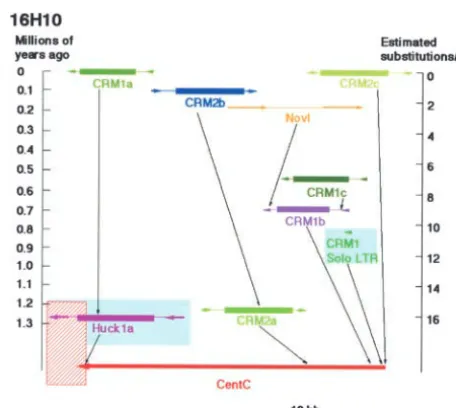
CentC fragment was separated into three CentC tracts The 3⬘end of CentC tract A2 and the 5⬘end of CentC due to retrotransposon invasions. All retroelements tract B are located in the same position in a CentC within 16H10 are younger than 1.3 million years. Four monomer, suggesting that these two CentC tracts were CRM elements inserted directly into the CentC frag- separated by the insertion of the CRM2a that transposed ment (Figure 8), but the locations within the CentC ⵑ
1.22 million years ago. Interestingly, CentC tracts A2 156-bp repeat unit of the four insertions are different,
and B showed completely different patterns (Figure 9), indicating that targeting sites of the CRM elements are
suggesting that retrotransposon invasion may signifi-not sequence specific.
cantly impact the divergence of the centromeric satellite The insertion timing of the majority of the
retro-repeats. transposons in BAC 15C5 was difficult to determine
due to the significant sequence degeneracy. Only three
retrotransposons retained a pair of complete LTRs. One DISCUSSION of these three elements, Cinful2a, is highly rearranged
DNA sequences located within centromeric regions and its structure is difficult to define. The ages of the
have been isolated in numerous plant species. However, other two retrotransposons, Cinful2c and Zeon1a, were
large-scale sequencing and organization studies of cen-estimated to be 2.63 and 42.22 million years, respectively
TABLE 3
Estimated age of CR elements and retrotransposons in BACs 16H10 and 15C5
Name Clonea Reference Sites kb Timec
Cinful2c 15C5 This article 607 0.0342 2.63
Zeon1a 15C5 This article 548 0.5488 42.22
Novl 16H10 This article 2471 0.0024 0.19
CRM1a 16H10 This article 577 0.0000 0.00
CRM1b 16H10 This article 569 0.0090 0.69
CRM1c 16H10 This article 574 0.0071 0.55
CRM2a 16H10 This article 918 0.0158 1.22
CRM2b 16H10 This article 931 0.0011 0.08
CRM2c 16H10 This article 608 0.0000 0.00
CRR B1108H10 (AP003562) 901 0.0057 0.44
CRR OSJNBb0023M11 (AC092749) 815 0.0496 3.82
CRR OSJNBb0052C09 (AC090441) 849 0.0109 0.84
CRR OSJNBa0045C13 (AC079634) 849 0.0109 0.84
CRR OSJNBa0034E23 (AC022352) 908 0.0000 0.00
CRR P0436D06 (AP003054) 787 0.0013 0.10
cereba-1 (AY040832) Hudakovaet al.(2001) 251 0.0040 0.31
cereba-2 (AY040832) Hudakovaet al.(2001) 865 0.0155 1.19
CentA (AF078917) Ananievet al.(1998) 1233 0.0100 0.77
RCB11-1 (AB013613) NonomuraandKurata(1999) 778 0.0132 1.02
CRR4.4kb (AY101510) Chenget al. (2002) 779 0.0000 0.00
aGenBank accession numbers are in parentheses.
bThe estimated number of substitutions per nucleotide site. cMillion years.
plant species. In rice, the central domains of rice centro- two centromeric DNA fragments were derived from the insertion of retroelements into intact CentC arrays (Fig-meres are occupied by a 155-bp satellite repeat CentO
(Chenget al. 2002). Surprising sequence similarity be- ure 3). These findings add additional evidence that satellite repeats and retrotransposons are the main DNA tween CentO and the CentC satellite in maize was
discov-ered (Chenget al. 2002). The CentO satellite arrays are components of plant centromeres. interrupted irregularly by the CRR elements (Chenget
al. 2002) and other retrotransposons (Nonomuraand
Kurata2001). In general, the organization of centro-meric DNA in rice, as well as in several other species, including Beta species (Gindullis et al. 2001), barley (Hudakova et al. 2001), and Zingeria biebersteiniana (Saunders andHouben 2001), are all similar to that ofA. thaliana and contain mainly satellite repeats and retrotransposons.
Previous work byAnanievet al. (1998) suggested that maize centromeres also contain a centromere-specific satellite repeat (CentC) and the centromere-specific ret-rotransposon, which we have named CRM. Molecular and cytological data suggest that some maize centro-meres contain very limited amounts of CentC and CRM-related sequences (Ananievet al. 1998). These results imply that these centromeres may contain additional centromere-specific DNA sequence families. In this study, we sequenced two maize BACs containing the CentC satellite repeat. Sequence analysis revealed that
Figure8.—Timing of transposition of the retrotransposons these two BACs exclusively contain satellite repeats and
in BAC 16H10. Each retroelement is marked by a different retrotransposons. BAC 16H10 contains
retrotranspo-color. The age of the retrotransposons is estimated on the sons both specific and nonspecific to centromeres, while basis of sequence divergence of the two LTRs. The DNA in BAC 15C5 contains only retrotransposons that are not the red-shadowed box is not cloned in BAC 16H10. The ages
Figure9.—Higher-order structure of the CentC re-peats in BACs 16H10 and 15C5. Each subgroup of the CentC monomer is indi-cated by a different letter and then the subgroups are aligned sequentially. The arrows above the sequence indicate the higher-order repeat.
Langdonet al. (2000) demonstrated that all CR ele- mate as retrotransposition itself is an error-prone pro-cess. A total of 45 reverse transcriptase-encoding clones ments reported in grass species were derived from a
single ancient family. The CR family has a conventional were obtained from five species and 31 integrase-encod-ing clones were obtained from eight species. All clones organization and its protein components are highly
con-served even in Arabidopsis homologs (Langdon et al. conformed closely to the relevant species consensus, and total variation was in the range of a few percent. 2000). Our sequencing results, coupled with the
se-quenced CRR elements recently deposited in GenBank, The ages of the elements within most species were⬍1 million years of divergence.Langdonet al. (2000) sug-provide new data for evolutionary studies of this special
retrotransposon family. Phylogenic analysis demon- gested that the CR family is likely to still be active in most if not all species, while the failure to detect “old” strated that the nonautonomous CR elements in both
maize and rice are significantly diverged from the full- elements implies that either the family is rapidly increas-ing in abundance at an equivalent rate in each of the size CR elements (Figure 5B). The full-size CR elements
in maize can be divided into two groups on the basis divergent species sampled or ancestral sequences are relatively rapidly removed in their entirety before sig-of sequence similarity analysis (Figure 5, A and B). The
most diverged sequences between the two groups are nificant levels of degradation occur.
We estimated the age of centromere-specific retro-located within the LTRs and 5⬘UTR. Cytological
analy-ses suggest that the full-size elements from the two transposons by comparing the sequences of the two LTRs in individual retrotransposons, an approach more groups are not uniformly intermingled at least in some
maize centromeres (Figure 7). accurate than the method employed byLangdonet al. (2000). All CRM elements discovered in BAC 16H10 The most striking characteristic of this
retrotranspo-son family is its centromere specificity. All the subfamil- transposed within the last 1.22 million years (Table 3 and Figure 8). We also analyzed six CRR elements re-ies in different specre-ies have maintained their exclusive
centromere locations. The mechanism of this centro- cently deposited in GenBank. The oldest CRR element transposed 3.82 million years ago, and the other five mere-specific insertion is unknown. In rice, many of the
CRR elements inserted either in the CentO satellite were transposed within 1 million years. Thecereba ele-ments in barley transposed between 0.31 and 1.19 mil-repeat or in other CRR elements (Chenget al. 2002),
suggesting that the satellite repeat or the CRR element lion years ago. These data suggest that a majority of the CR elements discovered in all these three species itself may create the conditions such as chromatin
con-firmation (Langdon et al. 2000) for direct targeting. transposed recently, consistent with previous conclu-sions (Langdonet al. 2000). In contrast, the non-centro-We found strikingly conserved motifs within the LTRs
of the CR elements. Although the grass species were mere-specific retrotransposons discovered in BAC 15C5 are significantly rearranged, suggesting that these ele-diverged⬎55 million years ago (Kellogg2001), these
motifs were found in all the subfamilies (Figure 6). ments transposed much earlier. A Zeon1a element pres-ent in 15C5 was estimated to be 42 million years old These results suggest that the LTRs may be critical for
the centromere-specific transposition. (Table 3). The young age of the CR elements in differ-ent grass species suggests that certain parts of the
cen-Langdon et al. (2000) cloned and sequenced PCR
products of the CR elements from a number of grass tromeres, possibly the functional domains, are highly dynamic and evolve rapidly at the DNA sequence level. species. The sequence information was expected to
pro-vide a basis for estimating the age of individual insertion The recent discovery of the interaction between CRM sequences and centromeric histone H3 in maize (Zhong
underesti-plication of fiber-FISH in genome analysis ofArabidopsis thaliana.
et al. 2002) provided the first evidence that the CR
ele-Genome41:566–572.
ments participate in centromere function and may be Jackson, S. A., F. Dong and J. Jiang, 1999 Digital mapping of a driving force in grass centromere evolution. bacterial artificial chromosomes by fluorescencein situ
hybridiza-tion. Plant J.17:581–587.
We thank Evelyn Hiatt for technical assistance. This research was Jiang, J., B. S. Gill, G. L. Wang, P. C. RonaldandD. C. Ward, supported by National Science Foundation grant 9975827 to R.K.D. 1995 Metaphase and interphase fluorescencein situ
hybridiza-and J.J. tion mapping of the rice genome with bacterial artificial
chromo-somes. Proc. Natl. Acad. Sci. USA92:4487–4491.
Jiang, J., S. Nasuda, F. Dong, C. W. Scherrer, S. Wooet al., 1996 A conserved repetitive DNA element located in the centromeres of cereal chromosomes. Proc. Natl. Acad. Sci. USA93:14210–
LITERATURE CITED 14213.
Kaszas, E., andJ. A. Birchler, 1996 Misdivision analysis of
centro-Alfenito, M. R., andJ. A. Birchler, 1993 Molecular characteriza- mere structure in maize. EMBO J.15:5246–5255. tion of a maize B chromosome centric sequence. Genetics135:
Kaszas, E., and J. A. Birchler, 1998 Meiotic transmission rates
589–597. correlate with physical features of rearranged centromeres in
Ananiev, E. V., R. L. PhillipsandH. W. Rines, 1998 Chromosome- maize. Genetics150:1683–1692.
specific molecular organization of maize (Zea maysL.) centro- Kellogg, E. A., 2001 Evolutionary history of the grasses. Plant Phys-meric regions. Proc. Natl. Acad. Sci. USA95:13073–13078. iol.125:1198–1205.
ArabidopsisGenomeInitiative, 2000 Analysis of the genome se- Kimura, M., 1980 A simple method for estimating evolutionary rates quence of the flowering plantArabidopsis thaliana.Nature408: of base substitution through comparative studies of nucleotide
796–815. sequences. J. Mol. Evol.16:111–120.
Aragon-Alcaide, L., T. Miller, T. Schwarzacher, S. Readerand Kishii, M., K. NagakiandH. Tsujimoto, 2001 A tandem repetitive
G. Moore, 1996 A cereal centromeric sequence. Chromosoma sequence located in the centromeric region of common wheat
105:261–268. (Triticum aestivum) chromosomes. Chromosome Res.9:417–428.
Cheng, Z., F. Dong, T. Langdon, S. Ouyang, C. R. Buellet al., 2002 Kumekawa, N., T. Hosouchi, H. TsuruokaandH. Kotani, 2000 Functional rice centromeres are marked by a satellite repeat and The size and sequence organization of the centromeric region a centromere-specific retrotransposon. Plant Cell14:1691–1704. ofArabidopsis thalianachromosome 5. DNA Res.7:315–321.
Clarke, L., 1998 Centromeres: proteins, protein complexes, and Kumekawa, N., T. Hosouchi, H. TsuruokaandH. Kotani, 2001 repeated domains at centromeres of simple eukaryotes. Curr. The size and sequence organization of the centromeric region
Opin. Genet. Dev.8:212–218. ofArabidopsis thalianachromosome 4. DNA Res.8:285–290.
Copenhaver, G. P., K. Nickel, T. Kuromori, M. I. Benito, S. Kaul Langdon, T., C. Seago, M. Mende, M. Leggett, H. Thomaset al.,
et al., 1999 Genetic definition and sequence analysis of Arabi- 2000 Retrotransposon evolution in diverse plant genomes.
Ge-dopsis centromeres. Science286:2468–2474. netics156:313–325.
Csink, A. K., andS. Henikoff, 1998 Something from nothing: the Maluszynska, J., andJ. S. Heslop-Harrison, 1991 Localization of evolution and utility of satellite repeats. Trends Genet.14:200– tandemly repeated DNA sequences inArabidopsis thaliana.Plant
204. J.1:159–166.
Dong, F., J. T. Miller, S. A. Jackson, G. L. Wang, P. C. Ronald Martinez-Zapater, J. M., M. A. EstelleandC. R. Somerville, 1986
et al., 1998 Rice (Oryza sativa) centromeric regions consist of A high repeated DNA sequence inArabidopsis thaliana.Mol. Gen. complex DNA. Proc. Natl. Acad. Sci. USA95:8135–8140. Genet.204:417–423.
Francki, M. G., 2001 Identification of Bilby, a diverged centromeric Miller, J. T., F. Dong, S. A. Jackson, J. SongandJ. Jiang, 1998a
Ty1-copiaretrotransposon family from cereal rye (Secale cerealeL.). Retrotransposon-related DNA sequences in the centromeres of
Genome44:266–274. grass chromosomes. Genetics150:1615–1623.
Fransz, P. F., A. Armstrong, J. H. De Jong, L. D. Parnell, C. Van Miller, J. T., S. A. Jackson, S. Nasuda, B. S. Gill, R. A. Winget al.,
Drunenet al., 2000 Integrated cytogenetic map of chromosome 1998b Cloning and characterization of a centromere-specific arm 4S ofA. thaliana: structural organization of heterochromatic repetitive DNA element fromSorghum bicolor.Theor. Appl. Genet.
knob and centromere region. Cell100:367–376. 96:832–839.
Gaut, B. S., B. R. Morton, B. C. McCaigandM. T. Clegg, 1996 Nagaki, K., H. TsujimotoandT. Sasakuma, 1998 A novel repetitive Substitution rate comparisons between grasses and palms: synony- sequence of sugar cane, SCEN family, locating on centromeric mous rate differences at the nuclear gene Adh parallel rate differ- regions. Chromosome Res.6:295–302.
ences at the plastid gene rbcL. Proc. Natl. Acad. Sci. USA93: Nizetic, D., R. DrmanacandH. Lehrach, 1990 An improved
bacte-10274–10279. rial colony lysis procedure enables direct DNA hybridization using
Gindullis, F., C. Desel, I. GalassoandT. Schmidt, 2001 The short (10, 11 bases) oligonucleotides to cosmids. Nucleic Acids large-scale organization of the centromeric region inBetaspecies. Res.19:182.
Genome Res.11:253–265. Nonomura, K. I., andN. Kurata, 1999 Organization of the 1.9-kb
Harrington, J. J., G. V. Bokkelen, R. W. Mays, K. Gustashawand repeat unit RCE1 in the centromeric region of rice chromosomes.
H. F. Willard, 1997 Formation ofde novocentromeres and Mol. Gen. Genet.261:1–10.
Nonomura, K. I., andN. Kurata, 2001 The centromere composi-construction of first-generation human artificial
microchromo-somes. Nat. Genet.15:345–355. tion of multiple repetitive sequences on rice chromosome 5.
Chromosoma110:284–291.
Harrison, G. E., andJ. S. Heslop-Harrison, 1995 Centromeric
repetitive DNA in the genusBrassica.Theor. Appl. Genet.90: Page, B. T., M. K. WanousandJ. A. Birchler, 2001 Characteriza-tion of a maize chromosome 4 centromeric sequence: evidence 157–165.
Henning, K. A., E. A. Novotny, S. T. Compton, X.-Y. Guan, P. P. for an evolutionary relationship with the B chromosome centro-mere. Genetics159:291–302.
Liuet al., 1999 Human artificial chromosomes generated by
modification of a yeast artificial chromosome containing both Presting, G. G., L. Malysheva, J. FuchsandI. Schubert, 1998 A Ty3/gypsyretrotransposon-like sequence localizes to the centro-human alpha satellite and single-copy DNA sequences. Proc. Natl.
Acad. Sci. USA96:592–597. meric regions of cereal chromosomes. Plant J.16:721–728.
Round, E. K., S. K. FlowersandE. J. Richards, 1997 Arabidopsis
Hudakova, S., W. Michalek, G. G. Presting, R. Ten Hoopen, K.
Dos Santoset al., 2001 Sequence organization of barley centro- thalianacentromere regions: genetic map positions and repetitive DNA structure. Genome Res.7:1045–1053.
meres. Nucleic Acids Res.29:5029–5035.
Ikeno, M., B. Grimes, T. Okazaki, M. Nakano, K. Saitohet al., 1998 Saitou, N., andM. Nei, 1987 The neighbor-joining method: a new method for reconstructing phylogenic trees. Mol. Biol. Evol.4: Construction of YAC-based mammalian artificial chromosomes.
Nat. Biotech.16:431–439. 406–425.
Ap-Bennetzen, 1998 The paleontology of intergene retrotranspo- 2002 Centromeric localization and adaptive evolution of an Arabidopsis histone H3 variant. Plant Cell14:1053–1066. sons of maize. Nat. Genet.20:43–45.
Saunders, V. A., andA. Houben, 2001 The pericentromeric hetero- Thompson, J. D., T. J. Gibson, F. Plewniak, F. JeanmouginandD. G. Higgins, 1997 The CLUSTAL_X windows interface: flexible chromatin of the grassZingeria biebersteiniana(2n⫽4) is composed
of Zbcen1-type tandem repeats that are intermingled with accu- strategies for multiple sequence alignment aided by quality analy-sis tools. Nucleic Acids Res.25:4876–4882.
mulated dispersedly organized sequences. Genome44:955–961.
Shizuya, H., B. Birren, U. J. Kim, V. Mancino, T. Slepaket al., 1992 Yang, Z., 1997 PAML: a program package for phylogenetic analysis Cloning and stable maintenance of 300-kilobase-pair fragments by maximum likelihood. Comput. Appl. Biosci.13:555–556. of human DNA inEscherichia coliusing an F-factor-based vector. Yuan, Q., J. Hill, K. Moffat, J. Hsiao, Z. Chenget al., 2002 Genome Proc. Natl. Acad. Sci. USA89:8794–8797. sequencing of a 239-kb region of rice chromosome 10L reveals
Song, J., F. DongandJ. Jiang, 2000 Construction of a bacterial a high frequency of gene duplication and a large chloroplast artificial chromosome (BAC) library for potato molecular cytoge- DNA insertion. Mol. Genet. Genomics267:713–720.
netics research. Genome43:199–204. Zhong, C. X., J. B. Marshall, C. Topp, R. Mroczek, A. Kato et
Sutton, G. G., O. White, M. D. AdamsandA. R. Kerlavage, 1995 al., 2002 Centromeric retroelements and satellites interact with TIGR assembler: a new tool for assembling large shotgun sequenc- maize kinetochore protein CENH3. Plant Cell14:2825–2836. ing projects. Genome Res.1:9–19.