Towards Automatic Detection of Narrative Structure
Jessica Ouyang, Kathleen McKeown
Columbia University New York, NY 10027, USA
[email protected], [email protected]
Abstract
We present novel computational experiments using William Labov’s theory of narrative analysis. We describe his six elements of narrative structure and construct a new corpus based on his most recent work on narrative. Using this corpus, we explore the correspondence between Labovs elements of narrative structure and the implicit discourse relations of the Penn Discourse Treebank, and we construct a mapping between the elements of narrative structure and the discourse relation classes of the PDTB. We present first experiments on detecting Complicating Actions, the most common of the elements of narrative structure, achieving an f-score of 71.55. We compare the contributions of features derived from narrative analysis, such as the length of clauses and the tenses of main verbs, with those of features drawn from work on detecting implicit discourse relations. Finally, we suggest directions for future research on narrative structure, such as applications in assessing text quality and in narrative generation.
Keywords:narrative, annotation, discourse
1
Introduction
Labov and Waletzky (1967) pioneered the study of nar-rative in their analysis of oral narnar-ratives of personal ex-perience – true stories from the narrators’ lives, collected through sociolinguistic interviews. From their seminal pa-per, the discipline of narrative analysis emerged, but it is only recently that computational linguists have begun to tackle questions of narrative. The theory put forth by Labov and Waletzky (1967) and refined by Labov (2013) has yet to be approached computationally, and its relationship with other tasks in computational linguistics has remained unex-plored.
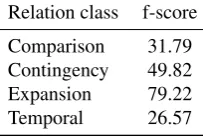
In this work, we describe Labov’s theory of narrative analysis (Section 2). We construct a new corpus of nar-rative structure directly from narnar-ratives collected and an-notated by Labov (2013) (Section 3). We use this corpus to explore the similarities between narrative structure and implicit discourse relations (Section 4). Detecting implicit discourse relations is difficult, and state-of-the-art systems achieve results ranging from 26.57 f-score on some classes of discourse relations to 79.22 f-score on others (Pitler et al., 2009; Zhou et al., 2010; Park and Cardie, 2012; Biran and McKeown, 2013). We show that the elements of nar-rative structure defined by Labov (2013) can be mapped to the four classes of discourse relations annotated in the Penn Discourse Treebank (Prasad et al., 2008a).
We propose a computational linguistics task that embod-ies Labov’s theory of narrative structure (Section 5) and conduct preliminary experiments using supervised learn-ing on our corpus to automatically detect Complicatlearn-ing Ac-tions, a narrative structure element, achieving 71.55 f-score (Sections 6). Our results show that the theory proposed by Labov and Waletzky (1967) describes a narrative structure that can be detected automatically. In addition, we com-pare the informativeness of features adapted from Labov’s theory of narrative analysis to that of features drawn from work on implicit discourse relations and find that, while the narrative features outperform the discourse features, the
best results are achieved using both feature sets (Section 7). Our findings suggest that integrating the task of detecting narrative structure with that of detecting discourse relations may help both.
Finally, we suggest directions for future work on detect-ing narrative structure and argue that this work can be lever-aged to improve the detection of implicit discourse relations (Section 8).
2
Narrative Analysis
Labov and Waletzky (1967) defined a structure of narra-tive consisting of three elements: the orientation, the com-plicating action, and the evaluation. Labov (2013) refined this structure to include additional elements: the abstract, the resolution, and the coda. Each clause of a narrative is assigned to one of these elements of narrative structure, but not all elements are necessary in every narrative – the orig-inal three defined by Labov and Waletzky (1967) are suffi-cient for a narrative.
The Abstract Narratives are organized around a single “most reportable event”. Of all the events in the story, this is the most fantastic (the least credible) and has the great-est effect on the lives of the characters. The abstract is an introduction to the story and often contains a description of the most reportable event. For example,
Shall I tell you about the first man got kilt – killed by a car here... Well, I can tell you that.
When I let go his arm, there was a knife on the table,
is given towards the end of the narrative, just before the Schissel is stabbed with the knife.
The Complicating ActionThe complicating action is a chain of causal or instrumental events that culminates in the most reportable event. The complicating action chain tells what happened in the story. In “Jacob Schissel’s story”, the chain of complicating actions is as follows:
1. He saw a rat out in the yard 2. and he started talk about it [sic] 3. and I told him to cut it out. 4. ...I grabbed his arm
5. and twisted it up behind him. 6. he picked up [the knife] 7. and he let me have it.
Each event is causally related to the one before it, except for events 5 and 7, which are instrumentally related to events 4 and 6.
The Evaluation The evaluation is where the narrator gives his opinions on the events of the story, considers alter-native outcomes, assigns praise or blame to the characters, or attempts to add credibility to the story. Evaluations usu-ally come at the end of a narrative, but like orientations, they can be interjected among the events of the complicat-ing action. For example, Jacob Schissel gave this evaluation on being stabbed:
And the doctor just says, “Just that much more,” he says, “and you’d a been dead.”
This evaluation serves two purposes: first, it presents an alternative outcome in which the narrator did not survive the stabbing; second, it adds credibility to the stabbing by quoting a third party witness, the doctor.
The Resolution Some narratives extend the chain of events to a final resolution of the situation created by the most reportable event. For example, in a narrative about a fight, the narrator gives the resolution,
An’ they took us – they took us to the hospital.
The CodaThe coda signals the end of the story by bring-ing the listener back to the present. For example, in the story about the fight, the lines
An’ that was it. That’s the only fight I can say I ever lost.
relates the events of the narrative to the present.
3
Corpus
We created a corpus from 20 oral narratives of personal experience collected by Labov (2013). Of these, ten were longer, episodic narratives, where each episode had its own internal structure. We treated each episode as an indepen-dent narrative, for a final count of 49 such narratives. Labov (2013) also discusses biblical and historical narratives, but these are very different in style from the narratives of per-sonal experience that make up the bulk of his work, so we
did not include them. The corpus is small, but we refrained from including additional narratives. We used only narra-tives collected and annotated by Labov (2013) because we tried to represent his theory as accurately as possible in our work.
We did measure interannotator agreement in order to establish a ceiling on performance for our computational experiments and to determine how difficult it would be to train new annotators. We compared two annotators to Labov’s gold standard annotations: one of the authors, who was trained by Labov in a semester-long course on narra-tive analysis and had high agreement with Labov (86.04%; κ = 0.85), and an undergraduate computer science stu-dent who was trained by the authors over the course of two weeks and had only moderate agreement with Labov (61.08%;κ= 0.58). Most disagreements between the an-notators and Labov were on Evaluation labels. In the ex-ample previously given,
And the doctor just says, “Just that much more,” he says, “and you’d a been dead.”
Labov chose the Evaluation annotation because he believed that the narrator intended to use this quote to add credibility to his story. However, there is no way to know for sure what the narrator intended, so whether an annotator marks this line as Evaluation or Complicating Action depends on what he or she believes the narrator was trying to say.
Labov was careful to transcribe each narrative exactly as it was presented by the original narrator, including the narrator’s gestures and non-verbal reactions from the in-terviewer and other listeners. We removed all non-verbal communications and retained only what was said by the narrator. We also manually normalized speakers’ accents. These normalizations are systematic throughout the narra-tives where they appear and therefore are unrelated to nar-rative structure. For instance, in a narnar-rative taken from an interview with a Scottish speaker, Labov (2013) tran-scribes the speaker’s accent in words such as “doon” and “ootside”, “couldnae” and “wasnae”; we normalized these words to “down” and “outside”, “could not” and “was not”. These normalizations allowed us to use off-the-shelf tools for part-of-speech tagging and parsing.
Labov (2013) manually split each narrative into clauses and annotated each clause with one of the elements of nar-rative structure. However, because the narnar-ratives are tran-scribed speech, many of Labov’s clauses consist of run-on sentences or multiple fragments of sentences. As will be discussed in Section 6, some of our features are based on the verb phrase and main verb of the clause, so we need to consider each independent clause separately. As a re-sult, in building the corpus, we used an automatic, rule-based chunker to split narratives into clauses. Each result-ing clause was annotated with the label of the correspond-ing Labov clause. In many cases, our chunker split Labov clauses into multiple clauses. For example, the following is split into two clauses at the comma after “again”:
Predicted Relation Class
Arguments Temporal Contingency Comparison Expansion Total
Abstract, Abstract 0 6 4 1 11
Abstract, Orientation 0 6 4 7 17
Orientation, Orientation 3 77 78 86 244
Orientation, Complicating Action 0 25 13 29 67
Complicating Action, Orientation 0 9 9 15 33
Complicating Action, Complicating Action 2 188 127 134 451
Complicating Action, Evaluation 0 42 12 14 68
Evaluation, Complicating Action 0 22 10 8 40
Evaluation, Evaluation 0 71 33 33 137
Evaluation, Resolution 0 8 4 5 17
Resolution, Resolution 0 11 8 7 26
[image:3.595.69.525.78.259.2]Total 5 467 307 340 1,119
Table 2: Mapping from narrative structure to discourse relations.
Structural Element Number of Clauses
Abstract 25
Orientation 340
Complicating Action 573
Evaluation 262
Resolution 47
Coda 30
Total 1,277
Table 1: Distribution of clauses in the corpus.
In other cases, our automatically chunked clauses con-sisted of multiple, consecutive Labov clauses joined to-gether; these were annotated with the Labov clause with which they had the greatest overlap. For example, Labov (2013) treats the following as four clauses:
CA So he walked into Martin Cassidy’s house, his own house,
CA came out with a double-bitted axe, RS hit him across the head once, RS turned over,
We treat this as a single clause with the label CA (com-plicating action). For convenience, we will refer to a clause that is labeled as part of the abstract as an Abstract, a clause that is labeled as part of the orientation as an Orientation, and so on.
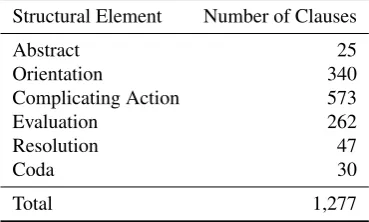
Our finished corpus consists of 1,277 clauses distributed among the structural elements as shown in Table 1. In Labov’s gold standard annotations, there are only 1,233 clauses: 20 fewer Orientations, 3 fewer Complicating Ac-tions, 29 fewer EvaluaAc-tions, 5 fewer ResoluAc-tions, and 3 fewer Codas than our corpus. Our automatic clause chunker performed 82 joins, where two consecutive Labov clauses were joined into one clause, and 127 splits, where one Labov clause was split into two clauses.
4
Comparison to Implicit Discourse
Relations
We hypothesize that the tasks of detecting narrative structure and detecting implicit discourse relations are re-lated. While discourse relations hold between two argu-ments and narrative structure eleargu-ments are assigned to indi-vidual clauses, the four sense classes of discourse relations defined by Prasad et al. (2008b) can be mapped to the el-ements of narrative structure that serve as their arguments. For clarity, PDTB relations are initalics.
To test this hypothesis, we use a modified version of the system described by Biran and McKeown (2013) to identify implicit discourse relations between adjacent clauses in our corpus. In private communication, Biran noted two differ-ences between this system and that which was published. First, this system uses culled word-pair lists that are more practical for applications than the very large word-pair lists used in the publication. Here, only the top 10% of pairs are used, with only a slight decrease in performance. Second, this system implements five-way classification, which the publication did not. The four binary classifiers described in the publication are cascaded in order of precision, and NoRel, or no relation, is predicted if none of the binary classifiers predicts a relation. The accuracy of this mod-ified classifier on a balanced test set with NoRel and the four classes of discourse relations equally represented is 51.75%. The output of the classifier on our corpus is shown in Table 2. We only show narrative structure pairs that oc-curred more than ten times in the corpus.
NoRel is never predicted, and the distribution of dis-course relation sense tags in our corpus is different from that in the Penn Discourse Treebank (PDTB). In our corpus, Contingencyrelations are the most common, while Expan-sionrelations are the most common in the PDTB (Prasad et al., 2008a). In both corpora, implicitTemporalrelations are relatively rare.
[image:3.595.77.262.308.419.2]which it can be an argument because certain relation classes are more likely to occur between particular narrative struc-tures. For example, about half of all relations in which one argument is an Evaluation areContingency relations, while relations in which one argument is an Orientation are more likely to beExpansions.
To better understand the correspondences between dis-course relations and elements of narrative structure, we an-alyzed a subset of ten narratives from our corpus (289 pairs of consecutive clauses) that Biran annotated by hand with the relation classes, types, and subtypes used in the PDTB. For each class of PDTB relations below, we identify the frequency of PDTB relations within this class in our corpus and how they corresponds to Labov’s narrative structure.
TemporalThe two types,Temporal:Synchronyand Tem-poral:Asynchronous, occur with equal frequency in this subset of our corpus.
Contingency Contingency:Cause relations occur be-tween pairs of Orientations and Complicating Actions and pairs of two Complicating Actions. This corresponds to Labov’s assertion that the events of a complicating action chain must be causally or instrumentally related to each other or to background information or characters’ motiva-tions. Contingency:Pragmatic Causerelations, where the first argument makes a claim that the second argument jus-tifies, are rare and occur between pairs of Complicating Ac-tions and EvaluaAc-tions. These relaAc-tions occur when the nar-rator is explaining a character’s motivations:
Arg1I talked him out of it and says, “Well, we’ll go look for her, and if we can’t find her well you can – go ahead, pull the trigger if you want to.” Arg2I was maneuvering.
Pragmatic Cause relations in which the justification is stated first, and the claim second, do not occur in the PDTB, but they do appear in our corpus:
I hurt my one knee... And I thought that was what my wife was coming to the shipyard to see me for, right? And here it is, I mean.
Arg1 “Oh, hey babe,” I said, “they got limousines that take you home if you’re hurt. You know.
Arg2You didn’t have to come see me.”
This may be due to a difference in genre; the PDTB anno-tates the Wall Street Journal corpus, while our narratives are transcribed speech.
Comparison Comparison:Concession relations, where one argument denies an expectation presented by the other, are the only type ofComparisonto occur in this subset of our corpus. This may be because the narratives in our cor-pus are about life-and-death situations, which Labov asserts are intrinsically surprising and unusual. For example, the above example about the narrator’s wife coming to see him at work continues,
“Oh, hey babe,” I said, “they got limousines that take you home if you’re hurt. You know. Arg1You didn’t have to come see me.”
Arg2And here it is she’s coming to tell me that my son died...
Here, the first argument sets an expectation for why the nar-rator’s wife has come, and the second argument violates that expectation. Another example is,
And I thought – I thought I’d bought it. I said, “Whoa, whoa, wait a minute, I’m not dead yet!” Arg1And the guys said, “No, we’re just shield-ing you from the sun.”
Arg2Boy, I thought I was dead!
Here the denial is given by the first argument, and the ex-pectation is given by the first.
Expansion Expansion:Conjunction relations are ex-tremely common in this subset of our corpus. Expan-sion:Restatementrelations are also relatively common and likely correspond to the narrator emphasizing a particular piece of information. Expansion:Alternative relations are rare and are used when the narrator is unsure of or does not clearly remember a piece of information.
5
Task Description
In the rest of the paper, we describe our experiments on automatically detecting narrative structure using supervised learning. Our ultimate goal is, for every clause in a narra-tive, to label it with one of the elements of narrative struc-ture, as annotated by Labov (2013); in this paper, we fo-cus on labeling the complicating action. For example, the clause
and Dad said, “George, I’m so sorry to hear about the death of –”
should be labeled as Complicating Action, while the clause
This was a good many years ago.
should be labeled as Other (it is part of the orientation), and the clause
“If he had died, I would have been one of the first people to know.”
should also be labeled as Other (it is part of the evaluation).
5.1 Related Work on Narrative
Computational approaches to narrative are largely split between work on characters and work on plot. Our exper-iments fall into the category of plot. Previous work in this area has focused on causality and temporal relations in nar-rative.
are related to Chambers and Jurafsky’s later work on nar-rative schemas, sequences of events that are characteristic of a particular domain (Chambers and Jurafsky, 2009). In contrast, our work focuses not on whether a Complicating Action chain is typical of stories in a particular domain, but rather on whether the Complicating Actions can be distin-guished from the other structural elements in the story.
Elson and McKeown (2009) created a tool for generat-ing semantic encodgenerat-ings of narratives. They later extended this work to produce a system for generating narrative text from semantic encodings, using tense and aspect to express the temporal relationships among events and states (Elson and McKeown, 2010). This differs from our work in that Labov’s theory of narrative structure focuses on the func-tions of clauses in a narrative and does not consider the se-mantics behind them.
Reidl and Young (2010) created a narrative planner that considered both causality among events and character in-tentionality to generate coherent narratives with believable characters. Rather than detecting Complicating Actions, as we do in this work, Reidl and Young (2010) generate them by choosing a sequence of actions to transition from an initial state to a pre-defined outcome state. However, the structure of the narratives produced by this system con-sists of a block of Orientations describing the initial state, followed by a block of Complicating Actions, and ending with a block of Resolutions describing the outcome state. This structure is relatively simple compared to the struc-tures produced by human narrators, which are the focus of our work.
6
Experiments
We focused on the task of distinguishing the Compli-cating Action from the rest of the narrative – just under half of the clauses in our corpus are Complicating Actions, while Orientations and Evaluations are less common, and Abstracts, Resolutions, and Codas are rare.
6.1 Features
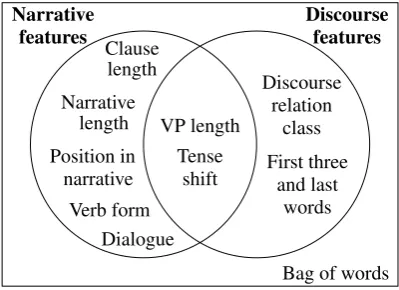
We used a bag of words over each clause, with proper nouns replaced with their named entity types as tagged by the Stanford Named Entity Recognizer (Finkel et al., 2005). We also used several features adapted from Labov’s theory of narrative analysis, as well as features drawn from work on detecting implicit discourse relations (Pitler et al., 2009). The organization of these features is shown in Figure 1.
For each clause, we also included the features ofn pre-ceding clauses to account for some narrative elements be-ing more likely to follow others. For example, Complicat-ing Actions are very likely to be preceded by Orientations and other Complicating Actions, somewhat likely to be pre-ceded by Evaluations, and highly unlikely to be prepre-ceded by Abstracts, Resolutions, and Codas. We experimented withnranging from 0 to 9. An experiment withn = 3, for example, would considern+ 1, or four, times as many features as an experiment withn= 0.
6.11. Narrative Features
Length of ClauseThe number of words in the clause. This serves as a simple approximation of the complexity of
Narrative features
Clause length
Narrative length
Position in narrative
Verb form Dialogue
VP length
Tense shift
Discourse features
Discourse relation
class
First three and last
words
[image:5.595.304.504.69.214.2]Bag of words
Figure 1: The organization of features.
a clause; Complicating Action clauses tend to be short and simple, while the other structural elements, and especially Evaluations, tend to be longer and more complex.
Length of NarrativeThe total number of clauses in the narrative containing the clause. Shorter narratives tend to consist mostly of Complicating Actions, while the other structural elements are more likely to occur in longer nar-ratives.
Position in NarrativeWhich quarter of the narrative the clause is in. Complicating Actions occupy the middles of narratives, while the other structural elements tend to occur near the beginnings (Abstracts, Orientations) or the ends (Evaluations, Resolutions, Codas).
Verb Form The tense of the main verb and the pres-ence of modals in the clause. Complicating Action clauses tend to be in either the past tense or what Labov terms the “historical present”, which is most commonly used with dialogue (“And then he says...”). The tenses of the other structural elements are more varied. The verbs and modals were tagged using the Stanford Parser (Klein and Manning, 2003) and were represented by binary features enumerating all possible tenses.
Dialogue Whether or not the clause contains a line of dialogue. Dialogue is more common in Complicating Ac-tions than in the other elements of narrative structure.
6.12. Discourse Features
Explicit Relation Class The sense classes of any ex-plicit PDTB connectives in the clause. Pitler et al. (2009) reported that some implicit discourse relations were more likely to appear immediately before or after certain explicit discourse relations. The sense classes were automatically extracted using the tool described by Pitler and Nenkova (2009) and represented by four binary features, one for each class.
Implicit Relation ClassThe sense classes of the implicit relation between the clause and the preceding clause and that between the clause and the following clause. The rela-tions were automatically identified using the classifier de-scribed in Section 4.
were represented as binary features enumerating the words that occur in the first three and last positions of all clauses in the corpus.
6.13. Shared Features
These features were motivated both by Labov’s theory of narrative analysis and work on implicit discourse relations. Length of Verb Phrase The number of words in the largest VP subtree in the clause, as produced by the Stan-ford Parser (Klein and Manning, 2003). Like the length of the clause, this is also an approximation for clause com-plexity. In addition, Pitler et al. (2009) suggested that longer verb phrases may correspond to Contingency rela-tions, while shorter verb phrases correspond toExpansion andTemporalrelations.
Tense ShiftWhether or not the tense of the main verb in the clause is different from that of the main verb in the preceding clause. A tense shift may occur when transi-tioning between the different elements of narrative struc-ture, such as from a past perfect Orientation to a historical present Complicating Action. From a discourse perspec-tive, Pitler et al. (2009) suggested that tense shifts occur in Contingency andTemporalrelations but not inExpansion relations. In addition, Labov (2013) proposes that tense shifts occur when the narrator tries to emphasize a part of the narrative. In a narrative told mostly in the past tense, the most reportable event may be given in the historical present, and in a narrative told in the historical present, the most re-portable event may be given in the past.
6.2 Methodology
We partitioned our corpus into a balanced training set of 918 clauses: 459 Complicating Actions and 459 Other clauses. Our testing set consisted of 114 Complicating Actions and 140 Other clauses. In both cases, the Other clauses were selected following the natural distribution of structural elements, shown in Table 1.
We trained a logistic regression classifier in Mallet (Mc-Callum, 2002) and chose the number of preceding clauses n = 9using 10 runs of two-fold cross-validation. We ex-perimented with other classifiers, including C4.5 and Naive Bayes, but these did not perform as well in cross-validation.
7
Results
[image:6.595.370.475.68.167.2]We achieved the best results using a logistic regression classifier on all features withn = 9, which we present in Table 3.
Experiment f-score
All features 71.55
Bag of words features 64.42 Majority (Other) baseline 61.96
[image:6.595.352.492.360.429.2]Random baseline 49.60
Table 3: Best results.
7.1 Analysis and Discussion
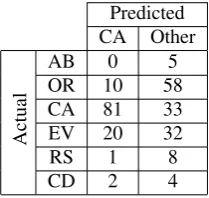
Table 4 shows the confusion matrix for our best results. Abstracts and Resolutions were relatively easy to
distin-Predicted
CA Other
Actual
AB 0 5
OR 10 58
CA 81 33
EV 20 32
RS 1 8
CD 2 4
Table 4: Confusion matrix for best results.
guish from Complicating Actions, while Evaluations and Codas were especially difficult.
We compared the performance of the narrative-motivated features with that of the discourse-motivated features (Ta-ble 5). Both feature sets include the bag of words fea-tures and the shared feafea-tures described in Section 6.13.. The narrative features outperform the bag of words base-line (p = 0.0050by two-tailed pairedt-test) and the dis-course features (p = 0.0058), but the difference between the discourse features and the bag of words baseline is not statistically significant.
Features f-score
All features 71.55
Narrative features 68.18 Discourse features 65.12 Bag of words features 64.42
Table 5: Comparison of narrative and discourse features.
We also compared the performance of individual features by ablation in Table 6. The best feature was the position of the clause in the narrative, which suggests that a sequence-tagging model may be suited to this task. The second best feature was the classes of the implicit relations in which the clause was an argument. This supports our hypothesis that the tasks of detecting narrative structure and detecting im-plicit discourse relations are related and that improvements in one task may be applicable to the other.
Features f-score
+Length of VP & narrative, first 3 & last words 71.55
+Explicit relation class 71.05
+Length of clause, dialogue 70.80
+Tense shift, verb form 69.68
+Implicit relation class 68.52
+Position in narrative 67.61
[image:6.595.307.546.595.701.2]Bag of words features 64.42
Table 6: Comparison of individual features.
[image:6.595.92.248.634.704.2]suggests that successfully detecting Complicating Actions could help in detecting certain classes of implicit discourse relations. For comparison, Biran and McKeown (2013) re-port the best scores over several state-of-the-art implicit dis-course relation detection systems (Table 7): Expansion re-lations are relatively easy to distinguish, whileContingency andComparisonrelations are more difficult.
Relation class f-score
Comparison 31.79
Contingency 49.82
Expansion 79.22
[image:7.595.118.220.168.236.2]Temporal 26.57
Table 7: Best scores on implicit discourse relations.
8
Future Work
We hope to explore the relationship between narrative structure and discourse by examining whether first identi-fying a structural element for each clause in a narrative can assist in detecting implicit discourse relations.
To do this, we must extend our system from distinguish-ing only between Complicatdistinguish-ing Actions and Others to de-tecting all of the elements of narrative structure. The main obstacle we face is the small amounts of Abstracts, Reso-lutions, and Codas available. These structural elements do not occur in every narrative – as Table 1 shows, our corpus contains only 25 Abstracts, 47 Resolutions, and 30 Codas. To address this problem, we need to collect significantly more data. We plan to explore the use of blogs. Blogs are a likely source of personal narrative and are easier for automated tools to handle than is our current corpus of tran-scribed speech.
After collecting more data, we would need to annotate the data or explore semi-supervised approaches. While it is not difficult to train an annotator, we saw in Section 3 that it can be difficult to assign a single element of narrative struc-ture to a clause – in particular, annotators tend to disagree on which clauses should be considered Evaluations. A pos-sible solution would be to allow clauses to have multiple labels.
We would also like to try reframing the task of detect-ing narrative structure as a sequence taggdetect-ing problem. As our experiments showed, information about the preceding clauses helped in labeling the current clause.
9
Conclusion
We have described a new task of detecting narrative structure elements based on the work of Labov and Walet-zky (1967) and Labov (2013) and presented experiments on detecting one element, the Complicating Action. We achieved 71.55 f-score, performing comparably to state-of-the-art work on detecting implicit discourse relations, and argued that the integration of these two related tasks can benefit both.
The advantage of Labov’s theory of narrative structure over discourse relations is that, while discourse relations
are general across all domains, narrative structure is specific to narrative. As a result, it is well-suited to tasks of narrative analysis and generation.
From the analysis side, narrative structure provides some measure of what it means for a narrative to be well-formed. While Labov’s theory is intended to be descriptive rather than prescriptive, it would certainly be strange for a nar-rative to have all orientating information at the end. This description of the expected skeleton of a “good” narrative could have applications in assessing the quality of narra-tive writing. Louis and Nenkova (2013) explored predict-ing the quality of science journalism articles uspredict-ing features that included the proportion of narrative text in the article and discourse-based measures for how well-written an arti-cle was – both are related to this work. Information about narrative structure could also be useful in automatic essay grading or detecting which blog posts or news articles will become popular. If there are two blog posts about the same topic and written by equally well-connected bloggers, and one goes viral while the other does not, is there something about the way the popular post was written that makes it a more effective narrative?
From the generation side, learned models of narra-tive structure could improve narranarra-tive generation systems. A narrative generation system might naively present all orienting information at the beginning of the narrative, whereas a human narrator might save a piece of information for later so as not to give away the ending. For example, in “Jacob Schissel’s story,” which was discussed in Section 2, it comes as a shock to the listener that Schissel is suddenly stabbed – if the Orientation about the knife had been pre-sented at the beginning, the narrative would have signifi-cantly less impact. A learned model of narrative structure could help narrative generation systems produce more flu-ent narratives.
10
References
Biran, O. and McKeown, K. (2013). Aggregated word pair features for implicit discourse relation disambiguation. InProceedings of the 51st Annual Meeting of the Asso-ciation for Computational Linguistics.
Chambers, N. and Jurafsky, D. (2008). Unsupervised learning of narrative event chains. InProceedings of the 46th Annual Meeting of the Association for Computation Linguistics: Human Language Technologies.
Chambers, N. and Jurafsky, D. (2009). Unsupervised learning of narrative schemas and their participants. In Proceedings of the 47th Annual Meeting of the Associa-tion for ComputaAssocia-tional Linguistics and the 4th Interna-tional Joint Conference on Natural Language Processing of the AFNLP.
Elson, D. and McKeown, K. (2009). A tool for deep se-mantic encoding of narrative texts. InProceedings of the ACL-IJCNLP 2009 Software Demonstrations.
Elson, D. and McKeown, K. (2010). Tense and aspect assignment in narrative discourse. In Proceedings of the Sixth International Conference in Natural Language Generation.
extrac-tion systems by gibbs sampling. InProceedings of the 43rd Annual Meeting on Association for Computational Linguistics.
Klein, D. and Manning, C. D. (2003). Accurate unlexical-ized parsing. InProceedings of the 41st Meeting of the Association for Computational Linguistics.
Labov, W. and Waletzky, J., (1967). Narrative Analysis, pages 12–44. University of Washington Press, Seattle, W.A.
Labov, W. (2013). The Language of Life and Death. Cam-bridge University Press, CamCam-bridge, U.K.
Louis, A. and Nenkova, A. (2013). What makes writing great? first experiments on article quality prediction in the science journalism domain. Transactions of Associa-tion for ComputaAssocia-tional Linguistics.
McCallum, A., (2002).MALLET: A Machine Learning for Language Toolkit.
Park, J. and Cardie, C. (2012). Improving implicit dis-course relation recognition through feature set optimiza-tion. InProceedings of the 13th Annual Meeting of the Special Interest Group on Discourse and Dialogue. Pitler, E. and Nenkova, A. (2009). Using syntax to
dis-ambiguate explicit discourse connectives in text. In Pro-ceedings of the ACL-IJCNLP 2009 Conference Short Pa-pers.
Pitler, E., Louis, A., and Nenkova, A. (2009). Auto-matic sense prediction for implicit discourse relations in text. InProceedings of the Joint Conference of the 47th annual Meeting of the ACL and the 4th International Joint Conference on Natural Language Processing of the AFNLP.
Prasad, R., Dinesh, N., Lee, A., Miltsakaki, E., Robaldo, L., Joshi, A., and Webber, B. (2008a). The penn dis-course treebank 2.0. InProceedings of the 6th Interna-tional Conference on Language Resources and Evalua-tion.
Prasad, R., Miltsakaki, E., Dinesh, N., Lee, A., and Joshi, A., (2008b). The PDTB 2.0 Annotation Manual. Reidl, M. and Young, R. M. (2010). Narrative planning:
Balancing plot and character. Journal of Artificial Intel-ligence Research, 39.