R E S E A R C H
Open Access
Energy-efficient power allocation for
massive M2M communication over LTE-A
cellular uplink
Ning Li, Yingqing He
*, Cong Wang, Yancheng Chen and Jianhui Xu
Abstract
In order to enable massive machine-to-machine (M2M) communication in Long Term Evolution-Advanced (LTE-A) cellular network, a machine-type communication gateway (MTCG) is introduced to solve the issue of control signaling overheads. In this paper, a power allocation algorithm based on the method of Lagrange multipliers is proposed for massive M2M communication over LTE-A cellular uplink. The proposed algorithm can decrease the signaling overheads by enabling the machine-type communication device (MTCD) to access the base station (BS) via a MTCG that collects the data from a group of M2M devices and forward it to the BS. The core objective of the proposed algorithm is to maximize the total energy efficiency of a group of M2M devices, while satisfying the time delay of the M2M devices, by coordinating the power transmission of the MTCDs and the MTCG. The simulation results
demonstrate that the proposed algorithm outperforms the heuristic algorithm and has relatively close performance to the optimal design.
Keywords: Machine-to-machine communications, Power allocation, Long term evolution-advanced cellular network, Machine-type communication gateway, Machine-type communication device, Lagrange multipliers
1 Introduction
The number of radio devices that connect and transmit data to the radio network via Internet of Thing (IoT) [1] is increasing with the development of IoT. An important part of IoT is machine-to-machine (M2M) communica-tion, also known as the machine-type communication (MTC). This type of communication refers to automati-cally connect the M2M devices, also called the machine-type communication devices (MTCDs), to the radio network without human intervenes [2,3]. M2M commu-nication is widely used in various applications such as remote data collection, information perception, remote vehicle scheduling, smart grit, E-health, and remote main-tenance due to its special feature [4].
The Long Term Evolution-Advanced (LTE-A) cellu-lar network plays an important role in the deploy-ment of M2M communications due to its wide coverage and universal connectivity [5]. Enabling the M2M
*Correspondence:[email protected]
1Institute of Communication Engineering, Army Engineering University of PLA, No. 88 Houbiaoying Street, 210007 Nanjing, China
communications in LTE-A cellular network can signifi-cantly expand the radio connectivity of MTCDs and pro-mote the development of automation. Compared with the traditional human-to-human (H2H) communications, the M2M communications always consist of a large number of devices. The simultaneous communication of large num-ber of MTCDs with the base station (BS) will result in network congestion and paralysis leading to communica-tion failure and decrease in the quality of services (QoS) of H2H communication, due to the limited radio resource [6,7]. In order to resolve this issue, a machine-type com-munication gateway (MTCG) is required in the LTE-A network for M2M communications. A MTCG can reduce the number of MTCDs that are directly connected to the BS, decrease the control signaling overhead between the MTCDs and the BS, relieve the network congestions, and increase the spectral efficiency.
The MTCDs are always powered by a battery because they are usually deployed in dangerous or unreach-able places. Therefore, the energy efficiency becomes a more serious matter for massive MTCDs than for the conventional H2H user equipments [8, 9]. Thus, the
investigation of efficient radio resource allocation sched-ule and power control policy to increase the spectral efficiency while satisfying the time delay of MTCDs has become a trending research topic.
1.1 Related works
Limited literature is available about the power alloca-tion for M2M communicaalloca-tion between the BS and the MTCDs over the LTE-A cellular uplink. Ghavimi et al. [10] investigated the uplink scheduling and the power allocation for M2M communication in the LTE-A cellular network in order to improve the QoS, which consid-ered the MTCD communication directly with the BS. They jointly allocated the sub-channel and the devices’ transmit power to make maximize the sum-throughput and achieved improvement in the performance. However, they did not consider the energy efficiency of devices and when the massive MTCDs connect directly to the BS, it will rapidly increase the signaling overhead. Zhang et al. [11,12] investigated the optimal power control for delay-constraint M2M communications over the cellular uplink and decreased the control signaling overhead by adding a MTCG to the communication link between the MTCDs and the BS. However, they only studied the power allocation and did not consider the power efficiency for the MTCDs. Aijaz et al. [13] went into energy-efficient uplink resource allocation with M2M/H2H co-existence. They used the effective capacity as the throughput and considered the statistical time delay instead of the real-time delay of M2M/H2H users. Multiple source power allocation with buffer-aided relay network using adap-tive link selection has been investigated in [14]. However, this study did not consider the power allocation for the MTCDs and used the half-duplex transmission mode at the relay, considering only the statistical time delay. Tang et al. [15][16] investigated the resource allocation to max-imize the energy efficiency in MIMO broadcast channels and heterogeneous networks. However, they also did not consider the power allocation for relay MTCDs. All the abovementioned researches either focused on the energy-efficient power allocation without signaling overhead or considered the power allocation without energy efficiency. Therefore, this paper investigates the energy efficient power allocation for massive M2M communications with real-time delay to decrease the signaling overhead.
1.2 Contributions
In this paper, the main focus is on the power allocation for massive M2M communication over the LTE-A cellu-lar uplink. It introduces a MTCG that can collect data from a group of MTCDs and forward it to the BS in order to reduce the number of MTCDs that are directly connected to the BS, decrease the control signaling over-head between the MTCDs and the BS, and increase the
spectral efficiency. The paper aims to maximize the total power efficiency of the MTCDs while satisfying the delay requirements of data transmission by jointly allocating the power to the MTCDs and the MTCG. The main contributions of this work are summarized as follows:
• The MTCG relay-based massive M2M uplink model is used to allocate the MTCDs and the MTCG’s power. A MTCG can effectively collect the data from a group of MTCDs and forward it to the BS. Using the MTCG relay-based massive M2M uplink model, the control signaling overhead between the MTCDs and the BS is reduced and the spectral efficiency is increased.
• The total energy efficiency maximization for the MTCDs over the LTE-A cellular uplink is mainly focused in order to synergistically allocate power to the MTCDs and the MTCG. The framework is formulated as a total energy efficiency maximization problem, while respecting all the constraints
associated with power allocation for the MTCDs and the MTCG.
• The total energy efficiency maximization problem that uses bits/joule as the energy efficiency metric is transformed into the total joules/bit energy efficiency minimization problem [17,18]. Then, a Lagrange multipliers-based power allocation algorithm [19] is proposed to solve the problem and obtain the sub-optimal power solution.
1.3 Methods or experimental
The remainder of this paper is organized as follows: Section3provides the MTCG relay-based massive M2M uplink model and discusses the problem formulation; Section 4 describes the proposed Lagrange multipliers-based power allocation algorithm. The numerical results and the conclusions are presented in Sections 5 and 6, respectively.
2 System model and optimization problem
2.1 System model
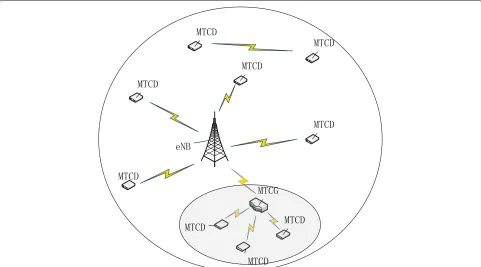
Fig. 1The resource allocation model. It is assumed that the distance between the MTCDs and the BS is large enough to ensure that no M2M device communicates directly with the BS, and all the devices transmit data via the MTCG in the LTE-A uplink
This paper only considers the second communication type in which the MTCDs transmit data bits to the BS through the MTCG. The MTCDs are divided into several groups. Each MTCD of a group communicates with the BS via a MTCG that can connectKactive M2M users. It is assumed thatK= {1, 2,· · ·,K}. It is also assumed that the MTCG can simultaneously receive-and-forward informa-tion for the active MTCDs at the same frequency, which can be realized by using the full-duplex (FD) relay tech-nology [20]. To this end, the MTCG should be equipped with two antennas, one for receiving the MTCDs’ data and the other is for forwarding information to the BS. The use of two antennas will introduce self-interference to the MTCG; it is assumed that the severe self-interference from transmit antenna to receive antenna can be elimi-nated completely.
2.2 Assumptions and LTE-A restrictions
In the considered system model, it is assumed that both the MTCDs-to-MTCG and the MTCG-to-BS links use the LTE-A specifications. It is supposed that the M2M devicek needs to transmitLk bit data to the BS within
time T, which can be treated as the time requirement that must be guaranteed from M2M devicek to the BS. The information of the MTCG connected withK active MTCDs isLG=Kk=1Lk, and the time for the
MTCG-to-BS link must be less thanT, which is considered to beTin
this paper. The data of the MTCG will be less thanLGin
reality because it will use data aggregation [21] when the MTCG will be decoding or re-encoding the received data. Assuming FD relay and receive-and-forward are used at the MTCG, the information transmission will be com-pleted in two phases. In the first phase, the MTCDs transmit data bits to the MTCG that detects and decodes the received signals, while in the second phase, the MTCG re-encodes the received data and sent it to the BS. It will add time delays in the process of signal processing, but it is ignored in this work. Since the distances between the MTCDs and the BS are large enough, the MTCDs cannot directly communication with the BS.
There exist some restrictions in resource allocation while using the SC-FDMA in the LTE-A cellular uplink [22]. For the allocations of subcarriers: (1) exclusivity restriction, a single RB should only be allocated to at most one user; (2) adjacent restriction, multiple RBs allocated to a same user must be adjacent. For the allocation of power: (1) The peak power transmitted on a RB of a user must be less than a given peak power levelPGmax,l ; (2) The total power transmitted by user should not exclude the given total power levelPGmax; (3) Power transmitted over all RBs that allocated to a same user must be equal. In this paper, the subcarrier allocation is not considered, soPmaxk and
2.3 Achievable data rates
Assume that the channel gain between the MTCDs and the MTCG is the same as the channel coefficient between the MTCG and the BS; both are modeled as the frequency-flat and block-fading, i.e., the MTCG as well as each of the MTCDs experiences the same channel fading in one TTI. The channel coefficienthmis given byhm =
Fm√1/Zm, whereFmis the channel fading coefficient and
Zm is the path loss [23]. The channel fading coefficient
Fmis always modeled as complex Gaussian random
vari-able with zero mean and unit variance. The path lossZm
is related to the distance between the transmitter and the receiver. It is given byZm = dα, wheredis the distance
andαis the path loss exponent, usually given from 2 to 6, depending on the communication environment.
Then, the channel gains in each TTI from the M2M device k to the MTCG and from the MTCG to the BS are hk,G = Fk,G
1/Zk,G and hG,B = FG,B
1/ZG,B,
respectively. There will exist interference in the received signal for the MTCG from the transmitted signal due to incomplete elimination,hSI is used as the channel gain of
self-interference link andis used as the self-interference intensity.
By using Shannon’s capacity formula, the upper bound on the achievable data rates (in bit/s) for the M2M device
kand the MTCG are respectively given by
Rk =Bklog2
whereBkandBGare the transmit bandwidths of the M2M
devicekand the MTCG, respectively, whilePkandPGare
the transmit powers of the M2M devicekand the MTCG, respectively,σ2is the power of Additive White Gaussian noise. The bandwidth of the MTCG is depended on the number of MTCDs connected to it.
2.4 Optimization problem
The required time for the M2M devicekto transmitLk
data bits to the MTCG is given asLk/Rk, and the MTCG
requires LG/RG time to forward LG data bits to the BS.
The energy efficiency is defined as the amount of data bits that can be transmitted per joule of energy consumed. Therefore, the power efficiency of each M2M device can be denoted asηk = TPLkk, and then, the sum-energy effi-ciency maximization power allocation problem can be derived as follows:
wherePmaxk andPGmaxare the maximal transmitting pow-ers of the M2M device k and the MTCG, respectively. Constraint (a) and (b) are the transmit power restrains for the MTCDs and the MTCG, respectively, which means that the device’s (MTCG’s) power is positive and must be less than the maximal value. Constraint (c) and (d) are time requirements for the MTCDs to send data bits to the MTCG and for the MTCG to forward the received information to the BS, respectively. This implies that the transmission time from the MTCDs to the MTCG and from the MTCG to the BS both should not exceedT .
3 The Lagrange multipliers-based power allocation algorithm
Although the optimization problem (3) is more tractable to obtain the optimal solution, the calculation is quite large and requires complex computation to solve the prob-lem directly, while the computing resources are limited for the system. Therefore, it is impractical to obtain the optimal solution directly from the optimal algorithm. To this end, a Lagrange multipliers-based power allocation algorithm is proposed that is relatively feasible in compu-tational complexity.
In order to use the proposed algorithm, the total energy efficiency maximization problem (3) that uses bits/joule as the energy efficiency metric is transformed into the total joules/bit power efficiency minimization problem [12,13] as follows: Lemma 1The solution of problem (3) is same as that for problem (4).
Proof Problem (3) and (4) are the inverse of each other, which can be decomposed into max Lk
TPk and min
TPk
Lk , respectively. WhenPk>0, letx=pkanda= LTk, then the
andy2 = xa, respectively. The objective do is to prove that the solutions of maxy1and miny2are the same. Now, taking the first-order derivatives ofy1andy2will provide
y,1 = −xa2 < 0,∀x > 0, and y,2 = 1ax > 0,∀x > 0,
respectively. This implies that y1 and y2 are monotonic subtraction and monotonic addition functions, respec-tively, and for any non-zero positive x ∈[x1,x2], the solutions of both maxy1 and miny2 are at x1. Hence, the solutions of maxy1and miny2 are the same, that is, the solution of problem (3) is same as that for problem (4). In order to solve problem (4), the optimal values of this problem are obtained as the upper bounds of the pro-posed algorithm by using the build-in function “fmincon” in MATLAB. The “fmincon” function uses thee branch and bound method and the Liner programming relax-ation to find the optimal solution. After that, the Lagrange multipliers-based power allocation algorithm is used to obtain the sub-optimal solution.
The Lagrange function of problem (4) is given as follows:
vectors of Lagrange multipliers for the MTCDs’ transmit power and data rate constraints, respectively, whileλand ρare the Lagrange multipliers for the MTCG’s power and rate constraints, respectively.
In order to solve the problem (5), the first-order deriva-tives ofL(Pk,γ,μ,λ,ρ) are obtained with respect toPk
andPG, respectively, and are made to be equal to zero. By
substituting (1) and (2) into (5)
The sub-optimal transmit power of MTCDs and MTCG can be obtained by
P∗k = BkμkLkh
After acquiring the solution of problem (5), the values of Lagrange multipliers(γ,μ)and(λ,ρ)are determined to obtain the solution of problem (4) by utilizing the ellipsoid and the subgradient methods [24], respectively (actually, the ellipsoid method is also a type of subgradient method; the only difference is that the former is used for a group of irrelevant variables while the latter is used for sin-gle variable). The Lagrange multipliers(γ,μ) and(λ,ρ) are jointly updated at each iteration, and problem (5) is solved to achieve the optimal(γ∗,μ∗) and(λ∗,ρ∗). The subgradient ofL(Pk,γ,μ,λ,ρ)is required by the ellipsoid
method and the subgradient method at each iteration and can be readily given atith iteration by
gi(γk)=Pmaxk −Pk,k=1, 2, ...,K, (10)
the multipliers (γ,μ) at each iteration and the ellip-soid method to update the Lagrange multipliers (γ,μ) as follows. First, the center of the ellipsoid is defined as Z = [γ,μ]T, and the shape asA−1. Then, the ellipsoid is
A minimal−volume new ellipsoid will be created at each iteration by using the subgradient that contains the other half of the past ellipsoid. Mathematically, the update algorithm is given as follows:
The variables (λ,ρ) are updated using the following simple iteration:
λi+1=λi−αλigi(λ), (18)
ρi+1=ρi−αρigi(ρ). (19)
where αiλ and αρi are step sizes for updating λ and ρ, respectively. Both do not depend on any data computed during the algorithm and must be determined before the algorithm is run [24]. Some basic step size rules are as fol-lows: (1) Constant step size. In this case, the step size is a positive constant and is independent of iterationi. (2) Square summable but not summable. The step sizes satisfy αi≥0,∞i=1αi2<∞,
The step sizes that satisfy this condition are called dimin-ishing step size rules. A typical example isαi=a/
√
i,a≥
0. In this paper, the square summable but not summable rule is used and the step sizesαiλandαiρare given as:
where Cλ andCρ are the constants for variables λ and ρ, respectively, and iis the iteration number order. The proposed Lagrange multipliers-based algorithm is sum-marized as Algorithm 1.
For the complexity analysis of the algorithm, the com-putation ofP∗G,P∗k, and the update of the Lagrange mul-tipliers(γ,μ)and(λ,ρ)are considered. In each iteration, it needsK computations to calculate the MTCDs’ power and 1 computation to calculate the MTCG’s power, so the worst-case complexity isO(I(K+1))with the algorithm executes to the maximum iterationI. However, in reality, it will not carry out toI. The ellipsoid method converges inO(2K)2iterations [25] with 2K multipliers variable. Then, the worst-case complexity of the proposed algorithm isOI(K+1)+(2K)2, approximate toOIK+4K2.
Algorithm 1Proposed Lagrange-base Power Allocation Algorithm
1. Initialization:K,Lk,∀k∈1, 2,· · ·,K,PGmax,Pmaxk ,
∀k∈1, 2,· · ·,K,γ0,μ0,λ0,ρ0andA−01.
2. Whilei≤I, do
3. Calculate the optimal transmit powerPG∗of MTCG by (9);
4. fork<K
5. Calculate the optimal powerPk∗of MTCDs via (8);
6. end for
7. Update sub-gradient by (10)-(13); 8. Update Lagrange multipliers(γ,μ)and
ellipsoidA−1by ellipsoid method with (15)-(17); 9. Update Lagrange multipliers(λ,ρ)by sub-gradient method
with formulation (18)-(21);
10. Until converge to optimal(γ∗,μ∗)and(λ∗,ρ∗).
4 Simulation results and discussions
The simulation in this paper is based on the single cell, multi-users model in the LTE-A cellular uplink system. In the simulation, a MTCG and a group ofK =10 MTCDs connected to the MTCG in the cell are considered. The distances from the MTCDs to the MTCG and the MTCG to the BS are randomly varied from 50 to 100 and 500 to 1000 m, respectively. The channel fading accounts for small Rayleigh fading, large-scale path loss, and shad-owing (log-normally distributed). The power of Additive White Gaussian noise isσ2 = 10−10, and the other sim-ulation parameters are configured as Pmaxk = 14 dBm,
PmaxG = 24 dBm,T = 1 ms,Bk = 180 kHz, andBG =
Bk =1800 kHz.
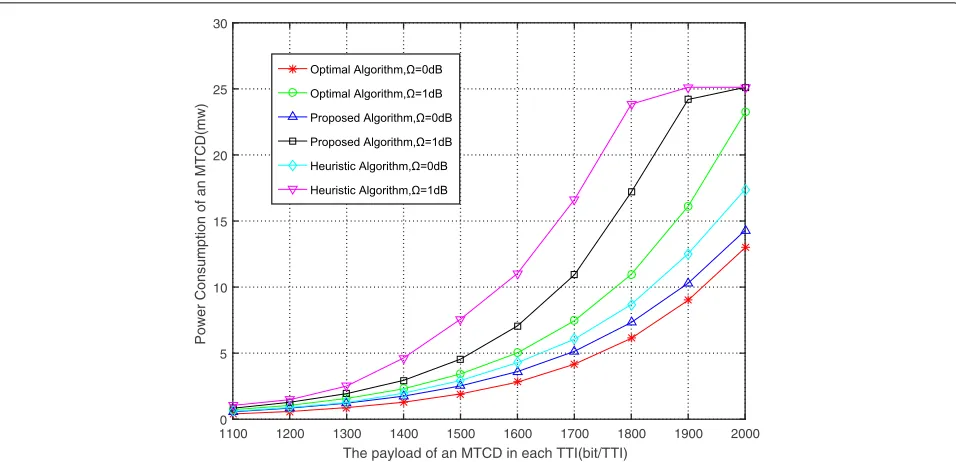
In order to verify the feasibility of the proposed Lagrange multipliers-based power allocation algorithm, the solution for energy efficiency problem (4) is obtained
1100 1200 1300 1400 1500 1600 1700 1800 1900 2000 The payload of an MTCD in each TTI(bit/TTI)
0 5 10 15 20 25 30
Power Consumption of an MTCD(mw)
Fig. 2The power consumption with different payloads. The MTCDs are uniformly distributed in 100-m radius of the MTCG, and the MTCG is uniformly distributed in 1000-m radius of the BS. The number of groups of MTCDs isK=10. The other configuration parameters are Pmax
k =14 dBm,PmaxG =24 dBm,T=1 ms,Bk=180 kHz, andBG=KBk=1800 kHz
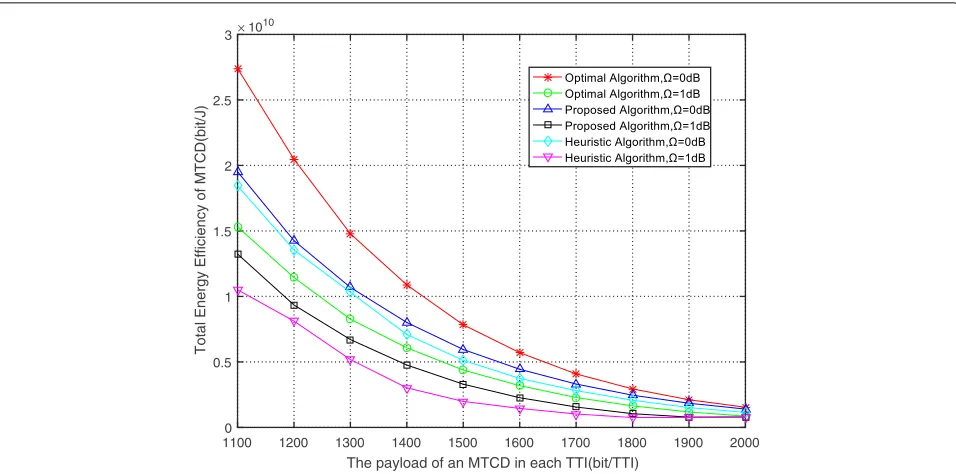
first by using the built-in function “fmincon” in MAT-LAB, which is considered as the optimal algorithm and treated as the upper bound of the achievable performance. Both scenarios, MTCG with self-interference ( =1 dB) and without self-interference (=0 dB), are considered. The data to be transmitted by the MTCDs in each TTI is changed from 1.1 Kbit/TTI to 2 Kbit/TTI, and the perfor-mances of the optimal algorithm, the proposed Lagrange multipliers-based algorithm, and the heuristic algorithm [9] are compared. The heuristic algorithm’s main process is as follows: firstly, the power of MTCDs and MTCG is computed based on the minimal data rate; then, the power of MTCDS and MTCG is updated to satisfy the restric-tion of SC-FDMA in reference’s assumprestric-tion; and lastly, the final power allocation is obtained by coordinating the MTCG’s power.
Figure2represents the relationship between the power consumption and the data to be transmitted by the M2M devices. It can be seen from the figure that the power consumption of devices increases with the increase in the data to be transmitted in each TTI. The reason is that with the data increase, the devices must increase their transmit power to ensure that the real transmit time sat-isfies the time requirements. The power consumption of MTCDs varies rapidly when there is no self-interference from the transmit signal at the MTCG. This is due to the fact that the MTCDs need more transmission power to balance out the MTCG’s self-interference and ensure essential decode performance for the MTCG when there
is interference from the MTCG’s transmit signal. It is obvi-ous from Fig.2that the proposed Lagrange multipliers-based power allocation algorithm is much better than the heuristic algorithm in simulation performances, and the consumed power of each MTCD is closer to the optimal algorithm, with low power consumptions.
1100 1200 1300 1400 1500 1600 1700 1800 1900 2000 The payload of an MTCD in each TTI(bit/TTI)
0 0.5 1 1.5 2 2.5 3
Total Energy Efficiency of MTCD(bit/J)
1010
Fig. 3The total energy efficiency with different payloads. The MTCDs are uniformly distributed in 100-m radius of the MTCG, and the MTCG is uniformly distributed in 1000-m radius of the BS. The number of groups of MTCDs isK=10. The other configuration parameters are Pmax
k =14 dBm,PmaxG =24 dBm,T=1 ms,Bk=180 kHz, andBG=KBk=1800 kHz
is built in MATLAB, it is difficult to compute the accu-rate convergence behavior of the optimal algorithm. The convergence behavior shown in the figure is an approxi-mation). The cost of quick convergence of the proposed algorithm is less energy efficiency compared to the opti-mal algorithm, which implies that the complexity of the
proposed algorithm is lower than the optimal algorithm, and is acceptable for the system.
Figure5demonstrates the influence on the total power efficiency of the MTCDs when the bandwidth of MTCG changes. From the formulation of MTCDs’ data rate, it can be observed that the MTCG’s transmission power
10 11 12 13 14 15 16 17 18 19 20 The Bandwidth of MTCG(x180k)
0 0.5 1 1.5 2 2.5
Total Energy Efficiency of MTCD(bit/J)
109
Fig. 5The total energy efficiency with different MTCG’s bandwidths. The MTCDs are uniformly distributed in 100-m radius of the MTCG, and the MTCG is uniformly distributed in 1000-m radius of the BS. The payload of each MTCD is 300 bit/TTI, and the number of groups of MTCDs isK=10
has nothing to do with MTCDs’ data rate when there is no self-interference at MTCG. Thus, the change in the MTCG’s bandwidth will not affect the devices’ power effi-ciency when there is no self-interference at the MTCG. However, self-interference exists at the MTCG, and the
powers of the MTCDs decrease with the increase in the bandwidth of the MTCG, increasing the total energy effi-ciency. This is due to the fact that the power of MTCG decreases when the MTCG’s bandwidth increases, which leads to the decrease in the self-interference and then
10 12 14 16 18 20
The Numbers of MTCDs
0 1 2 3 4 5 6
Total Energy Efficiency(bit/j)
109
MTCG Bandwidth=20*180k MTCG Bandwidth=25*180k MTCG Bandwidth=30*180k
2
0 4 6 8
50 55 60 65 70 75 80 85 90 95 100 The Distances between MTCG and MTCD(m)
0 1 2 3 4 5 6 7 8 9
Total Energy Efficiency of MTCD(bit/J)
109
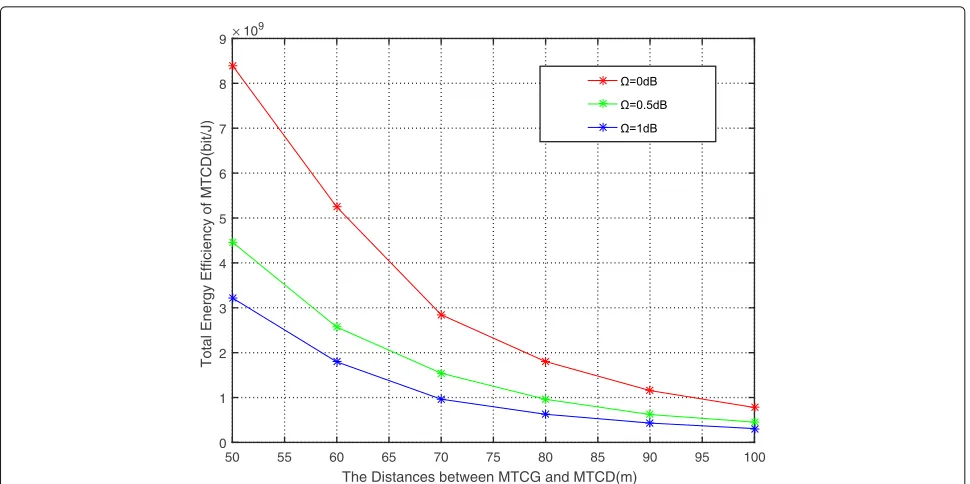
Fig. 7The total energy efficiency with varying MTCD-to-MTCG distances. The payload of each MTCD is 1000 bit/TTI, the MTCG’s bandwidth is 20×180 kbit, and the number of groups of MTCDs isK=10
causes the MTCDs’ power decrease. In addition, the total power efficiency increases with decrease in the self-interference.
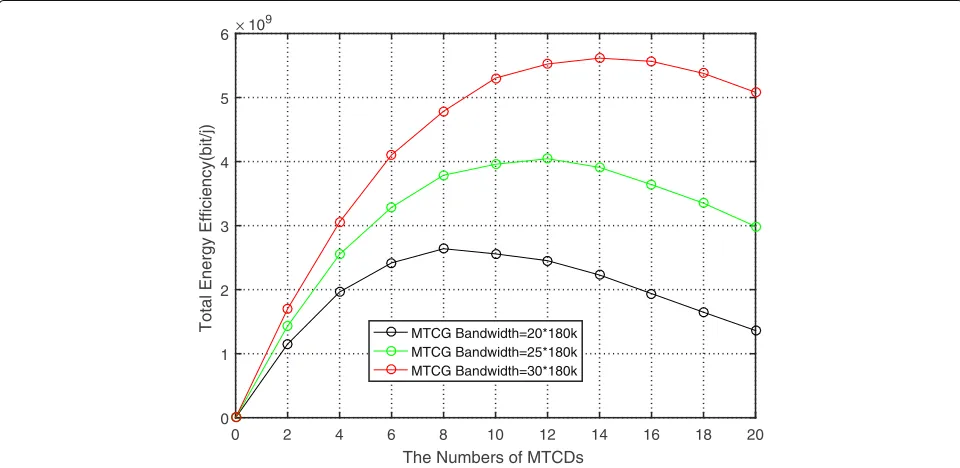
Figure 6 represents the total energy efficiency of MTCDs when the numbers of MTCDs change. It can be evidently seen that each MTCG bandwidth corresponds to the best number of MTCDs, which results in the total energy efficiency maximization. When the number of the MTCDs is less than the best number, the total energy efficiency increases with the increase in the number of MTCDs. The reason for this increase is that the MTCG’s bandwidth is abundant to transmit the data. The MTCDs’ transmit power increases slowly with the increase in the number of MTCDs. However, the data to be transmit-ted increases at a uniform rate, which is greater than the growth rate of MTCDs’ power, thus increasing the total energy efficiency increases. When the number of MTCDs exceeds the best number, the MTCG’s bandwidth becomes short for data transmission and the power con-sumption grows exponentially with the increasing number of MTCDs, e.g., the growth rate of power consumption is greater than the date rate increase speed that decreases the total energy efficiency. In summary, if it is required to increase the connected devices at MTCG, the MTCG bandwidth should also be increased to ensure the maxi-mization of the total energy efficiency.
Figure7shows the relationship between the total power efficiency and the distances from the MTCDs to the MTCG. It can be observed from the figure that when the distances increase, the channel fading also increases due
to the path loss that causes the increase of MTCDs’ trans-mit power to ensure the transtrans-mit time requirements, then results in the total efficiency decreasing.
5 Conclusions
In this paper, a power allocation problem for M2M com-munication in single cell and multi-user with LTE-A cel-lular uplink is thoroughly investigated. In addition, an novela Lagrange multipliers-based power allocation algo-rithm is proposed that is acceptable in computational complexity to allocate the MTCDs’ and the MTCG’s power, with a group of MTCDs connected to the MTCG. Simulations are performed to analyze and compare the performance of the proposed Lagrange multipliers-based algorithm with the optimal algorithm and the heuris-tic algorithm. Furthermore, the influences on the total power efficiency of varying the information to be trans-mitted by the MTCDs are studied with and without the self-interference at the MTCG. Moreover, the relationship of the MTCDs’ total energy efficiency and the band-width of the MTCG is analyzed. The simulation results demonstrate and validate that the proposed algorithm’s performance is closer to the optimal algorithm and has an acceptable complexity.
Abbreviations
BS: Base station; FD: Full-duplex; H2H: Human-to-human communications; IoT: Internet of Thing; LTE-A: Long Term Evolution-Advanced; M2M:
Quality of services; RB: Resource block; SC-FDMA: Single Carrier Orthogonal Frequency Division Multiple Access; TTI: Transmission time intervals.
Acknowledgements
This work is supported by the National Natural Science Foundation of China (nos. 61771486 and 61571463).
Funding
This work is supported by the National Natural Science Foundation of China (nos. 61771486 and 61571463).
Authors’ contributions
NL and YH conceived and designed the proposed scheme; they also performed the simulations. YH wrote the paper. CW, YC, and JX analyzed the simulation results. All of the authors participated in the project, and they read and approved the final manuscript.
Competing interests
The authors declare that they have no competing interests.
Publisher’s Note
Springer Nature remains neutral with regard to jurisdictional claims in published maps and institutional affiliations.
Received: 13 March 2018 Accepted: 11 October 2018
References
1. P. Andres-Maldonado, P. Ameigeiras, J. Prados-Garzon, J. Navarro-Ortiz, J. M. Lopez-Soler, Narrowband IoT data transmission procedures for massive machine-type communications. IEEE Net.31(6), 8–15 (2017) 2. G. Wu, S. Talwar, K. Johnsson, N. Himayat, K. D. Johnson, M2M: from
mobile to embedded internet. IEEE Commun. Mag.49(4), 36–43 (2011) 3. F. Ghavimi, H. H. Chen, M2M communications in 3GPP LTE/LTE-A
networks: architectures, service requirements, challenges, and applications. IEEE Commun. Surv & Tutor.17(2), 525–549 (2015) 4. G. Wu, S. Talwar, K. Johnsson, N. Himayat, K. D. Johnson, M2M: from
mobile to embedded internet. IEEE Commun. Mag.49(4), 36–43 (2011) 5. A. Aijaz, A. H. Aghvami, in2013 IEEE 77th Veh. Technol. Conf.On Radio
Resource Allocation in LTE Networks with Machine-to-Machine Communications (VTC Spring, Dresden, 2013), pp. 1–5
6. A. Rajandekar, B. Sikdar, A survey of MAC layer issues and protocols for machine-to-machine communications. IEEE Internet Things J.2(2), 175–186 (2015)
7. T. Taleb, A. Kunz, Machine type communications in 3GPP networks: potential, challenges, and solutions. IEEE Commun. Mag.50(3), 178–184 (2012)
8. A. Ahmad, M. Assaad, in2011 IEEE 22nd International Symposium on Personal, Indoor and Mobile Radio Communications. Power efficient resource allocation in uplink SC-FDMA systems, (Toronto, 2011), pp. 1351–1355
9. D. Feng, C. Jiang, G. Lim, L. J. Cimini, G. Feng, G. Y. Li, A survey of energy-efficient wireless communications. IEEE Commun. Surv.& Tutor.
15(1), 167–178 (2013)
10. F. Ghavimi, Y. W. Lu, H. H. Chen, Uplink scheduling and power allocation for M2M communications in SC-FDMA-based LTE-A networks with QoS guarantees. IEEE Trans. Veh. Technol.66(7), 6160–6170 (2017) 11. G. Zhang, A. Li, K. Yang, L. Zhao, D. Cheng, Optimal power control for
delay-constraint machine type communications over cellular uplinks. IEEE Commun. Lett.20(6), 1168–1171 (2016)
12. G. Zhang, A. Li, K. Yang, L. Zhao, Y. Du, D. Cheng, Energy-efficient power and time-slot allocation for cellular-enabled machine type
communications. IEEE Commun. Lett.20(2), 368–371 (2016)
13. A. Aijaz, M. Tshangini, M. R. Nakhai, X. Chu, A. H. Aghvami, Energy-efficient uplink resource allocation in LTE networks with M2M/H2H co-existence under statistical QoS guarantees. IEEE Trans. Commun.62(7), 2353–2365 (2014)
14. L. Rongkuan, P. Popovskiy, W. Gang, in2015 10th International Conference on Communications and Networking in China (ChinaCom). Adaptive link selection and power allocation buffer-aided relay networks with multiple sources, (Shanghai, 2015), pp. 312–316
15. J. Tang, D. K. C. So, N. Zhao, A. Shojaeifard, K. K. Wong, Energy efficiency optimization with SWIPT in MIMO broadcast channels for Internet of Things. IEEE Internet of Things J.
16. J. Tang, D. K. C. So, E. Alsusa, K. A. Hamdi, A. Shojaeifard, Resource allocation for energy efficiency optimization in heterogeneous networks. IEEE Sel, J., Areas Commun.33(10), 2104–2117 (2015)
17. V. Rodoplu, T. H. Meng, Bits-per-joule capacity of energy-limited wireless networks. IEEE Trans. Wirel. Commun.6(3), 857–865 (2007)
18. S. Kim, B. G. Lee, D. Park, Energy-per-bit minimized radio resource allocation in heterogeneous networks. IEEE Trans. Wirel. Commun.13(4), 1862–1873 (2014)
19. P. P. Mariio, inOptimization of Computer Networks: Modeling and Algorithms: A Hands-On Approach. Appendix B: mathematical optimization basics, vol. 1 (Wiley Telecom, 2015), p. 420.https://doi.org/ 10.1002/9781119114840app2
20. G. Zheng, Joint Beamforming Optimization and power control for full-duplex MIMO two-way relay channel. IEEE Trans. Signal Proc.63(3), 555–566 (2015)
21. G. Rigazzi, N. K. Pratas, P. Popovski, R. Fantacci, in2015 IEEE International Conference on Communications (ICC). Aggregation and trunking of M2M traffic via D2D connections, (London, 2015), pp. 2973–2978
22. I. C. Wong, O. Oteri, W. Mccoy, Optimal resources allocation inuplink SC-FDMA systems. IEEE Trans. Wirel. Commun.8(5), 2161–2165 (2009) 23. R. O’Donnell, Prolog to a unified approach to the performance analysis of
digital communication over generalized fading channels. Proc. IEEE.
86(9), 1858–1859 (1998)
24. Lecture Slides on Class EE364b of Stanford Univ. S. Boyd, Ellipsoid Method.https://www.stanford.edu/class/ee364b/lectures.html. Accessed 16 Dec 2017