R E S E A R C H
Open Access
Q-learning-enabled channel access in
next-generation dense wireless networks
for IoT-based eHealth systems
Rashid Ali
1, Yazdan Ahmad Qadri
1, Yousaf Bin Zikria
1, Tariq Umer
2, Byung-Seo Kim
3and Sung Won Kim
1*Abstract
One of the key applications for the Internet of Things (IoT) is the eHealth service that targets sustaining patient health information in digital environments, such as the Internet cloud with the help of advanced communication
technologies. In eHealth systems, wireless networks, such as wireless local area networks (WLAN), wireless body sensor networks (WBSN), and wireless medical sensor networks (WMSNs), are prominent technologies for early diagnosis and effective cures. The next generation of these wireless networks for IoT-based eHealth services is expected to confront densely deployed sensor environments and radically new applications. To satisfy the diverse requirements of such dense IoT-based eHealth systems, WLANs will have to face the challenge of assisting medium access control (MAC) layer channel access in intelligent adaptive learning and decision-making. Machine learning (ML) offers services as a promising machine intelligence tool for wireless-enabled IoT devices. It is anticipated that upcoming IoT-based eHealth systems will independently access the most desired channel resources with the assistance of sophisticated wireless channel condition inference. Therefore, in this study, we briefly review the fundamental models of ML and discuss their employment in the persuasive applications of IoT-based systems. Furthermore, we propose Q-learning (QL) that is one of the reinforcement learning (RL) paradigms as the future ML paradigm for MAC layer channel access in next-generation dense WLANs for IoT-based eHealth systems. Our goal is to contribute to refining the motivation, problem formulation, and methodology of powerful ML algorithms for MAC layer channel access in the framework of future dense WLANs. This paper also presents a case study of next-generation WLAN IEEE 802.11ax that utilizes the QL algorithm for intelligent MAC layer channel access. The proposed QL-based algorithm optimizes the performance of WLAN, especially for densely deployed devices environment.
Keywords: Internet of Things, eHealth systems, Machine learning, Next-generation dense WLANs, MAC layer channel access
1 Introduction
Internet of Things (IoT) technology connects physical objects with the help of sensors and actuators by utilizing the existing infrastructure of communication networks, specifically with the help of unlicensed wireless networks [1]. Therefore, IoT technology uses the existing network infrastructure and communication technologies to ensure its strength. Sensors and actuators play a vital role in connecting the physical world to the digital world [2,3]. The applications of IoT technology such as smart-cities,
*Correspondence:[email protected]
1Department of Information and Communication Engineering, Yeungnam
University, Gyeongsan, 38541, Republic of Korea
Full list of author information is available at the end of the article
industries, metering, grid, and smart-healthcare systems (IoT-based eHealth) are continuously increasing. It is expected that by the end of 2020, wireless-enabled devices will increase to 36.5 billion, and 70% of those would comprise sensor devices [1].
One of the key applications for the IoT is the eHealth service that targets sustaining patient health information in digital environments such as the Internet cloud with the help of advanced communication technologies. The World Health Organization (WHO) conducted a survey in 2013 and highlighted that upcoming decades would face the challenge of shortage of global health workforce, which would reach 12.9 million [4]. The main reasons of
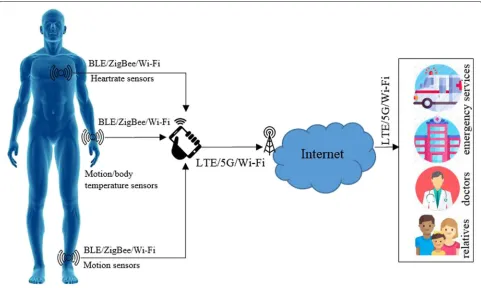
the decline are decreased interest in young people to pur-sue this profession, aging of current workforce, and the growing risk of non-infectious diseases such as cancer and heart stroke [4]. However, nowadays, health-related information can be easily monitored and tracked with the help of smart sensors and devices. This IoT-based eHealth enables people to allow emergency services/hospitals, doctors, and relatives to access their health-related data through different applications for immediate and efficient treatment. Handheld devices, such as smartphones and fitness bands, can act as on-body coordinators for person-alized health monitoring because they are equipped with a variety of sensors, such as heart rate measurement sensor, blood glucose and pressure sensors, temperature sensors, humidity measurement sensors, accelerometers, magne-tometers, and gyroscope (Fig. 1) [5]. There exist several built-in applications in such handheld smartphones, such as S-Health, to keep track of daily body fitness. How-ever, there are always concerns regarding data privacy and security, reliability, and trustworthiness in the extensive usage of wearable smart devices [5].
One of the key issues in IoT-based eHealth systems is the requirement of appropriate communication technolo-gies for efficient information sharing [6, 7]. Particularly, reliable connectivity is essential for real-time health-related information sharing. Wireless communication technologies are flexible and cost-effective for IoT-based
information sharing. As shown in Fig.1, a combination of both short-range wireless communication technologies, such as Bluetooth Low Energy (BLE), ZigBee, and IEEE 802.11 wireless local area network (WLAN), and long-range wireless communication technologies, such as Sub-1 Giga, LoRaWAN, and 4G/5G/LTE cellular systems, are typically considered [8,9]. Both academic and indus-trial communities have recognized the significant atten-tion given to future WLANs (IEEE 802.11) for IoT-based eHealth systems. One of their motivating services is the promisingly high throughput to support extensively advanced technologies even in densely deployed devices environment [10,11]. However, unlicensed WLAN would face huge challenges in the future to access the shared channel resources, especially for highly dense IoT device deployments. The use of small cells and information-centric sensor networks in forthcoming IoT-based system may help to reduce the performance degradation issues [3, 12]. The most popular wireless channel resource uti-lization technique utilized by the WLAN medium access control (MAC) protocol is known as carrier sense multiple access with collision avoidance (CSMA/CA). To achieve maximum channel resource utilization through fair chan-nel access in the WLANs with the ever-increasing density of contending IoT devices, the CSMA/CA scheme is very important as a part of IoT-based systems. CSMA/CA uses a binary exponential backoff (BEB) as its typical and
traditional channel contention mechanism [11]. In BEB, a backoff value for contention is generated randomly from a specified contention window (CW). The CW size is expo-nentially increased for each unsuccessful transmission and reset to its initial size once transmitted successfully. For a network with a heavy load, resetting CW to its mini-mum size after successful transmission will result in more collisions and poor network performance. Similarly, for fewer contending devices, the blind exponential increase of CW for collision avoidance causes an unnecessary long delay. Besides, this blind increase/decrease of the backoff CW is more inefficient in highly dense net-works proposed for IoT-based systems. Thus, the current CSMA/CA mechanism does not allow wireless networks to achieve high efficiency in highly dense environments.
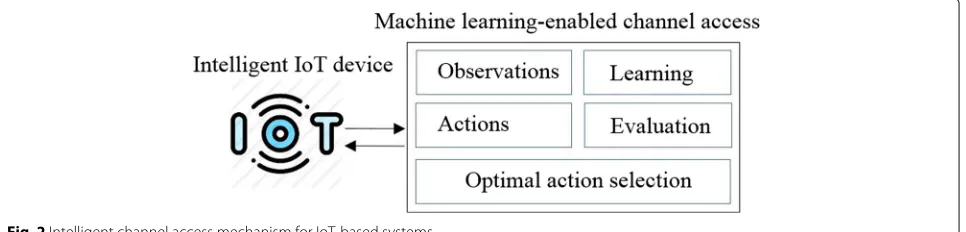
Future dense WLANs are anticipated to infer the diverse and interesting features of both the devices’ environments and their behavior to spontaneously optimize the relia-bility and efficiency of communication. Machine learning (ML), which is one of the prevailing machine intelligence tools, establishes an auspicious paradigm for optimiza-tion of the performance of WLANs [13]. As illustrated in Fig.2, we can imagine an intelligent IoT device that is capable of accessing channel resources with the aid of ML. Therefore, an intelligent device would observe and learn the performance of a specific action with the objective of preserving a specific performance metric. Further, based on this learning, the intelligent device aims to reliably improve its performance while executing future actions by exploiting previous experience. ML algorithms are typ-ically categorized into supervised [14] or unsupervised [15] learning algorithms. The supervised and unsuper-vised algorithms specify whether there are categorized samples in the available data (usually known as training data). Recently, another class of ML, known as reinforce-ment learning (RL), has emerged. It is encouraged by behavioral psychology [16,17]. RL is concerned with a cer-tain form of reward for a learner (such as an intelligent IoT device) that is associated with its environment (such as IoT-based eHealth system) through its observations and actions.
In this study, we briefly assess the fundamental perceptions of ML and propose services in persuasive applications for IoT-based systems based on the super-vised, unsupersuper-vised, and RL categories. ML can be used extensively for revealing numerous practical problems in the future dense WLANs of the IoT-based application like eHealth systems. Examples include massive multiple-input multiple-output (MIMO), device-to-device (D2D) communications, femto/small cell-based heterogeneous networks, and high contention in dense WLAN environ-ments. Following are the contributions of this paper:
• We briefly present the fundamental insights of ML in persuasive applications for IoT-based systems. • Furthermore, we propose Q-learning (QL) that is one
of the prevailing algorithms of RL as the future ML paradigm for channel access in contention-based dense WLANs for IoT-based systems.
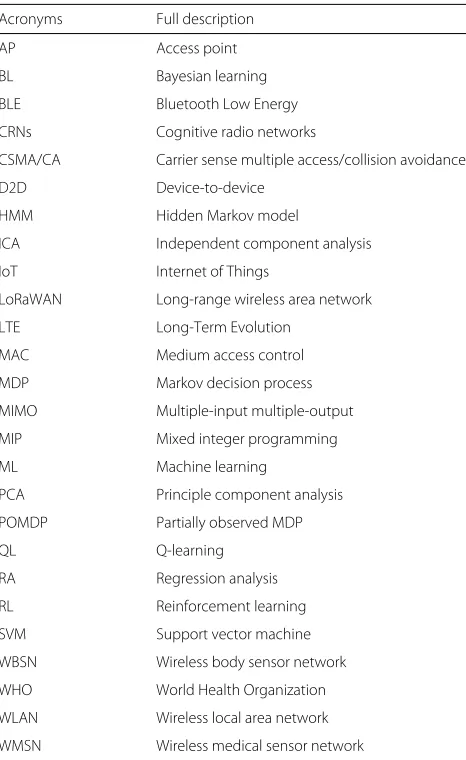
The goal of this paper is to aid readers in refining the enthusiasm for problem devising and the approach to powerful ML algorithms for channel access in the frame-work of future dense WLANs to tap into previously unex-plored applications of IoT-based systems. Table1shows list of acronyms used in this paper.
2 Machine learning in WLANs for IoT-based
systems
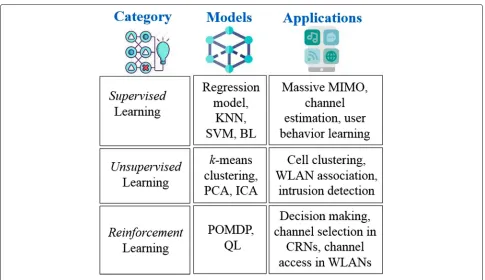
As aforementioned, ML is usually categorized as super-vised, unsupersuper-vised, and the most recently evolved RL algorithms. In this section, we elaborate the role of these categories in wireless communication networks for IoT-based systems. Figure 3 summarizes the family archi-tecture of ML techniques, models, and their potential applications in dense IoT-based systems.
2.1 Supervised learning
In supervised ML, the learning agent learns from a labeled training dataset supervised by an erudite exterior super-visor. Each labeled training dataset is a depiction of a state comprising a specification, label, particular action,
Table 1List of acronyms used in this paper
CSMA/CA Carrier sense multiple access/collision avoidance
D2D Device-to-device
HMM Hidden Markov model
ICA Independent component analysis
IoT Internet of Things
LoRaWAN Long-range wireless area network
LTE Long-Term Evolution
WBSN Wireless body sensor network
WHO World Health Organization
WLAN Wireless local area network
WMSN Wireless medical sensor network
and class to which that particular action belongs. The objective of supervised ML is to make the system infer its retorts so that it acts intelligently in states not present in the labeled training dataset [18]. Although supervised ML is a significant type of ML, it is not suitable for a learner to learn the environment without the help of a supervisor and the available training dataset in it. Therefore, for the systems that need to deal interactively, it is often imprac-tical to obtain a sample training dataset of anticipated behavior that is equally precise and descriptive regarding all the states in which the device has to perform actions in the future. In an unexplored environment, wherein ML is expected to be most valuable, a device must be able to learn from its own experience of interaction with the environment [18,19].
Examples of supervised ML algorithms are regression models [20],k-nearest neighbor (KNN) [21], support vec-tor machine (SVM) [22], and Bayesian learning (BL) [18]. Regression analysis (RA) depends on a statistical method for assessing the relations among input parameters. The
objective of RA is to envisage the assessment of one or more continuously valued estimation objectives, given the assessment of a vector of input parameters. The estima-tion objective is a funcestima-tion of the independent parameters. The KNN and SVM techniques are mostly employed to categorize different objects in the system. In the KNN technique, an agent/device is categorized according to the votes of the neighbor agents. The agent is associ-ated with the category that is most common among its k-nearest neighbors. On the contrary, the SVM algorithm uses non-linear mapping for object classification. First, it converts the original training dataset into a higher measurement, where it befits distinguishability. Later, it explores for the optimized linearly separating hyperplane that is accomplished by distinguishing one category of agents from another [18]. On the contrary, the idea of BL is to estimate a posterior distribution of the target variables, given some inputs and the available training datasets. The hidden Markov model (HMM) is a simple example of reproductive paradigms that can be learned with the help of BL [19]. HMM is a tool for expressing probability distributions of the trail of observations in the system. More specifically, it is a generalization method, where the unseen (hidden) variables of the system are associated with each other through a Markov decision process (MDP) [23]. These hidden variables control the particular constituent to be selected for each observation, while being relatively independent of each other.
Fig. 3Machine learning family architecture models and their potential applications in dense IoT systems
proficient at learning the predominant factors for cogni-tive radio networks (CRNs). Their proposed mechanism covers both the MAC and the network layers of a wireless network.
2.2 Unsupervised learning
Unsupervised ML is usually regarding the verdict structure veiled in a collection of unlabeled training datasets. The terms supervised ML and unsupervised ML would appear to profoundly categorize most ML-based paradigms; however, they are not accurate. The aim of supervised ML is to learn the mapping from an input dataset to an output result where accurate values are pro-vided by a supervisor. On the contrary, in unsupervised learning, there is no external supervisor but only the avail-able input dataset. The objective is to find symmetries in the dataset. There is an edifice of the available dataset space, e.g., that certain patterns occur often, such patterns can help understand the action to be performed in the future for any unknown input. In the statistical context, this is also known as density estimation [18].
Examples of unsupervised ML algorithms arek-means clustering [21], principle component analysis (PCA) [26], and independent component analysis (ICA) [27]. The objective of k-means clustering is to divide user obser-vations into k clusters, where each observation is asso-ciated with the adjacent cluster. It uses the center of gravity (centroid) of the cluster, which is the mean value
of the observation points within that particular cluster. Continuous iteration of thek-means clustering algorithm keeps assigning an agent to the particular cluster in which the centroid is close to the agent based on a similar-ity metric. This similarsimilar-ity metric is known as Euclidean distance. Further, the in-cluster differences are also mini-mized until convergence by iteratively updating the cluster centroid is achieved [18]. PCA is used to transform a set of possibly associated parameters into a set of unassociated parameters that are known as the principal components (PCs). The number of PCs is always less than or equal to the number of original parameters/components. The first PC has the largest possible variance, and each sub-sequent PC has the utmost variance probable under the limitation that it is unassociated with the prior PCs. Basi-cally, the PCs are orthogonal (unassociated) because they are the eigenvectors of the covariance matrix that is sym-metric. Unlike PCA, ICA is a statistical method applied to expose unseen elements that inspire sets of haphazard parameters/components within the system [18].
networks to attain high energy efficiency, and the WLAN users are grouped to uphold an optimum access point (AP) association. Xia et. al. [28] proposed a hybrid sce-nario to diminish inclusive wireless traffic by encouraging the exploitation of a high-capacity optical infrastructure. They formulated a mixed-integer programming (MIP) problem to cooperatively optimize both network gateway splitting and the virtual radio channel provision based on typical k-means clustering. Both PCA and ICA are for-mulated to recover statistically autonomous source signals from their linear combinations using powerful statistical signal processing techniques. One of their key applica-tions is in the area of intrusion detection in wireless networks, which depends on traffic monitoring. Besides, similar issues may also be resolved in the dense wire-less communications technologies of IoT-based systems. PCA and ICA can also be invoked to classify user behav-ior in CRNs. In [29], the authors applied PCA and ICA in a smart grid scenario of IoT systems to improve the concurrent wireless transmissions of smart devices set up in the smart home. The statistical possessions of the received signals were oppressed to blindly isolate them using ICA. Their proposed mechanism enhances trans-mission capability by evading radio channel assessment and data security by excluding any wideband intrusion.
2.3 Reinforcement learning
Reinforcement learning (RL) is motivated by behavior-ist sensibility and a control philosophy, where an agent can achieve its objective by interacting with and learn-ing from its surroundlearn-ings. In RL, the agent does not have clear information whether it is close to its target objective. However, the agent can observe the environment to aug-ment the aggregate reward in an MDP [30]. RL is an ML technique that learns about the environment, what to do, and how to outline circumstances to current actions to maximize a numerical reward signal. Mostly, the agent is not informed about which actions to perform, and it has to learn which actions will produce maximum reward. In some exciting and inspiring situations, it is possible that actions will affect not only the instant reward but also the following state, and consequently, all succeeding rewards. MDPs offer a precise framework for model-ing decision-makmodel-ing in particular circumstances, where the consequences are comparatively haphazard, and the decision-maker partially governs the consequences.
Partially observable MDP (POMDP) [31] and QL [17] are the examples of RL. POMDP might be seen as specula-tion with MDP, where the agent is inadequate to perceive the original state transitions in a straightforward manner; therefore, it only has constrained information. The agent has to retain the trajectory of the probability distribution of the appropriate states based on a set of annotations, and the probability distribution of both the observation
probabilities and the original MDP [32]. QL might be conjured up to discover an optimum strategy for perform-ing action from any finite MDP, particularly when the environment is unknown [18].
The uses of POMDP paradigms create vital tools for supportive decision-making in IoT-based systems, where the IoT devices may be considered agents and the wire-less network constitutes the environment. In a POMDP problem, the technique first postulates the environment’s state space and the agent’s action space. Additionally, it endorses the Markov property among the states. Secondly, it constructs the state transition probabilities formulated as the probability of navigating from one state to another under a specific action. The third and final step is to enumerate both the agent’s instant reward and its long-term reward via Bellman’s equation [17]. Later, a wisely constructed iterative algorithm may be consid-ered to classify the optimum action in each state. The applications of POMDP comprise the network selection problems of heterogeneous networks, channel sensing, and user access in CRNs. In [32], the authors proposed a mechanism for transmission power control problems of energy-harvesting systems, which were scrutinized with the help of the POMDP model. In their proposed inves-tigation, the battery, channel, data transmission, and data reception states are defined as the state space, and an action by the agent is related to transmitting a packet at a certain transmission power. QL, usually in aggre-gation with the MDP models, has also been used in applications of heterogeneous networks. Alnwaimi et al. [33] presented a heterogeneous, fully distributed, multi-objective strategy for the optimization of femtocells based on a QL model [33]. Their proposed model solves both the channel resource allocation and interference coordi-nation issues in the downlink of heterogeneous femtocell networks. Their proposed model acquires channel distri-bution awareness and classifies the accessibility of vacant radio channel slots for the establishment of opportunis-tic access. Further, it helps choose sub-channels from the vacant spectrum pool.
3 Q-learning-enabled channel access for dense
WLANs
the challenges arising in QL but not in other types of ML techniques. To achieve considerable rewards, it is oblig-atory for a QL agent to choose those actions that it has tried before, and found them to be effective in construct-ing the reward (exploitation). However, to learn more about the environment, an agent has to try actions that it has not selected before (exploration). In exploitation, the agent has to attain what it has already experienced to optimize the process, and additionally, it must explore the environment to maximize the aggregated reward to make better selections in the future. The quandary is that neither exploration nor exploitation can be pursued exclu-sively without failing in the other process. The agent must try a diversity of actions and gradually favor those that appear to be the best. It is not possible to both explore and exploit with a particular action selection; therefore, we frequently refer to the “tussle” between these two.
3.1 Q-learning prototype
As aforementioned, QL algorithm utilizes a form of RL to solve MDPs without possessing complete information. In addition to the agent and the environment, a QL system has four main sub-elements: a policy, a reward, a Q-value function, and sometimes a model of the environment as an optional entity [17], as shown in Fig.4.
3.1.1 Policy
The learning agent’s manner of behaving at a particu-lar time is defined as a policy. A policy can be a modest utility or a lookup table; however, it may comprise exten-sive computations such an exploration process. A policy is fundamental for a QL agent because it alone is adequate to determine the behavior of an agent. Generally, poli-cies might be stochastic. A policy decides which action to perform in which state [17].
3.1.2 Reward
In each iteration, the QL agent receives a particular quan-tity from the environment known as the reward. The main objective of a QL algorithm is to collect as much reward
as possible. An agent’s exclusive goal is to exploit the accu-mulated reward collected over the long run. The reward describes the pleasant and unpleasant events for the agent. Reward signals are the instant and crucial topographies of the problem faced by the agent. The agent decides to change its policy based on the reward. For example, if the current action of the policy is followed by a low reward, then an agent may decide to select other actions in the future [17].
3.1.3 Q-value function
Although the reward specifies what is good at one instant, a Q-value function stipulates what is good in the end. Therefore, the Q-value of a state is the accumulated amount of reward that an agent gains at this state to pre-sume in the future [17]. For example, although a state may continuously produce a low instant reward, it may have a high Q-value owing to being repeatedly trailed by other states that produce high rewards. In a WLAN environment, rewards are similar to a high channel col-lision probability (unpleased) and a low channel colcol-lision probability (pleased), whereas Q-values resemble a more sophisticated and prophetic verdict of how pleased or unpleased the agent is in a particular state (e.g., the back-off stage). If there is no reward, then there will be no Q-value, and the only purpose of estimating the Q-value is to attain additional rewards. An agent is most anxious about the Q-value while giving and assessing verdicts. An agent selects optimum actions based on Q-value findings. It seeks actions that carry states of a maximum Q-value and not a maximum reward because these actions attain the highest amount from the rewards for the agent over the long run.
3.1.4 Environment model
Environment model is an optional element of QL, which imitates the performance of the system to some extent. Typically, it allows drawing inferences to be made about how the environment will perform [17]. For example, given a state and an action, the model might envision the
subsequent state and the next reward. Environment mod-els are used for planning a method to decide on a sequence of actions by considering latent future situations. In an example of a WLAN system, a device would like to plan its future decisions based on the given state (e.g., the back-off stage) and action, along with its rewards (e.g., channel collision probability).
3.2 Q-learning algorithm
LetSrepresent a finite set of conceivable states of an envi-ronment andArepresent a finite set of allowable actions to be performed. At timet, a learner (IoT device) observes the current state (s) of the environment and performs an action (a), i.e.,at = a ∈ A, based on both the apparent state and its previous experience. The action at changes the environmental state fromsttost+1 = s∗ ∈ S; conse-quently, the agent receives the reward (r) at timet,rtfor the specific action:at. The QL algorithm finds an optimal policy for state sthat optimizes the rewards over a long period of time. In the QL algorithm, a Q-value function, Q(s,a), estimates the reward as the cumulative discounted reward. An optimal Q-value, i.e.,Qopt(s,a), is determined using the Q-values. The QL algorithm finds the optimal Q-value in a greedy manner. The Q-value is updated as:
Q(s,a)=(1−α)×Q(s,a)+α×Q(s,a), (1)
whereαis the learning rate and takes values such as 0≤ α ≤1. Whenαis minimum, i.e., zero, the agent does not learn from the environment; therefore, the Q-value is not updated. When α is maximum, i.e., 1, the agent always learns; therefore, learning occurs quickly as seen in the following equation:
Q(s,a)=r(s,a)+β×maxaQ
s,a−Q(s,a), (2)
where β (0 ≤ β ≤ 1) weighs the immediate rewards more heavily than future rewards, and is known as the dis-count factor. Over a considerable period of time,Q(s,a) converges into Qopt(s,a). The simplest policy for action selection is to choose one of the actions with the max-imum measured Q-value (i.e., exploitation). If there are more than one greedy actions, then a choice is randomly
made among them. This greedy action selection method can be written as:
aopt=argmaxaQ(s,a), (3)
where argmaxa signifies the action a, for which the expression that follows it is exploited. An agent continu-ously exploits current knowledge to maximize the instant reward. A simple substitute is to perform greedily in most cases; however, sometimes (e.g., with a small probabilityε) the agent can randomly select from all the equal probabil-ity actions, independent of the Q-value. The method using this greedy and non-greedy action selection rule is known as theε-greedy method [17]. An advantage of such a tech-nique is that as the number of iterations increases, every action will guarantee thatQ(s,a)converges toQopt(s,a). This leads to the inference that the probability of choos-ing the optimum action converges to a value that is larger than 1 − ε, i.e., to adjacent certainty. In WLANs, for dense IoT-based systems, an agent would choose greedy actions from high-value actions (exploitation) to improve the throughput performance, and would perform a non-greedy action (exploration) to know the dynamicity of the network environment.
3.3 Case study: DCF-based backoff mechanism
The QL-based channel access scheme can be used to guide densely deployed IoT devices and allocate radio resources more efficiently. When an IoT device is deployed in a new environment, usually, no data are available on historical scenarios. Therefore, QL algorithms are the best choice to observe and learn the environment for optimal policy selection. For example, we consider the case study of DCF-based backoff mechanism of dense WLANs in IoT-DCF-based systems. In a densely deployed WLAN, channel collision is the most vital issue causing performance degradation. To tackle collision issues at the MAC layer, we propose adopting the QL algorithm. QL finds solutions through interacting and learning with an environment; therefore, we propose using the QL algorithm to model the optimal contention window (CW) in a channel observation-based
scaled backoff (COSB) mechanism [34] for dense wireless networks of IoT-based systems. In other words, a station (STA; a WLAN-enabled IoT device referred to as an STA) controls the CW selection intelligently with the aid of the QL-based algorithm.
In COSB [34] protocol, STAs select a random backoff value from the initial CW (CWmin) to contend for the wireless medium after observing the channel in an idle state for a distributed inter-frame space (DIFS) period. The period after DIFS is divided intoBobsdiscrete obser-vation time slots. The duration of each discrete time slot is either a constant idle slot time (σ) or a variable busy slot time (owing to successful or collided transmission). In COSB, each STA proficiently measures the channel observation-based collision probability (pobs) as:
pobs=1/Bobs× (Bobs−1)
(k=0)
Sk, (4)
whereSk =0 ifBobsis observed as idle or if the transmis-sion is successful, whereasSk = 1 if Bobsis observed as busy or the transmission has collided [34].
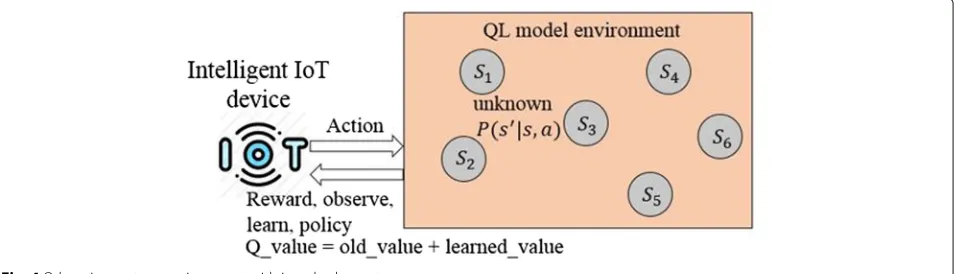
We assume backoff stages of COSB as a set ofmstates, i.e.,S= {0, 1, 2, ...,m}, where an intelligent IoT device per-forms an actionafrom a finite set of permissible actions A = {0, 1}, where 0 indicates decrement and 1 indicates increment. This is because in COSB, there are two possi-ble actions: increase or decrease the CW size [34]. At time t, the STA collects rewardrtin the response to an actionat following policyπin a particular statest; i.e.,rt(st,at)with the objective to exploit collective rewardQ(st,at), which is a Q-value function defined in Eqs. (1) and (2). Figure5
depicts the proposed QL model environment with its ele-ments in a DCF-based backoff mechanism for channel access in WLANs.
The selection of optimal action followingπoptis known as a greedy action
aπopt
selection policy that is defined in Eq. (3). A naivest policy can be to exploit in most cases; however, sometimes, the STA explores according to the default policyπ, independent ofaπopt. The explo-ration with probability (ε) and exploitation with probability (1−ε) is calledε-greedy method [17]. Theε-greedy tech-nique guarantees the convergence of learning estimate Q(s,a) with the increase of episodes (instances). In a dense WLAN environment, exploitation can be used to improve throughput performance by an IoT device, and exploration can be used to know the dynamicity of the WLAN environment.
In COSB [34], an STA conductspobsat every transmis-sion attempt. Therefore, we express pobs as the reward of the action at any specific state. Therefore, rewardrt produced by actionat taken in statest at time tcan be described as:
Table 2MAC layer and PHY layer simulation parameters
Parameter type Value
Frequency 5 GHz
Channel bandwidth 160/20 MHz
Data rate 1201/11 Mbps
Payload size 1472 bytes
Transmission range 10 m
Simulation time 100/500 s
Propagation loss model Log distance
Mobility model Constant position
Rate adaptation models Constant rate/minsttrel
rt(st,at)=1−pobs. (5)
The above equation indicates how pleased the STA was with its actionatin statest.
4 Experimental results and discussion
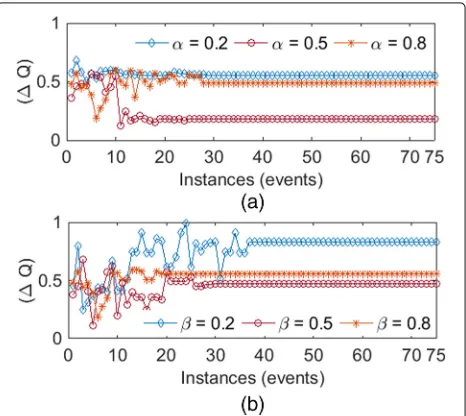
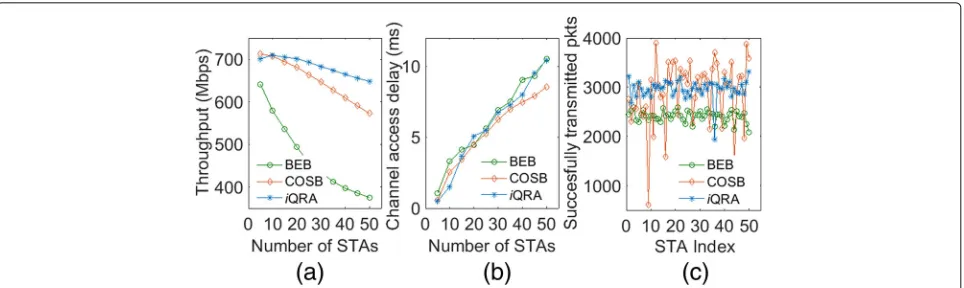
We used ns3.28 [35] simulator to perform experiments of the proposediQRA mechanism. Some important PHY layer and MAC layer simulation parameters are shown in Table 2. The results in Fig. 6a and b indicate that a small value ofαand a large value ofβmakeQ(learning estimate) converge faster. The convergence ofQclearly indicates that there exist optimal values that can be learned and exploited in the future. The throughput per-formance optimization of COSB using proposed iQRA is depicted in Fig. 7a. The performance of iQRA may degrade in small networks (i.e., for<10 contending STAs as shown in Fig.7a owing to low and irregular rewards).
Fig. 7Comparison of BEB, COSB, andiQRA forathroughput (Mbps),bchannel access delay (ms), andcsuccessfully transmitted packets (fairness)
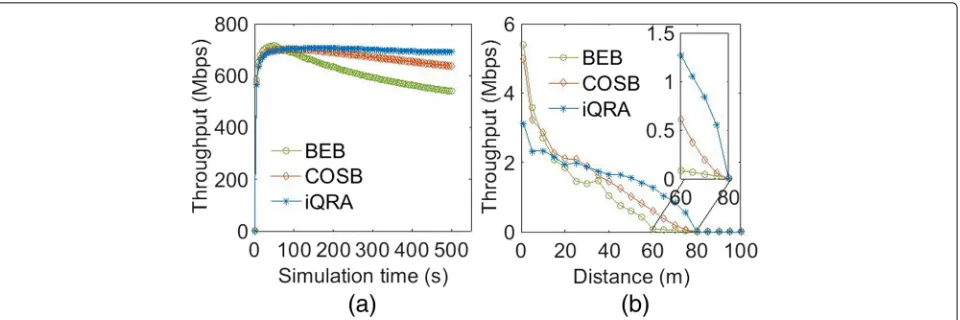
Additionally, the channel access delay is also increased for iQRA as compared to COSB; this is obvious owing to the environment inference characteristics; however, it remains lower than the conventional binary exponen-tial backoff (BEB) [11] mechanism shown in Fig. 7b. Figure7c portrays that the proposediQRA also improves the fairness of COSB. The optimized performance of COSB using iQRA clearly stipulates that the QL-based proposed mechanism is effective in learning the network environment. Additionally, iQRA is essentially intended to intelligently adjust its learning parameters according to the dynamics of the WLAN. Therefore, we simulated a dynamic network environment by increasing the number of contenders by 5 after every 50 s until the number of STAs reached 50. Figure8depicts the properties of net-work dynamics on Q. The figure shows simulation of a 500 s period with 1500 learning instances of a tagged STA. As shown in the figure, with the network dynamics, a tagged STA observes fluctuation in its learning esti-mate Q, thereby indicating the inference of change in the network. We see that the throughput performance of iQRA eventually reaches a steady state in a dynamic network environment, as shown in Fig. 9a. To evalu-ate the performance of the proposed iQRA for moving devices in the network, we simulated a distance-based rate adaptation model. This model changes the transmis-sion rate of the sender device according to the distance
between the sender and receiver to achieve the best pos-sible performance. IEEE 802.11a (11 Mbps) WLAN with 10 contending STAs is simulated for distance-based rate adaptation performance evaluation, as shown in Fig. 9b. Contending STAs are placed randomly around the access point (AP) within a distance of 25 m. A tagged STA starts moving away from the AP that is initially placed at a 1-m distance. As the distance from the AP increases, performance of a tagged STA degrades for all the three compared algorithms (BEB, COSB, andiQRA), as shown in Fig.9b. It is observed that the throughput of the BEB algorithm approaches close to zero after the STA reaches a distance of 60 m, and it finally becomes zero after reaching a distance of 80 m. Owing to the observation-based nature of COSB, it achieves higher throughput even after a 60-m distance, compared to BEB. How-ever, the proposediQRA performs optimally, even if the distance reaches 80 m owing to its network inference capability.
5 Conclusion
In this study, we investigated the benefits of ML-based intelligent dense wireless networks for IoT-enabled eHealth systems. We presented the key families of ML algorithms and deliberated their application in the con-text of dense IoT systems including next-generation wire-less networks with massive MIMO; heterogeneous IoT
Fig. 9Throughput comparison of BEB, COSB, andiQRA inadynamic network environment with increasing number of contenders after every 50 s andbdistance-based rate adaptation network environment
networks based on small cells; smart applications, such as the smart grid and smart city; and intelligent cognitive radio. The three well-known categories of ML, super-vised learning, unsupersuper-vised learning, and RL algorithms, are scrutinized in addition to a consistent sculpting methodology and possible future applications in dense IoT systems. Furthermore, we proposed Q-learning as a promising ML paradigm for MAC layer channel access in dense IoT systems. The proposed paradigm is imple-mented on a case study of DCF-based backoff mechanism in dense WLANs. We proposed an intelligent Q-learning-based resource allocation (iQRA) mechanism to optimize the performance of an existing (COSB) mechanism. The proposediQRA mechanism infers unknown wireless net-work conditions and exploits rapidly unexpected changes to learn dynamicity in dense WLANs. The experimental results show that iQRA significantly enhances the per-formance of COSB in terms of throughput and fairness. Results reveal the ability of the Q-learning scheme to determine dense wireless network environments in IoT-based systems. In conclusion, ML is a promising area for self-scrutinized intelligence-aided dense wireless network research for IoT-enabled eHealth systems.
In the future, we aim to further investigate the appli-cations of our proposed mechanism in various IoT-based systems such as smart city, smart home, smart grid, and smart industry.
Abbreviations
BLE: Bluetooth Low Energy; CSMA/CA: Carrier sense multiple access with collision avoidance; D2D: Device-to-device; IoT: Internet of Things; KNN:
k-nearest neighbor; MAC: Medium access control; MIMO: Massive multiple-input multiple-output; ML: Machine learning; QL: Q-learning; RL: Reinforcement learning; SVM: Support vector machine; WBSN: Wireless body sensor network; WHO: World Health Organization; WLAN: Wireless local area network; WMSN: Wireless medical sensor networks
Acknowledgements
This work was supported by the 2019 Yeungnam University Research Grant.
Authors’ contributions
RA and YAQ conceived the main idea, designed the algorithm, and proposed the intelligent framework for IoT-based eHealth systems. RA, YBZ, and TU performed the implementation of the proposition in the NS3 simulator. BK and SWK contributed to the structuring, reviewing, and finalizing of the manuscript. All authors read and approved the final manuscript.
Funding
The funding source is the same as described in the acknowledgements.
Availability of data and materials
Data sharing is not applicable to this article as no datasets were generated or analyzed during the current study.
Competing interests
The authors declare that they have no competing interests.
Author details
1Department of Information and Communication Engineering, Yeungnam
University, Gyeongsan, 38541, Republic of Korea.2Department of Computer
Science, COMSATS University Islamabad, Wah, Pakistan.3Department of
Computer and Information Communication Engineering, Hongik University, Seoul, 04066, Republic of Korea.
Received: 3 April 2019 Accepted: 24 June 2019
References
1. M. Pasha, W. SMShah, Framework for e-health systems in IoT-based environments. Wirel. Commun. Mob. Comput.2018(6183732), 1–11 (2018).https://doi.org/10.1155/2018/6183732
2. G. T. Singh, F. Al-Turjman, Learning data delivery paths in QoI-aware information-centric sensor networks. IEEE Internet Things J.3(4), 572–580 (2016).https://doi.org/10.1109/JIOT.2015.2504487
3. M. Z. Hasan, F. Al-Turjman, Evaluation of a duty-cycled asynchronous X-MAC protocol for vehicular sensor networks. EURASIP J. Wirel. Commun. Netw.2017(1), 95 (2017).https://doi.org/10.1186/s13638-017-0882-7 4. World Health Organization, Global health workforce shortage to reach
12.9 million in coming decades.http://www.who.int/mediacentre/news/ releases/2013/health--workforce-shortage/en/. Accessed 10 Dec 2018 5. H. M Alam, M. I. Malik, T. Khan, A. Pardy, Y. L. Kuusik, A. Moullec, Survey on
the roles of communication technologies in IoT-based personalized healthcare applications. IEEE Access.6, 36611–36631 (2018).https://doi. org/10.1109/ACCESS.2018.2853148
networks. J. Netw. Comput. Appl.58, 309–326 (2015).https://doi.org/10. 1016/j.jnca.2015.08.002
7. M. Faheem, V. C. Gungor, Energy efficient and QoS-aware routing protocol for wireless sensor network-based smart grid applications in the context of industry 4.0. Appl. Soft Comput.68, 910–922 (2018).https:// doi.org/10.1016/j.asoc.2017.07.045
8. M. Faheem, R. A. Butt, B. Raza, M. W. Ashraf, S. Begum, Md. A. Ngadi, V. C. Gungor, inTransactions on Emerging Telecommunications Technologies. Bio-inspired routing protocol for WSN-based smart grid applications in the context of Industry 4.0, (2018).https://doi.org/10.1002/ett.3503 9. M. Faheem, V. C. Gungor, Capacityandspectrum-awarecommunicationframework
for wireless sensor network-based smart grid applications. Comput. Stand. Interfaces.53, 48–58 (2017).https://doi.org/10.1016/j.csi.2017.03.003 10. S. Demir, F. Al-Turjman, Energy scavenging methods for WBAN
applications: a review. IEEE Sensors J.18(16), 6477–6488 (2018).https:// doi.org/10.1109/JSEN.2018.2851187
11. R. Ali, S. W. Kim, B. Kim, Y. Park, Design of MAC layer resource allocation schemes for IEEE 802.11ax: future directions. IETE Tech. Rev.35(1), 28–52 (2018).https://doi.org/10.1080/02564602.2016.1242387
12. F. Al-Turjman, E. Ever, H. Zahmatkesh, Small cells in the forthcoming 5G/IoT: traffic modelling and deployment overview. IEEE Commun. Surv. Tutor.21(1), 28–65 (2019).https://doi.org/10.1109/COMST.2018.2864779 13. R. Ali, N. Shahin, Y. B. Zikria, B. Kim, S. W. Kim, Deep reinforcement learning
paradigm for performance optimization of channel observation-based MAC protocols in dense WLANs. IEEE Access.7, 3500–3511 (2019). https://doi.org/10.1109/ACCESS.2018.2886216
14. C. Zhang, P. Patras, H. Haddadi, Deep learning in mobile and wireless networking: a survey. IEEE Commun. Surv. Tutor. Early Access (2019). https://doi.org/10.1109/COMST.2019.2904897
15. Y. Sun, M. Peng, Y. Zhou, Y. Huang, S. Mao, Application of machine learning in wireless networks: key techniques and open issues. ArXiv e-prints (2018).https://arxiv.org/abs/1809.08707
16. E. M. Joo,Theory and novel applications of machine learning. 12–16. (IntechOpen, London, 2009).https://doi.org/10.5772/56681
17. R. S. Sutton, A. G. Barto,Reinforcement learning: an introduction, Second ed. (MIT Press, Cambridge, 1998). isbn:0262193981
18. E. Alpaydin,Introduction to machine learning, Third ed. (MIT Press, Cambridge, 2014). isbn:978-0-262-028189
19. R. Ali, N. Shahin, R. Bajracharya, B. S. Kim, S. W. Kim, A self-scrutinized backoff mechanism for IEEE 802.11ax in 5G unlicensed networks. Sustainability.10, 1201 (2018).https://doi.org/10.3390/su10041201 20. Q. H. Abbasi, S. Liaqat, L. Ali, A. Alomainy, in2013 First International
Symposium on Future Information and Communication Technologies for Ubiquitous HealthCare (Ubi-HealthTech). An improved radio channel characterisation for ultra wideband on-body communications using regression method, (Jinhua, 2013), pp. 1–4. https://doi.org/10.1109/Ubi-HealthTech.2013.6708063
21. Y. Xu, T. Y. Fu, W. C. Lee, J. Winter, Processing k nearest neighbor queries in location-aware sensor networks. Signal Process.87(12), 2861–2881 (2007).https://doi.org/10.1016/j.sigpro.2007.05.013
22. Z. Dong, Y. Zhao, Z. Chen, inIEEE MTT-S International Wireless Symposium (IWS). Support vector machine for channel prediction in high-speed railway communication systems, vol. 2018, (Chengdu, 2018), pp. 1–3. https://doi.org/10.1109/IEEE-IWS.2018.8400912
23. V. S. Feng, S. Y. Chang, Determination of wireless networks parameters through parallel hierarchical support vector machines. IEEE Trans. Parallel Distrib. Syst.23(3), 505–12 (2012).https://doi.org/10.1109/TPDS.2011.156 24. C.-K. Wen, S. Jin, K.-K. Wong, J.-C. Chen, P. Ting, Channel estimation for massive
MIMO using Gaussian-mixture Bayesian learning. IEEE Trans. Wirel. Commun. 14(3), 1356–68 (2015).https://doi.org/10.1109/TWC.2014.2365813 25. C.-K. Yu, K.-C. Chen, S.-M. Cheng, Cognitive radio network tomography.
IEEE Trans. Veh. Technol.59(4), 1980–97 (2010).https://doi.org/10.1109/ TVT.2010.2044906
26. M. C. Raja, M. M. A. Rabbani, in2016 International Conference on Communication and Electronics Systems (ICCES). Combined analysis of support vector machine and principle component analysis for IDS, (Coimbatore, 2016), pp. 1–5.https://doi.org/10.1109/CESYS.2016.7889868 27. Z. Luo, C. Li, L. Zhu, Full-duplex cognitive radio using guided independent component analysis and cumulant criterion. IEEE Access.7, 27065–27074 (2019).https://doi.org/10.1109/ACCESS.2019.2901815
28. M. Xia, Y. Owada, M. Inoue, H. Harai, Optical and wireless hybrid access networks: design and optimization. IEEE/OSA J. Opt. Commun. Netw. 4(10), 749–59 (2012).https://doi.org/10.1364/JOCN.4.000749 29. R. C. Qiu, Z. Hu, Z. Chen, N. Guo, R. Ranganathan, S. Hou, G. Zheng,
Cognitive radio network for the smart grid: experimental system architecture, control algorithms, security, and micro grid testbed. IEEE Trans. Smart Grid.2(4), 724–40 (2011).https://doi.org/10.1109/TSG.2011. 2160101
30. R. Li, Z. Zhao, X. Zhou, G. Ding, Y. Chen, Z. Wang, H. Zhang, Intelligent 5G: when cellular networks meet artificial intelligence. IEEE Wirel. Commun. 24(5), 175–183 (2017).https://doi.org/10.1109/MWC.2017.1600304WC 31. Y. Li, B. Yin, H. Xi, Partially observable Markov decision processes and
performance sensitivity analysis. IEEE Trans. Syst Man Cybern. Part B Cybern.38(6), 1645–1651 (2008).https://doi.org/10.1109/TSMCB.2008. 927711
32. A. Aprem, C. R. Murthy, N. B. Mehta, Transmit power control policies for energy harvesting sensors with retransmissions. IEEE J. Sel. Top. Signal Process.7(5), 895–906 (2013).https://doi.org/10.1109/JSTSP.2013. 2258656
33. G. Alnwaimi, S. Vahid, K. Moessner, Dynamic heterogeneous learning games for opportunistic access in LTE-based macro/femtocell deployments. IEEE Trans. Wirel. Commun.14(4), 2294–2308 (2015). https://doi.org/10.1109/TWC.2014.2384510
34. R. Ali, N. Shahin, Y. T. Kim, B. S. Kim, S. W. Kim, Channel observation-based scaled backoff mechanism for high-efficiency WLANs. Electron. Lett. 54(10), 663–665 (2018).https://doi.org/10.1049/el.2018.0617
35. The network simulator-ns-3.https://www.nsnam.org/. Accessed 01 Sept 2018
Publisher’s Note