R E S E A R C H
Open Access
Data compression in ViSAR sensor networks
using non-linear adaptive weighting
Mohammad R. Khosravi
*and Sadegh Samadi
Abstract
Nowadays, industrial video synthetic aperture radars (ViSARs) are widely used for aerial remote sensing and surveillance systems in smart cities. A main challenge of a group of networked ViSAR sensors in an IoT-based environment is low bandwidth of wireless links for communicating big video data. In this research, we propose a non-linear statistical estimator for adaptive reconstruction of compressed ViSAR data. Our proposed reconstruction filter is based on an adaptively generated non-linear weight mask of spatial observations. It can strongly outperform several conventional and well-known reconstruction filters for three different video samples.
Keywords:Video synthetic aperture radar (ViSAR), Non-linear reconstruction filter, Adaptive weighting, Data compression, Interpolation, Internet of Things (IoT)
1 Introduction
The interpolation process is one of the most common processes in remote sensing image and video analysis. Some applications of interpolation in order to estimate unknown pixels are image compression, high-rate video transmission, image and video watermarking, image re-construction, restoration, and magnification. For in-stance in [1], a modified scheme was proposed for converting standard-definition television (SDTV) frames to high-definition television (HDTV) standard [2] to be used in video transmission technologies such as DVB-T. Researches on interpolation algorithms include a wide range of research on which some details of them are reviewed as follows. Two most famous interpolators are cubic convolution (mainly abbreviated as BC) and bi-linear (BL) [3]. Today, BC and BL are classified into non-adaptive techniques in terms of local edge computa-tion and indeed provide two linear reconstruccomputa-tion filters [4]. Another main point about them is to use both methods in image processing software tools for remote sensing such as ENVI and ERDAS. However, we wish to focus on newer and efficient types of interpolators enti-tled edge-guided interpolation algorithms. Edge-guided methods are often applicable in image and video recon-struction problems [5]. In [6], a technique has been
represented which estimates anything based on an as-sumption that every image can be modeled as a locally stationary Gaussian process. Based on this assumption, the local covariance coefficients in low-resolution (LR) images are estimated, and then, the interpolation process is performed based on geometric duality between the LR and the high-resolution (HR) covariance. A key issue of this method that makes it unsuitable for ViSAR frames is to consider some statistical assumptions which do not exist in practice. In [5], a new scheme was proposed which uses tensor tool for interpolation in order to realize the edge-guided interpolation. This method could outperform some existing methods.
In this research, we want to propose a new edge-guided interpolator based on statistical estimation. Our purposed method uses an adaptive weighting mechanism which makes it edge-guided, non-linear, and fully greedy. Our scheme is an extension for the method discussed in [7–9] for remote sensing applications. In [7], a basic edge-guided interpolation based on linear minimum mean square error estimation (LMMSE) was introduced for benchmark images such that some evaluations about it have been done in [10]. LMMSE includes two phases of directional filtering using a pre-interpolator and data fusion of two orthogonal directions. LMMSE scheme for remote sensing images has been dis-cussed in [9]. This interpolator is a relatively adaptive scheme needing a pre-interpolator based on linear filtering, e.g., lin-ear or cubic interpolation, for directional filtering. In the
© The Author(s). 2019Open AccessThis article is distributed under the terms of the Creative Commons Attribution 4.0 International License (http://creativecommons.org/licenses/by/4.0/), which permits unrestricted use, distribution, and reproduction in any medium, provided you give appropriate credit to the original author(s) and the source, provide a link to the Creative Commons license, and indicate if changes were made.
* Correspondence:[email protected]
current work, we are going to propose a full-adaptive version of LMMSE for remote sensing data of ViSAR whereas our proposed technique does not need any pre-interpolator. In fact, if LMMSE can outperform some linear methods like BL or BC, it is completely natural because they have been used as pre-interpolator in LMMSE structure (although as two one-dimensional components), but our proposed method which is named adaptive LMMSE (ALMMSE) can fuse dir-ectional observation without need to any linear pre-interpolator and however outperforms the linear interpola-tors. Our experiments show that it is winner against five con-ventional techniques among the most popular non-adaptive/ linear reconstruction filters.
We can also use the proposed approach for magnifying some multispectral images such as IKONOS and Quick-Bird images or images related to high-resolution optical remote sensing sensors [11–13]. In addition, there are many other applications for interpolation algorithms, e.g., data hiding [14–18], interpolation-based image denoising and demosaicking [19–21], SDTV to HDTV conversion (SD2HD) [2] in video processing, color processing [22], information fusion [8, 9], and shadow detection [23] which can be assisted by ALMMSE algorithm. As we men-tioned, the main focus of this research is towards interpolation-based image/video compression [10,24]. For compression, we firstly down-sample video frames to duce the information size at the sender side and then re-construct them using an interpolator at the receiver side. Consequently, ALMMSE can be used in different processes of remote sensing images.
The rest of this paper is organized as follows: in Sec-tion 2, we review LMMSE details and some of its appli-cations in digital image processing; then in Section 3, we present our proposed scheme (ALMMSE); and finally, we evaluate it in Section 4. Evaluations show that the use of a locally adaptive estimation in ViSAR frames creates better quality compared to many conventional techniques. The last section is a dedicated conclusion on the work.
2 Related work
LMMSE is a quartered interpolator for creating a four-time larger interpolated image and is widely used in different ap-plications such as enlargement (zooming) [7], noise re-moval (denoising) [19], color demosaicking [20], and image compression [10]. In this technique, each of non-existing pixels will be computed based on four nearest neighboring pixels which are previously known. Generally, a schematic according to Fig.1 is used for representing mechanism of LMMSE in two scenarios with orthogonal directions.
The main shortcoming in the design of LMMSE interpolator is to select equal weights for two corre-sponding pixels which are in the same direction. Ac-cording to logic of greedy algorithms, LMMSE is not classified into full-adaptive algorithms because it con-siders a general assumption about generality of images in its computations. However, we can consider it as a partially-adaptive interpolator compared to linear inter-polators such as BL and BC. In our study, the aim is to create a new LMMSE-based interpolator for reconstruc-tion of a kind of compressed remote sensing data with-out need to any pre-interpolation step.
In [21], the authors have proposed an LMMSE-based interpolator for color demosaicking. Demosaicking is a certain type of interpolation which is commonly applic-able in some color images, for example Kodak dataset [20]. The demosaicking algorithm in [20] is based on LMMSE and strongly outperforms BL interpolator [3]. Another application of LMMSE is noise reduction. A denoising algorithm is practically a low pass filter which filters high frequency variations of images, or in the other words, it reduces/removes the noises.
Most of the interpolators have mechanisms based on aver-aging process which is equal to low pass filtering. Therefore, LMMSE-based interpolators can be used in the noise re-duction problems. For example in [19], an LMMSE-based denoising algorithm has been proposed for a wide range of digital images. Quality of the scheme is observable.
Interpolation in spatial domain is also a way for image pression, for more details about LMMSE-based image com-pression refer to [10]. Thus, in addition to direct applications of interpolators such as magnification, interpolation is widely used for image restoration and re-construction. In other researches, interpolation-based data hiding [8, 14, 15, 18, 25] and multispectral image fusion (pan-sharpening) [9] are carried out using it. For example in [9], LMMSE has been applied as a magnifier for achiev-ing better quality in pan-sharpenachiev-ing process of Landsat-8 images compared to a linear interpolator. Another applica-tion for LMMSE is to do denoising for improving classifica-tion accuracy in digital images, because noise reduces accuracy of classifiers (a pre-process based on noise reduc-tion algorithms is normally essential before classificareduc-tion).
3 Proposed method
In the proposed scheme, an interpolation without any as-sumption regarding estimation weights is applied to
reconstruct compressed frames [4]. In fact, there are no de-fault weights, and all of them are computed adaptively. Our proposed scheme adaptively estimates non-existing pixels to keep edge information in the best way. In this section, we discuss our ALMMSE interpolation method which is an edge-guided scheme and uses four nearest neighbors from two orthogonal directions to estimate targeted pixels; thus, it has suitability for Markov random field (MRF)-based neighborhood systems with order of 1 or 2 such as many re-mote sensing images. An important point about ALMMSE is to be a full-adaptive non-linear approach that does not need any pre-interpolation compared to linear schemes using polynomials (non-adaptive methods) and traditional LMMSE (with a pre-interpolator).
In order to compress ViSAR frames using the pro-posed method, we should make down-sampled versions from HR frames (to create LR frames) with lower reso-lution and then reconstruct the LR frames using our interpolator. To do this, for example, we estimate 75% of
the removed pixels through compression (with a down-sampling algorithm like Algorithm 1) with using only 25% of the remaining cases (sample pixels). In such ex-periments, we can reduce the video size to be one fourth of the original version. Therefore, we use ALMMSE as a regular interpolation for a quartered template.
Here, we discuss details of ALMMSE interpolation using a template according to Fig.2a, as seen in continuation of this section. As per Fig.2b, five sample pixels are shown, and for simplicity, we utilize simple notations as Eq. (1):
xlð Þ ¼i;j x1
To calculate the non-existing pixels in LMMSE-based interpolated frames, i.e.,^xh(xhis an unknown ideal value
and ^xh is an estimate for xh) and all the same positions,
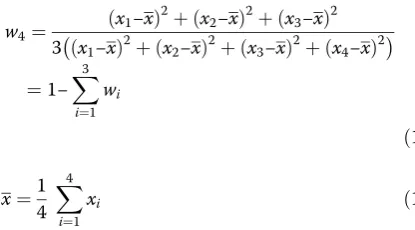
we use a linear combination of original pixels of LR frame. These original pixels are nearest neighbors of the targeted pixel according to Eq. (2) to generate an esti-mated value (in some scenarios, two of four nearest neighbors are also estimated pixels of a prior step). Al-though we are using a linear combination, but since all the interpolation weights are specified adaptively and are not fixed, thus, the final reconstruction filter based on ALMMSE will be non-linear [22]. In [22], the traditional LMMSE has been discussed extensively in order to keep the adaptivity for gray levels in every edge area. As can be followed in [22], a general form of LMMSE (for first/ second order MRF system and using the simplest pre-interpolator based on two 1D linear estimation (Eq. (3) shows two directional estimates through a kind of bi-linear)) can be written as per Eq. (4). The weights in Eq. (4) are according to Eq. (5) and computable through Eqs. (6–8). Therefore, the ALMMSE closed form is simi-lar as per Eq. (9):
Now in Eq. (9), we should compute four weights of w1, w2, w3, and w4. To do this, there are many ways,
but we represent a full-adaptive solution inspired by the traditional LMMSE. Our proposed ALMMSE is in-deed a heuristic idea towards extending LMMSE to be full-adaptive (not considering a similar weight for collinear pixels) and with no need to a linear pre-interpolator which makes more computational com-plexity. For eliminating the pre-interpolation step, we use an approximate as Eq. (10) to make Eqs. (6–7)
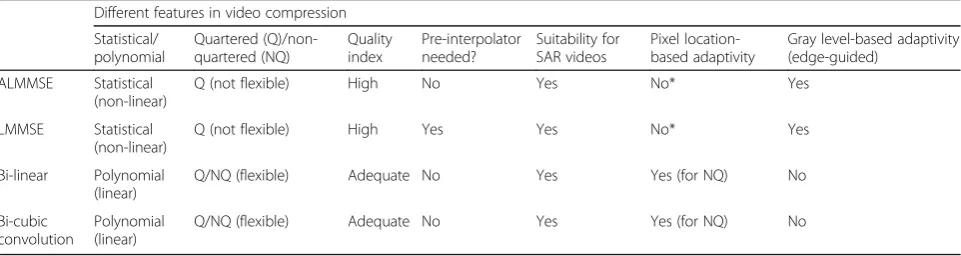
Table 1Qualitative descriptions of the interpolation methods
Different features in video compression
Statistical/
Q (not flexible) High No Yes No* Yes
LMMSE Statistical (non-linear)
Q (not flexible) High Yes Yes No* Yes
Bi-linear Polynomial (linear)
Q/NQ (flexible) Adequate No Yes Yes (for NQ) No
Bi-cubic convolution
Polynomial (linear)
Q/NQ (flexible) Adequate No Yes Yes (for NQ) No
*
more simple and then generate a heuristic expansion on LMMSE weights to achieve ALMMSE weights (Eq. (11)). As shown in Eqs. (12–16), efficient weights of
ALMMSE are very similar to LMMSE weights. In fact, we do not consider any equal weights for these four nearest pixels, and therefore, the approach is fully adaptive whereas LMMSE always selects the same weights for the collinear pixels. In addition, LMMSE has to compute some values as directional estimates of each set of collinear pixels. We could consider an adaptive structure which assumes each pixel as separ-ate sample, regardless of collinearity; therefore, the final approach does not need any pre-estimation for directional estimates that are no longer definable.
^xa−x
ð Þ2 ≈
0
^
xb−x
ð Þ2≈
0 ð10Þ
w1;w2;w3;w4
f g ¼Pargmin
4
i¼1wi¼1
Eð^xh−xhÞ2 ð11Þ
The estimation of non-existing pixels will be repeated to achieve all values of 75% of underestimate pixels, as illustrated in Fig.2c.
w1¼ x2−x
ð Þ2þ x
3−x
ð Þ2þ x
4−x
ð Þ2
3 ðx1−xÞ2þðx2−xÞ2þðx3−xÞ2þðx4−xÞ2
ð12Þ
w2¼ ðx1−xÞ 2þ x
3−x
ð Þ2þ x
4−x
ð Þ2
3 ðx1−xÞ2þðx2−xÞ2þðx3−xÞ2þðx4−xÞ2
ð13Þ
w3¼ x1−x
ð Þ2þ x
2−x
ð Þ2þ x
4−x
ð Þ2
3 ðx1−xÞ2þðx2−xÞ2þðx3−xÞ2þðx4−xÞ2
ð14Þ
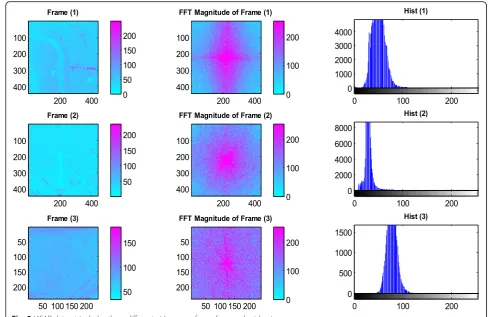
Fig. 3ViSAR dataset includes three different videos; one frame from each video is seen
Table 2Results for video 1
Schemes PSNR (dB) SSIM
Bi-cubic convolution 33.52 0.9377
Bi-linear 33.75 0.9388
Lanczos-2 kernel 33.51 0.9376
Lanczos-3 kernel 33.27 0.9349
Box kernel 32.34 0.9203
w4¼ x
Note that computing of the targeted pixels is firstly based on four nearest neighbors, but in some positions due to the existence of two estimated pixel among four nearest neighbors, practically, the estimation procedure has been performed by six neighbors of which four of these six pixels are not within MRF neighborhood. In the next section, the proposed scheme is evaluated. We will see that the proposed scheme is effective on ViSAR dataset.
Moreover, evaluation is performed based on objective and subjective quality assessment metrics. In addition to the proposed method, a pre-processing step before doing the re-sampling process exists which contains two blocks of down-sampling and up-sampling. Suppose that an in-put image is a typical M×N matrix (for simplicity, M and Nare even). Algorithm 1 and Algorithm 2 describe these two blocks.
For more details about impacts of different models of down-sampling and up-sampling in quartered interpola-tors, see detailed discussions in [10]. Table 1 provides more qualitative details of LMMSE, ALMMSE, BL, and BC.
4 Results
For evaluation, some ViSAR frames are used which are observable in Fig.3. PSNR and SSIM as main metrics are used in all evaluations. PSNR and SSIM definitions are seen in Eq. (17) and Eq. (18), respectively, for two
entire 8-bit images x and y with the same size N1 ×
N2. In Eq. (18), ux and uy denote mean of images, σ2x and σ2
y show variance of them, and σxy describes the
covariance between them. Re-sampling is done with the proposed scheme (ALMMSE) and some conven-tional methods including BL, BC, Lanczos (with par-ameter of 2 and 3 as an approximation for sinc function), and box kernel [3, 26]. All methods are similar in terms of not having a pre-interpolation step, and this makes the evaluations fair. In addition to-wards fairness, the down-sampling processes in all methods are the same, the up-sampling in our method is according to Algorithm 2, and the linear methods are according to the MathWork definition.
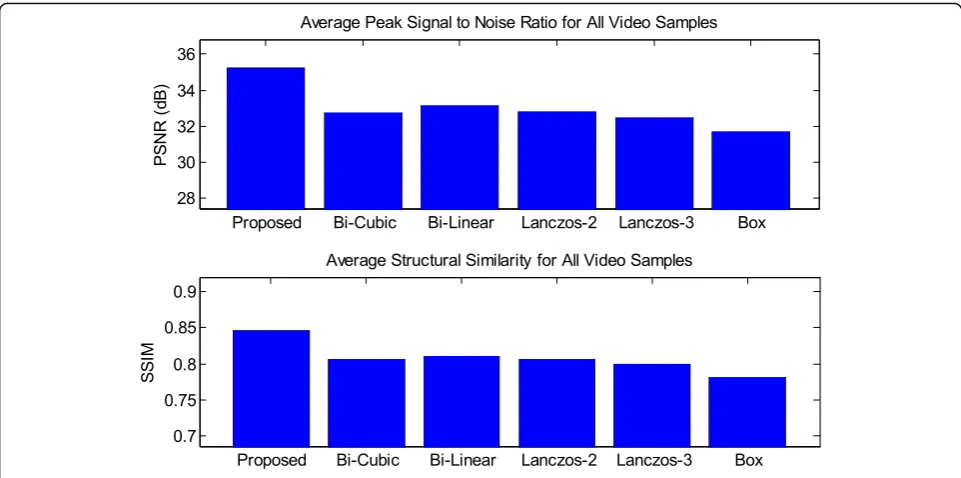
All simulations have been implemented using MATLAB and show that our scheme is strongly win-ner against non-adaptive/linear methods. Outputs of PSNR and SSIM with complete details are listed in Tables2, 3, and 4, and Fig.4 describes an average for all videos. We observe that the proposed scheme based on a full-adaptive approach causes a suitable impact in real ViSAR dataset and outperforms the other methods.
Table 3Results for video 2
Schemes PSNR (dB) SSIM
Bi-cubic convolution 35.33 0.8862
Bi-linear 35.63 0.8869
Lanczos-2 kernel 35.31 0.8859
Lanczos-3 kernel 35.02 0.8810
Box kernel 33.98 0.8521
ALMMSE 36.93 0.9149
Table 4Results for video 3
Schemes PSNR (dB) SSIM
Bi-cubic convolution 29.49 0.5972
Bi-linear 30.02 0.6045
Lanczos-2 kernel 29.46 0.5958
Lanczos-3 kernel 29.11 0.5824
Box kernel 28.72 0.5705
5 Conclusions
In the recent years, data processing for IoT became an interesting topic of research [27–30]. In our study, we proposed ALMMSE interpolation algorithm for the remote sensing ViSAR frames captured by im-aging radars in an IoT-enabled radar networks of drones and airplanes [31]. This scheme is a new edge-guided interpolator based on non-linear statis-tical estimation which has no assumption on local weights and also does not need any pre-interpolator. The main feature of the proposed method is to use the most adaptation in comparison to another edge-guided interpolator and conventional interpolation techniques. We compared it with several linear inter-polators which do not need any pre-interpolator too. All experiments illustrate a clear consequence about superiority of the proposed method. As a future work, we can go ahead to propose a more accurate version of ALMMSE with lower computational complexity. Evaluation of this proposed method for other remote sensing devices may determine some future directions.
Abbreviations
ALMMSE:Adaptive LMMSE; BC: Bi-cubic convolution; BL: Bi-linear; HDTV: High-definition television; IoT: Internet of Things; LMMSE: Linear minimum mean square error; MRF: Markov random field; SD2HD: SDTV to HDTV data conversion; SDTV: Standard-definition television; ViSAR: Video synthetic aperture radars
Acknowledgements
We would like to thank Sandia National Laboratory for ViSAR data used as dataset in this research.
Authors’contributions
MK participated in the mathematical design of the proposed method and its computer implementation. SS coordinated the industrial application and raw data preparation, and helped out for the study. MK and SS have completed the first draft of this paper. All authors have read and approved the manuscript.
Authors’information Not applicable.
Funding Not applicable.
Availability of data and materials
All the data and computer programs are available.
Competing interests
The authors declare that they have no competing interests.
Received: 5 July 2019 Accepted: 10 October 2019
References
1. J. Lua, M. Xiab, W. Li, An interpolation algorithm using center coordinates of pixels for converting SDTV images to HDTV images.
Optik. 124, 5251–5253 (2013)
2. R. Dianat, M. Ghanbari, Comparison between various standard definition to high definition image conversion methods.Recent Advances in
Communications and Networking Technology. 4, 6–15 (2015) 3. Gonzalez, R.C.; Woods, R.E. Digital image processing, 3rd edition, 2008,
Prentice Hall, New Jersey.
4. Khosravi, M.R.et al. A new statistical technique for interpolation of landsat images.ICAUCAE 2016, SID Conference Publications, 2016.
5. A. Baghaie, Z. Yu, Structure tensor based image interpolation method.
International Journal of Electronics and Communications. 69, 515–522 (2015) 6. X. Li, M.T. Orchard, New edge-directed interpolation.IEEE Transactions on
Image Processing. 10(10), 1521–1527 (2001)
7. L. Zhang, X. Wu, An edge-guided image interpolation algorithm via directional filtering and data fusion.IEEE Transactions on Image Processing. 15(8), 2226–2238 (2006)
8. M.R. Khosravi, M. Yazdi, A lossless data hiding scheme for medical images using a hybrid solution based on IBRW error histogram computation and quartered interpolation with greedy weights.Neural Computing and Applications30, 2017–2028 (2018)
9. Khosravi, M.R.et al. MRF-based multispectral image fusion using an adaptive approach based on edge-guided interpolation.Journal of Geographic Information System, 2017.
10. Khosravi, M.R.; Salari, R.; Rostami, H. Analysis of modeling error in digital image spatial estimation.International Congress of Electrical Engineering, Computer Science and Information Technology (IT2015), No. 3, SBU, 2015, pp. 363-371.
11. M. Huang, C. He, Q. Zhu,Qin, J(Maize seed variety classification using the integration of spectral and image features combined with feature transformation based on hyperspectral imaging,Applied Sciences, 2016) 12. D. Song, L. Song, Y. Sun, P. Hu, K. Tu, L. Pan, H. Yang,Huang, M(Black heart
detection in white radish by hyperspectral transmittance imaging combined with chemometric analysis and a successive projections algorithm,Applied Sciences, 2016)
13. S. Lee, M. Kang, K. Uhm, S. Ko, An edge-guided image interpolation method using Taylor series approximation.IEEE Transactions on Consumer Electronics.
62(2), 159–165 (2016)
14. M.R. Khosravi, S. Samadi, Modified data aggregation for aerial ViSAR sensor networks in transform domain. The 25th Int'l Conference on Parallel and Distributed Processing Techniques andApplications(PDPTA'19), 2019; Las Vegas. USA.
15. M.R. Khosravi, H. Rostami, S. Samadi, Enhancing the binary watermark-based data hiding scheme using an interpolation-based approach for optical remote sensing images.International Journal of Agricultural and Environmental Information Systems9(2), 53–71 (2018)
16. M. Vaidelys, J. Ragulskiene, P. Ziaukas,Ragulskis(M. Image hiding scheme based on the atrial fibrillation model,Applied Sciences, 2015)
17. W. Kuo, S. Kuo,Wuu, L(Multi-bit data hiding scheme for compressing secret messages,Applied Sciences, 2015)
18. L. Luo, Z. Chen, M. Chen, X. Zeng, Z. Xiong, Reversible image watermarking using interpolation technique.IEEE Transactions on Information Forensics and Security.5(1), 187–193 (2010)
19. L. Zhang, X. Li, D. Zhang, Image denoising and zooming under the linear minimum mean square-error estimation framework.IET Image Processing.
6(3), 273–283 (2012)
20. Getreuer, P. Zhang-Wu Directional LMMSE image demosaicking.Image Processing On Line (IPOL Journal). 2011.
21. L. Zhang, X. Wu, Color demosaicking via directional linear minimum mean square-error estimation.IEEE Transactions on Image Processing. 14(12), 2167–2178 (2005) 22. M.R. Khosravi, S. Samadi, R. Mohseni, Spatial interpolators for intra-frame
resampling of SAR videos: a comparative study using real-time HD, medical and radar data.Current Signal Transduction Therapy(2019)
23. M.K. Moghimi, H. Pourghassem, Shadow detection based on combinations of hessenberg decomposition and principal component analysis in surveillance applications.IETE Journal of Research.61(3), 269–284 (2015) 24. M.Y. Baig, E. Lai, A. Punchihewa, Compressed sensing-based distributed
image compression.Applied Sciences. 4, 128–147 (2014)
25. Dai, N.; Feng G.; Zeng Q. Reversible watermarking using adaptive edge-guided interpolation,KSII Transactions on Internet and Information Systems, 2011. 26. P. Getreuer, Linear methods for image interpolation.Image Processing On
Line. 1, 238–259 (2011)
27. R. Zhang, P. Xie, C. Wang, G. Liu, S. Wan,Classifying transportation mode and speed from trajectory data via deep multi-scale learning, Computer Networks 162, 106861(2019)
28. Z Gao, HZ Xuan, H Zhang, S Wan, KKR Choo, Adaptive fusion and category-level dictionary learning model for multi-view human action recognition,
IEEE Internet of Things Journal, 2019.
29. S. Wan, Y. Zhao, T. Wang, Z. Gu, Q.H. Abbasi, K.K.R. Choo,Multi-dimensional data indexing and range query processing via Voronoi diagram for internet of things, Future Generation Computer Systems 91, 382-391(2019)
30. S. Wan, Y. Zhang, J. Chen, On the construction of data aggregation tree with maximizing lifetime in large-scale wireless sensor networks.IEEE Sensors Journal16(20), 7433–7440 (2016)
31. B. Bahri-Aliabadi, M. Khosravi, S. Samadi, Frame rate computing in video SAR using geometrical analysis.The 24th Int'l Conference on Parallel and Distributed Processing Techniques and Applications(PDPTA'18), pp. 165-167, 2018; Las Vegas. USA.
Publisher’s Note
![Fig. 1 General positions for underestimate pixels. There are two general positions for underestimate pixels (square symbol) which should beshows another position with orthogonal directions of 45 and 135 degrees [computed by an LMMSE-based interpolator [19]: the left part shows a position with two orthogonal directions of 0 and 90 degrees, and the right7]](https://thumb-us.123doks.com/thumbv2/123dok_us/906794.1109499/2.595.58.540.561.695/underestimate-positions-underestimate-orthogonal-directions-interpolator-orthogonal-directions.webp)
![Fig. 2 The steps in estimating non-existing pixels [18]. a Original and non-existing pixels](https://thumb-us.123doks.com/thumbv2/123dok_us/906794.1109499/3.595.59.538.322.702/fig-steps-estimating-existing-pixels-original-existing-pixels.webp)