Particle Filtering for Joint Symbol and Code Delay
Estimation in DS Spread Spectrum Systems
in Multipath Environment
Elena Punskaya
Signal Processing Laboratory, Department of Engineering, University of Cambridge, Trumpington Street, Cambridge CB2 1PZ, UK
Email:[email protected] Arnaud Doucet
Signal Processing Laboratory, Department of Engineering, University of Cambridge, Trumpington Street, Cambridge CB2 1PZ, UK
Email:[email protected] William J. Fitzgerald
Signal Processing Laboratory, Department of Engineering, University of Cambridge, Trumpington Street, Cambridge CB2 1PZ, UK
Email:[email protected]
Received 19 June 2003; Revised 18 June 2004
We develop a new receiver for joint symbol, channel characteristics, and code delay estimation for DS spread spectrum systems under conditions of multipath fading. The approach is based on particle filtering techniques and combines sequential importance sampling, a selection scheme, and a variance reduction technique. Several algorithms involving both deterministic and random-ized schemes are considered and an extensive simulation study is carried out in order to demonstrate the performance of the proposed methods.
Keywords and phrases:direct sequence spread spectrum system, multipath fading, particle filters, signal detection, synchroniza-tion.
1. INTRODUCTION
Direct sequence (DS) spread spectrum systems are robust to many channel impairments, allow multiuser CDMA and low-detectability signal transmission, and, therefore, are widely used in different areas of digital communications. Un-like many other communication systems, however, spread spectrum receivers require additional code synchronization, which can be a rather challenging task under conditions of multipath fading, when severe amplitude and phase varia-tions take place.
The problem of joint symbol, delay, and multipath esti-mation has been addressed in the literature before (see e.g., [1, 2]), and proved to be a difficult one due to its inher-ited nonlinearity. The previously proposed approaches were mainly based on the use of the extended Kalman filter (EKF). However, many of them concentrated on the channel param-eters and delay estimation only; moreover, in a number of
cases, when EKF methods were applied, the estimated pa-rameters were divergent [1]. Joint signal detection and chan-nel estimation was performed using deterministic maximum likelihood (DML) methods [3,4]. However, since the un-known parameters of interest were assumed deterministic in this case, a serious drawback of DML-type approaches was the phenomenon of error propagation. Later, a stochastic maximum likelihood (ML) approach for the estimation of channel parameters was adopted with consequent symbol detection using Viterbi algorithms [5]. The space-alternating generalized expectation maximization (SAGE) scheme for maximum a posteriori (MAP) estimation was presented in [6].
interest by swarms ofN(N1) weighted points in the sam-ple space, called particles, which evolve randomly in time in correlation with each other and either give birth to offspring particles or die according to their ability to represent the dif-ferent zones of interest of the state space.
The methods have already been successfully applied to problems arising in digital communications, in particu-lar, demodulation in fading channels [7,8,9] and detec-tion in synchronous CDMA [10]. In all this work, the un-known fading channel characteristics were integrated out and only the symbols needed to be imputed. The algorithm, thus, made use of the structure of the model, and the un-known state involved discrete parameters only. Later inves-tigation [10,11], however, revealed some concerns regard-ing the efficiency of the standard randomized particle fil-tering techniques in this context. It has been shown that, for a fixed computational complexity, more efficient de-terministic schemes could be designed leading to an im-proved performance of the receiver. We attempt here to study these results further, and compare various random-ized and nonrandomrandom-ized approaches. Iltis [12] has recently developed a particle filtering method to address a problem closely related to ours. However, in his approach, the un-known symbol sequence is obtained through a standard al-gorithm, and only channel parameters and code delays are estimated using particle filtering. The problem we are deal-ing with is more complex, since it involves both discrete (symbols) and continuous-valued (delays) unknowns. The deterministic particle method, unfortunately, is not applica-ble directly in this case. However, in view of the recent re-sults, we propose to combine it with sequential importance sampling for the mixed, discrete and continuous-valued pa-rameter case, followed by an appropriate selection proce-dure. The resulting algorithm explores the state space in a more systematic way at little or no extra cost in compari-son with the standard particle filtering, employing a subop-timal importance distribution. We develop and test this ap-proach against other deterministic and stochastic schemes, and demonstrate its performance by means of an extensive simulation study.
The remainder of the paper is organized as follows. The model specifications and estimation objectives are stated in Section 2. In Section 3, a particle filtering method is developed for joint symbol/channel coefficients/code de-lay estimation. This section also introduces and reviews several alternative deterministic and stochastic schemes, with simulation results and comparisons presented in Section 4. Some conclusions are drawn at the end of the pa-per.
2. PROBLEM STATEMENT AND
ESTIMATION OBJECTIVES
Transmitted waveform
We denote, for any generic sequenceκt,κi:j (κi,κi+1,. . ., κj)T, and letdnbe thenth information symbol, andstx(τ) the corresponding analog bandpass spread spectrum signal
waveform transmitted in the symbol interval of durationT:
stx(τ)=Re
sn
d1:n
u(τ) expj2π f0τ
for (n−1)T < τ≤nT, (1)
wheresn(·) performs the mapping from the digital sequence
to waveforms and corresponds to the modulation technique employed, f0 denotes the carrier frequency, and u(τ) is a wideband pseudonoise (PN) waveform defined by
u(τ)=
K
k=1 ckη
τ−kTc
. (2)
Here,c1:Kis a spreading code sequence consisting ofKchips
(with values {±1}) per symbol,η(τ −kTc) is a
rectangu-lar pulse of unit height and duration Tc, transmitted at
(k−1)Tc < τ ≤ kTc, andTc is the chip interval satisfying
the relationTc=T/K.
Channel model
The signal is passed through a noisy multipath fading chan-nel which causes random amplitude and phase variations on the signal. The channel can be represented by a time-varying tapped-delayed line with taps spacedTsseconds apart, where
Tsis the Nyquist sampling rate for the transmitted waveform;
Ts = Tc/2 due to the PN bandwidth being approximately
1/Tc (see sampling theorem [13]). The equivalent
discrete-time impulse response of the channel is given by
ht= L−1
l=0
ft(l)δt,l, (3)
wheretis a discrete time index,t=1, 2,. . . .ByLwe under-stand the maximum number of paths (nonzero coefficients ofht) of the channel [5], ft(l)are the complex-valued
time-varying multipath coefficients arranged into the vector ft,
andδt,ldenotes the Kronecker delta, which is 1 ift=l, and 0
otherwise.
We assume here that the channel coefficientsftand code
delayθtpropagate according to the first-order autoregressive
(AR) model:
ft=Aft−1+Bvt, vti.i.d.∼ Nc
0,IL
, (4)
θt=γθt−1+σθϑt, ϑti.i.d.∼ N(0, 1), (5)
which corresponds to a Rayleigh uncorrelated scattering channel model; here A diag(α(0),. . .,α(L−1)), B diag(σ(0)f ,. . .,σ
(L−1)
f ), withσ
(l)
f being the standard deviation,
andα(l)accounting for the Doppler spread (see [2,14] for details and discussion on the use of higher-order AR). In this paper, matricesA,B, and parametersγ andσθ are
Received signal
The complex output of the channel sampled at the Nyquist rate, (in which case, t = 2K(n−1) + 1,. . ., 2Kn samples correspond to the nth symbol transmitted, that is, dn ↔
y2K(n−1)+1:2Kn) can, thus, be expressed as
the noise variance.1The noise sequencesϑ
t,t, andvt(l),l=
0,. . .,L−1 are assumed mutually independent and indepen-dent of the initial statesf0 ∼ Nc(f0,Σf,0),θ0 ∼ N(θ0,Σθ,0). The received waveformsrx(τ) is obtained after ideal lowpass filtering of rectangular pulses and is given by [2]
srx(τ)
The symbolsdn, which are assumed i.i.d., the channel
char-acteristicsft, and the code delayθtare unknown forn,t >0.
Our aim is to obtain sequentially in time an estimate of the joint posterior probability density of these parameters p(d1:n,f0:2Kn,θ0:2Kn|y1:2Kn), and some of its characteristics,
such as the MAP estimates of the symbols
and the minimum mean square error (MMSE) estimates of the channel characteristicsE(f0:2Kn|y1:2Kn) and the delays
E(θ0:2Kn|y1:2Kn). This problem, unfortunately, does not
ad-mit any analytical solution and, thus, approximate methods must be employed. One of the methods that has proved to be useful in practice is particle filtering, and, in the next section, we propose a receiver based on the use of these techniques.
3. PARTICLE FILTERING RECEIVER
Particle filtering receivers have already been designed in [7,8,9], although for a much simpler case including sym-bols estimation only. The problem considered here is more complicated since an additional continuous parameter is in-volved, and, in this section, the particle filtering algorithm
1The case of non-Gaussian noise can be easily treated using the
tech-niques presented in [9].
for the joint estimation of all unknown parameters is de-tailed. We begin our treatment with incorporating a variance reduction technique, namely, Rao-Blackwellisation, and then proceed with the derivation of the particle filtering equations for the estimation of the required posterior distribution. The alternative deterministic and stochastic approaches are con-sidered at the end of the section.
3.1. Rao-Blackwellisation
In this paper, we follow a Bayesian approach and, given the measurements y1:2Kn, base our inference on the joint
pos-terior distribution p(d1:n,f0:2Kn,θ0:2Kn|y1:2Kn). A
straightfor-ward application of particle filtering would, thus, focus on the estimation of this joint probability distribution, and, con-sequently, obtain the estimates ofd1:n,f0:2Kn, andθ0:2Kn
se-quentially in time. It is beneficial, however, to improve the standard approach by making most of the structure of the model and applying the variance reduction techniques.
Indeed, similar to [7,8,9,15], the problem of estimat-ing p(d1:n,f0:2Kn,θ0:2Kn|y1:2Kn) can be reduced to a one
of sampling from a lower-dimensional posterior p(d1:n,
θ0:2Kn|y1:2Kn). If the approximation of p(d1:n,θ0:2Kn|y1:2Kn)
could be obtained, say, via particle filtering:
one could compute the probability density p(f0:2Kn|y1:2Kn,
d1:n,θ0:2Kn) using the Kalman filter associated with (4) and
(6). As a result, the posterior p(f0:2Kn|y1:2Kn) could be
ap-proximated by a random mixture of Gaussians
leading to lower variance of the estimates and, therefore, in-creased algorithm efficiency [15].
Strictly speaking, we are interested in estimating the in-formation symbols only with the tracking of the channel being naturally incorporated into the proposed algorithm. However, following this approach, the MMSE (conditional mean) estimates of fading coefficients can, of course, be ob-tained if necessary as follows:
with E[f2K(n−1)+1:2Kn|y1:2Kn,d(1:i)n,θ0:2(i)Kn] being computed by
the Kalman filter, with 2K steps required for each symbol transmitted.
3.2. Particle filtering algorithm
We can now proceed with the estimation of p(d1:n,
θ0:2Kn|y1:2Kn) using particle filtering techniques. The method
is based on the following remark. Suppose N particles
{d(1:i)n,θ0:(i)n}Ni=1, whereθndenotes
θn=θ2K(n−1)+1:2Kn forn=1, 2,. . ., (13)
can be easily simulated according to an arbitrary conve-nient importance distribution π(d1:n,θ0:n|y1:n) (such that
p(d1:n,θ0:n|y1:n)>0 impliesπ(d1:n,θ0:n|y1:n)>0).
Then, using the importance sampling identity, an esti-mate ofp(d1:n,θ0:n|y1:n) is given by the following point mass
wherew(ni)are the so-called normalizedimportance weights,
andyndenotes
yn=y2K(n−1)+1:2Kn (16)
forn=1, 2,. . .. The distributionπ(d1:(i)n,θ(0:i)n|y1:n) has to
ad-mitπ(d1:(i)n−1,θ(0:i)n−1|y1:n−1) as a marginal distribution so that one could propagate this estimate sequentially in time with-out subsequently modifying the past simulated trajectories. The weightsw(ni)could also be updated online in this case:
w(i)
The sequential importance sampling described above is combined with a selection procedure when the effective sam-ple sizeNeff tails). This helps to avoid the degeneracy of the algorithm by discarding particles with low normalized importance weights and multiplying those with high ones.
Given for the (n − 1)th symbol N particles {d(1:i)n−1, θ(i)
0:n−1}Ni=1 distributed approximately according to p(d1:n−1, θ0:n−1|y1:n−1), the general particle filtering receiver, proceeds as inAlgorithm 1.
Sequential importance sampling step
Fori=1,. . .,N, sample (dn(i),θ
(i)
n)∼π(dn,θn|d(1:i)n−1,θ(0:i)n−1,y1:n). Fori=1,. . .,N, evaluate the importance
weightsw(ni)up to a normalizing constant. Fori=1,. . .,N, normalizewn(i)to obtainw(ni). Selection step
IfNeff < Nthres, multiply/discard particles {dn(i),θ
(i)
n}Ni=1with respect to high/low
wn(i)to obtainNunweighted particles {d1:(i)n,θ1:(i)n}Ni=1.
Algorithm1: Particle filtering algorithm.
Fori=1,. . .,N,
sampledn(i)∼p(dn), setw(ni)=1. Fort=2K(n−1) + 1,. . ., 2Kn,
sampleθ(ti)∼p(θt|θt(−i)1),
perform one-step Kalman filter update (w(ni)=wn(i)p(yt|d1:n,θ0:(i)t−1,θt(i),y1:t−1)).
Fori=1,. . .,N, normalizewn(i)to obtainwn(i).
Algorithm 2: Sequential importance sampling (prior as impor-tance distribution).
3.3. Implementation issues
The choice of importance distribution and selection scheme is discussed in [16]; depending on these choices, the compu-tational complexity of the algorithm varies.
3.3.1. Importance density
Prior density
The simplest solution is to take the prior as an importance distribution, that is,
thenwnbecomes
wn∝p
and requires evaluation of 2Kone-step Kalman filter updates for each symbol as shown inAlgorithm 2.
Suboptimal importance density
Of course, using the prior distribution in our case can be inefficient, as no information carried by the observations is used to explore the state space. The optimal choice, in a sense of minimizing the conditional variance of the importance weights [15], would consist of taking
πdn,θn|d1:n−1,θ0:n−1,y1:n
cannot be computed analytically. Our aim then is to de-velop a suboptimal importance density “closest” to p(dn,
θn|d1:n−1,θ0:n−1,y1:n).
tance function ifθnwere fixed given by
pdn|d1:n−1,θ0:n,y1:n
nately presents a problem since the integral in (23) cannot be evaluated in closed form. As a solution, we propose to use the prior density p(θn|θn−1) instead of p(θn|d1:n−1,θ0:n−1,y1:n)
and, thus, employ the following suboptimal importance function (see [17] for a similar approach developed indepen-dently):
Algorithm3: Evaluation of importance weights (suboptimal im-portance distribution).
The importance weights in this case can be calculated as
wn∝p
whereθnis drawn from the prior Gaussian distribution with
meanγθn−1and varianceσθ2:
ondn(i), and the weights evaluation and selection steps can be
done prior to the sampling ofdn(i)as inAlgorithm 3.
For each symbol detection, this procedure requires the evaluation of theM2K-step-ahead Kalman filters, which is quite computationally expensive. Further research should, therefore, concentrate on development of other more effi -cient suboptimal importance distributions on a case by case basis.
3.3.2. Selection
As far as the selection step is concerned, a stratified sam-pling scheme [18] is employed in this paper since it has the minimum variance one can achieve in the class of unbiased schemes [19]. The algorithm is based on generatingNpoints equally spaced in the interval [0, 1], with the number of off -spring Ni for each particle being equal to the number of
points lying between the partial sums of weightsqi−1andqi,
whereqi=
i
j=1w (j)
t . The procedure can be implemented in
O(N) operations.
3.4. Deterministic particle filter
However, as shown in [11], if one already opts for (27), and all the calculations have to be performed anyway, it might be better to base our approximation of p(d1:n,θ0:n|y1:n) directly “extensions” of the existing state sequences at each stepnare considered in this case, and one does not discard unneces-sarily any information by selecting randomly one path out of theMavailable. In the above expression,w(ni−1) is the weight of the “parent” particle, which hasM“offspring” instead of the usual one, resulting in a total number ofN×Mparticles at each stage. This number increases exponentially with time, and, therefore, a selection procedure has to be employed at each stepn.
The simplest way to perform such selection is just to choose the N most likely offspring and discard the others (as, e.g., in [20]). The superiority of this approach over other methods in the fully discrete framework is shown in [10,11]. A more complicated procedure involves preserving the par-ticles with high weights and resampling the ones with low weights, thus reducing their total number toN. An algorithm of this type is presented in [21] but other selection schemes can be designed. Contrary to the case involving the discrete parameters only, in this scenario, a resampling scheme with replacement could be employed, since θ(ni) is chosen ran-domly. Therefore, stratified resampling could be used in or-der to selectNparticles fromN×Mparticles available.
Whether we choose to preserve the most likely particles, employ the selection scheme proposed in [21], or stratified resampling, the computational load of the resulting algo-rithms at each time stepnis that ofN×M×2K Kalman filters, and the selection step in the first two cases is imple-mented in O(N ×MlogN×M) operations. Of course, if M is large, which is the case in many applications, all these methods are too computationally expensive to be used, and one should employ a standard particle filter.
4. SIMULATION RESULTS
In the following experiments the bit error rate (BER) and the tracking delay error (θt−θt) were evaluated by means of
com-puter simulations. Gray-encoded M-ary differential phase shift keyed (MDPSK) signals were employed, with mapping function
Figure1: Bit error rate performance (4DPSK signal,N=100).
In order to assess the performance of the proposed ap-proaches we first applied them to a simpler case of synchro-nization in flat fading conditions,L = 1, for a system with no spectrum spreading employed,c1=1,K=1. In the first experiment, 4DPSK signals were considered with the aver-age signal-to-noise ratio (SNR) varying from 5 to 20 dB. The AR coefficients for the channel, (4), were set toα(0)=0.999, σ(0)f = 0.01, and the delay model parameters in (5) were
chosen to be the same,γ = 0.999 andσθ =0.01. The BER
obtained by the particle filtering receiver employing prior (PFP) and suboptimal (PFS) importance distributions, and the deterministic receiver preservingNmost likely particles (DML) and using stratified resampling (DSR) is presented in Figure 1. The marginal maximum a posteriori estimate (MMAP)
was employed to obtain the symbols. The number of par-ticles used in these algorithms was equal toN = 100, and little or no improvement in BER was gained by increasing this number for deterministic schemes. For the randomized approaches, the number of particles required to achieve the BER of DSR algorithm was equal toN =1200. InFigure 2, the mean square delay error (MSE) is presented as a function of the number of particlesNfor SNR=10 dB:
0.025
0.02
0.015
0.01
0.005
0
50 100 150 200 250 300 350 400 450 500 Number of particles (N)
M
ean
squar
e
dela
y
er
ror
PFP DML
PFS DSR
Figure2: Mean square delay error for the different number of par-ticles (4DPSK, SNR=10 dB).
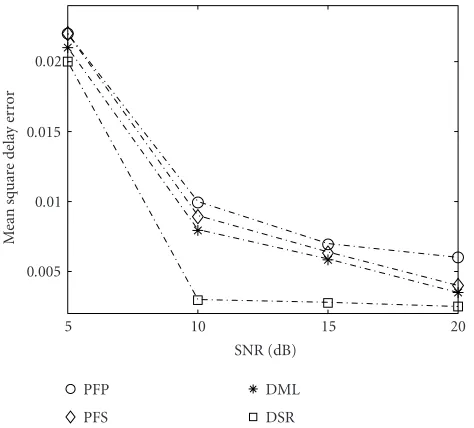
0.02
0.015
0.01
0.005
5 10 15 20
SNR (dB)
M
ean
squar
e
dela
y
er
ror
PFP PFS
DML DSR
Figure3: Mean square delay error via SNR (4DPSKN=100).
particles, and is more efficient than both standard particle filtering schemes.
The particle filtering approach was also compared with the EKF method [2] in the second experiment. The algo-rithm was simplified to consider channel and code delay esti-mation only (the transmitted symbols were assumed known as, e.g., with pilot symbols being used). Otherwise, simu-lation set-up was the same (N = 100 particles were em-ployed). The results for the SNR = 10 dB presented in Figure 4demonstrate good performance of the particle filter-ing method. Please note that deterministic particle filter is in
0.25 0.2 0.15 0.1 0.05 0 −0.05 −0.1 −0.15 −0.2 −0.25
0 100 200 300 400 500 600 700
Sample
Dela
y
estimation
er
ror
EKF DSR
Figure4: The error in delay estimation.
10−1
10−2
10−3
10−4
5 10 15 20
SNR (dB)
BER
PFS DSR
DS spread spectrum system
Figure5: Bit error rate.
0.5 0.4 0.3 0.2 0.1 0 −0.1 −0.2 −0.3 −0.4 −0.5
0 500 1000 1500 2000 2500 3000
Sample
Dela
y
estimation
er
ror
PFS DSR
DS spread spectrum system
SNR=10 dB
Figure6: The error in delay estimation.
Finally, we applied the proposed algorithm to perform joint symbols/channel coefficients/code delay estimation for DS spread spectrum systems withK =15,L =4. A binary DPSK modulation scheme was employed with the multipath channel response and AR coefficients chosen as in Channel B in [2]. As shown inFigure 5, the algorithm employing 100 particles exhibits good BER performance. A tracking error trajectory for 100 information symbols (corresponding to 1500 chips and 3000 channel samples) and an average SNR equal to 10 dB is presented in Figure 6.Figure 7 also illus-trates the mean square delay error as a function of SNR for Ld=1000.
5. CONCLUSION
In this paper, we propose the application of particle filter-ing techniques to a challengfilter-ing problem of joint symbols, channel coefficients, and code delay estimation for DS spread spectrum systems in multipath fading. The algorithm is de-signed to make use of the structure of the model, and incor-porates a variance reduction technique. The work is based on the recent results on the superiority of the DML ap-proach in a fully discrete environment [10,11]. The method cannot be applied straightforwardly, however, and several procedures combining both deterministic and randomized schemes are considered. The algorithms are tested and com-pared. Although computer simulations show that all meth-ods are capable of providing good performance, in this par-ticular case involving additional continuous-valued param-eters, the deterministic scheme employing stratified resam-pling turns out to be the most efficient one. The choice of the algorithm might, however, be application-dependent, so further investigation is necessary. The receiver can be ex-tended to address multiuser DS-CDMA transmission, using the techniques proposed in [24], for example, or simplified
0.018 0.016 0.014 0.012 0.01 0.008 0.006 0.004 0.002
5 10 15 20
SNR (dB)
M
ean
squar
e
dela
y
er
ror
PFS DSR
N=100 DS spread spectrum system
Figure7: Mean square delay error via SNR.
to consider channel tracking only since it is naturally incor-porated in the proposed algorithm. Future research should concentrate on the development of suboptimal importance distributions and selection schemes capable of increasing the algorithm efficiency.
REFERENCES
[1] R. A. Iltis, “A DS-CDMA tracking mode receiver with joint channel/delay estimation and MMSE detection,” IEEE Trans. Communications, vol. 49, no. 10, pp. 1770–1779, 2001. [2] R. A. Iltis, “Joint estimation of PN code delay and multipath using the extended Kalman filter,” IEEE Trans. Communica-tions, vol. 38, no. 10, pp. 1677–1685, 1990.
[3] U. Fawer and B. Aazhang, “A multiuser receiver for code di-vision multiple access communications over multipath chan-nels,” IEEE Trans. Communications, vol. 43, no. 2/3/4, pp. 1556–1565, 1995.
[4] H. Zamiri-Jafarian and S. Pasupathy, “Adaptive MLSDE using the EM algorithm,”IEEE Trans. Communications, vol. 47, no. 8, pp. 1181–1193, 1999.
[5] J. M´ıguez and L. Castedo, “Semiblind maximum-likelihood demodulation for CDMA systems,” IEEE Trans. Vehicular Technology, vol. 51, no. 4, pp. 775–781, 2002.
[6] A. Logothetis and C. Carlemalm, “SAGE algorithms for mul-tipath detection and parameter estimation in asynchronous CDMA systems,” IEEE Trans. Signal Processing, vol. 48, no. 11, pp. 3162–3174, 2000.
[7] A. Doucet, J. F. G. de Freitas, and N. J. Gordon, Eds., Sequen-tial Monte Carlo Methods in Practice, Springer, New York, NY, USA, 2001.
[8] R. Chen, X. Wang, and J. S. Liu, “Adaptive joint detection and decoding in flat-fading channels via mixture Kalman fil-tering,”IEEE Transactions on Information Theory, vol. 46, no. 6, pp. 2079–2094, 2000.
[9] E. Punskaya, C. Andrieu, A. Doucet, and W. J. Fitzgerald, “Particle filtering for demodulation in fading channels with non-Gaussian additive noise,” IEEE Trans. Communications, vol. 49, no. 4, pp. 579–582, 2001.
“Particle filtering for multiuser detection in fading CDMA channels,” inProc. IEEE 11th Signal Processing Workshop on Statistical Signal Processing (SSP ’01), pp. 38–41, Singapore, August 2001.
[11] E. Punskaya, A. Doucet, and W. J. Fitzgerald, “On the use and misuse of particle filtering in digital communications,” in Pro-ceedings XI European Signal Processing Conference (EUSIPCO ’02), Toulouse, France, September 2002.
[12] R. A. Iltis, “A sequential Monte Carlo filter for joint linear/ nonlinear state estimation with application to DS-CDMA,”
IEEE Trans. Signal Processing, vol. 51, no. 2, pp. 417–426, 2003. [13] J. G. Proakis, Digital Communications, McGraw-Hill, New
York, NY, USA, 3rd edition, 1995.
[14] C. Komninakis, C. Fragouli, A. H. Sayed, and R. D. Wesel, “Channel estimation and equalization in fading,” in Proc. IEEE 33rd Asilomar Conference on Signals, Systems, and Com-puters, vol. 2, pp. 1159–1163, Pacific Grove, Calif, USA, Octo-ber 1999.
[15] A. Doucet, S. Godsill, and S. Andrieu, “On sequential Monte Carlo sampling methods for Bayesian filtering,”Statistics and Computing, vol. 10, no. 3, pp. 197–208, 2000.
[16] A. Doucet, N. J. Gordon, and V. Kroshnamurthy, “Particle fil-ters for state estimation of jump Markov linear systems,”IEEE Trans. Signal Processing, vol. 49, no. 3, pp. 613–624, 2001. [17] T. Ghirmai, M. F. Bugallo, J. M´ıguez, and P. M. Djuric, “Joint
symbol detection and timing estimation using particle filter-ing,” inProc. IEEE Int. Conf. Acoustics, Speech, Signal Process-ing (ICASSP ’03), vol. 4, pp. 596–599, Hong Kong, April 2003. [18] G. Kitagawa, “Monte Carlo filter and smoother for non-Gaussian nonlinear state space models,” Journal of Compu-tational and Graphical Statistics, vol. 5, no. 1, pp. 1–25, 1996. [19] D. Crisan, “Particle filters—a theoretical perspective,” in
Se-quential Monte Carlo Methods in Practice, A. Doucet, J. F. G. de Freitas, and N. J. Gordon, Eds., Springer, New York, NY, USA, 2001.
[20] J. K. Tugnait and A. H. Haddad, “A detection-estimation scheme for state estimation in switching environments,” Au-tomatica, vol. 15, no. 4, pp. 477–481, 1979.
[21] P. Fearnhead,Sequential Monte Carlo methods in filter theory, Ph.D. thesis, University of Oxford, Oxford, UK, 1998. [22] T. Bertozzi, Applications of particle filtering to digital
commu-nications, Ph.D. thesis, CNAM, Paris, France, December 2003. [23] E. Punskaya,Sequential Monte Carlo methods for digital com-munications, Ph.D. thesis, Engineering Department, Cam-bridge University, CamCam-bridge, UK, June 2003.
[24] B. Dong, X. Wang, and A. Doucet, “A new class of soft MIMO demodulation algorithms,”IEEE Trans. Signal Processing, vol. 51, no. 11, pp. 2752–2763, 2003.
Elena Punskayareceived the B.S. and M.S. degrees in mechanical engineering from the Bauman Moscow State Technical Uni-versity, Moscow, Russia, in 1997, and the M.Phil. and Ph.D. degrees in information engineering from the University of Cam-bridge, CamCam-bridge, UK, in 1999 and 2003, respectively. She is currently with the Sig-nal Processing Laboratory, Department of Engineering, University of Cambridge, UK,
and is a Research Fellow of Homerton College, Cambridge, UK, where she is a Director of Studies in Engineering. Her research in-terests focus on Bayesian inference, simulation-based methods, in particular, Markov chain Monte Carlo and particle filtering, and their application to digital communications.
Arnaud Doucet was born in France on November 2, 1970. He received the M.S. de-gree from the Telecom INT in 1993 and the Ph.D. degree from University Paris XI Or-say in December 1997. From 1998 to 2000, he was a Research Associate in the Signal Processing group of Cambridge University. From 2001 to 2002 he was a Senior Lec-turer in the Department of Electrical and Electronic Engineering at Melbourne
Uni-versity, Australia. Since September 2002, he has been university Lecturer in information engineering at Cambridge University. He is a Member of the IEEE Signal Processing Theory and Methods Committee and an Associate Editor for The Annals of The Insti-tute of Statistical Mathematics and Test. His research interests in-clude Bayesian statistics and simulation-based methods for estima-tion and control. He has coedited with J. F. G. de Freitas and N. J. GordonSequential Monte Carlo Methods in Practice, 2001. William J. Fitzgerald received the B.S.,
M.S., and Ph.D. degrees in physics from the University of Birmingham, Birming-ham, UK. He is the Professor of applied statistics and signal processing and the Head of Research at the Signal Processing Lab-oratory, Department of Engineering, Uni-versity of Cambridge, UK. Prior to joining Cambridge, he worked at the Institut Laue Langevin, Grenoble, France, for seven years