R E S E A R C H
Open Access
The cost calculation method of
construction 3D printing aligned with
internet of things
Hongxiong Yang
1, Jacky K. H. Chung
2, Yuhong Chen
2and Yijia Li
1*Abstract
It is controversial that the cost of construction 3D printing is lower than the conventional construction in academic field. The reason is that some scholars have confused attributes between construction 3D printing and traditional construction. The cost calculation of construction 3D printing cannot follow the rules in conventional construction because construction 3D printing was identified as both industrial product and construction product. This paper proposed a new approach to cost calculation of construction 3D printing concerning both the properties of industrial and construction product. The cost elements and calculation methods of onsite and offsite 3D printing were discussed and concluded. The comparison of cost composition among conventional construction, onsite construction 3D printing, and offsite construction 3D printing was presented as well. The paper put forward the idea of cost calculation about industrialized construction, and it solved the problems of cost calculation among different construction technologies.
Keywords:Construction 3D printing, Offsite 3D printing, Onsite 3D printing, Conventional construction, Cost composition, Cost calculation
1 Introduction
The existing computer network in intelligent construc-tion engineering is the internet of things; it include the external network, the internal network, the bus network, the language network, the intelligent special network, and the metropolitan area network connection. At the construction site, the internet of things can enable con-struction machinery, equipment, materials, structures, and even templates to“talk”with the central platform to obtain key performance parameters. The technology of construction 3D printing is the application basis of the internet of things in the construction field. It is the internet among construction workers, construction equipment, construction sensors, and so on. This tech-nology can ensure the smooth progress of the buildings on the internet. The buildings built under 3D printing technology are called 3D printing construction. If the cost of the 3D printing construction is low or the output
efficiency is far greater than the input, the internet of things under 3D printing technology will be easily accepted by many enterprises in the construction field. This will greatly promote the building about internet of things. On the contrary, it is difficult to develop. Only when we understand the 3D printing construction cost can we accurately plan the development strategy of the internet of things in the construction industry. And the following is to solve the problems of cost accounting method to 3D printing construction.
The construction 3D printing (C3DP) was first intro-duced by James B Gardiner in 2011 and refers to buildings constructed with the 3D printing technology. There are two types of C3DP. That is onsite and offsite C3DP. In offsite C3DP, the units or components are printed in the factory and then transported to site for assembly. In onsite C3DP, the units are constructed at the site directly. Currently, there are some cases of 3D printed buildings. The Chinese company Yingchuang had successfully printed the office buildings in Dubai, and Huashang Luhai Ltd. had printed the first integrated non-modular house in Beijing. The 3D printing is a new technology which shows
* Correspondence:[email protected]
1School of Management, Tianjin University of Technology, Binshuixi Road, Xiqing District, Tianjin 300384, China
Full list of author information is available at the end of the article
© The Author(s). 2018Open AccessThis article is distributed under the terms of the Creative Commons Attribution 4.0
its advantage in constructing irregular buildings. To con-ventional construction, the cost of the flat wall is cheaper than the curved and irregular wall. On the contrary, the cost of C3DP is irrelevant to the shape [1,2].
As a new construction technology, the cost of C3DP re-mains controversial on whether the C3DP is higher or lower than conventional construction [3, 4]. There are two reasons why it is still a controversial topic. Firstly, the comparison was made based on the part of the factors in-fluencing the whole cost. Secondly, the cost calculation lacked overall understanding and analysis to construction. Therefore, it is necessary to study the calculating method and cost structure of construction. The cost calculation of conventional construction has been fully developed glo-bally, whereas, for C3DP, there is no structured bill of quantities, budget quota, and pricing basis, which confuse its cost calculation.
Some scholars thought that C3DP shortened the con-struction duration and reduced the labor cost and ma-terial waste [2, 5]. In particular, the cost of formwork is reduced, because C3DP technology does not need to use formwork [6,7]. The C3DP also improved the buildabil-ity, functional integrbuildabil-ity, and accuracy of construction [6,
7]. Bos et al. [8] and Hager et al. [9] believed that C3DP could reduce the cost of construction techniques to a great extent. Yingchuang, a high-tech enterprise of C3DP in Shanghai, China, claimed that C3DP could save 30 to 60% of construction materials and shortened 50 to 70% of construction duration while the labor cost could
be reduced by about 50 to 80% [6]. Jinghua and Huxin
[10] said that materials used in C3DP mainly come from construction waste. Thus, the cost of construction material should be lower than traditional construction. Liping et al. [11] studied the material of the world’s first 3D printed five-storey building in Suzhou, which is constructed by Yingchuang. They proved that the mater-ial comes from the construction waste, cement, organic binder, and fibers. However, Gosselin et al. [12] believed that the overall material cost of C3DP was higher than the cost of traditional construction material due to the special properties of concrete and other materials re-quired by C3DP. Nathalie et al. considered that there was not too much difference between the cost of mater-ial and labor in C3DP and the cost of traditional in-situ reinforced concrete [13]. They believed that comparing to the traditional construction method, 3D printing technology only revealed its advantage in cost in build-ing the complex shape structures [13].
Different scholars have different opinions about the buildings built by new construction technologies. Ling et al. [14] proposed that it is correct to separate the building structure part and building filling the material part and list out the prefabricated components for cost calculation. Shuang and Chunyan [15] proposed that for
prefabricated and assembled buildings, their cost were the conventional construction cost added the manufac-turing, transportation, and assembling cost. Erman [16] proposed that the cost of construction components ought to be counted as the material cost of onsite work and calculated as cost of construction measures. These researches tried to amend method of cost calculation for new construction technologies from the different per-spectives, such as the SI system, or the“Specification for Valuation of Bill of Quantities for Construction Pro-jects.”These provided the insights for C3DP.
2 Dual property of C3DP
Industrial and construction products are two most com-mon products in life. Industrial products are manufactured in factories according to the uniform procedures in batches and categories, whereas the construction products are eventually built at construction site directly on the foundation as specified according to the pre-approved de-signs. Although the components design are standardized and uniform within a certain country or region, for each construction product, the structure, building material, construction management, and construction methods are distinctively different from each other due to the difference of natural resources, techniques, and economic situation. Therefore, each construction product is uniquely built.
Meanwhile, the construction usually exists outdoors be-cause of the huge size of the product which no factory can accommodate. Even in the construction industrialization, the prefabricated components have to be assembled out-doors after being manufactured at factories.
For offsite C3DP, the components printed with auto-mated 3D printers belong to industrial products. But the process that these components are transported to the site and assembled belongs to construction products. For onsite C3DP, the printers are located on the pre-assigned location and print the structured building with automated control, which is typical industrial production process. Therefore, it is obvious that the C3DP is characterized as both industrial and construction production process [13, 16–18], which shall be reflected in its cost com-position and calculation method. The above charac-teristics of industrial product, construction products,
and C3DP are shown in Table 1 in great detail.
3 The analysis of influencing factors of cost calculation in C3DP
The cost calculation formulas of industrial and construc-tion products are the following:
Cost of industrial product¼material cost
þlabor costþmanufacturing cost
Table 1The dual property of C3DP
Characteristics Properties of industrial product Properties of construction product Properties of C3DP
Cost calculation characteristics Batch production. Total cost is shared among each product.
Cost is calculated as per component of construction product.
Solely characterized with properties of the construction product, because the cost of each 3D printed unit is calculated individually.
Variation of cost calculation with time
Cost is calculated after manufacturing.
No variation in cost after the product is manufactured.
Cost is calculated before the construction during the bidding stage. The final cost will change due to unforeseen factors during construction.
Characterized by properties of both industrial and construction product, because the cost is calculated before construction through estimation, budgeting and bidding to select contractors before printing, while there is no obvious variation in cost during construction due to the low chance of unforeseen factors in the controllable 3D printing process.
Party which determines the cost calculation
Cost calculation is determined by manufacturer.
Cost is calculated by both owner and contractor. Either party alone is not able to determine the final cost.
Solely characterized with properties of the construction product, because the cost is determined by both owner and contractor through bidding and settlement.
Composition of cost calculation Products of similar industry share similar manufacturing process and raw material. Cost compositions are stable without obvious variations across geometric regions.
There are obvious variations for each construction products and across geometric regions due to distinctive geometric and geographic conditions.
Solely characterized with properties of the industrial product, because the cost compositions are stable across different geometric regions.
Table 2Influencing factors of cost calculation in C3DP
Product properties Influencing factors Conventional construction
Construction product Cost for taking measures Safety, health, and environment √ √ √
Additional cost for night work √ √ √
Second removal cost √ √ √
Additional cost in winter-rainy season √ √ √
Cost of construction and equipment protection
√ √ √
Scaffolding fee √
Concrete formwork and support fee √
Charges Pollution discharge cost √ √ √ √
Management fee √
Industrial product Manufacturing cost Detailed design cost √ √
Electricity and water charges for printing √ √
Depreciation of equipment √ √
Intangible amortization √ √
Salaries √ √
Labor protection expense √ √
Environment protection fee √ √
Cost of construction product¼equipment cost
þconstruction installation cost
þconstruction cost other costð Þ þreserveþinterest
ð2Þ
In which, the construction installation cost can be calculated based on either sub-engineering tasks or the composition of cost.
For sub-engineering task-based calculation:
Construction installation cost
¼sub−engineering costsþcost of taking measures
þother costþchargesþtaxes
ð3Þ
For cost composition-based calculation:
Construction installation cost¼labor cost
þmaterial costþequipment cost
þmanagement costþinterestþchargesþtaxes
ð4Þ
It is obvious that the cost is jointly determined by various factors and the compositions of industrial and construction product are different. A detailed com-position structure of cost for these two types of prod-ucts is presented in Table 2. To simplify the analysis, the discussion in this paper is based on assumption that there is no loan and no unforeseen factors. Thus, the reserve and interest during construction will not be included.
The salaries, insurance, allowance, and the provident fund are included in labor cost. The taxes are deter-mined according to the authority regulations. For the
category “charges,” insurance and housing fund are
counted into labor cost whereas the pollution discharge cost is listed separately. The cost of transporting printed components can be calculated in two different methods Table 3Cost calculation of printed components
No. Cost composition Cost calculation
(1) Factory price = (a) + (b) + (c) + (d)
(a) Cost of 3D printing = Direct labor cost and material cost
(b) Manufacturing cost = Detailed design cost + electricity and water charges for printing + depreciation of equipment + intangible amortization + salaries + labor protection expense + environment protection fee + seasonal cost + loss during machine maintenance
(c) Management fee = Management cost + accounting cost + sales cost
(d) Profit Determined by manufacturers
(2) Transportation cost = Transportation distance × unit price
(3) VAT According to local regulations
Final cost of printed components
= (1) + (2) + (3)
Table 4Cost calculation of onsite assembly
No. Cost composition Cost calculation
(1) Sub-engineering fee =∑[(a) × (b)]
(a) Unit cost = (i) + (ii) + (iii) + (iv)
(i) Labor cost = Amount of labor × unit labor cost
(ii) Material cost = Amount of material × unit material cost
(iii) Machine cost = Amount of machine × unit machine cost
(iv) Management cost =[(i) + (iii)] × rate of management fee
(v) Profit Determined by manufacturers
(vi) VAT Determined by manufacturers
(b) Sub-engineering quantity
(2) Cost of taking measures =(c) + (d)
(c) Cost for taking measures (countable) =∑((b) × rate)
(d) Cost for taking measures (uncountable) = (vii) + (viii)
(vii) Safety construction = Base amount × rate of safe construction
(viii) Other measures = Base amount × rate of other measures as determined by management authority
(3) Other project cost Provisional sums, cost of daywork, contracting management fee
(4) Pollution discharge cost According to actual cost
practically due to its dual properties. One option is that the printing company is responsible for the delivery and the delivery cost is counted as manufacturing cost, with value added tax (VAT) is 17%. The other option is that the transportation is subcontracted by a logistic com-pany, which belongs to the transportation and logistics industry, VAT is 11%. The VAT rate shall be calculated according to actual cases.
4 The cost calculation method of C3DP
There are a few number of buildings printed by C3DP method because the C3DP is a newly emerged technol-ogy. There is no universal standard or technical system in C3DP. It is difficult for construction companies to ini-tiate mass production with C3DP because of the high cost in the investment and low demand in the market. The research into the cost calculation method is benefi-cial to promoting the C3DP.
4.1 Cost calculation of offsite C3DP
Offsite C3DP process is composed of two stages, compo-nents printing and site assembly, belonging to industrial construction products respectively. The cost calculation of both processes shall follow the regulations based on their properties. The labor and material cost of components manufacturing cannot be counted in the labor and mater-ial cost in assembly stage, because printed components belong to manufacturing industry and the labor and material cost are already integrated into the components.
The cost of onsite C3DP is the sum of both compo-nent printing cost and the assembly cost.
4.1.1 The cost structure in component printing stage The component printing stage is characteristic stage exclu-sively in C3DP compared with conventional construction. The cost in component printing stage shall be studied independently considering that the printing factory will be
developed as an independent sector instead of an auxiliary department of the construction company.
The cost of 3D printed components follows the regula-tions in industrial products. The price is cost price includ-ing manufacturinclud-ing cost and all charges arisinclud-ing durinclud-ing manufacturing period, considering that there is currently not standardized manufacturing process for C3DP. The cost of manufacturing cost includes printing cost (direct material, direct salary) and manufacturing cost. The charges arising during manufacturing period includes management cost, accounting cost, and sales cost. The interest of printing is included in the cost of printed com-ponents because the end product of 3D printing is the in-put element of the assembly of next stage. Consumption tax and resource tax are not applicable to 3D printed components, whereas the value added tax shall be topped up on the cost price together with transportation cost, to sum up, the cost of 3D printed components.
Usually, the management cost refers to all the charges arising in the manufacturing period in the indirect fee in the construction sector, which helps to compare with the
installation cost by simplifying the cost structure.
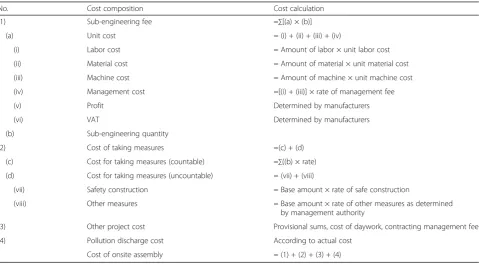
Table 3 is the cost calculation method of printed
components.
4.1.2 The cost structure in assembly stage
According to the GB50500-2013, all-cost unit pricing method is used in assembly stage, in which all the insurance, housing fund, and taxes are counted into the unit price. The cost in assembly stage includes the sub-engineering fee, cost of taking measures, and other project costs, which is detailed structured in Table4.
The provisional sums are specified in contracts between the owner and contractor. Contracting management fee is calculated according to the bidding documents and as per requirement from the contractor.
4.1.3 Analysis of cost calculation in offsite C3DP
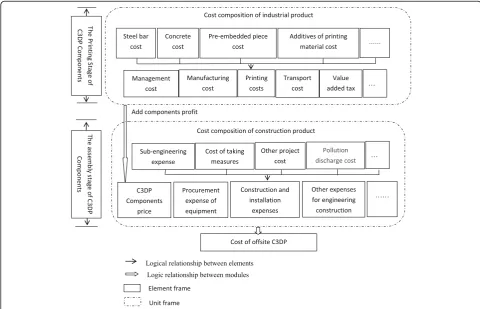
The cost of offsite C3DP is made up of cost in printing and assembly stage, which is characterized by industry and construction products, respectively. The compos-ition structure is indicated in Fig.1.
In printing stage, the printing cost of components, in-cluding steel bar cost, concrete cost, pre-embedded piece cost, and additives of printing material cost. The management cost, together with manufacturing cost, printing costs, transport cost, value added tax, and so on, in construction sector sums up the total cost of offsite C3DP.
In assembly stage, Fig.1 shows us cost composition of offsite C3DP components as construction product. The construction and installation expenses of offsite C3DP components consist of sub-engineering expense, cost of taking measures, other project cost, pollution discharge cost, and so on. The C3DP components cost include C3DP components price, procurement expense of equip-ment, construction and installation expense, and other expenses for engineering construction in assembly stage. The C3DP components price is the sum of all cost com-position in assembly stage plus components profit.
To summarize, cost of offsite C3DP is the sum of C3DP components profit, printing stage cost, and assembly stage cost.
4.2 Cost calculation of onsite C3DP
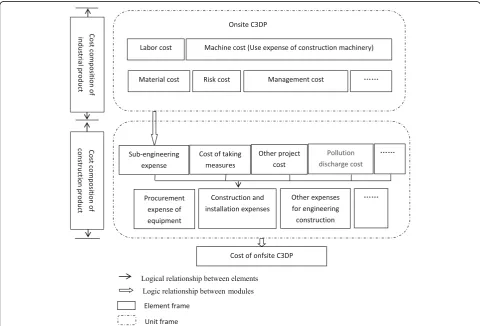
The 3D printed building is characterized as the indus-trial product. The cost calculation structure of onsite C3DP is similar to Fig.1. The cost features of the indus-trial product, such as the labor cost, material cost, ma-chine cost, management fee and risk cost, are integrated into the sub-engineering cost of construction product cost composition, as indicated in Fig. 2. All the construction product cost compositions, including sub-engineering cost, the cost of taking measures, other project cost, and pollution discharge cost, sum up as installation engineer-ing cost, together with the equipment cost and other con-struction cost to add up the total cost of onsite C3DP. This structure is based on the current level of technology and applications in the industry by considering three as-pects, the height of building achieved with C3DP and the fact that the contractors are responsible for C3DP now and in long future.
5 Results and discussion
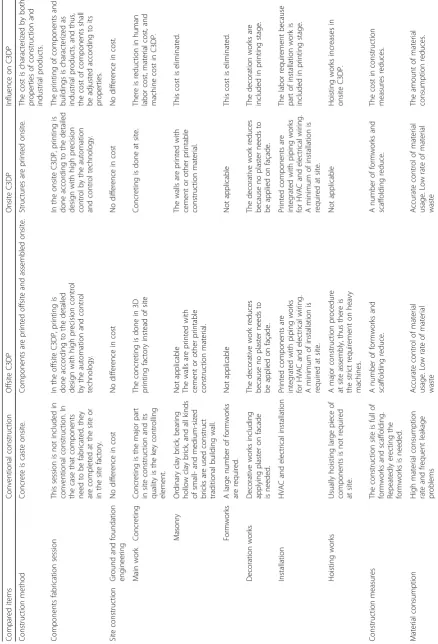
The emerging of C3DP technology has posed challenges to the cost calculation in tradition method, and actually, the cost composition is different from the conventional cost compositions. A summary of the difference in cost compositions among conventional construction, offsite C3DP, and onsite C3DP is presented in Table5.
6 Conclusions
From the above analysis, it is obvious that the cost of C3DP is more sensitive to social change. When calculating costs, both offsite and onsite factors need to be taken into consideration. This paper studied the cost compositions
of onsite and offsite C3DP with considerations on proper-ties of both industrial and construction products and proposed a new method of cost calculation for C3DP. This method separately analyses the cost calculation of compo-nents printing, compocompo-nents assembly, and onsite C3DP to emphasize the fundamental difference between the indus-trial and construction products in the cost calculation. The summary of influence on cost calculation brought by introducing C3DP to construction cost structure was given at the end.
The time cost of C3DP is an important topic for future study. This is because the construction duration is posi-tively proportional to the company expense. Currently, the time auditing is not included in conventional con-struction, and the companies are ignorant of such audit, which unconsciously increases the actual cost of con-struction which is not reflected in the financial state-ment. The absence of such information affects the scientific decision-making and covers up real competi-tiveness of C3DP.
Acknowledgements
The research presented in this paper was supported by Construction 3D Printing Research Unit, Singapore.
Funding
This work is part of the TD13-5019(Public Project and Construction Cost Man-agement). The authors would like to gratefully acknowledge the sponsor. It is“Innovation team training plan”of Colleges and Universities during 13th Five-Year Plan in Tianjin.
Authors’contributions
HY is the main writer of this paper. She proposed the main idea, deduced the cost calculation process of construction3D printing, completed the calculation model, and analyzed the result. JKHC gave very important suggestions for the cost calculation target and process. YC gave some important suggestions for the cost calculation theory and English writing. YL gave some cost calculations suggestions from the architectural perspective and made a later revision of the paper. All authors read and approved the final manuscript.
Competing interests
The authors declare that they have no competing interests.
Publisher’s Note
Springer Nature remains neutral with regard to jurisdictional claims in published maps and institutional affiliations.
Author details
1
School of Management, Tianjin University of Technology, Binshuixi Road, Xiqing District, Tianjin 300384, China.2School of Design & Environment, National University of Singapore, 4 Architecture Drive, Singapore 117566, Singapore.
Received: 8 March 2018 Accepted: 30 May 2018
References
1. W Gao, Y Zhang, D Ramanujan, K Ramani, Y Chen, CB Williams, et al., The status, challenges, and future of additive manufacturing in engineering. Comput. Aided Des.69(C), 65–89 (2015)
3. A Kazemian, X Yuan, E Cochran, B Khoshnevis, Cementitious materials for construction-scale 3D printing: laboratory testing of fresh printing mixture. Constr. Build. Mater.145, 639–647 (2017)
4. M Xia, J Sanjayan, Method of formulating geopolymer for 3D printing for construction applications. Mater. Des.110, 382–390 (2016)
5. M Sakin, YC Kiroglu, 3D printing of buildings: construction of the sustainable houses of the future by BIM. Energy Procedia134, 702–711 (2017) 6. SC Paul, WDT Yi, B Panda, MJ Tan, Fresh and hardened properties of 3D
printable cementitious materials for building and construction. Research article, Archives of Civil and Mechanical Engineering18(1), 311–319 (2018) 7. Biranchi Panda, Ming Jen Tan. Experimental study on mix proportion and
fresh properties of fly ash based geopolymer for 3D concrete printing, Ceramics International, In press, corrected proof, Available online 8 March 2018(2018)
8. F Bos, R Wolfs, Z Ahmed, T Salet, Additive manufacturing of concrete in construction: potentials and challenges of 3D concrete printing. Virtual & Physical Prototyping11(3), 209–225 (2016)
9. I Hager, A Golonka, R Putanowicz, 3D printing of buildings and building components as the future of sustainable construction? Procedia Engineering151, 292–299 (2016)
10. J Song, X Hu, Research on the review of 3D printing technology in construction. Huazhong Architecture (2), 7–10 (2015)
11. L Wang, R Xu, D Miao, G Jin, J Ge, J Bai, Study on 3D printing construction technique based on the Suzhou testing building. Construction Technology
44(10), 89–91+100 (2015)
12. C Gosselin, R Duballet, P Roux, N Gaudillière, J Dirrenberger, P Morel, Large-scale 3D printing of ultra-high performance concrete—a new processing route for architects and builders. Mater. Des.100, 102–109 (2016) 13. Nathalie Labonnote, Anders Rønnquist, Bendik Manum, Petra Rüther.
Additive construction: state-of-the-art, challenges and opportunities, Automation in Construction, 72.pp.347–366(2016)
14. L Fu, Jun Yong, J Lu, X Wang, Industrialization construction cost valuation based on component. J. Civ. Eng. Manag.34(1), 61–66 (2017)
15. S Wang, C Wang, Comparison of cost between prefabricated building and traditional cast-in-place building. Construction and Budget (7), 26–29 (2014) 16. N Erman, Research on the pricing of integrated precast housing
construction project. Engineering and technology17(4), 316+334 (2017) 17. R Duballet, O Baverel, J Dirrenberger, Classification of building systems for
concrete 3D printing. Autom. Constr.83, 247–258 (2017)