Identifying Twitter Location Mentions
Bo Han, Antonio Jimeno Yepes, Andrew MacKinlay, Qiang Chen IBM Research
Melbourne, VIC, Australia
[email protected],[email protected], [email protected],[email protected]
Abstract
This paper describes our system in the ALTA shared task 2014. The task is to identify location mentions in Twitter mes-sages, such as place names and point-of-interests (POIs). We formulated the task as a sequential labelling problem, and ex-plored various features on top of a condi-tional random field (CRF) classifier. The system achieved 0.726 mean-F measure on the held-out evaluation data. We dis-cuss our results and suggest ideas for fu-ture work on location mention recognition in social media.
1 Introduction
The ALTA shared task 2014 aims to identify loca-tion menloca-tions in Twitter data. The input is plain text messages, and the expected output is loca-tion entities such as country names, city names and POIs for each message. For instance, Auck-landand#eqnzare identified as location mentions in@USER are you considering an Auckland visit after #eqnz today?.1 This shared task is very simi-lar to a well-established NLP task — named entity recognition (NER) but with a focus on location en-tities in social media. Each token in a text message is categorised as either a location mention or not. The nearby tokens (i.e., context) may influence a token’s labelling, hence we incorporate context in-formation in our system. Following the literature on NER (Lingad et al., 2013), we formulate it as a sequential labelling task and use a conditional random field (CRF) as the classifier.
The main contributions of the paper are: (1) A sequential labeller for identifying location men-tions in social media; (2) Feature analysis and comparison in NER between social media and
1#eqnzis a short form for earthquake in New Zealand.
other genres. (3) Discussion on errors and exten-sions to current sequential labeller.
2 Challenges
Although CRF models for NER are widely used and are reported to achieve state-of-the-art results in literature (Finkel et al., 2005; Liu et al., 2011; Ritter et al., 2011), NER in social media still raises several non-trivial challenges.
First, Twitter text is noisy, with more non-standard words than polished text (Baldwin et al., 2013) including typos (e.g., challanges
“challenges”), abbreviations (e.g., ppl “people”) and phonetic substitutions (e.g., 4eva “forever”). These non-standard words often cause generali-sation issues (Han and Baldwin, 2011). For in-stance, lexical variants (e.g., Melb, Mel, melbn) will not be recognised in the test data when only standard forms (e.g., “Melbourne”) are observed in the training data.
In addition to non-standard words, informal writing style further reduces NER accuracy. One example is that conventional features relying on capitalisation are less reliable. For instance,LOL
is capitalised but it is not a location entity, while
brisbane may be a valid location mention even though it is in lowercase.
Similarly, Twitter specific entities sometimes are sentence constituents, e.g., #Melbourne in
#Melbourne is my fav city. However, they may be a topic tag that does not form part of the syntac-tic structure of the sentence, such as the hashtags in I like travel to beautiful places, #travel #mel-bourne, in which case syntactic features would be less effective.
3 Feature Engineering
3.1 Related work for NER
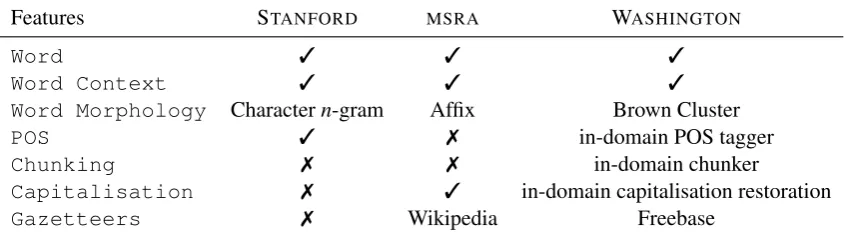
The starting point for our features comes from some other representative systems that are sum-marised in Table 1.
STANFORDNER (Finkel et al., 2005) combined Gibbs sampling and a widely used CRF model. The Gibbs sampling offers non-local constraints to the conventional CRF model that utilises a range of local features. The features in the CRF model are based on words, POS tags, charactern-grams , word shapes and the presence of words in a pre-defined window. The word and POS tag features also include the surrounding tokens and tags to capture the local context information.
Liu et al. (2011) proposed a two-stage CRF-based taggerMSRAfor Twitter NER. First, ak-NN classifier pcategorises words, and then feeds re-sults to a downstream CRF modeller. The features they adopted ink-NN are two word text windows including the target word (i.e., five words in total). The gazetted resources (from Wikipedia) are also utilised and shown to be effective in their experi-ments. As for the features for building the second stage CRF model, they followed Ratinov and Roth (2009) and made use of tokens, word types (e.g., whether the word is alphanumeric or capitalised), word morphological features (e.g., suffix and pre-fix of words), previous tagging labels, word con-text windows, and conjunction features that com-bine both tags and word context windows.
Recently, another WASHINGTON NER tool (Ritter et al., 2011) was developed by rebuilding a Twitter-specific NLP pipeline (from tokenisation and POS tagging to chunking and NER). They adopted rich information generated in the pipeline, such as POS tags, chunking and predicted capital-isation information, as well as clustering of lexical variants (Brown et al., 1992) and gazetted features from Freebase.
3.2 Proposed Features
Based on the previous representative NER work, we considered the following features:
• Word. Lowercased word types are included as a default feature as suggested by existing systems. Previous and next two words are also included to capture local context infor-mation. Larger context window size is not considered as Twitter data is fairly terse and
ungrammatical (Baldwin et al., 2013), so in-corporating long distance context may bring little context information and introduce more noise.
• POS. Based on the fact that location named entities are primarily nouns. A reliable POS tagger generates valuable clues for loca-tions. Instead of re-building a NLP pipeline, we adopt an off-the-shelf Twitter POS tag-gerCMUthat generates coursed-grained POS tags with high accuracy (≥90%) (Owoputi et al., 2013). Similar toword, the previous and next twoPOStags are also included. We also considerPOSbigrams.
• Capitalisation. Instead of predicting token case in Twitter (e.g., (Ritter et al., 2011)), four types of capitalisation informa-tion are retrieved based on the original sur-face form. Namely, they are all character uppercased (AU), all character lowercased (AL), first character uppercased and the rest are lowercased (UL) and mixed capitalisation (MC). We also considercapitalisation bigrams.
• Domain. Twitter specific entities such as user mentions, hashtags and URLs are considered as normal words. This is because many location mentions are em-bedded in these entities. For instance,
@Iran, #brisbane and http:www.abc.net. au/melbourne/. Furthermore, we distin-guish whether a word is in a stop word or not. Moreover, some location clues such asstreet
are also categorised as task-specific features in this feature group.
• Gazetteer. Literature has shown that ex-ternal gazetted resources are helpful in identi-fying named entities. Therefore, we incorpo-rate features based on external place names, e.g., whether a current word is in a refined list of locations. Details are in Section 3.3. • Gazetteer Morphology. As an
ex-tension of previous gazetteer features, we also observed that gazetted names may form part of a token and this is particularly common for Twitter specific entities, e.g.,
Features STANFORD MSRA WASHINGTON
Word 3 3 3
Word Context 3 3 3
Word Morphology Charactern-gram Affix Brown Cluster
POS 3 7 in-domain POS tagger
Chunking 7 7 in-domain chunker
Capitalisation 7 3 in-domain capitalisation restoration
[image:3.595.88.511.64.181.2]Gazetteers 7 Wikipedia Freebase
Table 1: Features comparison of representative NER Systems
3.3 Gazetteers
We adoptedGeoNamesas our primary source of gazetted features. It is a geographical database with information about all countries with over eight million places, such as cities and points of interest.2 However, as noted by Liu et al. (2011), some place names are also commonly used to denote something other than a location. Exam-ples of these terms include people’s names, nat-ural disasters (e.g.,storm), and names that usually do not denote a location (e.g., FridayorFriend). To alleviate the negative impact of these unreli-able place names, we collected stopwords starting with a standard one and then added 5K most fre-quent English terms,3natural disaster names from Wikipedia and a list of popular personal names.4
After extracting and cleaning the terms from GeoNames, the list had over 9.8 million terms.5 The dictionary was used to annotate the tweets us-ing ConceptMapper (Tanenblatt et al., 2010) and theGeoNamesannotation was used as a CRF fea-ture.
On top of refined gazetteers, we also collected country names, state abbreviations, airport IATA codes and place abbreviations (e.g.,stfor street) in some English speaking countries from Wikipedia and Google.6 The list is also filtered by stopword removal so that it represents a high quality place names and we can separately use them as gazetted features fromGeoNames.
2http://www.geonames.org 3
http://www.wordfrequency.info 4
https://online.justice.vic.gov.au/ bdm/popular-names
5
Locations might have more than one name to include variants.
6The data is available at https://github.com/ tq010or/alta-shared-task-2014-ibm
3.4 Gazetteer Morphology
The unique genre in Twitter generates many com-posite and non-standard location mentions. For instance, chch represents Christchurch in New Zealand inThoughts with everyone in chch #eqnz - not again!; A standard place name may be con-catenated with other tokens, e.g., #pakistanflood. A naive string match will miss these gazetted terms, therefore, we also match the prefix and suf-fix of all refined gazetted terms in Section 3.3 for each token in the tweet. The side effect of this approach is it also produces some false positives, e.g.,sa(as South Australia or South Africa) also matchessamsung. To avoid matching false posi-tives, we further restrict the other part (e.g.,msung
in the samsung example) must be a valid word from a 81K English lexicon.7.
Additionally, we also stripped spaces for higher order n-gram for this gazetteer morphol-ogy matching so thatnewzealand andlosangeles
would be recognised as well.
4 Experiments and Discussion
The training/dev/test data is offered by ALTA-shared task organisers. The collected and filtered tweets correspond to short time period when sev-eral disastrous events happened. 2K tweets are used to training and 1K tweets are randomly se-lected and equally split for dev and test purpose. The data set, however, is skewed to a number dis-astrous events such as New Zealand earthquake and Queensland floods.
The evaluation metric is mean-F score which averages the F1 number for each tweet. In addition to this official evaluation metric, we also present precision, recall and F1 numbers.
We adopted a state-of-the-art CRF
tation named CRF-SUITE (Okazaki, 2007) with default parameters. We used built-in tokenisation and POS tags inCMUand all our string matching is in lowercase. Furthermore, the features are repre-sented inBIOnotation, in whichBandIrepresent the beginning and continuity of a location entity, respectively. Odenotes non-entity words. Using lowercased features and BIO (instead of BIOLU (Ratinov and Roth, 2009)) notations are to avoid potential data sparsity issues in generalisation, as we only have 2K training tweets and many labels such as#eqnzare repeated fairly frequently.
To correct CRF tagging errors and misses, we further imposed some post-processing rules. Words satisfying the following rules are also added as location mentions:
1. A word is in the refined GeoNames dictio-nary or a Twitter-specific entity is a gazetted term combined with an English word; 2. A word is in a closed set of direction names
(e.g., north, nth or north-east) or location clues (e.g.,street,st);
3. An URL contains an entry in the refined GeoNamesdictionary;
4. If the tokens preceding and followingof are labelled as locations, then the middle of is counted as part of a location mention, e.g.,
northofBrunswick Heads;
5. CFAandCFSwith the following two words are labelled as location mentions, e.g., CFA district 123.
The evaluation numbers of our system for over-all and feature ablations are presented in Table 2. Kaggle’s site shows the results on the test set of our system compared to other systems.8 Our sys-tem seems to perform below other participating systems, which is cannot be discussed since we are not aware of the implementation of the other systems. Overall, our best tagger achieved 0.758 and 0.726 mean-F1 on dev and test data, respec-tively. The noticeable disagreements between the results on the dev and test data indicates that there is a large difference between the two sets and that larger training sets are required to avoid overfitting or that additional sets of features might be consid-ered.
8
Challenge results on the dev set:https://inclass. kaggle.com/c/alta-2014-challenge/
leaderboard, and public and private split of the test set: https://inclass.kaggle.com/c/ alta-2014-challenge/forums/t/10702/ and-the-winner-is/57341#post57341
Among all features, we saw that word and post-processingare the most important fea-tures to NER. By contrast,domain,gazetteer and gazetteer morphology contribute lit-tle to the overall performance. It makes sense that word are effective features, because many specific tokens (e.g., eqnz) are strong signals showing the token is a location mention. How-ever, it is counter-intuitive thatgazetteer and gazetteer Morphology failed to boost the performance (Ratinov and Roth, 2009; Liu et al., 2011). We hypothesise this may be because our CRF model down-weightedgazetteer fea-tures, when some location mentions (such as non-gazetted POIs) are not in the refinedGeoNames and there might be common words that share the same surface forms with entries in GeoNames. Nonetheless, this doesn’t indicate the gazetted data is not useful, but rather it should be integrated appropriately. Because when we added gazetted data in thepost-processing, a considerable boost in performance is observed.
Notably,capitalisationandPOSare use-ful in identifying location mentions. This sug-gests developing reliable capitalisation restoration and NLP pipeline will be beneficial to downstream NER.
5 Error Analysis
Our system incorrectly identified some tokens as locations. Most of the false positives were due to CRF mistakes. Examples of these mistakes are an-notation of tokens likebushfires, Probably a larger data set would allow the CRF model to avoid these mistakes. On the other hand, many false positives produced by our system look as genuine locations. For instance, bakery was not annotated in Chi-natown bakery but was annotated in Manchester Wong Wong’s bakerya few tweets below. Some locations such asKumbarilla State Forestseem to be false positives as well. Possibly the noise in the data set is also responsible for errors produced by our CRF tagger.
Even with our best efforts to remove location names that would not typically denote a location, there are someGeoNameslocations in our dictio-nary that typically do not denote a location, e.g.,
The End of the World.
lo-Data Dev Test
Evaluation metrics mean-F1 F1 P R mean-F1 F1 P R
Overall 0.758 0.774 0.784 0.764 0.726 0.756 0.770 0.742 -Word 0.716 0.738 0.717 0.760 0.683 0.715 0.702 0.729 -POS 0.744 0.767 0.780 0.755 0.713 0.742 0.772 0.715 -Capitalisation 0.748 0.761 0.769 0.752 0.723 0.753 0.769 0.737 -Domain 0.758 0.772 0.781 0.763 0.715 0.749 0.768 0.732 -Gazetteer 0.751 0.770 0.776 0.763 0.725 0.749 0.758 0.741 -Gazetteer Morph. 0.754 0.772 0.780 0.763 0.727 0.756 0.770 0.742 -Post-processing 0.714 0.743 0.814 0.684 0.700 0.736 0.814 0.672
Table 2: Overall experiment results and feature ablations
cations contain an acronym or abbreviation denot-ing a location as prefix or suffix, the rest part is not a valid single word in our English lexicon. For some locations, their variants were not in our lo-cation dictionary, e.g.,MelbforMelbourne.
Some location names were not in our GeoNames dictionary and nor were identi-fied by the CRF. Examples of these location names includeCoal Quay orMassabielle grotto. Some two letter US state abbreviations were not recognised by our system, e.g., OR or ID; this could possibly be alleviated by less aggressively filtering the stopwords such as OR from the gazetteer but this would in many cases result in many false positives.
In a few cases, our system missed part of the location name when it was a generic location to-ken attached to a specific named location. For in-stance,marketswas not annotated inKelvin Grove markets and grounds was not annotated in UTS grounds.
6 Discussion
In addition to standard CRF experiments and fea-ture ablation analysis, we also tried to improve the accuracy through two extensions. First, we lever-aged embedded topics to represent features, i.e., a feature is represented by the distribution of a lim-ited number of related topics. The feature to topic distribution map is generated on a larger number of English tweets using WORD2VEC.9 The re-sults, compared with the CRF experiments, turn to be negative or minor positive in various set-tings. We infer this may be due to the sub-domain difference in the representation. We used
gen-9https://code.google.com/p/word2vec/
eral English tweets from Twitter Streaming API to obtain the embedded topics, which is differ-ent from disaster-related tweets with location men-tions. Alternatively, this may be due to the high noise/signal ratio, i.e., expanding original feature to embedded topics brings more noise than the useful information.
Additionally, we also tried semi-supervised learning by first training a CRF model to anno-tate locations in a large amount of unseen new tweets, then feeding all locations and tweets into a CRF learner to train a new model for future tag-ging. This approach didn’t show improvement ei-ther. We hypothesise that this is due to the data set being skewed towards disaster-related location mentions, adding more training data from general tweets does not improve the results.
7 Conclusion and Future Work
References
Timothy Baldwin, Paul Cook, Marco Lui, Andrew MacKinlay, and Li Wang. 2013. How noisy social media text, how diffrnt social media sources? In
Proceedings of the Sixth International Joint Confer-ence on Natural Language Processing, pages 356– 364, Nagoya, Japan, October. Asian Federation of Natural Language Processing.
Peter F. Brown, Peter V. deSouza, Robert L. Mer-cer, Vincent J. Della Pietra, and Jenifer C. Lai. 1992. Class-based n-gram models of natural lan-guage. Computational Linguistics, 18(4):467–479.
Jenny Rose Finkel, Trond Grenager, and Christopher Manning. 2005. Incorporating non-local informa-tion into informainforma-tion extracinforma-tion systems by gibbs sampling. InProceedings of the 43rd Annual Meet-ing of the Association for Computational LMeet-inguistics (ACL 2005), pages 363–370, Ann Arbor, USA.
Bo Han and Timothy Baldwin. 2011. Lexical normal-isation of short text messages: Makn sens a #twit-ter. In Proceedings of the 49th Annual Meeting of the Association for Computational Linguistics: Human Language Technologies (ACL HLT 2011), pages 368–378, Portland, USA.
John Lingad, Sarvnaz Karimi, and Jie Yin. 2013. Lo-cation extraction from disaster-related microblogs. In WWW 2013 Companion, pages 1017–1020, Rio de Janeiro, Brazil.
Xiaohua Liu, Shaodian Zhang, Furu Wei, and Ming Zhou. 2011. Recognizing named entities in tweets. In Proceedings of the 49th Annual Meeting of the Association for Computational Linguistics: Human Language Technologies (ACL HLT 2011), pages 359–367, Portland, USA.
Naoaki Okazaki. 2007. CRFsuite: a fast implementa-tion of condiimplementa-tional random fields (CRFs).
Olutobi Owoputi, Brendan O’Connor, Chris Dyer, Kevin Gimpel, Nathan Schneider, and Noah A. Smith. 2013. Improved part-of-speech tagging for online conversational text with word clusters. In
Proceedings of the 2013 Conference of the North American Chapter of the Association for Computa-tional Linguistics: Human Language Technologies (NAACL HLT 2013), pages 380–390, Atlanta, Geor-gia.
Lev Ratinov and Dan Roth. 2009. Design chal-lenges and misconceptions in named entity recog-nition. In Proceedings of the 13th Conference on Natural Language Learning (CoNLL-2009), pages 147–155, Boulder, USA.
Alan Ritter, Sam Clark, Mausam, and Oren Etzioni. 2011. Named entity recognition in tweets: An ex-perimental study. InProceedings of the 2011 Con-ference on Empirical Methods in Natural Language Processing (EMNLP 2011), pages 1524–1534, Ed-inburgh, UK.