Clinical Information Extraction Using Word Representations
Shervin Malmasi♣ Hamed Hassanzadeh♦ Mark Dras♣
♣Centre for Language Technology, Macquarie University, Sydney, NSW, Australia
♦School of ITEE, The University of Queensland, Brisbane, QLD, Australia
[email protected], [email protected] [email protected]
Abstract
A central task in clinical information ex-traction is the classification of sentences to identify key information in publications, such as intervention and outcomes. Sur-face tokens and part-of-speech tags have been the most commonly used feature types for this task. In this paper we eval-uate the use of word representations, in-duced from approximately 100m tokens of unlabelled in-domain data, as a form of semi-supervised learning for this task. We take an approach based on unsuper-vised word clusters, using the Brown clus-tering algorithm, with results showing that this method outperforms the standard fea-tures. We inspect the induced word rep-resentations and the resulting discrimina-tive model features to gain further insights about this approach.
1 Introduction
Evidence-based Medicine (EBM) is an approach to enhance clinical decision making by leverag-ing currently available evidence. The rationale be-hind EBM is that clinicians can make more judi-cious decisions with access to abundant clinical evidence about a particular medical case. This ev-idence is sourced from research outcomes which can be found in medical publications accessible via online repositories such as PubMed.1 Al-though millions of publications are available, find-ing the most relevant ones is cumbersome usfind-ing current search technology. Additionally, the rapid growth of research output makes manual analysis and synthesis of search results unfeasible. This has given rise to the need for methods to auto-matically extract relevant information from publi-cations to support automatic summarization
(Has-1http://www.ncbi.nlm.nih.gov/pubmed
sanzadeh et al., 2015). This is an emerging re-search area that has begun to attract increasing at-tention (Summerscales et al., 2011).
This information extraction is generally per-formed at the sentence level on the paper ab-stracts (Verbeke et al., 2012). Scholarly publica-tions usually follow a common rhetorical structure that first defines the problem and research aims by introducing background information. They then describe the methodology and finally the out-comes of the research are presented. Abstracts, as the summary of the reported research, gener-ally have the same structure. This information, which can be considered asscientific artefacts, can usually be found in the form of whole sentences within the abstracts. More specifically, the arte-facts in the clinical research domain have been categorized as Intervention, Population or Prob-lem, Comparison, and Outcome. This is known as thePICO scheme (Richardson et al., 1995). An-other proposed approach to formalise the rhetori-cal structure of medirhetori-cal abstracts is the PIBOSO model (Kim et al., 2011), a refined version of the PICO criteria. It contains six classes, rather than four: (i) POPULATION: the group of individuals participating in a study; (ii) INTERVENTION: the
act of interfering with a condition to modify it or with a process to change its course; (iii) BACK
-GROUND: material that places the current study
in perspective, e.g. work that preceded the cur-rent study; information about disease prevalence; etc.; (iv) OUTCOME: a summarisation of the
con-sequences of an intervention; (v) STUDYDESIGN: the type of study that is being described; and (vi) OTHER: other information in the publication.
been devised to automatically recognise these sci-entific artefacts in publications (Hassanzadeh et al., 2014a). The most common approach, as dis-cussed in§2, is the use of supervised learning to classify sentences into the various categories.
Separately, another recent trend in Natural Lan-guage Processing (NLP) has been the use of word representations to integrate large amounts of un-labelled data into such supervised tasks, a form of semi-supervised learning (Turian et al., 2010). This is something that has not been applied to sci-entific artefacts extraction.
Accordingly, the primary aim of the present work is to draw together the two areas, evaluating the utility of word representations for this task and comparing them against the most commonly used features to see if they can enhance accuracy. A secondary goal is to inspect the induced word rep-resentations and the resulting discriminative mod-els to gain further insights about this approach.
The paper is structured as follows. We present related work on biomedical information extrac-tion in §2. Word representations are introduced in§3 along with our unlabelled data and cluster-ing method. The experimental setup is outlined in§4 followed by results in§5. In§6 we analyze the most discriminative features of our model and in§7 we present a brief error analysis. Finally, we conclude with a discussion in§8.
2 Related Work
The approaches for classifying scientific artefacts vary from having very coarse grained models of these artefacts, such as, publication zone/section identification (Teufel, 2000), to more fine grained ones, such as, sentence classification (Kim et al., 2011; Liakata et al., 2012). In this section, we review the literature that has a similar perspective as ours, that is, sentence-level classification.
Kim et al. (2011) perform classification in two steps using PIBOSO scheme. In the first step, a classifier identifies the sentences that contain PI-BOSO concepts, while in the second step, a dif-ferent classifier assigns PIBOSO classes to these sentences. The annotation is performed at the sen-tence level and one sensen-tence may have more than one class (i.e. multi-label classification). They also employ a Conditional Random Field (CRF) as their classifier using features derived from the context, semantic relations, structure and the se-quence of sentences in the text. Domain-specific
information is obtained via Metamap. Their fi-nal feature vector includes a combination of: bag-of-words, bigrams, part-of-speech (POS) tags, se-mantic information, section headings, sentence position, and windowed features of the previous sentences.
Verbeke et al. (Verbeke et al., 2012), on the other hand, apply a statistical relational learning approach using a kernel-based learning (kLog) framework to perform classification using the NICTA-PIBOSO corpus. They exploit the rela-tional and background knowledge in abstracts, but take into account only the sequential information at word level. More concretely, their feature set in-cludes a sequence of class labels of the four previ-ous sentences as well as of the two following ones, the lemma of the dependency root of the current sentence and the previous sentence, the position of the sentence, and the section information.
Finally, Sarker et al. (2013) use a set of bi-nary Support Vector Machine (SVM) classifiers in conjunction with feature sets customised for each classification task to attain the same goal. Using the same NICTA-PIBOSOcorpus, they use MetaMap to extract medical concepts, and in par-ticular UMLS Concept Unique Identifiers (CUIs) and Semantic Types, to be then considered as domain-specific semantic features. The rest of the features they employ consist of n-grams, POS tags, section headings, relative and absolute sen-tence positions and sequential features adapted from Kim et al. (2011), as well as class-specific features for the POPULATIONclass. Similar to our approach, they use an SVM classifier.
A key commonality of previous research is that lexical features and POS tags constitute a set of core features that are almost always used for this task. Although some approaches have applied dif-ferent external resources, from generic dictionar-ies such as WordNet to domain specific ontologdictionar-ies, no attempt has been made to leverage large-scale unlabelled data. The main aim of this work is to evaluate the feasibility of such an approach.
3 Word Representations
represen-tations, such as LSA, LSI and LDA, as well as distributed representations, also known as word embeddings. Yet another type of representation is based on inducing a clustering over words, with Brown clustering (Brown et al., 1992) being the most well known method. This is the approach that we take in the present study.
Recent work has demonstrated that unsuper-vised word representations induced from large un-labelled data can be used to improve supervised tasks, a type of semi-supervised learning. Exam-ples of tasks where this has been applied include dependency parsing (Koo et al., 2008), Named En-tity Recognition (NER) (Miller et al., 2004), sen-timent analysis (Maas et al., 2011) and chunking (Turian et al., 2010). Such an approach could also be applied to the clinical information extrac-tion task where although we only have a very limited amount of labelled data, large-scale unla-belled data — hundreds of millions of tokens — is readily available to us.
Researchers have noted a number of advan-tages to using word representations in supervised learning tasks. They produce substantially more compact models compared to fullylexicalized ap-proaches where feature vectors have the same length as the entire vocabulary and suffer from sparsity. They better estimate the values for words that are rare or unseen in the training data. During testing, they can handle words that do not appear in the labelled training data but are observed in the test data and unlabelled data used to induce word representations. Finally, once induced, word rep-resentations are model-agnostic and can be shared between researchers and easily incorporated into an existing supervised learning system.
3.1 Brown Clustering
We use the Brown clustering algorithm (Brown et al., 1992) to induce our word representations. This method partitions words into a set ofcclasses which are arranged hierarchically. This is done through greedy agglomerative merges which op-timize the likelihood of a hidden Markov model which assigns each lexical type to a single class. Brown clusters have been successfully used in tasks such as POS tagging (Owoputi et al., 2013) and chunking (Turian et al., 2010). They have been successfully applied in supervised learning tasks (Miller et al., 2004) and thus we also adopt their use here.
3.2 Unlabelled Data
To obtain suitable unlabelled data, we followed two strategies to retrieve data from the PubMed repository: (1) based on user-defined clinical in-quiries, and(2)using a generic query. In the first strategy we employed 456 clinical queries from the EBMSummariser corpus (Moll´a and Santiago-martinez, 2011). The inquiries in this corpus are collected from the Clinical Inquiries section of the Journal of Family Practice.2 This section of the journal contains a number of queries submit-ted by the users and their evidence-based answers by medical experts. We queried PubMed with these 456 inquiries and retrieved the results using their PM-IDs (i.e. PubMed’s unique identifiers) via PubMed’s eUtils API.3 In total, 212,393 ab-stracts were retrieved, of which 22,873 abab-stracts did not contain valid text, leaving 189,520.
For the second retrieval strategy, we queried PubMed with the term Randomised Controlled Trial. This results in retrieving publications pre-senting medical cases and providing evidence (i.e. desirable for EBM practice). PubMed returned 491,357 results for this query. After removing du-plicate results,i.e.those retrieved in the first strat-egy, we downloaded 200,000 abstracts. After re-moving empty abstracts, 171,662 remained.
The text of each abstract was extracted by pars-ing the PubMed XML file and it was then seg-mented into sentences; each sentence was then to-kenized and lowercased. This resulted in a total of96million tokens across3.7million sentences, with873k unique tokens.4
We next induced Brown clusters using this data. Five runs with clusters of size100,200,300,1000 and 3000 were performed for comparison pur-poses.
3.3 Clustering Results
We now turn to a brief analysis of the clustering re-sults. Table 1 shows examples of both generic and domain-specific clusters taken from the run with 3,000 clusters. We observe that words were clus-tered according to both their semantic and gram-matical properties, with some clusters containing highly domain-specific entries. These results show that the word clusters are very effective at
captur-2
http://jfponline.com/articles/clinical- inquiries.html 3
http://www.ncbi.nlm.nih.gov/books/NBK25497/
4We also note that this data has a much higher type-token
Cluster Path Top Words
00100111 article paper manuscript chapter commentary essay 001011011010 observations investigations evidences facts explorations 1000000011 evaluating investigating examining exploring
111010111011100 suggests indicates implies posits asserts contends
111010111011101 shows demonstrates reveals confirms concludes argues establishes assumes finds 1111011011001 mg/dl mmhg kg/m2 bpm beats/min u/ml mmol/mol
001111000101 antibiotics analgesics opioids antimicrobials placebos antihypertensives 11000100100 reconstruction dissection ligation instrumentation
010111101011110 oncology cardiology rheumatology psychiatry urology dermatology radiology 010111100011010 vaccination immunization inoculation immunisation immunizations revaccination
Table 1: Some example clusters and their top words (by frequency). Examples include both generic (top) and domain-specific (bottom) clusters.
ing lexical knowledge and organizing it by syn-tactic function. We will examine the cluster con-tents again in §6 as part of our feature analysis. We make these unsupervised clusters available for viewing or download from our website.5
4 Experimental Setup
We take a supervised classification approach, comparing previously used features against the un-supervised Brown cluster features.
As the primary focus of this work is the evalu-ation of word representevalu-ation features, we limit the scope of our experiment in two ways: (1) we do not attempt multi-label classification, as explained in§4.1 and (2) we do not use sentence sequence information, as outlined in§4.2. These conditions allow us to focus on systematically comparing fea-ture types in a controlled manner.
4.1 Data
We use the NICTA-PIBOSO corpus (Kim et al., 2011) in this experiment. Here each sentence is la-belled with one or more classes, making it a multi-label classification task. Table 2 lists a break-down of the per-class sentence statistics, showing that9% of the sentences have more than one la-bel. The multi-label characteristic of instances as well as imbalanced distribution of classes are two most common issues of many corpora in biomed-ical scientific artefacts classification task (Hassan-zadeh et al., 2014b). As the scope of our work is limited to evaluating word representation features, we simplify our setup by excluding the multi-label instances, thus reducing the task to a multi-class classification one. This avoids the use of multi-label evaluation metrics, making it easier to draw
5http://web.science.mq.edu.au/%7Esmalmasi/data/med3k/
All Multi-label
BACKGROUND 2,557 160(6%)
INTERVENTION 690 350(51%) OUTCOME 4,523 71(2%)
POPULATION 812 412(51%)
STUDYDESIGN 228 114(50%) OTHER 3,396 0(0%)
Total 12,206 1,107(9%)
Table 2: Sentence counts in the NICTA-PIBOSO
corpus. The multi-label column lists the number of sentences annotated with more than one label.
direct comparisons between the performance of the standard features and the word representations. The sentences were tokenized in a preprocessing step.
4.2 Classifier
We use a linear SVM to perform multi-class clas-sification. In particular, we use the LIBLINEAR6 package (Fan et al., 2008) which has been shown to be efficient for highly-dimensional text classifi-cation problems such as this (Malmasi and Dras, 2014; Malmasi and Dras, 2015b; Malmasi and Dras, 2015a).
Previous work (see§2) shows that CRF classi-fiers perform well for this task, exploiting the se-quential structure of abstracts. As our aim is to evaluate the effectiveness ofintrinsicword repre-sentation features we focus on the classification of individual sentences and do not useextrinsic fea-tures, i.e.the contents or predicted labels of pre-ceding sentences in an abstract. In practice this means that the sentences are being classified inde-pendently.
4.3 Features
We compare our proposed word representation features against the most commonly used features for this task, which we describe here.
Word n-grams Surface tokens are the most
commonly employed feature type in this task us-ing both bag-of-words (unigram) and n-grams. The length of the feature vector equals that of the vocabulary; n-gram vocabulary grows exponen-tially. We extracted wordn-grams of order1–3.
Part-of-Speech n-grams POS tags are another
frequently used feature type and capture the syn-tactic differences between the different classes.7 We tagged the sentences using the Stanford Tag-ger, which uses the Penn Treebank tagset contain-ing36tags, and extractedn-grams of order1–3.
Brown Cluster Features Brown clusters are
ar-ranged hierarchically in a binary tree where each cluster is identified by a bitstring of length ≤ 16 that represents its unique tree path. The bitstring associated with each word can be used as a fea-ture in discriminative models, Additionally, pre-vious work often also uses a p-length prefix of this bitstring as a feature. Whenpis smaller than the bitstring’s length, the prefix represents an an-cestor node in the binary tree and this superset includes all words below that node. We follow the same approach here, using all prefix lengths p ∈ {2,4,6, . . . ,16}. Using the prefix features in this way enables the use of cluster supersets as features and has been found to be effective in other tasks (Owoputi et al., 2013). Each word in a sen-tence is assigned to a Brown cluster and the fea-tures are extracted from this cluster’s bitstring.
4.4 Evaluation
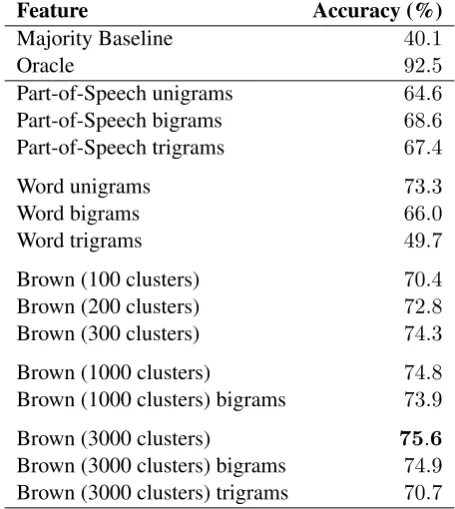
We report our results as classification accuracy un-derk-fold cross-validation, withk = 10. These results are compared against a majority baseline and an oracle. The oracle considers the predictions by all the classifiers in Table 3 and will assign the correct class label for an instance if at least one of the the classifiers produces the correct label for that data point. This approach can help us quan-tify thepotentialupper limit of a classification sys-tem’s performance on the given data and features (Malmasi et al., 2015).
7
e.g.Our own analysis showed that OUTCOMEsentences contained substantially more past tense verbs, comparative adverbs and comparative adjectives.
Feature Accuracy (%)
Majority Baseline 40.1
Oracle 92.5
Part-of-Speech unigrams 64.6
Part-of-Speech bigrams 68.6
Part-of-Speech trigrams 67.4
Word unigrams 73.3
Word bigrams 66.0
Word trigrams 49.7
Brown (100 clusters) 70.4
Brown (200 clusters) 72.8
Brown (300 clusters) 74.3
Brown (1000 clusters) 74.8
Brown (1000 clusters) bigrams 73.9
Brown (3000 clusters) 75.6
Brown (3000 clusters) bigrams 74.9 Brown (3000 clusters) trigrams 70.7
Table 3: Sentence classification accuracy results for the features used in this study.
5 Results
The results for all of our experiments are listed in Table 3. All features performed substantially higher than the baseline. We first tested the POS n-gram features, with bigrams providing the best result of 68.6% accuracy and performance drop-ping with trigrams. Word n-grams were tested next, with unigrams achieving the best result of73.3%. Unlike the POS features, word feature performance does not increase with bigrams.
Finally, the Brown cluster features were tested using clusters induced from the five runs of dif-ferent cluster difdif-ferent sizes. Accuracy increases with the number of clusters; 200 clusters match the performance of the raw unigram features and the largest cluster of size3000yields the best re-sult of 75.6%, coming within 17% of the oracle accuracy of92.5%. Another variation tested was Brown cluster n-grams. Although they outper-formed their wordn-gram counterparts, they did not provide any improvement over the standard Brown features.
Class Clusters of words
BACKGROUND [have has had]—[describes presents examines discusses summarizes addresses] [objectives goal]—[emerged evolved attracted fallen arisen risen proliferated]
INTERVENTION [received underwent undergoing taking]—[gel cream spray ointment]
[orally intravenously subcutaneously intramuscularly topically intraperitoneally] [mg/kg mg/kg/day g/kg ml/kgµg/kg mg/kg/d microg/kgµg/kg]
POPULATION [identified enrolled recruited contacted]—[aged]—[randomly] [twenty thirty forty sixty fifty eighty thirty-two twenty-eight. . .]
OUTCOME [revealed showed suggests indicates implies]—[found observed noted noticed] [significantly]—[p n r r2]—[demonstrate indicate imply]
[0.002 0.003 0.004 0.006.02 0.008 0.007.03 0.009.04. . .]
STUDYDESIGN [cross-sectional case-control quasi-experimental sectional mixed-methods case-crossover case-controlled. . .]—[randomised randomized-controlled]
OTHER [include]—[evaluate assess]—[obtained]—[measured] [articles papers publications literatures manuscripts]
Table 4: Some highly-weighted clusters associated with the NICTA-PIBOSOclasses. Each cluster is a single feature in the model, but we have expanded them here to include their constituent words.
6 Feature Analysis
In this section we analyze some of the discrimi-native features in our model to gain better insight about the knowledge being captured by our mod-els and the task in general. This was done by ranking the features according to the weights as-signed by the SVM model. In this manner, SVMs have been successfully applied in data mining and knowledge discovery tasks such as identifying dis-criminant cancer genes (Guyon et al., 2002).
Table 4 lists several highly weighted Brown clusters for each of our classes. Although each cluster is a single feature in the model, we have expanded the clusters here to include their con-stituent words.
The BACKGROUND class is associated with words that are quite common in the introductory rhetoric of scientific publications. These are de-scriptive of the current and previous research, and are mostly in the present/past perfect tense.
The INTERVENTION class is mostly associated
with clusters that include clinical vocabulary, in-cluding verbs such asreceived,underwentand tak-ing; medication-related nouns likegelorointment;
dosage descriptors such asmg/kgandmg/kg/day; and adverbs describing the route of administration, for exampleorallyandintravenously.
For POPULATIONsentences, numerical quanti-ties, likely relating to the number of participants,8 as well as verbs that are related to participation, are very frequent.
Similarly, reporting verbs are more likely to oc-cur in OUTCOME sentences. They are organized into different clusters according to their syntactic and semantic function. In addition, we also note that a cluster of decimal numbers is also common. These numbers are used in the sentences to report study results, including those from various statis-tical tests. This is accompanied by another clus-ter containing relevant tokens for reporting statis-tics,e.g.“p”, “r”, and “n” which could refer to “p-value”, “Pearson correlation” and “number”, re-spectively.
Overall, it can be seen that the clusters associ-ated with the features are logical. Furthermore, these examples underline the clustering method’s effectiveness, enabling us to encode a wide range of similar tokens (e.g. decimal values or dosage
8These are mostly spelled out as they appear at the start
BACKGROUND INTERVENTION
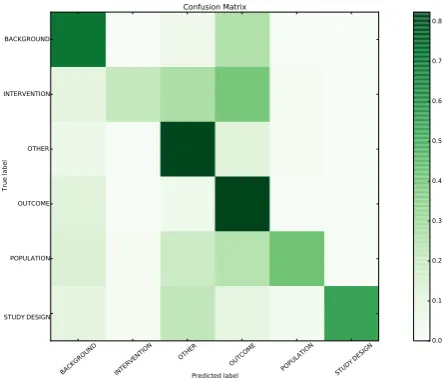
Figure 1: Normalized confusion matrix for results using Brown features (3000 clusters). The values are normalized due to the class size imbalance.
amounts) under a single cluster feature. This pro-vides a substantial reduction in the feature space without the loss of information.
7 Error Analysis
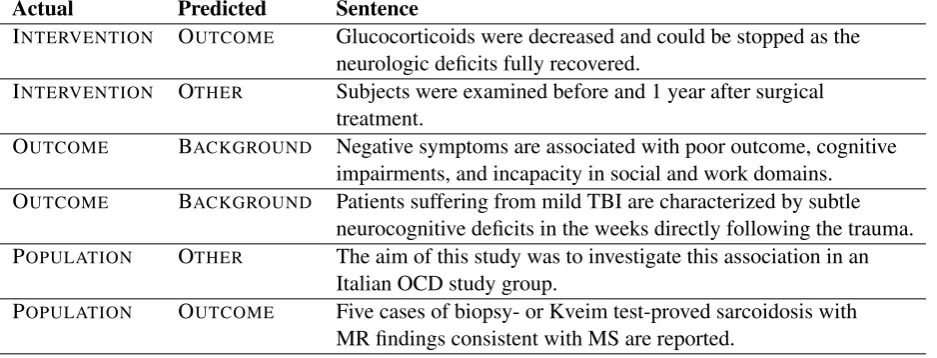
We now turn to an analysis of the errors be-ing committed by the classifier. The error dis-tribution is illustrated by the confusion matrix in Figure 1. We note that the two largest classes, OUTCOME and OTHER, are the most correctly classified. Conversely, INTERVENTION sentences are highly misclassified and mostly confused for OUTCOME. To better understand these errors we segregated the subset of misclassified instances for analysis. Table 5 lists a number of these sentences from highly confused classes.
Our analysis suggests that the occurrences of similar domain-specific terminologies in both types of sentences, in INTERVENTION sentences as the explanation of the methodologies, and re-stating them in OUTCOME sentences in order to describe the effects of those methodologies, can be a reason for this confusion.
There is also some confusion between BACK
-GROUNDand OUTCOMEinstances. Both of these classes commonly describe some challenges and findings of either previous studies (i.e. BACK
-GROUNDsentences) or the current reporting study (i.e. OUTCOME). This narrative characteristic of
these classes has similar rhetorical and linguis-tic attributes, e.g.they usually contain past tense verbs and similar structures. This is demonstrated
by the two example OUTCOME sentences in Ta-ble 5 which are misclassified. Looking at the sen-tences, it can be challenging even for a human to correctly label them without knowing the context; they both describe the outcome of a study, but it is not clear if it is the reporting study or previ-ous work. Only by reading it in the context of the abstract and the preceding sentence can we con-fidently determine that they are outcomes of the present study. This is the case for many of the misclassified instances.
However, this is not due to the feature types but rather the classification approach taken here and in many other studies for this task. The SVM does not model the sequential characteristics of sen-tences in an abstract, instead classifying them in-dependently. It is mostly for these reasons that se-quence labelling algorithms,e.g.Conditional Ran-dom Fields (CRF), have been found to be useful for this task, as we mentioned in§2. Hence, it has been noted that applying such methods with the most suitable features can considerably avoid such contextual errors and improve the overall accuracy (Jonnalagadda et al., 2015).
8 Discussion
We presented a semi-supervised classification ap-proach for clinical information extraction based on unsupervised word representations, outperforming the most commonly used feature types. This is the first application of word representation fea-tures for this task; the promising results here in-form current research by introducing a new feature class. We also made our word clusters available.
Actual Predicted Sentence
INTERVENTION OUTCOME Glucocorticoids were decreased and could be stopped as the
neurologic deficits fully recovered.
INTERVENTION OTHER Subjects were examined before and 1 year after surgical treatment.
OUTCOME BACKGROUND Negative symptoms are associated with poor outcome, cognitive impairments, and incapacity in social and work domains. OUTCOME BACKGROUND Patients suffering from mild TBI are characterized by subtle
neurocognitive deficits in the weeks directly following the trauma. POPULATION OTHER The aim of this study was to investigate this association in an
Italian OCD study group.
POPULATION OUTCOME Five cases of biopsy- or Kveim test-proved sarcoidosis with MR findings consistent with MS are reported.
Table 5: Examples of misclassified sentences with their true and predicted labels.
One limitation here was the size of the unla-belled data we used for inducing the Brown clus-ters.9 Future work could examine the effects of using more data on classification accuracy.
Having demonstrated the utility of the features, there are a number of directions for future work. We previously described that sequence labelling approaches have been found to be helpful for this task given the structured nature of the abstracts. At the same time, it has been shown that incorporat-ing word representations can result in significant improvements for sequence labelling tasks (Huang and Yates, 2009; Turian et al., 2010; Miller et al., 2004). Therefore, the combination of these two approaches for this task seems like a natural ex-tension.
The evaluation of these Brown cluster features on other datasets used for this task — such as the ART corpus (Liakata et al., 2012) — is another direction for research in order to assess if these results and patterns can be replicated.
Cross-corpus studies have been conducted for various data-driven NLP tasks, including pars-ing (Gildea, 2001), Word Sense Disambiguation (WSD) (Escudero et al., 2000) and NER (Noth-man et al., 2009). While most such experiments show a drop in performance, the effect varies widely across tasks, making it hard to predict the expected drop. This is something that could be evaluated for this task by future work.
9
e.g.Owoputi et al. (2013) used approx850m tokens of unlabelled text compared to our96m.
Finally, previous work has also found that com-bining different word representations can further improve accuracy, e.g.the results from Turian et al. (2010,§7.4). This is another avenue for further research in this area.
References
Peter F Brown, Peter V Desouza, Robert L Mercer,
Vincent J Della Pietra, and Jenifer C Lai. 1992.
Class-based n-gram Models of Natural Language. Computational Linguistics, 18(4):467–479.
Gerard Escudero, Llu´ıs M`arquez, and German Rigau. 2000. An empirical study of the domain dependence of supervised word sense disambiguation systems.
In Proceedings of the 2000 Joint SIGDAT
confer-ence on Empirical methods in natural language pro-cessing and very large corpora, pages 172–180.
Rong-En Fan, Kai-Wei Chang, Cho-Jui Hsieh, Xiang-Rui Wang, and Chih-Jen Lin. 2008. LIBLINEAR:
A library for large linear classification. Journal of
Machine Learning Research, 9:1871–1874.
Daniel Gildea. 2001. Corpus variation and parser
per-formance. InEMNLP, pages 167–202.
Isabelle Guyon, Jason Weston, Stephen Barnhill, and Vladimir Vapnik. 2002. Gene selection for cancer
classification using support vector machines.
Ma-chine learning, 46(1-3):389–422.
Hamed Hassanzadeh, Tudor Groza, and Jane Hunter. 2014a. Identifying scientific artefacts in biomedical literature: The evidence based medicine use case. Journal of Biomedical Informatics, 49:159 – 170.
Hamed Hassanzadeh, Tudor Groza, Anthony Nguyen, and Jane Hunter. 2014b. Load balancing for imbal-anced data sets: Classifying scientific artefacts for
evidence based medicine. InPRICAI 2014: Trends
in Artificial Intelligence, volume 8862 of Lecture
Hamed Hassanzadeh, Diego Moll´a, Tudor Groza, An-thony Nguyen, and Jane Hunter. 2015. Similarity Metrics for Clustering PubMed Abstracts for
Evi-dence Based Medicine. InProceedings of the
Aus-tralasian Language Technology Workshop (ALTA).
Fei Huang and Alexander Yates. 2009. Distributional representations for handling sparsity in supervised
sequence-labeling. InACL, pages 495–503.
Associ-ation for ComputAssoci-ational Linguistics.
Siddhartha R. Jonnalagadda, Pawan Goyal, and
Mark D. Huffman. 2015. New directions in
biomedical text annotations: definitions,
guide-lines and corpus construction. Systematic Reviews,
4(78):16.
Su Nam Kim, David Martinez, Lawrence Cavedon, and Lars Yencken. 2011. Automatic classification of sentences to support Evidence Based Medicine. BMC Bioinformatics, 12(Suppl 2):S5.
Terry Koo, Xavier Carreras, and Michael Collins. 2008. Simple semi-supervised dependency parsing.
InACL, pages 595–603.
Maria Liakata, Shyamasree Saha, Simon Dobnik, Colin Batchelor, and Dietrich Rebholz-Schuhmann. 2012. Automatic recognition of conceptualisation zones in scientific articles and two life science
ap-plications. Bioinformatics, 28(7):991–1000.
Andrew L Maas, Raymond E Daly, Peter T Pham, Dan Huang, Andrew Y Ng, and Christopher Potts. 2011. Learning word vectors for sentiment analysis. In Proceedings of the 49th Annual Meeting of the Asso-ciation for Computational Linguistics: Human Lan-guage Technologies-Volume 1, pages 142–150. As-sociation for Computational Linguistics.
Shervin Malmasi and Mark Dras. 2014. Chinese
Na-tive Language Identification. InProceedings of the
14th Conference of the European Chapter of the As-sociation for Computational Linguistics (EACL-14), pages 95–99, Gothenburg, Sweden, April. Associa-tion for ComputaAssocia-tional Linguistics.
Shervin Malmasi and Mark Dras. 2015a. Large-scale Native Language Identification with Cross-Corpus
Evaluation. InNAACL, pages 1403–1409, Denver,
CO, USA, June.
Shervin Malmasi and Mark Dras. 2015b. Multilingual
Native Language Identification. In Natural
Lan-guage Engineering.
Shervin Malmasi, Joel Tetreault, and Mark Dras. 2015. Oracle and Human Baselines for Native Language
Identification. In Proceedings of the Tenth
Work-shop on Innovative Use of NLP for Building Edu-cational Applications, pages 172–178, Denver, Col-orado, June.
Scott Miller, Jethran Guinness, and Alex Zamanian. 2004. Name tagging with word clusters and
discrim-inative training. InHLT-NAACL, pages 337–342.
Diego Moll´a and Maria Elena Santiago-martinez. 2011. Development of a corpus for evidence based
medicine summarisation. InProceedings of the
Aus-tralasian Language Technology Association Work-shop.
Joel Nothman, Tara Murphy, and James R Curran. 2009. Analysing Wikipedia and gold-standard
cor-pora for NER training. InProceedings of the 12th
Conference of the European Chapter of the Associa-tion for ComputaAssocia-tional Linguistics, pages 612–620. Association for Computational Linguistics.
Olutobi Owoputi, Brendan O’Connor, Chris Dyer, Kevin Gimpel, Nathan Schneider, and Noah A Smith. 2013. Improved part-of-speech tagging for
online conversational text with word clusters. In
NAACL. Association for Computational Linguistics.
W.S. Richardson, M.C. Wilson, J. Nishikawa, and R.S. Hayward. 1995. The well-built clinical question: a
key to evidence-based decisions. ACP Journal Club,
123(3):A12–A13.
Abeed Sarker, Diego Molla, and Cecile Paris. 2013. An Approach for Automatic Multi-label
Classifica-tion of Medical Sentences. In Proceedings of the
4th International Louhi Workshop on Health Docu-ment Text Mining and Information Analysis, Sydney, NSW, Australia.
Rodney L Summerscales, Shlomo Argamon, Shangda Bai, Jordan Huperff, and Alan Schwartz. 2011. Au-tomatic summarization of results from clinical trials.
In Bioinformatics and Biomedicine (BIBM), 2011
IEEE International Conference on, pages 372–377. IEEE.
Simone Teufel. 2000. Argumentative Zoning:
Infor-mation Extraction from Scientific Text. Ph.D. the-sis, School of Cognitive Science, University of Ed-inburgh, EdEd-inburgh, UK.
Joseph Turian, Lev Ratinov, and Yoshua Bengio. 2010. Word representations: a simple and general method
for semi-supervised learning. InProceedings of the
48th annual meeting of the association for compu-tational linguistics, pages 384–394. Association for Computational Linguistics.
Mathias Verbeke, Vincent Van Asch, Roser Morante, Paolo Frasconi, Walter Daelemans, and Luc De Raedt. 2012. A statistical relational learning ap-proach to identifying evidence based medicine
cat-egories. InProceedings of the 2012 Joint