Proceedings of the 27th International Conference on Computational Linguistics, pages 2055–2065 2055
Learning What to Share: Leaky Multi-Task Network
for Text Classification
Liqiang Xiao1,2, Honglun Zhang1,2, Wenqing Chen1,2, Yongkun Wang3, Yaohui Jin1,2 1 State Key Lab of Advanced Optical Communication System and Network,
Shanghai Jiao Tong University
2 Artificial Intelligence Institute, Shanghai Jiao Tong University 3 Network and Information Center, Shanghai Jiao Tong University
{jinyh}@sjtu.edu.cn
Abstract
Neural network based multi-task learning has achieved great success on many NLP problems, which focuses on sharing knowledge among tasks by linking some layers to enhance the perfor-mance. However, most existing approaches suffer from the interference between tasks because they lack of selection mechanism for feature sharing. In this way, the feature spaces of tasks may be easily contaminated by useless features borrowed from others, which will confuse the mod-els for making correct prediction. In this paper, we propose a multi-task convolutional neural network with the Leaky Unit, which has memory and forgetting mechanism to filter the feature flows between tasks. Experiments on five different datasets for text classification validate the benefits of our approach.
1 Introduction
Convolutional neural network (CNN) models have achieved impressive results on many natural language processing (NLP) tasks, which use convolving filters to extract local features and have been successfully applied in computer vision field. In recent years, increasing works transfer CNNs to natural language processing tasks, such as representation learning (Liu et al., 2015), information retrieval (Shen et al., 2014), text classification (Kalchbrenner et al., 2014), etc. In particular, feed-forward CNNs with word embedding have been proven to be a relatively simple yet powerful kind of models for text classification (Kim, 2014).
However, the reliance on large-scale corpus has been a formidable constraint for deep neural networks (DNNs) based methods due to their numerous parameters. It costs a lot for a large-scale dataset to train the huge volume of parameters, because constructing a large-scale labeled dataset is extremely labor-intensive. To solve this problem, these models usually employ a pre-trained phase to map words into vectors with semantic implication (Collobert et al., 2011), which just introduces extra knowledge and does not directly optimize the target task. The problem of insufficiency for annotated resources is not intrinsically solved either.
Multi-task learning (MTL) can implicitly increase the corpus size and create a synergy effect among datasets (Caruana, 1997). By learning related tasks in parallel, MTL has the ability to exploit the relations between similar tasks to benefit each other, and eventually improves the performance for classification. In addition, models handling multiple tasks also benefit from a regularization effect to decrease the overfitting. It can help the models to learn a more universal representation for text sequences.
Inspired by this, more DNN-based models (Collobert and Weston, 2008; Liu et al., 2015; Liu et al., 2016) utilize multi-task learning to improve their performance. Traditionally, multi-task learning only shares a few shallow layers among tasks, so only low-level knowledge is exchanged to benefit each other (Collobert and Weston, 2008). But recently more works prefer to share deeper layers to share more high-level knowledge, which has been proven effective to enhance the performance (Liu et al., 2015; Liu et al., 2016).
Task A Task B Task A Task B
Task A Task B Task A Task B Task A Task B
(a) Freely share
Task A Task B Task A Task B
Task A Task B
Task A Task B Task A Task B
[image:2.595.199.399.66.131.2](b) Selectively share
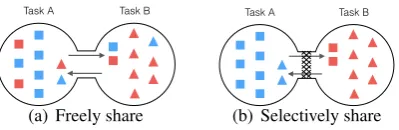
Figure 1: Two schemes for sharing knowledge among tasks. Boxes and triangles denote the features for Task A and B respectively. The red boxes and blue triangles represent the features can be shared to benefit the other task.
The scheme for information sharing is the linchpin for designing a practical multi-task network. Most existing work attempts to find an appropriate proportion to sharing the layers between tasks, despite they entirely reuse some layers among tasks (Liu et al., 2015; Caruana, 1997) or add the tasks’ layers up at a proportion (Fang et al., 2017). And recently, the latter architecture shows its advantages for controlling the relation intensity among tasks and becomes prevailing. More models adopt this thought to enhance the performance (Liu et al., 2015; Liu et al., 2016).
However, under the scheme of proportional addition (Ruder et al., 2017; Misra et al., 2016), all the features, between every pair of tasks, are shared in the same weight without selection. Helpless or harm-ful features if freely transported between tasks with the same importance as helpharm-ful ones, namely, the interference is generated just like Figure 1(a) shows. This would burden the network for distinguishing the helpful features and even mislead the predictions.
To resolve above problems, we propose a new CNN-based model LK-MTL for multi-task learning, which shares the features with a selective mechanism (Figure.1(b)). Our model employs a “split struc-ture” that every task owns a private subnet and shares their features through a well-designed module—
Leaky Unit, which has memory and forgetting mechanisms to control the feature flows, deciding what features should be shared or discarded. By that the feature flows are purified and the interference would be restrained.
We conduct extensive experiments on five benchmark datasets for text classification. And the result shows that our multi-task model gains great improvement over the single-task CNNs and other multi-task competitors.
The contributions of this paper can be briefly summarized as follows:
• Proposed Leaky Unit has the ability to remember and forget, which is effective for filtering the feature flows and can help multi-task learning dispel the interference among tasks.
• The architecture of our multi-task model combines the advantages of GRU and CNN. The perfor-mance is enhanced by both memory mechanism from gated recurrent unit (GRU) and the feature extraction ability from convolutional neural network.
• Our model achieves strong results on several benchmark classification datasets and outperforms the state-of-the-art baselines on four datasets.
2 CNN Models for Text Classification
The main capability of DNNs for text classification is to represent word sequences into fix-length vec-tors. There are many frameworks can be used for sentence modeling, involving Neural Bag-of-Words (NBOW) model, recursive neural network (RecNN) (Socher et al., 2012; Socher et al., 2013), recurrent neural network (RNN) (Chung et al., 2014) and convolutional neural network (CNN) (Collobert et al., 2011).
constructed by alternating the convolution layers and pooling layers. In this paper, this kind of CNN architectures is defined as the subnet in our multi-task network, which can be detailed as follows.
2.1 CNN for Text Representation
Given a text sequencex1:l =x1x2· · ·xl, we first use a lookup table to get the embedding results (word
vector)xi for each wordxi. Then the input matrix can be represented asx = x1 ⊕x2 ⊕ · · · ⊕xl by
concatenating each word vector, where⊕denotes the operation of concatenation. CNNs produce the representation of the input sequence through stacking the layer of convolution, pooling in order, which can be briefly formalized as:
F =H∗x (1)
ˆ
F =pooling(F) (2)
y=wFˆ+b, (3)
whereH is the filter for convolutional operation∗; pooling denotes the pooling operation;F andFˆ
represent the feature maps; wandbdenote the weight and bias respectively in fully connected layer. Usually, drop out mechanism is used as a kind of regularization for output layer and the Eq.3 can be rewrote as
y=wFˆ◦r+b. (4)
Here◦refers to the element-wise multiplication operator, andr∈Rdis a “masking” vector comprising Bernoulli random variables with probabilitypto be1.
2.2 Output Layer for Text Classification
Following the pooling layer, a fully connected layer with dropout and the softmax layer was used, which transforms the vector representation into the probability distribution over classes.
During backpropagation, the parameters in the network are updated by gradient of the loss between the predicted and true distributions. Such as cross-entropy function
L(ˆy,y) =−
N ∑ i=1 C ∑ j=1
yjilog(ˆyij), (5)
whereyˆis the predicted probability distribution;yis the ground-truth label;N andCare the batch size and the number of classes respectively.
3 Multi-Task CNN for Text Classification
The goal of multi-task learning is to utilize the connection among these related tasks to improve classi-fication when learning tasks in parallel. Recently, “split architecture” that provides each task a private subnet is widely accepted by researchers, since it has ability to make a balance between task specific features and shared features. Hence, the key factor of multi-task learning is the fusion mechanism for the information flow between tasks. In CNN models, the information lies in the feature maps. Therefore, the biggest difference of the multi-task architecture is the method for fusing the feature maps. Here we introduce a typical architecture for CNN based multi-task models: PA-MTL.
Leaky Unit Fm
i−1 F
m i
Fn
i−1 F
n i tanh × σ σ 1-× × r mn i−1
zmni −1 Fmn i
…
…
…
…
Task m Task n…
…
…
αmn αmm αnm αnn Fmi−1
Fn i−1
Fm i
[image:3.595.188.412.639.731.2]Fn i
Conv
LU
Embedding Pooling Softmax
PL
Conv Pooling Conv
ym y Task m Task n Input Conv PL PL SM SM Conv PL Conv EB EB
LU LU LU LU
yn
[image:4.595.113.493.65.154.2]Text
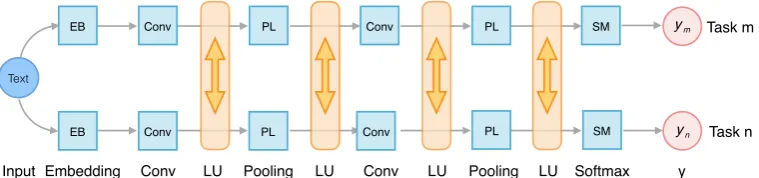
Figure 3: Illustration of the architecture of Leaky Multi-Task Network. LU denotes the Leaky Unit.
Proportional Addition Model (PA-MTL) Generally, most existing multi-task CNN models share the information between tasks by proportional addition (Misra et al., 2016; Fang et al., 2017). As Figure 2 shows, they share the information by adding the feature maps between tasksm, n with scalar weights αi−1.αi−1 is updated by back-propagation, which reflects the strength of association between tasks but has no selection for the features. Between thei−1-th andi-th layers, the whole process for fusing the feature mapsFi−1fromM tasks can be formulated as:
Fi1 .. . FiM
=
α11 · · · α1M
..
. . .. ... αM1 · · · αM M
Fi1−1 .. . FiM−1
, (6)
4 Leaky Multi-Task CNN
The key factor for multi-task learning is the scheme for sharing the features. So an elaborate architecture that can well control the feature sharing among tasks is very crucial for multi-task learning. A good architecture is supposed to not only fully exchange the features to help extend tasks’ feature space, but also select the helpful features to avoid the contamination. So, in this section, we propose a selective architecture to optimize the sharing scheme.
4.1 Model Architecture Choice
Multi-task model with deeper layers shared can fuse high-level knowledge and greatly increase the fea-ture space. But undesirable interference is inevitable and simultaneously comes with the benefits, espe-cially between the less-related tasks. This would burden the models with the overhead on distinguishing helpful features. To overcome above problem, we explore another structure— Leaky Multi-Task CNN (LK-MTL), in which the tasks have ability to selectively borrow helpful knowledge from others.
As shown in Figure 3, in order to reduce the interference, we assign each task a private subnet, under which circumstance the information is shared indirectly and easy to control. These relatively separated tasks can only borrow information from others through the bridge: Leaky Unit. Memory mechanism is employed in this unit to control the feature sharing. The parameters are updated through backpropagation to optimize the selection without needing for extra supervision. This is an end-to-end and easy-training method and its thought is easy to be employed by other works. The convolutional neural network can be easily replaced by multi-layer perceptrons or recurrent neural networks for other applications.
4.2 Leaky Unit
Leaky Unit
Fmi−1 F
m i
Fn
i−1 F
n i tanh × σ σ 1-× × r mn i−1
zmn i−1
[image:5.595.188.412.64.180.2]Fmn i
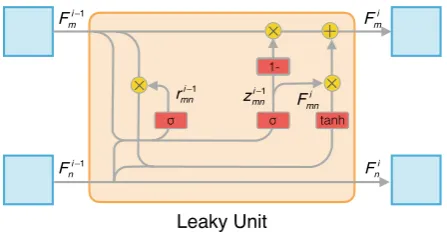
Figure 4: Illustration of the details for Leaky Unit
As shown in Figure 4, aLeaky Gatermnis first generated from the feature maps in(i−1)-th layers
rimn−1 =σ(Wir−1·[Fim−1,Fin−1]), (7)
wheremnmeans the direction of feature flow is from tasknto taskm;σdenotes the logistic sigmoid function, which limits the values into[0,1];Fmi−1,Fin−1 is the feature maps from taskm, nrespectively. Leaky gate decides what features will be leaked in from other tasks. Hence, a new feature map is calculated by
˜
Fimn=tanh(Ui−1·Fim−1+Wi−1·(rimn−1⊙Fin−1)). (8)
When thej-th element in vectorrimn−1 is close to0, the corresponding feature[Fin−1]j in tasknwill be
discarded. On the contrary, feature[Fin−1]j will be kept and passed to taskm.
In addition, we employ another Update Gate zmni−1 to determine how much information should be maintained from current taskminto the next layer, which is emitted by
zimn−1=σ(Wzi−1·[Fim−1,Fin−1]). (9)
And final output for current taskmis calculated by
Fim=zimn−1·Fim−1+ (1−zimn−1)·F˜imn. (10)
If we consider all the directions of information flows and extend above formulations into allMtasks, the output of Leaky Unit is the sum of each row in
∑M k=1z
i−1
1k (1−z i−1
12 ) · · · (1−z i−1 1M)
(1−zi21−1) ∑Mk=1z2ki−1 · 1−zi2M−1)
..
. ... . .. ...
(1−ziM1−1) (1−zMi−12) · · · ∑Mk=1ziM k−1
·
Fi1−1 Fi12−1 · · · Fi1M−1
˜
Fi21 Fi2−1 · · · F˜i2M ..
. ... . .. ...
˜
Fi
M1 F˜iM2 · · · F˜iM
/M. (11)
Leaky units adjust the states of two gates according to the helpfulness of other tasks’ features. The units tend to borrow more features from other tasks will more frequently activate the leaky gate. On the contrary, the update gate will be more active to preserve more information in current task.
4.3 Training
In the last layer of model, the vector representationsFˆmof input sequences are fed into different output
layers to fit the number of class, which emits the prediction of probability distribution for taskm
ˆ
ym=sof tmax(WmFˆm+bm), (12)
whereyˆmis predictive result,Wmis the weight of the full-connected layer, andbmis the bias term.
Given the prediction of all tasks, a global loss function forces models to take every task into account.
Φ =
M ∑
m=1
Dataset Target Type Train Size Dev. Size Test Size Class Avg. Length SST-1
Sentiment
Sentence 8544 1101 2210 5 19
SST-2 Sentence 6920 872 1821 2 19
IMDB Document 25000 - 25000 2 279
SUBJ Subjectivity Sentence 9000 - 1000 2 21
[image:6.595.75.527.63.147.2]QC Question Types Sentence 5153 - 489 6 10
Table 1: Statistics of the five text classification datasets. Dev. and Avg. are the abbreviations of develop-ment and average respectively.
whereλmis the weight for the taskm. In this paper, we simply setλmto1/M for allM tasks to make
a balance.
In order to train the parameters with different datasets, following (Collobert and Weston, 2008), each task is trained by turn in a stochastic manner. The steps can be described as follows:
1. Pick up a taskmrandomly;
2. Select an arbitrary samplesfrom the taskm;
3. Feed the samplesinto the model and update the parameters; 4. Go back to 1.
Following the training phase, we employ fine tuning strategy (Liu et al., 2016) to further optimize the parameters for each task alone.
5 Experiments
In this section, we investigate the empirical performances of our models on five related benchmark tasks for text classification. And the results are compared with the state-of-the-art models. Furthermore, we also intuitively show the operation mechanism of leaky unit via visualization.
5.1 Datasets
As Table 1 shows, we collect five benchmark datasets for text classification that are related to each other to different degree. These datasets contain sentiment, subjectiveness and question type classification, which belong to different class of target and can be briefly introduced as follows:
• SST-1Stanford Sentiment Treebank1(Socher et al., 2013), a movie review dataset with five classes of labels (very positive, positive, neutral, negative, very negative), and split into train/dev/test three parts.
• SST-2Also from the Stanford Sentiment Treebank, but with neutral reviews removed and binary labels.
• SUBJSubjectivity dataset2 that the task is to classify a sentence level text as being subjective or objective (Pang et al., 2004).
• IMDBBinary class dataset3 (Maas et al., 2011) consisting of 100,000 document-level movie re-views that are classified to be positive/negative.
• QCQuestion dataset classifying a given question into six types (whether the question subjects to person, location, numeric information, etc.) (Li and Roth, 2002).
1
http://nlp.stanford.edu/sentiment.
2
http://www.cs.cornell.edu/people/pabo/movie-review-data/
Hyperparameter Setting Embedding size 300
Dropout rate 0.5
Mini-batch size 30 Learning rate 0.001 l2constraint 0.1
Filter size 3,4,5
[image:7.595.233.368.62.172.2]Filter number 50×6
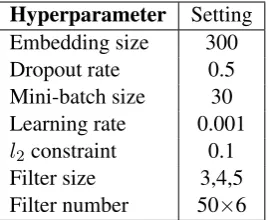
Table 2: Hyperparameter settings
Model SST-1 SST-2 IMDB SUBJ QC
Single-Task
RNTN 45.7 85.4 - -
-DCNN 48.5 86.8 - -
-MGNC-CNN 48.7 88.3 - 94.1
-PV 44.6 82.7 91.7 90.5 91.8
Multi-Task4
MT-GRNN 49.2 87.7 91.6 - 92.3
MT-RNN 49.6 87.9 91.3 94.1
-MT-CNN 49.0 86.9 91.5 94.1 92.0
MT-DNN 48.1 87.3 91.4 94.0 92.1
PA-MTL 48.2 87.1 90.7 94.0 91.5
Our Models
LK-MTL (hidden unit) 49.4 88.6 91.1 94.3 92.9
LK-MTL (hidden unit + peephole) 49.6 88.2 91.3 94.1 93.8
[image:7.595.89.510.207.387.2]LK-MTL (leaky unit) 49.7 88.5 91.3 94.5 93.8
Table 3: Results of LK-MTL against other state-of-the-art models.
5.2 Hyperparameters and Training
Initializing word vectors with the dataset trained by an unsupervised neural network model is an efficient method to enhance the performance without a large-scale supervised training data (Collobert et al., 2011; Socher et al., 2011; Iyyer et al., 2014). In all of our experiments, our models contain a lookup table by employing Word2Vec (Mikolov et al., 2013) trained on Google News, which comprises more than 100B words with a vocabulary size of around 3M. Word2Vec derives from a continuous bag-of-words architecture and each vector has 300 dimensions.
Word vectors are further fine-tuned during training to get a more optimized embedding result that fits the datasets. The whole network is trained through stochastic gradient decent using Adadelta update rule (Zeiler, 2012). For datasets without development set, we randomly select 10% of the training data as the dev set. The key hyperparameters are chosen via a small grid search, and final setting is illustrated in Table 2.
5.3 Performance of Multi-task CNN
We simultaneously train our model LK-MTL on five datasets and compare it with single-task scenario in Table 3. We can see that our model improves the performance with a large margin over the single task models, which demonstrates the positive synergy of our multi-task architecture. This also testified our assumption that separate structure for MTL is conducive to the information sharing between tasks, helping making better representations for text sequences.
We also test several variants of LK-MTL. The first one replaces Leaky Unit by the Hidden Unit5 of standard LSTM, and the second one further adds the peephole connections. The results reported in Table
4
We use reported data for MT-GRNN and MT-RNN and implement MT-CNN, MT-DNN and PA-MTL since the authors do not release the code.
5To suit the multi-task learning architecture, hidden stateh
3 shows that our LK-MTL with Leaky Unit outperforms its variants, which proves the mechanism of Leaky Unit is more suitable for multi-task CNNs.
Comparisons with the State-of-the-art Models
We compare our proposed model against the following models:
• RNTNRecursive Neural Tensor Network with tensor-based feature function and parse trees (Socher et al., 2013).
• DCNNConvolutional Neural Network with a novel dynamic k-max pooling (Kalchbrenner et al., 2014)
• MGNC-CNN Multi-group norm constraint CNN. We use the result of
MGNC-CNN(w2v+Syn+Glv) (Zhang et al., 2016).
• PVParagraph vectors based logistic regression (Le and Mikolov, 2014).
• MT-GRNNA general multi-task learning architecture with Recurrent Neural Network (Zhang et al., 2017).
• MT-RNNMulti-task learning with Recurrent Neural Networks by a shared-layer architecture (Liu et al., 2016)
• MT-DNNMulti-Task learning with Deep Neural Networks that uses bag-of-word representations and a hidden shared layer (Liu et al., 2015).
• MT-CNNMulti-Task learning with Convolutional Neural Network that partially shares a lookup table (Collobert and Weston, 2008).
As shown in Table 3, LK-MTL also outperforms the state-of-the-art multi-task learning works in four datasets and show competitive results in the other one. Competitors slightly outperform our models in IMDB, since its unique character that the sequences are much longer than other datasets. Specifically, LK-MTL surpasses the PA-MTL, which result demonstrates that the memory and forgetting mechanisms in leaky unit indeed have advantages over other sharing approaches, which help distinguish the helpful-ness of the features and making a balance between features in current task and borrowed features. In another word, task-specific feature and shared feature is organically fused by leaky unit in a better way.
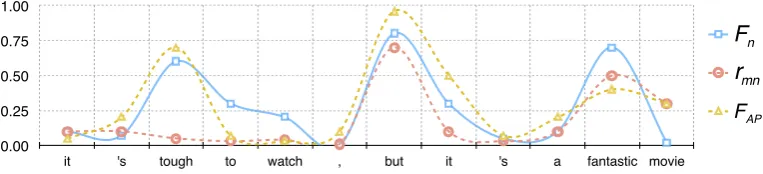
0.00 0.25 0.50 0.75 1.00
it 's tough to watch , but it 's a fantastic movie
[image:8.595.107.489.531.618.2]FAP rmn Fn
Figure 5: Lines illustrate the feature weights ofF1SU BJ in SUBJ subnet. And red line shows the value ofr1
SST−1←SU BJ that filters the features from SUBJ subnet to SST-1 subnet. FAP line visualizes the
feature weights in the first layer of PA-MTL.
5.4 Visualization
Figure 5 illustrates the behavior of leaky unit on a random selected sentence from test set of SST-2 task. We visualize the results of the first feature map for SUBJ subnet and the leak gater1mnthat filters the features from SUBJ to SST-2 task. For the positive sentence “it’s tough to watch, but it’s a fantastic movie”, we can see that subnet for SUBJ task focuses on two critical positions “tough” and “fantastic”. The word “tough” is subjective for SUBJ task, so the subnet focuses on that world, but actually it is useless and may mislead the prediction of SST-2 task. Successfully, our leaky gate lowers the intensity of that interference “tough”, making a correct prediction. However, PA-MTL wrongly makes a negative prediction for lacking resistance to interference. This indicates the effectiveness of our memory and forgetting mechanism in the leaky unit.
6 Related Work
In the NLP field, NN-based multi-task learning has been proven to be effective (Collobert and Weston, 2008; Liu et al., 2015; Liu et al., 2016). The synergy between multi-task learning and neural network is obvious. The earliest idea can be traced back to (Caruana, 1997).
(Collobert and Weston, 2008) develops a multi-task learning model based on CNN. It shares only the partial lookup table to train a better word embedding. And (Liu et al., 2015) proposes a DNN based model for multi-task learning, which shares some low layers to represent the text. These works allow the tasks to reuse low-level layers but separate the high-level layers.
Some models are proposed to sharing deeper layer of networks, which can exchange high level knowl-edge among tasks and gain better performance. (Liu et al., 2016) and (Zhang et al., 2017) introduce some RNN architectures and design different schemes for knowledge sharing among tasks. These tri-als promote the performance of models, but they give no consideration to the interference in multi-task learning.
Thus, more approaches are proposed to reduce the interference among tasks. One is to strengthen con-nection between the strong-related tasks and weaken the less-related ones. (Misra et al., 2016; Fang et al., 2017) proposes a model for images, trying to reduce the interference through weighting the connections between tasks and finding an appropriate proportion. Though this kind of methods weakens the noise from less-related tasks, the processing is coarse-grained and cannot distinguish the useful information in smaller feature level.
Different from these models, our model control the information flows between tasks in feature level, which uses the mechanism of remembering and forgetting, passing only the useful features for the current task. It solves the problems of what should be maintained in current task and what should be borrowed from other tasks. By that our model is capable of reducing the interference without extra supervision.
7 Conclusion and Future Work
In this paper, we propose a CNN based framework for multi-task learning, which has the structure to control the passing of information in feature level. By remembering the helpful features and forgetting the useless ones, LK-MTL can reduce the interference between the tasks. And we also visualize the property of our models and intuitively show the selection mechanism of Leaky Unit. Experiment result on five datasets for text classification demonstrates the effectiveness of our model for text representation. In the feature, we would like to investigate deeper into the interference problem, testing more kinds of gate mechanisms and find better one to purify the feature flows. We also want to equip our unit on other neural networks for other applications, such as multi-layer perceptrons and RNNs.
8 Acknowledge
References
Yoshua Bengio, Nicolas Boulanger-Lewandowski, and Razvan Pascanu. 2013. Advances in optimizing recurrent networks. InIEEE International Conference on Acoustics, Speech and Signal Processing, pages 8624–8628.
Rich Caruana. 1997. Multitask learning.Machine Learning, 28(1):41–75.
Kyunghyun Cho, Bart Van Merrienboer, Caglar Gulcehre, Dzmitry Bahdanau, Fethi Bougares, Holger Schwenk, and Yoshua Bengio. 2014. Learning phrase representations using rnn encoder-decoder for statistical machine translation. Computer Science.
Junyoung Chung, C¸ aglar G¨ulc¸ehre, KyungHyun Cho, and Yoshua Bengio. 2014. Empirical evaluation of gated recurrent neural networks on sequence modeling. CoRR, abs/1412.3555.
Ronan Collobert and Jason Weston. 2008. A unified architecture for natural language processing: deep neural net-works with multitask learning. InMachine Learning, Proceedings of the Twenty-Fifth International Conference (ICML 2008), Helsinki, Finland, June 5-9, 2008, pages 160–167.
Ronan Collobert, Jason Weston, L Bottou, Michael Karlen, Koray Kavukcuoglu, and Pavel Kuksa. 2011. Natural language processing (almost) from scratch.Journal of Machine Learning Research, 12(1):2493–2537.
Yuchun Fang, Zhengyan Ma, Zhaoxiang Zhang, Xu-Yao Zhang, and Xiang Bai. 2017. Dynamic multi-task learning with convolutional neural network. InProceedings of the Twenty-Sixth International Joint Conference on Artificial Intelligence, IJCAI 2017, Melbourne, Australia, August 19-25, 2017, pages 1668–1674.
Mohit Iyyer, Peter Enns, Jordan Boyd-Graber, and Philip Resnik. 2014. Political ideology detection using recur-sive neural networks. InMeeting of the Association for Computational Linguistics, pages 1113–1122.
Nal Kalchbrenner, Edward Grefenstette, and Phil Blunsom. 2014. A convolutional neural network for modelling sentences. InProceedings of the 52nd Annual Meeting of the Association for Computational Linguistics, ACL 2014, June 22-27, 2014, Baltimore, MD, USA, Volume 1: Long Papers, pages 655–665.
Yoon Kim. 2014. Convolutional neural networks for sentence classification. InProceedings of the 2014 Confer-ence on Empirical Methods in Natural Language Processing, EMNLP 2014, October 25-29, 2014, Doha, Qatar, A meeting of SIGDAT, a Special Interest Group of the ACL, pages 1746–1751.
Quoc V. Le and Tomas Mikolov. 2014. Distributed representations of sentences and documents. Computer Science, 4:1188–1196.
Xin Li and Dan Roth. 2002. Learning question classifiers.Coling, 12(24):556–562.
Xiaodong Liu, Jianfeng Gao, Xiaodong He, Li Deng, Kevin Duh, and Ye Yi Wang. 2015. Representation learning using multi-task deep neural networks for semantic classification and information retrieval. InConference of the North American Chapter of the Association for Computational Linguistics: Human Language Technologies, pages 912–921.
Pengfei Liu, Xipeng Qiu, and Xuanjing Huang. 2016. Recurrent neural network for text classification with multi-task learning.
Andrew L Maas, Raymond E Daly, Peter T Pham, Dan Huang, Andrew Y Ng, and Christopher Potts. 2011. Learning word vectors for sentiment analysis. In Meeting of the Association for Computational Linguistics: Human Language Technologies, pages 142–150.
Tomas Mikolov, Ilya Sutskever, Kai Chen, Greg Corrado, and Jeffrey Dean. 2013. Distributed representations of words and phrases and their compositionality. Advances in Neural Information Processing Systems, 26:3111– 3119.
Ishan Misra, Abhinav Shrivastava, Abhinav Gupta, and Martial Hebert. 2016. Cross-stitch networks for multi-task learning. InThe IEEE Conference on Computer Vision and Pattern Recognition (CVPR), June.
Pang, Bo, Lee, and Lillian. 2004. A sentimental education: sentiment analysis using subjectivity summarization based on minimum cuts. Proceedings of Acl, pages 271–278.
Yelong Shen, Xiaodong He, Jianfeng Gao, Li Deng, and Gr´egoire Mesnil. 2014. A latent semantic model with convolutional-pooling structure for information retrieval. InProceedings of the 23rd ACM International Con-ference on ConCon-ference on Information and Knowledge Management, CIKM 2014, Shanghai, China, November 3-7, 2014, pages 101–110.
Richard Socher, Jeffrey Pennington, Eric H Huang, Andrew Y Ng, and Christopher D Manning. 2011. Semi-supervised recursive autoencoders for predicting sentiment distributions. InConference on Empirical Methods in Natural Language Processing, EMNLP 2011, 27-31 July 2011, John Mcintyre Conference Centre, Edinburgh, Uk, A Meeting of Sigdat, A Special Interest Group of the ACL, pages 151–161.
Richard Socher, Brody Huval, Christopher D Manning, and Andrew Y Ng. 2012. Semantic compositionality through recursive matrix-vector spaces. InJoint Conference on Empirical Methods in Natural Language Pro-cessing and Computational Natural Language Learning, pages 1201–1211.
R. Socher, A. Perelygin, J. Y. Wu, J. Chuang, C. D. Manning, A. Y. Ng, and C. Potts. 2013. Recursive deep models for semantic compositionality over a sentiment treebank.
Matthew D. Zeiler. 2012. Adadelta: An adaptive learning rate method.Computer Science.
Ye Zhang, Stephen Roller, and Byron C. Wallace. 2016. MGNC-CNN: A simple approach to exploiting multiple word embeddings for sentence classification. InNAACL HLT 2016, The 2016 Conference of the North Amer-ican Chapter of the Association for Computational Linguistics: Human Language Technologies, San Diego California, USA, June 12-17, 2016, pages 1522–1527.