M o r p h o l o g y w i t h a N u l l - I n t e r f a c e
H a r a l d T r o s t and J o h a n n e s M a t i a s e k A u s t r i a n Research I n s t i t u t e for ArtificiM Intelligence.*
Scllottengasse 3, A-IOIO Vienna, A u s t r i a { h a r a l d , j o h n } 0 a i . u n i v i e , a c . at
A b s t r a c t
We present an integrated architecture for word-level and sentence-level processing in a unification-based paradigm. The core of the sys- tem is a CLP implementation of a nnilication en- gine for feature structures suplmrting relational values. In this framework an IiPSC,-style granl- mar is implemented. Word-level processing uses X 2 M o l t F , a morphological component I)ased on an extended version of two-level morphology. This component is tightly integrated with the g r a m m a r as a relation. The advantage of this apl)roach is that morphology and syntax are kept logically au- tonomous while at the same time minimizing in- terface problems.
1
I n t r o d u c t i o n
Over the last few years there has 1)eeu a growing interest in computational morphology and phonol- ogy. A number of systems have been developed that deal with word-level processing. A widely used approach is finite-state morphology, most no- tably two-level morphology (for an introduction, see Sproat 92). Morphological components are sueeessflflly used for a wide range of stand-alone applications like sl)elling correction a M hyphen- ation. One obvious application is the use in NI,P systems geared to the analysis/generation of text. Surprisingly, they have not been widely al)l)lied in this domain up to now.
A major reason for this is the llrolllem of interfacing morphology with syntax. Reflecting tile current trend in syntax towards lexicalism, unification-1)ased systems use highly structured feature structures as inI)ut. Translating tile out- put of morphologieM components into such it rel)- resentation has proved to be diiticult. Reducing interface problems is therefore crucial to success.
*Financial support for the Austrian Research Institute for Artificial Intelligence is provkled by the Austrian Min- istry o] Science and Research. We wouhl like to thank Wolfgang lleinz for vMuable comments and suggestimls
A tight integration between word and sen- tence level processing also has linguistic advan- tages. The boundary between morphology and syntax is fuzzy. When processing written text the units nmrl>hology has to deal with are, ill it tech- nicM sense, not words M t character strings sepa- rated by delimiters. While these strings roughly correspond to the words of a sentence there are problematic cases. In German, e.g., zu-infinitive or w'rbs with separMfie prefixes ;Lre written as a single unit in some instances a n d separately ill
o t h e r s .
The prol)lem has boon recognized and seine possihle remedies have been prol)osed. They all try to minimize or to elhninMe the intel'r:tce be- tweell w o r d a n d sontoiic(: low4 processing. One stop is the descriptiml of word fl)rmation ill terms of a unification-based gl'all/lnai' to make the result (~1' morphological l)rocessing dir(,ctly ~wMhd)le to syntax and vice w~rsa, an :g)l)roa(-h ah'eady ti~ken in X2Moltl,' (Trost 90, '['rost 91), an extension of two-hwel nmrphohlgy.
The harder probhml is the integration of mor- phol)honology which is traditionally formalized in it way n o t easily t,':mshmdlle into the fei~ture for- malisnx. We will show how this can he achieved by merging the word-level g r a m m a r of X2MolI.I,' into an lll'S(;-styl0 gralnnla.r, alld by adopting a relational view of its two-level rules.
1l, this llal)or we a s s / l i l l e basic flmfilhu'ity with
unification-ha.seal N I,P techniques and two-low~l lnorphology.
2
I n t e g r a t i n g M o r p h o l o g y into
I IPSG
terprise.
I t P S G differentiates between three strata--- PIION, SYNSEM and DTItS. T h o u g h morphology is not considered in the standard approach, it sug- gests itself to be included as a fourth stratum by introducing a feature MORPH into the type sign. Morphotactics are easily described in terms of a feature based grammar. The problem is how to deal with morphophonology. Two proposals have been made to overcome this problem.
Krieger et al. 93 encode finite state a u t o m a t a directly in the feature formalism. Since two-level rules can be compiled into such a u t o m a t a , r o o f phophonology can be straightforwardly integrate<l into the grammar. While this is formally elegant it seems to be no good solution for practical consid- erations. First, it is not entirely clear frmn their paper how the problem of null characters can be handled. Second, encoding large a u t o m a t a will result in a very large and unwieldy type hierar- chy. In general, introducing a u t o m a t a into fea- ture structures and encoding morphophonology directly at that level seems to be too low-level.
Bird & Klein 93 argue against the use of two-level morphology because of linguistic con- siderations. The linguistic background of two- level rules--main stream segmental p h o n o l o g y - - has widely been rejected as a valid linguistic model. Instead, they base their implementation on autosegmental p h o n o l o g y (of. Goldsmith 90).
This is certainly linguistically appealing. But there are reasons for sticking to a more conser- vative approach. Finite-state morphology as a formalism is not necessarily tied to segmental phonology. There are various approaches to cope with non-concatenative p h e n o m e n a - - o n e of tlmm X 2 M o l t F (Trost 90). Also, for a nmnber of lan- guages complete sets of two-level rules do exist and can immediately be brought to bear. Finally, finite-state morphology has proven to be eflicient while the method proposed by Bird ~: Klein 93 seems to be computationally costly.
Like the other apl>roaches ours is also based on IIPSG. Itowever, we employ a different approach to integration. Our g r a m m a r is encoded using a unification engine based on constraint logic pro- gramming (CLP). Besides conventional attril)ute- value descriptions this system allows for the direct representation of more general relations, as they are required by IIPSG. This extension of the for- malism is used for the integration of morl>hology. Thus X2MoI~F is treated as one special relation
of tile grammar. As a result, our approach is more modular than the others. While being fully inte- grated morphology can still be viewed as an au- tonomous component leading to a more llexible design.
We will now give an overview of X 2 M o l I F he- fore describing the integrated system and its im- plementation in detail.
W o r d
Level P r o c e s s i n g
X2MoRF
X 2 M o R F differs fi'mn standard two-level mor- l>hology hi two h n p o r t a n t respects. Continua- tion classes are replaced by a feature-based word grammar. This allows for a more line-grained description of morphs. It is also a prerequisite for a tight integration with a unification-based grammar. X 2 M o R F uses a morph lexicon where each morl>h has one or more feature structures assigned. The word g r a m m a r itself is shnple. Morphs have a functor-argument structure along the lines of di Sciullo ,~: Williams 87. Affixes are unary functors while stems are arguments with- out ally further structure, resulting in a hinary tree structure.
Tile othe,' extension concerns the two-level rules, which are supplemented with a morpholog- ical filter consisti,g of a feature structure. This is hnportant because in morl~hol>honology only some rules are purely l)honologically nmtivated. Oth- ers are triggered by a mixture of phonologicM and morphological facts. Such rules cannot be prop- erly represented in tile standard al>proach.
TAD,, e.g., umlaut an<l schwa epenthesis in (lerman: The third I>erson singular present tense suffix for (;er,nan w~rbs is 4, e.g., sag-t --+ sagt. For stems ending in a dental, schwa is inserted befi)re the ending, e.g., bad-t - , badct. This rule does not hold across the whole vocabulary though. Stems of the stroTIg paradignl <1o exhibit umlaut in 3,'dPersSgPres which blocks schwa epenthesis. The /inal dental of tile stem must be omitted in- stead, e.g., rat-t --+ riil.
The th,'ee miles I shown in Fig. l I t o g e t h e r with the a.pl)ropriate entries in the morl>h lexicon (el. Fig. 7 below)--produce the re<luired behav- ior. In particular, these rules relate surface Nit to lexical $ r A t ÷ t $ 2. X 2 M o l d '~ can be seen as a re-
*These rules as well as other data presented in the e×: amples are simplified for the purl)ose of denmnstration
(i)
A:(L
~ _ j' [MORPIIIMIII':AI)IUMLAIITaolt-lt111la*tl]
(ii) t:O ¢=::V _ 4 . : 0 t(iii) + :e ¢=e,. d e n t a l _ + : 0 [s It] ; [MORPHIMtII.;ADIEPl.;NTIIESI.; -[-]
Figure [: Three extended two-level Rules
lation between a surface string (the word i~orm), a lexical string, and a feature structure (tim inter- pretation of the word form). Relevant for sentence level processing is the morl)hosyntactic informa- tion and the stem, found as the values of paths
MOltPlI [MIIEAI) and MOR, Pll [STEM resl)ectively (of.
Fig. 9 below). This is supplemented by lexeme specific information in the value of SYNSF:M (for a detailed description see Trost 93).
4
I m p l e m e n t i n g HPSG in a C L P
F r a m e w o r k
I I P S G employs strongly typed feature structures together with principles constraining them fur- ther.
Well-typcdness
requirements restrict the space of valid feature structures (cf. Carl)enter 92): Every feature s t r u c t u r e must I)e associated with a type, and every t y p e restricts its associ- ated feature s t r u c t u r e in t h a t only certain features are allowed and the values of these features must be of a certain type. A p p r o p r i a t e n e s s and value restrictions are inherited along the t y p e hierarchy. The second source of constraints, in order to a d m i t only linguistically valid feature structures, are the principles of g r a m m a r . Pollard ,~ Sag 87 allow general implicative and negative constraints in the form of conditional feature structures. In Pollard h Sag in press principles are given only in verbal form. Recent work on formalizing the basis of I I P S G models them as constraints a t t a c h e d to types (e.g., C a r p e n t e r et al. 91). Iiowever, these distinctions affect only how the applicability of a principle is specified. More iml)ortant for our present purpose is the form which the constraints expressed by a principle may take. Besides con- straints enforcing simple s t r u c t u r e sharing (e.g., the Head F e a t n r e Principle given in Fig.2) there are also complex relational dependencies (e.g., in the Subcategorization Principlea). Constraintstions a and d. The rule ha.s an empty phonological context but a morphological filter. This is an example for the treat- meat of non-concatenative phenomena in X 2 M o n F .
3 , i n a headed phrase (i.e., a phrmsal sign whose DTRS value is of sort
head-struc),
the suncAT value of the headlike these go beyond the exl)ressivity of l)ure Da- ture formalisms alone and need to be defined in a recursive manner.
In order to integrate such complex constraints in the feature unification framework we interpret unitication of typed feature structures under the restrictions of princil)led constra.ints as constraint solving in the C L I ' p a r a d i g m (Jafl'ar ,~ Lassez g7). In CI,P the notion of unification is replaced by the more general notion of constraint solving. Constraint solvers may be embedded into a logic l)rogramufing language either by writing a nteta- itlterl)reter or by urn.king use of a system which allows [or the impletn(mtation el + unification ON-
tollS]OilS.
The s~,cond approacls is taken by I ) M C A I (:l,l)4 (l[olzbaur 92), it l)rolog system whose uni- tication mechanlsnl is extended in such a way t h a t the user may introduce interl)reted terms and specify their meaning with regard to uni[ica- tion through l'rolog predicates. T h e basic mech- anism to a chiow, this behavior is the use of at-
tributed variables,
which may l)e qualified by ar- 1)itrary user-defined a t t r i b u t e s . A t t r i b u t e d vari- ables behave like ordinary l)rolog variables with two notal)le exceptions: when an a t t r i b u t e d vari- able is to be unified with a non-wu'iable term o ranother attril)uted variable the unifi('.atk)n exten- sions come into play. For either case the user has to supply a predicate which explicitly specifies how the attril)utes interact and how they should 1)e interpreted with respect to the semantics of the al)l)lication domain. Unilication succeeds only if these constraint solving clauses m a n a g i n g the cond)inati,m -el' vm'ification--af the involved at- tril)utes are successfid.
The iml)hm~entati(m of typed feature struc- tures in our system makes use of the CLP facilities provided by this enhanced Prolog system. Fea- ture structures are imlflemented by the attril)ute
daughter is the concatenation of the phrase's SUBCAT llst with tile list (in order of incre~Lslng obliqueness) of SYNSEM values of the COml)hmlent daughters."(Pollard & .gag in I)ress)
[image:3.612.124.478.86.126.2]:fs (Type, Dag, Goals), where Dag is a list of feature- value pairs (which is empty in case of atomic types) or a marker indicating uninstantiatedness of the substructure (feature structures are instan- tiated lazily). Goals is a list of delayed constraints (see below). Well-typed unification of two feature structures is implemented via the constraint solv- ing clauses mentioned above, taking into account type hierarchy and feature appropriateness (for a detailed description cf. Matiasek & Ileinz 93).
Constraints imposed onto feature structures by the principles of g r a m m a r are stated in a con- ditional form where the antecedent is restricted to contain only typing requirements. 5 In order to ac- count for these conditional constraints we adopt a licensing view: Every node of a feature structure has to be licensed by all principles of grammar.
A node is l i c e n s e d by a principle if either
(i)
the feature structure F rooted in that nodesat-
isfies
the applicability conditions of the l)rinciple and the constraints expressed by the l)rinciple suc- cessfully unify with F, or(ii)
the feature structure F rooted in that node isincompatible
with the applicability conditions of the principle. The in- teresting case arises when a feature structure doesnot satisfy
the applicability conditions of the l)rin- ciple but iscompatible
with them. Thus applica- bility of tile principle can be decided only later, af- ter further instantiation or unification steps have restricted the (sub)structure rooted at that node. In precisely this case the application (or the al)an- doning) of the constraint has to be delayed. The delay mechanism utilizes tim Goals slot in the f s / 3 6 attribute, which is dedicated to hold the delayed constraints. As an example take the well known Ilead Feature Principle of IIPSG (Fig.2) r. The conditional operator ===> is translated at read time via terra_expansion/2 and implements the delay mechanism by coml)iling l>recon<lition checks into the principle. These antecedent checks trigger either the application of the princiltle, its abandomnent, or its delay (by annotating the vari- ables wlfich are not sufficiently constrained to de- cide on the antecedent with the delayed goals).Two advantages of this approach to implement
SThis is only a syntactic variant of attaching constraints solely to types (Carpenter et al. 91) and does not permit general conditional structnres ms used in Pollard & Sag 87. 6pred/n is the usual notation for a n-ary Prolog predicate.
VThe operators ::,,, : :, :, === are defined for typing of a node, path restriction, path concatenation aim value restriction (type
or
coreference) respectively.A VM:
[SYNSEMILOCICATII'E
D
[]
headed-
LD'I'ItS[I
[I';AD-DTIII
SYNSEMILO<':ICATII1EAI)
[~] ]
phrase
Proloq:
h e a d _ f e a t u r e _ p r i n c i p l e ( X ) :- X : : = h e a d e d _ p h r a s e
===>
X::synsem:loc:cat:head===H,
X::dtrs:head_dtr:synsem:loc:cat:head===H.
Figure 2: Head Feature Princil)le
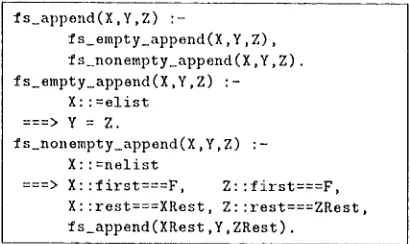
principled constraints are especially important for our present purpose: First, stating redundant typing re<luirements for embedded structures (i.e. type restrictions that would follow automatically from well-typing) forces delay of the conditional constraint until these sul)structures are instanti- ated. This device can, e.g., be used to block in: finite recursion in recursively detlned constraints. Second, the right hand part of the conditional is not restricted to feature logical expressions, but instead can contain arbitrary Prolog goals. In this way constraints involving relational depen- dencies (such as the Subcategorization Principle and the morl>hological relation between a lexical and a surface string) can be expressed within the feature fornmlism and there is no need for external devices controllh~g this interaction. Furthermore, the conditional constraint syntax is not restricted to unary licensing principles but can also be used to express relations, such as *s_append/3--needed for implementing the Subcat l~rinciple--which ap- l>ends two feature structure lists (Fig. 3). Note
fs_append(X,Y,Z) :-
fs_empty appond(X,Y,Z), fs nonempty append(X,Y,Z). fs_empty append(X,Y,Z) : -
X : : = e l i s t ===> Y = Z.
f s _ n o n e m p t y _ a p p e n d ( X , Y , Z ) :- X : : = n e l i s t
===> X : : f i r s t = = = F , Z : : f i r s t = = = F , X : : r e s t = = = X R e s t , Z : : r e s t = = = Z R e s t , f s _ a p p e n d ( X R e s t , Y , Z R e s t ) .
Figure 3: A1)pend for feature structure lists
[image:4.612.322.528.72.234.2] [image:4.612.323.528.517.639.2]Inp u l <=> t:O <=> ['+':0, t:t].
m o r p h r u l e ( [ l l G , 4 3 , 1 1 6 I L S ] , [ S c , d S , 1 1 6 1 S S 0 ] , S S , L C o n , S C o n , F ) :~ !, Sc=48,
m o r p h o l o g y ( [ 4 3 , 1 1 6 I I , S ] , [ 4 8 , 1 1 6 1 S S 0 ] , S S , [ l 1 6 I L C o n ] , [ H I S C o n ] , F ) . Compiled
Figure 4: Sample Two-l,evel R . l e
morphology (LexStream, SurfStream0, SurfPlainln, LexContext, SurfCont e x t , F) : - i n s t a n t i a t e ( L e x S t r e a m , S u r f S t r o a m 0 , S u r f P l a i n l n , S u r f P l a i n O u t ,F) ,
m o r p h r u l e (LexStr earn, Surf Sir earn, Surf Pla inOut, LexCont ext, Surf Cont ext, F ). i n s t a n t i a t e ( [ L C I L C s ] , [SCISCs] , S u r f P l a i n I n , S u r f P l a i n O u t , F ) :-
v a l i d a l p h a b e t _ p a i r (LC, SC],
s y n c h r o n i z e ( [SC I SCs] , S1trf PlainIn, S~irf Plain0ut ), l o o k a h e a d (LC, LCs, SCs, Surf P l a i n O u t ) .
~ y n c h r o n i z e ( [ 4 8 1 _ ] , S t r e a m , S t r e a m ) :~- !. s y n c h r o n i z e ( [Char I_] , [Char I Stream] , Stream) .
F i g u r e 5: The m o r p h o l o g y rela.t, iml
finite loops due to u n i n s t a n t i a t e d variM)les can never occur, a cruciM requirement when integr;tt- ing relational dependencies into st l a z y instantiat- ing f e a t u r e f o r m a l i s m .
5
E m b e d d i n g X 2 M o u F into t h e
F e a t u r e S y s t e m
Originally X 2 M o I t F was realized ~ts st s e p a r a t e morphological c o m p o n e n t interfaced to the sen- tence a n a l y z e r / g e n e r a t o r only via s e q . e n t i a l (lat~ transfer. In the case. of analysis, the feature strm> ture representing the word form was t r a n s m i t t e d to the parser. For generation, X 2 M o R F ' expected a feature s t r u c t u r e as inlmt reproducing one or more word forms. This l)urely sequential architec- ture w a s not satisfactory lmcauso, of the l)roblems mentioned in the i n t r o d u c t i o n .
In order to achieve tight integration, we a(h|l)t a relational view of X 2 M o M ; ' and encode the re- lation between surfiLce string and lexical string <li- reetly without using finite s t a t e a u t o m a t a (for ar- guments suI)porting this ai)pro~Lch of. A1)ramson 92). Ilowever, our al)l)roach extends A1)ramson 92 in t h a t it
(i)
explicitly accounts for the inser- tion of null characters and(ii)
introduces the filter concept of X 2 M o l t F into the relational approach. T h e general format of a two-hwel rule sl)eciIi- cation in our system isLCon <=> T r a n s i t i o n <=> RCon [ : - F i l t e r ]
in the case of equiwdence rules, option:d rules are w r i t t e n using only single arrows (=> and <=).
These rules aro cmnpiled into Prolog c]a,uses 8 re-
buting the ]oxical and surfaco character streams a p p r o p r i a t e l y (see Fig.,1 for an example of the l- elision rtlle f'or ( ] e r l l l a t l ) .
q'- obtain a c . r r o c t relathmship between sur- fa, c(, and h~xi('al string ewwy transition has to be licensed I)y st morphological rule. Transitions not mentioned by rules are handled by a defitult rule. Instantiation of contexts may not be done by the rules themselw,s, since this would make it impos~ sible to obt~dn negation via the c u t - o p e r a t o r . In- stead, it is handled Sel)a.rately in a backtrackable f~shion.
The central relation is the morphology predi- cate, (soe l"iI';. 5) nledia.tiug between lexical string, surf:we string (with inserted n . l l elements), the
puro (dellullifiod) surl~w(~ string and the feature s t r u c t u r e of the morl)hologica.l sign. l n s t a n t i a t i o n of pairs is done del)onding on the possible lexi-
cal con|in,rations (the lexicon b e i , g represented by a trie-structure). The a m o u n t o f l o o k a h e a d is detormilmd by the current pair which is to be li- censed by morphrule. '~ Synchronization of s , r f a c e and lexical string by insertion of mill characters is also ha.lMlml a.t the insta.ntiatlon hwel.
Tim intogra.tion (ff tim two-hwel rohU, ion into
KN(II~! l.hat ]e[t Collie×Is are encoded reversed to ac- count for the lelt to rlg, ht traw~rsa] af the pair of character s[.r(!itlllS;. [J('.[t COIItCXts C~tll be rellleHIbered 3.1ld c]lecked most efficiently this way.
[image:5.612.106.498.77.291.2]the general framework of the feature based sentence-level and word-level grammars is now performed by adding this relation as a principled constraint at the appropriate level.
In a definite clause style AVM notation this could be written as follows (given that morpho:l.ogy/a is a wrapper around the morphol- ogy relation given above, starting with empty left context and hiding the nullified surface stream):
rPnON
~]strlng
/
msignLMm~AO mheod
j|lEAD heod wordLSYNSEM synsem
The actual imi)lementation as a princil)led con- straint in our formalism additionally takes care of delaying the actual enforcement of this relation in case the strings are not sufficiently instantiated.
A second provision has to be made in the word level g r a m m a r to assnre prol)er concatena- tion of the lexical strings of the morl)hological signs being combined. Given the subtyping of
resign
intomarg
andmfunctor,
which in turn has the suhtypesleftfunctor
andrightfunctor,
the principled constraints ensuring concatenation of a left functor with its argument are shown in Fig. 6. Concatenation is delayed until the ar-concat_right_gunctor(X) :- X::=rightfunctor,
X::arg:mstring===subtype_of(string)
= = = >
X::arg:mstring===hrg,
X::affix===Suffix,
X::mstring===Mstring,
concat(hrg,Suffix,Mstring).
Figure 6: Concatenation of lexical strings
gument's MSTRING is instantiated. Thus, infinite loops when concatenating are avoided.
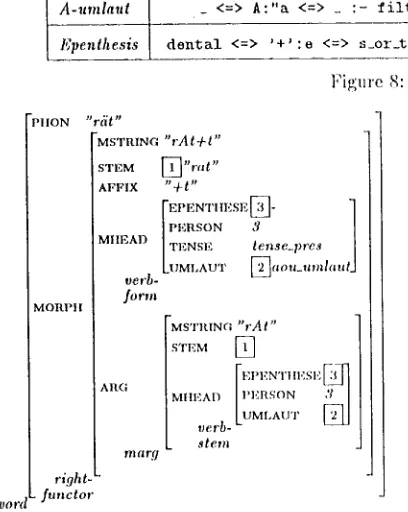
As an example we demonstrate how these con- straints interact in forming the third person sin- gular present tense form of the German verb
raten
(to guess). The lexical string is composed of the stemrat
and the suffix +t. The lexical entries of these two morphs are given in Fig. 7.The two-level rules applicable for this examl)le are the
t-elision
rule (Fig.4) and two rules with filters licensinga-umlavt
andepenthesis,
given inrightfunctor
I
MSTRING STEM"rAt"
" r o t "1
|
LUMLAUT aou_umlautJ J verb_stemm a
rg
'STEM
[~string
AH"IX " 4"t"M,,,.:A,) |PERSON 3 /
LIIMI,AUT
[~]umlautJ
verb_formI-s'r,.:M [ ] l
ARG
/
[EPENq'HESI'
1/
/MI~,,,D
/
1-71//
IIl~/#/II L tJt?I'b_st¢;TII"UMLAUT u a .1
Fignre 7: Lexical entries
the input notation for our system (Fig.8). lnteractkm between syntactic and morpholog- ical processes takes place at the word level. The apl)lieation of the two-lew'J rules relating the sur- face string (i.e the pllON-value of the
word)
and the lexic:d-string (i.e. MORP,IMsTRINC ) is also triggered here. This interaction is completely neu- tral with respect to the direction of l)rocessing due to its relational nature. Parsing is performed by simply instantiating the PIION value. Generation can be achieved when MORPIIIMSTRING is present, which in turn is obtained by concatenating the lexical strings of theresigns
instantiated by the morph grammar.As a result of this constraint interaction the structure shown in Fig. 9 is obtahmd. Features relevant at the syntactic level (such as PERSON and TENSE) are percolated fi'om MORPIIIMI1EAD to SYNSI,:MILoc[CAT [ll~,:al) via structure sharing constraints attached to the type
word
(this in- teraction is not shown in Fig. 9). Informationon sul)c;d,egorization and semantic content for the word is obtained fi-om the lexeme lexicon using MORPIIIsTNM aS a key. These constraints con> plete the interaction between syntactic and mor- phological processing at the word-level.
6
C o n c l u s i o n
[image:6.612.104.307.190.277.2]A - u m l a u t _ <=> h:"a <=> _ :- filter(X, [X::mhead:umlaut===aou-umlaut])
[image:7.612.89.293.85.341.2] [image:7.612.90.517.85.411.2]Epenthesis d e n t a l <=> ' + ' : e <=> s_or_t : - f i l t o r ( X , [ X : : m h e a d : o p e n t h o s e = = = ' + ' ] )
Figure 8: F'ilter lhiles
"PIlON "rift"
"MSTRING "rAt+t"
STEM [~'l"a t" AFFIX "4-t"
FEPENTnESE~"
]
MIIEAD |PERSON
3
/
[TI'~NSE tense_pre~
[
verb- LUMLAUT [~ft O ll_tl llll(l It t_]
SOFIII
MORPII
FMS'rItIN<I ",'At" ]
All.(; /MI1EAI) ] i>ERsON 3 I ]
L stem J
marg righ t-' word functor
F i g u r e 9: R e s u l t o f c o n s t r a i n t ini;eri~(:tion
tended feature formalism, w h i c h is indel>en<h,ntly
m o t i v a t e d by reqnh'enlents of s t a n d a r d I l l ' S t ; , iL reiml)lementation of X 2 M o R F was integr,~ted into the g r a m m a r as a specialized relation.
This architecture has c o m p u t a t i o n a l as well as l i n g u i s t i c a d v a n t a g e s , i n t e g r a t i n g morphology and m o r p h o p h o n o l o g y directly into the g r a l n m a r is in the spirit of I I P S G , which views gramm:cr as a relation between the I)honological (or gr~qllielnic) form of an u t t e r a n c e and its s y n t a c t i c / s e n i a n t i c rel)resentation. This way the t r e a t n m n t of phe- n o m e n a t r a n s c e n d i n g tile b o u n d a r y between in()r-
phology and s y n t a x is also nlade l)ossil)h~. On the i m p l e m e n t a t i o n si(h~, the practi('al problems of interfacing two inherently difl'erent modules are eliminated. For applh:ations this means t h a t using a morl)hological component is m a d e easy. N e v e r t h e l e s s , this tight i n t e g r a t i o n still leaves m o r p h o l o g y and s y n t a z / s o m a n t i c s as a u t o n o m o u s comI)onents, enal)]ing direct use ,)1' existing d a t a sets descril)ing morphopholmh)gy in t e r m s o f t h e t w o - l e v e l p,~ra(ligm.
R e f e r e n c e s
Abramson If.: A Logic Programmiilg View of l(.e- lational Morl)hology, in Proceedings of the 15th
COIANG, August 2?,-28, 1992, Vol.l II, pp.850-854, 1992.
Bird S., Klein E.: l']nriehing IIPSG Phonology, University of l']dildmrgh, UK, Research Paper I'~UCCS/I~ 1'-56, 1993.
Carpenter B., Pollard C., Franz A.: 'the ~pecification and Implementation of Constraint-Based Unifica- tion C, rammars, Proceedings of 2 '*'I IWPT, Can- curt, Mexico, 143-153, 1991.
C, arl>enter B.: The Logic of "l~ped I"calure ,S'h'uclures, (~amhridg,, [hfiversity Press, Caml)ritlge Tracts in Theoretical (~Omlmter Science 32, 1992.
(ilolclsmh.h J.A.: Anloseymcnhd and Metrical l'hovol- ogy , Basil Blacl(well, Oxford, 1990.
llolzbaur C.: Metastructures vs. Attrilmted Vari- ames in the (~ontext of Extensible Unification, in lh'uynooghe M. and Wirsing M.(eds.), l)rogram- ruing Language hnplementation and Logic Pro- gramming, Springer, LN(JS 6:/1, pp.260-268, 19!12. Jatl'ar J., lmssez .I.L.: CoIisl.raint Logic Programming, in I'ro('eodings 14t.tl ACM IK)PI, Conf., Muifich,
1987.
Kriegor II.-U., Pirker lI., Nerbolme J.: Fe~ture-bmsed Allomorldly , Ih'oceedings of the :l 1st Ammal Meet- ing of the At'L, (k)hmll)us, Ohio, Pl). 140-147, 1993. Matiasek J.,. lleinz W.: A CLI ~ Based Approach to lIPS(;, ()sterrei(:hisches Forschungsinstitut fiir Ar- tificial h,telligen(:e, Wien, TI(-93-26, 19!):{. l>ollard C.J., Sag I.A.: hi formation-Based 5'ynlaz ond
5'emmdics, Uuiw'rsity of C]licago Press, Chicago, 1987.
l'ollard, (2.I, .%g I.A.: Ih'ad-l)rivcn Phrase Sh'vchtre (;ra,mlar, I/niw'i'sil.y of (:hicago Iq'oss and (~Sl,I
l>uhlicat.ions, in press.
di ,q('iullo A.-M., }Viliialns I'].: Oil lhr [)efinitioli of Word, MIT l'ross, Caulbridge, MA, 1!)87. Sproal. R.: Morphology alid Coniputalion, MIT Press,
(Janibridge, MA, ACI,-MIT Series in NLI', 1!)92. 'l'rost 11.: The Appli(mtion of Two-Level Morphology to
Non-(ik)ncatenal.ive (i~el'lilall Morphology, hi I(arl-
gren II.(ed.), liroce(-dings of the 13th C O L I N ( ] ,
lh'lsinkl, F'inland, 1q).'371-376, 1990.
Trost II.: X 2 M O R F : A Morphological (JoDlpoli011~ 13asi,d Oll Augniei/l>ed 'l'wo-Lew~l Morphology, ill Proceedings of the 12th I J C A I , Morgal/Ka/ifilianil,