762
Automatic Road Crack Detection Techniques: A
Review
Swapnil Vilas Patil 1,Prof. Mangesh Manikrao Ghonge 2
PG Student, SPPU, Computer Engineering Department, SITRC, Nashik-422213, India1
Assistant Professor, SPPU, Computer Engineering Department, SITRC, Nashik-422213, India2
Email: [email protected] 1,[email protected] 2
Abstract- In everybody’s life road has important value because everyone uses road to reach their destination. But due to environmental change and poor material cause the degradation of the road quality. To maintain and preserve the quality of road first find the cracks and start the maintenance of the road. Manual inspection of the crack needed the expert, but it also has drawbacks like invisibility of cracks, time consuming and expensive. Due to the technology increases image processing it can automatically detects the cracks. This paper is review on the system and techniques which help the crack detection of the system. In this papers review is done on the crack detection and the analysis of the review is being done on image processing techniques.
Index Terms- Crack Detection, Image Processing, Crack Types, Crack Detection, Crack Classification, Random Forest.
1. INTRODUCTION
Crack is the main indication of security in the infrastructure. Cracks are found in all aspects of the framework in light of the fact that everything which is regularly utilized gets disintegrates because of ecological conditions like sun, climate, violent winds, tidal waves, quakes and the human condition like the consistent utilization of things, abuse with the things, low quality of material and so forth. A split is the partition of a partner in the material into at least two sections under the activity of stress. On the off chance that these splits are found on the streets, at that point it could be extremely hazardous for people in light of the fact that the street arrange assumes a vital part in the advance of the nation.[1]
With the help of road network to exchange turn out to be simple, transportation of different things turns out to be simple, in addition, back improvement and social digestion additionally turn out to be simple. Road network gives the best favorable position on a size of financial matters by giving a line of works and stretching out of business sectors. It additionally gives offices to transportation for the two individuals and products. The business transportation of the products and travelers inside India utilize streets for transportation turns out to be extremely normal medium throughout the years. Splits in streets come because of energy hub heaps of the vehicles, low quality of material utilized, natural and climatic conditions. Seeing the upsides of the road network, support of streets turn into an imperative factor, so we can advantageously take the offices of the street organize for extensive stretches. In the good old days,
people were utilized for manual inspection. Be that as it may, it was an exorbitant and tedious process. With the headway in the innovation, modernized frameworks were created for the support of streets. These system help in recognizing breaks in the streets and furthermore help in computing the parameters like split width, length, shape, power, and so forth. These frameworks set aside less time for support of streets and furthermore give exceptionally exact and proficient outcomes.
Crack detection also done by automatic inspection where trending technology image processing is used. In order to take the images of structures need the high resolution camera. Because the accuracy of the result completely depend on the image quality and visual crack. Till now image processing techniques were introduced in literature are Morphological approach, Hough transform, Edge detection Dijkstra’s algorithm, Neural Network, Statistical approach, Segmentation are the process that have been focused. Software’s like image processing lab, Open CV and MATLAB Graphical User interface can be developed for easy monitoring. It also help real time inspection through which data can be extracted.
Crack detection done using image processing following steps are included.
(1) Capture the image using high resolution camera as a crack image as input.
(2) After capturing crack images goes through the preprocessing where the process like scaling and segmentation perform.
763 (4) Lastly, Feature extraction is done with the
detection the shape of the crack.
1.1 Objectives
Following are the objective the system which help to achieve goal.
To increase the quality of road.
Provide safety and avoiding the major accidents.
Improve the quality maintenance of the road.
Improve the road network and reduce the maintenance cost of the government.
Advance the old crack detection system and improve the speed and accuracy as well the adding another feature to it.
2. LITERATURE REVIEW
This literature review gives the overview of all the image processing techniques and the algorithms used mostly in engineering structures for the detection of cracks.
E. Balasubramanian et al. [1] for crack detection they've proposed a way that integrates hat-rework and HSV thresholding. They have got proposed a set of rules which mixes the output of the two filters ensuing in an enhancement of an output photograph. It became based totally on mathematical morphological approach and there take a look at showed that backside hat remodel changed into capable of identifying the cracks extra without difficulty than the top-hat remodel. The previous method was then combined with the HSV thresholding which gave a precise output of the cracks. In their methodology, they used a unique concept which makes use of a UAV (unmanned aerial car) for detecting the cracks in real time. They evolved a GUI in Matlab that enabled them to hit upon and identify the cracks in actual time thereby saving the computational time.
Shivaprasad k et al. [2] have proposed an easy technique to stumble on cracks in pavements which include roads and urban systems. They used everyday aspect detection set of rules as a number one step as a pre-processing component to hit upon the false edges of the crack. The false edges have been eliminated by means of the usage of morphological approach. The drawback of the technique becomes the obtained output images contained false edges which expanded noise within the pics. Proposed approach turned into nicely perfect for the pre-dominant cracks. As an extension of their technique additionally they used thresholding approach, and the acquired outcomes have been exact.
Anders Landsterom et al. [3] conducted experiments on metal slabs for determination of cracks based on morphological technique. The
examiner makes a specialty of three-D floor profile information amassed by means of laser triangulation primarily based on morphological method. Two sets of A and B of 3-d profile have been taken. The records become processed in areas inside the form of pics of a 150 mm x 100 mm (width x length, or X * Y) in size. The performance of the given technique become confirmed via segmenting and classifying a second independent validation set B, containing 323 regions of 3D surface statistics accumulated from 4 distinctive metallic slabs. The results acquired have been nice main to the collection of records nearly at 90% crack opportunity. The attractive end result of their investigation turned into due to statistical category and automatic morphology technique.
Gunkel et al.[4] have designed a crack detection set of rules. The micro cracks have detected the use of shortest viable course in crack clusters whi Gunkel et al.[4] have designed a crack detection set of rules. The micro cracks have detected the use of shortest possible route in crack clusters which also follows the darkest elements. They used Dijkstra's algorithm to come across the crack course which enabled in studying kinks and curves of the crack. The method was carried out in c and r programming language package which furnished accurate results also follows the darkest components. They used Dijkstra's algorithm to hit upon the crack route which enabled in analyzing kinks and curves of the crack. The technique changed into implemented in c and r programming language bundle which furnished accurate results.
Kammar et al. [5] have proposed a gadget for street crack detection and characterization to limit the human involvement. On this sort of imaging, they used Hough transformation for crack detection and supervised approach for the characterization of crack which is primarily based on block-based total photo evaluation technique. For every pixel, the Hough remodel determines the straight line of that pixel and calculates the slope of the road with the aid of mapping Cartesian coordinate into the rotational coordinate gadget. Primarily based on the obtained consequences the cracks had been categorized and this -step method proved to be sturdy.
Pathak et al. [6] have offered a fuzzy logic approach for crack detection which is an opportunity for a non-damaging check. They used natural frequency of the cracks in a beam as an entrance to the fuzzy logic. The relative output received was the crack intensity and relative position of the crack. For that reason, the fuzzy controller changed into organized for varying herbal frequencies. At the give up, they [6] have been able to predict the region of the crack and crack intensity inside nanoseconds which stored computational time.
764 camera. The captured snapshots were stored in digital
pictures. For extracting the records from the pixel they studied and formulated an algorithm the usage of morphological and thresholding approach. The extracted pictures were as compared with grayscale pictures and they found that over 90% of crack length is preserved in the last output photograph of binary pixel. Moreover, the set of rules bottom hat transform proposed by them helped them for the type and crack detection purpose. The experimental outcomes have been based on exclusive parameter settings which confirmed that excessive accuracy can be received via using one of a kind kinds of classifiers. However, their experiments were subjected to eclectic cracks. Those techniques had been applicable for the cracks of cut up width greater than 0.3mm and object duration extra than 15cm, which become the disadvantage of the assignment.
Arun mohan, sumathi poobal [8] supplied an overview on the analysis of styles of imaging processing techniques used for crack detection. They surveyed numerous photo processing strategies including wavelet remodel, median filtering, and hat transform. Morphological approach, Gabor filtering, Otsu’s technique, statistical method, first-rate pixel set of rules, information fusion filtering, Hough transform, ultrasonic pulse speed approach. Based at the analysis they targeted their review on five capabilities. First of all, it turned into a goal primarily based characteristic which consisted width of the crack, length of the crack and course of propagation of the crack. Secondly, they analysed the facts units used inside the techniques for calculating actual information and thereby making it greater efficient. Additionally, they offered the strategies which supplied excessive accuracy. Subsequently, they completed the analysis of every picture processing strategies utilized in each device. Based totally on their analysis they concluded that the camera based image detection with algorithms consisting of thresholding and morphological approach proved to be green.
Maximum existing assessment strategies additionally have a disadvantage, the paper proposes a novel salience-based evaluation method that is demonstrated greater steady to human perception. From the salience-rating and noisy-coefficient, we will find image auto-annotation is far from the human requirement [13].
Image pre-processing which includes binary segmentation, morphological operations and get rid of set of rules which do away with the isolate dots and vicinity. Normally, after the ones operations above, many gaps nonetheless exists inside the crack, the typically generate false high-quality crack. A seed-based totally method is proposed to deal with avenue crack detection, combining multiple directional non minimum suppression (MDMNS) with a symmetry check [16].
Consistent with the technique, a sequence of photos is processed through the crack detection set of rules for you to come across the cracks. Along with the detected crack the set of rules gets photos as inputs and outputs a brand new image with crimson debris. Even no pavement picture databases are public to be had for crack detection and characterization assessment functions [18].
765 Diagonal
crack
Concrete road, concrete pavemen t and civil structure
Thresholdin g method, segmentatio n,
morphologi cal operation, color feature extraction method, particle filtering, sobel edge detection method, least square method, fractal thresholdin g, radon transform
SVM, random forest and adaboost
Alligator
crack
Bridges,
concrete
pavemen t
Thresholdin g method, segmentatio n,
morphologi cal operation, EMD method, binarisation , radon transform, region growing method, Least square method
SVM, random forest and adaboost
Reflexive
crack
Bridges
wavelet transform, morphologi cal operation, KD- tree
SVM
3. EXISTING SYSTEM WORK
Otsu’s thresholding based on global automatic thresholding principle and that’s the reason most of the existing system used it. Otsu’s method based on class-invariance principle i.e. within class variance is
minimum and between classes variance is maximum used to detect the cracks rom images.
Figure 1 .a) Preprocessing module b) Resize the image c) Normalizing the intensity value d)
Segmentation by thresholding e) Extracting crack region (labeled cracks are highlighted in green color)
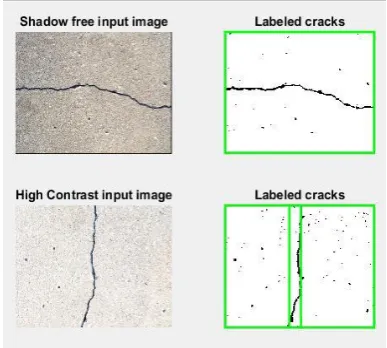
In Fig.1, stage I represents input image. In stage II, the contrast stretched image is obtained through normalization of the intensity value. In stage III, contrast stretched image is converted into gray scaled image. In stage IV, by optimum threshold crack region are segmented from non-crack region. In stage V, crack region is shown in green color. More sample set of output are shown in Fig.2 and Fig.3.
Figure 2.a) Shadow free image b) Result of shadow free image c) High contrast image d) Result of high contrast image
766
Figure.3.a) Shadow image b) Result of shadow image c) Low contrast image d) Result of low contrast image e) Discontinuities crack image f)
Result of discontinuities crack image.
4. SYSTEM OVERVIEW
Automated crack detection and the class system is proposed for road crack pictures. In pre-processing step, blurriness of the image is removed, using Wiener filter. Cracks in bad contrast and non-uniform illumination photographs aren't clean to identify and may yield inaccurate consequences.
Figure 4. Image Enhancement using Wavelet transform and SVD and Random Forest
To overcome those issues, wavelet rework and singular fee decomposition (SVD) are proposed. Grayscale processing of photographs for present crack detection methods appears to be properly enough, however unaffected areas are also recognized as cracks. To address this trouble, morphological operation and KD-tree is blanketed within the design. The morphological operation is used to enhance the picture for crack segmentation whereas KD tree is carried out to connect the discontinuities inside the crack place. In the category of cracks into precise type from the extracted functions, random wooded area algorithm is selected, since it resulted in higher accuracy in literature. Sooner or later, quantitative evaluation in phrases of duration, width, region, intensity and the wide variety of cracks are calculated. The design of the proposed system is proven in fig.4.
5. ANALYSIS AND DISCUSSION
This segment covers the analysis of the crack detection the usage of picture processing techniques based on the literature reviewed. Based on the paper reviewed, it turned into observed that during nearly all of the papers [1, 2, and 3] and [7] morphological technique became used. The circle of relatives of operations related to it (thickening, dilation, erosion, hat-remodel, commencing and ultimate) completed at the shape of the problem of an image is called the morphological method. The Hough remodels become used for sturdy effects [5]. Because of its suitable capabilities and actual time inspection, Hough transform is used for object recognition. Furthermore, the statistical technique proved to be green and accurate for information analysis and filtering of snapshots [5]. For decreased computational time, fuzzy good judgment [6] is an appropriate technique which anticipated the cracks in nanoseconds. For less complicated segmentation of photos in pre-processing stage strategies like HSV thresholding had been followed which superior the exceptional of photo making it extra identifiable. Eventually, evaluation based totally oSn the image processing techniques reviews the reality that the productiveness of image processing techniques has been delivered best inside the post-processing
6. CONCLUSION
767 remodel and SVD with random wooded area set of
rules for crack type. Eventually, the analysis is executed on the premise of image processing and machine getting to know techniques. The results need to be analyzed the usage of appropriate quantitative metrics of crack detection and type. The future gadget can capable of detect the crack, width, and intensity of the crack (depth).
ACKNOWLEDGMENT
I would sincerely like to thank our Professor Mangesh M. Ghonge, Department of Computer Engineering, SITRC, Nashik for his guidance, encouragement and the interest shown in this project by timely suggestions in this work. His expert suggestions and scholarly feedback had greatly enhanced the effectiveness of this work.
REFERENCES
[1] S. Sankarasrinivasan, E. Balasubramanian, K. Karthika, U. Chandrasekar and Rishi Gupta, Health Monitoring of Civil Structures with Integrated UAV and Image Processing System,Eleventh International Multi-Conference on Information Processing-2015 (IMCIP-2015). [2] Shivprasad .K,Vishwanath M K and Narasimha
Kaulgud,Morphology Based Surface Crack Detection,Journal of Advanced and Science Volume I-2015.
[3] Anders Landstr¨om and Matthew J. Thurley, Morphology-Based Crack Detection for Steel Slabs, IEEE Journal of Selected Topics in Signal Processing, 2012.
[4] Christina Gunkel, Alexander Stepper, Arne C. Mu¨ller, Christine H. Mu¨ ller, Micro crack detection with Dijkstra’s shortest path algorithm, Mach. Vis. Appl. 23 (3) (2012).
[5] Vivekanandreddy, Navaneetha.D, Amruta Kammar, Sowmyashree.B, Hough Transforms to Detect and Classify Road cracks, International Journal of Engineering Research and Technology (IJERT) Vol 3, June-2014.
[6] PatilAmit ,MeghanaPathak, P.K.Sharma,Review of Numerical Solution to the Detection of Crack in Structure by using Fuzzy Logic,International Journal of Advance Research in Science And Engineering,(IJARSE) Vol no.3,august-2014. [7] Wenyu Zhang, Zhenjiang Zhang, Dapeng Qi and
Yun Liu, Automatic Crack Detection and Classification method for Subway Tunnel Safety Monitoring, Sensors 2014 .
[8] Arun Mohan, Sumathi Poobal, Crack detection using image processing: A critical review and analysis, Alexandria Engineering Journal 2017. [9] Yong Shi, Limeng Cui, Automatic Road Crack
Detection Using Random Structured Forests,IEEE Transactions On Intelligent Transportation System 2016, pp1524-9050.
[10] Wenyu Zhang, Zhenjiang Zhang, Dapeng Qi and Yun Liu, Automatic Crack Detection and Classification for Subway Tunnel Safety Monitoring, Beijing Municipal Commission of Education, Beijing Jiaotong University, 3 Oct 2014.
[11] Ahmad Ardani, Shamshad Hussain, Evaluation of Premature PCC Pavement Longitudinal Cracking, in Colorado, Colorado Department of Transportation, Proceedings of the 2003 Mid-Continent Transportation Research Symposium, Ames, Iowa, August 2003.
[12] B. Hari Prasath, S. Karthikeyan, Computerized Highway Defects and Classification System, Sathyabama University, Chennai-600119. Accepted on 12-03-2016.
[13] Yong Ge1, Jishang Wei2, Xin Yang1, Xiuqing Wu1, Salience-based Evaluation Strategy for Image Annotation, in International Conference on Computational Intelligence and Security 2007 Pp381-385.
[14] Rabih Amhaz1,2, Sylvie Chambon2 Jerome Idier3, Vincent Baltazart1, A New Minimal Path Selection Algorithm For Automatic Crack Detection On Pavement Images,In ICIP 2014, pp 788-792.
[15] Weiling Huang Weiling Huang, A Novel Road Crack Detection and Identification, School of Computer and Information Technology,Beijing Jiaotong University Beijing, China 10120467,pp 397-401.
[16] Miguel Gaviln 1, David Balcones 1, Oscar Marcos 1, David F. Llorca 1, Miguel A. Sotelo 1, Adaptive Road Crack Detection System by Pavement Classification, in Sensors 2011,ISSN 1424-8220, Pp 9628-9658.
[17] Rabih Amhaz, Sylvie Chambon, Jerome Idier, ember, IEEE, and Vincent Baltazart, Automatic Crack Detection on Two-Dimensional Pavement Images: An Algorithm Based on Minimal Path Selection,in ITITS 2016, Vol. 17, No. 10, Oct 2016, pp 2718-2730.