A system for object-oriented dialogue in Swedish
1. Introduction
T w o m o d e ls fo r se m a n tic in te rp re ta tio n th a t are cu rre n tly b ein g d e v e lo p e d are co n strzu n t-b a se d m o d e ls (e .g . F e n sta d et al. 1985, H a lvorsen 1987) and m od els e m p lo y in g o b je c t-o r ie n te d k n o w le d g e re p re se n ta tio n form a lism s su ch as fram e system s o r se m a n tic n e tw o rk s (e .g. B o b r o w t W e b b e r , 1980; S on d h eim er et ad. 1984, H irst 1 98 7). T h is p a p e r d e scrib e s a diaJogue sy ste m for S w edish in w h ich I w ish to co m b in e featu res o f b o t h m o d e b . A large p a rt o f its lin gu istic k n o w le d g e , in clu d in g sem an tic and p r a g m a tic k n o w le d g e , is exp ressed 33 co n stra in ts. T h e se m a n tic o b je c ts a ssociated w ith lin g u istic ex p re ssio n s in th e in te rp re ta tio n p ro ce ss 3 ie elem en ts o f a sem an tic n e tw o rk . M o r e o v e r , c o n s tr
2
unts and o b je c t d e scrip tio n s p la y a m a jo r role also in the tre a tm e n t o f c o n te x t.T h e s y s te m , ca lle d F A L IN , is b ein g d e v e lo p e d w ith the fo llo w in g p u rp oses in m in d: F irst, I w a n t t o in v e stig a te and d e m o n stra te th e p ossib ilities o f in te g ra tin g s y n ta ctic, s e m a n tic 3nd p ra g m a tic k n o w le d g e in th e in te rp re ta tio n p ro ce ss w h ile still h avin g th at k n o w le d g e in se p a ra te m o d u le s. S e c o n d , I w a n t to in v estig a te the possibilities o f tre a tin g d ia lo g u e p h e n o m e n a su ch as in d e x ica lity and co h e re n ce w ith in su ch a system . T h e resu lts w ill b e u sed in th e d esign o f a larger an d m o re general syste m , LIN LIN (th e L in k ö p in g N a tu tra l L a n gu age In te rf
2
ice; see A h re n b e r g et al., 1986; A h ren berg 1 98 7).A s a p p lica tio n I h a v e ch o se n a sim p le d ra w in g sy s te m w h ere the h u m an pairtner can d ra w , m a n ip u la te and ask q u e stio n s a b o u t g e o m e trica l figu res o n a screen. T h e reason fo r th is ch o ice is th a t a visib le d o m a in m akes it q u ite o b v io u s w h eth er the system is in te rp re tin g in p u ts c o r re c tly o r n o t.
2. System overview
T h e in tera ction w ith F A L IN is restricted to sim p le sequ en ces o f th e k in d th a t can be expressed by fin ite a u to m a ta . T h e basic sequ en ces are, w ith the u s e r’s m oves first: Q u e s tio n /A n s w e r , I n s tr u c tio n /E x e c u tio n and A s s e r tio n /A c c e p ta n c e . T h e system m ay also ask qu estion s o f th e user in th e p rocess o f in te rp re ta tio n and in fo rm h im /h e r o f p rob lem s w ith th e in p u t.
T h e system w ill alw ays try to classify an in p u t in term s o f th e illo cu tio n a ry ca tegories th at are a llow ed. T h is cla ssifica tion t o a large e x te n t d eterm in es w h a t a ctio n s the system w ill ex e cu te and w h a t in fo rm a tio n it w ill p resen t t o th e user.
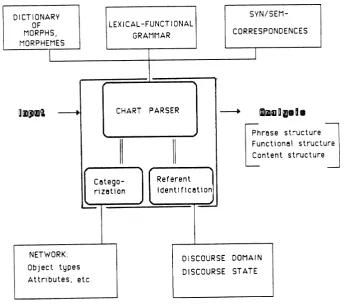
T h e smalyzer aind the k n ow led ge bases th a t it heis access to are illu strated in figure 1.
T h e m orph d iction a ry con sists o f a ste m d ictio n a ry and a set o f a ffix d ictio n a rie s, all o f th em co m p ile d in to letter trees. A ll entries are in th eir su rface fo rm (cf. K a rlsson , 1986). F ix ed exp ression s co m p risin g m ore than on e grap h ical w o r d su ch as t dag
[image:2.595.132.477.419.723.2](to d a y ) or hur m ånga (h o w m a n y ) are in clu d ed in the stem d ictio n a ry . T h e m orph d ic tio n a ry ca n be search ed in d ifferen t m o d e s, e.g. on e m ay ch o o se to look fo r on ly one analysis o f a given strin g, o r all o f th em , or on e m ay inclu d e o r exclu d e the possibility o f a n a lyzin g a w o rd aa a co m p o u n d .
A m o rp h in th e d ic tio n a ry is a ssociated w ith a set o f m orp h em es. W ith each m o rp h e m e th ere are a ssociated a co n tin u a tio n class o f su ffix lexicon s and, o p tio n a lly , a flag gu idin g the co n tin u e d search. A m o rp h e m e is eith er a stem or an affix. A stem m o rp h e m e carries in fo rm a tio n a b o u t syntewrtic c a te g o r y , m o r p h o s y n ta ctic features and m ean in g. T h e m ea n in gs o f a ste m m o rp h e m e are c o lle cte d in a lex em e set, w here a lexem e id en tifies a u n iq u e se m a n tic o b je c t as valu e o f a sem a n tic a ttrib u te . B asica lly, there is on e lexem e fo r ea ch sense o f the m o rp h e m e . A n afHx m o rp h e m e is a ssociated w ith m o r p h o s y n ta c tic featu res an d , p o ss ib ly , in fo rm a tio n a b o u t ca te g o ry changes that it in d u ces.
G iv e n a strin g su ch aa cirklarna (th e circles) th e d ictio n a ry search w ill result in the stru ctu re ( l a ) . T h e first elem en t o f this stru ctu re , N , in d ica tes s y n ta ctic ca te g o ry and the s e co n d e le m e n t, ICirkel, iden tifies a lexem e set. T h e co n te n t o f the lexem e set m a y be ( l b ) w h ere e a ch d ifferen t ite m iden tifies a n o d e in th e n etw ork . A t th a t n ode fu rth er in fo rm a tio n a b o u t this sense o f the m o rp h e m e ca n b e fo u n d . F o r in stan ce, ( ^ C i r c l e # ! m a y rep resen t th e geo m e trica l c o n c e p t o f a circle w h ereas < k C ircle#2 m ay rep resen t th e sense o f ” stu d y circ le ” .
( l a ) (N (IC irkel) ( (G E N D E R (N U M B E R (S P E C (C A S E
U tral) P lu ra l) D efin ite) U n m airk ed))))
( l b ) ICirkel = ( ( T Y P E i z C i r c l e # ! ) ( T Y P E i i C i r c l e # 2 ) )
T h e L e x ic a l-F u n c tio n a l G ram m ar is a p h ra se-stru ctu re gram m ar w ith ann otated fu n ctio n a l s ch e m a ta in th e style o f Kaplan<S^Bresnan (1 9 8 2 ). It d evia tes in several resp ects fro m th e cu rre n t th e o ry smd p ra ctice o f L F G , h ow ever. T h ere are no sem an tic form s and n o a ttrib u te P R E D . In stead o f P R E D an a ttrib u te L E X is used. T h e value o f L E X is a lexem e set. A n im p o rta n t d ifferen ce b etw een L E X and P R E D is th a t L E X is n o t o b lig a to r y . C o n se q u e n tly p rop erties such as coh e re n ce and co m p leten ess o f fu n ctio n a l s tru ctu re s are n o t d eterm in ed b y fu n ctio n a l in fo rm a tio n , b u t are in d u ced fro m se m a n tic co n stra in ts a ssociated w ith o b je c t ty p e d efin ition s.
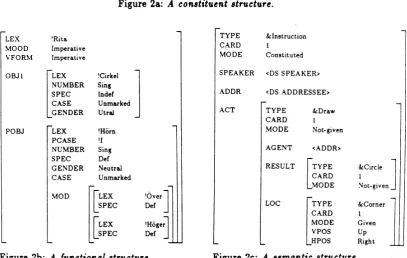
stru ctu re (s-stru ctu re ). T h e c-stru ctu re is a p h rase-stru ctu re tree w h ereas the oth er tw o stru ctu ru s are d e scrip to r stru ctu res e n co d in g in fo rm a tio n in term s o f a ttribu tes and V
2
dues. T h e f-stru ctu re e n co d e s g ra m m atica l in fo rm a tio n , in p2
Lrticular in form a tion a b o u t g ram m atica l relation s and m o r p h o s y n ta ctic featu res. T h e s -stru ctu re en cod es in form ation a b o u t the in p u t sen ten ce regarded as a m essage. T h u s , it is n o t a sem an tic stru ctu re in a strict sense, sin ce it represents a co n te x tu a lly a d eq u ate in te rp re ta tio n o f the in p u t and co n te x tu a l feu:tors are used in its co n s tr u c tio n . P a rtia l stru ctu res for sen ten ce (2) are sh ow n in figu res 2a-2c.(2) R ita en cirkel i ö v re h ö g ra h örn et. (D ra w a circle in th e u p p er righ t co rn e r.)
VIMP
Rita cirkel övre högra hörnet
Figure 2a: A co n s titu en t stru ctu re.
LEX M O O D V F O R M
OBJ I POBJ !Rita Imperative Imperative ”lex
N U M B E R SPEC C A S E _G E N D E R
”lex
P C A SE N U M B E R SPEC G E N D E R C A S E
M O D
ICirkel Sing Indef Unmarked Utral IHörn ! I Sing Def Neutral Unmarked Flex l^SPEC Ilex [_SPEC
[image:4.595.95.503.478.736.2]Figure 2b: A fu n c tio n a l stru ctu re. !Över"| Def
J
IHöger] Def
J
T Y P E C A R D M O D E
SP E A K E R
A D D R
A C T
<k Instruction
1
Constituted
<DS SP E A K E R >
<DS A D D R E SSE E >
T Y P E C A R D M O D E
A G E N T
R E SU L T
LOG
ifcDraw 1 Not-given
<AD D R>
T Y P E (k Circle C A R D 1 _M O D E Not-given _
T Y P E (S^Corner C A R D 1 M O D E Given
VPOS Up
_H PO S Right __
T o b e w e ll-fo rm e d th e three stru ctu res m u st b e in a relation o f p ro p er co rresp o n d en ce. T h e co n stra in ts o n p ro p e r co rre sp o n d e n ce s betw een c-stru ctu re and f-stru ctu re are sta ted in the le x ica l-fu n ctio n a l g r
2
unm ar w h ereas the con stra in ts on p roper co rre sp o n d e n ce s b e tw e e n f-stru ctu re aind s-stru ctu re are in clu d ed in the defin ition s o f in d ivid u a l o b je c t ty p e s and a ttrib u tes. A ls o fu n ctio n a l a ttrib u tes are assigned such co n st radnts. I refer t o th ese latter rules co lle ctiv e ly as S y n t2
u :tic/S e m a n tic co rre sp o n d e n ce s, o r S y n /S e m -c o rr e s p o n d e n c e s fo r sh ort.T h e d o m a in k n o w le d g e o f the system is e n co d e d in a sem an tic n etw ork w ith d a ta stru ctu res rep resen tin g o b je c t ty p e s, o b je c t instan ces and a ttrib u tes. T h e o b je c t typ es represen t co n c e p ts su ch as ” c irc le ” , ” lin e” and ” in stru ctio n ” and carry in form a tion a b o u t su p e rty p e s and s u b ty p e s , p a rt-w h o le rela tion sh ip s and ” p ro to ty p e s ” . A p r o to ty p e exp resses co n stra in ts on the valu es o f a ttrib u tes th at a ie allow ed for in sta n ces o f the ty p e . A s said a b o v e th ey also ca rry lin gu istic in fo rm a tio n sp ecific to the ty p e . F o r in sta n ce , th e o b je c t ty p e fo r ” circle ” w ill co n ta in the in fo rm a tio n th a t it is in clu d e d in th e lexem e set ICirkel. T h e o b je c t ty p e for ” in s tru ctio n ” w ill co n ta in the in fo rm a tio n th a t an in stru ctio n can be co n s titu te d b y m eans o f an im p era tive utterem ce. S im ila rly , a ttrib u te s rep resen tin g sem a n tic roles co n ta in in fo rm a tio n a b o u t h o w th ey are exp ressed lin gu istica lly, w h eth er b y lexem es or gra m m a tica l relation s.
A n o b je c t in sta n ce has a u nique intern al n am e and a d e scrip tio n . A n illu stration is given in (3 ).
(3) C ircle2 9 : ( ( T Y P E (C E N T R E (R A D I U S (C O L O U R
< k C ir c le # l) P o in t l3 )
6
)
B la ck ) (R E S U L T -O F D r a w 4 ))T h e d isco u rse d o m a in b asically con sists o f all the o b je c ts th a t exist, i.e. are part o f the n etw ork at any given stage in th e d iscou rse. H ow ever, w ith o u t im p osin g som e kind o f s tra tifica tio n on th e d iscou rse d o m
2
dn it w ill n o t b e p ossible to h andle anaphoric or im p licit referen ce. T h e re h ave b een va riou s su ggestion s h ow this sh ou ld be d on e (e.g. G ro sz , 1977; A lsh a w i, 1987). T h e first m e th o d th a t w ill be e x p lo re d in this system is to in tro d u ce an o b je c t rep resen tin g the s y s te m ’s view o f ” a d ia log u e sta te ” at any given m o m e n t. T h e d e scrip tio n o f this o b je c t , w h ich w ill co m p rise c o n te x t fa ctors such as speak er, a dd ressee, cu rre n t to p ic s, cu rren t visible o b je c ts e tc, w ill then be u p d a ted for ea ch n ew u tte ra n ce .parser has certain d e term in istic traits, w h ich I w ill n ot d escribe here, b u t it w ill adways find an analysis if there is on e.
T h e role o f the classifyin g co m p o n e n t is to determ in e an a p p ro p ria te o b je c t ty p e for an s-stru ctu re co n stitu e n t. S o m etim es a T Y P E -d e s c r ip to r ca n be d e te rm in e d easily fro m the lexical in fo rm a tio n , b u t th ere are several co m p lica tio n s , such as d isa m b ig u a tio n and the h an d lin g o f headless phrases. A general requ irem en t is th a t, if a lexem e set heis been in d ica te d , the value o f T Y P E m u st be an elem en t o f th a t set. O th e r d escrip tors o f the sem an tic stru ctu re are requ ired to be co m p a tib le w ith the T Y P E J-d escrip tor a cco rd in g to its p ro to ty p e .
T h e task o f th e referent id e n tifica tio n co m p o n e n t is to d eterm in e referents o f the d escrip tion fo u n d in an s-stru ctu re co n stitu e n t. N ot all s-stru ctu re co n s titu e n ts will refer to an aJready existin g in d ivid u al, o f cou rse. F or these th ere is still a need to d eterm in e a m o d e o f a p p lica tio n o f the d e scrip tio n , i.e. th e c o n d itio n s u n der w h ich a referent w ill exist.
T h e sem an tic stru ctu re eLSSOciated w ith a co n s titu e n t w ill n orm a lly n o t b e co n s tr u c te d until the co n stitu e n t is ju d g e d sy n ta ctica lly co m p le te b y the p arser, i.e. w h en an in a ctive edge is p ro p o se d for in tro d u ctio n in to th e ch a rt. T h u s , a co n s titu e n t su ch as
en svart frå ga (a black q u e stio n ) m ay b e re je cte d b y th e an a lyzer on th e grou n d s th a t
d e scrip tio n s o f question s ca n n o t co n ta in d e scrip to rs referin g to co lo u r. S im ilarly, sen ten ces su ch as (4) and (5 ) w ill be d isa m b ig u a te d w h en sem a n tic co n stra in ts are taken in to a cco u n t. F o r in sta n ce, an a ctiv e edge spa n n in g th e w o rd s fly tta cirkeln o f (5) and lo o k in g fo r a lo ca tiv e a d verbia l ca n co m b in e s y n ta ctica lly w ith an in a ctive edge sp a n n in g th e w ord s i h orn et, b u t th e p ro p o se d ed ge w ill be re je cte d on sem an tic grou nd s, sin ce th e lo ca tio n expressed b y th e latter w o rd s w o n ’t b e o f the a p p rop ria te typ e for a m o v e m e n t a ction .
(4) R ita cirk eln i h örn et.
(D ra w th e circle in the co rn e r.)
(5) F ly tta cirk eln i h örn et.
(M o v e th e circ le in the co rn e r.)
3. Rules for syntactic/semantic correspondences
et al. 1987). O th e r n atu ral lan gu age p rocessors rely im p licitly or exp licitly on stru ctu ra l iso m o rp h y b etw een s y n ta ctic and sem an tic stru ctu res (e .g. L ytin en , 1987; D an ieli et al., 1987). W h ile I b elieve th at sim ple o n e -to -o n e relation s betw een syn ta ctic and se m a n tic elem en ts are su fficien t to o han dle sim ple language fra gm en ts, I also feel th a t th ere are lim its to su ch a m e th o d o lo g y . T h ere are s y n t
2
Lctic con stitu en ts that co rre s p o n d to n o se m a n tic o b je c t (e.g. form a l su b je cts and o b je c t s ), there are those th a t co rre s p o n d to m o re th an on e sem a n tic o b je c t (e .g. lo cu tio n a ry and illocu tion a ry co n te n ts ) and th ere are ca ses w h ere several sy n ta ctic co n stitu e n ts relate to on e and the sam e se m a n tic o b je c t (e .g. id io m s, a d je ctiv a l a ttrib u te s). S uch stru ctu ra l m od ifica tion s are easily exp ressed b y d e scrip to r sch em a ta . M o r e o v e r , semauitic sch e m a ta can be a ssocia ted w ith s y n ta ctic o b je c ts and, in th e o th e r d ire ctio n , fu n ctio n a l sch em a ta can be a ssocia ted w ith se m a n tic o b je c ts . A ls o , d e scrip to r sch e m a ta ca n be aissociated w ith co n te x tu a l fax:tors in very m u ch the sam e w ay as th ey are a ssociated w ith s y n ta ctic o b je cts .A n o th e r q u e stio n is w h a t sy n ta ctic co n stitu e n ts sh ou ld be con sid ered relevan t fo r the co r re s p o n d e n ce rules. H alvorsen (19 83 ) d efin es the co rre sp o n d e n ce s in term s o f tran sla tion rules w h ich a ssociate fu n ctio n a l stru ctu res w ith sem a n tic stru ctu res. T h e sem a n tic stru ctu res h av e q u ite a restricted fo rm , h o w e v e r, (eq u iva len t t o form u las o f illo cu tio n a ry lo g ic ) and e m p lo y o n ly a lim ited n u m b er o f a ttrib u te s.
H alvorsen (1 9 8 7 ), on th e o th e r han d , states the co rre sp o n d e n ce s already at c-stru ctu re level. T h e co rre s p o n d e n ce s b etw een functionaJ and sem a n tic stru ctu res are ca p tu re d by m ean s o f a p r o je c tio n o p e ra to r, cr. T h e p ro je c tio n o p e ra to r takes fu n ction a l structures as argu m en ts and retu rn s th e co rre sp o n d in g sem a n tic stru ctu re. A sch em a associatin g the s u b je c t c o n s titu e n t w ith th e first a rgu m en t o f a verb is w ritte n as in (6 ).
(6 ) {{a T) A R G l ) = (ct(t S U B J ))
S ch em as o f th is k in d are a tta ch e d b o th to le x ica l en tries and to rules in the graunmar. A sch e m a su ch as (6 ) w o u ld b e a tta ch e d to every verbad ste m in the language that allow s this c o r re s p o n d e n ce , i.e. the great m a jo rity o f verbs. T h e lexical en try for the v e rb a l ste m kick is sp ecified as fo llo w s {ibid. p. 9 ):
(7) KICK V S-ED
{{aT) REL) = KICK
(T PRED) = ’
KICK’
{{a
t
) ARGl) = ((
t
(
t
SUBJ))
{{aT) ARG2) = (
ct
(
t
OBJ))
T h e re are som e d isa d v a n ta g e s w ith this m e th o d , h ow ever. F irst, co rre sp o n d e n ce s o f the ty p e in (6 ) are n o t sta ted as rules, in p a rticu la r n o t as rules a b o u t su b je cts and first a rgu m en ts, b u t as sp ecific in fo rm a tio n a b o u t in d ivid u al w o rd s, and, since there
are m a n y adternative co rre s p o n d e n ce s , lexical entries ten d to be o v e rlo a d e d w ith
le x ic
2
J entries are fully sp ecified . S e co n d , the role o f the fu n ctio n a l p re d ica te ’ K I C K ’ is unclear. If in form a tion a b o u t p re d ica te -a rg u m e n t stru ctu re is m o v e d fr o m fu n ctio n a l stru ctu re to sem a n tic stru ctu re , as H alvorsen suggests it sh o u ld , it seem s to b e o f very little significan ce.In F A L IN co rre sp o n d e n ce s o f th e ty p e (6 ), a lth ou gh in a sUghtly d ifferen t fo rm , are associated d ire ctly w ith the a ttribu tes SU B J and A R G l as elem en ts o f the n etw ork . T h ro u g h inh eritan ce th ey b e co m e available to any rela tion th a t a cce p t A R G l (o r on e o f its su b a ttrib u te s) sls an a ttrib u te.
S em an tic a ttribu tes su ch as A R G l and A R G 2 ca n b e regarded as a b stra ct sem an tic roles (cf. W a ch te l 1987). R oles su ch as b ein g th e agen t o f an a ct o f d ra w in g or the speaker o f an u ttera n ce are d ifferen tia tion s o f A R G l , w h ereas the result o f a d ra w in g , i.e. the p ictu re, and the m essage o f an u ttera n ce £ire d iffe re n tia tio n s o f A R G 2 . A lth o u g h these a ttrib u te s are n o t in th em selves represen tin g graimmaticaLl fu n ctio n s , they allow the fo rm u la tio n o f sim ple rules fo r the in te rp re ta tio n o f gra m m a tica l relations.
R ules th at in d u ce a d ifferen t m a p p in g b etw een graim m atical rela tion s and sem an tic argu m en ts, su ch as rules fo r passive co n s tru ctio n s , w ill also h ave th eir results sta ted on the d escrip tion s o f the a ttrib u tes in v o lv e d instead o n th e d e scrip tio n s o f in d ivid u a l verbs. In d iv id u al verbs need o n ly b e sp ecified for the kinds o f m a p p in g th ey p erm it. T h u s, if w e in clu d e b o th the a ctiv e and the passive cases in th e sam e rule, w e get som eth in g o f the fo rm o f (8 ). T h e arrow s h ave their usual in te rp re ta tio n s as m eta va riab les fo r co rre sp o n d in g stru ctu res. T o distin gu ish fu n ctio n a l and sem an tic stru ctu res the la tter are in d exed b y a low ered ’s ’ and the form er b y an ’f ’ . Schem as w ith o u t arrow s state co n d itio n s on th e stru ctu re in w h ich th e a ttrib u te itself o ccu rs.
(8) S U B J: { (P A S S IV E Y E S ) (t^ A R G 2 ) = / (P A S S IV E N O ) (T A R G l ) = i }
s s
C on versely, th e d e scrip tio n o f A R G l w ill b e as in (9 ), w h ere ( A V O B J ) iden tifies the agent rela tion in a p assive clause.
(9 ) A R G l : { (Tj P A S S I V E Y E S ) (t^ A V O B J ) = / (Tj P A S S I V E N O ) (Tj S U B J ) = }
to th e releva n t n o d e in th e n etw ork . F o r in sta n ce, the m o rp h e m e ta (tak e) is a sso cia te d w ith a L E X -v a lu e , !T a k e, th a t h ave a fairly large n u m b er o f differen t senses. In this set w e w o u ld also fin d the a ctio n & T a k e -a w a y , exp ressed in Sw edish as
ta bort. T h is ite m is d istin g u ish ed fro m all the oth ers in the sam e set by a special
c o n d itio n on fu n ctio n a l stru ctu res exp ressin g it, i.e. th a t it con ta in s the tw o d e scrip to rs in (10 ) at to p level. H ere, P R T is sn a ttrib u te rep resen tin g a verbal p article.
(1 0 ) <kTake-aw ay (T L E X ) = !T a
(tJ P R T L E X ) = !B o rt
A fu n ctio n a l stru ctu re m a y co rre s p o n d to a c o n te n t stru ctu re in tw o d ifferen t m od es. I d istin g u ish a co n s titu tiv e (o r illo cu tio n a ry ) m o d e fro m a str ic t (o r lo cu tio n a ry ) m od e. T h e u tte ra n ce o f an exp ression co n stitu te s an illo cu tio n a ry a ct, i.e. an o b je c t instan ce o f a p a rticu la r illo cu tio n a ry ty p e . T h e d e scrip tio n o f this o b je c t is said to co rre sp o n d to th e fu n c tio n a l stru ctu re o f the exp ression in the co n s titu tiv e m o d e . T h e d escrip tion s o f th e o b je c ts referred t o in th e u tte ra n ce , on the oth er h an d , are said to co rre sp o n d s trictly w ith th e f-stru ctu re s o f th eir refering exp ression s. C o n stitu tiv e co rre sp o n d e n ce w ill b e in d ica te d b y d o u b le arrow s, iy auid to d istin g u ish it fro m strict co rre s p o n d e n ce .
O f th e lin gu istic elem en ts th a t pEirticipate in co n s titu tiv e sch e m a ta I w ill here only co n sid e r m o o d d e scrip to rs . A rule fo r th e im p e ra tiv e m o o d m a y be form u lated as follow s:
(1 1 ) (M O O D Im p e ra tiv e ): (1V T Y P E ) = ^ In s tr u c tio n A G E N T ) = <DS S P E A K E R > (^ P A T I E N T ) = <DS A D D R E S S E E >
A C T ) =
A C T A R G l ) = {it P A T I E N T )
H ere DS is a referen ce to the d e scrip tio n o f the d iscou rse state. W h en an s-stru ctu re is c o n s tr u c te d b y m ean s o f (1 1 ) the cu rren t valu es for the in d ica te d a ttribu tes o f the d isco u rse state w ill b e retrieved . T h e fo u rth sch em a relates the tw o d ifferen t co r re s p o n d in g s-stru ctu re s t o ea ch o th e r, thus in tegra tin g the lo cu tio n a ry m ean in g in to the d e sc rip tio n o f th e illo cu tio n a ry a ct.
play n o role in the co rre sp o n d e n ce rela tion , w hereas every sem a n tica lly relevan t fu n ction a l d e scrip to r m u st co rre sp o n d to a stru ctu re o f sem an tic d e scrip to rs a cco rd in g to on e o f the s y n /s e m -co rr e s p o n d e n ce s d efin ed for it. B o th f-stru ctu re s and s-structu res m u st be co n siste n t and d eterm in ed . M o re o v e r, the s -stru ctu re con stitu en ts m ust be ty p e d , c o m p a tib le w ith a p r o to ty p e and specified as to h o w th ey app ly as d escrip tion s o f o b je c ts in the d iscou rse d o m ain . N ot all in fo rm a tio n in s-stru ctu res have a co u n te rp a rt in fu n ctio n a l d e scrip to rs, h o w ever. It m a y in stead be retrieved fro m the d iscou rse state. A ll this m eans th a t there is n o req u irem en t on strict iso m o rp h y , w h eth er d e riv a tio n a l or stru ctu ra l, b etw een f-stru ctu res and s-stru ctu res. Still, the use o f sch em a ta and the p o stu la tio n o f on ly tw o classes o f co rre sp o n d e n ce s m ake the fram ew ork b o th p rin cip led and restricted .
Acknowledgements
T h is paper rep orts w ork in p rogress o f the p r o je c t ” A n a ly sis
2
uid G e n e ra tio n o f N atural L an gu age T e x ts ” fin a n ced b y the N ation al S w edish B o a rd fo r T e ch n ich a l D ev e lo p m e n t. I am in d e b te d to Nils D a h lb ä ck , A m e J ö n sso n , M a g n u s M erk el and M a ts W irén fo r valu able d iscu ssion and to U lf D ah lén for m u ch o f th e p ro g ra m m in g .References
A h re n b e rg , L. D a h lb ä ck , N ., Jön sson , A ., M erkel, M . o ch W iré n , M . 1986. M o t ett d ia lo g sy ste m fö r svenska. N L P L A B M em o 86-01. D e p a rtm e n t o f co m p u te r and in fo rm a tio n scien ce, L in k öp in g u n iversity: L in k öpin g.
A h re n b e rg , L. 1987. P arsing in to D iscou rse O b je c t D escrip tion s. In P r o ce ed in g s, Third
C o n fe r e n c e o f the A C L E u rop ea n C hapter, C op en h a g en 1-3 A p r il, 1987, p p . 140-147.
A lsh aw i H. 1987. M e m o r y and c o n te x t f o r language in te rp re ta tio n . C aunbridge
U niversity P ress: C a m b rid g e .
A p p e lo , L ., F ellin ger, C . and L a n dsb ergen , J. 1987. S u b g ra m m a rs, R u le C lasses and C o n tro l in th e R o s e tta T ran sla tion S ystem . In P ro ce ed in g s, Third C o n fe r e n c e o f the
A C L E u ro p ea n C h apter, C op en h a gen 1-3 A p ril, 1987, p p . 118-133.
F e n sta d , J. E ., H alvorsen , P -K , L a n gh olm , T . and van B en th em , J. 1985. E qu a tion s, S ch e m a ta and S itu ation s; A fra m ew ork fo r lin gu istic sem an tics. M a n u scrip t, C S L I, S ta n ford U n iversity.
G ro sz , B . J. 1977. T h e R e p re se n ta tio n and Use o f F o cu s in D ialogu e U n derstan din g. (P h D th esis) S R I T ech n ieh a l N o te N o. 151, S R I In tern ation al: M e n lo P ark .
H alvorsen , P -K . 1983. S em a n tics fo r L e x ica l-F u n ctio n a l Graunmar. L in gu istic Inquiry
14:4 , 5 67-615.
H alvorsen , P -K . 1987. S itu a tion S em a n tics and S em a n tic In terp reta tion in C o n str a in t-b a se d G ra m m a rs. T ech n ieh a l R e p o r t C S L I-T R -8 7 -1 0 1 , C en tre for the
S tu d y o f L a n gu a g e and In fo rm a tio n : S ta n ford .
K a p la n , R . ic B resn an , J. 1982. L e x ica l-F u n ctio n a l G ran u n ar: A F o rm a l S ystem for G r a m m a tica l R e p re se n ta tio n . In B resnan J . (e d .) 1982: The M en ta l R ep r ese n ta tio n o f
G ra m m a tica l R ela tio n s, T h e M I T P ress: C a m b rid g e M a ss., p p . 173-281.
K a rlsso n , F . 1986. A p a ra d ig m -b a se d m o r p h o lo g ic a l a nalyzer. In K a rlsson , F . (e d .) 1986: P a p er s fr o m the F ifth S can d in avian C o n fe r e n c e o f C om p u ta tio n a l L in gu istics,
H elsin ki, D e c e m b e r 1 1 -1 2 1985. U n iversity o f H elsinki; H elsinki, p p . 95-11 2.
L y tin e n , S. L. 1987. In teg ra tin g synteoc and sem an tics. In N iren b u rg , S. (e d .) 1987:
M a ch in e tra n sla tion . C eunbridge U n iversity Press: C a m b rid g e , p p . 302-316.
M o r e n o , D ., F erra ra , F ., G e m e llo , R . and R u llen t, C . 1987. In teg ra tin g S em an tics and F le x ib le S y n ta x b y E x p lo itin g Iso m o rp h ism b etw een G r a m m a t ic d and Sem juitical R e la tio n s. In P r o c e e d in g s , Third E u ro p ea n C h ap ter A C L C o n fe r e n c e , C op en h a gen , A p r il 1-3, 1987, p p . 278 -2 83 .
S o n d h e im e r, N. K ., W e isch e d e l, R . M . and B o b r o w , R . J. 1984. S em antic In te rp re ta tio n U sing K L -O N E . In P r o c e e d in g s o f C olin g ’84, S ta n fo rd U niversity, Cal. 2-6 J u ly 1984, p p . 101-107.
W a c h te l, T . 1987. D isco u rse s tru ctu re in L O Q U I. In R e c e n t D ev elo p m en ts and
A p p lic a tio n s o f N atu ra l L an gu age U nderstanding. U N IC O M Sem inars L td: L o n d o n ,