A Multi-layer Annotated Corpus of Argumentative Text: From Argument
Schemes to Discourse Relations
Elena Musi
§, Tariq Alhindi
§, Manfred Stede
†, Leonard Kriese
†, Smaranda Muresan
§, Andrea Rocci
Columbia University§, Potsdam University†, Universita della Svizzera italiana475 Riverside Drive New York (USA)§, Karl-Liebknecht-Str. 24-25 Potsdam (Germany)†, Via Buffi 13 Lugano (Switzerland) em3202/ta2509/[email protected]§, [email protected], [email protected], [email protected]
Abstract
We present a multi-layer annotated corpus of 112 argumentative microtexts encompassing not only argument structure and discourse relations (Stede et al., 2016), but also argument schemes — the inferential relations linking premises to claims. We propose a set of guidelines for the annotation of argument schemes both for support and attack relations, and a new user-friendly annotation tool. The multi-layer annotated corpus allows us to conduct an initial study of dependencies between discourse relations (according to Rhetorical Structure Theory (Mann and Thompson, 1988)) and argument schemes. Our main contribution is that of offering the first resource for the combined study of (argumentative) discourse relations and inferential moves.
Keywords:argumentation mining, argument schemes, discourse relations
1.
Introduction
Recent interest in Argumentation Mining (e.g., (Lippi and Torroni, 2016; Habernal and Gurevych, 2017) has brought to the fore the need for corpora annotated with argument information, which can be used as training data. Gener-ally, the automatic search for arguments encompasses the following steps (Peldszus and Stede, 2013):
1. the segmentation of texts intoargumentative discourse units(ADUs);
2. the classification of the role (e.g., claim, premise) played by each ADU;
3. the analysis of the relations linking ADUs (e.g., sup-port, attack); and
4. the identification argument schemes, namely the im-plicit and exim-plicit inferential relations within and across ADUs.
Annotation efforts have so far provided corpora that focus on the first three steps, with genres ranging from persua-sive essays and scientific articles to online debates (e.g., (Kirschner et al., 2015; Ghosh et al., 2014; Stab and Gurevych, 2014; Walker et al., 2012). Step 4, which builds a bridge to reasoning, has not received nearly as much at-tention as the others. A notable exception is theAraucaria corpus (Reed and Rowe, 2004), which provides annotations based on Walton et al. (2008a) argument schemes. This an-notated corpus has led to work on automatically classifying argument schemes focusing on the five most frequent ones (Feng and Hirst, 2011). Other projects looked at restricted subsets of argument schemes (Green, 2017; Schneider et al., 2013) and have not yet led to publicly-available data. In this paper, we report on an annotation project that adds information about inferential rules, in the shape of argu-ment schemes, to an existing corpus that already holds an-notations of argumentation structure as well as discourse structure based on Rhetorical Structure Theory (RST) and Segmented Discourse Representation Theory(SDRT)
(Stede et al., 2016). Our emphasis thus is on amulti-layer resource that allows for correlating different levels and for studying dependencies between discourse relations and ar-gument structure, or — enabled by our new result — dis-course relations and underlying inferential moves.
Specifically, we propose guidelines for the annotation of argument schemes for both SUPPORT and ATTACK rela-tions using the Argumentum Model of Topics framework (Rigotti and Morasso, 2010) (Section 2). These guide-lines, based on semantic principles, are scalable to other text genres as well as languages. In addition, we present a new annotation tool for argument schemes with a user-friendly interface to support the annotation process (Sec-tion 3). The reliability of the guidelines is tested through a pilot annotation project on top of 40 microtexts, ob-taining moderate agreement (Section 4). Finally, we re-port on initial experiments on the mapping of rhetorical discourse relations and types of argument schemes (Sec-tion 5). The annota(Sec-tion guidelines, the corpus and the an-notation tool are available at http : //angcl.ling.uni− potsdam.de/resources/argmicro.html.
2.
Data and methods
2.1.
Corpus
RST and SDRT theories by Stede et al. (2016), and Becker et al. (2016) have provided the additional layer of situa-tion entity types (Becker et al., 2016). Annotating the argu-ment schemes, covering the underlying inferential moves, will provide a valuable annotation layer for studying the mechanics of argumentation from a theoretical, yet empiri-cally grounded perspective, and for argumentation mining.
2.2.
Annotation guidelines
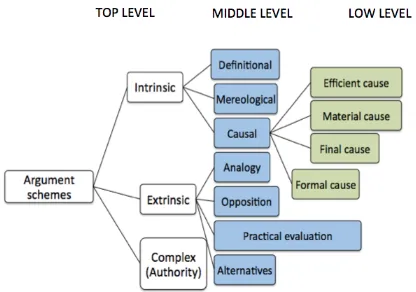
Our annotation of argument schemes is grounded in the Ar-gumentum Model of Topics (Rigotti and Morasso, 2010). Unlike other approaches (Walton et al., 2008b; Kienpoint-ner and others, 1986; Van Eemeren and Houtlosser, 2006), it offers ataxonomic hierarchyof argument schemes with a limited number of schemes that are based on semantic, mutually exclusive distinctive criteria (Figure 1).
Figure 1: the AMT taxonomy of argument schemes
The annotation consists of two subtasks: 1) given a SUPPORT or REBUT relation, identify the argument scheme among the 8 middle level schemes (DEFINI
-TIONAL,CAUSAL,MEREOLOGICAL,ANALOGY,OPPOSI
-TION,PRACTICAL EVALUATION,AUTHORITY) orNONEif no reasoning is present; and 2) identify the associated infer-ence rule.
An early pilot annotation testing the first version of guide-lines had been carried out on top of 30 persuasive essays from the corpus of Stab and Gurevych (2014), obtaining a fair inter-annotator agreement with trained but non-expert annotators (Musi et al., 2016).
The guidelines contain identification questions, linguistic clues and inferential rules for each argument scheme. An-notators are asked to first browse the identification yes/no questions and check whether inferential rules apply and linguistic clues are indeed present. The description of
CAUSALargument schemes contains, for example, the fol-lowing information:
• Identification Question: is x a cause/effect of y or is it a means to obtain y?
• Other clues: Evaluations about actions play a role as common ground knowledge but do not constitute the premise textually expressed.
• Inferential rules:
– if the cause is the case, the effect is the case
– if the effect is the case, the cause is probably the case
– if a quality characterizes the cause, then such quality characterizes the effect too
– if the realization of the goal necessitates the means x, x must be adopted
– if an action does not allow to achieve the goal, it should not be undertaken
– if somebody has the means to achieve a certain goal, he will achieve that goal
Compared to the previous version, although the taxonomy and related theoretical insights have been maintained, the definition of the argument schemes that gave rise to the highest disagreement in the previous study have been clar-ified pointing to distinctive features. In particular, the
CAUSALargument schemes (from means to end) that we mentioned above have been frequently annotated by others asPRACTICAL EVALUATION, described as follows:
• Identification Question: does x express an evaluation about a state of affairs and does y express an advice/a recommendation about stopping/continuing the state of affairs the premise refer to?
• Other clues: the premise contains adjectives or other linguistic items which qualify something as more or less good
• Inferential rules:
– if something is of important value, it should not be terminated
– if something has a positive value, it should be supported/continued/promoted/maintained
– if something has positive effects, it should be sup-ported/continued/promoted/maintained
– if something has a negative effect it should be ter-minated
These two argument schemes are perceived as similar due to the common reference to intentionality and to the frame of human action. To overcome this ambiguity, the guide-lines have been refined to stress that the distinctive pres-ence of evaluative propositions working as premises and of recommendation speech acts working as claims indicate a
Figure 2: The ArgScheme Annotation Tool
3.
The ArgScheme annotation tool
Human annotation is made most efficient when it is sup-ported by an easy-to-use annotation tool. Since we are adding a new layer to the already-existing annotation of argument trees, none of the standard tools for text anno-tation can be used for our purposes. Therefore, we built theArgSchemeAnnotator Tool, designed to provide a user-friendly interface for the labeling of support and attack re-lations with argument schemes. The annotation tool is writ-ten in C++ and was built within the Qt framework, which allows for building cross-platform GUI applications. We make the tool available for Linux, Windows, and Mac OS X.Once a microtext is loaded, the tool shows each proposition paired with the type of relation it instantiates, as well as the index of the proposition it is connected to. After click-ing on a relation, a window containclick-ing the list of argument schemes opens up. Once they have chosen the right argu-ment scheme, annotators are shown a set of scheme-specific inference rules and are asked to select one. See Figure 2 for illustration. The result of the annotation is stored as ad-ditional attributes on the original XML format used in the microtext corpus, allowing for an easy mapping between all different annotation layers.
4.
Results
4.1.
Inter-Annotator Agreement
To measure inter-annotator agreement, two sets of 20 mi-crotexts have been annotated by three annotators each (4 relations per microtext on average). The six annotators involved included four students with background in
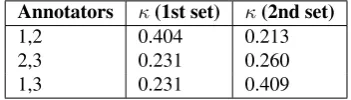
Lin-guistics and Argumentation, and 2 PhD students in NLP. Each annotator underwent a one-hour training session dur-ing which the guidelines have been explained and an exem-plary analysis collaboratively discussed. To evaluate the re-liability of the guidelines, we measured the inter-annotators agreement (IAA) using Fleissκto account for multiple an-notators (Fleiss and Cohen, 1973). We obtained an IAA (k=0.296), which corresponds to fair agreement. To ver-ify whether the idiosyncratic behavior of some annotators plays a role, we calculated the inter-annotator agreement pairwise for both sets. The IAAs for the first and second sets of microtexts (20 microtexts each) is given in Table 1. The set of three annotators is different for the 2 sets of 20 microtexts.
Annotators κ(1st set) κ(2nd set)
1,2 0.404 0.213
2,3 0.231 0.260
1,3 0.231 0.409
Table 1: pairwise IAA.
anno-D
PRACTICAL EVALUATION 218 10 8 29
ALTERNATIVES 4 0 4
AUTHORITY 24 0
NONE 6
Table 2: Confusion Matrix (since the matrix is symmetric we only show its upper triangular part)
tators who were in agreement. Considering the inherent difficulty of the task, which necessarily gives rise to am-biguities and disagreement (even among argumentation an-alysts) and the presence of outliers, this IAA score can be considered a positive index of the guidelines’ reliability. On this basis, we have asked an additional set of seven highly expert annotators (researchers in Linguistics and Argumen-tation Theory) to annotate a set of 10 microtexts each. As a result, we release to the community a set of 112 microtexts fully annotated as to argument schemes.
4.2.
Analysis of the disagreement space
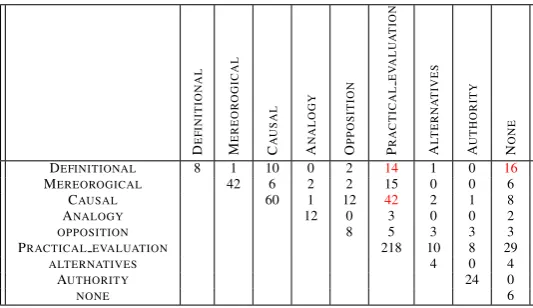
With the aim of understanding the reasons underlying dis-agreements among annotators, we have built a confusion matrix as shown in Table 2.
We notice that CAUSAL scheme is still confused with PRACTICAL EVALUATION, while DEFINITIONAL scheme is often confused with PRACTICAL EVALUATION and
NONE(i.e., no argument). The confusion betweenCAUSAL
and PRACTICAL EVALUATIONhas already been attested in the previous annotation project (Musi et al., 2016), as a con-firmation of the perceived closeness of the two types of ar-gument schemes.
From the qualitative analysis it emerges that DEFINI
-TIONAL argument schemes have not been recognized by some annotators and have been annotated as NONEin par-ticular for rebuttal relations (e.g., “Anti-virus software pro-tects the users of a computer from dangers from the in-ternet”. “Admittedly they do not generally prevent you from catching a virus”). A possible explanation is that in those cases, the presence of category in the claim is less salient since it has to be recognized after the claim has been negated.
Finally, DEFINITIONALargument schemes tend to be con-fused with PRACTICAL EVALUATION argument schemes since the evaluative propositions featuring as premises in PRACTICAL EVALUATION have been conceived as in-stances of categorizations. The premise-claim pair “Super-markets and shopping centers should be allowed to open on any Sundays and holidays”.“Considering the growing dig-itization of society, the traditional model of the weekend will soon be obsolete” constitutes an instance of PRACTI
-CAL EVALUATION argument scheme: a recommendation about carrying out an action is proposed on the basis of the
positive/negative evaluation (e.g., “obsolete”) of another state of affairs. The annotator that has chosen DEFINI
-TIONALhas most likely interpreted the premise as a cat-egorization. However, the categorization process is not at the basis of the inference that allows to support the con-clusion. Even though the available data are not enough to draw generalizations, we consider them as hints to be used to refine the guidelines. In particular, we plan to stress on the differences between the propositional and the inferen-tial levels of analysis.
5.
Argument schemes and rhetorical
relations
RST discourse relations (Mann and Thompson, 1988) over-lap with argumentative discourse relations, particularly the subset of Presentational relations meant to increase the reader’s positive inclination for the proposition functioning as nucleus clearly performing an argumentative act. The mapping of rhetorical discourse relations onto argumenta-tive relations carried out by Stede et al. (2016) confirms this pragmatic similarity: the rhetorical relation REASON
co-occurs for example 99 times with SUPPORT relations. Attack relations of the REBUT type tend, instead, to co-occur with the relationANTITHESIS, while those of theUN
-DERCUTtype withCONCESSIONS. In addition, Stede et al. (2016) showed that someSubject-matterrelations, meant to allow the reader to recognize a semantic relation, may in-stantiate an argumentative relation in specific contexts. In order to extend this investigation by analyzing the correla-tions among rhetorical relacorrela-tions and argument schemes, we have mapped the annotation of argument schemes on top of RST relations and observed as well as explained attested overlaps or mismatches.
5.1.
Mapping argument schemes to discourse
relations
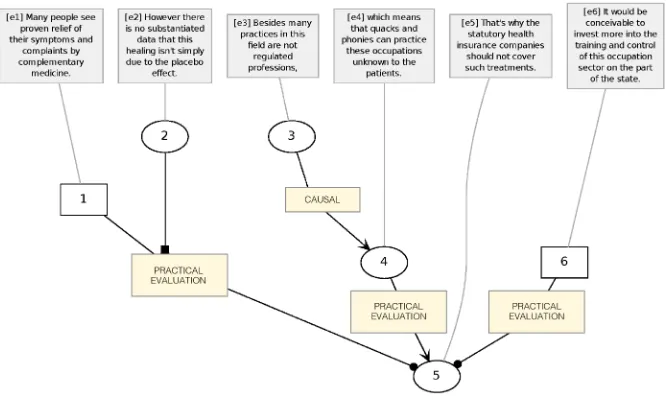
Figure 3: Argumentation structure and argument schemes of an example microtext
Figure 4: RST discourse structure of the same microtext given in Figure 3
(a) Argument Schemes (b) RST
Figure 5: Conversion of argument schemes and RST relations to dependency structures
which is converted to the source of that relation (Stede et al., 2016). For RST, converting the relations to dependency structure is done in two steps. First, eachelementary dis-course unit (EDU) in RST is linked to its corresponding ADU in the argumentation structure. This is a one-to-one mapping when there is no join relation. If there is a join relation, multiple EDUs are mapped to a single ADU. Sec-ond, multi-nuclear nodes in RST are mapped with the ADU of its leftmost child as done in (Stede et al., 2016).
To illustrate, Figure 3 shows an example of argument
the labels on each edge.
The corresponding RST structure for the same microtext is shown in Figure 4. It has the same six EDUs (there is a one-to-one mapping between EDUs are ADUs in this example) with five different discourse relations (REASON,
LIST, CONCESSION,CAUSE,ELABORATION). It is worth noting that multi-nuclear discourse relations do not have an EDU as their target. They target another relation instead, which is the case for theLISTrelation in the illustrated ex-ample.
The argumentation structure of the example shown in Fig-ure 3 has an UNDERCUT relation. Therefore, the depen-dency structure of the argument scheme shown in Figure 5(a) is equivalent to the argument structure in Figure 3 ex-cept for theUNDERCUTrelation, which maintains the same source and changes the target to the source of its target re-lation (i.e.,2→(1→5)is changed to2→1). To convert the RST structure of the microtext in Figure 4 to its depen-dency structure shown in Figure 5(b), the following steps are done:
1. All EDUs are labeled with their corresponding ADU using the argument structure of the microtext as a ref-erence.
2. Converting multi-nuclear relations,LISTin this exam-ple, to the two following relations:
(a) A relation with the source as the leftmost child ofLISTand the target as the target of the next re-lation (i.e., target ofREASON) and label asREA
-SON.
(b) A relation with the source as rightmost child of
LISTand the target as its leftmost child and label asLIST.
The resulting common dependency structure of the argu-ment schemes and RST discourse relations (Figure 5), al-lows us to analyze the overlap between the two annotations. We can see that three relations (3 →4,4 →5and6→5) exist in both RST and argument schemes, while one rela-tion in each annotarela-tion does not exist in the other (1→5in argument schemes and2→4in RST). A study of the over-lap between RST and argument schemes across the whole dataset is presented in the following section.
5.2.
Analysis of the correlations
The overlap between argument schemes forSUPPORTand REBUTrelations and RST discourse relations in our corpus is visualized in Table 3 and Table 4, respectively.
As a premise, it has to be stated that, with respect to the tra-ditional taxonomy of RST relations (Mann and Thompson, 1988), two relations have been added by (Stede et al., 2016) according to Stede and Taboada (2017). Among Presenta-tionalrelations, the new label REASONshows as nucleus “a subjective statement/thesis/claim, which R might not ac-cept or might not regard as sufficiently important or posi-tive” and as satellite “a subjective statement/thesis/claim”; the link between nucleus and satellite implies that “under-standing S makes it easier for R to accept N, or to share
A
Table 3: Overlap between RST relations and argument schemes forSUPPORTrelations
Table 4: Overlap between RST relations and argument schemes forREBUTrelations
the particular viewpoint of W”. While sharing with REA
-SON the same constraints on the nucleus, as well as the same effect (“R’s belief in N is increased”), the relations
per-son —JUSTIFY—. AmongSubject MatterRST relations, the labelE-ELABORATIONdiffers from simpleELABORA -TIONsince the satellite provides more information about a single entity mentioned in the nucleus, rather than about the described state of affairs.
Comparing Table 3 and Table 4 it is clear that some RST re-lations overlap with argument schemes only in the presence ofREBUTrelations orSUPPORTrelations, respectively.
Presentational RST Relations and Argument Schemes.
As far as Presentational RST relations are concerned,
ANTITHESISandCONCESSIONinstantiate inferences only withREBUTrelations, but do not seem to constrain the type of argument scheme at issue. Both relations entail a hi-erarchy of importance between the content of the nucleus (considered more important) and that of the satellite. The two relations differ in the type of comparison that is es-tablished: withANTITHESIS, the propositions forming the nucleus and the satellite are deemed incompatible while withCONCESSIONSthey are presented as both valid, while the nucleus is emphasized (e.g. “Although IBM s num-bers haven’t been staggering recently. You should buy IBM shares if you want to invest.”). In both cases the inference underlying the creation of such a hierarchy can vary from context to context. However, it cannot serve e support func-tion: the opposition relation signaled by the two relations makes the satellite support the negation of the nucleus and viceversa. In terms of frequency, the most frequent RST relation isREASON(92), followed byEVIDENCE(8),JUS
-TIFY(4) andMOTIVATION(2). While there is no attested overlap between argument schemes and EVIDENCE, JUS
-TIFYandMOTIVATIONwithREBUT relations, there is no incompatibility from a theoretical point of view.
The RST relation REASONoverlaps with the widest range of argument schemes, with a preference for PRACTICAL EVALUATIONS— more than half of overlapping cases (e.g. “Actually only those people should pay a TV and radio li-cence fee who really watch ARD, ZDF, Arte etc. It is in fact good to support sophisticated programming through fees”) — andCAUSALargument schemes — ca. one third of over-lapping cases. The subjectivity constraint imposed on the satellite well matches the semantic type of premises occur-ring with the argument schemePRACTICAL EVALUATION: evaluations, containing sentiment, presuppose a subjective perspective. CAUSAL argument argument schemes, coin-ciding with the REASON relation, show premises which are not descriptions of states of affairs, but speakers’ in-terpretations (e.g.“The universities in Germany should not under any circumstances charge tuition fees. The antici-pated objectives of tuition fees can be achieved by other means.”). Premises encoding factual states of affairs are, instead, present whenCAUSALargument schemes overlap with the RST relation EVIDENCE, due to the objectivity constraint imposed by this discourse relation on the satellite (e.g., “Our society is in danger of overheating due to ’never clocking off’.The last 20 years have seen the Sunday off work increasingly sacrificed to commerce.”). From a se-mantic point of view, the most suitable argument scheme to overlap with EVIDENCEis MEREOLOGICAL: premises express states of affairs whom realization is attestable and, thus, objective (“Especially the home games have seen the
team stay behind expectations. A sad highlight: Losing 60:87 to the weakish Mannheimers in a sold-out stadium.”). However, due to the scarcity of data, it is not possible to statistically evaluate the significance of this preferential as-sociation.
The RST relationsJUSTIFICATIONandMOTIVATION over-lap in our corpus with the argument scheme PRACTICAL EVALUATION only. This is probably due to the fact that the recommendation about setting up or terminating a cer-tain action featuring as a claim with this type of argument scheme mirrors the agentive constraint imposed by the re-lationsJUSTIFY(e.g. “Today I will delete my Facebook ac-count.[Not only because] I’m constantly astonished about who wants to be my friend”) andMOTIVATION(e.g “[But] still Germany produces way too much rubbish.We Berlin-ers should take the chance and become pioneBerlin-ers in waste separation!”) on their nuclei.
Subject-matter RST Relations and Argument Schemes.
Turning to Subject-matter relations, BACKGROUND and
RESTATEMENToverlap only with arguments schemes used inSUPPORT relations. These two relations areper defini-tion incompatible with REBUT relations since the BACK
-GROUND relation has as effect that of increasing the reader’s ability to comprehend the nucleus, while RE
-STATEMENT links a nucleus and a satellite with almost equivalent propositional contents. Although RESTATE
-MENTis primarily a textual and not a pragmatic relation, serving mainly to organize the text, it can acquire an argu-mentative function when the satellite is a rephrase that my help the reader in understanding the nucleus (“Intelligence services apparently enjoy indiscriminate liberties. No one can follow their activities in detail.”). The inferential link between the satellite and nucleus is necessarily belonging to the INTRINSIC class since the state of affairs encoded by a rephrase necessarily belong to the same frame of that expressed by the rephrased proposition.
The RST relationCAUSErecurrently correlates with argu-ment schemes (11 cases of overlap) that are for the major-ity, with no surprise, of the CAUSALtype. Although not constituting an inherently argumentative effect, making the reader aware of a cause/effect relation might have a per-suasive outcome, especially when the effect/cause works as an argument in support of a general claim: for instance, the claim “Fees result in longer durations of studies” sup-ported by the premise “That’s costly!” through a causal relation, works as an argument for the standpoint “Tuition fees should not be charged in Germany.”
6.
Conclusion
plan to refine the guidelines accordingly. We have shown initial results from the correlation between rhetorical re-lations and argument schemes: Presentational RST rela-tions such as REASONand ANTITHESIS select SUPPORT
andREBUTrelations, respectively, but do not point to spe-cific argument schemes, while the relationEVIDENCE cor-relates with MEREOLOGICAL and AUTHORITYargument schemes.Subject-matterrhetorical relations such asCAUSE
seems to constrain the argument scheme at issue.
7.
Bibliographical References
Becker, M., Palmer, A., and Frank, A. (2016). Argumenta-tive texts and clause types. InProceedings of the Third Workshop on Argumentation Mining, Berlin. Association for Computational Linguistics.
Feng, V. W. and Hirst, G. (2011). Classifying arguments by scheme. InProceedings of the 49th Annual Meeting of the Association for Computational Linguistics: Hu-man Language Technologies-Volume 1, pages 987–996. Association for Computational Linguistics.
Fleiss, J. L. and Cohen, J. (1973). The equivalence of weighted kappa and the intraclass correlation coefficient as measures of reliability. Educational and psychologi-cal measurement, 33(3):613–619.
Freeman, J. B. (2011). Argument Structure: Representa-tion and Theory. Argumentation Library (18). Springer. Ghosh, D., Muresan, S., Wacholder, N., Aakhus, M., and
Mitsui, M. (2014). Analyzing argumentative discourse units in online interactions. InArgMining@ ACL, pages 39–48.
Green, N. (2017). Manual identification of arguments with implicit conclusions using semantic rules for argument mining. In Proceedings of the 4th Workshop on Argu-ment Mining, pages 73–78.
Habernal, I. and Gurevych, I. (2017). Argumentation min-ing in user-generated web discourse.Computational lin-guistics, 43(1):125–179.
Kienpointner, M. et al. (1986). Towards a typology of ar-gument schemes.Proceedings of ISSA 1986.
Kirschner, C., Eckle-Kohler, J., and Gurevych, I. (2015). Linking the thoughts: Analysis of argumentation struc-tures in scientific publications. In ArgMining@ HLT-NAACL, pages 1–11.
Lippi, M. and Torroni, P. (2016). Argumentation mining: State of the art and emerging trends. ACM Trans. Inter-net Technol., 16(2):10:1–10:25.
Mann, W. C. and Thompson, S. A. (1988). Rhetorical structure theory: Toward a functional theory of text or-ganization. Text-Interdisciplinary Journal for the Study of Discourse, 8(3):243–281.
Musi, E., Ghosh, D., and Muresan, S. (2016). Towards fea-sible guidelines for the annotation of argument schemes. InProceedings of the third workshop on argument min-ing (ArgMinmin-ing2016), pages 82–93.
Peldszus, A. and Stede, M. (2013). From argument dia-grams to argumentation mining in texts: A survey. Inter-national Journal of Cognitive Informatics and Natural Intelligence (IJCINI), 7(1):1–31.
Peldszus, A. and Stede, M. (2016). An annotated corpus
of argumentative microtexts. InArgumentation and Rea-soned Action: Proceedings of the 1st European Confer-ence on Argumentation, Lisbon 2015 / Vol. 2, pages 801– 816, London. College Publications.
Reed, C. and Rowe, G. (2004). Araucaria: Software for argument analysis, diagramming and representation. International Journal on Artificial Intelligence Tools, 13(04):961–979.
Rigotti, E. and Morasso, S. G. (2010). Comparing the ar-gumentum model of topics to other contemporary ap-proaches to argument schemes: the procedural and ma-terial components. Argumentation, 24(4):489–512. Schneider, J., Samp, K., Passant, A., and Decker, S. (2013).
Arguments about deletion: How experience improves the acceptability of arguments in ad-hoc online task groups. InProceedings of the 2013 conference on Computer sup-ported cooperative work, pages 1069–1080. ACM. Stab, C. and Gurevych, I. (2014). Annotating argument
components and relations in persuasive essays. In COL-ING, pages 1501–1510.
Stede, M. and Taboada, M. (2017). Annotation guidelines for rhetorical structure. manuscript.
Stede, M., Afantenos, S. D., Peldszus, A., Asher, N., and Perret, J. (2016). Parallel discourse annotations on a cor-pus of short texts. InLREC.
Van Eemeren, F. H. and Houtlosser, P. (2006). Strategic maneuvering: A synthetic recapitulation. Argumenta-tion, 20(4):381–392.
Walker, M., Tree, J. F., Anand, P., Abbott, R., and King, J. (2012). A corpus for research on deliberation and de-bate. InProceedings of the Eighth Conference on Inter-national Language Resources and Evaluation (LREC), Istanbul/Turkey.
Walton, D., Reed, C., and Macagno, F. (2008a). Argu-mentation schemes. Cambridge University Press, Cam-bridge.