Information Extraction for Question Answering:
Improving Recall Through Syntactic Patterns
Valentin Jijkoun and Maarten de RijkeInformatics Institute University of Amsterdam {jijkoun,mdr}@science.uva.nl
Jori Mur Information Science University of Groningen
Abstract
We investigate the impact of the precision/recall trade-off of information extraction on the per-formance of an offline corpus-based question answering (QA) system. One of our findings is that, because of the robust final answer selection mechanism of the QA system, recall is more im-portant. We show that the recall of the extrac-tion component can be improved using syntac-tic parsing instead of more common surface text patterns, substantially increasing the number of factoid questions answered by the QA system.
1 Introduction
Current retrieval systems allow us to locate docu-ments that might contain the pertinent information, but most of them leave it to the user to extract the useful information from a ranked list of documents. Hence, the (often unwilling) user is left with a rel-atively large amount of text to consume. There is a need for tools that reduce the amount of text one might have to read to obtain the desired informa-tion. Corpus-based question answering is designed to take a step closer to information retrieval rather than document retrieval. The question answering (QA) task is to find, in a large collection of data, an answer to a question posed in natural language.
One particular QA strategy that has proved suc-cessful on large collections uses surface patterns de-rived from the question to identify answers. For ex-ample, for questions like When was Gandhi born?, typical phrases containing the answer are Gandhi was born in 1869 and Gandhi (1869–1948). These examples suggest that text patterns such as “name was born in birth date” and “name (birth year–death year)” formulated as regular ex-pressions, can be used to select the answer phrase.
Similarly, such lexical or lexico-syntactic pat-terns can be used to extract specific information on semantic relations from a corpus offline, before ac-tual questions are known, and store it in a repository for quick and easy access. This strategy allows one to handle some frequent question types: Who is. . . , Where is. . . , What is the capital of. . . etc. (Fleis-chman et al., 2003; Jijkoun et al., 2003).
A great deal of work has addressed the problem of extracting semantic relations from unstructured text. Building on this, much recent work in QA has focused on systems that extract answers from large bodies of text using simple lexico-syntactic patterns. These studies indicate two distinct prob-lems associated with using patterns to extract se-mantic information from text. First, the patterns yield only a small subset of the information that may be present in a text (the recall problem). Second, a fraction of the information that the patterns yield is unreliable (the precision problem). The precision of the extracted information can be improved signif-icantly by using machine learning methods to filter out noise (Fleischman et al., 2003). The recall prob-lem is usually addressed by increasing the amount of text data for extraction (taking larger collections (Fleischman et al., 2003)) or by developing more surface patterns (Soubbotin and Soubbotin, 2002).
Some previous studies indicate that in the setting of an end-to-end state-of-the-art QA system, with additional answer finding strategies, sanity check-ing, and statistical candidate answer rankcheck-ing, re-call is more of a problem than precision (Bernardi et al., 2003; Jijkoun et al., 2003): it often seems use-ful to have more data rather than better data. The aim of this paper is to address the recall problem by using extraction methods that are linguistically more sophisticated than surface pattern matching. Specifically, we use dependency parsing to extract syntactic relations between entities in a text, which are not necessarily adjacent on the surface level. A small set of hand-built syntactic patterns allows us to detect relevant semantic information. A com-parison of the parsing-based approach to a surface-pattern-based method on a set of TREC questions about persons shows a substantial improvement in the amount of the extracted information and num-ber of correctly answered questions.
find more information, at the same time avoiding the time-consuming manual development of increasing numbers of surface patterns.
The remainder of the paper is organized as fol-lows. In Section 2 we discuss related work on extracting semantic information. We describe our main research questions and experimental setting in Section 3. Then, in Section 4 we provide details on the extraction methods used (surface and syntac-tic). Sections 5 and 6 contain a description of our experiments and results, and an error analysis, re-spectively. We conclude in Section 7.
2 Related Work
There is a large body of work on extracting seman-tic information using lexical patterns. Hearst (1992) explored the use of lexical patterns for extracting hyponym relations, with patterns such as “such as.” Berland and Charniak (1999) extract “part-of” rela-tions. Mann (2002) describes a method for extract-ing instances from text by means of part-of-speech patterns involving proper nouns.
The use of lexical patterns to identify answers in corpus-based QA received lots of attention after a team taking part in one of the earlier QA Tracks at TREC showed that the approach was competi-tive at that stage (Soubbotin and Soubbotin, 2002; Ravichandran and Hovy, 2002). Different aspects of pattern-based methods have been investigated since. E.g., Ravichandran et al. (2003) collect surface pat-terns automatically in an unsupervised fashion us-ing a collection of trivia question and answer pairs as seeds. These patterns are then used to generate and assess answer candidates for a statistical QA system. Fleischman et al. (2003) focus on the preci-sion of the information extracted using simple part-of-speech patterns. They describe a machine learn-ing method for removlearn-ing noise in the collected data and showed that the QA system based on this ap-proach outperforms an earlier state-of-the-art sys-tem. Similarly, Bernardi et al. (2003) combine the extraction of surface text patterns with WordNet-based filtering of name-apposition pairs to increase precision, but found that it hurt recall more than it helped precision, resulting in fewer questions an-swered correctly when the extracted information is deployed for QA.
The application of deeper NLP methods has also received much attention in the QA community. The open-domain QA system by LCC (Moldovan et al., 2002) uses predicate-argument relations and lexical chaining to actually prove that a text snippet pro-vides an answer to a question. Katz and Lin (2003) use syntactic dependency parsing to extract
rela-tions between words, and use these relarela-tions rather than individual words to retrieve sentences relevant to a question. They report a substantial improve-ment for certain types of questions for which the usual term-based retrieval performs quite poorly, but argue that deeper text analysis methods should be applied with care.
3 Experimental Setting
We set up experiments to address two related issues. First, we wanted to understand how the usual pre-cision/recall trade-off shows up in off-line corpus-based QA, and specifically, whether extracting more data of lower quality (i.e., favoring recall) gives a QA system a better performance than extracting smaller amounts of more accurate data (i.e., favor-ing precision). Second, we tried to verify the hy-pothesis that syntactic parsing for information ex-traction does increase the exex-traction recall by iden-tifying relations between entities not adjacent on the surface layer but connected syntactically.
There are different approaches to the evaluation of information extraction modules. The usual recall and precision metrics (e.g., how many of the inter-esting bits of information were detected, and how many of the found bits were actually correct) require either a test corpus previously annotated with the required information, or manual evaluation (Fleis-chman et al., 2003). Although intrinsic evaluation of an IE module is important, we were mainly inter-ested in measuring the performance of this module in context, that is, working as a sub-part of a QA system. We used the number of questions answered correctly as our main performance indicator.
3.1 QA System
For the experiments described below we used an open-domain corpus-based QA system QUARTZ (Jijkoun et al., 2004). The system implements a multi-stream approach, where several different strategies are used in parallel to find possible an-swers to a question. We ran the system turning on only one stream, Table Lookup, which implements an off-line strategy for QA.
The Table Lookup stream uses a number of knowledge bases created by pre-processing a doc-ument collection. Currently, QUARTZ’ knowledge bases include 14 semi-structured tables containing various kinds of information: birth dates of persons, dates of events, geographical locations of different objects, capitals and currencies of countries, etc. All this information is extracted from the corpus off-line, before actual questions are known.
the question type, the Table Lookup stream identi-fies knowledge bases where answers to the question can potentially be found. The stream uses keywords from the question to identify relevant entries in the selected knowledge bases and extracts candidate an-swers. Finally, the QA system reranks and sanity checks the candidates and selects the final answer.
3.2 Questions and Corpus
To get a clear picture of the impact of using dif-ferent information extraction methods for the off-line construction of knowledge bases, similarly to (Fleischman et al., 2003), we focused only on questions about persons, taken from the TREC-8 through TREC 2003 question sets. The ques-tions we looked at were of two different types: person identification (e.g., 2301. What composer wrote “Die G¨otterd¨ammerung”?) and person defi-nition (e.g., 959. Who was Abraham Lincoln?). The knowledge base relevant for answering questions of these types is a table with several fields containing a person name, an information bit about the per-son (e.g., occupation, position, activities), the con-fidence value assigned by the extraction modules to this information bit (based on its frequency and the reliability of the patterns used for extraction), and the source document identification. The Table Lookup finds the entries whose relevant fields best match the keywords from the question.
We performed our experiments with the 336 TREC questions about persons that are known to have at least one answer in the collection. The collection used at TREC 8, 9 and 10 (referred to as TREC-8 in the rest of the paper) consists of 1,727,783 documents, with 239 of the correspond-ing questions identified by our system as askcorrespond-ing about persons. The collection used at TREC 2002 and 2003 (AQUAINT) contains 1,033,461 docu-ments and 97 of the questions for these editions of TREC are person questions.
4 Extraction of Role Information
In this section we describe the two extraction meth-ods we used to create knowledge bases containing information about persons: extraction using surface text patterns and using syntactic patterns.
Clearly, the performance of an information ex-traction module depends on the set of language phe-nomena or patterns covered, but this relation is not straightforward: having more patterns allows one to find more information, and thus increases recall, but it might introduce additional noise that hurts preci-sion. Since in our experiments we aimed at com-paring extraction modules based on surface text vs.
syntactic patterns, we tried to keep these two mod-ules parallel in terms of the phenomena covered.
First, the collections were tagged with a Named Entity tagger based on TnT (TnT, 2003) and trained on CoNLL data (CoNLL, 2003). The Named Entity tagger was used mainly to identify person names as separate entities. Although the tagging itself was not perfect, we found it useful for restricting our surface text patterns.
Below we describe the two extraction methods.
4.1 Extraction with Surface Text Patterns
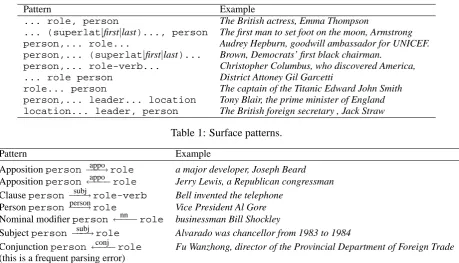
To extract information about roles, we used the set of surface patterns originally developed for the QA system we used at TREC 2003 (Jijkoun et al., 2004). The patterns are listed in Table 1.
In these patterns, person is a phrase that is tagged as person by the Named Entity tagger,role is a word from a list of roles extracted from the WordNet (all hyponyms of the word ‘person,’ 15703 entries),1 role-verb is from a manually con-structed list of “important” verbs (discovered, in-vented, etc.; 48 entries), leader is a phrase identify-ing leadership from a manually created list of lead-ers (president, minister, etc.; 22 entries). Finally, superlatis the superlative form of an adjective andlocation is a phrase tagged as location by the Named Entity tagger.
4.2 Extraction with Syntactic Patterns
To use the syntactic structure of sentences for role information extraction, the collections were parsed with Minipar (Lin, 1998), a broad coverage depen-dency parser for English. Minipar is reported to achieve 88% precision and 80% recall with respect to dependency relations when evaluated on the SU-SANNE corpus. We found that it performed well on the newpaper and newswire texts of our collec-tions and was fairly robust to fragmented and not well-formed sentences frequent in this domain. Be-fore extraction, Minipar’s output was cleaned and made more compact. For example, we removed some empty nodes in the dependency parse to re-solve non-local dependencies. While not loosing any important information, this made parses easier to analyse when developing patterns for extraction.
Table 2 lists the patterns that were used to ex-tract information about persons; we show syntactic dependencies as arrows from dependents to heads, with Minipar’s dependency labels above the arrows. As with the earlier surface patterns,roleis one of the nouns in the list of roles (hyponyms of person
1
Pattern Example
... role, person The British actress, Emma Thompson
... (superlat|first|last)..., person The first man to set foot on the moon, Armstrong
person,... role... Audrey Hepburn, goodwill ambassador for UNICEF.
person,... (superlat|first|last)... Brown, Democrats’ first black chairman.
person,... role-verb... Christopher Columbus, who discovered America,
... role person District Attoney Gil Garcetti
role... person The captain of the Titanic Edward John Smith
person,... leader... location Tony Blair, the prime minister of England
location... leader, person The British foreign secretary , Jack Straw
Table 1: Surface patterns.
Pattern Example
Appositionperson −−appo−→role a major developer, Joseph Beard Appositionperson ←−−−appo role Jerry Lewis, a Republican congressman Clauseperson −−subj−→role-verb Bell invented the telephone
Personperson −−person−→role Vice President Al Gore Nominal modifierperson ←−−−nn role businessman Bill Shockley
Subjectperson−−subj−→role Alvarado was chancellor from 1983 to 1984
Conjunctionperson ←−−−conj role Fu Wanzhong, director of the Provincial Department of Foreign Trade (this is a frequent parsing error)
Table 2: Syntactic patterns.
in WordNet),role-verbis one of the “important verbs.” The only restriction forpersonwas that it should contain a proper noun.
When an occurence of a pattern was found in a parsed sentence, the relation (person; info-bit) was extracted, where info-bit is a se-quence of all words below role orrole-verb in the dependency graph (i.e., all dependents along with their dependents etc.), excluding the per-son. For example, for the sentence Jane Goodall, an expert on chimps, says that evidence for so-phisticated mental performances by apes has be-come ever more convincing, that matches the pat-tern person ←−−−appo role, the extracted informa-tion was (Jane Goodall; an expert on chimps).
5 Experiments and Results
We ran both surface pattern and syntactic pattern extraction modules on the two collections, with a switch for role filtering. The performance of the Ta-ble Lookup stream of our QA system was then eval-uated on the 336 role questions using the answer patterns provided by the TREC organizers. An early error analysis showed that many of the incorrect answers were due to the table lookup process (see Section 3) rather than the information extraction method itself: correct answers were in the tables, but the lookup mechanism failed to find them or picked up other, irrelevant bits of information. Since we were interested in evaluating the two extraction
methods rather than the lookup mechanism, we per-formed another experiment: we reduced the sizes of the collections to simplify the automatic lookup. For each TREC question with an answer in the col-lection, NIST provides a list of documents that are known to contain an answer to this question. We put together the document lists for all questions, which left us with much smaller sub-collections (16.4 MB for the questions for the TREC-8 collection and 3.2 MB for the AQUAINT collection). Then, we ran the two extraction modules on these small collections and evaluated the performance of the QA system on the resulting tables. All the results reported below were obtained with these sub-collections. Compari-son of the extraction modules on the full TREC col-lections gave very similar relative results.
Table 3 gives the results of the different runs for the syntactic pattern extraction and the surface pat-tern extraction on the TREC-8 collection: the num-ber of correct answers (in the top one and the top three answer candidates) for the 239 person ques-tions. The columns labeled Roles+show the results for the extraction modules using the list of possible roles from WordNet (Section 4), and the columns la-beled Roles−show the results when the extraction modules consider any word as possibly denoting a role. The results of the runs on the AQUAINT col-lection with 97 questions are shown in Table 4.
Syntactic patterns Surface patterns Rank Roles− Roles+ Roles− Roles+ 1 80 (34%) 73 (31%) 59 (25%) 54 (23%) 1–3 90 (38%) 79 (33%) 68 (29%) 59 (25%)
Table 3: Correct answers for the TREC-8 collection (239 questions).
Syntactic patterns Surface patterns Rank Roles− Roles+ Roles− Roles+ 1 16 (17%) 14 (14%) 9 (9%) 6 (6%) 1–3 20 (21%) 14 (14%) 11 (11%) 6 (6%)
Table 4: Correct answers for the AQUAINT collec-tion (97 quescollec-tions).
questions answered correctly for the TREC-8 col-lection. Another interesting observation is that in all experiments the modules based on syntactic patterns outperformed the surface-text-based extraction.
Furthermore, there is a striking difference be-tween the results in Table 3 (questions from TREC 8, 9 and 10) and the results in Table 4 (questions from TREC 2002 and 2003). The ques-tions from the more recent ediques-tions of TREC are known to be much harder: indeed, the Table Lookup stream answers only 21% of the questions from TREC 2002 and 2003, vs. 38% for earlier TRECs.
In all experiments, both for syntactic and surface patterns, using the list of roles as a filtering mecha-nism decreases the number of correct answers. Us-ing lexical information from WordNet improves the precision of the extraction modules less than it hurts the recall. Moreover, in the context of our knowl-edge base lookup mechanism, low precision of the extracted information does not seem to be an ob-stacle: the irrelevant information that gets into the tables is either never asked for or filtered out during the final sanity check and answer selection stage. This confirms the conclusions of (Bernardi et al., 2003): in this specific task having more data seems to be more useful than having better data.
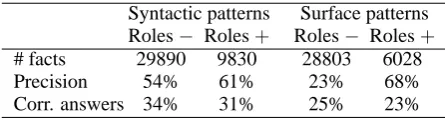
To illustrate the interplay between the precision and recall of the extraction module and the perfor-mance of the QA system, Table 5 gives the com-parison of the different extraction mechanisms (syn-tactic and surface patterns, using or not using the list of roles for filtering). The row labelled # facts shows the size of the created knowledge base, i.e., the number of entries of the form (person, info), ex-tracted by each method. The row labelled Preci-sion shows the preciPreci-sion of the extracted informa-tion (i.e., how many entries are correct, according to a human annotator) estimated by random sampling and manual evaluation of 1% of the data for each ta-ble, similar to (Fleischman et al., 2003). The row
la-belled Corr. answers gives the number of questions correctly answered using the extracted information.
Syntactic patterns Surface patterns Roles− Roles+ Roles− Roles+ # facts 29890 9830 28803 6028 Precision 54% 61% 23% 68% Corr. answers 34% 31% 25% 23%
Table 5: Comparison of the tables built with differ-ent extraction methods on the TREC-8 collection.
The results in Table 5 indicate that role filtering af-fects the syntactic and surfaces modules quite dif-ferently. Filtering seems almost essential for the surface-pattern-based extraction, as it increases the precision from 23% to 68%. This confirms the re-sults of Fleischman et al. (2003): shallow methods may benefit significantly from the post-processing. On the other hand, the precision improvement for the syntactic module is modest: from 54% to 61%.
The data from the syntactic module contains much less noise, although the sizes of the extracted tables before role filtering are almost the same. Af-ter filAf-tering, the number of valid entries from the syntactic module (i.e., the table size multiplied by the estimated precision) is about 6000. This is sub-stantially better than the recall of the surface module (about 4100 valid entries).
6 Error Analysis
In theory, all relatively simple facts extracted by the surface pattern module should also be extracted by the syntactic pattern module. Moreover, the syn-tactic patterns should extract more facts, especially ones whose structure deviates from the patterns pre-defined in the surface pattern module, e.g., where elements adjacent in the syntactic parse tree are far apart on the surface level. To better understand the differences between the two extraction approaches and to verify the conjecture that syntactic parsing does indeed increase the recall of the extracted in-formation, we performed a further (manual) error analysis, identifying questions that were answered with one extraction method but not with the other.
Syntactic patterns
Surface patterns
correct incorrect correct 47 12 incorrect 32 148
Table 6: Performance analysis for the TREC-8 col-lection with role filtering.
Syntactic patterns
Surface patterns
correct incorrect correct 51 17 incorrect 39 132
Table 7: Performance analysis for the TREC-8 col-lection without role filtering.
6.1 Syntactic Patterns vs. Surface Patterns
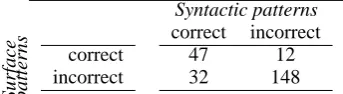
There were three types of errors responsible for pro-ducing an incorrect answer by the syntactic pattern module for questions correctly answered with sur-face patterns. The most frequent errors were pars-ing errors. For 6 out of 12 questions (see Table 6) the answer was not extracted by the syntactic pat-tern method, because the sentences containing the answers were not parsed correctly. The next most frequent error was caused by the table lookup pro-cess. For 4 questions out of the 12, the required information was extracted but simply not selected from the table as the answer due to a failure of the lookup algorithm. The remaining errors (2 out of 12) were of a different type: for these 2 cases the surface pattern extraction did perform better than the syntactic method. In both cases this was because of wildcards allowed in the surface patterns. E.g., for the sentence . . . aviator Charles Lindbergh mar-ried Anne Spencer Morrow. . . the syntactic pattern method extracted only the relation
(Charles Lindbergh; aviator),
whereas the surface pattern method also extracted
(Anne Spencer Morrow; aviator Charles Lindbergh married),
because of the pattern ‘role. . . person’ with role instantiated with aviator and personwith Anne Spencer Morrow. In fact, the extracted in-formation is not even correct, because Anne is not an aviator but Lindbergh’s wife. However, due to the fuzzy nature of the lookup mechanism, this new entry in the knowledge base allows the QA sys-tem to answer correctly the question 646. Who was Charles Lindbergh’s wife?, which is not answered with the syntactic pattern extraction module.
To summarize, of the 12 questions where the sur-face patterns outperformed the syntactic patterns
• 6 questions were not answered by the syntactic method due to parsing errors,
• 4 were not answered because of the table lookup failure and
• for 2 the surface-based method was more ap-propriate.
6.2 Surface Patterns vs. Syntactic Patterns
We also took a closer look at the 32 questions for which the syntactic extraction performed better than the surface patterns (see Table 6). For the sur-face pattern extraction module there were also three types of errors. First, some patterns were miss-ing, e.g., person role-verb.... The only difference from one of the actually used patterns (person,... role-verb...) is that there is no comma betweenpersonand role-verb. This type of incompleteness of the set of the surface patterns was the cause for 16 errors out of 32.
The second class of errors was caused by the Named Entity tagger. E.g., Abraham Lincoln was always tagged as location, so the name never matched any of the surface patterns. Out of 32 ques-tions, 10 were answered incorrectly for this reason. Finally, for 6 questions out of 32, the syntactic extraction performed better because the information could not be captured on the surface level. For ex-ample, the surface pattern module did not extract the fact that Oswald killed Kennedy from the sen-tence . . . when Lee Harvey Oswald allegedly shot and killed President John F. Kennedy. . . , because none of the patterns matched. Indeed, Lee Harvey Oswald and the potentially interesting verb killed are quite far apart in the text, but there is an imme-diate relation (subject) on the syntactic level.
It is worth pointing out that there were no lookup errors for the surface pattern method, even though it used the exact same lookup mechanism as the approach based on syntactic patterns (that did ex-perience various lookup errors, as we have seen). It seems that the increased recall of the syntactic pattern approach caused problems by making the lookup process harder.
To summarize, out of 32 questions answered us-ing syntactic extraction method but not by the sur-face pattern approach
• 16 questions would have required extending the set of surface patterns,
• 10 questions were not answered because of NE tagging error, and
6.3 Adding Patterns?
We briefly return to a problem noted for extrac-tion based on surface patterns: the absence of cer-tain surface patterns. The surface patternperson role-verb... was not added because, we felt, it would introduce too much noise in the knowledge base. With dependency parsing this is not an is-sue as we can require that personis the subject ofrole-verb. So in this case the syntactic pat-tern module has a clear advantage. More generally, while we believe that extraction methods based on hand-crafted patterns are necessarily incomplete (in that they will fail to extract certain relevant facts), these observations suggest that coping with the in-completeness is a more serious problem for the sur-face patterns than for the syntactic ones.
7 Conclusions
We described a set of experiments aimed at com-paring different information extraction methods in the context of off-line corpus-based Question An-swering. Our main finding is that a linguistically deeper method, based on dependency parsing and a small number of simple syntactic patterns, allows an off-line QA system to correctly answer substantially more questions than a traditional method based on surface text patterns. Although the syntactic method showed lower precision of the extracted facts (61% vs. 68%), in spite of parsing errors the recall was higher than that of the surface-based method, judg-ing by the number of correctly answered questions (31% vs. 23%). Thus, the syntactic analysis can in fact be considered as another, intensive way of im-proving the recall of information extraction, in ad-dition to successfully used extensive ways, such as developing larger numbers of surface patterns or in-creasing the size of the collection.
Moreover, we confirmed the claim that for a com-plex off-line QA system, with statistical as well as knowledge-intensive sanity checking answer selec-tion modules, recall of the informaselec-tion extracselec-tion module is more important than precision, and a sim-ple WordNet-based method for improving precision does not help QA. In our future work we plan to in-vestigate the effect of more sophisticated and, prob-ably, more accurate filtering methods (Fleischman et al., 2003) on the QA results.
8 Acknowledgements
Valentin Jijkoun and Maarten de Rijke were sup-ported by a grant from the Netherlands Organiza-tion for Scientific Research (NWO) under project number 220-80-001. De Rijke was also sup-ported by NWO under project numbers
365-20-005, 612.069.006, 612.000.106, 612.000.207, and 612.066.302.
References
M. Berland and E. Charniak. 1999. Finding parts in very large corpora. In Proceedings of the 37th Annual Meeting of the ACL.
R. Bernardi, V. Jijkoun, G. Mishne, and M. de Rijke. 2003. Selectively using linguistic resources through-out the question answering pipeline. In Proceedings of the 2nd CoLogNET-ElsNET Symposium.
M. Fleischman, E. Hovy, and A. Echihabi. 2003. Offline strategies for online question answering: answering questions before they are asked. In Proceedings of the 41st Annual Meeting of the ACL.
M. Hearst. 1992. Automatic acquisition of hyponyms from large text corpora. In Proceedings of the 14th International Conference on Computational Linguis-tics (COLING-92).
V. Jijkoun, G. Mishne, and M. de Rijke. 2003. Prepro-cessing Documents to Answer Dutch Questions. In Proceedings of the 15th Belgian-Dutch Conference on Artificial Intelligence (BNAIC’03).
V. Jijkoun, G. Mishne, C. Monz, M. de Rijke, S. Schlobach, and O. Tsur. 2004. The University of Amsterdam at the TREC 2003 Question Answering Track. In Proceedings of the TREC-2003 Conference. B. Katz and J. Lin. 2003. Selectively using relations to improve precision in question answering. In Proceed-ings of the EACL-2003 Workshop on Natural Lan-guage Processing for Question Answering.
D. Lin. 1998. Dependency-based evaluation of Minipar. In Proceedings of the Workshop on the Evaluation of Parsing Systems.
G. Mann. 2002. Fine-grained proper noun ontologies for question answering. In SemaNet’02: Building and Using Semantic Networks.
D. Moldovan, S. Harabagiu, R. Girju, P. Morarescu, A. Novischi F. Lacatusu, A. Badulescu, and O. Bolo-han. 2002. LCC tools for question answering. In Pro-ceedings of the TREC-2002.
TnT Statistical Part of Speech Tagging. 2003.
URL: http://www.coli.uni-sb.de/
˜thorsten/tnt/.
CoNLL: Conference on Natural Language Learn-ing. 2003. URL: http://cnts.uia.ac.be/ signll/shared.html.
D. Ravichandran and E. Hovy. 2002. Learning surface text patterns for a question answering system. In Pro-ceedings of the 40th Annual Meeting of the ACL. D. Ravichandran, A. Ittycheriah, and S. Roukos. 2003.
Automatic derivation of surface text patterns for a maximum entropy based question answering system. In Proceedings of the HLT-NAACL Conference. M.M. Soubbotin and S.M. Soubbotin. 2002. Use of