
Bayesian Text Segmentation for Index Term Identification
and Keyphrase Extraction
David Newman,
♦Nagendra Koilada,
♦Jey Han Lau
♥♠and Timothy Baldwin
♥♠♦
Dept of Computer Science, University of California, Irvine, USA
♥
Dept of Computing and Information Systems, The University of Melbourne,
Australia
♠
NICTA Victoria Research Laboratory, Australia
newmanui.edu
,
nkoiladaui.edu,
jhlausse.unimelb.edu.au,
tbldwin.netA
BSTRACTAutomatically extracting terminology and index terms from scientific literature is useful for a variety of digital library, indexing and search applications. This task is non-trivial, compli-cated by domain-specific terminology and a steady introduction of new terminology. Correctly identifying nested terminology further adds to the challenge. We present a Dirichlet Process (DP) model of word segmentation where multiword segments are either retrieved from a cache or newly generated. We show how this DP-Segmentation model can be used to successfully extract nested terminology, outperforming previous methods for solving this problem.
1 Introduction
Index terms and keyphrases are widely used to enhance the browsing/accessibility of
docu-ments, especially scientific literature (Gutwin et al., 1999). Index terms are the main terms and concepts in a document, as would be contained in the index of a book or edited collection of papers, for example. They typically number in the hundreds for a single volume, and are conventionally annotated for their key occurrences in the document. Keyphrases are assigned to each document in the form of a handful of terms which capture the key topics or concepts covered in the document. Keyphrases are commonly used as a means of clustering/linking
documents in digital libraries. While there is no question of the utility of both index terms and keyphrases, annotating a document with index terms is an arduous and largely unreward-ing task, and annotators are notoriously inconsistent at index term and keyphrase assignment (Leonard, 1977; Kim et al., 2010). As such, there is a real need for computational methods which both speed up and homogenize the assignment of index terms and keyphrases. The focus of this paper is an unsupervised methodology for automatically identifying both index terms in a document collection and keyphrases for a single document. The method-ology is called Dirichlet Process Segmentation (DP-seg) and was originally developed by Goldwater et al. (2009) for the task of word segmentation over phoneme streams, in the con-text of child language acquisition. DP-seg is particularly well suited to the tasks of index term identification and keyphrase extraction because: (1) it is able to identify individual type-level occurrences of a given term; (2) it is context-sensitive and able to robustly deal with “nested” multiword terminology (e.g. aresupport vectorandvector machinealso index terms, or just
support vector machine?); (3) it is highly sensitive and can be applied to small-scale corpora (important for keyphrase extraction, where the input may be a single document); and (4) it is highly parameterizable.
Our contributions in this paper are: (1) the novel application of DP-seg to the tasks of in-dex term identification and keyphrase extraction; (2) construction of a number of inin-dex term identification datasets spanning a number of scientific domains; and (3) extensive empirical comparison with standard methods for multiword extraction, and demonstration of the empir-ical superiority of DP-seg.
2 Related Work
There are several closely related language modeling tasks in this area that differ in important ways. Here we further clarify what tasks we are addressing in this paper, and review related work for each.
We define a multiword term (i.e.n-gram, wheren≥2) as any contiguous sequence of terms in a sentence from some text. We use the usual convention oftypesbeing the list of distinct multiword terms (at a document or document collection level), andtokensbeing the specific appearances of those multiword terms in the text. Note that we can extracttypesand/ortokens
either from a single document, or a collection of documents, and our focus for this work will be collection/corpus-based extraction.
prede-termined MWE type or lexicon of MWE candidates (Kim and Baldwin, 2010; Baldwin and Kim, 2009). Arguably the closest task to what we are doing is Keyphrase extraction, and indeed our content of interest is scientific literature (Witten et al., 1999; Kim et al., 2010). Keyphrase ex-traction operates over individual documents, often based on corpus-level lexical analysis. In this paper, in addition to experimenting over keyphrase extraction as conventionally defined, we introduce the additional task of index term extraction.
Extraction of index terms from a corpus is important and useful for a wide variety of digital li-brary and scholarly applications. It extends keyphrase extraction (which is typically performed on a single article or document) to the broader setting of extracting all concepts from a book or collection of papers. Thus index terms tend to be more numerous than keyphrases (the index of a textbook may list hundreds of index terms). Unlike keyphrases, index terms cover all con-cepts appearing in text — from fairly general concon-cepts (e.g.training data) to specific concepts (e.g.textual entailment). We are interested in both type-level extraction (for the index) and token-level identification (to be able to identify the individual occurrences in the text) of index terms. An important aspect of our task is uncovering the correctnesting. Extraction methods need to correctly determine when to choose a shorter and more generaln-gram (e.g.machine translation) vs. a longer and more specificn-gram (e.g.statistical machine translation), while avoiding extracting nonsensicaln-grams (e.g.statistical machine).
Keyphrase extraction is closely related to index term extraction. Recently, there was a shared task on keyphrase extraction in SemEval-2010 (Kim et al., 2010), where over twenty teams submitted systems to extract keyphrases from a set of 244 computer science articles. Evalua-tion was done against a matching set of gold standard keyphrases. We include this SemEval dataset in our experiments, and compare to those published results.
Perhaps the closest related work to our current work is the c/nc-value algorithm (Frantzi et al., 2000), which is designed for extracting and ranking a list of terminology types from a corpus. The c/nc-value algorithm specifically finds and ranksnestedmultiword terminology (such as
support vectoras well assupport vector machine). The c/nc-value algorithm is a heuristic that takes as input the exhaustive list of 2- through 5-gram noun chunks. The c-value is a score that is an “effective” frequency, which includes an upweighting of lognforn-grams, to take into account the geometrically fewern-grams asnincreases. The algorithm also includes a discounting ofn-grams that appear in longern-grams. The goal of the algorithm is to discover all nested terminology. The nc-value part of the algorithm is an extra boosting of the signal by using context information. Frantzi et al. showed c/nc-value to work well for producing the lexicon of index term types from a relatively small set of documents.
3 Bayesian Segmentation
We present and describe the DP-seg model almost verbatim from Goldwater et al. (2009). The model assumes that the sequence ofn-grams or multiword segments (MWE) in the corpus is generated using the following four steps:
1. Generate the number of MWE types that will be in the MWE lexicon 2. Generate the token frequency for each MWE type
3. Generate the word-sequence representation of each MWE type 4. Generate an ordering for the set of MWE tokens.
In the unigram version of the model where multiword segments are statistically independent, the ithMWE is generated as follows:
1. Decide if mweiis a novel lexical item
2. (a) If so, generate an MWE form (wordsw1. . .wM) for mwei (b) If not, choose an existing lexical formxfor mwei
We assign probabilities to each of the above steps as follows: 1. P(mweiis novel)=nα+α, P(mweiis not novel)=
n n+α
2. (a) P(mwei=w1. . .wM|mweiis novel) =p#(1−p#)M−1ΠMj=1P(wj) (b) P(mwei=x|mweiis not novel) =nnx
whereαis a parameter of the model,nis the number of previously generated MWEs,nx is
the number of times lexical itemxhas occurred in those MWEs, andp#is the probability of generating a segment boundary. We combine these probabilities to get the following expression for the distribution over mweigiven mwe−i, the previous MWE:
P(mwei=x|mwe−i) =
nx
i−1+α+
αP0(mwei=x)
i−1+α (1)
whereP0is the probability of generating the MWE anew, as per Step 2(a) above. Note that in all of the above, the MWE can consist of a single word.
As Goldwater et al. point out, this model is quite intuitive. In Step 1, whennis small, we are more likely to generate a new multiword segment. Asngrows, we increasingly tend to retrieve the multiword segment from the cache. Also, the model discourages long segments through longer products of probabilities. By having the likelihood of retrieving a multiword from the cache depend on its frequency, we produce a power-law distribution of multiword types, which is appropriate for language modeling.
This model is a type of Dirichlet Process, a popular tool in Bayesian statistics for nonparametric modeling, where the dimensionality of our MWE lexicon grows with the size of the data. The Dirichlet Process has two parameters, the concentration parameterαand the base distribution
P0. Formally, mwei|G∼G, G|α,P0∼DP(α,P0). As is customary, we integrate outG, and estimate the conditional probability of sampling a MWE by the Chinese Restaurant Process (CRP). Simply stated, the CRP is where the ithcustomer entering a Chinese Restaurant sits
at tableiwith probability proportional to the number of people sitting at tablei, or sits at a new table with probability proportional toα. Note this generation of MWEs is the two stage
3.1 Inference
For inference, we use the Gibbs sampling procedure presented by Goldwater et al. The Gibbs sampler considers one possible segment boundary point at a time, so each sample is from a set of two hypotheses,H0andH1. These hypotheses contain all the same segment boundaries except at the one position under consideration, whereH1has a boundary andH0does not. To sample a hypothesis, we calculate the relative probabilities ofH0 andH1. SinceH0 andH1 are the same except for a few rules, this is straightforward. LetH−be all of the structure and
data shared by the two hypotheses, includingnwords. Then, given MWEsw1andw2and the combined MWEw12, using Equation 1 we get:
P(H0|H−) =
n(w12) +αP0(w12)
n+α (2)
P(H1|H−) =
n(w1) +αP0(w1)
n+α ·
n(w2) +I(w1=w2) +αP0(w2)
n+1+α (3)
During preliminary experiments, we learned segmentations with DP-seg using between 5000 and 20000 sweeps through each corpus. We performed convergence checks to determine an appropriate number of iterations of the Gibbs sampler. Convergence can depend on thematic coherence and phrasing redundancy in the text (for example, a collection of abstracts from a PubMed search will have more repeatedn-grams than a similar sized collection of full-text articles). By creating an approximate gold standard (using 20,000 iterations and averaging over 10 differently initialized runs), we determined that 5,000 iterations of the Gibbs sampler produced reasonably well-converged segmentations. For all experiments, except for those investigating the effect of parameters, we used Goldwater’s settings ofα=20 andp#=0.5. We also used an annealing schedule with initial exponent of 0.1, going up to a exponent of 1 after 90% of the iterations, then no annealing for the final 10% of the iterations.
3.2 Pre-Processing
As with many NLP tasks, we have a variety of choices for preprocessing the raw input text. Some of these choices include whether to lemmatize (including stemming as a crude form of lemmatization), whether to POS tag, and whether to remove frequently occurring stopwords. Because we compare DP-seg to c/nc-value algorithm results, for the majority of experiments we selected a preprocessing strategy that was consistent with the input required by the c/ nc-value algorithm. We used OpenNLP for lemmatization and POS tagging, and filtered out stop-words from a very limited list of common stopstop-words consisting of prepositions and determiners (fewer than 100 stopwords in total). Note that this would make terminology such aspart of speechappear aspart speech. Since DP-seg does not requireanypreprocessing at all, for some experiments, we omitted all preprocessing to examine its effect.1
4 Datasets
We used a combination of new and existing datasets for our experiments. Since there are no readily-available gold-standard datasets for index terms, we generated our own. What constitutes an index term can be subtle and debatable: some index terms are obvious, such assemantic role labeling; others are less so, e.g.training datais a concept, albeit general, that
1Note, however, that preprocessing has a significant impact on runtime for DP-seg: the larger the vocabulary and
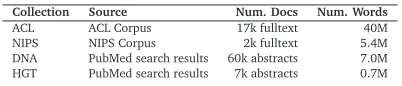
Collection Source Num. Docs Num. Words ACL ACL Corpus 17k fulltext 40M NIPS NIPS Corpus 2k fulltext 5.4M DNA PubMed search results 60k abstracts 7.0M HGT PubMed search results 7k abstracts 0.7M
Table 1: Description and sizes of the four document collections.
could reasonably be found in an index, whiledata pointis probably too generic to be found in most indexes.
4.1 Document Collection Data
Our experiments start with four document collections from scientific/technical literature,
de-scribed in Table 1. The ACL corpus consists of fulltext research articles from computational linguistics (Radev et al., 2009). The NIPS corpus consists of fulltext articles in machine learn-ing and neurobiology (frombooks.nips.). The final two document collections are search
results sets from PubMed (www.pubmed.gov). The DNA collection contains titles and
ab-stracts in the search results from the querydna microarray. The HGT collection contains titles and abstracts in the search results from the queryhorizontal gene transfer. All four of these collections are rich in technical terminology and nested index terms, and thus ideal for experi-mentation.
4.1.1 Creating Gold Standard
We created a list of gold standard index terms from our four datasets to evaluate the perfor-mance of DP-seg. Because of the size of these datasets (over 80K documents and 50M words), it was not possible to annotate an exhaustive/comprehensive list of index terms. Therefore we used a pooling strategy to create a gold standard from top-ranked candidate terms, using the top-1000 index terms from DP-seg, c/nc-value and the Student’s t-test (a baseline lexical
association measure for collocation extraction), restricted to noun chunks. Note that the rank-ing for c/nc-value and t-test is based directly on the scores returned by the methods, while the ranking for DP-seg is based on the token-level frequency of each term in the output. We used the union of all of these candidate index terms for annotation, and randomized the set so that annotators had no insights into which candidates came from which method. A prelim-inary observation of this list indicated that these top-ranked index terms were dominated by bigrams. Since we were interested in understanding the performance of DP-seg and c/nc-value on nested terminology, we also included for annotation the top-100 4-grams and 3-grams, and all 3-gram and 2-gram subphrases for each.
We used a pool of 25 annotators to annotate subsets of the combined list of 6500 candidate index terms, requesting a binary judgment on whether the candidate term was a plausible index term. We had a minimum of 3 annotators per candidate index term, and an average of 4.4 annotations per candidate index term. In cases of disagreement, we took the majority decision. Our instructions to annotators stated:
well-defined standalone meaning and would be appropriate for inclusion in an index of terms for that domain (e.g.decision tree, in the case of the machine learning domain, but notobservable markovas it is an incorrectly-extracted sub-string of something likepartially observable markov decision process).
The annotation tasked proved reasonably straightforward, with an inter-annotator agreement of 0.65 using Fleiss’ kappa, suggesting substantial agreement.
4.2 SemEval Keyphrase Extraction Data
In addition to our four collections of index terms, we used an existing dataset for keyphrase extraction evaluation — the SemEval-2010 keyphrase extraction data. The SemEval data is a collection of 244 scientific articles released as part of a shared task for keyphrase extrac-tion (Kim et al., 2010). In each document, there is a set of author- and reader-assigned key-words, and all keyphrases are stemmed using the English Porter stemmer. The gold standard keyphrases for each document are largely extracted from the document text, although approx-imately 15%-19% of the keyphrases do not appear in the paper.
To evaluate the participating systems, micro-averaged F-scores are calculated over the top-5/10/15 candidates. A candidate is considered a match if it is an exact match with one of the gold standard keyphrases; partial matching is not considered in the evaluation.
Note that there is a subtle difference between the two tasks: index term identification is an-notated/evaluated at thedocument collectionlevel (separately for each of our four document collections), while keyphrase extraction is annotated/evaluated at thedocumentlevel. Another reason for evaluating our method over keyphrase extraction is that the task is well established, and we can benchmark DP-seg against results for pre-existing systems tuned to the task.
5 Results
Standard evaluation for this type of task is based on precision (P), recall (R) and F-score (F), at the level of either types or tokens. In our index term data, we don’t have exhaustive annotations, meaning we aren’t able to evaluate recall. Instead, we use precision atN(P@N), which measures what proportion of the top-N rankedn-grams match gold standard index terms. We are guaranteed coverage up to N=1000, as that is what was used to create the list ofn-grams for annotation. We also use Mean Average Precision (MAP), a scalar version of the precision measurement, making it useful to evaluate choices of parameter settings or other operational decisions.
5.1 Index Term Results
The output of DP-seg is a nonoverlapping partitioning of the input corpus into a sequence of
Paper ID DP-seg Title
C10-1002 identify | multiword expression | leverage | morphological | syntactic idiosyncrasy C10-1007 fast accurate | arc | filtering | dependency parsing
C10-1008 hierarchical | classifier | applied | multi-way | sentiment detection C10-1032 entity disambiguation | knowledge base population C10-1034 empirical study | learning rank | tweet C10-1040 emdc | semi-supervised approach | word alignment P10-1005 identifying | generic | noun phrases
P10-1006 structural semantic relatedness | knowledge-based method | name entity disambiguation P10-1007 correct error | speech recognition | articulatory dynamics
P10-1025 towards | open-domain | semantic role label
P10-1035 accurate | context-free parsing | combinatory categorial grammar P10-1038 conditional random fields | word | hyphenation
P10-1040 word representation | simple | general | method | semi-supervised learning P10-1044 latent dirichlet allocation | method | selectional preference P11-1006 fast accurate | method | approximate string search P11-1017 comprehensive | dictionary | multiword expression P11-1026 interactive | topic modeling
P11-1027 faster | language models
P11-1033 joint | bilingual | sentiment classification | unlabeled | parallel corpora P11-1034 pilot study | opinion summarization | conversation
P11-1039 topical | keyphrase extraction | twitter
P11-1048 comparison | loopy belief propagation | dual decomposition | integrated | ccg supertagging | parsing P11-1053 semi-supervised relation extraction | large-scale | word clustering
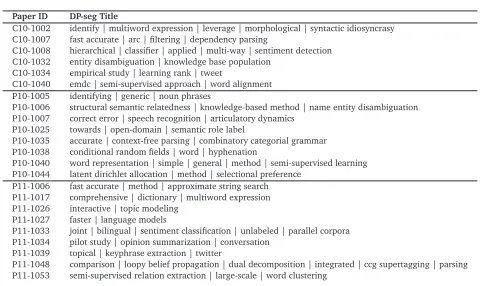
Table 2: Sample DP-seg of recent COLING and ACL paper titles (Paper ID is the ID from ACL Anthology).
ACL NIPS DNA HGT
training data (11924) training data (1475) gene expression (9822) horizontal gene transfer (1371) language model (6518) data set (1300) transcription factor (3557) horizontal transfer (869) test set (6233) data point (1217) gene expression profile (3536) gene transfer (677) noun phrase (5884) loss function (1162) dna microarray (3516) escherichia coli (625) natural language (5239) training set (1133) cell line (3462) lateral gene transfer (586) machine translation (4734) objective function (1011) microarray analysis (3429) e. coli (524) training set (4671) covariance matrix (868) breast cancer (2605) phylogenetic analysis (434) test data (4168) generative model (867) gene expression profiling (2313) gene cluster (372) data set (3920) probability distribution (840) microarray data (2147) lateral transfer (283) lexical item (3745) optimization problem (838) cdna microarray (1869) evolutionary history (275) target word (3703) graphical model (822) expression profile (1860) antibiotic resistance (273) lexical entry (3504) special case (818) target gene (1754) genomic island (232)
Table 3: Twelve most frequent types, corpus-wide.
Table 3 shows the 12 most frequentn-gram types from DP-seg, on our four corpora. The number in parentheses is the non-overlapping count of that exact type in the output of DP-seg (e.g. the 838 count ofoptimization problemfor NIPS does not include any counts ofconvex optimization problem). The list of most frequent types in the table looks reasonable, given the domain of each corpus. Note that the most frequent types include some very general concepts (e.g.training dataandtraining setare in both the ACL and NIPS top-12 list), and in the case of the PubMed search results, some unsurprising specific concepts, including our original query
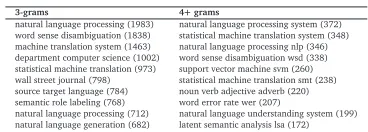
dna microarrayandhorizontal gene transfer. Note that the ACL and NIPS corpora only include bigrams in their top-12 list, reflecting the wider range of topics covered in these collections. Table 4 and Table 5 show the 10 most frequent 3-gram and 4+gram noun phrases from DP-seg
for the ACL and NIPS corpora, with the number in parentheses again showing the count. We see that the 3-grams are approximately one order of magnitude less frequent than the bigrams shown in Table 3. We see another drop in the frequency for the 4+-grams, compared to the
3-grams 4+grams
natural language processing (1983) natural language processing system (372) word sense disambiguation (1838) statistical machine translation system (348) machine translation system (1463) natural language processing nlp (346) department computer science (1002) word sense disambiguation wsd (338) statistical machine translation (973) support vector machine svm (260) wall street journal (798) statistical machine translation smt (238) source target language (784) noun verb adjective adverb (220) semantic role labeling (768) word error rate wer (207)
natural language processing (712) natural language understanding system (199) natural language generation (682) latent semantic analysis lsa (172)
Table 4: Ten most frequent 3-grams and 4+grams for ACL.
3-grams 4+grams
support vector machine (230) markov decision process mdp (93) convex optimization problem (169) support vector machine svm (87) latent variable model (151) markov chain monte carlo (86) stochastic gradient descent (127) latent dirichlet allocation lda (82) high dimensional data (110) markov chain monte carlo mcmc (67) binary classification problem (103) reproducing kernel hilbert space (62) training test set (101) principal component analysis pca (55) number training example (101) dirichlet process mixture model (47) natural language processing (100) conditional random field crf (45) probability density function (97) reproducing kernel hilbert space rkhs (42)
Table 5: Ten most frequent 3-grams and 4+grams for NIPS.
capitalization and parentheses around the acronym, which is lost in our preprocessing due to lowercasing and the removal of punctuation, including parentheses.
5.1.1 Empirical Evaluation
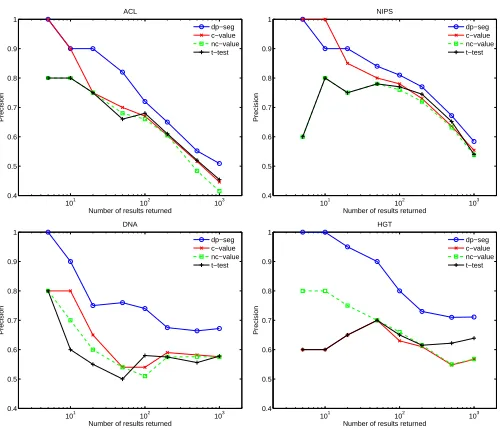
The P@Nresults for DP-seg, c-value, nc-value and t-test are shown in Figure 1. The four panels correspond to each of our four corpora, with P@Non the vertical axis, andNon the horizontal axis. We see that DP-seg outperforms c-value, nc-value and t-test across the range of datasets and values ofN. P@Nis a useful metric operationally, since one might consider or use the top-N ranked items from a system. We see the greatest difference of DP-seg against c/nc-value
and t-test for the DNA and HGT datasets. This is largely due to the greater frequency of nested terminology, and the ability to DP-seg to better handle nested terminology.
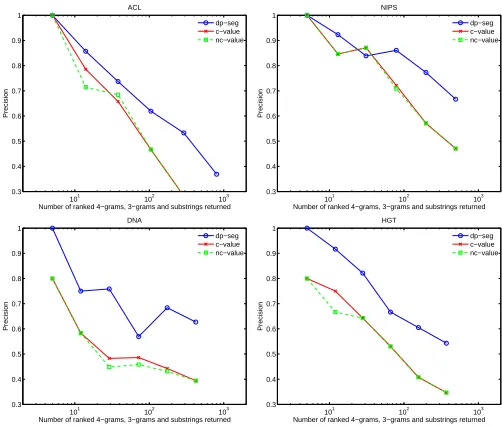
When we examine the effectiveness over the top-ranked 3- and 4-grams and their subphrases in Figure 2, we see a consistent picture of DP-seg outperforming c-value and nc-value (note: there is no t-test curve here since t-test was only used to produce bigram index term candidates). The larger difference in results, particularly in the ACL and NIPS datasets, is due to the more challenging task of correctly solving the nesting problem. DP-seg is more adept at segmenting nested terms, e.g. it correctly identifiesstatistical machine translationandmachine translation
with high frequency, butstatistical machineon its own is ranked quite low. Conversely, c/ nc-value performs poorly on this task, incorrectly listing, e.g.,horizontal geneas one of the top-ranked index terms.
This limitation of the c/nc-value algorithm is highlighted in Table 6, which compares the
101
Figure 1: P@Nafter N results returned, for N up to top-1000 ranked results.
ashorizontal genedo not exist.
5.1.2 Effect of Model Parameters
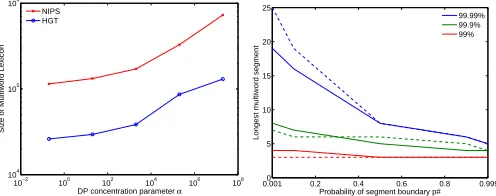
The DP-seg model has only two parameters:αandp#. αcontrols sparsity, i.e. the number of distinctn-gram types. The probability of segment boundaryp#controls the average length of
rel-101
Number of ranked 4−grams, 3−grams and substrings returned
Precision
Number of ranked 4−grams, 3−grams and substrings returned
Precision
Number of ranked 4−grams, 3−grams and substrings returned
Precision
Number of ranked 4−grams, 3−grams and substrings returned
Precision
HGT
dp−seg c−value nc−value
Figure 2: Precision for top-100 4-grams, 3-grams, and subphrases.
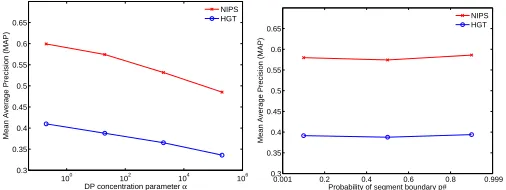
atively weak effect of the parameters on MAP is explained by MAP being a precision-focused metric, and that we only have relatively high frequency positive examples labeled. The pre-cision/recall tradeoff is well known for this type of parameter, with precision decreasing and recall increasing asαincreases.
Given our Bayesian framework, we could in principle learnαandp#, however we opt for the simpler choice of fixingαandp#, and leave this optimization for future work.
5.1.3 The Effects of Pre-Processing: POS Tagging and Stopword Removal
One advantage of DP-seg is that it can run on any stream of tokens, and does not require lemmatization, POS tagging, parsing or removal of common stopwords (stopping). To allow for a fair comparison with c/nc-value algorithm, we did POS tag and remove stopwords for
datasets in Section 4, creating a single input representation used by all algorithms (including t-test). In this section we investigate the effect of relaxing this preprocessing for DP-seg, and running DP-seg without POS tags, and without removing stopwords.
DP-seg nc-value horizontal gene transfer gene transfer horizontal transfer horizontal gene transfer gene transfer horizontal gene*
escherichia coli lateral gene transfer lateral gene transfer horizontal transfer
e. coli lateral gene*
phylogenetic analysis e. coli gene cluster escherichia coli lateral transfer phylogenetic analysis evolutionary history antibiotic resistance antibiotic resistance resistance gene*
genomic island gene cluster
Table 6: Comparison of top-12 ranked index terms from DP-seg and nc-value on the HGT dataset (incorrect terms are italicized and marked with *).
10−2 100 102 104 106 108
104
105
106
DP concentration parameter α
Size of Multiword Lexicon
NIPS HGT
0.0010 0.2 0.4 0.6 0.8 0.999 5
10 15 20 25
Probability of segment boundary p#
Longest multiword segment
99.99% 99.9% 99%
Figure 3: Effect of model parametersαandp#on the lexicon size and distribution ofn-gram length (in the right-hand figure, solid lines are percentiles from NIPS, and dashed lines are percentiles from HGT).
In the SemEval experiments in Section 5.2, DP-seg is run on the provided text as is, without any POS tagging or stopword removal.
5.2 SemEval Results
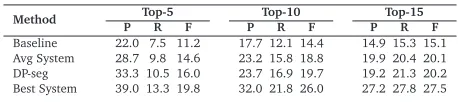
We ran DP-seg on the SemEval corpus of 244 fulltext articles. We used the input text as is (which was stemmed), for consistency with the published SemEval results. We performed the same evaluation as Kim et al. (2010), computing micro-averaged F-scores calculated over the top-5/10/15 candidates, with a candidate only being considered a match if there is an exact
match with one of the gold standard keyphrases. We base the selection of the top-Ncandidates on onlyn-grams, ordered by the token-level frequency within the document.
train-100 102 104 106
Figure 4: Effect of model parametersαandp#on Mean Average Precision
Processing HGT NIPS
POS tagged & Stopped 0.57 0.40 not POS tagged & Stopped 0.51 0.43 not POS tagged & not Stopped 0.55 0.36
(a) HGT and NIPS Mean Average Precision scores for various pre-processing strategies.
(b) Effect of not removing stopwords. List of of frequent segments that include “horizontal gene transfer”.
Table 7: Effect of POS tagging and stopword removal.
ing documents provided for the task. The fact that we are competitive over the task without any tweaking of the method or reranking of the results is highly encouraging, and comple-ments the P@Nresults in Section 5.1.1. Also note that this experiment was run without POS tagging and without stopwords removed, adding to the evidence that DP-seg is robust to these preprocessing choices.
6 Discussion and Conclusion
Our results indicate that DP-seg performs well at both index term identification and keyphrase extraction. As part of this, it performs well at disambiguating nested index terms from sci-entific literature — that is determining an optimal non-overlapping partitioning of a stream of words in a corpus — into a sequence ofn-grams. Places where DP-seg tends not to per-form so well are examples such asprevious workand boilerplate text such as authors thanking
anonymous reviewers[for]helpful comments, which are formulaic and certainly characteristic
of the domains we are working with, but not appropriate index terms of keyphrases. Given that DP-seg is based simply on the text stream and doesn’t capture positional information in the document, it has no way of differentiating these from conceptually-grounding index terms. One possible research direction for dealing with this issue would be to incorporate positional information (e.g. document zones or argumentative zoning (Teufel et al., 1999)).
Method P Top-5R F P Top-10R F P Top-15R F Baseline 22.0 7.5 11.2 17.7 12.1 14.4 14.9 15.3 15.1 Avg System 28.7 9.8 14.6 23.2 15.8 18.8 19.9 20.4 20.1 DP-seg 33.3 10.5 16.0 23.7 16.9 19.7 19.2 21.3 20.2 Best System 39.0 13.3 19.8 32.0 21.8 26.0 27.2 27.8 27.5
Table 8: Precision, Recall, and F-score on the SemEval dataset.
if it has seen just one occurrence, it is very likely to produce more of the samen-gram. In response to this, Goldwater proposed a bigram model that includes a Hierarchical Dirichlet Process (HDP) in place of the Dirichlet Process. We plan to investigate the performance of the Bigram/HDP model in future work.
One aspect of index term identification which we have ignored in this research is the location of the index term in the document collection, largely because of the much higher annotation complexity. If we are to deliver on the promise of building an automatic index generator, we need to additionally determine which instances of a given index term should be indexed. For example, for a paper which mentionssupport vector machineson every page, should each page be indexed, just the first mention, or a defining mention (e.g. in a section describing the methodology)? Related to this question is the question of index term equivalence. For example, if the paper mentions bothsupport vector machinesandSVMs, we would ideally like to be able to recognize them as interchangeable and alternative forms of the same index term. Again, the current model is unable to pick up on such equivalences, but a fully-functioned index term identification system should be able to deal with cases such as this, suggesting a direction for future work. Another possilble extension is the determination of noun chunk boundaries, which is currently based on a simple POS sequence heuristic. In terms of precision, the heuristic is robust and not problematic, but in terms of recall, we potentially miss more complex term candidates. Using a noun phrase chunker or parser could be used to boost recall. An interesting observation is the difficulty c/nc-value has in correctly extracting highly ranked
index terms for the HGT dataset, as was shown in Table 6. We believe that, while c/nc-value is designed to discount shortern-grams that appear as subphrases in longern-grams, the wide variety of contexts makes this a hard problem, and that there is no obvious fix to c/nc-value to
Acknowledgements
DN supported by the Intelligence Advanced Research Projects Activity (IARPA) via Department of Interior National Business Center contract number D11PC20155. The U.S. government is authorized to reproduce and distribute reprints for Governmental purposes notwithstanding any copyright annotation thereon. Disclaimer: The views and conclusions contained herein are those of the authors and should not be interpreted as necessarily representing the official policies or endorsements, either expressed or implied, of IARPA, DoI/NBC, or the U.S. Government. DN also supported by NSF-1106434. NICTA is funded by the Australian government as represented by Department of Broadband, Communication and Digital Economy, and the Australian Research Council through the ICT centre of Excellence programme.
References
Baldwin, T. and Kim, S. N. (2009). Multiword expressions. In Indurkhya, N. and Damerau, F. J., editors,Handbook of Natural Language Processing. CRC Press, Boca Raton, USA, 2nd edition.
Bordea, G. and Buitelaar, P. (2010). Deriunlp: A context based approach to automatic keyphrase extraction. InProceedings of the 5th International Workshop on Semantic Evalu-ation, pages 146–149, Uppsala, Sweden.
El-Beltagy, S. R. and Rafea, A. (2010). Kp-miner: Participation in semeval-2. InProceedings of the 5th International Workshop on Semantic Evaluation, pages 190–193, Uppsala, Sweden. Evert, S. (2004).The Statistics of Word Cooccurrences: Word Pairs and Collocations. PhD thesis, University of Stuttgart.
Frantzi, K., Ananiadou, S., and Mima, H. (2000). Automatic recognition of multi-word terms:. the c-value/nc-value method.International Journal on Digital Libraries, 3:115–130.
Goldwater, S., Griffiths, T., and Johnson, M. (2005). Interpolating between types and tokens by estimating power-law generators. InNIPS.
Goldwater, S., Griffiths, T., and Johnson, M. (2009). A bayesian framework for word segmen-tation: Exploring the effects of context.Cognition, 112:21–54.
Gutwin, C., Paynter, G., Witten, I., Nevill-Manning, C., and Frank, E. (1999). Improving browsing in digital libraries with keyphrase indexes. Decision Support Systems, 27(1-2):81– 104.
Kim, S. and Baldwin, T. (2010). How to pick out token instances of English verb-particle constructions.Language Resources and Evaluation, 44(1-2):97–113.
Kim, S. N., Medelyan, O., Kan, M., and Baldwin, T. (2010). Semeval-2010 task 5 : Automatic keyphrase extraction from scientific articles. InProceedings of the 5th International Workshop on Semantic Evaluation, pages 21–26, Uppsala, Sweden.
Kim, S. N., Medelyan, O., Kan, M.-Y., and Baldwin, T. (to appear). Automatic keyphrase extraction from scientific articles.Language Resources and Evaluation.
Leonard, L. (1977). Inter-indexer consistency studies, 1954-1975: a review of the literature and summary of study results. Technical report, Graduate School of Library and Information Science. University of Illinois at Urbana-Champaign.
Pecina, P. (2008).Lexical Association Measures. PhD thesis, Charles University.
Radev, D. R., Muthukrishnan, P., and Qazvinian, V. (2009). The ACL anthology network cor-pus. InProceedings, ACL Workshop on Natural Language Processing and Information Retrieval for Digital Libraries, Singapore.
![Cost effectiveness of microendoscopic discectomy versus conventional open discectomy in the treatment of lumbar disc herniation: a prospective randomised controlled trial [ISRCTN51857546]](data:image/gif;base64,R0lGODlhAQABAIAAAP///wAAACH5BAEAAAAALAAAAAABAAEAAAICRAEAOw==)