
Markov Chains for Robust Graph-based Commonsense
Information Extraction
N iket Tandon
1,4Dheera j Ra jagopal
2,4Gerard de M elo
3(1) Max Planck Institute for Informatics, Germany (2) NUS, Singapore
(3) ICSI, Berkeley (4) PQRS Research, pqrs-research.org
[email protected], [email protected], [email protected]
Abstract
Commonsense knowledge is useful for making Web search, local search, and mobile assistance behave in a way that the user perceives as “smart”. Most machine-readable knowledge bases, however, lack basic commonsense facts about the world, e.g. the property of ice cream being cold. This paper proposes a graph-based Markov chain approach to extract common-sense knowledge from Web-scale language models or other sources. Unlike previous work on information extraction where the graph representation of factual knowledge is rather sparse, our Markov chain approach is geared towards the challenging nature of commonsense knowledge when determining the accuracy of candidate facts. The experiments show that our method results in more accurate and robust extractions. Based on our method, we develop an online system that provides commonsense property lookup for an object in real time.
1 Introduction
For a search query like “what is both edible and poisonous?”, most search engines retrieve pages with the keywordsedibleandpoisonous, but users increasingly expect direct answers like
pufferfish. If a user wantshot drinks, a mobile assistant like Siri should search for cafés, not sleazy bars. Commonsense knowledge (CSK) has a wide range of applications, from high-level applications like mobile assistants and commonsense-aware search engines (Hsu et al., 2006) to NLP tasks like textual entailment and word sense disambiguation (Chen and Liu, 2011). State-of-the-art sources like Cyc and ConceptNet have limited coverage, while automated information extraction (IE) typically suffers from low accuracy (Tandon et al., 2011), as IE patterns can be noisy and ambiguous. Large-scale high precision IE remains very challenging, and facts extracted by existing systems thus have rarely been put to practical use. Previously, Li et al. (Li et al., 2011) filtered facts extracted from a large corpus by propagating scores from human seed facts to related facts and contexts. However, their method does not handle the very ambiguous patterns typical of CSK. FactRank (Jain and Pantel, 2010) uses a simple graph of facts to find mistyped or out-of-domain arguments. However, they do not exploit the large number of seeds provided by databases like ConceptNet for robust pattern filtering.
In contrast, our work proposes a joint model of candidate facts, seed facts, patterns and relations geared towards Web-scale CSK extractions. Standard IE deals with fact patterns like<X>is married to<Y>that are fairly reliable, so the same tuple is rarely encountered for multiple relations simultaneously and the resulting graphs are sparse. Our approach instead deals with CSK IE. Owing to the much more generic nature of patterns, e.g. <X>is/are/can be<Y>, an extracted tuple frequently has more than one candidate relation, leading to much more challenging graphs. This paper addresses these challenges with a graph-based Markov chain model that leverages rich Web-scale statistics from one or more large-scale extraction sources in order to achieve high accuracy. We develop an online system that can lookup commonsense property knowledge in real time. We make use of anchored patterns for fast lookup. The system provides a ranked property tag cloud. These scores are obtained using our graph-based Markov chain model.
2 Approach
Tuple Graph Representation. We follow the standard bootstrapped IE methodology, where seed facts lead to patterns, which in turn induce newly discovered candidate facts (Pantel and Pennacchiotti, 2006). We apply it, however, to Web-scale N-Grams data. For a given candidate factT, a directedtuple graph GT= (V,E)is created. The node set includes nodes for the candidate tupleT, for the pattern setPthat extractedT, for the seed setSthat induced
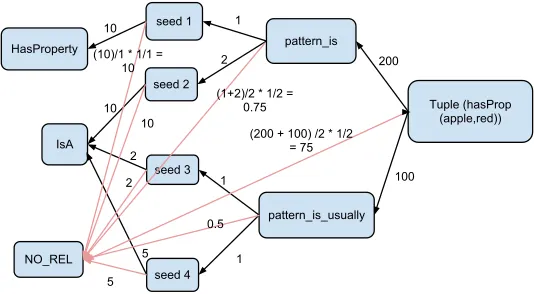
P, as well as all for the relationsRthats∈Sbelong to, plus an additional artificial relation nodeNO_RELATIONto account for noise. A weighted edge from the tuple nodevtto one or more patternsvpcorresponds (after normalization) to a tuple probabilityP r(p|t), which is estimated using the pattern frequency in an extraction source like the Google N-grams dataset. The outgoing edge weights of a node are normalized to sum to 1 in order to give us such probabilities. A weighted edge from a pattern nodevpto one or more seed nodesvscorresponds toP r(s|p)probabilities, which are estimated as the seed confidence scores delivered by the source of the seeds (ConceptNet in our case). These, too, are normalized as above. A weighted edge from a seed nodevsto a relation nodevrcorresponds to the conditional relation probability
HasProperty
of outgoing edges of the node and inversely proportional to the number of outgoing edges asPiouti/numoutk1numkout2, where k1 and k2 are parameters. The first component provides scaling and the second component depicts lower chances of noise when the tuple matches several patterns or when a pattern is generated from several seeds. All other node pairs remain unconnected in the adjacency matrix. Figure 1 shows an example of a tuple graph. One of the desirable properties of this model is that it is localized, allowing us to consider the local graphGTfor each tuple instead of a single graph with potentially millions of seeds, patterns and tuples. Our method can thus be parallelized very easily without additional communication overhead.
Fact scoring and classification. The Markov chain consists of states for every node and a transition matrixQ. The state transition probabilities inQare fixed by taking the edge weights and 1) incorporating random transitions to theNO_RELATIONstate in order to account for uncertainty and noise, and 2) additionally incorporating a random restart jump from any
3 System
The system takes as input a common noun likecar,flowerand provides a scored list of commonsense properties with visualization. The first step involves constructing semi-instatiated patterns(SIP) from the input, i.e. anchoring the input with patterns. For example,car/NN is very */JJ,car/NN seems really */JJare some SIPs in the current example. These SIPs are looked up in three resources: Google N-grams corpus, Wikipedia full text and Microsoft N-grams.
For fast lookup, we construct a SIP online lookup system:
• An index lookup over Wikipedia: Wikipedia XML dump was converted to text format and indexed in Lucene with stop-words included. We developed a lookup service takes a SIP as input and fetches relevant text by looking up the index for fast retrieval required for our online system.
• An index lookup over Google N-grams corpus: Google has published a dataset of raw frequencies for n-grams (n=1, . . . , 5) computed from over 1,024G word tokens of English text, taken from Google’s web page search index. In compressed form, the distributed data amounts to 24GB. We developed an index lookup service over Google n-grams such that given a SIP, all relevant Google 5-grams are fetched. 5-grams provide the largest context and are therefore preferred over 4-grams.
• Bing N-grams Web service caller: Microsoft’s Web N-gram Corpus is based on the complete collection of documents indexed for the English US version of the Bing search engine. The dataset is not distributed as such but made accessible by means of a Web service described using the WSDL standard. The service provides smoothed n-gram language model based probability scores rather than raw frequencies (Wang et al., 2010). We enable SIP lookup over this service.
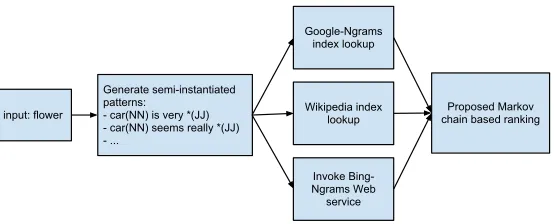
The results from these resources are then merged to generate tuple statistics of the form: x,y,[pattern:score]. These statistics form the input to our Markov chain method which provides a scored list of facts which are then displayed. Due to the locality of our approach, the system operates online. Figure 2 shows the flow of the system.
Figure 3,4 provides screenshot for the output of property lookup forflowerandfishat pattern support 2.
4 Experiments
4.1 Experimental Setup
input: flower Wikipedia index lookup Google-Ngrams index lookup
Invoke Bing-Ngrams Web
service Generate semi-instantiated
patterns: - car(NN) is very *(JJ) - car(NN) seems really *(JJ) - ...
Proposed Markov chain based ranking
Figure 2: System flow diagram
Figure 3: Screenshot for output of: flower
4.2 Experimental results
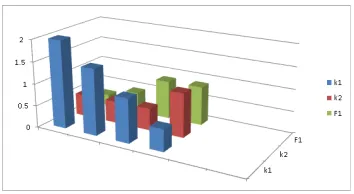
The gold set consists of 200 manually classified facts, 100 negative and 100 positive. The parameter selection for NO_RELATION edge weight is performed over F1 score. The best parameters are obtained at small k1 and large k2 values, see Figure 5. The minimum pattern support is 2, i.e. candidate assertions with less than 2 patterns matched are dropped because they have insufficient evidence.
Figure 4: Screenshot for output of: fish
Figure 5: Parameter selection based on F1 measure, small k1 and large k2 performs best
Method Precision Recall F1
PMI 0.84±0.1 0.83 0.84
Proposed method 0.88±0.0901 0.854 0.8861
Table 1: Results
5 Conclusion
References
Chen, J. and Liu, J. (2011). Combining conceptnet and wordnet for word sense disambiguation. InProceedings of 5th International Joint Conference on Natural Language Processing, pages 686–694, Chiang Mai, Thailand. Asian Federation of Natural Language Processing.
Hsu, M.-H., Tsai, M.-F., and Chen, H.-H. (2006). Query expansion with ConceptNet and WordNet: An intrinsic comparison. InInformation Retrieval Technology.
Jain, A. and Pantel, P. (2010). Factrank: Random walks on a web of facts. InProceedings of the 23rd International Conference on Computational Linguistics, pages 501–509. Association for Computational Linguistics.
Li, H., Bollegala, D., Matsuo, Y., and Ishizuka, M. (2011). Using graph based method to improve bootstrapping relation extraction. Computational Linguistics and Intelligent Text Processing, pages 127–138.
Pantel, P. and Pennacchiotti, M. (2006). Espresso: Leveraging generic patterns for automat-ically harvesting semantic relations. InProceedings of the 21st International Conference on Computational Linguistics and the 44th annual meeting of the Association for Computational Linguistics, pages 113–120. Association for Computational Linguistics.
Tandon, N., de Melo, G., and Weikum, G. (2011). Deriving a web-scale common sense fact database. InTwenty-Fifth AAAI Conference on Artificial Intelligence.
![Cost effectiveness of microendoscopic discectomy versus conventional open discectomy in the treatment of lumbar disc herniation: a prospective randomised controlled trial [ISRCTN51857546]](data:image/gif;base64,R0lGODlhAQABAIAAAP///wAAACH5BAEAAAAALAAAAAABAAEAAAICRAEAOw==)