Comparing corpora with WordSmith Tools:
How large must the reference corpus be?
Tony BERBER-SARDINHA LAEL, Catholic University of Sao Paulo
Rua Monte Alegre 984 05014-001 Sao Paulo SP, Brazil
Abstract
WordSmith Tools (Scott, 1998) offers a program for comparing corpora, known as KeyWords. KeyWords compares a word list extracted from what has been called 'the study corpus' (the corpus which the researcher is interested in describing) with a word list made from a reference corpus. The only requirement for a word list to be accepted as reference corpus by the software is that must be larger than the study corpus. one of the most pressing questions with respect to using KeyWords seems to be what would be the ideal size of a reference corpus. The aim of this paper is thus to propose answers to this question. Five English corpora were compared to reference corpora of various sizes (varying from two to 100 times larger than the study corpus). The results indicate that a reference corpus that is five times as large as the study corpus yielded a larger number of keywords than a smaller reference corpus. Corpora larger than five times the size of the study corpus yielded similar amounts of keywords. The implication is that a larger reference corpus is not always better than a smaller one, for WordSmith Tools Keywords analysis, while a reference corpus that is less than five times the size of the study corpus may not be reliable. There seems to be no need for using extremely large reference corpora, given that the number of keywords yielded do not seem to change by using corpora larger than five times the size of the study corpus.
KeyWords. This tool has been used in several studies as a means for describing various lexico- grammatical characteristics of different genres (Barbara and Scott, 1999; Batista, 1998; Berber Sardinha, 1995, 1999a, b; Berber Sardinha and Shimazumi, 1998; Bonamin, 1999; Collins and Scott, 1996; Conde, 1999; Dutra, 1999; Freitas, 1997; Fuzetti, 1999; Granger and Tnbble, 1998; Lima-Lopes, 1999; Lopes, 2000; Ramos, 1997; Santos, 1999; Scott, 1997; Silva, 1999; Tribble, 1998). The keywords identified by the program are not necessarily the 'most important words' in the corpus (Scott, 1997), or those that correspond to readers' intuitions as to what the topics of the texts are. It is generally thought that a set of WordSmith Tools keywords indicate 'aboutness' (Phillips, 1989).
KeyWords compares a word list extracted from what has been called 'the study corpus' (the corpus which the researcher is interested in describing) with a word list made from a reference corpus. The result is a list of keywords, or words whose frequencies are statistically higher in the study corpus than in the reference corpus. The software also identifies words whose frequencies are statistically lower in the study corpus, which are called 'negative keywords', in contrast to positive keywords, which have higher frequencies in the study corpus. Negative keywords, though, will not be discussed in the present paper. Hence, whenever keyword is mentioned in this paper, it will mean 'positive keyword'.
• The composition of the reference corpus.
• The size of the study corpus;. • The size of the reference corpus.
• The statistical test used in the comparison of frequencies (log- likelihood and chi-square are available). • The level of significance (p) used as the
'keyness' benchmark (the cut-off point). Since WordSmith Tools is Windows software, it has appealed to a large audience of applied linguists willing to do corpus-based research, to whom this platform is generally the only one that they know how to use. To them, one of the most pressing questions with respect to using KeyWords seems to be what would be the ideal size of a reference corpus. The aim of this paper is thus to propose answers to this question.
1 Using KeyWords
A KeyWord list is a portion of the study corpus word list. KeyWords compares the frequencies for each type in the study and reference corpora. The program calculates the log-likelihood (G2) 1 or Chi-Square (X 2) of each word form based on its distribution in both corpora, an example of which is given in the table below.
Study corpus Reference corpus
W o r d form x
10 (10%)
10(1%)
Remaining word forms
Total
90 (90%) 100
(100%)
1000 (99%) 1010(100%)
For a distribution such as the above, both the log-likelihood and chi-square statistics would probably flag the word form in question as a keyword, since its frequencies in the two corpora are so different (10% versus 1%). The way KeyWords processes word lists is not unique, and has been applied by researchers using other software (De Cock, Granger, Leech, and McEnery, 1998; Granger and Rayson, 1998; Milton, 1998).
After processing the word lists, the keyword lists appear in WordSmith Tools as illustrated below.
1 See Dunning (1992) for the formulae.
From left to right, the columns in the window refer to:
LI'P'~ l[]
,1
- ~_1.~1
i 192 0,905 97.787 0.11 495.7 0.000000
JOB 91 0,4,5 19.454 0.02 3,80.4 0.000000 LOVE 93 0,46 21.296 0.02 376.6 0.000000
RITA 33 O, 16 305 338.9 0.000000
NOWADAYS 38 0,19 1.365 290.4 0.000000
Is 45,,5 2,25 889.648 0,98 244.8 0.000000
14 0,07 0 235.4 0.000000
UNIVERSITY 51 0,25 15.333 0.02 180.3 0.000000 PERSON 54 0,27 21.747 0.02 161.9 0.000000 MONEY 60 0,30 31.442 0.03 151.6 0.0O0000 LIVE 45 0,22 15.551 0.02 147.5 0.000000
• 'Word': the keywords.
• 'Freq': frequency in the study corpus; • <file name> %: percent frequency in the
study corpus;
• 'Freq': frequency in the reference corpus;
• <file name> %: percent frequency in the reference corpus;
• Keyness: the value of the log-likelihood or chi-square statistics;
• p: the significance value associated with the statistic.
2 Methodology
In order to answer this question, the following English corpora were used:
• Corpus of j o b application letters, taken from the DIRECT Corpus 2 .
• Corpus of newspaper editorials, from the Brown Corpus ('B" subcorpus). • Corpus of newspaper reviews, from the
Brown Corpus ('C' subcorpus).
• Corpus of mystery fiction, from the Brown Corpus ('L" subcorpus).
• Corpus of science fiction, from the Brown Corpus ('M' subcorpus).
These five corpora added up to about 162
thousand words:
Corpus Tokens Letters 11,761 Editorials 54,626
Types 2,415 8,582
2 For more information on the DIRECT project, log on to www.direct.f2s.com
Reviews 35,741 17,746 Mystery 48,298 6,281 Sci-Fi 1 2 , 0 8 1 2,982 Total 162,5071
The reference corpora were compiled out of texts published in 'The Guardian'. The reason for choosing it is that newspaper text is the most typical kind of reference corpus used by applied linguists, mainly because it is easy to get. Therefore, the results obtained here would be relevant to the typical user of KeyWords. The reason for specifically choosing the Guardian is that Mike Scott, the author of WordSmith Tools, makes it available on his website a word list of 95 million tokens of The Guardian text on his website. This has become a popular choice for several WordSmith Tools users investigating English keywords. Once again, it was hoped that by using The Guardian, the investigation would mirror a typical choice of WordSmith users. For the present study, a portion of the Guardian word list was used, namely from texts published in 1994, taken randomly.
The size of the reference corpora varied according to the size of the study corpora. For each study corpus, 18 reference corpora were created. Each one was n times larger than the study corpus, with n being 2, 3, 4, 5, 6, 7, 8, 9, 10, 20, 30, 40, 50, 60, 70, 80, 90, and 100. For instance, the letters corpus had 11,761 tokens, and so for n=2 the size of the reference corpus was 23,552 tokens (11,761 * 2); for n=3, the reference corpus size was 35,283 (11,761 x 3), for n=4 47,044, and so on, up to n=100, whose size was 1,176,100 words.
The KeyWords settings used for the comparisons were as follows:
Setting Procedure Max p. value Max wanted Min frequency * most allowed
Value
loglikelyhood 0.01
160(0*
Table 1: KeyWords settings
The table below shows the size of all of the reference corpora used in the study:
Size of reference corpora
N=2 n=3x n=4 n=5 N=6 N=7
Letters Tokens 23,522 35,283 47,044 58,805 70,566 82,327
Editorials
Reviews
Mystery
Sci-Fi
Types 5,543 10,161 11,163
71,482
12,249 Tokens 109,252 163,878 218,504 273,130 327,756 382,382
Types 14,973 18,378 21,746 24,118 26,537 28,382
Tokens 178,705
11,000
7,409 8,863
107,223 142,964 14,331 17,758
148,324 i 7,550 9,032
214,446 Types
250,187 19,490 21,559 23,402 Tokens 96,596 144,894 193,192 241,490 289,788 338,086
Types 13,880 17,636 ~20,285 22,861 24,925 26,928
Tokens 24,162 36,243 60,405 72,486 84,567
5,644
Types 11,318
Size of reference corpora
10,325 12,422
n=8 n=9 n=10 n=20 n=30 n=40
Letters Tokens 94,088 105,849 117,610 235,220 352,830 470,440 13,095
Editorials i
!
iReviews
Mystery
Types 13,896 14,879 22,650 27,763 31A71
Tokens 437,008 !491,634 546,260 1092,520 1,638,780 12,185,040
Types 30,292 31,825 33,672 47,305 57,325 65,237
Tokens 285,928 321,669 357,410 714,820 1,072,230 1,429,640
Types 24,940 26,524 27,812 38,610 47,081 53,695
n=50 n=60 n=70 In=80 n=90 n=100 Letters Tokens 588,050 705,660 823,270 940,880 1,058,490 1,176,100
Types 35,083 38,560
Editorials
Reviews
Mystery
Sci-Fi
42,421 44,607 47,061 48,902
Tokens 2,731,300 3,277,560 3,823,820 4,370,080 4,916,340 5,462,600 Types 71,680 77,397 8 2 , 7 4 3 87,902 92,884 97,121 Tokens 1,787,050 2,144,460 12,501,870 2,859,280 3,216,690 3,574,100 Types 59,690 6 4 , 7 5 3 ! 6 9 , 2 4 2 73,167 76,945 80,574 Tokens 2,414,900 2,897,880 3,380,860 3,863,840 4,346,820 14,829,800 Types 68,117 7 3 , 6 2 3 7 8 , 5 0 8 83,076 87,578 [92,157 Tokens 604,050 724,860 845,670 966,480 1,087,290 [1,208,100
42,822
[image:4.596.119.516.91.241.2]Types 38,959 45,101 47,474
Table 2: Size of reference corpora
135,460 49,617
3 Results
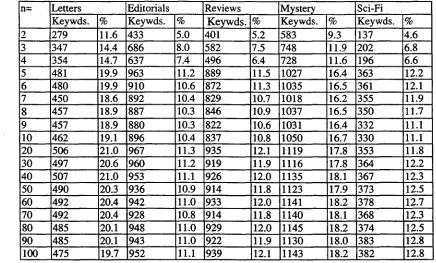
The results for the total number of keywords obtained are shown in the following table. Since the study corpora were of different sizes, the number of keywords is also shown as a
percentage of the total types of the study corpus. For instance, the letters corpus had 2,415 types; the number of keywords obtained comparing this corpus to the n=2 reference corpus was 279; therefore, this corresponds to 11.6% of the total types.
n= Letters I Editorials Reviews Mystery Sci-Fi
Keywds. % i Keywds. % K e y w d s . % Keywds. % Keywds. %
2 279 11.6 433 5.0 401 5.2 583 9.3 137 4.6
3 347 14.4 1686 8.0 582
17.5
748 11.9 202 6.84 354 14.7 637 7.4 496 6.4
!728
11.6 !196 6.65 481 19.9 963 11.2 889 11.5 i1027 16.4 363 12.2
6 480 19.9 910 10.6 872 11.3 1035 16.5 361 12.1
7 450 18.6 892 10.4 829 10.7 1018 16.2 355 11.9
8 457 18.9 887 10.3 846 10.9 1037 16.5 350 11.7
9 !457 18.9 880 10.3 822 10.6 1031 116.4 332 11.1
1 0 462 19.1 896 10.4 837 10.8 1050 16.7 330 11.1
30 497 20.6 960 11.2 919 i11.9 1116 17.8 364 12.2
40 507 21.0 953 11.1 926
112.0
1135 18.1 367 12.350 490 20.3 936 10.9 !914 11.8 !1123 17.9 373 12.5
60 492 20.4 942 11.0 i933 12.0 11141 18.2 378 12.7
7 0 492 20.4 928 10.8 !914 11.8 11140 18.1 368 12.3
80 485 20.1 948 11.0 929 12.0 1145 18.2 i374 12.5
90 485 20.1 943 11.0 922 11.9 1130 18.0 i383 12.8
100 475 19.7
1952
11.1 939 12.1 1143 18.2 382 12.8Table 3: Keyword totals (% = pct. of the total number of types in the study corpus).
The results indicate that the number of keywords increases as the size of the reference corpus increases, but this increase is not linear. For instance, the keywords for n=2 in the letters corpus was 279, for n=3 it was 347, and for n=
100 the total keywords was 475. Had the growth been linear, for n=3 there would be 418 keywords, and for n=100 13,950. Obviously, a total of 13,950 keywords could never have been obtained since die maximum possible number of
[image:4.596.93.529.375.638.2]keywords in the letters corpus is 2,415, which is the total number of types. The same is true of all the other corpora.
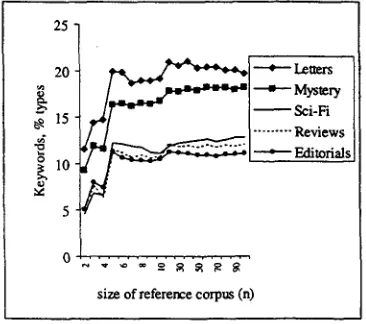
This suggests that there must be a point at which the growth in number of keywords diminishes. This can be shown by plotting the number of keywords for each size of n across all the study corpora, as in the graph below.
25
20
15
10
5
0
size of reference corpus (n)
* Letters • Mystery
Sci-Fi ... Reviews
• Editorials
Plot 1: Distribution of keywords
The plot shows that for all study corpora the keyword totals rose from n=2 to n=3, then fell or stabilized at n=4, rose again at n=5 and from then on basically reached a plateau. For instance, for the letters corpus, the keyword totals for n=2, n=3, n=4, n=5, and n=6 were respectively 11.6, 14.4, 14.7, 19.9, and 19.9. Hence, there was indeed a considerable rise from n=2 to n=3 (11.6 to 14.4), followed by a slight rise at n=4 (14.7), then a major increase at n=5 (19.9), and there was no change from n=5 to n=6 (19.9 to 19.9).
In order to check where the major changes occurred, an ANOVA was run on the keyword totals across the various n sizes. The results are shown in the table below.
Source df I SS Size o f n 21 ] 1540.8087 Error 68i18.6184 Total 18911559.4271
F
Ip
[image:5.596.101.284.197.359.2]267.98 [ < 0.0001
Table 4: Results of ANOVA for keyword totals across reference corpora
The value of F(21,68)=267.98 is significant at p<0.0001, which indicates that size of the
reference corpora had a significant effect on the keyword totals. This does not show us the differences in keyword totals among n sizes.
In order to know at which n sizes the keyword totals are statistically different, the REGWF (Ryan-Einot-Gabriel-Welsch) Multiple F Test was run in SAS. The results appear in the table below, in decreasing order of the average percentage of keyword totals across the five study corpora.
A A A A A A A A A A A
Groupings Avg. % Size
keywords o f n !14.8840 40
14.8480 i60 14.7900 20 14.7780 100 14.7780 80 14.7600 90 14.7220 30
B 14.6940 70
B C 14.6780 50
B C D 14.2280 5
B C D 14.0660 6
B C D 13.6860 8
C D 13.6340 10
D 13.5660 7
D 13.4640 9
E 9.100 3
]E 9.3280 4
[ F 7.1300 2
Table 5: Results of REGWF test
The REGWF test presents the results in terms of groupings, identified by letters. Keyword totals in the same grouping are not statistically different. Hence, sizes of n equal to 40, 60, 20, 100, 80, 90, 30, 70, 50, 5, and 6 formed grouping A, which has on average 14.066% to 14.884% keyword totals. Likewise, n sizes equal to 70, 50, 5, 6, and 8 were in grouping B, with averages ranging from 13.686% to 14.694%. Note that this is overlap among groupings, and so groupings A, B, C and D are in fact joined. This grouping comprises n sizes ranging from 5 to 100. The remaining groupings are non- overlapping: grouping E was formed by n sizes 3 and 4, and grouping F by n=2.
[image:5.596.342.511.225.501.2]and 5. These correspond to the major peaks and plateaus visible in the plot.
The results suggest, then, that the critical value for a reference corpus seems to be five. In other words, the answer to the question 'what is the ideal size o f a reference corpus' is five. A reference corpus that is five times as large as the study corpus yields a larger number of keywords than a smaller reference corpus. This means that the results o f a keyword analysis based on a reference corpus that is less than five times the size o f the study corpus could be very different from a study done on a corpus, say, just three times larger than the study corpus, in so far as the number ofkeywords go. Several potentially revealing keywords could be left out o f the analysis iftbe reference corpus is not as large as five times or more.
Condusion
The aim o f this study was to estimate the ideal size o f a reference corpus to be used in
WordSmith Tools KeyWords procedure.
KeyWords provides facilities for comparing a study corpus to a reference corpus, which, by default, must be larger than study corpus.
The results indicated that a reference corpus that is five times larger than the study corpus yields a similar amount o f keywords than reference corpora that are up to 100 times larger than the study corpus. This was taken to mean that a reference corpus does not need to be more than five times larger than the study corpus.
In sum, a larger reference corpus is not always better than a smaller one, for WordSmith Tools Keywords analysis. There seems to be no need for using extremely large reference corpora, given that the number of keywords yielded do not seem to change by using corpora larger than five times the size of the study corpus. This may be important for WordSmith Tools users, who may be short o f disk space and memory on their PCs to process large reference corpora. A suggestion that might come out o f this finding is that researchers should not spend time and resources building, collecting or searching for larger and larger reference corpora. Resources would be better spent in the compilation o f reference corpora that are more suitable in terms o f their contents viz ~ viz the study corpus.
This study did not tackle several important questions. One o f them is whether the keywords
that were identified represent the main concepts or topics found the texts. Aqualitative study would be needed to answer this, as an independent test o f validity o f the status o f the keywords. Another question is the effect of the size of the study corpus. It is not known how study corpora o f the same size behave in terms of the total keywords that they yield when compared to reference corpora o f the same size. Another question is the composition o f the keyword lists obtained. This study restricted itself to quantitative aspects o f keyword list variation, but it would be important that changes be assessed qualitatively as well. In particular, it would be pertinent to know which keywords were added or dropped as the levels o f n changed ~. Finally, the fact that Brown corpus texts are short fragments and not whole texts may have upset the results, since the number o f keywords seems to vary considerably as a function o f the size o f the texts (Mike Scott, personal communication). Shorter texts provide less room for repetition, which in turn influences word frequencies.
Acknowledgements
My thanks go to Mike Scott and the three anonymous reviewers for their comments.
References
Leila Barbara and Mike Scott (1999). Homing on a genre: invitations f o r bids. In "Writing Business: Genres, media and discourse", In F. Bargiela- Chiapini & C. Nickerson, ed., Longman, New York, USA, pp. 227-254.
Maria Eug~nia Batista (1998) E-Mails na troca de informafao numa muitinacionah o g~nero e as escolhas 16xico-gramaticais. Unpublished MA Thesis, LAEL, Catholic University of Sao Paulo, Brazil.
Tony Berber-Sardinha (1995). The OJ Simpson trial: Connectivity and consistency. Paper presented at the BAAL Annual Meeting, Southampton, England, 14 September 1995.
Tony Berber-Sardinha (1999a) UsingKeyWords in text analysis: Practical aspects. DIRECT Papers, 42. LAEL, Catholic University of Sao Paulo, Brazil / AELSU, University of Liverpool, England. (Available online at www.direct.f2s.com)
3 This could be done in WordSmith itselftl~ough the 'consistency list' function.
Tony Berber- Sardirdaa (1999b) Wordsets, keywords, and text contents: an investigation of text topic on the computer. Delta, 15, pp. 141-149. (Available online at www.scielo.br)
Tony Berber-Sardinha and Marilisa Shimazumi (1998) Using corpus linguistics to describe the APU (Assessment of Performance Unit) archive of schoolchildren's writing. Unpublished manuscript. (Available online at www.tonyberber.f2s.com) MArcia Bonamin (I 999) Anfilise organizational e
16xico-gramatieal de duas se95es de revistas de informfitica, em ingles. Unpublished MA Thesis, LAEL, Catholic University ofS~o Paulo, Brazil. (Available online at www.lael.t2s.com/online.htm) Heloisa Collins and Mike Scott (1996)Lexical
landscaping. DIRECT Papers, 32. CEPRIL, Catholic University of S~o Panlo, Brazil, and AELSU, Liverpool University, England. Helena Conde (1999) Aspeetos culturais da escrita de
alunos de urea escola americana em S~o Paulo - Urea perspectiva baseada em corpus. MA Project. LAEL, Catholic University of S~o Paulo, Brazil. Sylvie De Cock, Syivianne Granger, Geoffrey Leech and Tony McEnery (1998)An automated approach to the phrasicon of EFL learners. In "Learner English on Computer", S. Granger, ed., Longman, New York, pp. 67-79.
Ted Dunning (1992) Accurate methods for the statistics of surprise and coincidence.
Computational Linguistics, 19, pp. 61-74. Patrlcia Durra (I 999) Anfilise 16xico-gramatical
baseada era corpus da mfsiea pop contemporfinea. MA Project, LAEL, Catholic University of S~o Paulo, Brazil.
Alice de Freitas (1997). Amrrica m~gica, Gr~- Bretanha real e Brasil tropical: um estudo iexieal de panfletos de hot,is. Unpublished Doctoral Thesis, LAEL, Catholic University of S~o Paulo, Brazil. (Available online at www.lael.f2s.com /online.htm)
Helena Fuzetti (1999) A interag~o oral entre eriangas numa escola arnerieana- Urea abordagem baseada em corpus. MA Project, LAEL, Catholic University of Sao Paulo, Brazil.
Sylvianne Granger and Paul Rayson (1998)
Automatic profiling of learner texts. In "Learner
English on Computer", S. Granger, ed., Longman, New York, USA, pp. 119-131.
Sylvianne Granger and Chris Tribble (1998) Learner
corpus data in the foreign language classroom: Form-focused instruction and data-driven learning. In "Learner English on Computer", S. Granger ed., Longraan, New York, USA, pp. 199- 209.
Rodrigo Lima-Lopes (1999) Padr~es colocaeionais dos participantes ern cartas de neg6eios em lingua inglesa. Manuscript. LAEL, Cafl~olic University of
Sao Paulo, Brazil.
Maria Cecilia Lopes (2000) Homepages institucionais em portugu~s e suas vers~es para o ingles: Urea anfilise baseada em corpus de aspeetos lexicais e discursivos. Unpublished MA Thesis, Sao Paulo, Brazil, LAEL, Catholic University of
Sao Paulo, Brazil•
John Milton (1998)ExploitbtgL1 andinterlanguage corpora in the design o f an electronic language learning and production environment. In "Learner English on Computer", S. Granger, ed., Longman, New York, USA, pp. 186-199.
Martin Phillips (1989) Lexical Structure of Text.
Birmingham: ELR, University of Birmingham, 80 p.
Rosinda Guerra Ramos (1997) Proje~o de imagem atrav~s de escolhas lingfiisticas: Um estudo no eontexto empresarial. Unpublished Doctoral Thesis, LAEL, Catholic University ofSao Paulo, Brazil.
Valrria Branco Pinto dos Santos (1999) PadrSes interpessoais no g~nero de cartas de negociag~o. Unpublished MA Thesis, LAEL, Catholic University of S~o Paulo, Brazil. (Available online at www.lael.f2s.com/online.htm)
Mike Scott (1997) PC Analysis of key words-and key key words. System, 25, pp. 233-245. Mike Scott (1998) WordSmith Tools Version 3.
Oxford University Press, Oxford, England. Maria Fernanda da Silva (1999) Anfilise lexical de
folhetos de propagandas de escolas de linguas e as representa95es de ensino. Unpublished MA Thesis, LAEL, Catholic University of Sao Paulo, Brazil. (Available online at http//www.lael.f2s.eom/ online.htm)