Using the Web to Train a Mobile Device Oriented
Japanese Input Method Editor
Xianchao Wu, Rixin Xiao, Xiaoxin Chen
Baidu Inc.
[email protected], {xiaorixin, chenxiaoxin}@baidu.com
Abstract
This paper describes the construction of a Japanese Input Method Editor (IME) sys-tem for mobile devices, using the large-scale Web pages. We provide the training process of our IME model, n-pos model for local Kana-Kanji conversion and n-gram model for online cloud service. Es-pecially, we propose an online algorithm of mining new compound words, together with the detailed post-filtering process to prune the billion level entries to be used in mobile services. Experiments show that our IME system outperforms two state-of-the-art Japanese IME baselines. We have released our system in a completely free form1 and the system is currently used by millions of users.
1 Introduction
Mobile devices such as smart phones and tablet PCs are used by billions of users. For example, Google’s Android system has obtained more than 900 million2 active devices till May 2013. In this paper, we use large-scale Web pages to train a Japanese IME system for mobile devices.
Languages such as Chinese and Japanese can not been typed directly using Latin keyboards. This is because there are only 26 English letters in a Latin keyboard, yet the number of Chinese characters are in tens thousands level. Further-more, by connecting several Chinese characters together, the number of yielded words and fre-quently used phrases/idioms are in million level. Thus, language-dependent Input Method Editor (IME) systems are indispensable which maps from combinations of English letters to Chinese
char-1
http://simeji.me/
2http://www.android.com/
acters/words/phrases and Japanese Kanji/Kana se-quences.
For example, suppose we want to input a Japanese verb “炒める” (means “fry”, “炒” is a Japanese Kanji character, “める” are two Japanese Kana characters). We first need to know the Kana pronunciation of the Kanji character “炒”, which is “いた”. That is, the verb is pronunced as “いた
める”. Then, we need to know the mapping from English letters to Japanese Kanas. Here, “い”, “た”, “め”, “る” respectively correspond to “i”, “ta”, “me”, “ru”, which can be directly typed by using the Latin keyboards. This mapping (e.g., from “i” to “い”) is unique and predefined already. Thus, the real challenge for constructing an IME system for Japanese is to provide the most reason-able Kanji sequence from a given Kana sequence:
• one Kanji character can have several correct Kana pronunciations (e.g., “炒” can be pro-nounced as “いた”, “しょう”, “そう”, etc.);
• one Kana sequence corresponds to numerous Kanji candidates (such as “いためる” for “炒める”, “痛める” (pain), etc.);
It is the context that determines the selection of the most reasonable Kanji sequence. For example, “心をいためる” (“心” = heart, “を” is a Japanese particle right follows an argument and before the argument’s predicate) requires the Kanji to be “痛
める" (heart pain) and “野菜をいためる” needs the Kanji to be “炒める” (fry vegetables). How-ever, it is not a trivial work for modelling the con-text. That is, how to choice the context from large-scale Web pages such that the context is optimized to be used in a mobile device oriented Japanese IME?
To answer this question, we need to consider the following constraints:
• mobile devices need more strict controlling of CPU and memory usages than laptops;
• free wireless services are not supposed to be available anywhere, any time.
Consequently, we have to limit the number of Kana-Kanji entries to be loaded into memory and ensure a high precision of Kana-Kanji conversion even without on-line services (such as cloud in-put).
2 The Model
Our Japanese IME system is constructed based on the n-pos3 model (Mori et al., 1999; Komachi et al., 2008; Kudo et al., 2011). For statistical Kana-Kanji conversion, we predicate the optimal mixed Kana-Kanji sequenceyˆ (= w1...wn) from the
in-put Hirakana sequencex:
ˆ
y= argmaxyP(y)P(x|y) (1)
P(y) = n
∏
i=1
P(wi|ci)P(ci|ci−1) (2)
P(x|y) = n
∏
i=1
P(ri|wi) (3)
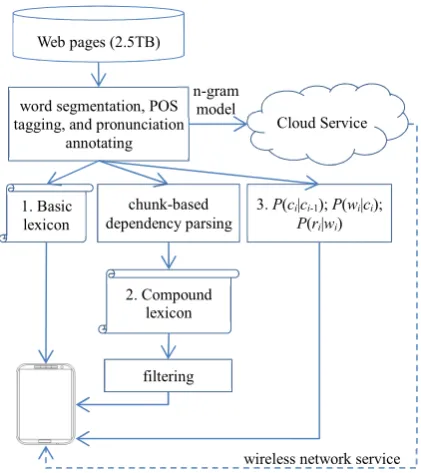
As shown in Figure 1, for training this model, we used 2.5TB Japanese Web pages as the train-ing data. We run Mecab4 with IPA dictionary5 on Hadoop6, an open source software that im-plemented the Map-Reduce framework (Dean and Ghemawat, 2004), for parallel word segmenting, Part-of-Speech (POS) tagging, and Kana pronun-ciation annotating. Then, based on maximum like-lihood estimation, we estimate:
• P(ci|ci−1), bi-gram POS tag model;
• P(wi|ci), POS-to-word emission model,
fromcito a wordwi; and,
• P(ri|wi), pronunciation model, from wi to
its Kana pronunciationri.
There are several lexicons/models to be used in the final IME system. The first is called the basic lexicon. An entry in this lexicon is alike < wii+m, cii+m, rii+m >. Here, wii+m stands for m + 1 words (of wi...wi+m). One word wi
ex-actly corresponds to one POS tagci and one Kana
3n-pos model is short for n-gram part-of-speech model 4
https://code.google.com/p/mecab/
5
http://code.google.com/p/mecab/downloads/detail? name=mecab-ipadic-2.7.0-20070801.tar.gz
6http://hadoop.apache.org/
Web pages (2.5TB)
Cloud Service word segmentation, POS
tagging, and pronunciation annotating
1. Basic lexicon
2. Compound lexicon
n-gram model
filtering chunk-based dependency parsing
wireless network service 3. P(ci|ci-1); P(wi|ci);
P(ri|wi)
Figure 1: The main process of using the Web to train the IME system.
sequence ri as its pronunciation. One word
se-quence with multiple reasonable POS sese-quences and/or Kana pronunciations will be stored sepa-rately as different entries. This lexicon contains: (1) Japanese words (such as particles, adjectives, adverbs, verbs, nouns, etc.) with the highest fre-quencies, and (2) the most frequently used idioms which are collected manually by our Japanese lan-guage experts.
The second is the compound lexicon which contains new words, collocations, and predicate-argument phrases. As drawn in Figure 1, depen-dency parsing is performed before mining. Web sentences were parsed by a state-of-the-art chunk-based Japanese dependency parser, Cabocha7 (Kudo and Matsumoto, 2002a). The mining and filtering process will be introduced in the next sec-tion. The motivation of constructing this lexicon is to extract the most important context information, such as the strong constraints among predicates and their arguments. For example, as former men-tioned, the pre-predicate arguments such as “心” (heart) or “野菜” (vegetables) with given Kana se-quence “をいためる” will determine which pred-icate verb to choose, “痛める” or “炒める”.
The third is the n-pos model with three kinds of probabilities which are used during decoding, i.e., searching the n-best ys from a given input Kana
sequencex.
Finally, we train a 4-gram language model on surface word level and construct a cloud Kana-Kanji conversion service through wireless network communication between a mobile device and the cloud. The only difference with former n-pos model is the factorization ofP(y):
P(y) = n
∏
i=1
P(wi|wi−1, wi−2, wi−3) (4)
The first three lexicons/models are stored in the mobile devices to be accessed during Kana-Kanji decoding using Equation 1. The final 4-gram lan-guage model is estimated in a different way from the n-pos model. Thus, we are forced to interpo-late cloud’s m-best Kanji candidates into local mo-bile device’s n-best Kanji candidates. We perform duplicated candidate removing before interpolat-ing. Possible methods includes:
• insert the cloud candidates into fixed posi-tions, e.g., from the second position to the m+1 position of the local n-best list; or,
• upload the local n-best candidates to the cloud and then use the 4-gram language model to compute the candidates’ language model scores; or,
• download POS tags of the m-best candidates from the cloud and locally compute their scores under the local n-pos model.
The first method is the simplest without a large us-age of the wireless network. The later two meth-ods make the direction comparison of cloud and local candidates yet possibly take a large usage of the network. For simplicity, we choose the first method (e.g., taking cloud result as the first candi-date) in our IME system.
3 Compound Word Mining and Filtering
3.1 Mining Process
The basic lexicon used in our Japanese IME sys-tem is short at capturing new words and phrases, which are appearing everyday in the latest Web pages. For example, person names, technical terms and organization names are newly created and used in Web pages such as news, blogs, question-answering systems. We argue it is es-sential for the IME system to regularly update
its compound lexicon to cover these new and hot words/phrases.
Alike the format of the basic lexicon, entries withm+ 1(m differs among the entries) words in the compound lexicon is also triples of < wii+m, cii+m, rii+m >. In this paper, we mine three types of new compound words, together with their pronunciations from Japanese Web pages:
• words, which are combinations of single characters and shorter words (e.g., “副/ふ
く垢/あか" = “secondary (twitter) account”);
• collocations, which are combinations of words (e.g., “ドバイ ショック” = “Dubai (debt) crisis” ). Here, Japanese collocations are allowed to include Kanjis, Katakanas and Hirakanas. Different from many former re-searches (Manning and Schütze, 1999; Liu et al., 2009) which only mine collocations of two words, we do not limit the number of words in our “collocation” lexicon; and,
• predicate-argument phrases, which are com-binations of chunks constrained by semantic dependency relations (e.g., “心を痛める” = heart pain).
New words and collocations are mined from single chunks in the dependency trees gener-ated by Cabocha. This mining idea is based on the fact that an Japanese morphological analyser (e.g., Mecab) tends to split one out-of-vocabulary (OOV) word into a sequence of known Kanji char-acters, and most of these known Kanji characters are annotated to be notional words. Consequently, Cabocha, which takes words/characters and their POS tags as features for discriminative training us-ing a SVM model (Kudo and Matsumoto, 2002b), can still correctly tend to include these single-Kanji-character words into one chunk. Thus, we can re-combine the wrongly separated pieces into one (compound) word.
Predicate-argument phrases are mined from ad-jacent chunks with dependency relations. Since Japanese is a Subject-Object-Verb (SOV) lan-guage, the predicate frequently follows its sub-ject/object arguments.
0
# of words in single chunk compounds cut.1
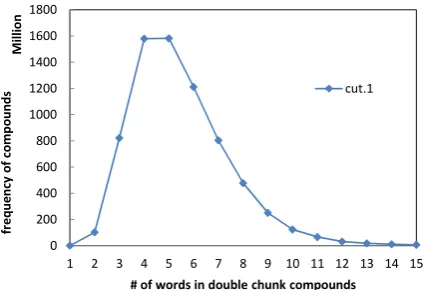
Figure 2: The distributions of the number of words per compound in single chunk lexicon, mined from the 2.5TB web data.
0
# of words in double chunk compounds cut.1
Figure 3: The distributions of the number of words per predicate-argument phrases, mined from the 2.5TB web data.
from single chunks, we limit the number of words frequently ranges from 2 to 8. For predicate-argument phrases, most number (of words) is in the interval of [2, 11].
Frequency information is used for pruning the compound entries to be finally used in mobile de-vices. The mining algorithm can be performed in an online way. For one aspect, we can timely crawl the latest Web pages and execute the min-ing process. The frequencies of lastly mined tries can be simply accumulated to the existing en-tries. On the other hand, we allow the users to up-load their input logs to the cloud and execute the mining process to extract single user oriented per-sonally entries. Again, the frequencies of similar words/phrases are simply accumulated.
Recall the n-pos model and the n-gram language model. Since all the probabilities are estimated in a maximum likelihood way, we can simply up-date the probabilities in these models by
accumu-lating frequencies to similar words/phrases. Thus, we say that our IME system is self-growing as the Web becoming larger and users using it longer.
3.2 Filtering Process
After successful mining of the compound lexicon, it is still challenging to prune it to be used in mo-bile devices with limited computing ability and memory. The trade-off is that, we have to maintain a good enough local lexicon yet with extremely limited number of entries. We use the following algorithms step by step for filtering:
• use the likelihood ratio method as described in (Manning and Schütze, 1999);
• use the LH score as described in (Okazaki and Ananiadou, 2006);
• use the log file of the cloud service; and,
• use hand-made deep filtering rules.
We hereafter describe these filtering strategies. Likelihood ratio is an approach to hypothesis test-ing, which has been proved to be appropriate for sparse data (Manning and Schütze, 1999). That is, even for candidate phrases will relatively low fre-quencies, if they share a strong relation with each other, then they are still possibly kept. Likelihood ratio is simply a number that tells us how much more likely one hypothesis is than the other one:
• Hypothesis 1. P(w2|w1) = p = P(w2| − w1);
• Hypothesis 2. P(w2|w1) = p ̸= P(w2| − w1).
The first hypothesis judges if the occurrence of word w2 is independence with word w1, and the second hypothesis is about dependence
which is good evidence for an interesting col-location candidate. The computing of logλ =
log(L(H1)/L(H2)) exactly follows the defini-tions in (Manning and Schütze, 1999). Deal to short of space, we skip the detail here. Note that for phrases with more than two words (e.g., three words), we separately take the first/last two words as one unit, and the other word as another unit. Then, if and only if bothw1w2, w3andw1, w2w3 are collocation candidates, thenw1w2w3 is taken as one reasonable collocation.
many nested entries. For example, even both w1w2w3 and w1w2 were kept in the final com-pound lexicon, only one of them was judged man-ually to be the correct one. Dealing with this prob-lem, we use the LH score formula as described in (Okazaki and Ananiadou, 2006). we reuse the heuristic LH formula to compute the collocation likelihood LH(c) for a candidatec:
LH(c) =freq(c)−∑ t∈Tc
freq(t)×∑ freq(t) t∈Tcfreq(t)
.
Here, c is a Kanji (sub-)sequence candidate; freq(c) denotes the frequency of co-occurrence of cwith the final/first word(s) of the phrases; andTc
is a set of nested Kanji sequence candidates, each of which consists of a preceding (or, succeeding) Kanji or Kana character followed by (or, follows) the candidatec. This LH score can be computed in left-to-right (i.e., taking the former one or more words as no-changing words and seek the word list that follows these former words) direction or right-to-left direction. For example, for left-to-right computing, we can collect all the phrases starts with the similar word w1 and then collect all the compound entries start withw1. Then, after computing LH score, we can limit the number of entries start withw1.
Even after these two automatic filtering algo-rithms, we still find there are too many entries re-maining in the compound lexicon. The third step of filtering is the usage of the cloud log file which stores the entries that users uploads to the cloud. This filtering strategy is to only keep those entries whose Kana pronunciations were found in the log file. The consideration is to connect the Web to the real requirements of the users.
Finally, we manually check the remaining licon and construct deep filtering rules. For ex-ample, entries that starts with “ない”, “等” are pruned out; entries with POS tags of “particles”, “auxilary verbs” are pruned out. Note that, this manual checking is performed before the final lex-icon is generated. Filtering rules are constructed after this manual checking step and further used for filtering the test set as can be find in the next section (22 entries were filtered from the 5K en-tries in the test set).
4 Experimental Results
We have described in detail the training and filter-ing process for constructfilter-ing lexicons and models.
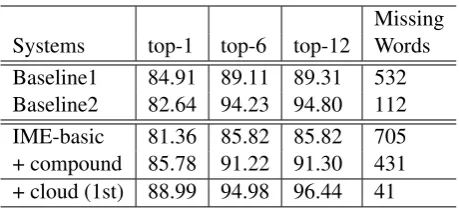
Missing Systems top-1 top-6 top-12 Words Baseline1 84.91 89.11 89.31 532 Baseline2 82.64 94.23 94.80 112 IME-basic 81.36 85.82 85.82 705 + compound 85.78 91.22 91.30 431 + cloud (1st) 88.99 94.98 96.44 41
Table 1: The top-1/6/12 precisions (%) of the baselines and our IME system under several con-figurations. Here, IME-basic stands for our IME system with only the basic lexicon; + compound stands for the system together with the basic lexi-con and the compound lexilexi-con; + cloud stands for taking cloud’s best candidate as IME’s first candi-date.
In terms of the decoding algorithm, we use beam searching for n-best Viterbi decoding (Huang and Chiang, 2005). The training data is a 2.5TB Japanese Web page set. Our basic lexicon contains around 100k entries, while the compound lexicon is limited to contain around 50k entries. No limi-tation is set to the 4-gram language model running in the cloud.
Our test set contains 4,978 Kana-Kanji entries of frequently used word, idioms, and phrases. The entries of this test set comes from the following three lexicons/corpora:
• (partial) “JDMWE” (Japanese Dictionary of Multi-Word Expressions) (Shudo et al., 2011) lexicon with 2,169 entries;
• “Nagoya” compound word lexicon8 with 3,628 entries such as idioms;
• 16,611 long form words in the “BCCWJ” (Balanced Corpus of Contemporary Written Japanese) corpus (Maekawa, 2008).
We then retrieve each entry in these three lexicons using Google9 and only keep the top 5K entries with higher frequencies. After obtaining the 5K entries, we perform manually constructed deep fil-tering rules (which have been used during train-ing) and remove 22 entries which are judged to be not suitable to be taken as collocations with com-plete meaning.
We use top-n precisionsPnto evaluate the
ac-curacy of the IME systems. We use <km,rm> to
8
http://kotoba.nuee.nagoya-u.ac.jp/jc2/base/list
express one entry in the test set, wherem ranges from 1 to M,km is the Kana input andrm is the
Kanji reference.
Pn=
∑M
m=1{δ(rm,IMEn(km))}
M (5)
Given one km, IMEn(km) generates the n-best
Kanji candidate for km. The δ() function is
de-fined as follows:
δ(rm,IMEn(km)) =
{
1 ifrm∈IMEn(km), 0 otherwise.
When n takes 1,P1is equivalent to the traditional definition of precision.
Table 1 shows the top-n precisions and the number of missing words of two starte-of-the-art Japanese IME baseline systems and our IME system under several configurations of lexi-cons/models. Both the baseline systems and our IME systems are in mobile device versions.
Here, baseline110 is a commercial Japanese IME system whose lexicon contains around 200k entries. This baseline system is constructed by us-ing statistical methods on relatively a small-scale training data and a lot of hand-made Kana-Kanji conversion rules. Deal to resource limitation, we could not obtain further detailed technical infor-mation of this system and can only buy one copy and test it in an open testing way.
The second baseline IME system (Kudo et al., 2011), baseline211, is constructed in a statistical way by using the large-scale Japanese Web pages as the training data. N-pos model is also the major model supporting its training and decoding algo-rithms. This system can be freely obtained.
From the table, we have the following observa-tions:
• when only using the basic lexicon, our IME system is worse than both of the baselines;
• when the compound lexicon is appended, the top-1 precision of our IME system is bet-ter than baselines, yet top-6/12 precisions are still not good (by checking the lexicon size of baseline2, we found that around 300k to 400k entries were contained. Yet there are only around 100k+50k entries in our ba-sic/compound lexicons);
10
http://www.justsystems.com/jp/products/atok_android/
11https://play.google.com/store/apps/details
?id=com.google.android.inputmethod.japanese
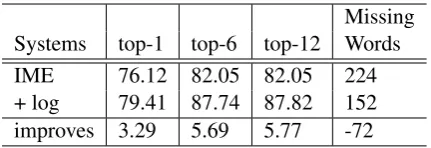
Missing Systems top-1 top-6 top-12 Words IME 76.12 82.05 82.05 224 + log 79.41 87.74 87.82 152 improves 3.29 5.69 5.77 -72
Table 2: The top-1/6/12 precisions (%) of our IME system under several configurations. Here, IME stands for the system using basic and compound lexicons; + log stands for appending compound entries mined from users’ log.
• finally, by using cloud service, the top-n pre-cisions are significantly better than two base-lines.
We did another experiment for testifying the “online” ability of our IME system. The training data is the users’ logs. We used these logs (of during two months) to extract compound words and append them to existing compound lexicons. There are 6k entries appended. The testing data (which contains 1,248 entries) is a set of com-pound words using logs of the latest three days.
Table 2 shows the changes of top-1/6/12 pre-cisions by appending the compound entries mined from users’ log. We observe that the precisions are improved 3.29% to 5.77%. These improvements show evidence that the IME system can grow itself in an online way with more data and more users.
5 Conclusion
We have described the construction of a Japanese Input Method Editor (IME) system for mobile devices, using 2.5TB Web pages. We provided the training process of our IME model, n-pos model for local Kana-Kanji conversion and n-gram model for online cloud service. In particular, we described an online algorithm of mining new compound words, together with the detailed post-filtering process to prune the billion level entries to be used in mobile services. Experiments showed that our IME system outperforms two state-of-the-art Japanese IME baselines. We have released our system in a completely free form and the system has been downloaded by more than 5 million users and is currently used by users in million level12.
12https://play.google.com/store/apps/details
References
Jeffrey Dean and Sanjay Ghemawat. 2004. Mapre-duce: simplified data processing on large clusters. InProceedings of OSDI.
Liang Huang and David Chiang. 2005. Better k-best parsing. InProceedings of IWPT.
Mamoru Komachi, Shinsuke Mori, and Hiroyuki Toku-naga. 2008. Japanese, the ambiguous, and input methods (in japanese). InProceedings of the Sum-mer Programming Symposium of Information Pro-cessing Society of Japan.
Taku Kudo and Yuji Matsumoto. 2002a. Japanese de-pendency analysis using cascaded chunking. In Pro-ceedings of Co-NLL, pages 63–69.
Taku Kudo and Yuji Matsumoto. 2002b. Japanese de-pendency analysis using cascaded chunking. In Pro-ceedings of CoNLL-2002, pages 63–69. Taipei, Tai-wan.
Taku Kudo, Taiyaki Komatsu, Toshiyuki Hanaoka, Jun Mukai, and Yusuke Tabata. 2011. Mozc: A sta-tistical kana-kanji conversion system (in japanese). InProceedings of Japan Natural Language Process-ing, pages 948–951.
Zhanyi Liu, Haifeng Wang, Hua Wu, and Sheng Li. 2009. Collocation extraction using monolingual word alignment method. InProceedings of EMNLP, pages 487–495, Singapore, August.
Kikuo Maekawa. 2008. Compilation of the kotonoha-bccwj corpus (in japanese). Nihongo no kenkyu (Studies in Japanese), 4:82–95.
Chris Manning and Hinrich Schütze. 1999. Foun-dations of Statistical Natural Language Processing. MIT Press, Cambridge, Massachusetts, May.
Shinsuke Mori, Masatoshi Tsuchiya, Osamu Yamaji, and Makoto Nagao. 1999. Kana-kanji conversion by a stochastic model (in japanese). Journal of In-formation Processing Society of Japan, 40(7).
Naoaki Okazaki and Sophia Ananiadou. 2006. Build-ing an abbreviation dictionary usBuild-ing a term recogni-tion approach. Bioinformatics, 22(22):3089–3095.