Augmenting Wikipedia with Named Entity Tags
Wisam Dakka
Columbia University
1214 Amsterdam Avenue
New York, NY 10027
[email protected]
Silviu Cucerzan
Microsoft Research
1 Microsoft Way
Redmond, WA 98052
[email protected]
Abstract
Wikipedia is the largest organized knowledge repository on the Web, increasingly employed by natural language processing and search tools. In this paper, we investigate the task of labeling Wikipedia pages with standard named entity tags, which can be used further by a range of in-formation extraction and language processing tools. To train the classifiers, we manually anno-tated a small set of Wikipedia pages and then ex-trapolated the annotations using the Wikipedia category information to a much larger training set. We employed several distinct features for each page: bag-of-words, page structure, ab-stract, titles, and entity mentions. We report high accuracies for several of the classifiers built. As a result of this work, a Web service that classi-fies any Wikipedia page has been made available to the academic community.
1
Introduction
Wikipedia, one of the most frequently visited web sites nowadays, contains the largest amount of knowledge ever gathered in one place by volunteer contributors around the world (Poe, 2006). Each Wikipedia article contains information about one entity or concept, gathers information about entities of one particular type of entities (the so-called list pages), or provides information about homonyms (disambiguation pages). As of July 2007, Wikipedia contains close to two million articles in English. In addition to the English-language version, there are 200 versions in other languages. Wikipedia has about 5 million registered contributors, averaging more than 10 edits per contributor.
Natural language processing and search tools can greatly benefit from Wikipedia by using it as an
authoritative source of common knowledge and by exploiting its interlinked structure and disambiguation pages, or by extracting concept co-occurrence information. This paper presents a successful study on enriching the Wikipedia data with named entity tags. Such tags could be employed by disambiguation systems such as Bunescu and Pa ca (2006) and Cucerzan (2007), in mining relationships between named entities, or in extracting useful facet terms from news articles (e.g., Dakka and Ipeirotis, 2008).
In this work, we classify the Wikipedia pages into categories similar to those used in the CoNLL shared tasks (Tjong Kim Sang, 2002; Tjong Kim Sang and De Meulder, 2003) and ACE (Doddington et al., 2004). To the best of our knowledge, this is the first attempt to perform such classification on the English language version of the collection.1 Although the task settings are different, the results we obtained are comparable with those previously reported in document classification tasks.
We examined the Wikipedia pages to extract several feature groups for our classification task. We also observed that each entity/concept has at least two pseudo-independent views (page-based features and link-based features), which allow the use a co-training method to boost the performance of classifiers trained separately on each view.
The classifier that achieved the best accuracy on out test set was applied then to all Wikipedia pages and its classifications are provided to the academic community for use in future studies through a Web service.2
1 Watanabe et al. (2007) have reported recently
experi-ments on categorizing named entities in the Japanese version of Wikipedia using a graph-based approach.
2
Related Work
This study is related to the area of named entity recognition, which has supported extensive evalua-tions (CoNLL and ACE). Since the introduction of this task in MUC-6 (Grishman and Sundheim, 1996), numerous systems using various ways of exploiting entity-specific and local context features were proposed, from relatively simple character-based models such as Cucerzan and Yarowsky (2002) and Klein et al. (2003) to complex models making use of various lexical, syntactic, morpho-logical, and orthographical information, such as Wacholder et al. (1997), Fleischman and Hovy (2002), and Florian et al. (2003). While the task we address is not the conventional named entity rec-ognition but rather document classification, our classes are a derived from the labels traditionally employed in named entity recognition, following the CoNLL and ACE guidelines, as described in Section 3.
The areas of text categorization and document classification have also been extensively re-searched over time. These task have the goal of assigning to each document in a collection one or several labels from a given set, such as News-groups (Lang, 1995), Reuters (Reuters, 1997), Ya-hoo! (Mladenic, 1998), Open Directory Project (Chakrabarti et al., 2002), and Hoover’s Online (Yang et al., 2002). Various supervised machine learning algorithms have been applied successfully to the document classification problem (e.g., Joachims, 1999; Quinlan, 1993; Cohen, 1995). Dumais et al. (1998) and Yang and Liu (1999) re-ported that support vector machines (SVM) and K-Nearest Neighbor performed the best in text cate-gorization. We adopted SVM as our algorithm of choice because of these findings and also because SVMs have been shown robust to noise in the fea-ture set in several studies. While Joachims (1998) and Rogati and Yang (2002) reported no improve-ment in SVM performance after applying a feature selection step, Gabrilovich and Markovitch (2004) showed that for collection with numerous redun-dant features, aggressive feature selection allowed SVMs to actually improve their performance. However, performing an extensive investigation of classification performance across various machine learning algorithms has been beyond the purpose of this work, in which we ran classification ex-periments using SVMs and compared them only
with the results of similar systems employing Naïve Bayes.
In addition to the traditional bag-of-words, which has been extensively used for the document classification task (e.g. Sebastiani, 2002), we em-ployed various other Wikipedia-specific feature sets. Some of these have been previously employed for various tasks by Gabrilovich and Markovitch, (2006); Overell and Ruger (2006), Cucerzan (2007), and Suchanek et al. (2007).
3
Classifying Wikipedia Pages
The Wikipedia pages that we analyzed in this study can be divided into three types:
Disambiguation Page (DIS): is a special kind of
page that usually contains the word “disambigua-tion” in its title, and that contains several possible disambiguations of a term.
Common Page (COMM): refers to a common
object rather than a named entity. Generally, if the name of an object or concept appears non-capitalized in text then it is very likely that the ob-ject or the concept is of common nature (heuristic previously employed by Bunescu and Pa ca, 2006). For example, the Wikipedia page “Guitar” refers to a common object rather than a named entity.
Named Entity Page: refers to a specific object
or set of objects in the world, which is/are com-monly referred to using a certain proper noun phrase. For example, any particular person is a named entity, though the concept of “people” is not a named entity. Note that most names are am-biguous. “Apollo” can refer to more than 30 differ-ent differ-entities of differdiffer-ent types, for example, the Fin-nish rock band of the late 1960s/early 1970s , the Greek god of light, healing, and poetry, and the series of space missions run by NASA.
To classify the named entities in Wikipedia, we adopted a restricted version of the ACE guidelines (ACE), using four main entity classes (also similar to the classes employed in the CoNLL evaluations):
Animated Entities (PER): An animate entity
can be either of type human or non-human.
Hu-man entities are either huHu-mans that are known to
the robot from the movie “I, Robot”). Fictional characters also include mythological figures and deities (e.g. “Zeus”, “Apollo”, “Jupiter”). The fic-tional nature of a character must be explicitly indi-cated. Non-human entities are any particular ani-mal or alien that has lived or that is described in a fictional work and can be singled out using a name. Organization Entities (ORG): An organization entity must have some formally established asso-ciation. Typical examples are businesses (e.g., “Microsoft”, “Ford”), governmental bodies (e.g., “United States Congress”), non-governmental or-ganizations (e.g., “Republican Party”, “American Bar Association”), science and health units (e.g., “Massachusetts General Hospital”), sports organi-zations and teams (e.g., “Angolan Football Federa-tion”, “San Francisco 49ers”), religious organiza-tions (e.g., “Church of Christ”), and entertainment organizations, including formally organized music groups (e.g., “San Francisco Mime Troupe”, the rock band “The Police”). Industrial sectors and industries (e.g., “Petroleum industry”) are also treated as organization entities, as well as all media and publications.
Location Entities (LOC): These are physical
lo-cations (regions in space) defined by geographical, astronomical, or political criteria. They are of three types: Geo-Political entities are composite entities comprised of a physical location, a population, a government, and a nation (or province, state, county, city, etc.). A Wikipedia page that mentions all these components should be labeled as Geo-Political Entity (e.g., “Hawaii”, “European Union”, “Australia”, and “Washington, D.C.”). Locations are places defined on a geographical or astronomi-cal basis and do not constitute a politiastronomi-cal entity. These include mountains, rivers, seas, islands, con-tinents (e.g., “the Solar system”, “Mars”, “Hudson River”, and “Mount Rainier”). Facilities are arti-facts in the domain of architecture and civil engi-neering, such as buildings and other permanent man-made structures and real estate improvements: airports, highways, streets, etc.
Miscellaneous Entities (MISC): About 25% of
the named entities in Wikipedia are not of the types listed above. By examining several hundred examples, we concluded that the majority of these named entities can be classified in one of the fol-lowing classes: Events refer to historical events or actions with some certain duration, such as wars,
sport events, and trials (e.g., “Gulf War”, “2006 FIFA World Cup”, “Olympic Games”, “O.J. Simp-son trial”). Works of art refer to named works that are imaginative in nature. Examples include books, movies, TV programs, etc. (e.g., the “Batman” movie, “The Tonight Show”, the “Harry Potter” books). Artifacts refer to man-made objects or products that have a name and cannot generally be labeled as art. This includes mass-produced mer-chandise and lines of products (e.g. the camera “Canon PowerShot Pro1”, the series “Canon Pow-erShot”, the type of car “Ford Mustang”, the soft-ware “Windows XP”). Finally Processes include all named physical and chemical processes (e.g., “Ettinghausen effect”). Abstract formulas or algo-rithms that have a name are also labeled as proc-esses (e.g., “Naive Bayes classifier”).
4
Features Used. Independent Views
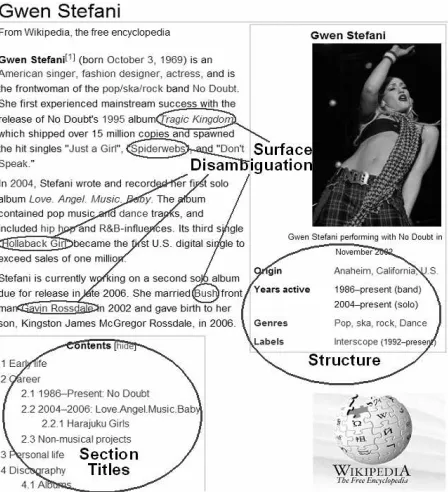
When creating a Wikipedia page and introducing a new entity, contributors can refer to other related Wikipedia entities, which may or may not have corresponding Wikipedia pages. This way of gen-erating content creates an internal web graph and, interesting, results in the presence of two different and pseudo-independent views for each entity. We can represent an entity using the content written on the entity page, or alternatively, using the context from a reference on the related page. For example, Figures 1 and 2 show the two independent views of the entity “Gwen Stefani”.
Figure 1. A partial list of contextual references taken
from Wikipedia for the named entity “Gwen Stefani”. (There are over 600 such references.)
1 such as ’Let Me Blow Ya Mind’ by Eve and [[Gwen Stefani]] (whom he would produce
2 In the video ”[[Cool (song)—Cool]]”, [[Gwen Stefani]] is made-up as Monroe.
3 ’[[South Side (song)—South Side]]’ (featuring [[Gwen Stefani]]) #14 US
4 [[1969]] - [[Gwen Stefani]], American singer ([[No Doubt]])
5 [[Rosie Gaines]], [[Carmen Electra]], [[Gwen Stefani]], [[Chuck D]], [[Angie Stone]],
6 In late [[2004]], [[Gwen Stefani]] released a hit song called ’Rich Girl’ which
7 [[Gwen Stefani]] - lead singer of the band [[No Doubt]], who is now a successful
8 [[Social Distortion]], and [[TSOL]]. [[Gwen Stefani]], lead vocalist of the [[alternative rock]]
9 main proponents (along with [[Gwen Stefani]] and [[Ashley Judd]]) in bringing back the
Figure 2. Wikipedia page for the named entity “Gwen
Stefani”. Other than the regular text, information such as surface and disambiguated entities, structure proper-ties, and section titles can be easily extracted.
We utilize this important observation to extract our features based on these two independent views: page-based features and context features. We dis-cuss these in greater detail next.
4.1 Page-Based Features
A typical Wikipedia page is usually written and edited by several contributors. Each page includes a rich set of information including the following elements: titles, section titles, paragraphs, multi-media objects, hyperlinks, structure data, surface entities and their disambiguations. Figure 2 shows some of these elements in the page dedicated to singer “Gwen Stefani”. We use the Wikipedia page XML syntax to draw a set of different page-based feature vectors, including the following:
Bag of Words (BOW): This vector is the term
frequency representation of the entire page.
Structured Data (STRUCT): Many Wikipedia
pages contain useful data organized in tables and other structural representations. In Figure 2, we see that contributors have used a table representation to list different properties about Gwen Stefani. We extract for each page, using the Wikipedia syntax, the bag-of-words feature vector that corresponds to this structured data only.
Figure 3. The abstract provided by Wikipedia for
“Gwen Stefani”. Note the concatenation of “Stefani” and “Some”, which results in a new word, and is a rele-vant example of noise encountered in Wikipedia text.
First Paragraph (FPAR): We examined several
hundred pages, and observed that a human could label most of the pages by reading only the first paragraph. Therefore, we built the feature vector that contains the bag-of-word representation of the page’s first paragraph.
Abstract (ABS): For each page, Wikipedia
pro-vides a summary of several lines about the entity described on the page. We use this summary to draw another bag-of-word feature vector based on the provided abstracts only. For example, Figure 3 shows the abstract for the entity “Gwen Stefani”.
Surface Forms and Disambiguations (SFD):
Contributors use the Wikipedia syntax to link from one entity page to another. In the page of Figure 2, for example, we have references to several other Wikipedia entities, such as “hip hop”, “R&B”, and “Bush”. Wikipedia page syntax lets us extract the disambiguated meaning of each of these references, which are “Hip hop music,” “Rhythm and blues,” and “Bush band”, respectively. For each page, we extract all the surface forms used by contributors in text (such as “hip hop”) and their disambiguated meanings (such as “Hip hop music”), and build feature vectors to represent them.
4.2 Context Features
Figure 1 shows some of the ways contributors to Wikipedia refer to the entity “Gwen Stefani”. The Wikipedia version that we analyzed contains about 35 million references to entities in the collection. On average, each page has five references to other entities.
We decided to make use of the text surrounding these references to draw contextual features, which can capture both syntactic and semantic properties of the referenced entity. For each entity reference, we compute the feature vectors by using a text window of three words to the left and to the right of the reference.
<abstract>
[image:4.612.74.298.71.317.2]BOW 1,821,966 ABS 372,909
SFD 847,857 BCON 35,178,120
[image:5.612.74.298.72.112.2]STRUCT 159,645 FPAR 781,938
Table 1. Number of features in each group, as obtained
by examining all the Wikipedia pages.
We derived a unigram context model and a bigram context model, following the findings of previous work that such models benefit from employing information about the position of words relative to the targeted term:
Unigram Context (UCON): The feature vector
is constructed in a way that preserves the positional information of words in the context. Each feature fti in the vector represents the total number of times a term t appears in position i around the entity.
Bigram Context (BCON): The bigram-based
context model was built in a similar way to UCON, so that relative positional information is preserved.
5
Challenges
For our classification task, we faced several challenges. First, many Wikipedia entities have only a partial list of the feature groups discussed above. For example, contributors may refer to enti-ties that do not exist in Wikipedia but might be added in the future. Also, not all the page-based features groups are available for every entity page. For instance, abstracts and structure features are only available for 68% and 79% of the pages, re-spectively. Second, we only had available several hundred labeled examples (as described in Section 6.1). Third, the feature space is very large com-pared to the typical text classification problem (see Table 1), and a substantial amount of noise plagues the data. A further investigation revealed that the difference in the dimensionality compared to text classification stems from the way Wikipedia pages are created: contributors make spelling errors, in-troduce new words, and frequently use slang, acro-nyms, and other languages than English.
We utilize all the features groups described in Section 4 and various combinations of them. This provides us with greater flexibility to use classifi-ers trained on different feature groups when Wikipedia entities miss certain types of features.
In addition, we try to take advantage of the inde-pendent views of each entity by employing a co-training procedure (Blum and Mitchell, 1998; Ni-gam and Ghani, 2000). In previous work, this has
been shown to boost the performance of the weak classifiers on certain feature groups. For example, it is interesting to determine whether we can use the STRUCT view of a Wikipedia pages to boost the performance of the classifiers based on context. Alternatively, we can employ co-training on the STRUCT and SFD features, hypothesized as two independent views of the data.
6
Experiments and Findings
6.1 Training Data
We experimented with two data sets: Human
Judged Data (HJD): This set was obtained in an
annotation effort that followed the guidelines pre-sented in Section 3. Due to the cost of the labeling procedure, this set was limited to a small random set of 800 Wikipedia pages. Human Judged Data
Extended (HJDE): The initial classification results
obtained using a small subset of HJD hinted to the need for more training data. Therefore, we devised a procedure that takes advantage of the fact that Wikipedia contributors have assigned many of the pages to one or more lists. For example, the page “List of novelists” contains a reference to “Orhan Pamuk”, which is part of the HJD and is labeled as PER. Our extension procedure first uses the pages in the training set from HJD to extract the lists in Wikipedia that contain references to them and then projects the entity labels of the seeds to all ele-ments in the lists. Unfortunately, not all the Wikipedia lists contain only references named enti-ties of the same category. Furthermore, some lists are hierarchical and include sub-lists of different classes. To overcome these issues, we examined only leaf lists and manually filtered all the lists that by definition could have pages of different catego-ries. Finally, we filtered out all list pages that con-tain entities in two or more entity classes (as de-scribed in Section 3).
PER MISC ORG LOC COMM
41% 25.1% 11.2% 11.7% 11%
Table 2. The distribution of labels in the HJDE data set.
Our extension procedure resulted initially in 770 lists, which were then reduced to 501. In step (5), we chose a maximal random sample from all la-beled pages in HJDE so that it matched the entity class distribution in the original HJD training set (shown in Table 2).
6.2 Classification
From the numerous machine learning algorithms available for our classification task (e.g., Joachims, 1999; Quinlan, 1993; Cohen, 1995), we chose to the SVMs (Vapnik, 1995), and the Naïve Bayes (John and Langley, 1995) algorithms because both can output probability estimates for their predic-tions, which are necessary for the co-training pro-cedure. We use an implementation of SVM (Platt, 1999) with linear kernels and the Naïve Bayes im-plementation from the machine learning toolkit Weka3. Our implementation of co-training fol-lowed that of Nigam and Ghani (2000).
Using the HJDE data, we experimented with learning a classifier for each feature group dis-cussed in Section 4. We report the results for two classification tasks: binary classification to identify all the Wikipedia pages of type PER, and 5-fold classification (PER, COM,ORG,LOC,and MISC). To reduce the feature space, we built a term fre-quency dictionary taken from one year’s worth of news data and restrict our feature space to contain only terms with frequency values higher than 10.
6.3 Results on Bag-of-words
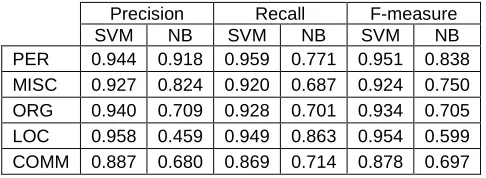
This feature group is of particular interest, since it has been widely used for document classification and also, because every Wikipedia page has a BOW representation. We experimented with the two classification tasks for this feature group. For the binary classification task, both SVM and Naïve Bayes performed remarkably well, obtaining accu-racies of 0.962 and 0.914, respectively. Table 3 shows detailed performance numbers for SVM and Naïve Bayes for the multi-class task. Unlike in the binary case, Naïve Bayes falls short of achieving results similar to those from SVM, which obtains an average F-measure of 0.928 and an average pre-cision of 0.931.
Precision Recall F-measure
SVM NB SVM NB SVM NB
PER 0.944 0.918 0.959 0.771 0.951 0.838
MISC 0.927 0.824 0.920 0.687 0.924 0.750
ORG 0.940 0.709 0.928 0.701 0.934 0.705
LOC 0.958 0.459 0.949 0.863 0.954 0.599
COMM 0.887 0.680 0.869 0.714 0.878 0.697
Table 3. Precision, recall, and F1 measure for the
multi-class multi-classification task. Results are obtained using SVM and Naïve Bayes after a stratified cross-validation using HJDE data set and the bag-of-words features.
SFD 83.14% ABS 68.96%
STRUCT 79.55% BCON 83.57%
Table 4. Percentage of available examples HJDE for
each feature group.
Precision Recall F-measure
SVM NB SVM NB SVM NB
BOW 0.901 0.858 0.894 0.880 0.897 0.869
SFD 0.851 0.775 0.830 0.882 0.840 0.825
STRUCT 0.888 0.840 0.875 0.856 0.881 0.848
FPAR 0.867 0.872 0.854 0.896 0.860 0.884
ABS 0.861 0.833 0.852 0.885 0.857 0.858
BCON 0.311 0.245 0.291 0.334 0.300 0.283
Table 5. Average precision, recall, and F1 measure
val-ues for the multi-class task. Results are obtained using SVM and Naïve Bayes across the different feature groups on the test set of HJDE.
6.4 Results on Other Feature Groups
[image:6.612.307.550.71.160.2]second and third best, with average F1 measure values of 0.881 and 0.860, respectively. The results also show that it is difficult to learn if a page is COMM in all learning combination. This could be related to the membership complexity of that class. Finally, the results on the bigram contextual fea-tures, namely BCON, for both SVM and Naïve Bayes are not encouraging and surprisingly low.
6.5 Results for Co-training
Motivated by the fact that some feature groups can be seen as independent views of the data, we used a co-training procedure to boost the classification accuracy. One combination of views that we exam-ined is BCON with BOW, hoping to boost the classification performance of the bigram context features, as this classifier could be used for entities in any new text, not only for Wikipedia pages . Unfortunately, the results were not encouraging in either of the cases (SVM and Naïve Bayes) and for none of the other feature groups used instead of BOW. This indicates that the context features ex-tracted have limited power and that further investi-gation of extracting relevant context features from Wikipedia is necessary.
7
Conclusions and Future Work
In this paper, we presented a study on the classifi-cation of Wikipedia pages with named entity labels. We explored several alternatives for extracting useful page-based and context-based features such as the traditional bag-of-words, page structure, hy-perlink text, abstracts, section titles, and n-gram contextual features. While the classification with page features resulted in high classification accu-racy, context-based and structural features did not work similarly well, either alone or in a co-training setup. This motivates future work to extract better such features. We plan to examine employing more sophisticated ways both for extracting contextual features and for using the implicit Wikipedia graph structure in a co-training setup.
Recently, the Wikipedia foundation has been taken steps toward enforcing a more systematic way to add useful structured data on each page by suggesting templates to use when a new page gets added to the collection. This suggests that in a not-so-distant future, we may be able to utilize the structured data features as attribute-value pairs
rather than as bags of words, which is prone to los-ing valuable semantic information.
Finally, we have applied our classifier to all Wikipedia pages to determine their labels and made these data available in the form of a Web service, which can positively contribute to future studies that employ the Wikipedia collection.
References
ACE Project. At
http://www.nist.gov/speech/history/in-dex.htm
Reuters-1997. 1997. Reuters-21578 text categorization test collection. At
http://www.daviddlewis.com/re-sources/testcollections/reuters21578
A. Blum and T. Mitchell. 1998. Combining labeled and unlabeled data with co-training. In Proceedings of
COLT’98, pages 92–100.
A. Borthwick, J. Sterling, E. Agichtein, and R. Grish-man. 1998. NYU: Description of the MENE named entity system as used in MUC. In Proceedings of
MUC-7.
R. Bunescu and M. Pasca. 2006. Using encyclopedic knowledge for named entity disambiguation. In
Pro-ceedings of EACL-2006, pages 9–16.
S. Chakrabarti, M.M. Joshi, K. Punera, and D.M. Pen-nock. 2002. The structure of broad topics on the web. In: Proceedings of WWW ’02, pages 251–262. W.W. Cohen. 1995. Fast effective rule induction. In
Proceedings of ICML’95.
S. Cucerzan. 2007. Large-Scale Named Entity Disam-biguation Based on Wikipedia Data. In Proceedings
of EMNLP-CoNLL 2007, pages 708–716.
S. Cucerzan and D. Yarowsky. 2002. Language Inde-pendent NER using a Unified Model of Internal and Contextual Evidence, in Proceedings of CoNLL 2002, pages 171–174.
W. Dakka and P. G. Ipeirotis. 2008. Automatic Extrac-tion of Useful Facet Terms from Text Documents. In
Proceedings of ICDE 2008 (to appear).
G. Doddington, A. Mitchell, M. Przybocki, L. Ramshaw, S. Strassel, and R. Weischedel. 2004. ACE pro-gram – task definitions and performance measures. In
Proceedings of LREC, pages 837–840.
S. Dumais, J. Platt, D. Heckerman, and M. Sahami. 1998. Inductive learning algorithms and representa-tions for text categorization. In Proceedings of
CIKM ’98, pages 148–155.
M. Fleischman and E. Hovy. 2002. Fine Grained Classi-fication of Named Entities. In Proceedings of
R. Florian, A. Ittycheriah, H. Jing, and T. Zhang, Named Entity Recognition through Classifier Com-bination, in Proceedings of CoNLL 2003, pages 168– 171.
E. Gabrilovich and S. Markovitch. 2004. Text categori-zation with many redundant features: using aggres-sive feature selection to make SVMs competitive with c4.5. In Proceedings of ICML ’04, page 41. E. Gabrilovich and S. Markovitch. 2006.
Overcoming-the brittleness bottleneck using Wikipedia: Enhanc-ing text categorization with encyclopedic knowledge. In Proceedings of AAI 2006.
R. Grishman and B. Sundheim. 1996. Message Under-standing Conference - 6: A brief history. In
Proceed-ings of COLING, 466-471.
T. Joachims. 1998. Text categorization with support vector machines: Learning with many relevant fea-tures. In Proceedings of ECML ’98, pages 137–142. T. Joachims. 1999. Making large-scale support vector
machine learning practical. Advances in kernel
meth-ods: support vector learning, pages 169–184.
G.H. John and P. Langley. 1995. Estimating continuous distributions in Bayesian classifiers. Proceedings of
the Eleventh Conference on Uncertainty in Artificial Intelligence, pages 338–345.
D. Klein, J. Smarr, H. Nguyen, and C. D. Manning. 2003. Named Entity Recognition with Character-Level Models, in Proceedings of CoNLL 2003. K. Lang. 1995. NewsWeeder: Learning to filter netnews.
In Proceedings of ICML’95, pages 331–339.
D. Mladenic. 1998. Feature subset selection in text learning. In Proceedings of ECML ’98, pages 95–100. K. Nigam and R. Ghani. 2000. Analyzing the
effective-ness and applicability of co-training. In Proceedings
of CIKM’00, pages 86–93.
S.E. Overell and S. Ruger. 2006. Identifying and grounding descriptions of places. In Workshop on
Geographic Information Retrieval, SIGIR 2006.
J.C. Platt. 1999. Fast training of support vector ma-chines using sequential minimal optimization.
Ad-vances in kernel methods: support vector learning,
pages 185–208.
M. Poe. 2006. The hive: Can thousands of wikipedians be wrong? How an attempt to build an online ency-clopedia touched off history’s biggest experiment in collaborative knowledge. The Atlantic Monthly, Sep-tember 2006.
J.R. Quinlan. 1993. C4.5: programs for machine
learn-ing. Morgan Kaufmann Publishers Inc.
M. Rogati and Y. Yang. 2002. High-performing feature selection for text classification. In Proceedings of
CIKM ’02, pages 659–661.
F. Sebastiani. 2002. Machine learning in automated text categorization. ACM Computing. Surveys, 34(1):1–47. F.M. Suchanek, G. Kasneci, and G. Weikum. 2007.
Yago: A Core of Semantic Knowledge. In
Proceed-ings of WWW 2007.
E.F. Tjong Kim Sang and F. De Meulder. 2003. Intro-duction to the CoNLL-2003 shared task: Language-independent named entity recognition. In
Proceed-ings of CoNLL-2003, pages 142–147.
E. F. Tjong Kim Sang. 2002. Introduction to the CoNLL-2002 shared task: Language-independent named entity recognition. In Proceedings of
CoNLL-2002, pages 155–158.
V.N. Vapnik. 1995. The nature of statistical learning theory. Springer-Verlag New York, Inc.
N. Wacholder., Y. Ravin, and M. Choi. 1997. Disam-biguation of proper names in text. In Proceedings of
ANLP’97, pages 202-208.
Y. Watanabe, M. Asahara, and Y. Matsumoto. 2007. A Graph-based Approach to Named Entity Categoriza-tion in Wikipedia using CondiCategoriza-tional Random Fields. In Proc. of EMNLP-CoNLL 2007, pages 649-657. Y. Yang and X. Liu. 1999. A re-examination of text
categorization methods. In Proceedings of SIGIR ’99, pages 42–49.
Y. Yang, S. Slattery, and R. Ghani. 2002. A study of approaches to hypertext categorization. Journal of.