Automatic Identification of Learners’ Language Background based on
their Writing in Czech
Katsiaryna Aharodnik
1, 2[email protected]
Marco Chang
1[email protected]
Anna Feldman
1[email protected]
Jirka Hana
3[email protected]
1Montclair State University, New Jersey, USA
2City University of New York, The Graduate Center, New York, USA 3 Charles University, MFF, Czech Republic
Abstract
The goal of this study is to investigate whether learners’ written data in highly inflectional Czech can suggest a consistent set of clues for automatic identification of the learners’ L1 background. For our experiments, we use texts written by learners of Czech, which have been automatically and manually annotated for errors. We define two clas-ses of learners: speakers of Indo-European guages and speakers of non-Indo-European lan-guages. We use an SVM classifier to perform the binary classification. We show that non-content based features perform well on highly inflectional data. In particular, features reflecting errors in orthography are the most useful, yielding about 89% precision and the same recall. A detailed dis-cussion of the best performing features is provid-ed.
1
Introduction
The role of a learner’s native language (L1) in second language (L2) acquisition has been widely discussed in the theories of Second Lan-guage Acquisition (SLA) (Lado, 1957; Rich-ards, 1971; Corder, 1975). The literature sug-gests that writers’ spelling, grammar and lexicon in second languages are often influenced by pat-terns in their native language. However, the ex-tent of the importance of L1 for acquiring L2 still cannot be determined exactly and remains a controversial topic of SLA research. Recently, the availability of learner corpora (e.g., Granger, 2003) has provided opportunities for verifying
SLA hypotheses. The previous literature sug-gests that the best performing features for native language identification are largely the features that rely on the content of the data, such as word n-grams, function words and character n-grams (Kochmar, 2011; Koppel et al., 2005; Tsur et al., 2007). This means that future applicability of these features is limited to corpus specific data. The primary goal of our work is to address this problem. We use only non-content based fea-tures, part-of-speech tags (POS) and error tags. Exploring these features is useful for corpora independent approaches to native language iden-tification. Our secondary goal is to analyze the features that perform best for highly inflectional data. We approach binary classification as the beginning step in the development of a system-atic tool for recognizing a specific L1 from morphologically complex L2 data. We use ma-chine learning techniques to identify features contributing to the classification between Indo-European (IE) and non-Indo-Indo-European (NIE) L1 backgrounds of learners of L2 Czech. We em-ploy Support Vector Machines (Joachims, 1999) to perform the classification. The results of the experiments show that the non-content based features, especially error tags, are the strongest indicators of the learners’ language background.
2
Related Work
identify the papers’ authors. They looked at function words as their features. There is plenty of work addressing authorship profiling for data in languages other than English, for instance Dutch, Greek and Arabic (Van Halteren, 2004; Stamatos et al., 2001; Estival et al., 2007).
For automatic native language identification researchers have been exploiting learner corpora (Koppel et al., 2005; Wong and Dras, 2009; Tsur et al., 2007; Kochmar, 2011). Several SLA theo-retical foundations have been taken as the basis for this task, for instance, the Contrastive Analy-sis HypotheAnaly-sis (CAH) (Lado, 1957). CAH posits that difficulties in second language learning are derived from the differences between the source and target languages. It is expected that the more similar L1 and L2 are, the acquisition of L2 is more natural for a learner, and fewer mistakes are made, or positive transfer takes place. At the same time, learners have more difficulties in ac-quiring L2 if there are more differences between the source and target languages, which results in negative transfer, or errors. Richards (1971) ad-dresses the nature of errors within the Error Analysis approach. He outlines interlingual and developmental types of errors. Developmental errors are common errors for any learner of a given L2, while interlingual errors are specific for each L1 or a group of L1s. Hence, interlingual errors should possess a discriminato-ry nature (Corder, 1975) and are of primadiscriminato-ry in-terest for the purpose of the native language identification.
In the search for empirical evidence, the re-searchers have looked at learners’ errors and other idiosyncrasies in non-native writings as cues to predict a learner’s native language and to conform to the above theoretical approaches as well as the phenomenon of language transfer in particular (Jarvis et al., 2012; Tsur et al., 2007). Koppel et al. (2005) look at 185 error types, in-cluding misspellings and syntactic errors as fea-tures. Besides errors, function words, character n-grams, and rare POS bigrams of non-standard English extracted from the Brown Corpus are used in the study. Koppel et al. (2005) experi-ment with essays from the International Corpus of Learner English in five source languages: Bulgarian, Czech, French, Russian and Spanish, and demonstrate that some types of errors are particularly useful for native language identifica-tion. Koppel et al. (2005) report slightly above 80% accuracy (with all features combined) com-pared to 20% baseline for 5-class classification. However, it is unclear from the study if the
utili-zation of error-based features would improve the performance with the same significance if taken on their own. We can only infer from the dia-gram in the paper that error features perform at slightly higher than 50% on their own and do not contribute significantly to the performance when combined with other features. Koppel et al. (2005) make valuable observations about func-tion words and character n-grams as the most discriminative features.
Wong and Dras (2009) explore the contribution of three syntactic errors to the same task: sub-ject-verb disagreement, noun-number disagree-ment and misuse of articles. The L1 backgrounds in the experiments are Bulgarian, Czech, French, Russian, Spanish, Chinese and Japanese. The accuracy obtained from classification based on these three features is 24.57% for multi-class classification. This, compared to the baseline of 14.29%, appears to be a significant improvement at the 95% confidence level. To achieve better results, the syntactic features are combined with function words, character grams and POS n-grams. The best accuracy is 73.71% using a combination of all the features. The results of this study demonstrate that the three syntactic errors do not contribute noticeably to classifica-tion if used without other features.
Tsur et al. (2007) investigate native language identification in the domain of phonology. Tsur et al. (2007) work with essays of Bulgarian, Czech, Russian, Spanish and French L1 back-grounds. The essays are taken from the Interna-tional Corpus of Learner English. Tsur et al. (2007) suggest that learners’ L1 has a strong effect on word choice in their L2 writings. The results of the classification, based only on char-acter bi-grams, yield an accuracy of 66% in a 5-class task. The results demonstrate that the learners’ choice of words when writing in a se-cond language is influenced by the phonology of their native language suggesting evidence for language transfer (Tsur et al., 2007).
this group is achieved for the combination of character tri-grams, POS n-grams and corpus derived error rates.
While the previous research widely exploits con-tent based features, in our work we evaluate the usability of non-content based features and show that these features are reliable cues for native language identification. Moreover, all the above studies focus on learners’ writings in English. In our work we investigate learner Czech data.
3
Experiments
3.1 Corpus
We use the Czech as a Second Language (CzeSL) (Hana et al., 2010; Jelinek et al., 2012; Rosen et al., 2013) corpus, a newly developed learner corpus of Czech. Czech is a West Slavic language that belongs to the Indo-European lan-guage family. It is a morphologically complex language with very rich derivational and inflec-tional morphology. It has seven noun cases, a complex declension and conjugation system, pronominal clitics and other morpho-syntactic structures, which all make the Czech language difficult for language learners. The CzeSL cor-pus is unique because it provides opportunities for a researcher to analyze learners’ linguistic output of a highly inflectional target language. The corpus consists of several sub-corpora, with a total of 2 million words.
Out of this, about 200K words are corrected and error annotated using a two level annotation scheme. The first layer corrects individual words disregarding their context, for example spelling errors. In addition to manually annotated tags, e.g., error in ending (incorInfl) or error in stem (incorBase), some tags are added automatically, e.g., missing vowel accent (formQuant0) or er-roneous character substitution (formSingCh). The second layer describes corrections within context that concern mostly morpho-syntactic and stylistic errors, e.g., the valency error (dep) includes noun declension and verb-noun agree-ment errors. For our purpose, we use both layers of annotation. The tagset is described in the an-notation manual (Štindlová et al., 2012), in addi-tion to the papers menaddi-tioned above.
Each document in the corpus is labeled with metadata information, including the author’s proficiency level and native language back-ground. The essays are encoded in the Prague Markup Language format.1
1 http://ufal.mff.cuni.cz/jazz/pml/
We report our findings for a binary classification between IE and NIE language backgrounds. We use 382 essays for lower intermediate (A2) and
38 essays for intermediate (B1) levels of profi-ciency. The essays are equally distributed among the language backgrounds within these levels. The essays are written on several topics, which are consistent throughout the groups. The topics include “My life in Prague”, “The best/worst day in my life” and “Holidays”, among several oth-ers. Every essay is written by a different author. 3.2 Native Speakers’ Predictions
Prior to implementing machine learning classifi-cation, we decided to conduct an experiment with native speakers of Czech using the same data. The motivation for this experiment is to see whether it is possible for a native speaker to pre-dict the learners’ IE vs. NIE language back-grounds based on their essays.
We asked 24 Czech native speakers with NLP and /or linguistic backgrounds to read the essays and make their predictions about the language background of the writers. To avoid content bias, we substituted all proper names of places with a capital X; and personal names with generic names across all essays, e.g., Eva and Pavel. There were a total of 76 essays to evaluate. An online questionnaire was created,3 where native
speakers read as many randomly assigned essays as they wanted and filled in the keys according to their predictions. The possible answers were “IE”, “NIE” and “unclear”. As the result of this experiment, an average accuracy of 55% was achieved. This result is only slightly better than the baseline of 50% for two-group classifica-tion.
The participants of our experiment all had some training in linguistics. This suggests that if the participants did not have any linguistic back-ground, their performance on the task would probably be even lower. Moreover, the essays could have still contained some contextual cues about the authors’ background, which might have triggered a higher result as well. The
2The CzeSL corpus is in final stages of development prior to public release. We used only those essays where we had access to all of: data itself, error annotation, morphological annotation and L1 metadata. We are planning to repeat the experiments, once there are more essays with such properties available.
3 Using the open-source system developed by Jan Štěpánek
ipants expressed their intuitions about the predic-tions. Specifically, they said they looked at the way the essays were written, the overall amount of errors. If an essay was written reasonably well the participants assumed that the author be-longed to the IE group of learners, and vice ver-sa. However, even having these intuitions in mind, our participants’ performance was only slightly better than chance.
Overall, the experiment provided interesting ob-servations and guided us towards a machine learning experiment.
3.3 SVM Classification Data representation
For this experiment, our first goal is to see whether machine learning techniques are able to categorize the same set of data at higher perfor-mance rates than human native speakers using non-content based features. Our second goal is to see whether the native speakers’ intuitions can be validated, specifically if it is the number of errors or other criteria that help to discriminate between the two classes.
We use the SVM-light classifier (Joachims, 1999). Each feature value is represented as a term weight of the feature, computed as a loga-rithmic ratio of the token frequency in the file to the total amount of tokens in the file.
S
ij= round (10× (1+log (tf
ij))/(1+log(l
j)))
Equation 1. The formula for computing the term weight of a feature where Sij is a term weight, tfij
is the number of occurrences of term i in docu-ment j, and ljis the length of the document. (Manning and Schuetze, 1999, p.580).
The feature set includes 264 most frequent POS bi-grams (3 or more occurrences in the data), 305 most frequent POS tri-grams and 35 error types extracted from the corpus. The total of POS n-grams for all essays amounts to 20,000. For error types, the total amount of error type tokens is 2000. After preprocessing, each essay is characterized by a vector with no more than 604 dimensions.
We report the classification results for the best performing parameters (C, γ) of the radial basis function (RBF) kernel SVM on the data set. Classification is performed by running the leave-one-out cross validation technique.
Results
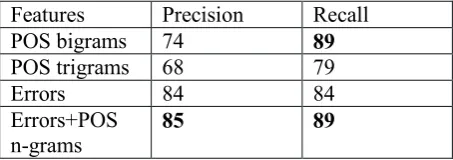
Our best modelis trained on a corpus that con-tains essays of the lower intermediate level of learners and receives 89% precision and the same recall using only orthographic types of er-rors as features. This is almost 40% higher than the baseline of 50% for the two-class classifica-tion. The precision and recall measures for each experiment are described in Tables 1-3.
Features Precision Recall POS bigrams 78 74 POS trigrams 70 74
Errors 70 78
Errors+POS
[image:4.595.300.527.206.287.2]n-grams 71 75
Table 1. Classifier performance on Level B1 (in-termediate) Czech
Features Precision Recall POS bigrams 70 74 POS trigrams 70 78
Errors 89 89
Errors+POS
n-grams 78 95
Table 2. Classifier performance on Level A2 (lower intermediate) Czech
Features Precision Recall POS bigrams 74 89 POS trigrams 68 79
Errors 84 84
Errors+POS
n-grams 85 89
Table 3. Classifier performance on Level A2 + Level B1 (combined) Czech
[image:4.595.296.528.335.415.2] [image:4.595.299.526.464.544.2]3.4 Classification experiment using error tags only
Following the native speakers’ intuitions from the experiment described in Section 3.2, we can assume that the discriminative power of errors should not be surprising; learners of Czech of a NIE language background are likely to make more errors than the learners of the IE group due to the differences between L1 and L2. However, we need to perform a more detailed error analy-sis to conform or disagree with these intuitions. The SVM classifier performs fairly well by us-ing only error tags as features. In this section, we further investigate the results of the previous experiment, considering each feature separately. To verify what error types are good markers for the two groups, we run additional classification experiments on each error-tag feature using the Weka implementation of the Naïve Bayes classi-fier (Witten et al., 2011). Naïve Bayes is a prob-ability-based classifier. It implements Bayes’ Theorem, the basic idea of which is the inde-pendence assumption, i.e. the presence or ab-sence of one feature does not depend on the presence or absence of another feature. Naïve Bayes is simple to implement and interpret. We perform the 10-fold cross-validation technique on each data set for this task. We report the pre-cision and F-measure which are calculated from the feature values normalized by total token amounts.
Results
The results of the Naïve Bayes classification ex-periments for both levels of proficiency are de-scribed in Table 4 and Table 5. The best per-forming features are shown in bold.
Table 4 displays the results for the intermediate level (B1) with morpho-syntactic and stylistic errors, the second layer in CzeSL. At this level, 5 errors out of 13 perform with precision and F-measure higher than 50%. These errors are the errors in valency (dep), errors in incorrect use of bookish, dialectal expressions and hypo-corrections (stylOther), misuse of grammatical forms (use), and odd constituent error (odd). The results suggest that these types of errors mostly contribute to the classification performance at this level.
Table 5 shows the results for the lower interme-diate level (A2), the first layer of corrections in CzeSL. This level contains corrections of word-level errors, often of orthographic character.
The errors that perform with precision and F-measure higher than 50% (6 out of 22) are miss-ing vowel accent (formQuant0), erroneous char-acter substitution (formSingCh), incorrect use of ‘i’ instead of ‘y’(formY0) (‘i’ and ‘y’ have the same pronunciation in Czech), incorrect use of ‘y’ instead of ‘i’ (form Y1), errors in inflections (incorInfl), and errors in stems (incorBase). We also calculate error scores in order to identi-fy which group (IE or NIE) tends to make more errors. The error scores are the ratios of the total frequency of an error type for all files to the total amount of errors in files.
The results of the Naïve Bayes classification suggest that depending on their nature, some er-rors contribute significantly to classification per-formance, but some have low discriminative power. For our purposes, these results are im-portant for further analysis of the variety in the performance of the errors.
4
Discussion
Our results demonstrate that written texts regard-less of the level of proficiency can be classified at 85% precision using non-content features, POS n-grams, and error tags combined. The re-sults show that error-based features of two levels combined demonstrate a high performance of 84% suggesting that error annotated written learner Czech data provide reliable cues for dis-tinguishing between the learners’ IE and NIE backgrounds. The results show 89% precision and the same recall for a lower intermediate lev-el (A2), which is annotated mostly for ortho-graphic errors. The errors at the intermediate level (B1) with error tags of morpho-syntactic and stylistic character perform lower, at 70% precision and 78% recall.
researchers (Tsur et al., 2007; Kochmar, 2011) that character n-grams extracted from learner data contribute significantly to classification per-formance. As Tsur et al. (2007) hypothesized, the learners’ choice of characters in L2 reflects the phonology of their L1. Although we do not specifically look at character n-grams, the better discriminating power of errors of orthographic nature achieved in our experiments might as well reflect spelling conventions of a specific L1 group. Thus, such errors are more likely to be learners’ L1 to L2 transfer errors.
[image:6.595.307.504.106.292.2]Below, we provide a more detailed error analysis to verify the nature of errors and possible rea-sons for their contribution to the performance. 4.1 Error Analysis
Table 4 describes the results for Level B1. Lexi-cal error (lex) shows 69% precision and 66% F-measure. These are lexicon or phraseology errors which occur, for instance, when learners misuse prepositions, choose false friends or false cog-nates instead of the correct variants. In the phrase dopadlo to přírodně the use of the adverb
přírodně in this context results in an error. The intention of the author is more likely to say ‘it ended naturally’, but the word přírodně means ‘naturally’ in a sense of nature/non-artifical. The error scores show that learners of the IE lan-guage background tend to make more errors of this type (19.9/11.5). IE learners might use false cognates in Czech more often because of the similarity between L1 and L2 languages, e.g., Russian and Polish.
Stylistic errors (stylOther) reflect stylistic dis-crepancies, such as misuse of bookish, dialectal forms, slang, and hyper-corrections. For in-stance, in the phrase pláči nad vejdělkem ‘be unhappy about the result’ the correct use will be
pláču nad vydelkem. There is a hypercorrection
in the use of pláči instead of pláču. These types of errors occur exclusively within the IE group of learners (5.4/0) and perform with the highest precision of 79% and F-measure of 59%. This result together with the observations made for the lex type of error suggests that the L1s which are closer related to Czech influence the produc-tion of the L2 in a less subtle way than more dis-tant languages. Specifically, the use of cognates in the incorrect context or use of incorrect stylis-tic variants might result in a transfer error in this case (Kroll et al., 2002).
The valency error (dep), e.g., using bojí se pes
instead of bojí se psa ‘he is scared of a dog’ (dog
is a direct object, thus accusative psa instead of nominative pes must be used) yields 61%
Error Type Precision F-measure
agr 46 42
dep 61 56
lex 69 66
miss 50 49
stylOther 79 59
use 64 64
odd 53 51
sec 50 49
rflx 19 19
stylCol 50 44
vbx 46 44
cvf 44 39
[image:6.595.308.503.340.647.2]ref 50 46
Table 4. Results of Naïve Bayes classification, Level B1.
Error Type Precision F-measure formCap1 50 41
formCaron0 43 42 formCaron1 46 42 formQuant0 76 73 formReduChar 56 45 formSingCh 74 70 formVoiced 40 37
formY0 70 55
formY1 81 65
incorBase 80 79 incoInfl 67 65
styCol 39 39
wbdOtherJnt 77 49
flex 64 47
formQuant1 50 47 formVoiced0 50 38
fwNc 36 35
fwFab 50 43
missChar 60 49 wbdPreSplit 41 36 formDiaE 41 36 formMeta 76 44
Table 5. Results of Naïve Bayes classification, Level A2.
[image:6.595.307.503.342.646.2]formed comparative, and singular instead of plu-ral among others. For instance, using včera bude sněžit ‘yesterday it will snow’ instead of včera sněžilo results in a verb tense error, future form
bude sněžit is used instead of the past
snežilo.The two errors above largely concern Czech morpho-syntax. Thus, greater differences between L1 and L2 grammatical structures might trigger a higher amount of errors within the NIE group. However, a more detailed analysis of er-ror distribution within each group and probably a larger data set are needed to investigate this claim.
The results for Level A2 are displayed in Table 5. The missing vowel accent (formQuant0) error occurs in such cases as incorrect vzpominám vs. correct vzpomínám, or doufam vs. doufám. This error type performs at 76% precision and 73% F-score. The erroneous character substitution error (formSingCh), e.g., incorrect otevrila vs. correct
otevrela or vezmíme vs. vezmeme, performs well at 74% precision and 70% F-measure. The error scores show that the NIE learners tend to make more errors of this type (6/11). Errors in inflec-tional endings (incoInfl), e.g., using plavám in-stead of plavu ‘I swim’(1Sg ending‘-ám’of one paradigm is used with a verb of another), per-form at 67% precision and 65% F-measure. Er-rors in stems (incorBase) e.g., using ditem in-stead of dítětem, discriminate rather well, at 80% precision and 79% F-measure. The two types of errors that describe incorrect use of ‘i’ and ‘y’ (formY0 and formY1, respectively) show high precision (70% and 81%) and F-measure (55% and 65%). The NIE learners make more errors of type Y0 (1.4/7.4), e.g., pražskích instead of
pražských, vipije vs. vypije, whereas
the IE group solely makes errors in the other type, Y1 (1.5/0), e.g., hlavným instead of
hlavním, líbyl vs. líbil. The above results suggest that learners might make some motivated spelling choices related to their L1 backgrounds (Jarvis et al., 2012; Tsur et al., 2007). For in-stance, speakers of Russian and Belarusian, IE group, would use the letter ‘y’ more often in the ending because it corresponds to the phonologi-cal equivalent of the letter ‘ы’ of the Cyrillic alphabet, e.g., главным in Russian will be a phonological equivalent of incorrect hlavným in Czech.
Our analysis of the best performing features shows that learners of both language back-grounds within each level of proficiency produce errors that discriminate well and vary in nature between IE and NIE learners. Thus, we cannot
strictly follow the intuition that the NIE learners make more errors, although these results might change with a larger number of learner essays. The error analysis at Level B1shows that the best performing morpho-syntactic errors occur more within the NIE group of learners, whereas errors of stylistic and lexical character discriminate better for the IE group compared to NIE within the same level of proficiency. From the analysis of Level A2, we can conclude that the learners’ L1 can be traced from some errors which pro-vides evidence for L1 to L2 transfer. At the same time, for other errors, it is impossible to identify their nature and group prevalence based on the data available.
Our results also suggest that a wide range of manually and automatically annotated error tags is a valuable venue to explore in the context of native language identification. Error-based fea-tures have been approached by other researchers as it is mentioned in Section 2. Koppel et al. (2005) use 185 error types, which do not appear to contribute significantly to the performance. Wong and Dras (2009) use only three features which do not improve the overall results, and do not perform as high as our error-based features on their own. Kochmar (2011) provides a very systematic error analysis and conducts a number of two-group classifications. Her results demon-strate that using character quad-grams achieves the highest precision of 100% for the Danish - Swedish group. However, the author points out that character quad-grams are likely to create content bias. In our case, tags are used for errors and a high result is achieved.
to use more prepositions and adverbs of time. If learners write about themselves, they tend to use personal pronouns. Argamon et al. (2009) de-scribe function words as the most effective fea-tures for the task. However, when interpreting their results, we should keep in mind that the results might be artifacts of topical bias, since the topics were not strictly controlled in this study.
4.2 SLA Implications
We believe that our results are important for SLA. In particular, the results provide empirical evidence for the different types of errors dis-cussed within the Error Analysis approach. We observe that some of the best performing errors occur when a learner’s L1 interferes and affects the production of L2. We suggest that some of the highly discriminative spelling errors at the lower intermediate level are likely to be transfer errors for both groups, in support of the obser-vations made by other researchers in regards to character n-grams. We also suggest that some stylistic errors are highly discriminative at the intermediate level within the IE group. At the same time, some of the errors that occur often within both IE and NIE groups might be devel-opmental, and at this point these observations are not completely evident. Further experiments with more fine-grained error annotation and lin-guistic analysis might provide better insights on whether the best performing errors are of interlingual or developmental character. Overall, our results suggest that native speakers of Indo-European and non-Indo-Indo-European languages ap-proach Czech differently, in their specific L1 background ways and make consistent types of errors across different linguistic levels, in partic-ular lexicon and orthography, based on our data.
5
Conclusions and Future Work
We have described several experiments in which we explore various features to distinguish be-tween two large language groups of learners, Indo-European and non-Indo-European. We have addressed non-content based features, and have shown that they work well for highly in-flectional data. Exploring non-content based fea-tures is important because it provides opportuni-ties for corpus independent approaches for native language identification. We have also discussed the best performing features and their contribu-tion to the task.
Section 4.2 discussed the implications of our work to the field of SLA, but this work has fur-ther applications. By knowing what typical er-rors L1 learners make, language instructors can concentrate on helping their students to erase their “non-native” footprints. Other applications include marketing research, automatic error-correction and grading applications.
Our results go along with similar observations made for learner English data, that data-driven machine learning approaches are valuable for verifying SLA hypotheses (Jarvis et al., 2012). In addition, we look at Czech as the target lan-guage, which has not been discussed in the con-text of language background identification thus far, to the best of our knowledge. Also, our data shed light on the acquisition of target languages with complex morphology.
As for the future directions of our work, we would like to develop methods to derive best performing error tags automatically. Further, we would like to perform experiments with larger sets of data and to compare the performance of features for other levels of proficiency. Ultimate-ly, we would like to develop a method that will be able to make more fine-grained distinctions between learners’ language backgrounds using non-content based features and pin down the actual native language of the learner based on this type of data.
Acknowledgements
We would like to thank the native speakers of Czech for their participation in our experiment and to Jan Štěpánek for tailoring his question-naire system to our needs. We would also like to thank Jing Peng and the anonymous reviewers for their comments.
This material is based in part upon work sup-ported by the Grant Agency of the Czech Repub-lic P406/10/P328 and National Science Founda-tion under Grant Numbers 0916280 and 1048406. Any opinions, findings and conclu-sions or recommendations expressed in this ma-terial are those of the authors and do not neces-sarily reflect the views of the National Science Foundation.
References
Stephen P. Corder. 1975. Error analysis, interlanguage and second language acquisition. Language Teaching, 8:201-218.
Dominique Estival, Tanja Gaustad, Son Bao Pham, Will Radford. 2007. TAT: An author profiling tool with application to Arabic emails. In Proceedings of the 5th Australasian Language Technology
Workshop, pages 21-30.
Sylviane Granger. 2003. The International Corpus of Learner English: A new resource for foreign language learning and teaching second language acquisition research. TESOL Quarterly, 37:538-546
Jirka Hana, Alexandr Rosen, Svatava Škodová, and Barbora Štindlová. 2010. Error-tagged Learner Corpus of Czech. In Proceedings of the Fourth Linguistic Annotation Workshop (LAW IV), Uppsa-la, pages 11-20.
Hans van Halteren. 2004. Linguistic profiling for author recognition and verification. In Proceedings of the 42nd Annual Meeting on Association for
Computational Linguistics (ACL’04), page 199-207.
Scott Jarvis and Scott A. Crossley, editors. 2012. Ap-proaching Language Transfer through Text Classi-fication: Explorations in the Detection-based Ap-proach. Multilingual Matters, UK, US, Canada. Tomáš Jelínek, Barbora Štindlová, Alexandr Rosen,
and Jirka Hana. 2012. Combining manual and au-tomatic annotation of a learner corpus. Text, Speech and Dialogue Lecture Notes in Computer Science, 7499:127-134.
Thorsten Joachims. 1998. Text categorization with Support Vector Machines: Learning with many relevant features. In Machine Learning: ECML -98, pages 137-142.
Thorsten Joachims. 1999. Making large-scale SVM learning practical. In Bernhard Schoelkopf and Christopher Burges and Alexander Smola, editors. Advances in Kernel Methods – Support Vector Learning, pages 169-185. MIT Press.
Ekaterina Kochmar. 2011. Identification of a writer’s native language by error analysis. Master of Phi-losophy Thesis. University of Cambridge, 2011. Moshe Koppel, Jonathan Schler, and Kfir Zigdon.
2005. Determining an author’s native language by mining a text for errors. In Proceedings of the Eleventh ACM SIGKDD International Conference on Knowledge Discovery and Data Mining, Chica-go, IL, pages 624-628.
Judith F. Kroll, Erica Michael, Natasha Tokowicz, and Robert Dufour. 2002. The development of lex-ical fluency in a second language. Second Lan-guage Research, 18:137-171.
Robert Lado. 1957. Linguistics across Cultures: Ap-plied Linguistics for Language Teachers. Universi-ty of Michigan Press, Ann Arbor, MI, US.
Christopher D. Manning and Hinrich Schuetze. 1999. Foundations of Statistical Natural Language Pro-cessing. MIT Press, Cambridge, MA, US.
F. Mosteller and D.L. Wallace. 1984. Applied Bayes-ian and Classical Inference in the Case of the Fed-eralist Papers (2nd edition). Springer Verlag, New
York.
Jack C. Richards. 1971. A non-contrastive approach to error analysis. ELT Journal, 25:204-219. Alexandr Rosen, Jirka Hana, Barbora Štindlová, and
Anna Feldman. 2013. Evaluating and automating the annotation of a learner corpus. Language Re-sources and Evaluation, 47:1-28.
Efstathios Stamatatos, Nikos Fakotakis, and George Kokkinakis. 2001. Computer-based authorship at-tribution without lexical measures. Computers and the Humanities, 35: 193-214.
Štindlová Barbora and Alexandr Rosen. 2012. Návod k anotaci chybového korpusu [Learner Corpus An-notation Manual]. Unpublished. http://utkl.ff.cuni.cz/~rosen/public/anotace.pdf Oren Tsur and Ari Rappoport. 2007. Using classifier
features for studying the effect of native language on the choice of written second language words. In Proceedings of the Workshop on Cognitive Aspects of Computational Language Acquisition, pages 9-16.
Ian H. Witten, Eibe Frank, and Mark A. Hall. 2011. Data Mining: Practical Machine Tools and Tech-niques. 3d Edition, Morgan Kaufmann, San Fran-cisco, 2011.
Sze-Meng Jojo Wong and Mark Dras. 2009. Contras-tive analysis and naContras-tive language identification. In Proceedings of the Australian Language Technol-ogy Association Workshop, pages 53-61.