Modeling Virtual Meetings within
Software Engineering Environment
Dr. Aiman Turani Applied Science University
Amman, Jordan [email protected] Dr. Ayman A. AbuBaker Applied Science University
Amman, Jordan [email protected]
Dr. Faiz Al-Shrouf Amman ArabUniversity
Amman, Jordan [email protected]
Abstract—It is a common scenario to see project’s stakeholders, such as managers, team leaders, and
developers carrying out their meeting in the online environment without a suitable preparation and facilitation For instance, stakeholders engaging in negotiation sessions trying to communicate system requirements in the virtual environment might face requirements misunderstanding which in turn might cause a whole project to fail. Usually a meeting agenda and design is implicit in the facilitator’s head. Conducting such meetings without obvious structure would potentially lead to various problems such as no one seemed to be in charge? Or there was no clear reason to meet or no agenda etc.
In this paper, we are presenting a general framework to model group-based activities and meetings within software engineering field in a simplified and formal manner. Traditionally, managers submit their web-based group meeting information in a form of text-based instructions [1]. Then a group facilitator or chairperson will lead the group throughout the meeting to achieve the desired objectives.
These types of meeting are relatively easy to manage in face-to-face environment where web based meeting in the other hand, is more challenging to facilitate and manage. Therefore, more and more specialized tools are immerging to manage and facilitate such meetings. For instance, Adobe Connect [2] is tool for facilitating web-based meetings. These tools usually allow facilitators to organize and prepare the meeting floor by inserting specific collaboration components such as chat, whiteboard, voting, etc. Then during the meeting the facilitator guides participants using the video or text component. This usually leads to undesirable outputs due to the lack of a clear structure or agenda in addition to the virtual distance that weakens the communication.
In this paper a two level of modeling views are proposed, the static view and the dynamic view. The static view mainly represents the aggregation association between session stages, phases, and activities. The dynamic view shows how meeting modules or elements within various activities are accessed during runtime. A particular modeling tool called “MEET-Represent” is being developed according to the proposed process in this paper to assist meetings designers to collaborate and model their meetings in advance to ensure the coherence and alignment of the meeting mini-tasks with the overall meeting objectives and goals.
Keywords-Software Engineering, Virtual Groups, Modelling, Meeting Design.
I. INTRODUCTION
As known, during software development there are many activities that need to be done by the project’s stakeholders. These activities are typically carried out in a sequential or parallel form [3] during the project’s life time cycle. A wide range of activities could be found. An activity could be reading software development artifacts, engaging in assigned individual task, or participating in various group-based meetings such as
brainstor mode and Model Software discipline [5]. This Neverthe proper m meetings according time caus Meetin complica meeting meeting i and tools systemati logical re numbers, should b abstract w In this creator n members himself, views. T implemen meeting. rming, voting, d ineffective w ling has its r e Engineering es to simplify s is usually do eless, there ha modeling meth s are reporting g to a specifie sing more dela
ngs preparati ated task due objectives, gr is an even mo s performed a ic form. Typic elationships b , to make it e e used. No s where only im s paper we are needs to defin s, group activi if he has the hese views co nt these desig , debating, et when perform roots in majo g, etc [4]. Rep y the descriptio one before th as been a little hod while de g serious pro ed time table, ays, jumping II. M ion and orga
to its diversi roup nature, ore challengin and used in a cally, modelin etween variou easier for man ingle view co mportant conce e introducing a ne the session ities, roles, as e required kno ould be used gns by realizin tc. These gro med on the onli
or disciplines, presenting a on of a system he implementa e evidence th esigning their blems such a communicatio in and out dur
MODELLING W anization with ity nature [6] assessment ty ng task. In one a virtual dista ng is a core co us entities. In nagers and de ould present e epts should be a general mod objectives. T signments, etc owledge, will as guideline ng these mod Figure 1: E oup meeting ine environme , such as Arc system using m while prese ation of a sys hat managers w r meetings es as, keeping pa on collagen w ring the meeti
WITHIN THE ME hin software . It may inclu ypes, individu e hand, the de ance, and in o omponent wit n addition, mo esigner to rem every design e represented. deling process Then he needs c. After that t l analyze thes during the m dels and diagr
E-Meeting Design are sometime ent. chitecture Eng g graphical no erving only a l
stem for bette within softwa specially with articipants fo where more th ing causing fu EETING DESIG engineering ude many int ual and group
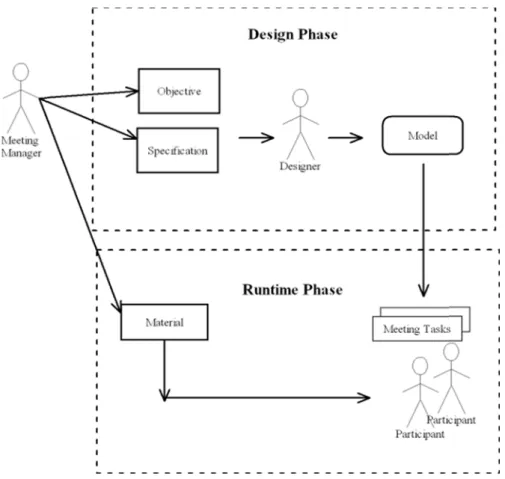
sign should re other hand it thin design ph odeling notatio member and u aspect or beh s as shown in s to state his d the meeting de se specificatio meeting time. rams into app
n Framework es costly whe gineering, Me otations has b limited numbe er understandi are engineerin hin the online cus on meetin an one person urther frustrati GN PHASE discipline is erconnected t p activities, et elate to a wide should be do hases. Modelin ons should be use. Also, dif havior. Finally
Figure 1. In th design specifi esigner, which ons and creat
Also speciali propriate supp en done in fa echanical Eng been adopted er of its origin ing and highe ng field are fo e environmen ng agenda, p n try to talk at ion, etc. s considered tasks, such as tc. Designing e spectrum of one in a simp ng should rep e limited to a fferent model ly, modeling this process a fications, such h could be the te a multiple ized applicati porting tools d ce-to-face gineering, d in many nal details er quality. ollowing a nt. These roceeding t the same to be a s defining g a virtual f activities lified and present the set of few ing views should be meeting’s h as group e manager modeling ons could during the
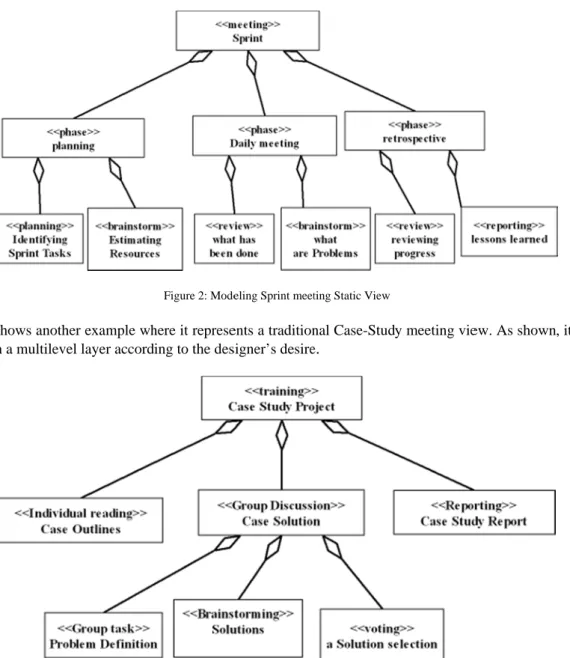
MEET has been Curre two type session e nature. T A. Static The granulari etc. A sta Figur modeled. identified meeting i As sh Figur “Retrosp Figure 3 detailed i T-Represent is proposed in t ently MEET-R es of views: S entities or no The Dynamic V c View Static view ity. At a high age is compos re 2 shows a S . Usually, eac d and estimat is usually don hown in re 2, each ph ective”, etc. shows anothe in a multileve s a graphical-b this paper. Represent incl Static view an des. The rela View describe
represents th her level, a se sed from differ Static View ex ch Sprint is p ted and also t ne where the p hase is assign er example wh l layer accord III. based modelin
ludes two typ nd Dynamic v ations’ type is es primary the he aggregation ssion is comp rent phases w xample where preceded by a the Sprint goa progress is rev
ed to specific
Figure 2: Mode
here it represe ding to the des
Figure 3: A
MEET-REPR
ng tool. This t es of views a view. The Sta s mainly the e paths and con
n association posed from di where each pha e a Sprint mee a planning m als are made. viewed and les c tasks. The
eling Sprint meet
ents a tradition signer’s desire
Activity phase Sta RESENT
toolis being b along with a s tic view repre
“include” rel nditions betw
n between se ifferent stages ase may includ eting within th meeting. In thi . At the end ssons for the n meeting phas
ting Static View
nal Case-Stud e.
atic Diagram
built according small set of gr esents the rela lation that rep een various se
ession nodes s, such as, pre de various reso he Agile devel
is meeting, ta of Sprint, a r next Sprint are se stereo-type y meeting vie g to the frame raphical notat ations betwee presents the ession nodes. at different e-session, pos ources and ac lopments proc asks for the S review or retr e identified. e could be “P ew. As shown ework that tions. The en various hierarchal levels of st-session, ctivities. cess [7] is Sprint are rospective Planning”, n, it can be
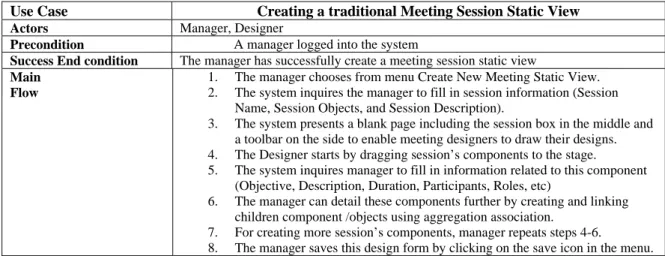
A detailed Use Case that explains how a meeting designer creates a traditional meeting static view within MEET-Represent is demonstrated in TABLE I.
TABLE I. Building a “Meeting Static View” Use Case
Use Case Creating a traditional Meeting Session Static View
Actors Manager, Designer
Precondition A manager logged into the system
Success End condition The manager has successfully create a meeting session static view
Main Flow
1. The manager chooses from menu Create New Meeting Static View. 2. The system inquires the manager to fill in session information (Session
Name, Session Objects, and Session Description).
3. The system presents a blank page including the session box in the middle and a toolbar on the side to enable meeting designers to draw their designs. 4. The Designer starts by dragging session’s components to the stage. 5. The system inquires manager to fill in information related to this component
(Objective, Description, Duration, Participants, Roles, etc)
6. The manager can detail these components further by creating and linking children component /objects using aggregation association.
7. For creating more session’s components, manager repeats steps 4-6.
8. The manager saves this design form by clicking on the save icon in the menu. Design Reusability can be archived by exporting and importing design details. Meet-Represent can generate automatically the session’s schema representing all elements and details included in the static view.
B. Dynamic View
Dynamic view shows how meeting modules or elements are accessed during runtime. The most common scenario is the linear style where participants finish one meeting component before moving to the next. The other type is the parallel style where more than one component is done concurrently.
MEET-Represent provides limited customization options for meeting designers. There are two common types of customization. The first type is the “Open-form”, where participants can access any component within the session. Secondly the “Restricted-form” where participants can access certain component only if a specific condition holds such as specific time, completion of other module, or facilitator permission.
The scenario for creating a dynamic view is presented in TABLE II. Any meeting phase that includes children tasks can have a dynamic view. If the designer did not specify the dynamic view, the system assumes the default view in which participants can access any task at any time without any restrictions.
TABLE II. Creating a “Meeting Dynamic View” Use Case
Use Case Creating a Meeting Dynamic View
Actors Designer
Precondition A designer logged into the system
A Meeting Static View was built
Success End condition The designer has successfully build a meeting dynamic view
Main Flow
1. The designer right-clicks within a meeting static view. 2. Chooses from sub-menu create a dynamic view.
3. The system presents on the sidebar all the children meeting tasks within the selected meeting phase.
4. The designer starts by dragging meeting tasks to the stage. 5. The designer connects these tasks using a link association.
6. The designer saves this design form by clicking on the save icon in the menu.
Alternative Flow
5-a The designer can specify a precondition regarding accessing meeting task by selecting an accessing rule.
6-a if not all meeting tasks are presented in the diagram, the system will present a warning message.
IV. CONCLUSIONS
The main objective behind this research was to define a modeling scheme that enables meeting managers to effectively engage in designing effective e-meetings within software development environment. Assuming that providing the most advanced communication tools will ensure a successful virtual meeting is a mistaken belief where many organizational managers are reporting serious frustration when conducting virtual informal
meetings with their employees. There are usually the risks that participants cannot start, get lost, or cannot reach the stated meeting’s objectives.
The process of designing and modeling is important specially in developing large-scale software products. We are developing a tool “MEET-Represent” as a proof of concept of such methodology. MEET-Represent supports multilevel of granularity, multiple views, Static and Dynamic view, and a high learnability curve where very few graphical notations are need. An early phase of evaluation indicates promising results such as better retention and faster tasks fulfillment. A full evaluation study will be conducted to verify targeted goals and objectives of this research. .
ACKNOWLEDGMENT
The authors are grateful to the Applied Science Private University, Amman, Jordan, for the financial support granted to cover the publication fee of this research article.
REFERENCES
[1] Sammi Chan, Alicia Cuello, Brian Kirk, Lara Procknow, Joy Smesny, Paul Trinh, “Web-Based Training” , Topic Report developed by
Wee-Go-Commando Group, 2013, from http://coursesite.uhcl.edu/BPA/bpa/training/Web-BasedTraining.doc
[2] Adobe. Retrieved 22 January 2014, from http://www.adobe.com/products/breeze/index.html. [3] Fan, Shaokun, "Electronic Dissertation," University of Arizona, 2013, from
http://arizona.openrepository.com/arizona/handle/10150/242374?mode=full&submit_simple=Show+full+item+record
[4] MAHONEY,MICHAEL S, "FINDING A HISTORY FOR SOFTWARE ENGINEERING ,"ANNALS OF THE HISTORY OF COMPUTING,IEEE,VOL. 26,2004, PP.8-19.
[5] R. Koper, "Modeling unit of study from a pedagogical perspective the pedagogical meta-model behind EML." Retrieved January 2014, from http://www.imsglobal.org/learningdesign/ldv1p0/imsld_infov1p0.html.
[6] Damian, D.E, " The impact of stakeholders' geographical distribution on managing requirements in a multi-site organization ", Requirements Engineering, 2002. Proceedings. IEEE, pp. 319 - 328.
[7] Schwaber, Ken; Beedle, Mike. Agile software development with Scrum. Prentice Hall. ISBN 0-13-067634-9, 2002. AUTHORS PROFILE
Aiman Turani received the BSc degree in electrical/ computer engineering from Louisiana Tech University, Louisiana, USA, in 1990, MSc degree in electrical/computer engineering from Louisiana Tech University, Louisiana, USA, in 1992. He finished his PhD from the Information Engineering School, Sydney University, in 2007. His research interests include synchronous collaborative and learning designs methods. He is currently working at the IT College of Electrical and Computer Engineering, Jordan.
Faiz Al-Shrouf received his Bsc from KSA University in Computer Science, Msc in Mathematical Statistics from Yarmouk University, and PhD in Software Engineering from University Science of Malaysia. He is currently working as an Assistant Professor at Faculty of IT at Amman ArabUniversity/Jordan. His main research interests: AgentOriented Engineering, Mobile Agents, Software Design Patterns, and MCommerce. Dr. Ayman A. Abubaker: Asst. Prof. at Electrical and Computer Engineering Department, Applied Science Private University, Amman-Jordan. He got his PhD in Electronic Imaging and Media Communications (EIMC) from University of Bradford-UK. His main interests are image processing, machine learning, and intelligent mobile robots.