A Re-examination of Dependency Path Kernels for Relation Extraction
Mengqiu Wang Computer Science Department
Stanford University
Abstract
Extracting semantic relations between enti-ties from natural language text is an impor-tant step towards automatic knowledge ex-traction from large text collections and the Web. The state-of-the-art approach to rela-tion extracrela-tion employs Support Vector Ma-chines (SVM) and kernel methods for classi-fication. Despite the diversity of kernels and the near exhaustive trial-and-error on ker-nel combination, there lacks a clear under-standing of how these kernels relate to each other and why some are superior than oth-ers. In this paper, we provide an analysis of the relative strength and weakness of several kernels through systematic experimentation. We show that relation extraction can bene-fit from increasing the feature space through convolution kernel and introducing bias to-wards more syntactically meaningful feature space. Based on our analysis, we propose a new convolution dependency path kernel that combines the above two benefits. Our experimental results on the standard ACE 2003 datasets demonstrate that our new ker-nel gives consistent and significantly better performance than baseline methods, obtain-ing very competitive results to the state-of-the-art performance.
1 Introduction
There exists a large body of knowledge embedded in unstructured natural language text on the Web. The sheer volume and heterogeneity of such knowledge renders traditional rule-based and manually-crafted knowledge extraction systems unsuitable. Thus it calls for methods that automatically extract knowl-edge from natural language text. An important step towards automatic knowledge discovery is to extract semantic relations between entities.
Two types of collections are commonly studied for relation extraction. The first type is annotated newswire text made available by programs such as Message Understanding Conferences (MUC) and Automatic Content Extraction (ACE). The types of entities that are of interest to these programs include person, organization, facilities, location and GPE (Geo-political entities). Given entities in a docu-ment, the relation extraction task is to identify ex-plicit semantic relationship such as Located-In and Citizen-Of between pairs of entities. For example, in the sentence “The funeral was scheduled for Thurs-day in Paris at the Saint-Germain-des-Pres Church”, the organization Saint-Germain-des-Pres Church is “Located-In” GPE Paris. The second type of collec-tion that has been widely studied is biomedical liter-ature (Bunescu and Mooney, 2005b; Giuliano et al., 2006; McDonald et al., 2005b), promoted by evalu-ation programs such as BioCreAtIvE and JNLPBA 2004. In this particular domain, studies often focus on specific entities such as genes and proteins. And the kinds of relations to extract are usually gene-to-protein interactions.
and Mooney, 2005b; Bunescu and Mooney, 2005a; Culotta and Sorensen, 2004; Cumby and Roth, 2003; Zelenko et al., 2003; Zhang et al., 2006a; Zhang et al., 2006b; Zhao and Grishman, 2005).
Despite the large number of recently proposed kernels and their reported success, there lacks a clear understanding of their relative strength and weak-ness. In this study, we provide a systematic com-parison and analysis of three such kernels — sub-sequence kernel (Bunescu and Mooney, 2005b), de-pendency tree kernel (Culotta and Sorensen, 2004) and dependency path kernel (Bunescu and Mooney, 2005a). We replicated these kernels and conducted experiments on the standard ACE 2003 newswire text evaluation set. We show that whereas some ker-nels are less effective than others, they exhibit prop-erties that are complementary to each other. In par-ticular, We found that relation extraction can benefit from increasing the feature space through convolu-tion kernel and introducing bias towards more syn-tactically meaningful feature space.
Drawn from our analysis, we further propose a new convolution dependency path kernel which combines the benefits of the subsequence kernel and shortest path dependency kernel. Comparing to the previous kernels, our new kernel gives consistent and significantly better performance than all three previous kernels that we look at.
2 Related Work
Statistical methods for relation extraction can be roughly categorized into two categories: feature-based and kernel-feature-based.
Feature-based methods (Jiang and Zhai, 2007; Kambhatla, 2004; Zhou et al., 2005) use pre-defined feature sets to extract features to train classifica-tion models. Zhou et al. (2005) manually crafted a wide range of features drawn from sources such as lexical, syntactic and semantic analyses. Com-bined with SVM, they reported the best results at the time on ACE corpus. Kambhatla (2004) took a similar approach but used multivariate logistic re-gression (Kambhatla, 2004). Jiang & Zhai (2007) gave a systematic examination of the efficacy of un-igram, bigram and trigram features drawn from dif-ferent representations — surface text, constituency parse tree and dependency parse tree.
One drawback of these feature-based methods is that the feature space that can be explored is often limited. On the other hand, kernel-based methods offer efficient solutions that allow us to explore a much larger (often exponential, or in some cases, in-finite) feature space in polynomial time, without the need to explicitly represent the features.
Lodhi et al. (2002) described a convolution string kernel, which measures the similarity between two strings by recursively computing matching of all possible subsequences of the two strings. Bunescu & Mooney (2005b) generalized the string kernel to work with vectors of objects occurred in relation ex-traction. In a later work also done by Bunescu & Mooney (2005a), they proposed a kernel that com-putes similarities between nodes on the shortest de-pendency paths that connect the entities. Their ker-nel assigns no-match to paths that are of different length. And for paths that are of the same length, it simply computes the product of the similarity score of node pairs at each index. The dependency tree kernel proposed by Zelenko et al. (2003) was also inspired by the string kernel of Lodhi et al. (2002). Their kernel walks down the parse trees from the root and computes a similarity score for children nodes at each depth level using the same subse-quence algorithm as the string kernel. Culotta & Sorensen (2004) worked on the same idea but ap-plied it to dependency parse trees. Prior to these two tree kernels, Collins & Duffy (2001) proposed a con-volution tree kernel for natural language tasks. Their kernel has since been applied to relation extraction by Zhang et al. (2006a). The tree kernel consid-ers matching of all subtrees that share the same production rule at the root of the subtree. Zhang et al. (2006a) showed results that are significantly better than the previous two dependency tree ker-nels. They obtained further improvements in their later paper (2006b) by composing the tree kernel with a simple entity kernel and raising the compos-ite kernel to polynomial degree 2. Another study on kernel composition is the work by Zhao & Grish-man (2005).
feel that there is a sense of increasing confusion down this line of research. Although partly due to the lack of compatibility in evaluation results, we believe it is more due to the lack of understanding in the relative strength and weakness of these kernels. Therefore we focus on analyzing and understanding the pros and cons of different kernels, through sys-tematic comparison and experimentation.
3 Kernel Methods for Relation Extraction
In this Section we first give a very brief introduc-tion to kernel methods. We then present the al-gorithms behind three kernels that we are particu-larly interested in: subsequence kernel (Bunescu and Mooney, 2005b), dependency tree kernel (Culotta and Sorensen, 2004) and shortest path dependency kernel (Bunescu and Mooney, 2005a).
3.1 SVM and Kernels
Support-Vector Machines (Cortes and Vapnik, 1995; Cristianini and Shawe-Taylor, 2000) learn to find hyperplanes that separate the positive and negative data points so that the margin between the support-vector points and the hyperplane is maximized. The dual formulation of the optimization problem in-volves only computing the dot product of feature vectors. This is equivalent to mapping the data points into a high dimensional space. And the sepa-rating plane learnt in the high dimensional space can give non-linear decision boundaries. The dot prod-uct of data points can be computed using a kernel function K(X, Y) = hφ(X), φ(Y)i for any map-ping function. A valid kernel function satisfies cer-tain properties: it is symmetric and the Gram matrix Gformed byK(X, Y)is positive semi-definite.
3.2 Subsequence Kernel
The subsequence kernel introduced in (Bunescu and Mooney, 2005b) is a generalization of the string kernel first introduced by Lodhi et al. (2002). The feature space of the original string kernel
Σstringkernel is defined as Σstringkernel = Σchar,
whereΣchar is simply a set of characters. Bunescu
& Mooney (2005a) re-defined the feature space to beΣx= Σ1×Σ2× · · · ×Σk, whereΣ1,Σ2,· · ·,Σk
can be some arbitray disjoint feature spaces, such as the set of words, part-of-speech (POS) tags, etc. We can measure the number of common features shared
by two feature vectors x, y ∈ Σx using function
c(x, y). Lets, tbe two sequences over the feature setΣx, we use|s|to denote the length ofs. Thuss
can be written out as s1· · ·s|s|. We use s[i : j]to
denote a continuous subsequencesi· · ·sj ofs. Let
i = (i1,· · ·, i|i|) be a sequence of |i| indices ins,
we define the length of the index sequence i to be l(i) = i|i|−i1 + 1. Similarly we have index se-quencejintof lengthl(j).
Let Σ∪ = Σ1 ∪Σ2∪ · · · ∪Σk be the set of all
possible features. A sequence u ∈ Σ∗∪ is a subse-quence of feature vector sesubse-quencesif there exists a sequence of|u|indicesi, such thatuk ∈ sik,∀k ∈
{1,· · ·,|u|}. Follow the notions in (Bunescu and Mooney, 2005b; Cumby and Roth, 2003), we use u ≺ s[i] as a shorthand for the above component-wise ‘∈’ relationship. Now we can define the kernel functionKn(s, t)to be the total number of weighted
common subsequence of lengthn between the two sequenecessandt.
Kn(s, t) = X
u∈Σn ∪
X
i:u≺s[i]
X
j:u≺t[j]
λl(i)+l(j) (1)
whereλis a decaying factor≤ 1, penalizing long, sparse subsequence. We can re-write this kernel function as
Kn(s, t) = X
i:|i|=n X
j:|j|=n n Y
k=1
c(sik, tjk)λ l(i)+l(j)
(2)
(Bunescu and Mooney, 2005b) showed that us-ing the recursive dynamic programmus-ing algorithm from (Cumby and Roth, 2003), the kernelKn(s, t)
can be computed inO(kn|s||t|)time.
3.3 From Subsequence to Tree Kernels
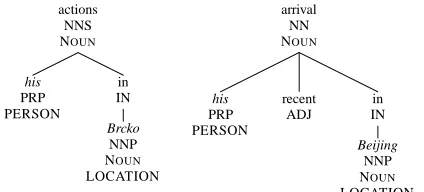
actions NNS NOUN
his
PRP PERSON
in IN
Brcko
NNP NOUN
LOCATION
arrival NN NOUN
his
PRP PERSON
recent ADJ
in IN
Beijing
NNP NOUN
LOCATION
The entities in these two relations are the pro-noun mentions of “his”, and two locations “Br-cko” and ”Beijing”, all shown in italic. The de-pendency tree kernel visits nodes in the two trees starting from the root. And at each depth level, it takes nodes that are at that level and form two se-quences of nodes. For example, in the example in-stances, nodes at one level below the root forms vectors s=h{his, PRP, PERSON},{in, IN}i and t=h{his,PRP,PERSON},{recent, ADJ},{in, IN}i. It then makes use of the subsequence kernel in the previous section to compute the total number of weighted subsequences between these two vectors. The kernel returns the sum of subsequence match-ing scores at each depth level as the final score.
3.4 Shortest Path Dependency Kernel
The shortest path dependency kernel proposed by Bunescu & Mooney (2005a) also works with depen-dency parse trees. Reuse our example in the previ-ous section, the shortest dependency path between entity his and Brcko in the first sentence is s=h{his, PRP, PERSON},{actions, NNS, NOUN},{in, IN},
{Brcko, NNP, NOUN, LOCATION}i; and the path between his and Beijing in the second sentence is t=h{his, PRP, PERSON}, {arrival, NN, NOUN},
{in, IN}, {Beijing, NNP, NOUN, LOCATION}i. Since most dependency parser output connected trees, finding the shortest path between two nodes is trivial. Once the two paths are found, the kernel simply computes the product of the number of com-mon features between a pair of nodes at each index along the path. If the two paths have different num-ber of nodes, the kernel assigns 0 (no-match) to the pair. Formally, the kernel is defined as:
K(s, t) =
0, if|s| 6=|t|
Qn
i=1c(si, ti), if|s|=|t|
(3)
[image:4.612.76.288.76.172.2]5-fold CV on ACE 2003 kernel method Precision Recall F1 subsequence 0.703 0.389 0.546 dependency tree 0.681 0.290 0.485 shortest path 0.747 0.376 0.562
Table 1: Results of different kernels on ACE 2003 training set using 5-fold cross-validation.
4 Experiments and Analysis
We implemented the above three kernels and con-ducted a set of experiments to compare these ker-nels. By minimizing divergence in our experiment setup and implementation for these kernels, we hope to reveal intrinsic properties of different kernels.
4.1 Experiment setup
We conducted experiments using the ACE 2003 standard evaluation set. Training set of this collec-tion contains 674 doc and 9683 relacollec-tions. The test set contains 97 doc and 1386 relations. 5 entity types (Person, Organization, Location, Facilities and Geo-political Entities) and 5 top-level relation types (At, Near, Part-of, Role and Social) are manually anno-tated in this collection. Since no development set is given, we report results in this section only on the training set, using 5-fold cross-validation, and de-fer the comparison of results on the test set till Sec-tion 6. Corpus preprocessing is done as the follow-ing: sentence segmentation was performed using the tool from CCG group at UIUC1; words are then to-kenized and tagged with part-of-speech using MX-POST (Ratnaparkhi, 1996) and dependency parsing is performed using MSTParser (McDonald et al., 2005a). We used the SVM-light (Joachims, 2002) toolkit and augmented it with our custom kernels. SVM parameters are chosen using cross-validation (C=2.4), and the decaying factor in all kernels are uniformally set to be 0.75. We report precision (P), recall (R) and F-measure (F) on the training (5-fold cross-validation) and test set.
4.2 Comparison of Kernels
In table 1 we listed results of the above three kernels on the training set using 5-fold cross-validation. A
1
http://l2r.cs.uiuc.edu/∼cogcomp/atool.
first glimpse of the results tells us that the shortest path kernel performs the best in terms of F-measure, while the dependency tree kernel did the worst. The performance of subsequence kernel is not as good as the dependency path kernel, but the difference is small. In particular, the subsequence kernel gave the best recall, whereas the dependency path kernel gave the highest precision.
To understand why shortest path kernel performs better than the subsequence kernel, let us review the definition of these two kernels. The subsequence kernel considers all subsequences of feature vector sequences that are formed by all words occurred in-between two entities in a sentence; while the shortest path kernel only considers feature vector sequences formed by words that are connected through a de-pendency path. In general, the sequences consid-ered in the dependency path kernel are more com-pact than the sequences used in the subsequence ker-nel. Actually, in most cases the dependency path se-quence is indeed one particular subsese-quence of the entire subsequence used in subsequence kernel. Ar-guably, this particular subsequence is the one that captures the most important syntactic information. Although the feature spaces of the dependency path kernels are not subsets of the subsequence kernel, we can clearly see that we get higher precisions by introducing bias towards the syntactically more meaningful feature space.
However, the dependency path kernel is fairly rigid and imposes many hard constraints such as re-quiring the two paths to have exactly the same num-ber of nodes. This restriction is counter-intuitive. To illustrate this, let us reconsider the example given in Section 3. In that example, it is obviously the case that the two instances of relations have very similar dependency path connecting the entities. However, the second path is one node longer than the first path, and therefore the dependency path kernel will de-clare no match for them. The subsequence kernel, on the other hand, considers subsequence matching and therefore inherently incorporates a notion of fuzzy matching. Furthermore, we have observed from the training data that many short word sequences carry strong relational information; hence only part of the entire dependency path is truly meaningful in most cases. It also helps to understand why subsequence kernel has better recall than dependency path kernel.
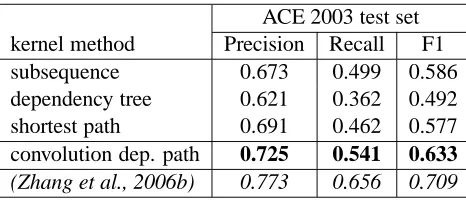
[image:5.612.314.547.70.171.2]ACE 2003 test set kernel method Precision Recall F1 subsequence 0.673 0.499 0.586 dependency tree 0.621 0.362 0.492 shortest path 0.691 0.462 0.577 convolution dep. path 0.725 0.541 0.633 (Zhang et al., 2006b) 0.773 0.656 0.709
Table 2: Results on the ACE 2003 test set. We ref-erence the best-reported score (in italic) on this test set, given by (Zhang et al., 2006b)
The disappointing performance of the depen-dency tree kernel can also be explained by our anal-ysis. Although the dependency tree kernel performs subsequence matching for nodes at each depth level, it is unclear what the relative syntactic or semantic relation is among sibling nodes in the dependency tree. The sequence formed by sibling nodes is far less intuitive from a linguistic point of view than the sequence formed by nodes on a dependency path.
To summarize the above results, we found that de-pendency path kernel benefits from a reduction in feature space by using syntactic dependency infor-mation. But the subsequence kernel has an edge in recall by allowing fuzzy matching and expanding the feature space into convolution space. We will show in the following section that these two benefits are complementary and can be combined to give better performance.
5 Combining the Benefits – A New Kernel
It is a natural extension to combine the two bene-fits that we have identified in the previous section. The idea is simple: we want to allow subsequence matching in order to gain more flexibility and there-fore higher recall, but constrain the sequence from which to deduce subsequences to be the dependency path sequence. We call the combined kernel a “con-volution dependency path kernel”.
6 Final Test Results
the test set as cross-validation on training set. There is one exception that the shortest path kernel’s F-measure score is no longer better than the subse-quence kernel on the test set, but the difference is small. And our new convolution dependency path kernel beats all above three kernels in precision, re-call and F-measure, suggesting that our analysis is accurate and the benefits we outlined are truly com-plementary.
Comparing to the best reported results on the same test set from (Zhang et al., 2006b), our scores are not as high, but the results are quite competitive, given our minimum efforts on tuning kernel param-eters and trying out kernel combinations.
7 Conclusion
We re-examined three existing kernel methods for relation extraction. We conducted experiments on the standard ACE 2003 evaluation set and showed that whereas some kernels are less effective than others, they exhibit properties that are complemen-tary to each other. In particular, we found that rela-tion extracrela-tion can benefit from increasing the fea-ture space through convolution kernel and introduc-ing bias towards more syntactically meanintroduc-ingful fea-ture space. Drawn from our analysis, we proposed a new convolution dependency path kernel which combines the benefits of the subsequence kernel and shortest path dependency kernel. Comparing with previous kernels, our new kernel consistently and significantly outperforms all three previous kernels, suggesting that our analyses of the previously pro-posed kernels are correct.
References
R. C. Bunescu and R. J. Mooney. 2005a. A shortest path dependency kernel for relation extraction. In
Proceed-ings of HLT/EMNLP.
R. C. Bunescu and R. J. Mooney. 2005b. Subsequence kernels for relation extraction. In Proceedings of
NIPS.
M. Collins and N. Duffy. 2001. Convolution kernels for natural language. In Proceedings of NIPS.
C. Cortes and V. Vapnik. 1995. Support-vector networks.
Machine Learning, 20(3):273–297.
N. Cristianini and J. Shawe-Taylor. 2000. An
Introduc-tion to Support-vector Machines. Cambridge
Univer-sity Press.
A. Culotta and J. Sorensen. 2004. Dependency tree ker-nels for relation extraction. In Proceedings of ACL.
C. M. Cumby and D. Roth. 2003. On kernel methods for relation learning. In Proceedings of ICML.
C. Giuliano, A. Lavelli, and L. Romano. 2006. Ex-ploiting shallow linguistic information for relation ex-traction from biomedical literature. In Proceedings of
EACL.
J. Jiang and C. Zhai. 2007. A systematic exploration of the feature space for relation extraction. In
Proceed-ings of NAACL-HLT.
T. Joachims. 2002. Learning to Classify Text Using
Sup-port Vector Machines. Ph.D. thesis, Universit¨’at
Dort-mund.
N. Kambhatla. 2004. Combining lexical, syntactic and semantic features with maximum entropy models for extracting relations. In Proceedings of ACL.
H. Lodhi, C Saunders, J. Shawe-Taylor, N. Cristianini, and C Watkins. 2002. Text classification using string kernels. JMLR, 2:419–444.
R. McDonald, K. Crammer, and F. Pereira. 2005a. On-line large-margin training of dependency parsers. In
Proceedings of ACL.
R. McDonald, F. Pereira, S. Kulick, S. Winters, Y. Jin, and P. White. 2005b. Simple algorithms for complex relation extraction with applications to biomedical ie. In Proceedings of ACL.
A. Ratnaparkhi. 1996. A maximum entropy part-of-speech tagger. In Proceedings of EMNLP.
D. Zelenko, C. Aone, and A. Richardella. 2003. Kernel methods for relation extraction. JMLR, 3:1083–1106.
M. Zhang, J. Zhang, and J. Su. 2006a. Exploring syntac-tic features for relation extraction using a convolution tree kernel. In Proceedings of NAACL-HLT.
M. Zhang, J. Zhang, J. Su, and G. Zhou. 2006b. A com-posite kernel to extract relations between entities with both flat and structured features. In Proceedings of
ACL.
S. Zhao and R. Grishman. 2005. Extraction relations with integrated information using kernel methods. In
Proceedings of ACL.
G. Zhou, S. Jian, J. Zhang, and M. Zhang. 2005. Ex-ploring various knowledge in relation extraction. In