An Effective Compositional Model for Lexical Alignment
B´eatrice Daille Emmanuel Morin Universit´e de Nantes, LINA - FRE CNRS 2729
2, rue de la Houssini`ere, BP 92208 F-44322 Nantes cedex 03
beatrice.daille,emmanuel.morin @univ-nantes.fr
Abstract
The automatic compilation of bilingual dic-tionaries from comparable corpora has been successful for single-word terms (SWTs), but remains disappointing for multi-word terms (MWTs). One of the main problems is the insufficient coverage of the bilingual dic-tionary. Using the compositional translation method improved the results, but still shows some limits for MWTs of different syntac-tic structures. In this paper, we propose to bridge the gap between syntactic structures through morphological links. The results show a significant improvement in the com-positional translation of MWTs that demon-strate the efficiency of the morphologically based-method for lexical alignment.
1 Introduction
Current research in the automatic compilation of bilingual dictionaries from corpora uses of compara-ble corpora. Comparacompara-ble corpora gather texts shar-ing common features (domain, topic, genre, dis-course) without having a source text-target text re-lationship. They are considered by human transla-tors more trustworthy than parallel corpora (Bowker and Pearson, 2002). Moreover, they are available for any written languages and not only for pairs of lan-guages involving English. The compilation of spe-cialized dictionaries should take into account multi-word terms (MWTs) that are more precise and spe-cific to a particular scientific domain than single-word terms (SWTs). The standard approach is based
on lexical context analysis and relies on the simple observation that a SWT or a MWT and its trans-lation tend to appear in the same lexical contexts. Correct results are obtained for SWTs with an ac-curacy of about 80% for the top 10-20 proposed candidates using large comparable corpora (Fung, 1998; Rapp, 1999; Chiao and Zweigenbaum, 2002) or 60% using small comparable corpora (D´ejean and Gaussier, 2002). In comparison, the results ob-tained for MWTs are disappointing. For instance, (Morin et al., 2007) have achieved 30% and 42% precision for the top 10 and top 20 candidates in a 0.84 million-word French-Japanese corpus. These results could be explained by the low frequency of MWTs compared to SWTs, by the lack of paral-lelism between the source and the target MWT ex-traction systems, and by the low performance of the alignment program. For SWTs, the process is in two steps: looking in a dictionary, and if no direct translation is available, starting the contextual anal-ysis. Looking in the dictionary gives low results for MWTs: 1% compared to 30% for French and 20% for Japanese SWTs (Morin and Daille, 2006). To ex-tend the coverage of the bilingual dictionary, an in-termediate step is added between looking in the dic-tionary and the contextual analysis that will propose several translation candidates to compare with the target MWTs. These candidate translations are ob-tained thanks to a compositional translation method (Melamed, 1997; Grefenstette, 1999). This method reveals some limits when MWTs in the source and the target languages do not share the same syntactic patterns.
compo-sitional method that bridges the gap between MWTs of different syntactic structures through morpho-logical links. We experiment within this method of French-Japanese lexical alignment, using multi-lingual terminology mining chain made up of two terminology extraction systems; one in each lan-guage, and an alignment program. The term extrac-tion systems are publicly available and both extract MWTs. The alignment program makes use of the direct context-vector approach (Fung, 1998; Rapp, 1999). The results show an improvement of 33% in the translation of MWTs that demonstrate the effi-ciency of the morphologically based-method for lex-ical alignment.
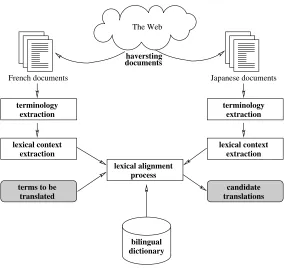
2 Multilingual terminology mining chain Taking a comparable corpora as input, the multi-lingual terminology mining chain outputs a list of single- and multi-word candidate terms along with their candidate translations (see Figure 1). This chain performs a contextual analysis that adapts the direct context-vector approach (Rapp, 1995; Fung and McKeown, 1997) for SWTs to MWTs. It con-sists of the following five steps:
1. For each language, the documents are cleaned, tokenized, tagged and lemmatized. For French, Brill’s POS tagger1and the FLEM lemmatiser2 are used, and for Japanese, ChaSen3. We then extract the MWTs and their variations using the ACABITterminology extraction system
avail-able for French4 (Daille, 2003), English and Japanese5 (Takeuchi et al., 2004). (From now on, we will refer to lexical units as words, SWTs or MWTs).
2. We collect all the lexical units in the context of each lexical unit and count their occurrence frequency in a window of words around . For each lexical unit of the source and the target languages, we obtain a context vector
1http://www.atilf.fr/winbrill/
2http://www.univ-nancy2.fr/pers/namer/ 3http://chasen-legacy.sourceforge.jp/ 4http://www.sciences.univ-nantes.fr/
info/perso/permanents/daille/ and release for Mandriva Linux.
5http://cl.cs.okayama-u.ac.jp/rsc/
jacabit/
which gathers the set of co-occurrence units
associated with the number of times that and occur together
. In order to iden-tify specific words in the lexical context and to reduce word-frequency effects, we normal-ize context vectors using an association score such as Mutual Information (Fano, 1961) or Log-likelihood (Dunning, 1993).
3. Using a bilingual dictionary, we translate the lexical units of the source context vector. If the bilingual dictionary provides several transla-tions for a lexical unit, we consider all of them but weigh the different translations by their fre-quency in the target language.
4. For a lexical unit to be translated, we com-pute the similarity between the translated con-text vector and all target vectors through vector distance measures such as Cosine (Salton and Lesk, 1968) or Jaccard (Tanimoto, 1958).
5. The candidate translations of a lexical unit are the target lexical units closest to the translated context vector according to vector distance.
dictionarybilingual
Japanese documents French documents
terminology
extraction terminologyextraction
lexical context
extraction lexical contextextraction
process
translated terms to be
translationscandidate haversting
lexical alignment
The Web
documents
Figure 1: Architecture of the multilingual terminology mining chain
3 Default compositional method
In order to increase the coverage of the dictionary for MWTs that could not be directly translated, we gen-erated possible translations by using a default com-positional method (Melamed, 1997; Grefenstette, 1999).
For each element of the MWT found in the bilin-gual dictionary, we generated all the translated com-binations identified by the terminology extraction system. For example, for the French MWTfatigue chronique(chronic fatigue), there are four Japanese translations forfatigue(fatigue) – , , ,
– and two translations forchronique(chronic) – , . Next, we generated all possi-ble combinations of the translated elements (see Ta-ble 16) and selected those which refer to an existing MWT in the target language. In the above example, only one term for each element was identified by the Japanese extraction system: . In this ap-proach, when it is not possible to translate all parts of an MWT, or when the translated combinations are not identified by the extraction system, the MWT is
6The French word order is reversed to take into account the different constraints between French and Japanese.
not taken into account in the translation step.
chronique fatigue
!"
!" !
!
!"
!"
#
#
Table 1: Illustration of the compositional method (the underlined Japanese MWT actually exists)
example, the French MWT syndrome de fatigue chronique(chronic fatigue disorder) yields the fol-lowing four combinations: i) $syndrome de fatigue chronique%, ii)$syndrome de fatigue%&$chronique%, iii)
$syndrome%'$fatigue chronique% and iv) $syndrome%
$fatigue%($chronique%. We limit ourselves to the com-bination of type iv) above since 90% of the French candidate terms provided by the term extraction pro-cess after clustering are only composed of two con-tent words.
4 Pattern switching
The compositional translation presents problems which have been reported by (Baldwin and Tanaka, 2004; Brown et al., 1993):
Fertility SWTs and MWTs are not translated by a term of a same length. For instance, the French SWThypertension(hypertension) is translated by the Japanese MWT )"* + (here the kanji
) (taka) meanshighand the term*+ ( ketsu-atsu) meansblood pressure).
Pattern switching MWTs in the source and the tar-get language do not share the same syntactic patterns. For instance, the French MWT cel-lule graisseuse(fat cell) ofN ADJstructure is translated by the Japanese MWT, -/./0 of
N N structure where the French noun cellule is translated by the Japanese noun .10 ( sai-boo - cellule - cell) and the French adjective graisseuseby the Japanese noun , - (shiboo -graisse-fat).
Foreign name When a proper name is part of the MWT, it is not always translated: within the French MWT syndrome de Cushing ( Cush-ing syndrome), Cushing is either transliterated
2346587:9<;<=
or remains unchanged Cushing9";=
. The foreign nameCushingis of course not present in the dictionary.
The pattern switching problem involves the Ad-jective/Noun and the Noun/Verb part-of-speech switches. The Adjective/Noun switch commonly involves a relational adjective (ADJR). According to grammatical tradition, there are two main cate-gories among adjectives: epithetic adjectives such as important (significant) and relational adjectives
such as sanguin (blood). The former cannot have an agentive interpretation in contrast to the lat-ter: the adjectivesanguin (blood) within the MWT acidit´e sanguine (blood acidity) is an argument to the predicative noun acidit´e (acidity) and this is not the case for the adjectiveimportant(significant) within the noun phrase acidit´e importante ( signifi-cant acidity). Such adjectives hold a naming func-tion (Levi, 1978) and are particularly frequent in sci-entific fields (Daille, 2001). Relational adjectives are either denominal adjectives, morphologically de-rived from a noun thanks to a suffix, or adjectives having a noun usage such asmath´ematique( mathe-matical/mathematics). For the former, there are ap-propriate adjective-forming suffixes for French that lead to relational adjectives such as-ique,-aire,-al. For a noun, it is not possible to guess the adjective-forming suffix that will be employed as well as the alternation of the noun stem that could occur. Re-lational adjectives part of a MWT are often trans-lated by a noun whatever the target language is. From French to Japanese, the examples are numer-ous:prescription m´edicamenteuse(>?!@ - medic-inal prescription),surveillance glyc´emique(*"A!B
C
- glycemic monitoring), fibre alimentaire (DE F!G
-dietary fibre),produit laitier(H:I1J -dairy product),fonction r´enale (K!L MN - kidney func-tion).
The problem of fertility could only be solved thanks to a contextual analysis in contrast to the foreign name problem that could be solved by an heuristic. We decided to concentrate on the MWT pattern switching problem.
5 Morphologically-based compositional method
OQPSRUTWVYXZO[P]\_^a`cb'RU^adfe]gihjRUTWVlkaOUmon
gathers a relational adjective RpTWV such asglyc´em-iqueand the nounO m
from which the adjective has been derived such asglyc´em-iethanks to the stripping-recoding rule $ts|uwzy
`{k svu
`
%. We gen-erate all possible forms ofOWm
as matching stripping-recoding rules and keep those that belong to the biligual dictionary such asglyc´em-ie. Thus, we have created a morphological link between the MWT contrˆole glyc´emique (glycemic control) of N ADJ structure and multi-word unit (MWU) of N Prep Nstructure contrˆole de la glyc´emie (lit. control of glycemia). Since it has not been possible to trans-late all the parts of the MWTcontrˆole glyc´emique, becauseglyc´emiquewas not found in the dictionary, we use the morpholocally-linked MWUcontrˆole de la glyc´emie of which all the parts are translated. The morpholocally-linked MWU could be seen as a canonical lexical form in the translation process that possibly does not exist in the source language. For instance, ifindex glyc´emique(glycemic index) is a French MWT, the MWUindex de la glyc´emie(lit. index of the glycemia) does not appear in the French corpus.
The stripping-recoding rules could be manually encoded, mined from a monolingual corpus using a learning method such as (Mikheev, 1997), or sup-plied by a source terminology extraction system that handles morphological variations. For such a sys-tem, a MWT is a canonical form which merges sev-eral synonymic variations. For instance, the French MWT exc`es pond´eral (overweight) is the canoni-cal form of the following variants: exc`es pond´eral (overweight) of N ADJ structure, exc`es de poids (overweight) ofN PREP Nstructure. It is this last method that we used for our experiment.
6 Evaluation
In this section, we will outline the different lin-guistic resources used for our experiments. We then evaluate the performance of the default and morphologically-based compositional methods.
6.1 Linguistic resources
In order to obtain comparable corpora, we selected the French and Japanese documents from the Web. The documents were taken from the medical do-main, within the sub-domain of ‘diabetes’ and ‘nu-trition’. Document harvesting was carried out by a domain-based search, then by manual selection. A search for documents sharing the same domain can be achieved using keywords reflecting the special-ized domain: for French alimentation, diab`ete and ob´esit´e (food, diabetes, and obesity); for Japanese,
A" and (diabetes, andoverweight). Then the documents were manually selected by native speakers of each language who are not domain spe-cialists. These documents (248 for French and 538 for Japanese) were converted into plain text from HTML or PDF, yielding 1.5 million-word corpus (0.7 million-word for French and 0.8 million-word for Japanese).
The French-Japanese bilingual dictionary used in the translation phase was composed of four dictionaries freely available on the Web ($dico 1%
7, Japanese Scientific Dictionary (1989) (called
$dico 5%). Besides $dico 4%, which deals with the medical domain, the other resources are general (as $dico 1, 2, and 3%) or technical (as $dico 5%) dictionaries. Merging the dictionaries yields a single resource with 173,156 entries (114,461 single words and 58,695 multi words) and an average of 2.1 translations per entry.
6.2 French N ADJ reference lists
We needed to distinguish between relational and epi-thetic adjectives appearing among the French N ADJ candidates to demonstrate the relevance of the mor-phological links. To build two FrenchN ADJ refer-ence lists, we proceeded as follows:
1. From the list of MWT candidates, we selected those sharing aN ADJstructure.
2. We kept only the candidate terms which occur
more than 2 twice in the French corpus. As a result of filtering, 1,999 candidate terms were extracted.
3. We manually selected linguistically well-formed candidate terms. Here, 360 candidate terms were removed that included: misspelled terms, English terms, or subparts of longer terms.
4. We took out the terms that are directly trans-lated by the bilingual dictionary and found in the comparable corpora. We identified 61 terms of which 30 use a relational adjective such as vaisseau sanguin (blood vessel - *B ), pro-duit laitier(dairy product-HIJ ) and insuff-isance cardiaque(heart failure- :! ). Finally, we created two French reference lists:
$N ADJE% composed of 749 terms whereADJE is a epithetic adjective;
$N ADJR% composed of 829 terms whereADJR is a relational adjective.
6.3 Default compositional method
We first evaluated the quality of the default compo-sitional method for the two French reference lists. Table 2 shows the results obtained. The first three columns indicate the number of French and Japanese terms found in the comparable corpora, and the number of correct French-Japanese translations.
The results of this experiment show that only a small quantity of terms were translated by the de-fault compositional method. Here, the terms belong-ing to $N ADJE% were more easily translated (10% with a precision of 69%) than the terms belonging to$N ADJR% (1%). We were unable to generate any translations for 56 (12%) and 227 (27%) terms re-spectively from the $N ADJE% and $N ADJR% lists. This was because one or several content words of the MWT candidates were not present in the bilin-gual dictionary. The best translations of candidates belonging to the $N ADJE% list are those where the adjective refers to a quantity such as faible (low), moyen(medium), orhaut(high). Since our French-Japanese dictionary contained a small quantity of medical terms, the identified translations of the can-didates belonging to the $N ADJR% list refers to
generic relational adjectives such as poids normal (standard weight - ! ),´etude nationale ( na-tional study- ! ), oractivit´e physique( phys-ical activity-!! ). We noticed that some gen-erated MWUs do not exist in French such aspoids (de) norme (standard weight), only the N ADJR form exists.
# French # Japanese # correct terms terms translations
$N ADJE% 76 98 68
$N ADJR% 8 8 5
Table 2: Production of the default compositional method
6.4 Morphologically-based compositional method
We will now turn to the evaluation of the morphologically-based compositional method is are dedicated to the translation of the$N ADJR% list (see Table 4).
By comparison with the previous method, the re-sults of this experiment show that a significant quan-tity of terms have now been translated. Since the compositional method can yield several Japanese translations for one French term, we associated 170 Japanese terms to 128 French terms with a high level of precision: 88.2%. Here, we were unable to gener-ate any translations for 136 (16%) terms in compar-ison with the 227 terms (27%) for the default com-positional method.
# French # Japanese # correct terms terms translations
$N ADJR% 128 170 150
Table 4: Production of the morphologically-based compositional method
Suffix # occ. French term Japanese term (English)
-ique 94 patient diab´etique A! (diabetes patient)
-al 27 traitement hormonal !¡
5£¢"¤
(hormonal therapy) -el 18 trouble nutritionnel ¥!¦§"¨ (nutritional disorder)
-aire 15 cellule musculaire ©ª«.!0 (muscular cell)
-if 5 apport nutritif ¥¦!¬" (nutrition intake)
-euse 4 cellule graisseuse ,"-!.!0 (fat cell)
-ier 4 centre hospitalier ®
5¯°
± (hospital complex)
-ien 2 hormone thyro¨ıdien ²´³µ !¡
5
(thyroid hormone)
-in 1 lipide sanguin *¶!,· (blood lipid)
Table 3: Production of relational adjective according to suffix
corps/corporel (body/bodily), and -airesuch as al-iment/alimentaire(food/dietary).
Finally from 859 terms relative toN ADJR struc-ture, we translated 30 terms (5.1%) with the dic-tionary, 5 terms (0.6%) by the default compo-sitional method, and 150 terms (17.5%) by the morphologically-based compositional method. It was difficult to find more translations for several rea-sons: i) some specialized adjectives or nouns were not included in our resources, ii) some terms were not taken into account by the Japanese extraction system, and iii) some terms were not included in the Japanese corpus.
7 Conclusion and future work
This study investigated the compilation of bilin-gual terminologies from comparable corpora and showed how to push back the limits of the methods used in alignment programs to translate both single and multi- word terms. We proposed an extended compositional method that bridges the gap between MWTs of different syntactic structures through mor-phological links. We experimented with the method on MWTs ofN ADJstructure involving a relational adjective. By the use of a list of stripping-recoding rules conjugated with a terminology extraction sys-tem, the method was more efficient than the de-fault compositional method. The evaluation pro-posed at the end of the paper shows that 170 French-Japanese MWTs were extracted with a high preci-sion (88.2%). This increases the coverage of the French-Japanese terminology of MWTs that can be obtained by the bilingual dictionary or the default
compositional method. We are aware that the ef-ficiency of this method relies on the completeness of the morphological ressources, dictionaries and stripping-recoding rules. Such resources need to be up todate for new domains and corpus.
In this study, we have observed that MWTs are of a different nature in each language: French patterns cover nominal phrases while Japanese patterns focus on morphologically-built compounds. A Japanese nominal phrase is not considered as a term: thus, the Japanese extraction system does not identify ¸¹
º
°»
¬1 (caloric intake) as a candidate MWT but ¸#¹
º
°
¬¼ , unlike the French extraction system which does the contrary (apport calorique - caloric intake). Since our morphologically-based compositional method associated ¸¹
º
°
¬ to apport calorique, we could yield the nominal phrase
¸¹ º °½»
¬ and improve lexical alignment.
References
Timothy Baldwin and Takaaki Tanaka. 2004. Trans-lation by Machine of Complex Nominals: Getting it
Right. InProceedings of the ACL 2004 Workshop on
Multiword Expressions: Integrating Processing, pages 24–31, Barcelona, Spain.
Lynne Bowker and Jennifer Pearson. 2002. Working
with Specialized Language: A Practical Guide to Us-ing Corpora. Routeledge, London/New York.
Peter F. Brown, Stephen A. Della Pietra, Vincent J. Della Pietra, and Robert L. Mercer. 1993. The Mathe-matics of Statistical Machine Translation: Parameter
Estimation. Computational Linguistics, 19(2):263–
Yun-Chuang Chiao and Pierre Zweigenbaum. 2002. Looking for candidate translational equivalents in
spe-cialized, comparable corpora. In Proceedings of the
19th International Conference on Computational Lin-guistics (COLING’02), pages 1208–1212, Tapei, Tai-wan.
B´eatrice Daille. 2001. Qualitative terminology extrac-tion. In Didier Bourigault, Christian Jacquemin, and
Marie-Claude L’Homme, editors, Recent Advances
in Computational Terminology, volume 2 of Natu-ral Language Processing, pages 149–166. John Ben-jamins.
B´eatrice Daille. 2003. Terminology Mining. In
Maria Teresa Pazienza, editor,Information Extraction in the Web Era, pages 29–44. Springer.
Herv´e D´ejean and ´Eric Gaussier. 2002. Une nouvelle ap-proche `a l’extraction de lexiques bilingues `a partir de
corpus comparables. Lexicometrica, Alignement
lexi-cal dans les corpus multilingues, pages 1–22.
Ted Dunning. 1993. Accurate Methods for the Statistics
of Surprise and Coincidence. Computational
Linguis-tics, 19(1):61–74.
Herv´e D´ejean, Fatia Sadat, and ´Eric Gaussier. 2002. An approach based on multilingual thesauri and model combination for bilingual lexicon extraction. In Pro-ceedings of the 19th International Conference on Computational Linguistics (COLING’02), pages 218– 224, Tapei, Taiwan.
Robert M. Fano. 1961. Transmission of Information:
A statistical Theory of Communications. MIT Press, Cambridge, MA, USA.
French-Japanese Scientific Dictionary. 1989. Hakusu-isha. 4th edition.
Pascale Fung and Kathleen McKeown. 1997. Find-ing Terminology Translations from Non-parallel
Cor-pora. InProceedings of the 5th Annual Workshop on
Very Large Corpora (VLC’97), pages 192–202, Hong Kong, China.
Pascale Fung. 1998. A Statistical View on Bilingual Lexicon Extraction: From Parallel Corpora to Non-parallel Corpora. In David Farwell, Laurie Gerber, and Eduard Hovy, editors,Proceedings of the 3rd Con-ference of the Association for Machine Translation in the Americas (AMTA’98), pages 1–16, Langhorne, PA, USA.
Gregory Grefenstette. 1999. The Word Wide Web as a Resource for Example-Based Machine Translation Tasks. InASLIB’99 Translating and the Computer 21, London, UK.
Judith Levi. 1978.The syntax and the semantics of com-plex nominals. Academic Press, London.
I. Dan Melamed. 1997. A Word-to-Word Model of Translational Equivalence. In Philip R. Cohen and
Wolfgang Wahlster, editors, Proceedings of the 35th
Annual Meeting of the Association for Computational Linguistics and 8th Conference of the European Chap-ter of the Association for Computational Linguistics, pages 490–497, Madrid, Spain.
Andrei Mikheev. 1997. Automatic rule induction for
unknown-word guessing. Computational Linguistics,
23(3):405–423.
Emmanuel Morin and B´eatrice Daille. 2006. Com-parabilit´e de corpus et fouille terminologique
multi-lingue. Traitement Automatique des Langues (TAL),
47(2):113–136.
Emmanuel Morin, B´eatrice Daille, Koichi Takeuchi, and Kyo Kageura. 2007. Bilingual Terminology Mining –
Using Brain, not brawn comparable corpora. In
Pro-ceedings of the 45th Annual Meeting of the Association for Computational Linguistics (ACL’07), pages 664– 671, Prague, Czech Republic.
Reinhard Rapp. 1995. Identify Word Translations in Non-Parallel Texts. InProceedings of the 35th Annual Meeting of the Association for Computational Linguis-tics (ACL’95), pages 320–322, Boston, MA, USA. Reinhard Rapp. 1999. Automatic Identification of Word
Translations from Unrelated English and German Cor-pora. InProceedings of the 37th Annual Meeting of the Association for Computational Linguistics (ACL’99), pages 519–526, College Park, MD, USA.
Xavier Robitaille, Xavier Sasaki, Masatsugu Tonoike, Satoshi Sato, and Satoshi Utsuro. 2006. Compil-ing French-Japanese Terminologies from the Web. In Proceedings of the 11th Conference of the European Chapter of the Association for Computational Linguis-tics (EACL’06), pages 225–232, Trento, Italy.
Gerard Salton and Michael E. Lesk. 1968. Computer
evaluation of indexing and text processing.
Jour-nal of the Association for ComputatioJour-nal Machinery, 15(1):8–36.
Koichi Takeuchi, Kyo Kageura, B´eatrice Daille, and Lau-rent Romary. 2004. Construction of grammar based term extraction model for japanese. In Sophia
Anana-diou and Pierre Zweigenbaum, editors, Proceedings
of the COLING 2004, 3rd International Workshop on Computational Terminology (COMPUTERM’04), pages 91–94, Geneva, Switzerland.