The Choice of Features for Classification of Verbs in Biomedical Texts
Anna Korhonen University of Cambridge
Computer Laboratory 15 JJ Thomson Avenue Cambridge CB3 0FD, UK
Yuval Krymolowski Dept. of Computer Science
Haifa University Israel
Nigel Collier
National Institute of Informatics Hitotsubashi 2-1-2 Chiyoda-ku, Tokyo 101-8430
Japan
Abstract
We conduct large-scale experiments to in-vestigate optimal features for classification of verbs in biomedical texts. We intro-duce a range of feature sets and associated extraction techniques, and evaluate them thoroughly using a robust method new to the task: cost-based framework for pair-wise clustering. Our best results compare favourably with earlier ones. Interestingly, they are obtained with sophisticated fea-ture sets which include lexical and seman-tic information about selectional prefer-ences of verbs. The latter are acquired au-tomatically from corpus data using a fully unsupervised method.
1 Introduction
Recent years have seen a massive growth in the scientific literature in the domain of biomedicine. Because future research in the biomedical sciences depends on making use of all this existing knowl-edge, there is a strong need for the development of natural language processing (NLP) tools which can be used to automatically locate, organize and man-age facts related to published experimental results. Major progress has been made on information retrieval and on the extraction of specific rela-tions (e.g. between proteins and cell types) from biomedical texts (Ananiadou et al., 2006). Other tasks, such as the extraction of factual information, remain a bigger challenge.
Researchers have recently begun to use deeper NLP techniques (e.g. statistical parsing) for
im-c
°2008. Licensed under the Creative Commons Attribution-Noncommercial-Share Alike 3.0 Unported li-cense (http://creativecommons.org/licenses/by-nc-sa/3.0/).
Figure 1: Sample lexical classes
proved processing of the challenging linguistic structures (e.g. complex nominals, modal subordi-nation, anaphoric links) in biomedical texts. For optimal performance, many of these techniques require richer syntactic and semantic informa-tion than is provided by existing domain lexicons (e.g.UMLSmetathesaurus and lexicon1). This par-ticularly applies to verbs, which are central to the structure and meaning of sentences.
Where the information is absent,lexical
classi-ficationcan compensate for it, or aid in obtaining
it. Lexical classes which capture the close rela-tion between the syntax and semantics of verbs provide generalizations about a range of linguis-tic properties (Levin, 1993). For example, con-sider theINDICATEandACTIVATE verb classes in Figure 1. Their members have similar subcatego-rization frames SCFs (e.g. activate / up-regulate /
induce / stimulateNP) and selectional preferences
(e.g. activate / up-regulate / induce / stimulate
GENES:WAF1), and they can be used to make sim-ilar statements describing simsim-ilar events (e.g.PRO -TEINS:P53ACTIVATE GENES:WAF1).
Lexical classes can be used to abstract away from individual words, or to build a lexical or-ganization which predicts much of the behaviour of a new word by associating it with an appro-priate class. They have proved useful for various NLPapplication tasks, e.g. parsing, word sense
dis-1http://www.nlm.nih.gov/research/umls
ambiguation, semantic role labeling, information extraction, question-answering, machine transla-tion (Dorr, 1997; Prescher et al., 2000; Swier and Stevenson, 2004; Dang, 2004; Shi and Mi-halcea, 2005). A large-scale classification spe-cific to the biomedical data could support keyBIO -NLPtasks such as anaphora resolution, predicate-argument identification, event extraction and the identification of biomedical (e.g. interaction) rela-tions. However, no such classification is available. Recent research shows that it is possible to auto-matically induce lexical classes from corpora with promising accuracy (Schulte im Walde, 2006; Joa-nis et al., 2007; Sun et al., 2008). A number of machine learning (ML) methods have been applied to classify mainly syntactic features (e.g. subcat-egorization frames (SCFs)) extracted from cross-domain corpora using e.g. part-of-speech tagging or robust statistical parsing techniques. Korho-nen et al. (2006) have recently applied such an approach to biomedical texts. Their preliminary experiment shows encouraging results but further work is required before such an approach can be used to benefit practicalBIO-NLP.
We conduct a large-scale investigation to find optimal features for biomedical verb classification. We introduce a range of theoretically-motivated feature sets and evaluate them thoroughly using a robust method new to the task: a cost-based framework for pairwise clustering. Our best re-sults compare favourably with earlier ones. Inter-estingly, they are obtained using feature sets which have proved challenging in general language verb classification: ones which incorporate information about selectional preferences of verbs. Unlike in earlier work, we acquire the latter from corpus data using a fully unsupervised method.
We present our lexical classification approach in section 2 and data in section 3. Experimental eval-uation is reported in section 4. Section 5 provides discussion and section 6 concludes.
2 Approach
Our lexical classification approach involves (i) ex-tracting features from corpus data and (ii) cluster-ing them. These steps are described in the follow-ing two sections, respectively.
2.1 Features
Lexical classifications are based on diathesis alter-nations which manifest in alternating sets of
syn-tactic frames (Levin, 1993). Most verb classifi-cation approaches have therefore employed shal-low syntactic slots orSCFs as basic features. Some have supplemented them with further information about verb tense, voice, and/or semantic selec-tional preferences on argument heads.2
The preliminary experiment on biomedical verb classification (Korhonen et al., 2006) employed basic syntactic features only: SCFs extracted from corpus data using the system of Briscoe and Carroll (1997) which operates on the output of a domain-independent robust statistical parser (RASP) (Briscoe and Carroll, 2002). Because such deep syntactic features seem ideally suited for challenging biomedical data, we adopted the same basic approach, but we designed and extracted a range of novel feature sets which include addi-tional syntactic and semantic information.
The SCFextraction system assigns each occur-rence of a verb in the parsed data as a member of one of the 163 verbal SCFs, builds a lexical entry for each verb (type) andSCFcombination, and fil-ters noisy entries out of the lexicon. We do not employ the filter in our work because its primary aim is to filter outSCFs containing adjuncts (as op-posed to arguments). Adjuncts have been shown to be beneficial for general language verb classifi-cation (Sun et al., 2008; Joanis et al., 2007) and particularly meaningful in biomedical texts (Co-hen and Hunter, 2006).
The lexical entries provide various information useful for verb classification, including e.g. the fre-quency of the entry in the data, the part-of-speech (POS) tags of verb tokens, the argument heads in argument positions, the prepositions inPPframes, and the number of verbal occurrences in active and passive. Making use of this information we de-signed ten feature sets for experimentation.
The first three feature sets F1-F3 include basic SCFfrequency information for each verb:
F1: SCFs and their relative frequencies. TheSCFs abstract over lexically governed particles and prepositions.
F2: F1 with two high frequency PP frames pa-rameterized for prepositions: the simple PP and NP-PP frames refined according to the prepositions provided in the lexical entries (e.g.PP at,PP on,PP in).
F3: F2 with 13 additional high frequency PP frames parameterized for prepositions. Although prepositions are an important part of the syntactic description of lexical classes and therefore F3 should be the most informative fea-ture set, we controlled the number of PP frames parameterized for prepositions to examine the ef-fect of sparse data in automatic classification.
F4-F7 build on the most refinedSCF-based fea-ture set F3, supplementing it with information about verb tense (F4-F5) and voice (F6-F7):
F4: The frequencies of POS tags (e.g. VVD for
activated) calculated over all the SCFs of the
verb.
F5: The frequencies of POS tags calculated spe-cific to eachSCFof the verb.
F6: The frequency of the active and passive oc-currences of the verb (calculated over all the SCFs of the verb).
F7: The frequency of the active and passive occur-rences of the verb (calculated specific to each SCFof the verb).
Also F8-F10 build on feature set F3. They sup-plement it with information about lexical or se-mantic selectional preferences (SPs) of the verbs in the following slots: subject, direct object, sec-ond object, and theNPwithin the PPcomplement. The SPs are acquired using argument head data in the ten most frequent SCFs. We use two baseline methods (F8 and F9) which employ raw data and one method based on clustering (F10):
F8: The raw argument head types are considered asSPclasses.
F9: Only those raw argument head types which occur with four or more verbs with frequency of≥3are considered asSPclasses.
F10: SPs are acquired by clustering those argu-ment heads which occur with ten or more verbs with frequency of≥3. We used thePC clustering method described below in section 2. The number of clusters Knp was set to 10,
20, and 50 to produceSPclasses. We call the feature sets corresponding to these different values of Knp F10A, F10Band F10C,
respec-tively. Since the clustering algorithms have an element of randomness, clustering was ran
100 times. The output is a result of voting among the outputs of the runs.
F3-F10 are entirely novel feature sets in biomed-ical verb classification. Variations of some of them have been used in earlier work on general language classification (see section 5 for details).
2.2 Classification
The clustering method which proved the best in the preliminary experiment on biomedical verb classi-fication was Information Bottleneck (IB) (Tishby et al., 1999). We compare this method against a probabilistic method: a cost-based framework for pairwise clustering (PC) (Puzicha et al., 2000).
2.2.1 Information Bottleneck
IB is an information-theoretic method which controls the balance between: (i) the loss of information by representing verbs as clusters (I(Clusters;V erbs)), which has to be min-imal, and (ii) the relevance of the output clusters for representing the SCF distribution (I(Clusters;SCFs)) which has to be maximal. The balance between these two quantities ensures optimal compression of data through clusters. The trade-off between the two constraints is realized through minimising the cost function:
LIB= I(Clusters;V erbs)
−βI(Clusters;SCFs),
where β is a parameter that balances the con-straints. IBtakes three inputs: (i)SCF-verb -based distributions, (ii) the desired number of clustersK, and (iii) the initial value ofβ. It then looks for the minimalβthat decreasesLIBcompared to its value with the initialβ, using the givenK. IBdelivers as output the probabilitiesp(K|V).
2.2.2 Pairwise Clustering
PC is a method where a cost criterion guides the search for a suitable clustering configuration. This criterion is realized through a cost function
H(S, M)where
(i) S = {sim(a, b)}, a, b∈ A: a collection of pairwise similarity values, each of which pertains to a pair of data elementsa, b∈A.
(ii) M = (A1, . . . , Ak): a candidate clustering
1 Have an effect on activity (BIO/29) 9 Report (GEN/30)
1.1 Activate / Inactivate 9.1 Investigate
1.1.1 Change activity:activate, inhibit 9.1.1 Examine:evaluate, analyze
1.1.2 Suppress:suppress, repres s 9.1.2 Establish:test, investigate
1.1.3 Stimulate:stimulate 9.1.3 Confirm:verify, determine
1.1.4 Inactivate:delay, diminish 9.2 Suggest
1.2 Affect 9.2.1 Presentational:
1.2.1 Modulate:stabilize, modulate hypothesize, conclude
1.2.2 Regulate:control, support 9.2.2 Cognitive:
1.3 Increase / decrease:increase, decrease consider, believe 1.4 Modify:modify, catalyze 9.3 Indicate:demonstrate, imply
Table 1: Sample classes from the gold standard
Journal Years Words
Genes & Development 2003-5 4.7M Journal of Biological Chemistry 2004 5.2M
(Vol.1-9) The Journal of Cell Biology 2003-5 5.6M
Cancer Research 2005 6.5M
Carcinogenesis 2003-5 3.4M
Nature Immunology 2003-5 2.3M Drug Metabolism and Disposition 2003-5 2.3M Toxicological Sciences 2003-5 3.1M
Total: 33.1M
Table 2: Data fromMEDLINE
The cost function is defined as follows:
H =−Pnj·Avgsimj,
Avgsimj= 1 nj·(nj−1)
P {a,b∈Aj}
sim(a, b)
wherenjis the size of thejthcluster andAvgsimj
is the average similarity between cluster members. We used the Jensen-Shannon divergence (JS) as the similarity measure.
3 Data
3.1 Test Verbs and Gold Standard
We employed in our experiments the same gold standard as earlier employed by Korhonen et al. (2006). This three level gold standard was created by a team of human experts: 4 domain experts and 2 linguists. It includes 192 test verbs (typically fre-quent verbs in biomedical journal articles) classi-fied into 16, 34 and 50 classes, respectively. The classes created by domain experts are labeled as BIO and those created by linguists as GEN. BIO classes include 116 verbs whose analysis required domain knowledge (e.g. activate, solubilize, har-vest). GEN classes include 76 general or scientific text verbs (e.g.demonstrate, hypothesize, appear). Each class is associated with 1-30 member verbs. Table 1 illustrates two of the gold standard classes with 1-2 example verbs per (sub-)class.
3.2 Test Data
We downloaded the data from the MEDLINE database, from eight journals covering various
ar-SCF F1 98 39
F2 247 64
F3 486 75
F3 + tense F4 490 79
F5 920 176
F3 + voice F6 488 77
F7 682 153
F3 + SP F8 150407 2112
F9 13352 344
F10A 110280 2091 F10B 115208 2091 F10C 114793 2091
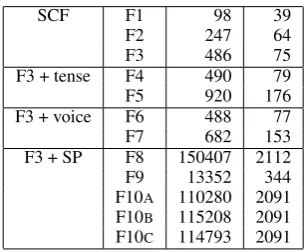
Table 3: (i) The total number of features and (ii) the average per verb for all the feature sets
eas of biomedicine. The first column in table 2 lists each journal, the second shows the years from which the articles were downloaded, and the third indicates the size of the data. We experimented with two test sets: 1) The 15.5M word sub-set shown in the first three rows of the table (this was used for creating the gold standard). 2) All the data: this new larger data was necessary for exper-iments with new feature sets as the most refined ones do not appear in 1) with sufficient frequency. 4 Experimental Evaluation
4.1 Processing the Data
The data was first processed using the feature ex-traction module. Table 3 shows (i) the total num-ber of features in each feature set and (ii) the av-erage per verb in the resulting lexicon. The clas-sification module was then applied. We requested K = 2 to60 clusters from both clustering meth-ods. We did not want to enforce the actual num-ber of classes but preferred to let the class hierar-chy emerge from the clustering results. In order to find the values ofKwhere the clustering output might correspond to a level in the class hierarchy we used the relevance criterion. For each method (clustering method and feature set combination) we choose as informativeK’s the values for which the relevance informationI(Clusters;SCFs)) in-creases more sharply betweenK−1andKclusters than betweenKandK+1. We then chose for eval-uation the outputs corresponding only to informa-tive values ofK. The clustering was run 50 times for each method. The output is a result of voting among the outputs of the runs.
4.2 Measures
adjusted pairwise precision, evaluates clusters in terms of verb pairs:
APP= 1 K
K P i=1
num. of correct pairs inki
num. of pairs inki · |ki|−1 |ki|+1
APP is the average proportion of all within-cluster pairs that are correctly co-assigned. Mul-tiplied by a factor that increases with cluster size it compensates for a bias towards small clusters.
The second measure ismodified purity, a global measure which evaluates the mean precision of clusters. Each cluster is associated with its preva-lent class. The number of verbs in a clusterKthat take this class is denoted by nprevalent(K). Verbs
that do not take it are considered as errors. Clusters wherenprevalent(K) = 1are disregarded as not to
introduce a bias towards singletons:
mPUR=
P
nprevalent(ki)≥2nprevalent(ki) number of verbs
The third measure is theweighted class accu-racy, the proportion of members of dominant clus-ters DOM-CLUSTiwithin all classesci.
mPUR can be seen to measure the precision of clusters and ACCthe recall. We define anF mea-sure as the harmonic mean ofmPURandACC:
F = 2·mPUR·ACC
mPUR+ACC
The experiments were run 50 times on each in-put to get the distribution of performance due to the randomness in the initial clustering. We calcu-lated the average performance and standard devia-tion from the results of these runs.
4.3 Results for Test Set 1
We first comparedIBandPCon the smaller test set 1 using feature set F2. We chose for evaluation the outputs corresponding to the most informative val-ues ofK: 20, 33, 53 for IB, and 19, 26, 51 forPC. In the results included in table 4IBshows slightly better performance than PC, but the difference is not significant for K=34 and 50. We decided to use PC for larger experiments because it has two ad-vantages overIB: 1) It can cluster the large test set 2 withK = 10−60in minutes, whileIBrequires a day for this. 2) It can deal with (and combine) different feature sets, while IB runs into numeri-cal problems. Due to its speed and flexibility PC is thus more suitable for larger-scale experiments involving comparison of complex feature sets.
4.4 Results for Test Set 2
Tables 5 and 6 include thePCresults on the larger test set 2. Table 5 shows the results for each in-dividual feature set (indicated in the second col-umn). It shows also the standard deviations (σavg)
of the four performance measures averaged across all the runs. These are very similar for 16, 34, and 50 classes and hence only included in one of the columns. In addition, σdiff is indicated. This is
√
2·σavgand used for calculating the significance
of the performance differences. In the following discussion we consider a difference of more than
2σdiff(p >97.7%) as significant.
The first feature sets F1-F3 include basic SCF (frequency) information for each verb, F2-F3 re-fined with prepositions. F2 shows clearly better results than F1 (over 10 F-measure) at all the levels of gold standard. This demonstrates the usefulness of prepositions for the task. When moving to F3 the performance decreases for 34 and 50 classes, while improving for 16 classes, but these differ-ences are not statistically significant.
Feature sets F4-F10 build on F3. F4-F5 include information about verb tense. This information proves quite useful for verb classification, partic-ularly when specific to individual SCFs. When compared against the baseline featureset F3, F5 is clearly better - particularly at 50 classes where the difference is 3.9 in F-measure (2σdiff). Verb
voice information is not equally helpful: F6-F7 are not better than F3. In some comparisons they are worse, e.g. F7 vs. F3 at 16 classes.
F8-F10 supplement F3 with information about SPs. Surprisingly, these lexical and semantic fea-tures prove the most useful for our task. At the level of 34 and 50 classes, the bestSPfeatures are even better than the best tense features (the dif-ference is statistically significant), and they yield notable improvement over the baseline features (e.g. 6.8 difference in F-measure between F9 and F3). The performance is not equally good at 16 classes. This makes perfect sense because class members are unlikely to have similarSPs at such a coarse level of semantic classification.
16 Classes 34 Classes 50 Classes
APP mPUR ACC F APP mPUR ACC F APP mPUR ACC F
IB 74 77 66 71 69 75 81 77 54 72 79 75
PC 71 78 58 67 64 71 81 75 63 71 73 72
± 1.1 1.0 1.0 0.8 1.8 1.6 1.3 1.4 2.1 1.5 1.6 1.1
Table 4: Performance on test set 1
16 Classes 34 Classes 50 Classes
APP mPUR ACC F APP mPUR ACC F APP mPUR ACC F
SCF F1 62.7 68.2 54.6 60.6 50.4 58.4 53.4 55.8 41.5 50.3 55.7 52.9 F2 68.7 76.4 66.4 71.1 61.9 65.5 65.8 65.6 53.9 61.2 65.4 63.2 F3 69.3 77.7 67.6 72.3 61.6 66.0 64.0 65.0 53.7 60.2 65.9 62.9 F3 + tense F4 70.1 77.5 65.5 71.0 62.0 70.3 69.4 69.8 53.3 60.6 68.0 64.1 F5 68.5 75.4 71.7 73.5 61.9 67.8 68.2 68.0 58.2 62.7 71.7 66.8 F3 + voice F6 70.6 78.1 64.0 70.4 61.2 66.0 65.8 65.9 54.3 59.6 70.1 64.4 F7 74.0 79.5 59.7 68.2 62.6 65.4 65.1 65.2 55.1 60.9 69.2 64.7 F3 + SP F8 77.1 78.2 61.6 68.9 69.6 69.3 71.2 70.2 61.3 62.7 71.1 66.6 F9 72.4 77.1 64.0 69.9 72.2 72.0 71.6 71.8 62.3 65.6 72.4 68.8 F10A 75.6 80.0 63.2 70.6 66.1 69.2 70.6 69.9 59.4 63.5 69.0 66.2 F10B 68.8 77.1 69.2 72.9 65.3 67.2 69.8 68.5 59.9 61.9 70.5 65.9 F10C 74.1 78.9 65.7 71.7 68.8 71.7 69.7 70.7 59.8 63.4 71.1 67.0
σavg 2.2 1.5 1.8 1.4
σdiff 3.1 2.1 2.5 2.0
Table 5: Performance on test set 2: PC clustering results for individual feature sets at the three levels of gold standard.σavgandσdiff were calculated across all the three classification levels.
16 CL. F5+F9 F4+ F10C F5 F5+ F8
APP 72.3 68.2 68.5 72.2
mPUR 76.4 77.0 75.4 76.5
ACC 73.6 70.9 71.7 69.9
F 75.0 73.8 73.5 73.0
34 CL. F5+ F9 F5+ F8 F9 F4+ F10A
APP 68.7 71.0 72.2 62.9
mPUR 70.1 71.0 72.0 68.4
ACC 74.8 73.4 71.6 75.0
F 72.4 72.2 71.8 71.5
50 CL. F9 F5+ F9 F5+ F8 F4+ F9
APP 62.3 59.8 62.8 59.7
mPUR 65.6 63.8 64.1 63.1
ACC 72.4 72.7 71.0 71.8
F 68.8 68.0 67.4 67.1
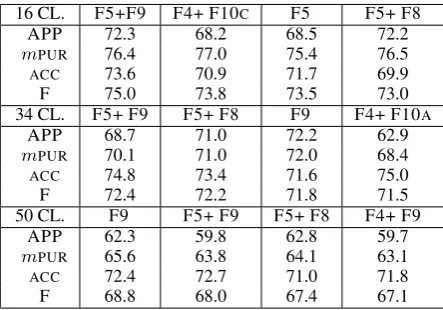
Table 6: Results for the top four feature set combi-nations. All the feature sets build on F3.
fine grained clusters (F10C) or coarse-grained ones (F10A) asSPs does not make much difference.
We next combined various feature sets. Table 6 shows the performance for the top four combina-tions. Comparing these results against the ones in Table 5, (see theσdiffvalues in Table 5) we can see
that combining feature sets does not result in better performance3. The only exception is the difference
in APP andmPURbetween F9 and F4 + F10A at N=34. However, these results show similar ten-dencies as the earlier ones: at 16 classes the most
3Recall that all F4-F10 are actually already ’combined’ with F3 - we do not refer to this combination here.
useful features are based on verb tense, while at 34 and 50 classes they are based onSPs.
5 Discussion
The results presented in the previous section are in interesting contrast with those reported in ear-lier work. In previous work on general lan-guage verb classification, syntactic features (slots or SCFs) have proved generally the most help-ful features, e.g. (Schulte im Walde, 2006; Joa-nis et al., 2007). The preliminary experiment on biomedical verb classification (Korhonen et al., 2006) experimented only with them. In our ex-periments, SCFs proved useful baseline features. When we refined them further, we faced sparse data problems: considerable improvement was ob-tained when moving from F1 to F2, but not when moving to F3. Although many verb classes are sensitive to preposition types, many of the types are low in frequency. Future work could address this problem by employing smoothing techniques, or backing off to preposition classes.
un-distinctiveness of passive in biomedical texts where it is used typically with high frequency. However, tense-based features clearly improved the baseline performance in our experiments. This could be partly because we ’parameterize’POS in-formation for SCFs, and partly because semanti-cally similar verbs in biomedical language tend to behave similarly also in terms of tense (Friedman et al., 2002).
Joanis (2002) and Schulte im Walde (2006) used SP-based features in general English and German verb classifications, respectively. The former ac-quired them from WordNet (Miller, 1990) and the latter from GermaNet (Kunze, 2000). Joa-nis (2002) obtained no improvement over syntactic features while Schulte im Walde (2006) obtained, but the improvement was not significant. In our experiments, SPfeatures gave the best results and the clearest improvement over the baseline features at the finer-grained levels of classification where class members are indeed likely to be the most uni-form in terms of theirSPs.
We obtained this improvement despite using a fully unsupervised approach to SP acquisition. We did not exploit lexical resources like Joa-nis (2002) and Schulte im Walde (2006) because it would have required combining general re-sources (e.g. WordNet) with domain specific ones (e.g. UMLS). We opted for a simpler approach in this initial work – using raw argument heads and clustering – and obtained surprisingly good results. In our experiments filtering of raw argument heads and clustering with N=50 produced equivalent re-sults, suggesting that relatively fine-grained clus-ters are optimal. Future work will require quali-tative analysis of noun clusters and comparison of these against classes in lexical resources to deter-mine an optimal method forSPacquisition.
Does the fact that we obtain good results with features which have not proved helpful in general language classification indicate a need for domain-specific feature engineering? We do not believe so. The feature sets we experimented with are the-oretically well-motivated and should, in principle, also aid general language verb classification. We believe they proved helpful in our experiments be-cause being domain-specific, biomedical language is conventionalised and therefore less varied in terms of verb sense and usage than general lan-guage. For example, verbs have stronger SPs for their argument heads when many of their corpus
occurrences are of similar sense. This rendersSP -based features more useful for classification.
Due to differences in the data, methods, and ex-perimental setup, direct comparison of our perfor-mance figures with previously published ones is difficult. The closest comparison point with gen-eral language is (Korhonen et al., 2003) which re-ported 59% mPUR using IB to assign 110 polyse-mous English verbs into 34 classes. Our best re-sults are substantially better (72-80% mPUR). It is encouraging that we obtained such good results despite focusing on a linguistically challenging do-main.
In addition to the points mentioned earlier, our future plans include seeding automatic classifica-tion with more sophisticated informaclassifica-tion acquired automatically from domain-specific texts (e.g. us-ing named entity recognition and anaphoric link-ing (Vlachos et al., 2006)). We will also explore semi-automatic ML technology and active learn-ing in aidlearn-ing the classification. Finally, we plan to conduct a bigger experiment with a larger number of verbs, make the resulting classification publicly available, and demonstrate its usefulness for prac-ticalBIO-NLPapplication tasks.
6 Conclusion
We reported large-scale experiments to investigate the optimal characteristics of features required for biomedical verb classification. A range of feature sets and associated extraction methods were intro-duced for this work, along with a robust cluster-ing method capable of dealcluster-ing with large data and complex feature sets. A number of experiments were reported. The best performing feature sets proved to be the ones which include information about SCFs supplemented with information about verb tense and SPs in particular. The latter were acquired automatically from corpus data using an unsupervised method. Similar feature sets have not proved equally useful in earlier work in gen-eral language verb classification. We discussed reasons for this and highlighted several areas for future work.
Acknowledgement
References
Ananiadou, S., B. D. Kell, and J. Tsujii. 2006. Text mining and its potential applications in systems biol-ogy.Trends in Biotechnology, 24(12):571–579. Briscoe, E. J. and J. Carroll. 1997. Automatic
extrac-tion of subcategorizaextrac-tion from corpora. In5th ACL Conference on Applied Natural Language Process-ing, pages 356–363, Washington DC.
Briscoe, E. J. and J. Carroll. 2002. Robust accurate statistical annotation of general text. In3rd Interna-tional Conference on Language Resources and Eval-uation, pages 1499–1504, Las Palmas, Gran Canaria. Cohen, K. B. and L. Hunter. 2006. A critical review of PASBio’s argument structures for biomedical verbs.
BMC Bioinformatics, 7(3).
Dang, H. T. 2004. Investigations into the Role of Lexi-cal Semantics in Word Sense Disambiguation. Ph.D. thesis, CIS, University of Pennsylvania.
Dorr, B. J. 1997. Large-scale dictionary construction for foreign language tutoring and interlingual ma-chine translation. Machine Translation, 12(4):271– 322.
Friedman, C., P. Kra, and A. Rzhetsky. 2002. Two biomedical sublanguages: a description based on the theories of zellig harris. Journal of Biomedical In-formatics, 35(4):222–235.
Joanis, E., S. Stevenson, and D. James. 2007. A gen-eral feature space for automatic verb classification.
Natural Language Engineering.
Joanis, E. 2002. Automatic verb classification using a general feature space. Master’s thesis, University of Toronto.
Korhonen, A., Y. Krymolowski, and N. Collier. 2006. Automatic classification of verbs in biomedical texts. InACL-COLING, Sydney, Australia.
Kunze, C. 2000. Extension and use of germanet, a lexical-semantic database. In 2nd International Conference on Language Resources and Evaluation, Athens, Greece.
Levin, B. 1993. English Verb Classes and Alterna-tions. Chicago University Press, Chicago.
Miller, G. A. 1990. WordNet: An on-line lexical database. International Journal of Lexicography, 3(4):235–312.
Prescher, D., S. Riezler, and M. Rooth. 2000. Using a probabilistic class-based lexicon for lexical am-biguity resolution. In 18th International Confer-ence on Computational Linguistics, pages 649–655, Saarbr¨ucken, Germany.
Puzicha, J., T. Hofmann, and J. M. Buhmann. 2000. A theory of proximity-based clustering: structure detection by optimization. Pattern Recognition, 33(4):617–634.
Schulte im Walde, S. 2006. Experiments on the au-tomatic induction of german semantic verb classes.
Computational Linguistics, 32(2):159–194.
Shi, L. and R. Mihalcea. 2005. Putting pieces to-gether: Combining FrameNet, VerbNet and Word-Net for robust semantic parsing. InProceedings of the Sixth International Conference on Intelligent Text Processing and Computational Linguistics, Mexico City, Mexico.
Sun, L., A. Korhonen, and Y. Krymolowski. 2008. Verb class discovery from rich syntactic data. In
9th International Conference on Intelligent Text Pro-cessing and Computational Linguistics, Haifa, Is-rael.
Swier, R. and S. Stevenson. 2004. Unsupervised se-mantic role labelling. In Proceedings of the 2004 Conference on Empirical Methods in Natural Lan-guage Processing, pages 95–102, Barcelona, Spain, August.
Tishby, N., F. C. Pereira, and W. Bialek. 1999. The information bottleneck method. In Proc. of the
37th Annual Allerton Conference on Communica-tion, Control and Computing, pages 368–377. Vlachos, A., C. Gasperin, I. Lewin, and E. J. Briscoe.
2006. Bootstrapping the recognition and anaphoric linking of named entitites in drosophila articles. In