Using Context Events in Neural Network Models for Event Temporal
Status Identification
Zeyu Dai, Wenlin Yao, Ruihong Huang
Department of Computer Science and Engineering Texas A&M University
{jzdaizeyu, wenlinyao, huangrh}@tamu.edu
Abstract
Focusing on the task of identifying event temporal status, we find that events di-rectly or indidi-rectly governing the target event in a dependency tree are most im-portant contexts. Therefore, we extract de-pendency chains containing context events and use them as input in neural network models, which consistently outperform previous models using local context words as input. Visualization verifies that the de-pendency chain representation can effec-tively capture the context events which are closely related to the target event and play key roles in predicting event temporal sta-tus.
1 Introduction
Event temporal status identification aims to rec-ognize whether an event has happened (PAST), is currently happening (ON-GOING) or has not happened yet (FUTURE), which can be crucial for event prediction, timeline generation and news summarization.
Our prior work (Huang et al.,2016) showed that linguistic features, such as tense, aspect and time expressions, are insufficient for this challenging task, which instead requires accurate understand-ing of composite meanunderstand-ings from wide senten-tial contexts. However surprisingly, the best per-formance for event temporal status identification was achieved by a Convolutional Neural Network (CNN) running on local contexts (seven words to each side) surrounding the target event (Huang et al.,2016).
Considering the following sentence with a fu-ture event “protest”:
(1)Climate activists from around the world will launch a hunger strike here on Friday,
describ-ing theirprotest (FU)as a “moral reaction to an immoral situation” in the face of environmental catastrophe.
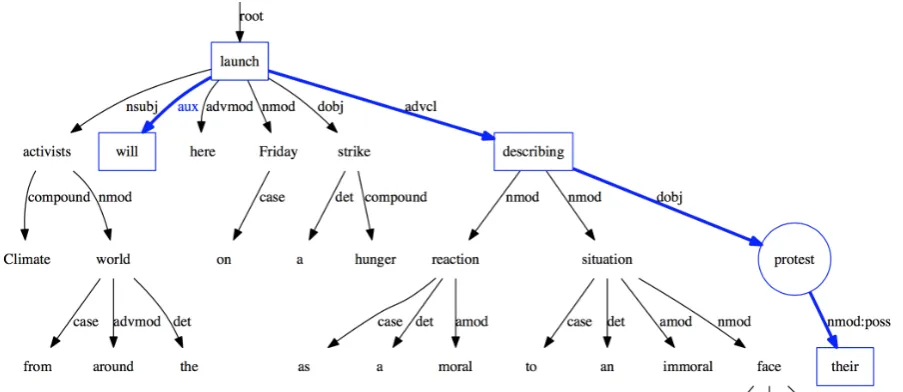
The local context “describing” may mislead the classifier that this is an on-going event, while the actual future temporal status indicative words, “will launch”, appear nine words away from the target event mention “protest”. Clearly, the local window of contexts is filled with irrelevant words, meanwhile, it fails to capture important tempo-ral status indicators. However, as shown in fig-ure1, the event “launch” is actually a high order indirect governor word of the target event word “protest” and is only two words away from the tar-get event in the dependency tree. Indeed, we ob-served that the temporal status indicators are often words that syntactically govern or depend on the event mention at all levels of a dependency tree. Furthermore, we observed that higher level gov-erning words in dependency trees frequently refer to events as well, which are closely related to the target event and useful to predict its temporal sta-tus.
Following these observations, we form a de-pendency chain of relevant contexts by extract-ing words that appear between an event mention and the root of a dependency parse tree as well as words that are governed by the event mention. Then we use the extracted dependency chain as in-put for neural network classifiers. This is an ele-gant method to capture long-distance dependency between events within a sentence. It is known that a verb and its direct or indirect governor can be far away in a word sequence if modifiers such as adjectives or clauses lie in between, but they are adjacent in the parse tree.
Experimental results using two neural network models (i.e., LSTMs and CNNs) show that clas-sifiers with dependency chains as input can bet-ter capture temporal status indicative contexts and
Figure 1: The dependency parse tree for the example (1). The blue and bold edges show the extracted dependency chain for the target event “protest” (in circle).
clearly outperform the ones with local contexts. Furthermore, the models with dependency chains as input outperform a tree-LSTM model in which the full dependency trees are used as input. Vi-sualization reveals that it is much easier for neu-ral net models to identify and concentrate on the relevant regions of contexts using the dependency chain representation, which further verifies that additional event words in a sentential context are crucial to predict target event temporal status.
2 Related Work
Constituency-based and dependency-based parse trees have been explored and applied to im-prove performance of neural nets for the task of sentiment analysis and semantic relation extrac-tion (Socher et al.,2013;Bowman and Potts,2015;
Tai et al., 2015). The focus of these prior stud-ies is on designing new neural network architec-tures (e.g., tree-structured LSTMs) corresponding to the parse tree structure. In contrast, our method aims at extracting appropriate event-centered data representations from dependency trees so that the neural net models can effectively concentrate on relevant regions of contexts.
Similar to our dependency chains, dependency paths between two nodes in a dependency tree have been widely used as features for various NLP tasks and applications, including relation extrac-tion (Bunescu and Mooney, 2005), temporal re-lation identification (Choubey and Huang, 2017) semantic parsing (Moschitti, 2004) and question
answering (Cui et al., 2005). Differently, our dependency chains are generated with respect to an event word and include words that govern or depend on the event, which therefore are not bounded by two pre-identified nodes in a depen-dency tree.
3 Dependency Chain Extraction
Figure1shows the dependency parse tree1for the
example (1). To extract the dependency chain for the target event, we have used a two-stage ap-proach to create the chain. In the first stage, we start from the target event, traverse the dependency parse tree, identify all its direct or indirect gover-nors and dependents and include these words in the chain. For the example (1), a list of words [launch, describing, protest, their] are included in the dependency chain after the first stage.
Then in the second stage, we apply one heuris-tic rule to extract extra words from the depen-dency tree. Specifically, if a word is in a partic-ular dependency relation2, aux, auxpass or cop,
with a word that is already in the chain after the first stage, then we include this word in the chain as well. For the example (1), the word “will” is inserted into the dependency chain in the second stage. The reason we perform this additional step is that context words identified with one of the above three dependency relations usually indicate 1We used the Stanford CoreNLP to generate dependency parse trees.
2http://nlp.stanford.edu/software/
Model PA OG FU Macro Micro Local Contexts
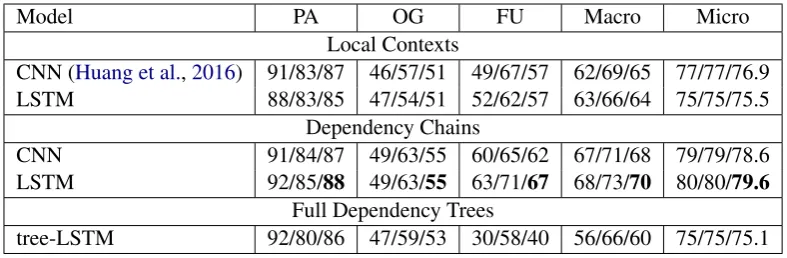
CNN (Huang et al.,2016) 91/83/87 46/57/51 49/67/57 62/69/65 77/77/76.9 LSTM 88/83/85 47/54/51 52/62/57 63/66/64 75/75/75.5
Dependency Chains
CNN 91/84/87 49/63/55 60/65/62 67/71/68 79/79/78.6 LSTM 92/85/88 49/63/55 63/71/67 68/73/70 80/80/79.6
Full Dependency Trees
tree-LSTM 92/80/86 47/59/53 30/58/40 56/66/60 75/75/75.1
Table 1: Classification results on the test set. Each cell shows Recall/Precision/F1 score.
tense, aspect or mood of a context event, which are useful in determining the target event’s tempo-ral status.
For each extracted dependency chain, we sort the words in the chain according to their textual order in the original sentence. Then the ordered sequence of words will be used as the input for LSTMs and CNNs.
4 Experiments
4.1 The EventStatus Corpus
We experiment on the EventStatus corpus (Huang et al., 2016), which contains 4500 English and Spanish news articles about civil unrest events (e.g., protest and march), where each civil unrest event mention has been annotated with three cat-egories, Past (PA),On-Going (OG)and Future (FU), to indicate if the event has concluded, is cur-rently ongoing or has not happened yet.
We only use the English portion of the corpus which include 2364 documents because our pre-vious work (Huang et al.,2016) has reported that the quality of dependency parse trees generated for Spanish articles is poor and our approach heavily rely on dependency trees. Furthermore, we ran-domly split the data into tuning (20%) and test (80%) set, and conduct the final evaluation using 10-fold cross-validation on the test set, following the prior work (Huang et al.,2016). Table2shows the distribution of each event temporal status cate-gory in the dataset.
PA OG FU
Test 1406(67%) 429(21%) 254(12%)
[image:3.595.102.496.61.190.2]Tuning 354(61%) 157(27%) 66(12%)
Table 2: Temporal Status Label Distribution
4.2 Neural Network Models
In our experiments, we applied three types of neu-ral network models including CNNs (Collobert et al., 2011; Kim, 2014), LSTMs (Schmidhuber and Hochreiter,1997), and tree-LSTMs (Tai et al.,
2015). For CNNs, we used the same architecture and parameter settings as (Huang et al.,2016) with a filter size of 5. For LSTMs, we implemented a simple architecture that consists of one LSTM layer and one output layer with softmax function. For tree-LSTMs, we replicated the Dependency tree-LSTMs3from (Tai et al.,2015) and added an
output layer on top of it. Both of the two latter neural nets used the same number (300) of hid-den units as CNNs. Note that we have also ex-perimented with complex LSTM models, includ-ing the ones with multiple layers, with bidirec-tional inferencing (Schuster and Paliwal,1997) as well as with attention mechanism (Bahdanau et al.,
2015;Wang et al., 2016), however none of these complex models improve the event temporal sta-tus prediction performance.
All the models were trained using RMSProp optimizer with the initial learning rate 0.001 and the same random seed. In addition, we used the pre-trained 300-dimension English word2vec4
embeddings (Mikolov et al.,2013b,a). The train-ing epochs and dropout (Hinton et al.,2012) ratio for neural net layers were treated as hyperparame-ters and were tuned using the tuning set. The best LSTM model ran for 50 training epochs and used a dropout ratio of 0.5.
3Our tree-LSTMs implementation were adjusted from https://github.com/ttpro1995/ TreeLSTMSentiment
4Downloaded from https://docs.google.com/
0 50 100 150 200 250
Word Embedding Dimension hunger
strike hereon Friday
describingtheir protestas a
moral reactionto an
immoral
0.00000015 0.00000030 0.00000045 0.00000060 0.00000075 0.00000090 0.00000105
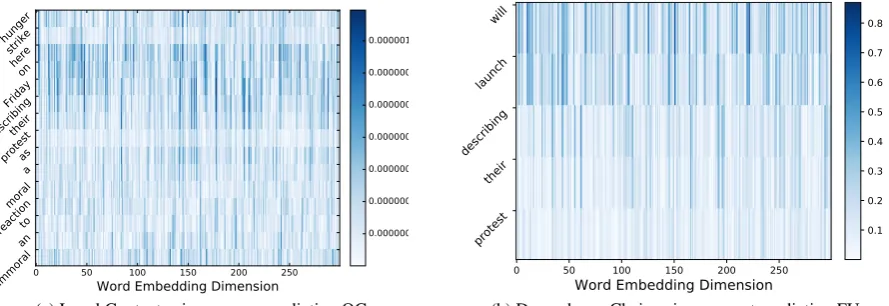
(a) Local Contexts gives wrong prediction OG
0 50 100 150 200 250
Word Embedding Dimension will
launch
describing their
protest 0.1
0.2 0.3 0.4 0.5 0.6 0.7 0.8
[image:4.595.78.523.72.225.2](b) Dependency Chains gives correct prediction FU Figure 2: Saliency heatmaps for the example (1). Local Context Input: hunger strike here on Friday, describing their protest as a moral reaction to an immoral; Dependency Chain Input: will launch de-scribing their protest. A deeper color indicates that the corresponding word has a higher weight and contributes more to the prediction.
4.3 Classification Result
Table1shows the new experimental results on the test set as well as our prior results (Huang et al.,
2016). For models using local contexts as input, the context window size of 7 (7 words preced-ing and followpreced-ing the target event mention, there-fore, 15 words in total) yields the best result, as reported in our prior paper (Huang et al., 2016). Note that dependency chains we generated have an average length of 7.4 words in total, which are much shorter than 15 words of local contexts as used before.
From Table1, we can see that both LSTM and CNN models using dependency chains as input consistently outperform the corresponding mod-els using local contexts. Especially, the LSTM model running on dependency chains achieves the best performance of 70.0% Macro and 79.6% Mi-cro F1-score, which outperforms the previous lo-cal context based CNN model (Huang et al.,2016) by a large margin. Statistical significance test-ing shows that the improvements are significant at the p < 0.01 level (t-test). In particular for on-going and future events, the dependency chain based LSTM model improves the temporal status classification F-scores by 4 and 10 percentages re-spectively. In addition, the tree-LSTM model tak-ing account of full dependency trees achieves a comparable result with local context based neural network models, but performs worse than depen-dency chain based models. The reason why the tree-LSTM model does not work well is that
irrel-evant words, including adjective modifiers and ir-relevant clauses forming branches of dependency trees, may distract the classifier and have negative effect in predicting the temporal status of an event.
5 Visualizing LSTM
Following the approach used in (Li et al., 2016), we drew salience heatmaps5in order to understand
contributions of individual words in a dependency chain to event temporal status identification. Fig-ure2shows heatmaps of LSTM models when ap-plied to example (1) using its different data repre-sentations as input. We can clearly see that the de-pendency chain input effectively retains contexts that are relevant for predicting event temporal sta-tus. Specifically, as shown in Figure 2(b), the context event “launch” that indirectly governs the target event “protest” in the dependency chain to-gether with the auxiliary verb “will” have received the highest weights and are most useful in predict-ing the correct temporal status.
6 Error Analysis
temporal status is majority in the dataset, which explains the low performance on predicting on-going events. To resolve such difficult cases, even wider contexts beyond one sentence should be considered.
Around 10% of errors are time expression re-lated. The neural net models seem not be able to wisely use time expressions (e.g., “in 1986”, “on Wednesday”) without knowing the exact doc-ument creation time and their temporal relations. In addition, some mislabelings occur because neu-ral nets are unable to capture compositionality of multi-word expressions or phrasal verbs that alone can directly determine the temporal status of their following event, such as “on eve of” and “go on”.
7 Conclusion
We presented a novel dependency chain based approach for event temporal status identification which can better capture relevant regions of con-texts containing other events that directly or indi-rectly govern the target event. Experimental re-sults showed that dependency chain based neu-ral net models consistently outperform commonly used local context based models in predicting event temporal status, as well as a tree-structured neural network model taking account of complete dependency trees. To further improve the perfor-mance of event temporal status identification, we believe that wider contexts beyond the current sen-tence containing an event should be exploited.
Acknowledgments
We acknowledge the support of NVIDIA Corpo-ration for their donation of one GeForce GTX TI-TAN X GPU used for this research.
References
Dzmitry Bahdanau, Kyunghyun Cho, and Yoshua Ben-gio. 2015. Neural machine translation by jointly learning to align and translate. InProc. ICLR.
Samuel R Bowman and Christopher Potts. 2015. Re-cursive neural networks can learn logical semantics. ACL-IJCNLP 2015, page 12.
Razvan C Bunescu and Raymond J Mooney. 2005. A shortest path dependency kernel for relation extrac-tion. In Proceedings of the conference on human language technology and empirical methods in nat-ural language processing, pages 724–731. Associa-tion for ComputaAssocia-tional Linguistics.
Prafulla Kumar Choubey and Ruihong Huang. 2017. A sequential model for classifying temporal relations between intra-sentence events. Proceedings of the 2017 Conference on Empirical Methods in Natural Language Processing, Short Papers.
Ronan Collobert, Jason Weston, L´eon Bottou, Michael Karlen, Koray Kavukcuoglu, and Pavel Kuksa. 2011. Natural language processing (almost) from scratch. Journal of Machine Learning Research, 12(Aug):2493–2537.
Hang Cui, Renxu Sun, Keya Li, Min-Yen Kan, and Tat-Seng Chua. 2005. Question answering passage re-trieval using dependency relations. InProceedings of the 28th annual international ACM SIGIR confer-ence on Research and development in information retrieval, pages 400–407. ACM.
Geoffrey E Hinton, Nitish Srivastava, Alex Krizhevsky, Ilya Sutskever, and Ruslan R Salakhutdinov. 2012. Improving neural networks by preventing co-adaptation of feature detectors. arXiv preprint arXiv:1207.0580.
Ruihong Huang, Ignacio Cases, Dan Jurafsky, Cleo Condoravdi, and Ellen Riloff. 2016. Distinguishing past, on-going, and future events: The eventstatus corpus. InProceedings of the 2016 Conference on Empirical Methods in Natural Language Process-ing, pages 44–54, Austin, Texas. Association for Computational Linguistics.
Yoon Kim. 2014. Convolutional neural net-works for sentence classification. arXiv preprint arXiv:1408.5882.
Jiwei Li, Xinlei Chen, Eduard Hovy, and Dan Jurafsky. 2016. Visualizing and understanding neural models in nlp. InProceedings of NAACL-HLT, pages 681– 691.
Tomas Mikolov, Kai Chen, Greg Corrado, and Jeffrey Dean. 2013a. Efficient estimation of word represen-tations in vector space.ICLR Workshop.
Tomas Mikolov, Ilya Sutskever, Kai Chen, Greg S Cor-rado, and Jeff Dean. 2013b. Distributed representa-tions of words and phrases and their compositional-ity. InAdvances in neural information processing systems, pages 3111–3119.
Alessandro Moschitti. 2004. A study on convolution kernels for shallow semantic parsing. In Proceed-ings of the 42nd Annual Meeting on Association for Computational Linguistics, page 335. Association for Computational Linguistics.
J¨urgen Schmidhuber and Sepp Hochreiter. 1997. Long short-term memory. Neural Comput, 9(8):1735– 1780.
Richard Socher, Alex Perelygin, Jean Wu, Jason Chuang, Christopher D. Manning, Andrew Ng, and Christopher Potts. 2013. Recursive deep models for semantic compositionality over a sentiment tree-bank. In Proceedings of the 2013 Conference on Empirical Methods in Natural Language Process-ing, pages 1631–1642, Seattle, Washington, USA. Association for Computational Linguistics.
Kai Sheng Tai, Richard Socher, and Christopher D. Manning. 2015. Improved semantic representations from tree-structured long short-term memory net-works. InACL.