Blueprint for a High Performance
NLP
Infrastructure
James R. Curran
School of Informatics
University of Edinburgh
2 Buccleuch Place, Edinburgh. EH8 9LW
[email protected]
Abstract
Natural Language Processing (NLP) system de-velopers face a number of new challenges. In-terest is increasing for real-world systems that useNLPtools and techniques. The quantity of text now available for training and processing is increasing dramatically. Also, the range of languages and tasks being researched contin-ues to grow rapidly. Thus it is an ideal time to consider the development of new experimen-tal frameworks. We describe the requirements, initial design and exploratory implementation of a high performanceNLPinfrastructure.
1
Introduction
Practical interest in NLP has grown dramatically in re-cent years. Accuracy on fundamental tasks, such as part of speech (POS) tagging, named entity recognition, and broad-coverage parsing continues to increase. We can now construct systems that address complex real-world problems such as information extraction and question an-swering. At the same time, progress in speech recogni-tion and text-to-speech technology has made complete spoken dialogue systems feasible. Developing these complexNLPsystems involves composing many different NLP tools. Unfortunately, this is difficult because many implementations have not been designed as components and only recently has input/output standardisation been considered. Finally, these tools can be difficult to cus-tomise and tune for a particular task.
NLP is experiencing an explosion in the quantity of electronic text available. Some of this new data will be manually annotated. For example, 10 million words of the American National Corpus (Ide et al., 2002) will have manually correctedPOStags, a tenfold increase over the Penn Treebank (Marcus et al., 1993), currently used for training POS taggers. This will require more efficient learning algorithms and implementations.
However, the greatest increase is in the amount of raw text available to be processed, e.g. the English Giga-word Corpus (Linguistic Data Consortium, 2003). Re-cent work (Banko and Brill, 2001; Curran and Moens, 2002) has suggested that some tasks will benefit from using significantly more data. Also, many potential ap-plications ofNLPwill involve processing very large text databases. For instance, biomedical text-mining involves extracting information from the vast body of biological and medical literature; and search engines may eventu-ally applyNLPtechniques to the whole web. Other po-tential applications must process text online or in real-time. For example, Google currently answers 250 million queries per day, thus processing time must be minimised. Clearly, efficientNLPcomponents will need to be devel-oped. At the same time, state-of-the-art performance will be needed for these systems to be of practical use.
Finally, NLP is growing in terms of the number of tasks, methods and languages being researched. Al-though many problems share algorithms and data struc-tures there is a tendency to reinvent the wheel.
Software engineering research on Generative Program-ming (Czarnecki and Eisenecker, 2000) attempts to solve these problems by focusing on the development of con-figurable elementary components and knowledge to com-bine these components into complete systems. Our in-frastructure forNLPwill provide high performance1
com-ponents inspired by Generative Programming principles. This paper reviews existingNLPsystems and discusses the requirements for anNLPinfrastructure. We then de-scribe our overall design and exploratory implementa-tion. We conclude with a discussion of programming in-terfaces for the infrastructure including a script language andGUIinterfaces, and web services for distributedNLP system development. We seek feedback on the overall design and implementation of our proposed infrastruc-ture and to promote discussion about software engineer-ing best practice inNLP.
1We use high performance to refer to both state of the art
2
Existing Systems
There are a number of generalisedNLPsystems in the lit-erature. Many provide graphical user interfaces (GUI) for manual annotation (e.g. General Architecture for Text Engineering (GATE) (Cunningham et al., 1997) and the Alembic Workbench (Day et al., 1997)) as well asNLP tools and resources that can be manipulated from the GUI. For instance, GATE currently provides a POS tag-ger, named entity recogniser and gazetteer and ontology editors (Cunningham et al., 2002). GATE goes beyond earlier systems by using a component-based infrastruc-ture (Cunningham, 2000) which theGUIis built on top of. This allows components to be highly configurable and simplifies the addition of new components to the system. A number of stand-alone tools have also been devel-oped. For example, the suite ofLTtools (Mikheev et al., 1999; Grover et al., 2000) perform tokenization, tagging and chunking on XML marked-up text directly. These tools also store their configuration state, e.g. the trans-duction rules used inLT CHUNK, in XMLconfiguration files. This gives a greater flexibility but the tradeoff is that these tools can run very slowly. Other tools have been designed around particular techniques, such as fi-nite state machines (Karttunen et al., 1997; Mohri et al., 1998). However, the source code for these tools is not freely available, so they cannot be extended.
Efficiency has not been a focus for NLP research in general. However, it will be increasingly important as techniques become more complex and corpus sizes grow. An example of this is the estimation of maximum en-tropy models, from simple iterative estimation algorithms used by Ratnaparkhi (1998) that converge very slowly, to complex techniques from the optimisation literature that converge much more rapidly (Malouf, 2002). Other attempts to address efficiency include the fast Transfor-mation Based Learning (TBL) Toolkit (Ngai and Florian, 2001) which dramatically speeds up training TBL sys-tems, and the translation ofTBLrules into finite state ma-chines for very fast tagging (Roche and Schabes, 1997). The TNT POS tagger (Brants, 2000) has also been de-signed to train and run very quickly, tagging between 30,000 and 60,000 words per second.
The Weka package (Witten and Frank, 1999) provides a common framework for several existing machine learn-ing methods includlearn-ing decision trees and support vector machines. This library has been very popular because it allows researchers to experiment with different methods without having to modify code or reformat data.
Finally, the Natural Language Toolkit (NLTK) is a package of NLP components implemented in Python (Loper and Bird, 2002). Python scripting is extremely simple to learn, read and write, and so using the existing components and designing new components is simple.
3
Performance Requirements
As discussed earlier, there are two main requirements of the system that are covered by “high performance”: speed and state of the art accuracy. Efficiency is required both in training and processing. Efficient training is re-quired because the amount of data available for train-ing will increase significantly. Also, advanced methods often require many training iterations, for example ac-tive learning (Dagan and Engelson, 1995) and co-training (Blum and Mitchell, 1998). Processing text needs to be extremely efficient since many new applications will re-quire very large quantities of text to be processed or many smaller quantities of text to be processed very quickly.
State of the art accuracy is also important, particularly on complex systems since the error is accumulated from each component in the system. There is a speed/accuracy tradeoff that is rarely addressed in the literature. For in-stance, reducing the beam search width used for tagging can increase the speed without significantly reducing ac-curacy. Finally, the most accurate systems are often very computationally intensive so a tradeoff may need to be made here. For example, the state of the art POS tag-ger is an ensemble of individual tagtag-gers (van Halteren et al., 2001), each of which must process the text sepa-rately. Sophisticated modelling may also give improved accuracy at the cost of training and processing time.
The space efficiency of the components is important since complexNLP systems will require many different NLPcomponents to be executing at the same time. Also, language processors many eventually be implemented for relatively low-specification devices such asPDAs. This means that special attention will need to be paid to the data-structures used in the component implementation. The infrastructure should allow most data to be stored on disk (as a configuration option since we must tradeoff speed for space). Accuracy, speed and compactness are the main execution goals. These goals are achieved by implementing the infrastructure in C/C++, and profiling and optimising the algorithms and data-structures used.
4
Design Requirements
The remaining requirements relate to the overall and component level design of the system. Following the Generative Programming paradigm, the individual com-ponents of the system must be elementary and highly configurable. This ensures minimal redundancy between components and makes them easier to understand, im-plement, test and debug. It also ensures components are maximally composable and extensible. This is particu-larly important in NLP because of the high redundancy across tasks and approaches.
Memory-based learning (MBL) (Daelemans et al., 2002) have been applied to many different problems, so a sin-gle interchangeable component should be used to repre-sent each method. We will base these components on the design of Weka (Witten and Frank, 1999).
Representations should be reusable: for example, named entity classification can be considered as a se-quence tagging task or a bag-of-words text classification task. The same beam-search sequence tagging compo-nent should be able to be used forPOS tagging, chunk-ing and named entity classification. Feature extraction components should be reusable since manyNLP compo-nents share features, for instance, most sequence taggers use the previously assigned tags. We will use an object-oriented hierarchy of methods, representations and fea-tures to allow components to be easily interchanged. This hierarchy will be developed by analysing the range of methods, representations and features in the literature.
High levels of configurability are also very impor-tant. Firstly, without high levels of configurability, new systems are not easy to construct by composing exist-ing components, so reinventexist-ing the wheel becomes in-evitable. Secondly, different languages and tasks show a very wide variation in the methods, representations, and features that are most successful. For instance, a truly multilingual tagger should be able to tag a sequence from left to right or right to left. Finally, this flexibility will allow for research into new tasks and languages to be un-dertaken with minimal coding.
Ease of use is a very important criteria for an infras-tructure and high quality documentation and examples are necessary to make sense of the vast array of compo-nents in the system. Preconfigured standard compocompo-nents (e.g. an English POS tagger) will be supplied with the infrastructure. More importantly, a Python scripting lan-guage interface and a graphical user interface will be built on top of the infrastructure. This will allow components to be configured and composed without expertise in C++. The user interface will generate code to produce stand-alone components in C++ or Python. Since the Python components will not need to be compiled, they can be distributed immediately.
One common difficulty with working on text is the range of file formats and encodings that text can be stored in. The infrastructure will provide components to read/write files in many of these formats includingHTML files, text files of varying standard formats, email folders, Postscript, Portable Document Format, Rich Text Format and Microsoft Word files. The infrastructure will also readXML andSGMLmarked-up files, with and without DTDs and XML Schemas, and provide an XPath/XSLT query interface to select particular subtrees for process-ing. All of these reading/writing components will use ex-isting open source software. It will also eventually
pro-vide components to manipulate groups of files: such as it-erate through directories, crawl web pages, get files from ftp, extract files from zip and tar archives. The system will provide full support to standard character sets (e.g. Unicode) and encodings (e.g.UTF-8 andUTF-16).
Finally, the infrastructure will provide standard imple-mentations, feature sets and configuration options which means that if the configuration of the components is lished, it will be possible for anyone to reproduce pub-lished results. This is important because there are many small design decisions that can contribute to the accuracy of a system that are not typically reported in the literature.
5
Components Groups
When completed the infrastructure will provide highly configurable components grouped into these broad areas:
file processing reading from directories, archives,
com-pressed files, sockets,HTTPand newsgroups;
text processing reading/writing marked-up corpora, HTML, emails, standard document formats and text file formats used to represent annotated corpora.
lexical processing tokenization, word segmentation and
morphological analysis;
feature extraction extracting lexical and annotation
fea-tures from the current context in sequences, bag of words from segments of text
data-structures and algorithms efficient lexical
repre-sentations, lexicons, tagsets and statistics; Viterbi, beam-search and n-best sequence taggers, parsing algorithms;
machine learning methods statistical models: Na¨ıve Bayes, Maximum Entropy, Conditional Random Fields; and other methods: Decision Trees and Lists, TBLandMBL;
resources APIs to WordNet (Fellbaum, 1998), Google and other lexical resources such as gazetteers, on-tologies and machine readable dictionaries;
existing tools integrating existing open source
compo-nents and providing interfaces to existing tools that are only distributed as executables.
6
Implementation
A key aspect of increasing the efficiency of the system will be using a common text and annotation representa-tion throughout the infrastructure. This means that we do not need to save data to disk, and load it back into mem-ory between each step in the process, which will provide a significant performance increase. Further, we can use techniques for making string matching and other text pro-cessing very fast such as making only one copy of each lexical item or annotation in memory. We can also load a lexicon into memory that is shared between all of the components, reducing the memory use.
The implementation has been inspired by experience in extracting information from very large corpora (Cur-ran and Moens, 2002) and performing experiments on maximum entropy sequence tagging (Curran and Clark, 2003; Clark et al., 2003). We have already implemented aPOStagger, chunker,CCGsupertagger and named entity recogniser using the infrastructure. These tools currently train in less than 10 minutes on the standard training ma-terials and tag faster than TNT, the fastest existingPOS tagger. These tools use a highly optimised GIS imple-mentation and provide sophisticated Gaussian smoothing (Chen and Rosenfeld, 1999). We expect even faster train-ing times when we move to conjugate gradient methods.
The next step of the process will be to add different sta-tistical models and machine learning methods. We first plan to add a simple Na¨ıve Bayes model to the system. This will allow us to factor out the maximum entropy specific parts of the system and produce a general com-ponent for statistical modelling. We will then implement other machine learning methods and tasks.
7
Interfaces
Although C++ is extremely efficient, it is not suitable for rapidly gluing components together to form new tools. To overcome this problem we have implemented an in-terface to the infrastructure in the Python scripting lan-guage. Python has a number of advantages over other options, such as Java and Perl. Python is very easy to learn, read and write, and allows commands to be entered interactively into the interpreter, making it ideal for ex-perimentation. It has already been used to implement a framework for teachingNLP(Loper and Bird, 2002).
Using the Boost.Python C++ library (Abrahams, 2003), it is possible to reflect most of the components directly into Python with a minimal amount of coding. The Boost.Python library also allows the C++ code to ac-cess new classes written in Python that are derived from the C++ classes. This means that new and extended com-ponents can be written in Python (although they will be considerably slower). The Python interface allows the components to be dynamically composed, configured and extended in any operating system environment without the need for a compiler. Finally, since Python can
pro-duce stand-alone executables directly, it will be possible to create distributable code that does not require the entire infrastructure or Python interpreter to be installed.
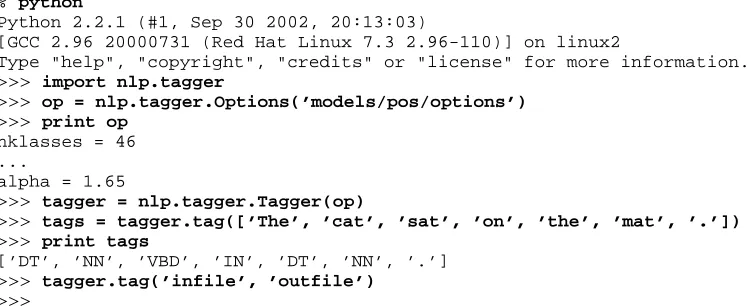
The basic Python reflection has already been imple-mented and used for large scale experiments with POS tagging, using pyMPI(a message passing interface library for Python) to coordinate experiments across a cluster of over 100 machines (Curran and Clark, 2003; Clark et al., 2003). An example of using the Python tagger interface is shown in Figure 1.
On top of the Python interface we plan to implement aGUI interface for composing and configuring compo-nents. This will be implemented in wxPython which is a platform independentGUI library that uses the native windowing environment under Windows, MacOS and most versions of Unix. The wxPython interface will gen-erate C++ and Python code that composes and config-ures the components. Using the infrastructure, Python and wxPython it will be possible to generate newGUI ap-plications that useNLPtechnology.
Because C++ compilers are now fairly standards com-pliant, and Python and wxPython are available for most architectures, the infrastructure will be highly portable. Further, we eventually plan to implement interfaces to other languages (in particular Java using the Java Native Interface (JNI) and Perl using theXSinterface).
8
Web services
The final interface we intend to implement is a collec-tion of web services forNLP. A web service provides a remote procedure that can be called usingXML based encodings (XMLRPCorSOAP) of function names, argu-ments and results transmitted via internet protocols such asHTTP. Systems can automatically discover and com-municate with web services that provide the functionality they require by querying databases of standardised de-scriptions of services with WSDLandUDDI. This stan-dardisation of remote procedures is very exciting from a software engineering viewpoint since it allows systems to be totally distributed. There have already been several attempts to develop distributedNLPsystems for dialogue systems (Bayer et al., 2001) and speech recognition (Ha-cioglu and Pellom, 2003). Web services will allow com-ponents developed by different researchers in different lo-cations to be composed to build larger systems.
% python
Python 2.2.1 (#1, Sep 30 2002, 20:13:03)
[GCC 2.96 20000731 (Red Hat Linux 7.3 2.96-110)] on linux2
Type "help", "copyright", "credits" or "license" for more information.
>>> import nlp.tagger
>>> op = nlp.tagger.Options(’models/pos/options’)
>>> print op
nklasses = 46 ...
alpha = 1.65
>>> tagger = nlp.tagger.Tagger(op)
>>> tags = tagger.tag([’The’, ’cat’, ’sat’, ’on’, ’the’, ’mat’, ’.’])
>>> print tags
[’DT’, ’NN’, ’VBD’, ’IN’, ’DT’, ’NN’, ’.’]
>>> tagger.tag(’infile’, ’outfile’)
[image:5.612.102.477.74.227.2]>>>
Figure 1: Calling thePOStagger interactively from the Python interpreter
quantities of text (e.g. a single document). The second advantage they have is that there is no startup costs when tagger loads up, which means local copies of the web service could be run to reduce tagging latency. Finally, web services will allow developers of resources such as gazetteers to provide the most up to date resources each time their functionality is required.
We are currently in the process of implementing aPOS tagging web service using the gSOAPlibrary, which will translate our C infrastructure binding into web service wrapper code and produce the necessaryXMLservice de-scription files.
9
Conclusion
The Generative Programming approach to NLP infras-tructure development will allow tools such as sentence boundary detectors, POS taggers, chunkers and named entity recognisers to be rapidly composed from many el-emental components. For instance, implementing an ef-ficient version of the MXPOST POStagger (Ratnaparkhi, 1996) will simply involve composing and configuring the appropriate text file reading component, with the sequen-tial tagging component, the collection of feature extrac-tion components and the maximum entropy model com-ponent.
The individual components will provide state of the art accuracy and be highly optimised for both time and space efficiency. A key design feature of this infrastructure is that components share a common representation for text and annotations so there is no time spent reading/writing formatted data (e.g.XML) between stages.
To make the composition and configuration process easier we have implemented a Python scripting inter-face, which means that anyone can construct efficient new tools, without the need for much programming experi-ence or a compiler. The development of a graphical user interface on top of the infrastructure will further ease the
development cycle.
Acknowledgements
We would like to thank Stephen Clark, Tara Murphy, and the anonymous reviewers for their comments on drafts of this paper. This research is supported by a Common-wealth scholarship and a Sydney University Travelling scholarship.
References
David Abrahams. 2003. Boost.Python C++ library. http://www.boost.ory (viewed 23/3/2003).
Andrei Alexandrescu. 2001. Modern C++ Design: Generic
Programming and Design Patterns Applied. C++ In-Depth
Series. Addison-Wesley, New York.
Michele Banko and Eric Brill. 2001. Scaling to very very large corpora for natural language disambiguation. In Proceedings
of the 39th annual meeting of the Association for Computa-tional Linguistics, pages 26–33, Toulouse, France, 9–11 July.
Samuel Bayer, Christine Doran, and Bryan George. 2001. Dia-logue interaction with the DARPA Communicator Infrastruc-ture: The development of useful software. In J. Allan, editor,
Proceedings of HLT 2001, First International Conference on Human Language Technology Research, pages 114–116, San
Diego, CA, USA. Morgan Kaufmann.
Avrim Blum and Tom Mitchell. 1998. Combining labeled and unlabeled data with co-training. In Proceedings of the
11th Annual Conference on Computational Learning Theory,
pages 92–100, Madisson, WI, USA.
Thorsten Brants. 2000. TnT - a statistical part-of-speech tagger. In Proceedings of the 6th Conference on Applied Natural
Language Processing, pages 224–231, Seattle, WA, USA, 29
April – 4 May.
Eric Brill. 1993. A Corpus-Based Appreach to Language Learning. Ph.D. thesis, Department of Computer and
Stanley Chen and Ronald Rosenfeld. 1999. A Gaussian prior for smoothing maximum entropy models. Technical report, Carnegie Mellon University.
Stephen Clark, James R. Curran, and Miles Osborne. 2003. Bootstrapping POS-taggers using unlabelled data. In
Pro-ceedings of the 7th Conference on Natural Language Learn-ing, Edmonton, Canada, 31 May – 1 June. (to appear).
Hamish Cunningham, Yorick Wilks, and Robert J. Gaizauskas. 1997. GATE – a general architecture for text engineering. In
Proceedings of the 16th International Conference on Com-putational Linguistics, pages 1057–1060, Copenhagen,
Den-mark, 5–9 August.
Hamish Cunningham, Diana Maynard, C. Ursu K. Bontcheva, V. Tablan, and M. Dimitrov. 2002. Developing language processing components with GATE. Technical report, Uni-versity of Sheffield, Sheffield, UK.
Hamish Cunningham. 2000. Software Architecture for
Lan-guage Engineering. Ph.D. thesis, University of Sheffield.
James R. Curran and Stephen Clark. 2003. Investigating GIS and smoothing for maximum entropy taggers. In
Proceed-ings of the 11th Meeting of the European Chapter of the As-sociation for Computational Lingustics, pages 91–98,
Bu-dapest, Hungary, 12–17 April.
James R. Curran and Marc Moens. 2002. Scaling context space. In Proceedings of the 40th Annual Meeting of the
As-sociation for Computational Linguistics, Philadelphia, PA,
USA, 7–12 July.
Krzysztof Czarnecki and Ulrich W. Eisenecker. 2000.
Gen-erative Programming: Methods, Tools, and Applications.
Addison-Wesley.
Walter Daelemans, Jakub Zavrel, Ko van der Sloot, and An-tal van den Bosch. 2002. TiMBL: Tilburg Memory-Based Learner reference guide. Technical Report ILK 02-10, In-duction of Linguistic Knowledge. Tilburg University.
Ido Dagan and Sean P. Engelson. 1995. Committee-based sam-pling for training probabilistic classifiers. In Proceedings of
the International Conference on Machine Learning, pages
150–157, Tahoe City, CA, USA, 9–12 July.
David Day, John Aberdeen, Lynette Hirschman, Robyn Kozierok, Patricia Robinson, and Marc Vilain. 1997. Mixed-initiative development of language processing sys-tems. In Proceedings of the Fifth Conference on Applied
Natural Language Processing, pages 384–355, Washington,
DC, USA, 31 March – 3 April.
Cristiane Fellbaum, editor. 1998. Wordnet: an electronic
lexi-cal database. The MIT Press, Cambridge, MA USA.
Claire Grover, Colin Matheson, Andrei Mikheev, and Marc Moens. 2000. LT TTT - a flexible tokenisation tool. In
Pro-ceedings of Second International Language Resources and Evaluation Conference, pages 1147–1154, Athens, Greece,
31 May – 2 June.
Kadri Hacioglu and Bryan Pellom. 2003. A distributed archi-tecture for robust automatic speech recognition. In
Proceed-ings of Conference on Acoustics, Speech, and Signal Pro-cessing (ICASSP), Hong Kong, China, 6–10 April.
Nancy Ide, Randi Reppen, and Keith Suderman. 2002. The american national corpus: More than the web can provide. In Proceedings of the Third Language Resources and
Eval-uation Conference, pages 839–844, Las Palmas, Canary
Is-lands, Spain.
Lauri Karttunen, Tam´as Ga´al, and Andr´e Kempe. 1997. Xerox Finite-State Tool. Technical report, Xerox Research Centre Europe Grenoble, Meylan, France.
Linguistic Data Consortium. 2003. English Gigaword Corpus. catalogue number LDC2003T05.
Edward Loper and Steven Bird. 2002. NLTK: The Natural Lan-guage Toolkit. In Proceedings of the Workshop on Effective
Tools and Methodologies for Teaching NLP and Computa-tional Linguistics, pages 63–70, Philadelphia, PA, 7 July.
Robert Malouf. 2002. A comparison of algorithms for max-imum entropy parameter estimation. In Proceedings of the
6th Conference on Natural Language Learning, pages 49–
55, Taipei, Taiwan, 31 August – 1 September.
Mitchell Marcus, Beatrice Santorini, and Mary Marcinkiewicz. 1993. Building a large annotated corpus of English: The Penn Treebank. Computational Linguistics, 19(2):313–330.
Andrei Mikheev, Claire Grover, and Marc Moens. 1999. Xml tools and architecture for named entity recognition. Journal
of Markup Languages: Theory and Practice 1, 3:89–113.
Mehryar Mohri, Fernando C. N. Pereira, and Michael Riley. 1998. A rational design for a weighted finite-state transducer library. Lecture Notes in Computer Science, 1436.
Grace Ngai and Radu Florian. 2001. Transformation-based learning in the fast lane. In Proceedings of the Second
Meeting of the North American Chapter of the Association for Computational Linguistics, pages 40–47, Pittsburgh, PA,
USA, 2–7 June.
Adwait Ratnaparkhi. 1996. A maximum entropy part-of-speech tagger. In Proceedings of the EMNLP Conference, pages 133–142, Philadelphia, PA, USA.
Adwait Ratnaparkhi. 1998. Maximum Entropy Models for
Nat-ural Language Ambiguity Resolution. Ph.D. thesis,
Univer-sity of Pennsylvania.
Emmanuel Roche and Yves Schabes. 1997. Deterministic part-of-speech tagging with finite-state transducers. In Em-manuel Roche and Yves Schabes, editors, Finite-State
Lan-guage Processing, chapter 7. The MIT Press.
Hans van Halteren, Jakub Zavrel, and Walter Daelemans. 2001. Improving accuracy in wordclass tagging through combina-tion of machine learning systems. Computacombina-tional
Linguis-tics, 27(2):199–229.
Ian H. Witten and Eibe Frank. 1999. Data Mining: Practical