LOCATION AWARE MODIFIED AODV TO
SELECT BEST PATH
Anagha R. Raich
1, Prof. Amarsinh Vidhate
2 1 2Department of Computer Science 1RamraoAdik Instituteof Technology 2RamraoAdik Instituteof Technology 1Email- [email protected]ABSTARCT:
Routing is an essential function for traffic management in ad hoc networks. Ad hoc network is a collection of wireless, mobile, dynamic, and arbitrarily located nodes. The high mobility of nodes results in rapid changes in the routes, thus requiring some mechanism for determining new routes with minimum overheads and bandwidth consumption. Node mobility may result in frequent route failures. In location aware modified AODV routing protocol, route discovery is performed in a reactive manner. Here location is checked by GPS coordinates and best route is discovered based on performance calculated based on various parameters like Node ID, Time Stamp, Bandwidth, RTT, and Packet Loss Ratio. This paper present empirical study of location aware modified AODV. The proposed modified AODV selects the based on the said matrix instead of only shortest route. Our proposal is neither completely proactive nor completely reactive. Based on the network condition it tries to find the optimum route. Such proposals are more suitable for highly mobile network where the mobility rate is high. Route discovery is calculated for different topology.
Keywords: MANET; AODV; Round trip time (RTT); Packet loss ratio, Bandwidth, location aware, best route,
global position system.
1. INTRODUCTION
A mobile ad hoc network is the collection of nodes which form the temporary network without the centralized body due to constant changes in network topology. Each node in a MANET serves as a router and performs mobility functionalities in an autonomous manner. Guaranteeing delivery and the capability to handle dynamic connectivity are the most important issues for routing protocol in mobile ad hoc network. In MANET protocols are three type proactive, reactive and hybrid. Proactive maintain a continues view of the full topology of the network in each node. Ex. DSDV, OLSR. Reactive protocol is an on demand protocols. Ex. AODV, TORA. Hybrid protocol combination of proactive as well as reactive. Location aware modified AODV protocol is reactive protocol. Route discovery is performed reactively i.e. on demand.
2. Performance matrices
A performance matrix shows various parameters are i) Node id ii) Time stamp iii) GPS coordinate, iv) Bandwidth v) RTT
vi) Packet loss ratio.
2.1 Node id
Node id is nothing but node identification number.
2.2 Time Stamp
A timestamp is the current time of an event that is recorded by a computer.
2.3 GPS Coordinate
GPS coordinate gives the physical location of nodes. Here we calculate GPS position by broadcasting messages in the network.
2.4 Bandwidth
Bandwidth is relates to the amount of data that a link or network path can deliver per unit time. Bandwidth is proportional to energy level and traffic load. Therefore to check bandwidth, we check energy level and traffic load of node.
2.5 Round Trip Time
Round-trip time (RTT) is also known as the ping time. RTT is the length of time it takes for a signal (data packet) to be sent plus the length of time it takes for acknowledgment of that data packet to be received. This time delay therefore consists of transmission times between the two of a data packet. Ping ( ) function is use to check round trip time.
2.6 Packet loss ratio
Packet loss occurs when one or more packets of data travelling across a computer network fail to reach their destination. Packet loss is distinguished as one of the three main error types encountered in digital communications. The other two being bit error and spurious packets caused due to noise. Loss ( ) function is use to measure the packet loss ratio.
3. Location Aware Modified AODV:
Phase I–Neighbor node selection Phase II- Route DiscoveryFigure1 Sample Network
[image:3.595.107.497.204.319.2]To find best path we check nodes location. Nodes locations are checked by their GPS co-ordinates. If nodes are healthy then we compare their location with source node. if it is far from source node but near to destination then we select those nodes. The routes with minimum over head reach to destination. That route gets selected to transmit the data. Here such route is called best path.
Figure 2 Route Discovery
Step 1:
• Node weightage (d) = x1a + y1b + z1c, where a= BW, b= RTT, c= Pkt Loss Ratio.
• If d > predefined value say 70% it is considered as healthy to forward the message.
Step 2:
• Based on Destination Co-ordinate (Xd,Yd) & it’s velocity (v) the Expected Zone is calculated as
indicated by Circle, where R=v (t1-t0).
• Based on above Request zone is calculated as indicated by rectangle,
[image:3.595.169.427.516.567.2]If Node is within the Request Zone it will forward the RERQ Message, else it will be discarded.
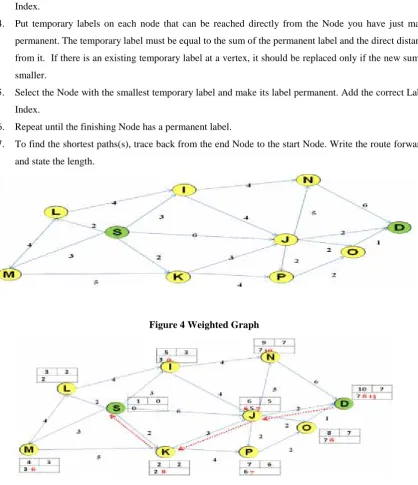
1. Label the start Node with permanent label 0 and Label Index 1.
2. Assign temporary labels to all the Nodes that can be reached directly from the start.
3. Select the Nodes with the smallest temporary label and make its label permanent. Add the correct Label
Index.
4. Put temporary labels on each node that can be reached directly from the Node you have just made
permanent. The temporary label must be equal to the sum of the permanent label and the direct distance
from it. If there is an existing temporary label at a vertex, it should be replaced only if the new sum is
smaller.
5. Select the Node with the smallest temporary label and make its label permanent. Add the correct Label
Index.
6. Repeat until the finishing Node has a permanent label.
7. To find the shortest paths(s), trace back from the end Node to the start Node. Write the route forwards
[image:4.595.93.512.154.640.2]and state the length.
Figure 4 Weighted Graph
Figure 5 For Selecting Shortest Path
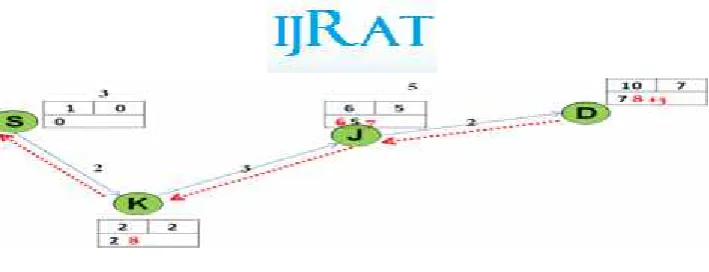
Figure 6 Computed Shortest Path
As evident route identified by proposed method broadcast the RREQ to nodes. We consider only healthy nodes to transmit the data. Due to this energy is consumed. Reduce the flooding of messages. Try to avoid congestions in MANET.
5. Conclusion
One of the main difficulties in MANET (Mobile Ad hoc Network) is the routing problem, which is aggravated by frequent topology changes due to node movement, radio interference and network partitions.
Due to the presence of mobility, the routing information will have to be changed to reflect changes in link connectivity. There are several possible paths from source to destination. The routing protocols find a route from source to destination and deliver the packet to correct destination.
Location Aware protocol finds best path from source to destination using reactive routing. Here route discovery is performed using various parameters like GPS position, bandwidth, RTT, packet loss ratio, time stamp. We are minimizing the search time and providing best path to transfer packet. In future we compare these results with AODV protocol. We will find best path for varying nodes.
6. References
[1]. Kristian Evensen, Andreas Petlund, Haakon Riiser, Paul Vigmostad, Dominik Kaspar, Carsten Griwodz,Pal Halvorsen ,"Mobile Video Streaming Using Location-Based Network Prediction and Transparent Handover", NOSSDAV, 2011, pp. 1–3.
[2]. Aris a. Papadopoulos, julie a. Mccann, “Towards the Design of an Energy-efficient, Location-aware Routing Protocol for Mobile, Ad-hoc Sensor Networks”,International Workshop on Database and Expert
Systems Applications (DEXA’04) 1529-4188/04 IEEE
[3]. Young-Bae Ko and Nitin H. Vaidya, “Location –Aided Routing (LAR) in Mobile ad hoc network”,
Wireless Networks 6 (2000) ,pp 307-321.
[4]. Hossein Ashtiani, Shahpour Alirezaee, Seyed mohsen mir Hussein, HamidKhosravi, “PNR: New Position based Routing Algorithm for Mobile Ad Hoc Networks”, WCE 2009, pp
[5]. Soumya Roy,J.J.Garcia-Luna-Aceves ,“An Efficient Path Selection Algorithm for On-Demand Link-State Hop-by-Hop Routing “,IEEE 2002 , pp 561-564.
[6]. Kavita Pandey, Abhishek Swaroop ,"A Comprehensive Performance Analysis of Proactive, Reactive and Hybrid MANETs Routing Protocols", IJCSI, November 2011, pp 432- 441
Neighborhood”, 978-1-4244-2100-8/08 IEEE 2008
[14] C. Perkins, E. Belding-Royer, S. Das,” Ad-hoc On-Demand Distance Vector (AODV) Routing”, Internet
experimental RFC 3561, July 2003, pp.7-24.
[15]. Wen-hwa liao and jang-ping sheu,yu-chee tseng , “GRID: A Fully Location-Aware Routing Protocol for