Manual vs Automatic Bitext Extraction
Aibek Makazhanov, Bagdat Myrzakhmetov, Zhenisbek Assylbekov
Nazarbayev University, National Laboratory AstanaNazarbayev University, School of Science and Technology 53 Kabanbay Batyr ave., Astana, Kazakhstan
[email protected], [email protected], [email protected] Abstract
We compare manual and automatic approaches to the problem of extracting bitexts from the Web in the framework of a case study on building a Russian-Kazakh parallel corpus. Our findings suggest that targeted, site-specific crawling results in cleaner bitexts with a higher ratio of parallel sentences. We also find that general crawlers combined with boilerplate removal tools tend to retrieve shorter texts, as some content gets cleaned out with the markup. When it comes to sentence splitting and alignment we show that investing some effort in data pre- and post-processing as well as fiddling with off-the-shelf solutions pays a noticeable dividend. Overall we observe that, depending on the source, automatic bitext extraction methods may lack severely in coverage (retrieve fewer sentence pairs) and on average are fewer precise (retrieve lessparallelsentence pairs). We conclude that if one aims at extracting high-quality bitexts for a small number of language pairs, automatic methods best be avoided, or at least used with caution.
Keywords:bitext extraction, crawling, sentence alignment
1. Introduction
The Web has long been used as one of, if not, the most important source for obtaining language resources of various purpose, size and quality. Given the large amount and accessibility of text available in a vari-ety of languages, it is particularly appealing to mine the Web for parallel and comparable corpora (bitexts), resources essential for building and evaluating data-driven machine translation systems.
The task of extracting bitexts from the Web typically involves the following four major consecutive steps: (i) data collection (crawling), (ii) document alignment, (iii) sentence segmentation, and (iv) sentence align-ment. Depending on the degree of user involvement in the first two steps, approaches to the problem can be classified roughly as: (i) manual methods (Koehn, 2005; Tiedemann, 2007; Myrzakhmetov et al., 2016) that crawl specific websites and usually rely on their id-iosyncratic properties at the document alignment step; (ii) semi-automatic methods (Esplà-Gomis and For-cada, 2010; Papavassiliou et al., 2013) that make no site-specific assumptions, but still require a target list of URLs to extract bitexts from; (iii) completely au-tomatic methods (Smith et al., 2013; Ljubes̆ić et al., 2016; Resnik and Smith, 2003) that crawl the entire Web and produce whatever bitexts they can.
Choosing appropriate extraction strategy depends greatly on the task at hand. Thus, if the goal is to extract bitexts for dozens of language pairs automatic approaches may come in handy. However, if one needs a high quality parallel corpus for just one or two pairs of languages, what is the difference between bitexts obtained by manual and automatic methods? Is the final quality of manual extraction worth time and ef-fort? To our disappointment, we could not find de-tailed answers to these questions in the literature. Var-ious implementations of the extraction strategies are typically evaluated in terms of the alignment quality of
the obtained bitexts and/or performance of SMT sys-tems trained on those bitexts. Comparative evaluation mostly concerns different implementations of the semi-automatic approaches (Toral et al., 2014; Esplà-Gomis et al., 2014; Laranjeira et al., 2014). We believe that even a rough estimate of the quality/quantity trade off between bitexts obtained manually and automati-cally can provide important insights and guidelines for building parallel corpora. In this work we attempt to provide such an estimate.
We divide the process of bitext extraction (BE) in two stages as a pre- and post-document alignment (DA) stage. The pre-DA stage involves crawling and DA it-self. The post-DA stage is about sentence splitting and alignment, with possible cleaning steps that may im-prove the quality of an extracted bitext. We compare (semi-) automatic and manual approaches to both BE stages using a range of metrics and manual and auto-matic estimates.
1.1.
General Setting
(a) Side-by-side boxplots (b) Scatter plot
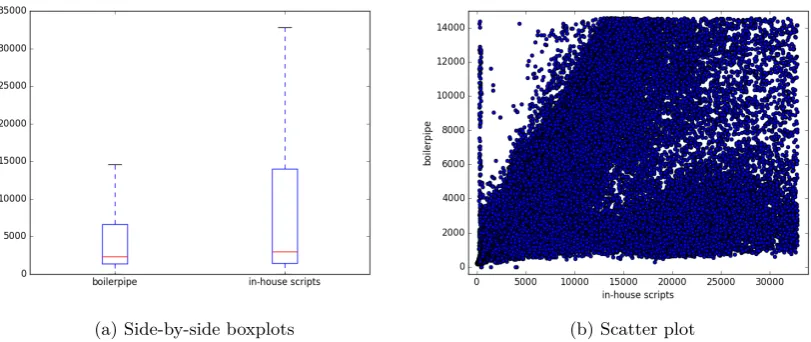
Figure 1: Lengths (in characters) of the texts extracted by the boilerpipe and in-house scripts
2.
General vs Targeted Crawling
The crawling step can be divided into three parts: (1) obtaining the links to parallel web pages (spidering), (2) downloading raw HTML files, (3) extracting plain texts from the downloaded web pages. The download-ing step is trivial; it is steps (1) and (3) where general and targeted crawling diverge.
General crawling. For a given page-aligned website we obtain the links to all pages in one language (source language), using theGNU wgettool in spider mode and specifying a regular expression pattern to accept only the links to pages in sourcelanguage (e.g. '/ru/' for the links in Russian). Then we useGNU wgetagain to download all the pages in the source language. Next from raw HTML source pages we obtain the corre-sponding links to pages in target language from the raw source language HTML files and download all the web pages in the target language. Finally, we remove boiler-plate text, i.e. navigational elements, templates, and advertisements which are not related to the main content, and extract plain text from the downloaded HTML-files using the boilerpipe tool. We also re-move duplicates using fdupestool1.
Targeted crawling. For this task we use site-specific crawlers, which are essentially in-house python scripts (one per website). Here instead of obtaining the links and later using them to download the content. We can traverse certain branches of a website (say, news), download pages in both source and target languages, and extract meaningful content relying on the HTML-structure of the site: all in one go.
2.1. Comparison of the Spider Methods
For a given website, letB be the set of unique source-language links obtained by the baseline method, and I be the set of unique source-language links obtained by the in-house scripts. Cardinalities of B, I, B∩I, B\I,I\B for the four websites are given in Table 1. One should notice that the numbers in Table 1 are not directly comparable between the two methods: in the1https://github.com/adrianlopezroche/fdupes
baseline approach we use thewgettool to obtainallthe URLs from a given website, whereas the hand-made scripts are designed to crawl only particular branches (legal documents, news, announcements, etc.) on each website. Theoretically,wgetin--spidermode should obtainall links from a given website, and one should expect thatB ⊃I (or almost so depending on a time lag between two crawls), but this is not always the case as it can be seen from Table 1. Moreover, in some cases the in house scripts obtained more links, and as our closer analysis reveals in the case of akordathere were 3 unique links per page in B.
2.2. Comparison of the Text Extraction
Methods
We consider the links fromB∩I, i.e. those links which were obtained by both the baseline and the in-house methods. According to Table 1, there are 108,960 of such links per each language. We downloaded the web pages from those links, and then we applied the
boilerpipe tool and the in-house Python scripts to extract texts from them. After that character lengths were calculated for all texts, and outliers were removed using the Tukey’s IQR rule (Tukey, 1977).
Website |B| |I| |B∩I| |B\I| |I\B|
adilet 86,234 87,363 79,088 7,146 8,275
akorda 33,572 6,357 6,347 27,225 10
astana 28,067 6,512 6,496 21,571 16
[image:3.595.161.432.67.144.2]strategy 28,078 28,253 17,029 9,246 11,224 TOTAL 175,951 128,485 108,960 65188 19525
Table 1: Number of links obtained by the baseline (B) and by the in-house (I) methods
Website Annotator-1 Annotator-2 Annotator-3 Final
Wget + boilerp.
In-house scripts
Wget + boilerp.
In-house scripts
Wget + boilerp.
In-house scripts
Wget + boilerp.
In-house scripts
adilet 0.7950 0.9375 0.8050 0.9425 0.7125 0.8825 0.7500 0.9075
akorda 0.8200 0.9525 0.8125 0.9450 0.7625 0.8675 0.7750 0.9050
astana 0.6400 0.7925 0.6350 0.7950 0.5050 0.7325 0.5975 0.7400
[image:3.595.80.514.186.271.2]strategy 0.7550 0.7700 0.7200 0.7525 0.6250 0.6575 0.6425 0.6900
Table 2: Crawling vs Alignment: manual evaluation, proportions of parallel pairs are provided
Metrics Wget+boilerpipe In-house crawling scripts
adilet akorda astana strategy adilet akorda astana strategy # parallel 6,522,758 94,855 208,515 250,536 22,728,878 70,949 63,729 201,671 parallel/total 0.7680 0.8309 0.5698 0.6680 0.8803 0.9116 0.7215 0.6650 short/parallel 0.3079 0.1211 0.0676 0.2276 0.6312 0.0190 0.0098 0.0202 junk/total 0.1260 0.0998 0.3897 0.1191 0.0743 0.0294 0.0610 0.0982
Table 3: Crawling vs Alignment: automatic evaluation
2.3.
Impact of Crawling
To see how the two different ways of crawling affect the final quality of the bitext we applied both meth-ods to the four websites and obtained two sets of par-allel documents, which we proceed to split into sen-tences using NLTK Punkt tokenizer(Kiss and Strunk, 2006), and align with Hunalign(Varga et al., 2007). Thus we end up with two sets of bitexts which dif-fer only in the way they were crawled. To compare these set we randomly sampled 400 pairs from each population2 and asked three annotators if each pair of sentences intended to provide the same content in the two different languages3. The fourth annotator made the final decision. One can see from Table 2 that de-spite the differences in annotations, crawling with the in-house Python scripts consistently outperforms the
Wget+boilerpipe-based crawling across the annota-tions. The difference in sample proportions for the ‘Final’ column is significant at 0.001 level foradilet,
akorda, astana, and at 0.1 level for strategy, two-sided z-test for proportions. This supports the hypoth-esis that the in-house scripts result incleaner bitexts than thewget+boilerpipe-based crawling.
2According to Cohran’s sample size formula (Cochran,
2007), this is enough to ensure 5% margin of error at 95% confidence level.
3The rationale behind asking this question instead of the
question “Are these sentences translations of each other?” is provided by (Resnik and Smith, 2003).
We can also compare the levels of noise in the bitexts by considering the following metrics: (i) proportion of short pairs among parallel pairs; (ii) proportion of ob-viously nonparallel pairs (junk) among all pairs. Here a pair considered short whenever the lengths of each sentence in a pair does not exceed three words. Junk pairs are defined as follows: (i) at least one of the sides (source or target) is empty; (ii) at least one of the sides does not contain any letters (Latin and Cyrillic); (iii) both sides are identical after tokenization and lower-casing. The results of this comparison across the four websites are given in Table 3. We can see again that the targeted crawling produces cleaner bitexts than that of general.
2.4. Automatic Evaluation
[image:3.595.77.520.315.390.2]Metrics Manual BE pipeline Bitextor
[image:4.595.163.434.176.250.2]adilet akorda astana strategy adilet akorda astana strategy # of parallel 22,658,881 70,025 70,449 202,633 296,650 42,217 20,129 67,643 parallel/total 0.9075 0.9484 0.7992 0.7303 0.8725 0.7900 0.3000 0.4350 short/parallel 0.3412 0.0095 0.0075 0.0195 0.0000 0.0285 0.0250 0.0057 junk/total 0.0000 0.0000 0.0000 0.0000 0.0000 0.0025 0.0000 0.0000
Table 4: End-to-end bitext extraction: manual vs automatic
Method P P/T S/P J/T
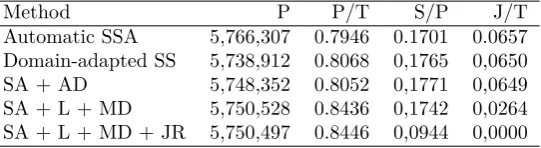
Automatic SSA 5,766,307 0.7946 0.1701 0.0657 Domain-adapted SS 5,738,912 0.8068 0,1765 0,0650 SA + AD 5,748,352 0.8052 0,1771 0,0649 SA + L + MD 5,750,528 0.8436 0,1742 0,0264 SA + L + MD + JR 5,750,497 0.8446 0,0944 0,0000
Table 5: Evaluation of consecutive modification of SSA tools: P - # of sentence pairs deemed parallel; T - total pairs; S - short pairs; J - junk pairs; SS - sentence splitting; SA - sentence alignment; AD - automatic dictionary; L - lemmatization; MD - manual dictionary; JR - junk removal.
the estimates in the ‘Final’ column of Table 2. There-fore we have a quick and reliable method to get the approximate proportion (and number) of parallel sen-tence pairs in a given corpus, which can be used to evaluate any further modifications to the BE pipeline.
3. Bitext Extraction Beyond Crawling
Once crawling and document alignment is complete, we can proceed to the next stage of BE, which in-cludes sentence splitting and alignment (SSA). Here we also distinguish between automatic and manual ap-proaches. An automatic approach entails direct appli-cation of the SSA tools, whereas a manual approach assumes pre- and post-processing of data, as well as adapting SSA tools for a particular language pair. Starting with the parallel documents that we have ex-tracted at the crawling stage, we perform SSA: first automatically and then with successive application of the following modifications: (i) domain adaptation of a sentence splitter (retraining Punkt tokenizer); (ii) using automatically extracted dictionary for sentence alignment (-realign option of Hunalign); (iii) using hand-crafted dictionary in conjunction with prelimi-nary lemmatization of texts4; (iv) removal of junk pairs (cf. subsection 2.3.).After consecutive application of all the modifications we have compared the resulting bitext with the one that was extracted by a popular off-the-shelf tool
Bitextor (Esplà-Gomis and Forcada, 2010). Bitex-tor was run on the four sites on default settings. As it can be seen from Table 4 the manual pipeline ex-tracts more parallel sentences (especially for adilet
data) and is more accurate than an unsupervised au-tomatic tool. However, on average, Bitextor produces
4For lemmatization we use: Mystem (Segalovich, 2003)
for Russian, and a data-driven morphological disambigua-tor (Makhambetov et al., 2015) for Kazakh.
cleaner bitexts with lower short/parallel ratios and sur-prisingly low amount of junk.
Lastly we would like to assess the dynamics of mod-ifying SSA tools. To this end, we perform automatic evaluation of the bitexts extracted after successive ap-plication of each modification. The results of this as-sessment (averaged over the four sites) are given in Ta-ble5. As it can be seen consecutive application of the modifications “cleanses” resulting bitexts, as the ratio of junk pairs decreases. At the same time there is a steady increase in the ratio of parallel sentences. How-ever, the number of parallel and short/parallel pairs do not change monotonically. When we apply domain adapted SS the amount of parallel pairs drops almost 30K, but after that enjoys a steady growth. It turns out that as we provided Punkt sentence splitter with the list of abbreviations a total number of sentences dropped as the number of incorrect segmentations (due to dotted abbreviations) has been reduced.
4.
Related Work
5.
Conclusion
We have compared manual and automatic approaches to the problem of extracting bitexts from the Web in the framework of a case study on building a Russian-Kazakh parallel corpus. We conclude that if one aims at extracting high quality bitexts for a small number of language pairs, automatic methods best be avoided, or at least used with caution. In the future we plan to expand the work on manual bitext extraction, and experiment with more Kazakhstani websites, includ-ing not page-aligned ones. Our ultimate goal is to build a high quality, decent-sized parallel corpus for the Russian-Kazakh pair.
6.
Acknowledgements
This work has been funded by the Nazarbayev Uni-versity under the research grant №129-2017/022-2017 and by the Committee of Science of the Ministry of Education and Science of the Republic of Kazakhstan under the research grant AP05134272.
7. Bibliographical References
Assylbekov, Z., Myrzakhmetov, B., and Makazhanov,A. (2016). Experiments with Russian to Kazakh Sentence Alignment. Izvestija KGTU im.I.Razzakova, 38(2):18–23.
Cochran, W. G. (2007). Sampling techniques. John Wiley & Sons.
Esplà-Gomis, M. and Forcada, M. (2010). Combin-ing content-based and url-based heuristics to har-vest aligned bitexts from multilingual sites with bi-textor. The Prague Bulletin of Mathematical Lin-guistics, 93:77–86.
Esplà-Gomis, M., Klubic̆ka, F., Ljubes̆ić, N., Ortiz-Rojas, S., Papavassiliou, V., and Prokopidis, P. (2014). Comparing two acquisition systems for au-tomatically building an english-croatian parallel cor-pus from multilingual websites. In LREC, pages 1252–1258.
Kiss, T. and Strunk, J. (2006). Unsupervised multi-lingual sentence boundary detection. Computational Linguistics, 32(4):485–525.
Koehn, P. (2005). Europarl: A parallel corpus for statistical machine translation. InMT summit, vol-ume 5, pages 79–86.
Laranjeira, B., Moreira, V. P., Villavicencio, A., Ramisch, C., and Finatto, M. J. B. (2014). Com-paring the quality of focused crawlers and of the translation resources obtained from them. InLREC, pages 3572–3578. Citeseer.
Ljubes̆ić, N., Esplà-Gomis, M., Toral, A., Rojas, S. O., and Klubic̆ka, F. (2016). Producing mono-lingual and parallel web corpora at the same time - spiderling and bitextor’s love affair. In Nicoletta Calzolari (Conference Chair), et al., editors, Pro-ceedings of the Tenth International Conference on Language Resources and Evaluation (LREC 2016), Paris, France, may. European Language Resources Association (ELRA).
Makhambetov, O., Makazhanov, A., Sabyrgaliyev, I., and Yessenbayev, Z. (2015). Data-driven morpho-logical analysis and disambiguation for kazakh. In Proceedings of the 2015 Computational Linguistics and Intelligent Text Processing, Part I, pages 151– 163, Cairo, Egypt. Springer International Publish-ing.
Myrzakhmetov, B., Sultangazina, A., and Makazhanov, A. (2016). Identification of the parallel documents from multilingual news websites. In Application of Information and Communication Technologies (AICT), 2016 IEEE 10th International Conference on, pages 197–202. IEEE.
Papavassiliou, V., Prokopidis, P., and Thurmair, G. (2013). A modular open-source focused crawler for mining monolingual and bilingual corpora from the web. InProceedings of the Sixth Workshop on Build-ing and UsBuild-ing Comparable Corpora, pages 43–51. Resnik, P. and Smith, N. A. (2003). The web as a
par-allel corpus. Computational Linguistics, 29(3):349– 380.
Segalovich, I. (2003). A fast morphological algorithm with unknown word guessing induced by a dictionary for a web search engine. InMLMTA.
Shapiro, S. S. and Wilk, M. B. (1965). An analysis of variance test for normality (complete samples). Biometrika, 52(3/4):591–611.
Smith, J. R., Saint-Amand, H., Plamada, M., Koehn, P., Callison-Burch, C., and Lopez, A. (2013). Dirt cheap web-scale parallel text from the common crawl. InACL (1), pages 1374–1383.
Tiedemann, J. (2007). Building a multilingual parallel subtitle corpus. Proc. CLIN, page 14.
Toral, A., Rubino, R., Esplà-Gomis, M., Pirinen, T., Way, A., and Ramirez-Sanchez, G. (2014). Ex-trinsic evaluation of web-crawlers in machine trans-lation: a case study on croatian–english for the tourism domain. In Proceedings of the 17th Confer-ence of the European Association for Machine Trans-lation (EAMT), pages 221–224.
Tukey, J. W. (1977). Exploratory data analysis. Varga, D., Halacsy, P., Kornai, A., Nagy, V., Nemeth,
L., and Tron, V. (2007). Parallel corpora for medium density languages. Recent Advances in Nat-ural Language Processing IV: Selected Papers from RANLP 2005, 292:247.