Portuguese Named Entity Recognition using Conditional Random Fields and
Local Grammars
Juliana P. C. Pirovani, Elias de Oliveira
Universidade Federal do Esp´ırito Santo - UFES Av. Fernando Ferrari, 514, 29075-910 Vit´oria, ES, Brazil[email protected],[email protected]
Abstract
Named Entity Recognition involves automatically identifying and classifying entities such as persons, places, and organizations, and it is a very important task in Information Extraction. Conditional Random Fields is a probabilistic method for structured prediction, which can be used in this task. This paper presents the use of Conditional Random Fields for Named Entity Recognition in Portuguese texts considering the term classification obtained by a Local Grammar as an additional informed feature. Local grammars are handmade rules to identify named entities within the text. The Golden Collection of the First and Second HAREM considered as a reference for Named Entity Recognition systems in Portuguese were used as training and test sets respectively. The results obtained outperform the results of competitive systems reported in the literature.
1.
Introduction
Named Entity Recognition (NER) aims at automatically identifying and classifying entities such as persons, places, organizations and values. This is a fundamental task in In-formation Extraction since, besides having several applica-tions, other tasks such as relations and events extraction, question answering systems and entity-oriented search de-pend on it as a preprocessing step (Jiang, 2012).
NER is not a simple task. Several categories of named en-tities (NEs) are written similarly and they appear in similar contexts. In addition, the same NE can be classified into different categories depending on the surrounding context and some entities do not appear even in large training sets. Thus, dictionaries are not always useful.
In 1995, the Message Understanding Conference (MUC-6) (Grishman and Sundheim, 1996) included the NER task for the first time for the English. Several similar events have emerged later such as the CoNLL (Tjong Kim Sang and De Meulder, 2003) and the HAREM (Santos and Cardoso, 2007; Mota and Santos, 2008). HAREM was an initiative for the Portuguese and the annotated corpora used in the First and Second HAREM, known as the Golden Collec-tions (GC), are used as a golden standard reference for NER systems in Portuguese.
HAREM differs from other similar events in two aspects (Mota and Santos, 2008): the classification of an NE de-pends only on its use in context and more than one classi-fication can be assigned to an NE. Moreover, the HAREM classifies 10 categories of NEs (Person, Place, Organiza-tion, Value, Time, Event, AbstracOrganiza-tion, Work, Thing and Other). Thus, the HAREM presents a more demanding task and, therefore, the performance values obtained using its reference data sets are still lower compared to the others (Santos and Cardoso, 2007).
NER systems can be developed using the following ap-proaches: linguistics, machine learning or hybrid. This work seeks to explore the potential of the linguistics and machine learning approaches by constructing a hybrid system for NER in Portuguese. The presented strategy, CRF+LG, combines a labeling obtained by a Conditional
Random Fields (CRF) with a term classification obtained from Local Grammars (LGs). Sutton and McCallum in (Sutton and McCallum, 2012) say that an interesting type of feature for the CRF can be the result of simpler methods for the same task. Thus, in this work we apply LGs to per-form the pre-labeling by capturing general evidence of NEs in texts and the CRF performs sequential labeling using this pre-labeling. The pre-labeling is sent to the CRF together with other features and can be seen as a suggestion for the CRF.
Conditional Random Fields (Lafferty et al., 2001) is a ma-chine learning method, which has been successfully used in several Natural Language Processing (NLP) tasks, includ-ing NER. NER is treated as a sequence labelinclud-ing problem and a conditional model is constructed from a training data set to predict which is the best labeling sequence given an input sentence.
Local Grammars are one means of representing the contex-tual rules of the linguistics approach. ”Local grammars are finite-state grammars or finite-state automata that represent sets of utterances of a natural language” (Gross, 1999). This paper is organized in 5 sections. Section 2 presents the state of the art and the Section 3 presents the methodology used in this work. The results of the study are presented in Section 4 and Section 5 presents conclusions and future works.
2.
State of the Art
The systems presented in (Amaral, 2013) and (Santos and Guimaraes, 2015) achieved the best results for the 10 cate-gories of the HAREM to date.
In (Santos and Guimaraes, 2015), the authors proposed a language-independent system based on the CharWNN Deep Neural Network (DNN), which uses word-level and character-level representations to perform sequential clas-sification. The approach presented better results compared to the ETLC M T system, an ensemble method that uses
En-tropy Guided Transformation Learning (ETL).
A combination of K-Nearest Neighbors (KNN) and CRF for English NER in tweets was proposed in (Liu et al., 2011). Due to insufficient information in a tweet and the unavailability of training data, a semi-supervised learning and 30 gazetteers were used. The KNN classifier conducts a word-level classification and the labeled results are fed into a CRF together with other conventional features. The KNN and CRF models are repeatedly retrained with an in-crementally augmented training set. The method showed advantages over the baselines.
In (Constant and Tellier, 2012), the authors propose to eval-uate the impact of external lexical resources into a CRF in order to perform the joint task of multiword segmenta-tion and part-of-speech tagging in French. The informasegmenta-tion coming from dictionaries and local grammars recognizing numerical determiners and some NEs like organization or place was coupled as features into a CRF in two different ways: concatenating each possible POS category (Learn-concat) and considering each possible category in the re-sources as a new boolean property (Learn-bool). They ob-tained a gain of 0.5% in terms of F-measure and showed that the integration of lexicon-based features significantly compensates the use of a small training corpus.
This paper aims to perform the NER for the 10 categories of the HAREM using CRF as it was carried out in (Ama-ral, 2013); however, the preprocessing of the texts was per-formed differently and an initial information about the label of each word was obtained by LGs and added to the feature set sent to the CRF training phase.
This work also differs from those presented in (Liu et al., 2011) and (Constant and Tellier, 2012) by combining a rules-based approach with CRF for Portuguese NER and by not using gazetteers or dictionaries. To the best of our knowledege, there is not yet a work that combines LG (or other lexical resources) and CRF for NER in Portuguese.
3.
The Methodology
In this work, the GC of the First and Second HAREM were used as training and test sets respectively. Both GC have 129 texts written in Portuguese and are available in (Lin-guateca, 2017).
During the training phase, initially each input file is splitted into sentences by the tool Unitex1. Unitex uses LGs to de-scribe the different ways that indicate the end of a sentence. For this work, the LG that performs sentence segmentation in Unitex was changed to not split the sentences in a colon (:) and a semicolon (;).
A copy of the segmented files has their tags removed since the GC used has the NEs tags. An LG is applied to these files without any markup and the NEs identified by it are annotated.
1
http://unitexgramlab.org/
On the other hand, the segmented files are tokenized using the OpenNLP2library. In order to represent the NER as a sequence labeling problem, a label must be assigned to each text token. Several notations can be used to delimit NEs and identify tokens in text (Konkol and Konop´ık, 2015), but the IO notation was chosen because it presented better results in previous tests performed during this work.
The IO notation is used as follows: all tokens which are part of the NE are then labeled with I (Inside) and all other tokens with O (Outside or Other). In this case, the class of the NE is also mentioned in label I as shown in Table 1.
Table 1: IO notation for the sentenceMeu pai ´e Gabriel Raimundo da Silva (My father is Gabriel Raimundo da Silva)
(Token IO-Notation)
(Meu O) (pai O) (´e O) (Gabriel I-PERSON) (Raimundo I-PERSON) (da I-PERSON)
(Silva I-PERSON) (. O)
Next, several features are added for each token of the files. These features are used during supervised learning of the CRF prediction model. The features used were the same proposed by (Amaral, 2013), in addition to that feature cor-responding to the label assigned by LG. The feature set is presented in Table 2.
The POS-Tagging of a word corresponds to its grammati-cal class and it was also assigned by the OpenNLP library. When a word does not have one of the previous words (p-1 or p-2) or posterior (p+1 or p+2), the corresponding feature values are ”null”. Table 3 presents an example of a vector of features.
The methodology used for testing is similar. The difference is that the input files do not have the NEs tags. In addi-tion to the files containing the tokens and features, the CRF receives the previously trained model to predict a label for each token.
3.1.
Local Grammars (LG)
An LG created in Unitex is represented as a set of one or more graphs. The LG built in this work consists of 10 graphs, one for each of the NEs categories considered by HAREM.
We observed in the training file in which context each type of NE appeared, what words could somehow indicate the existence of NE to construct each graph. We observed that, for example, words with the first letter capitalized preceded by the prepositionem(in) were labeled as Place. We also observed that some NEs of the Person category are pre-ceded by words such asdiz(say),explicou(explained), afir-mou(said), etc.
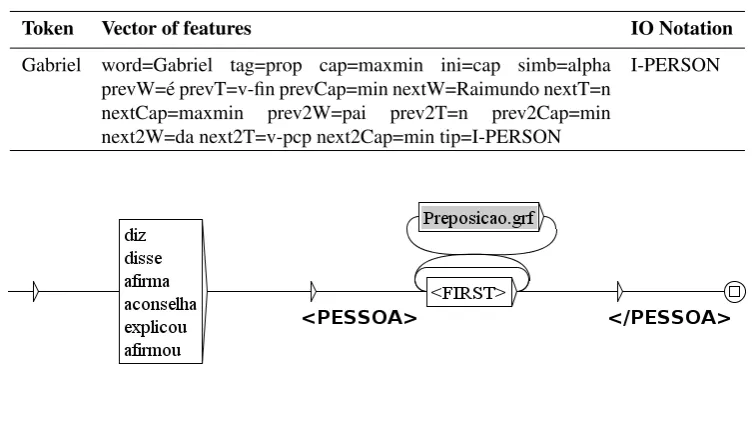
Thus, the graphs created capture some simple heuristics to the recognition of NEs in the training set. An example of rule in the graph created for the Person category is pre-sented in Figure 1.
2
Table 2: Feature set assigned to each token
Features Description
word current word (position p)
tag POS-Tagging of the word corresponding to its grammatical class cap if the word is composed of only capital letters, only lowercase or mixed ini if the word starts with uppercase, lowercase or symbols
simb if the word is composed of symbols, digits or letters prevW, prevT, prevCap word, tag and cap for the word in position p-1 prev2W, prev2T, prev2Cap word, tag and cap for the word in position p-2 nextW, nextT, nextCap word, tag and cap for the word in position p+1 next2W, next2T, next2Cap word, tag and cap for the word in position p+2
tip label assigned by LG to the word
Table 3: Example of a vector of features to the Gabriel token in sentenceMeu pai ´e Gabriel Raimundo da Silva
Token Vector of features IO Notation
Gabriel word=Gabriel tag=prop cap=maxmin ini=cap simb=alpha prevW=´e prevT=v-fin prevCap=min nextW=Raimundo nextT=n nextCap=maxmin prev2W=pai prev2T=n prev2Cap=min next2W=da next2T=v-pcp next2Cap=min tip=I-PERSON
I-PERSON
Figure 1: Example of rule in the graph that recognizes the Person category
This graph recognizes words such asdiz (say) orafirmou (said) followed by words with the first letter capitalized, as identified by the code<FIRST>in Unitex dictionaries. Among words with the first letter capitalized, prepositions may appear whose recognition has been previously detailed in graph Preposicao.grf included as subgraph. Examples of occurrences identified by this graph were:
diz<PESSOA>Moncef Kaabi</PESSOA>
afirmou<PESSOA>Jos´e S ´OCRATES</PESSOA>
afirma<PESSOA>Jason Knight</PESSOA>.
Note that identified person will appear between the tags
<PESSOA>(<PERSON>) and</PESSOA>in the con-cordance file containing the list of occurrences identified.
3.2.
Conditional Random Fields (CRF)
Conditional Random Fields (CRF) is a machine learning method for structured prediction proposed by (Lafferty et al., 2001). It is used for labeling of sequential data based on a conditional approach.
Let X = (x1,x2, ..., xn) be a sequence of words in a text,
we want to determine the best sequence of labels Y = (y1,
y2, ...,yn) for these words, corresponding to the categories
of NEs (10 categories of the HAREM or the label O in this work). The CRF models a conditional distributionp(Y|X) that represents the probability of obtaining the output Y given the input X.
In this work, we used a linear-chain CRF that predict the output variables Y as a sequence for sequences of input variables X. According to (Sutton and McCallum, 2012), a linear-chain CRF is a conditional distribution that takes the form shown in Equation 1:
p(y|x) = 1
Z(x)
T
Y
t=1
exp
(K
X
k=1
θkfk(yt, yt−1,xt)
)
(1)
where Z(x) is a normalization function given by Equation 2:
Z(x) =X
y T
Y
t=1
exp
( K
X
k=1
θkfk(yt, yt−1,xt)
)
(2)
F ={fk(yt, yt−1,xt)}Kk=1is a set of feature functions that
a function which takes the value 1 when the word begins with a capitalized letter (component of the input vectorxt),
its label is Person (yt) and the previous label (yt−1) is Other
and 0 otherwise. The vectorxtcontains all the components
of the global observations x that are needed for computing features at time t.θ={θk}is a vector of weights that must
be estimated from the training set. This is usually done by maximum likelihood learning. The weights depend on each feature function and the more discriminating the function, the higher its computed weight will be.
The MALLET3toolkit was used in this work to estimate the vector of weights and then apply the CRF model obtained to label the test set. This CRF model combines the weights of each feature function to determine the probability of a certain value (yt).
4.
Results and Discussion
The annotated files by CRF+LG and NERP-CRF (Amaral, 2013) were submitted to SAHARA4for performance uation. SAHARA is an online system for automatic eval-uations of the HAREM. This system computes metrics of Precision (P), Recall (R) and F-Measure (F) of an NER system after submitting annotated XML files and config-ures the evaluation desired by the user. In this setting, the evaluation mode is chosen, denoting which task should be evaluated: identification that evaluates only if the recog-nized string is actually an NE; or classification that in ad-dition to checking the boundaries of the NE also checks if the category is correct. The only modification made to the default configuration was the assignment of the value zero for theβ andγparameters because they correspond to the types and subtypes of the categories that were not classified in this work.
The file annotated by NERP-CRF was obtained as indi-cated in (Amaral et al., 2014)5. We modified the identi-fiers (ID) of each NE by adding a unique number at the end for the evaluation in the SAHARA due to the NERP-CRF uses the same ID for all NEs in a document and this changes the actual system performance computed by SA-HARA. Note that, when a unique ID is not assigned to ev-ery NE, the computed metrics do not consider all false pos-itives, only one per document that has false positive. We realized this by studying the evaluation architecture of the Second HAREM and analyzing the files generated by each module.
The results obtained overcome the NERP-CRF results in more than 10% for the Recall metric in the identification task (Table 4) and more than 8% in the classification task (Table 5). For the F-Measure metric, CRF+LG overcome the NERP-CRF results in more than 8% and 7% in the iden-tification and classification tasks respectively, representing considerable gain.
The authors in Santos and Guimaraes (Santos and Guimaraes, 2015) used the GC of the First HAREM as training set and the MiniHAREM as the test set. As (San-tos and Guimaraes, 2015) did not present the results for
3
http://mallet.cs.umass.edu/
4http://www.linguateca.pt/harem/ 5
http://www.inf.pucrs.br/linatural/recursos para reconhecimento de entidades nomeadas/NERP CRF.xml
Table 4: Comparison with NERP-CRF - Identification
Systems P (%) R (%) F(%)
NERP-CRF 73.68 53.79 62.19
CRF+LG 78.58 64.12 70.62
Table 5: Comparison with NERP-CRF - Classification
Systems P (%) R (%) F(%)
NERP-CRF 61.04 43.18 50.57
CRF+LG 65.46 51.75 57.8
the GC of the Second HAREM, CRF+LG was rerun us-ing the GC that they used for trainus-ing and testus-ing. The CoNLL-20026 script that evaluates the classification task was also used as done by those authors to compute the met-rics in our experiments. The selective scenario (categories Person, Place, Organization, Time and Value) was consid-ered in this case because the results presented for the 10 categories of the HAREM were obtained using word-level embeddings previously trained by (Santos and Zadrozny, 2014) who used three other corpus (Portuguese Wikipedia, CETENFolha and CETEMPublico) to perform this unsu-pervised pre-training. Therefore the comparison with this result would be unfair since the CRF+LG uses only the GC of the First HAREM for the CRF training phase and LG construction. Hence, just for the sake of comparison, the GC of the First HAREM has approximately 78667 words while only the CETEMPublico, one of the three corpus used by (Santos and Guimaraes, 2015), has about 180 mil-lion words.
The results are presented in Table 6. Note that CRF+LG achieved a gain of approximately 2% in each metric evalu-ated.
Table 6: Comparison with CharWNN
Systems P (%) R (%) F(%)
CharWNN 65.21 52.27 58.03
CRF+LG 67.09 54.85 60.36
We observed some errors when analyzing false positives and false negatives obtained by CRF+LG: prepositions like de(of) and conjunctions likee(and) that are not considered part of NEs since they are also common outside NEs (e.g., Joaninha Sampaiolabeled as Person when the name was Joaninha Sampaio e Melo); names labeled as Person names when they are part of a larger NE (e.g., Jos´e Mourinhoin Lideranc¸a - As Lic¸˜oes de Jos´e Mourinhothat should be la-beled as Work); capitalized words lala-beled as Organization (e.g.,FESTAwhich is not NE).
6
Several errors occurred due to some inconsistencies in the GC of the First HAREM and Second HAREM. For exam-ple, in the GC of the First HAREM, strings as ”2004” pre-ceded by the prepositionem(in) are considered NEs of the Time category and the CRF+LG learned this and labeled all similar strings preceded byemas Time. However, in the GC of the Second HAREM, the prepositionem is part of the NE. So all these NEs were wrongly labeled. The same happened in other situations of the categories Time, Value and Person.
5.
Conclusions
This paper presented a hybrid approach for the Named En-tity Recognition in Portuguese texts using Conditional Ran-dom Fields and Local Grammars. The term classification obtained initially from LG was sent as a feature for the learning process of the CRF prediction model together with other features. The CRF model performs the final labeling of the NEs. Our approach is a good way to consider the hu-man expertise for capturing the rules that do not appear in examples of the annotated corpus used for training by the CRF.
The results obtained outperform the results of competitive systems reported in the literature when performing under equivalent conditions. It is important to mention that these are the results for a small corpus and the gains can become more expressive when using a larger corpus for training. In future work, we will investigate the impact of some pre-processing decisions on the performance of the CRF and the impact of using the result of other classifiers to inform new features for the CRF learning process rather than an LG.
6.
Bibliographical References
Amaral, D. O., Fonseca, E. B., Lopes, L., and Vieira, R. (2014). Comparative analysis of portuguese named enti-ties recognition tools. InProceedings of the Ninth Inter-national Conference on Language Resources and Evalu-ation (LREC’14), pages 2554–2558.
Amaral, D. O. F. d. (2013). O reconhecimento de enti-dades nomeadas por meio de conditional random fields para a l´ıngua portuguesa. Master’s thesis, Pontif´ıcia Uni-versidade Cat´olica do Rio Grande do Sul, Porto Alegre, Brazil.
Constant, M. and Tellier, I. (2012). Evaluating the im-pact of external lexical resources into a crf-based multi-word segmenter and part-of-speech tagger. In8th Inter-national Conference on Language Resources and Evalu-ation (LREC’12), pages 646–650.
Grishman, R. and Sundheim, B. (1996). Message under-standing conference-6: A brief history. InCOLING, vol-ume 96, pages 466–471.
Gross, M. (1999). A Bootstrap Method for Constructing Local Grammars. In Neda Bokan, editor, Proceedings of the Symposium on Contemporary Mathematics, pages 229–250. University of Belgrad.
Jiang, J. (2012). Information extraction from text. In Min-ing text data, pages 11–41. SprMin-inger.
Konkol, M. and Konop´ık, M. (2015). Segment representa-tions in named entity recognition. InInternational Con-ference on Text, Speech, and Dialogue, pages 61–70. Springer.
Lafferty, J., McCallum, A., and Pereira, F. (2001). Condi-tional random fields: Probabilistic models for segment-ing and labelsegment-ing sequence data. In Proceedings of the Eighteenth International Conference on Machine Learn-ing, ICML 2001, volume 1, pages 282–289.
Linguateca. (2017). http://www.linguateca.pt/ HAREM/. Accessed 27/01/2017.
Liu, X., Zhang, S., Wei, F., and Zhou, M. (2011). Rec-ognizing named entities in tweets. In Proceedings of the 49th Annual Meeting of the Association for Com-putational Linguistics: Human Language Technologies-Volume 1, pages 359–367. Association for Computa-tional Linguistics.
Mota, C. and Santos, D. (2008). Desafios na avaliac¸˜ao con-junta do reconhecimento de entidades mencionadas: O Segundo HAREM.
Santos, D. and Cardoso, N. (2007). Reconhecimento de entidades mencionadas em portuguˆes: Documentac¸˜ao e actas do harem, a primeira avaliac¸˜ao conjunta na ´area. Santos, C. N. d. and Guimaraes, V. (2015). Boosting
named entity recognition with neural character embed-dings. InProceedings of the Fifth Named Entities Work-shop, ACL 2015, pages 25–33.
Santos, C. N. d. and Zadrozny, B. (2014). Learning character-level representations for part-of-speech tag-ging. InICML, pages 1818–1826.
Sutton, C. and McCallum, A. (2012). An introduction to conditional random fields. Foundations and TrendsR in Machine Learning, 4(4):267–373.