Adding Semantic Relations to a Large-Coverage Connective Lexicon of German
Tatjana Scheffler and Manfred Stede
FSP Cognitive Science / Applied Computational Linguistics University of Potsdam
Karl-Liebknecht-Str. 24-25, 14476 Potsdam, Germany tatjana.scheffler|[email protected]
Abstract
DiMLex is a lexicon of German connectives that can be used for various language understanding purposes. We enhanced the coverage to 275 connectives, which we regard as covering all known German discourse connectives in current use. In this paper, we consider the task of adding the semantic relations that can be expressed by each connective. After discussing different approaches to retrieving semantic information, we settle on annotating each connective with senses from the new PDTB 3.0 sense hierarchy. We describe our new implementation in the extended DiMLex, which will be available for research purposes.
Keywords:connectives, lexicon, semantics
1.
Introduction
Discourse connectives are closed-class lexical items that are known to provide very useful information for tasks like discourse parsing in the style of RST (e.g., (Hernault et al., 2010)) or PDTB (e.g., (Lin et al., 2014)), relation ex-traction (e.g., finding causal statements in biomedical text, (van der Horn et al., 2008)), or argumentation mining (e.g., (Peldszus and Stede, 2015)), because they indicate the kind of coherence relation holding between adjacent text spans (e.g.,because: causal;although: concessive). While there can be a non-trivial ambiguity problem,1 connectives are generally regarded as highly predictive cues. Having access to a list of connectives for a language, along with informa-tion on their syntactic and semantic/pragmatic behavior, is thus an important asset. In addition to the “straightforward” use in a discourse parser, connective lists can moreover help to generate training data for identifying unsignalled (‘im-plicit’) coherence relations, as shown by (Ji et al., 2015). In this paper, we report on our recently completed exten-sion of a German connective lexicon, which has grown both in the number of entries and in the amount of information per connective. In particular, we focus here on the diffi-cult problem of selecting the coherence relations that are to be associated with lexical entries. First, Section 2. pro-vides background on the lexicon, then Section 3. presents our current solution. We discuss results of the procedure in Section 4., and Section 5. concludes.
2.
A Lexicon of Discourse Connectives
Our work extends DiMLex, the German Discourse Marker Lexicon (Stede and Umbach, 1998; Stede, 2002). We have now partially restructured the lexicon and added almost 100 new connectives. Our underlying definition of discourse connectives in German is based on (Pasch et al., 2003, p. 331):(1) Def.:Adiscourse connectiveis a lexical itemxthat exhibits each of the following five properties:
1Some words have non-/connective uses; some connectives
can signal more than one relation; see (Stede, 2014).
(M1) x cannot be inflected.
(M2) x does not assign case features to its syntactic environment.
(M3) The meaning of x is a two-place relation. (M4) The arguments of the relation (the meaning of x) are propositional structures.
(M5) The expressions of the arguments of the relation can be sentential structures.
Following (Stede, 2002), we drop M2 because our lexicon deliberately includes several prepositions that can be used as connectives (in the sense of M1, M3-M5), e.g.,trotz (‘de-spite’) orwegen(‘due to’). In German, these prepositions are often used with nominalized arguments that in every other way (semantically and pragmatically) resemble their sentential origins.
The lexicon now contains 275 German connectives that ad-here to this definition and are in current use. Having com-pared the list to that of the extensive work of (Pasch et al., 2003) and used it for text annotation, we confirmed that our list is by and large complete. Current and future work ad-dresses the structure and content of the individual entries. Currently, each entry in the publicly-available version of DiMLex2specifies:
• possible orthographic variants,
• ambiguity information (whether the lexical item also has non-connective readings),
• examples of non-connective readings,
• information on focus particles or correlates that can be associated with the connective, and
• syntactic category of the connective (different types of adverbs, conjunctions, and pre/postpositions are being distinguished).
3.
Assigning Discourse Relations
While the compilation of orthographic and morphosyntac-tic information for connectives is a relatively objective step, associating them with semantic/pragmatic discourse rela-tions is methodologically far from trivial and prone to inter-subjective disagreement. We see three central questions that need to be answered and that we will consider in turn:1. Which set of relations is to be used?
2. On what grounds do we assign one or more relations to a specific connective?
3. How is ambiguity of different kinds represented?
3.1. Choice of relation set
Addressing the first question, there is a large range of dis-course relation hierarchies that could potentially be used. Starting with (Knott, 1996), these schemas cover at least the four basic relation types (additive, conditional-causal, tem-poral, and contrastive), and provide different further gran-ularities. The relation schemas from the PDTB (Webber et al., Submitted 2016), RST (Mann and Thompson, 1988), and SDRT (Asher and Lascarides, 2003) frameworks have received the most practical use for the annotation and anal-ysis of discourse structure. These frameworks define an inventory of discourse relations of approximately similar granularity, and the inventories have considerable overlap (e.g., each contains a ‘cause’ relation). However, they are based on different foundations and approaches.
RST defines relations between text segments (elementary or complex discourse units), based on the cognitive effect of the combination on the reader. Though connectives may be present, and sometimes signal relations, they are not con-sidered central for determining the identified relation. In addition, equal stretches of text can sometimes receive dif-ferent relation assignments based on the larger discourse context (e.g., with regard to the nuclearity of the first or second segment).
SDRT is a semantic theory that assigns discourse relations as part of identifying a comprehensive semantic interpre-tation of the discourse. In as far as the lexical semantic content of discourse connectives is taken into account in the semantic computation, SDRT relations therefore can be mapped well onto connectives. On the other hand, several types of relations are missing from SDRT (e.g., negative ones like ‘concession’ (Roze et al., 2012)), and the strict split in coordinating and subordinating relations relies on a mix of syntactic and semantic properties that does not carry over in a clear way to connectives in our language. Finally, the PDTB sense hierarchy (Webber et al., Submit-ted 2016) was developed from a lexicalized, flat representa-tion of discourse structure. In PDTB, connectives are seen as the central vehicles for discourse relations (some other relations being ‘implicit’, i.e. unmarked), and each connec-tive use is assigned one PDTB sense tag from the inventory. The new, improved PDTB 3.0 schema corresponds better to the other proposals (e.g., it includes some previously miss-ing relations and exhibits a relatively flat hierarchy grouped in the four large classes mentioned above) and turns out to be quite useful for our purpose. Choosing the PDTB set of
relations, one can see the list of senses associated with a particular connective in the lexicon as a list ofoptions, i.e. the potential relations that this connective can signal in a text.
In summary, we decided to make PDTB senses the primary relational information in our lexicon. This means that the decision whether a connective is semantically ambiguous is made relative to the PDTB sense hierarchy (see Sct. 3.3.). At the same time, we wish to also store information that we can obtain from other sources, using other frameworks. Collecting these in the dictionary entries will enable sys-tematic comparisons of the mis-/matches of the different frameworks – examples of which will be shown in Sct. 4.
3.2. Assigning relations to connectives
For obtaining information on which relation(s) to assign to a connectiveC, we see four different sources of informa-tion:
Annotated corpus: If there is an independently annotated corpus (for English: PDTB corpus, RST-DT, etc.), ex-tract all discourse relations assigned to instances ofC.
Lexicon in a different language: If there is a connective lexicon for some other language, mapCto its transla-tion correspondent(s) and extract the associated rela-tion informarela-tion from the target lexicon.
Grammars or other literature: Consult traditional lin-guistic or lexicographical resources about seman-tic/pragmatic information onC.
Intuitive judgement on raw corpus samples: Obtain samples of corpus instances for C and annotate them with relations (using annotation guidelines and substitution tests).
All these methods will by themselves lead only to partial information for our purposes, and the fourth in addition is costly. So, in order to gather information as comprehen-sively as possible, we used all four options in our work, restricting method 4 to a limited number of samples. Theannotated corpusat our disposal is the Potsdam Com-mentary Corpus (Stede and Neumann, 2014), which has been independently annotated for discourse connectives (without relations) and with RST discourse trees. We ex-tracted each instance of a connectiveCand automatically associated it with the RST relation that corresponds to C in the text.3 This way, we extracted between one and 19
at-tested possible relations for 126 connective types that occur in the PCC. About half of the connectives in DiMLex never occur in the PCC, due to the small size of the corpus and the infrequency of many connectives.
For an existing lexicon, we used LexConn (Roze et al., 2012), a large lexicon of French connectives. In joint work with Margot Colinet (Universit´e Paris 7), we identified the correspondences between German and French connectives. We then transferred the LexConn relation annotations to the
3Not all connective instances could be matched, because some
corresponding German connective. LexConn uses a rela-tion set based on SDRT, but with some relarela-tion types added from the RST inventory. This method yields relation anno-tations for 149 of the connectives in DiMLex. Of course, connectives of syntactic types that have no equivalent in the French lexicon (such as prepositions) cannot receive re-lation assignments in this way.
Traditional linguistic grammars are a valuable resource especially for well-researched languages like German. We collected connective senses from the (Helbig and Buscha, 1984) grammar of German. Like most grammers, it does not use ‘connective’ as a unified category, though, so the in-formation had to be collected from portions on adverbials, conjunctions, and prepositions, and non-connective read-ings had to be filtered. It turns out that half of the DiMLex connectives (mostly rare and/or phrasal items) do not ap-pear in that grammar and thus do not receive relational in-formation through this method. Further, Helbig and Buscha use their own semantic classification schema that differs slightly from the ones we discussed in Sct. 3.1.
Finally, we collected 100 raw corpus samples for each of our connectives from the DWDS4 corpus collection of
newspaper text (Geyken, 2014). We applied the new PDTB 3.0 annotation manual (see Sct. 4.2. for more details). This method guarantees complete coverage of the entries in our lexicon. Many connectives (like außerdem‘in addition’) are quite straightforward and unambiguous, but ambiguous (w¨ahrend‘while’) or vague (aber‘but, though, however’) connectives may not exhibit all usage variants in a small number of instances. Hence, there is no guarantee that all semantic readings occur in the sample set, so that the infor-mation from methods 1-3 is needed to supplement our final assignment of relations in the lexicon entries.
3.3. Representation in the lexicon
We now explain the design decisions for our new extension of the lexicon, which is encoded in XML. The first prin-ciple is to retain a primary division of lexical entries into syntactic frames. That is, when a connective has more than one syntactic category, each of them is stored in a sepa-rate <syn> section, where the appropriate syntactic fea-tures are collected.
Within each syntactic category, as explained above, PDTB senses are taken to motivate the semantic reading(s). Thus for every syntactic category we decide whether more than one PDTB sense can be assigned; each of these generates a <sem>field within the corresponding<syn>field. Con-sider the example of w¨ahrend, which corresponds to En-glish ‘while’ and ‘during’. It has two<syn>fields, the first for the preposition, the second for the subordinator. When w¨ahrendis used as a preposition, it can only have a tem-poral reading; therefore there is just one<sem>field de-scribing the PDTB sense ’synchronous’ (and possibly fur-ther semantic information such as role linking and exam-ples, which will be added in future work). When used as a subordinator, this connective has the same ambiguity as English ‘while’ and thus receives twosemfields within the syn, one for ‘contrast’ and one for ‘synchronous’. — The
4www.dwds.de
<entry id="k173" word="w¨ahrend"> <dict_info>
<sdrt_lexconn> <concession/> <background/> <contrast/> <temploc/> </sdrt_lexconn> <helbig_buscha>
<temporal>
<gleichzeitigkeit/> </temporal>
<adversativ/> </helbig_buscha> <rst>
<antithesis/> <contrast/> <circumstance/> </rst>
</dict_info> <syn>
<cat>subj</cat> <sem>
<coherence_relations> <synchronous /> <contrast />
</coherence_relations> </sem>
<sem> </sem> </syn> <syn>
<cat>praep</cat> <praep>
<ante>1</ante> <post>0</post> <circum>0</circum> <case>gen</case> </praep>
<sem>
<coherence_relations> <synchronous /> </coherence_relations> </sem>
</syn> </entry>
Figure 1: Simplified lexical entry ofw¨ahrend.
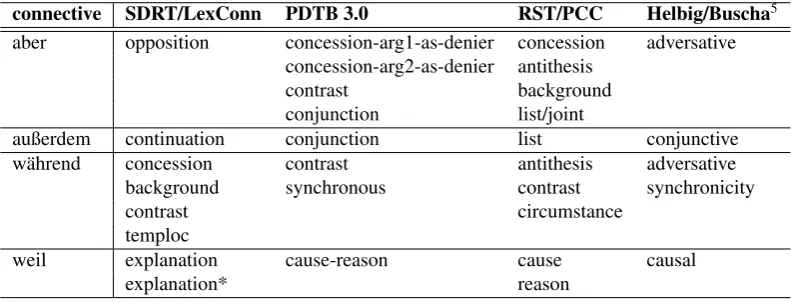
connective SDRT/LexConn PDTB 3.0 RST/PCC Helbig/Buscha5 aber opposition concession-arg1-as-denier concession adversative
concession-arg2-as-denier antithesis
contrast background
conjunction list/joint
außerdem continuation conjunction list conjunctive
w¨ahrend concession contrast antithesis adversative
background synchronous contrast synchronicity
contrast circumstance
temploc
weil explanation cause-reason cause causal
explanation* reason
Table 1: Selected connectives and their associated relations.
not intend to make any commitment on the mapping be-tween different relation hierarchies (which is an unresolved research issue), we do not relate the other senses to the PDTB ones, but instead store them on the top level of the lexicon entry in a dictionary-info field, which has subfields for RST, SDRT/LexConn, and Helbig/Buscha. In this way, all the information about a connective is assem-bled within the lexicon entry and can be exploited for study-ing correlations between the different sense/relation inven-tories.
4.
Results
In our view, collecting different semantic analyses through these different methods results in a richer and ultimately more useful resource, for at least two reasons. First, if two analyses are found to agree or can be mapped to one another, this increases their trustworthiness, since different kinds of evidence have contributed to the finding. Second, in cases where two analyses in different frameworks do not agree, the differences often point out new and interesting research problems rather than mere errors.
4.1. Case Studies
In Table 1 we show the semantic relations we obtain for four frequent connectives. These examples illustrate our approach. Some connectives are semantically quite straightforward. For example, weil (‘because’) is the most common causal subordinating conjunction in German. Each framework provides a basic causal relation, which is the one commonly assigned to weil.6 Some frameworks
provide additional granularity wrt. volition (RST) or epis-temicity (SDRT), but one can easily map these facets to a basic causal sense. Similarly, außerdem(‘in addition’) marks an additive discourse relation in each formalism.
5
Helbig/Buscha’s German relation names have been trans-lated: ‘adversativ’ = ‘adversative’, ‘kopulativ’ = ‘conjunctive’, ‘Gleichzeitigkeit’ = ‘synchronicity’, ‘kausal’ = ‘causal’.
6
Of course,weilcan also be used for pragmatic justifications, either of a belief or a speech act. Even though PDTB 3.0 provides distinct senses for “cause+belief” and “cause+speech act”, it is argued that these additional facets might be better accounted for by using features on top of some discourse connective senses. In fact, pragmatic uses are also known for concessives, conditionals, and other relations. Therefore, we only assign a basic overarching “cause” relation here for PDTB.
These connectives illustrate the first case above, where con-verging analyses reassure the researcher of their validity. Some other cases are more complex. For example, aber (‘but’) is tagged as merely contrastive in the traditional Ger-man grammar, as well as in the SDRT relations obtained through LexConn (“opposition”). The corpus annotations in RST and PTDB, however, also indicate a narrower con-cessive reading of the connective. In addition, both meth-ods also identified a non-contrastive additive reading (“con-junction” in PDTB, “list/joint” in RST) closer tobut also that might have been missed in the other work. Here, the multi-pronged approach helped validate the analyses and identify missing relations.
4.2. Agreement
We have tested the applicability of the new PDTB 3.0 an-notation schema to our German newspaper data with two independent expert annotators (the authors), in order to ob-tain first agreement values. (Another study with guideline-trained annotators will follow later.) We picked five previ-ously unannotated connectives of different syntactic types and complexities:
falls (‘in case’), a subordinator with a conditional meaning,
ferner (‘furthermore’), an adverbial with additive seman-tics,
folglich (‘consequently’), an adverbial that has been char-acterized as marking the result clause of a causal or purpose relation,
freilich (‘admittedly, indeed, however’), an adverbial with many different uses,
gleichzeitig (‘at the same time’), an ambiguous adverbial similar to ‘while’ with a temporal and a contrastive sense.
The two annotators classified 50 instances for each connec-tive according to the PDTB 3.0 schema (27 senses) with the additional option of marking an instance as not being a connective. This option was chosen when the lexical item occurred in a non-connective sense (e.g. fernercan also be used as the comparative adjective ‘further (from)’), or when the context did not suffice to decide whether the in-stance was used as a connective (and in which sense). The annotation was carried out using WebAnno (Yimam et al., 2013) and the agreement computed with R.
connective agree Fleiss’κ Jaccard
falls 95.7 -0.02 1
ferner 93.9 0.85 1
folglich 72.7 -0.02 0.17
freilich 42.9 0.20 0.86
gleichzeitig 61.4 0.41 0.60
all 75.2 0.71 0.72 (mean)
Table 2: Annotation agreement between 2 annotators.
Table 2 shows the agreement for the five connectives. The raw agreement values confirm the intuitive rating of the dif-ficulty of the connectives: for the unambiguous connectives fallsandferner, the raw agreement is very high. Kappa val-ues suffer from the high expected agreement in these cases, since only few senses are taken into account, and are not reliable for these connectives (third column). In addition, we computed the overlap between the sets of senses ever assigned by the two annotators (fourth column, Jaccard in-dex). Since our ultimate goal is not a corpus of annotated instances, but an enriched lexicon, we only need to obtain a set of senses that each connective can express. Thus, a high Jaccard index7 indicates that the sets of senses chosen by
7
The Jaccard index between sets A and B is defined as
|A∩B|/|A∪B|.
the annotators for this connective overlap significantly, and therefore that the sense annotation in the lexicon is robust. Freilichillustrates a class of highly ambiguous connectives. The raw agreement as well as chance corrected agreement for the sense annotation of individual instances is quite low (second and third column), because the meaning of the con-nective is vague and hard to differentiate in each instance. The high overlap of assigned senses between the two anno-tators (fourth column), however, shows that lexicographi-cally, it is straightforward to determine the kinds of senses this connective can express8.
Finally, the low agreement on folglich and especially gleichzeitigindicated that these need additional work in ad-judication: For both connectives, one annotator assigned additional senses that the other annotator did not deem applicable. For example, one annotator identified several “contrastive” or “concessive” uses of gleichzeitig(‘at the same time’), where the other annotator saw the basic tem-poral synchronicity sense as sufficient. Therefore, we dis-cussed all connectives with the entire team of three annota-tors and decided difficult cases by consensus.
5.
Conclusion
We presented our extension to the German DiMLex lexi-cal resource of discourse connectives, which now has wide coverage, and in particular, all the entries have been as-signed semantic/pragmatic relational information. We dis-cussed different means of obtaining such semantic infor-mation, as well as our way of representing various kinds of ambiguities in the lexicon. Finding the “right” relations is by no means simple, and we consider it important to as-semble information from different sources in the lexicon entries; this now enables systematic comparisons. At the same time, when a discourse parser (or similar software) is to make use of DiMLex, it is important to also have one single layer of sense information; we argued that the new PDTB 3.0 sense hierarchy is a good choice for this task, and extended our entries accordingly. The lexicon in the form described here will be freely available for research purposes at its Github locationhttps://github.com/ discourse-lab/dimlexwhen it is completed.
6.
Acknowledgements
Thanks to Erik Haegert for his help with collecting in-formation for DiMLex and building lexicon entries. We are grateful to the research group Deutsches Textarchiv at Berlin-Brandenburgische Akademie der Wissenschaften (BBAW) for their assistance with obtaining corpus exam-ples for our connectives. Our collaboration with Mar-got Colinet was supported by the European COST action TextLink through a Short Term Scientific Mission.
7.
References
Nicholas Asher and Alex Lascarides. 2003. Logics of Con-versation. Cambridge University Press, Cambridge. Alexander Geyken. 2014. Methoden bei der
W¨orterbuchplanung in Zeiten der Internetlexikographie. Lexicographica, 30(1):77–111.
8One annotator also saw one instance of mere “conjunction”,
Gerhard Helbig and Joachim Buscha. 1984. Deutsche Grammatik. Verlag Enzyklop¨adie.
Hugo Hernault, Hemut Prendinger, David duVerle, and Mitsuru Ishizuka. 2010. Hilda: A discourse parser us-ing support vector machine classification. Dialogue and Discourse, 1(3):1–33.
Yangfeng Ji, Gongbo Zhang, and Jacob Eisenstein. 2015. Closing the gap: Domain adaptation from explicit to implicit discourse relations. In Proceedings of the 2015 Conference on Empirical Methods in Natural Lan-guage Processing, pages 2219–2224, Lisbon, Portugal, September. Association for Computational Linguistics. Alistair Knott. 1996. A data-driven methodology for
moti-vating a set of coherence relations. Ph.D. thesis, Depart-ment of Artificial Intelligence, University of Edinburgh. Ziheng Lin, Hwee Tou Ng, and Min-Yen Kan. 2014. A
pdtb-styled end-to-end discourse parser. Natural Lan-guage Engineering, 20:151–184.
William Mann and Sandra Thompson. 1988. Rhetorical structure theory: Towards a functional theory of text or-ganization.TEXT, 8:243–281.
Renate Pasch, Ursula Brauße, Eva Breindl, and Ulrich Her-rmann Waßner. 2003.Handbuch der deutschen Konnek-toren. Walter de Gruyter, Berlin/New York.
Andreas Peldszus and Manfred Stede. 2015. Joint pre-diction in mst-style discourse parsing for argumentation mining. InProceedings of the 2015 Conference on Em-pirical Methods in Natural Language Processing, pages 938–948, Lisbon, Portugal, September. Association for Computational Linguistics.
Charlotte Roze, Laurence Danlos, and Philippe Muller. 2012. LEXCONN: A french lexicon of discourse connectives. Discours [En ligne], 10. http://discours.revues.org/8645.
Manfred Stede and Arne Neumann. 2014. Potsdam Com-mentary Corpus 2.0: Annotation for discourse research. InProceedings of the Ninth International Conference on Language Resources and Evaluation (LREC’14), Reyk-javik, Iceland, may. European Language Resources As-sociation (ELRA).
Manfred Stede and Carla Umbach. 1998. Dimlex: A lexi-con of discourse markers for text generation and under-standing. InProceedings of the 17th international con-ference on Computational linguistics-Volume 2, pages 1238–1242.
Manfred Stede. 2002. DiMLex: A lexical approach to dis-course markers. InExploring the Lexicon - Theory and Computation. Edizioni dell’Orso, Alessandria.
Manfred Stede. 2014. Resolving connective ambiguity: A prerequisite for discourse parsing. InThe Pragmatics of Discourse Coherence. John Benjamins, Amsterdam. Pieter van der Horn, Bart Bakker, Gijs Geleijnse, Jan
Ko-rst, and Sergei Kurkin. 2008. Determining causal and non-causal relationships in biomedical text by classify-ing verbs usclassify-ing a naive bayesian classifier. In Proceed-ings of the Workshop on Current Trends in Biomedical Natural Language Processing, pages 112–113, Colum-bus, Ohio, June. Association for Computational Linguis-tics.
Bonnie Webber, Rashmi Prasad, Alan Lee, and Aravind Joshi. Submitted, 2016. Extending the Penn Discourse Treebank: Discourse relations and conjoined VPs. 10th Linguistic Annotation Workshop (LAW-X), Berlin. Seid Muhie Yimam, Iryna Gurevych, Richard Eckart