What differentiates effective followers from less
effective followers: An exploratory mixed-methods field
study using survey- and video-data
Author: Thom van Es
University of Twente P.O. Box 2017, 7500AE EnschedeThe Netherlands
Abstract
Over the past decades, studies within the field of leadership research increasingly emphasised the importance of effective followers within the effective leadership equation. While there is an extensive amount of research on effective leadership, effective followership has been studied to a much lesser extent. This study tries to fill this gap in the research field and examines to which extent effective followers differ from less effective followers based on behaviours, self-perceptions, attributes and biographical characteristics. A mixed-methods design is applied consisting of 1) video-based data of regular staff meetings which are minutely coded to measure the followers’ behavioural repertoire (n=1503), 2) follower effectiveness ratings provided by each leader (n=112), and 3) open questions in a post-meeting survey on self-perceptions, attributes and biographical characteristics of each participant. Results pointed out that while there are significant behavioural differences between effective and less effective followers, overall these behaviours do not significantly explain follower effectiveness.
However, we did found that the self-perceptions competence, self enhancement, workload sharing and job satisfaction significantly determine 33.5% of the variance of follower effectiveness. In the discussion section, the results of this research are reviewed, its limitations and practical implications are pointed out, and some suggestions for future research are given.
Supervisors:
Prof. dr. C.P.M. Wilderom Drs. A.M.G.M. Hoogeboom Keywords
2
1. Introduction
While there is an extensive amount of research on leadership, much less attention has been paid to the role of followers (Manning & Robertson, 2016). Kelley (1988) was one of the first researchers to note that followers did have an active role in corporate success rather than it solely depending on dynamic leaders. But even prior to the research of Kelley (1988), research of Hollander and Webb (1955) already recognised that for a leader to be considered effective, followers must be at least equally effective. Therefore followership should be treated as an important component to effective leadership (Hollander & Webb, 1955). More recent studies acknowledge these statements and address that it is highly useful to gain in-depth knowledge about followership constructs such as follower behaviour and characteristics (Uhl-Bien et al., 2014; Baker, 2007). Moreover, the fact that followers fill such a crucial part of the effective leadership equation in creating good organizational outcomes emphasises the need to get a clearer understanding on what makes a follower effective even more (Lappiere & Carsten, 2014; Howell & Mendez, 2008; Lord, 2008; Baker, 2007). Since follower effectiveness is fundamentally intertwined with organizational outcomes, several studies have focused on the effect of personality constructs to job performance (e.g. Barrick, Mount & Judge, 2001; Judge & Ilies, 2002; Judge, Bono, Ilies & Gerhardt, 2002; Hogan & Holland, 2003).
Many studies on follower effectiveness are based on leader’s implicit images of what an effective follower would be according to them. These implicit images are found to be biased since they are influenced by context, personality characteristics, experience, racism, cultural background, or affective events (Hoogeboom & Wilderom, 2015; Lord et al., 2010; Lord & Maher, 1993). Due to this bias, Shondrick, Dinh and Lord (2010) concluded that actual behaviour cannot be accurately reflected based on perception. Hence, more objective methods are needed to capture an unbiased image of actual follower behaviour in organizational settings. Some researchers suggest that using observer-ratings of personality traits could be used to predict job performance (Zimmerman, Triana & Barrick, 2010; Connelly & Ones, 2010; Oh, Wang & Mount, 2011). While personality traits have been found to affect job performance, the people themselves must be studied in order to find out to which extent
personality could predict job performance (Barrick and Mount, 2005). Since behaviour could be a reflection of peoples personality (Snyder, 1983), studying the behaviour and personality of followers that are considered to be effective by their leaders might provide new insights in predicting job performance. Therefore the main purpose of this study has a rather exploratory nature and consists of finding consistent attributes present within effective followers that distinguishes them from less effective followers to gain further insights on the effective followership equation (e.g. the combination of variables that explain follower effectiveness).
This study attributes to the current followership research domain because of several reasons. First, this study applies a mixed-method design, which integrates both quantitative and qualitative data (Creswell & Plano Clark, 2011). This method does not only combine both the strengths of quantitative and qualitative approaches (Östlund, Kidd, Wengström & Rowa-Dewar, 2011), but also optimizes the strength of both approaches and compensates the weaknesses (Clark & Creswell, 2011). Second, the research sample was drawn from a large Dutch public organization in which several regular staff-meetings (n=112) from different leaders (N=112) and their team members (n=1503) were videotaped. Creswell and Plano Clark (2011) state that a large sample size will increase reliability and reduce
3 systematically and minutely. Finally, this study tries to identify consistent behavioural and personality characteristics of effective followers which could be very useful data for similar companies when recruiting new employees.
In the next section, relevant theories are reviewed. Then the methodology used to gather and analyse the data of this study will be explained. Followed up by the result section in which the results of this study will be summarized. Lastly, the found results will be discussed and final conclusions will be drawn.
2 Theory
2.1 Followership Research
2.1.1 The emerging field of followership research
As mentioned before, followership research emerged only recently. While it is believed that “leadership is an interactive process determined by both leaders and followers” (Zhu, Avolio &Walumbwa, 2009, p2), most leadership theory has been focussing “almost exclusively on the impact of leader traits and behaviours on followers’ attitudes and behaviours” (Howel & Shamir, 2005, p. 96). Lord, Brown and Freiberg (1999, p. 167) acknowledge that followers are still a much “unexplored source of variance in understanding leadership processes”. However, the field of followership research has been emerging only recently (Carsten et al., 2010; Collinson, 2006; Hoption et al., 2012 & Sy, 2010), since the topic has become equally worthy of study as leadership (Uhl-Bien & Pillai, 2007).
The studying of followership is defined as “the characteristics, behaviours and processes of individuals acting in relation to leaders and/or in contexts in which individuals identify themselves in follower positions or as having follower identities” (Uhl-Bien et al. ,2014, p. 96). In order to study followership, one needs to examine the effect of followership on the process of leadership (Uhl-Bien et al., 2014; Carsten et al., 2010; Howell & Shamir, 2005; Dvir & Shamir, 2003; Sy, 2010). By studying followership, our understanding of leadership is enhanced in several ways. First, studies in the followership field have led to the recognition of including of follower behaviour and styles within the leadership research (Carsten et al., 2010). Secondly, follower research adds to the overall understanding of leadership, since it is believed to be interrelated (Collinson, 2006; Lord & Brown, 2003). Third, studying followership has explored the role of followers in the reciprocal relationship with leaders, hence adding to the
4 leadership by co-producing leadership outcomes. This clearly indicates the importance of followership within the concept of leadership.
The role-based views rather focus on how leadership and followership are defined within the context of hierarchical roles (Uhl-bien et al., 2014). Most role-based research try to obtain a full understanding of the way subordinates work with their leaders and how this contributes (or not) to leadership and organizational outcomes (Oc & Bashschur, 2013; Sy, 2010; Carsten et al., 2010). Therefore role-based research mainly focusses on subjects like follower role orientations, implicit followership theories (Carsten et al., 2010; Sy, 2010) and how follower traits, behaviour and characteristics influences leaders and leadership effectiveness (Dvir & Shamir, 2003; Howell & Shamir, 2005). Graen and Uhl-Bien (1995, p. 223) stated that role-based research tries to answer the question: “What is the proper mix of follower characteristics and follower behaviour to promote desired outcomes?”.
2.1.2 The changing role of followers within Leadership Research
Throughout the past decades, the role of followers within leadership research has transformed from followers (or subordinates) being part of the leadership process to followership having a research field on their own and being an essential part within leadership research (Haytorn et al., 1956; Clifford and Cohn, 1964; Uhl-Bien et al. 2014). Uhl-Bien et al. (2014, p. 88) describes this transformation within the leadership research as a “progression from leader-centric to follower centric, to relational views”. The leader-centric views approached followers as being the moderator of the influence of leaders on production outcome (Shamir, 2007; Crossmann & Crossman, 2011; Bass & Bass, 2009; Uhl-Bien et al., 2014). Follower centric views consider the followers as ‘constructor’ of leadership (Meindl, 1990; Meindl, Ehrlich & Dukerich, 1985). Lastly, the relational view considers leader and follower to be both partaking in a reciprocal influence process (Uhl-Bien et al., 2014).
In de past, the majority of leadership research has solely focussed on leaders themselves. This leader-centric approach has resulted in a view of leaders being almost solely responsible for organizational outcomes (Hollander, 1993, Meindl et al., 1985; Yukl & Van Fleet, 1992). The stereotypical view on leaders conceived as the motivational individual that leads his followers to action in order to achieve goals (Bass, 1985). The stereotypical followers on the other hand, were regarded as submissive
recipients of their leaders’ influence who carried out all orders without resistance (Shamir, 2007; Kelley, 1988), or as a simple moderator of the leaders’ influence to acquire results (Kerr & Jermier, 1978; Vroom & Jago, 1978).
5 would treat that leader as such. Another follower-centric view, the social identity theory, bridged the gap with relational views by arguing that the effectiveness of leaders depend on the willingness of followers to work with that leader (Uhl-Bien et al., 2014).
The relational view addresses the importance of relational dynamics to leadership and considers leadership to be a process that is mutually influenced by followers and leaders (Uhl-Bien et al., 2014). One of the first researchers to recognise leadership as a relational process was Hollander (1971, 1986, 2012). He criticized the leader-centric approaches due to those failing to distinguish between a leader that is in the centre of a process called leadership and that this process consists of a mutual effort between leader and followers to achieve a goal.
The progression from leader-centric to relational views has resulted in the “widely acceptation that leadership cannot be fully understood without considering the role of followers in the leadership process” (Uhl-Bien et al., 2014, p. 89). Although followership is recognised to be a crucial part of leadership research, it is still mostly absent in many leadership literature (Bligh, 2011). However, the lack of follower research in past studies increases urge for studying followership in the future (Uhl-Bien et al., 2014).
2.2 Leader
’s
image of an effective follower
Over the past view decades, researchers have acknowledged that everybody has their own personality and that this personality will affect behaviour expressed at work (Barrick & Mount, 2005; Goldberg, 1993). Some researchers therefore argue that someone’s personality could be a predictor of work-outcomes (effectiveness) (Barrick & Mount, 2005), since the way someone behaves can influence the leaders opinion about that person. Dunn, Mount, Barrick and Ones (1995) even state that leaders equally care about personality as with general mental ability during the hiring process. Traits like persistency, goal directedness, confidence, and being organized are often preferred when hiring since leaders connect these traits to a positive work performance (Barrick & Mount, 2005). Moreover, research has pointed out that the use of observer-ratings of personality traits could be used to predict job performance (Zimmerman, Triana & Barrick, 2010; Connelly & Ones, 2010; Oh, Wang & Mount, 2011).
Several studies have focused on the effect of personality constructs to job performance (e.g. Barrick, Mount & Judge, 2001; Judge & Ilies, 2002; Judge, Bono, Ilies & Gerhardt, 2002; Hogan & Holland, 2003). One example is the Big five personality traits in which especially the traits ‘conscientiousness’ and ‘emotional stability’ have been found to have a significant effect on job performance. Conscientiousness affects the followers’ willingness to follow rules and exert effort, while emotional stability affects a followers’ capacity to accomplish tasks and allocate resources (Barrick & Mount, 2005). Both personality traits have been found to affect job performance throughout all different fields since they generally represent work motivation. Moreover, another factor that has been found to influence job performance throughout all work fields is general mental ability (Schmidt & Hunter, 1998).
6 nurturing, might be the single best predictor of job performance if the job mainly involves working in a team (Mount, Barrick & Steward, 1998). Followers that score low on agreeableness, which includes being argumentative, inflexible, uncaring, disagreeable, often show behaviours that are considered to be counterproductive and therefore should be considered as less effective (Barrick & Mount, 2005). Lastly, Openness to experience, which consists of being curious, original, artistically sensitive, intellectual, and independent, is related to having the ability to adapt to change more easily and contribute more to innovation (George & Zhou, 2001; Lepine, Colquitt & Erez, 2000).
In their paper, Barrick and Mount (2005) note that while personality traits have been found to affect job performance, the people themselves must be studied in order to find out to which extent personality predicts performance. Since behaviour could be a reflection of peoples personality (Snyder, 1983), studying the behaviour of followers that are considered to be effective according to their leaders, might provide new insights in predicting job performance (Beaty, Cleveland & Murphy, 2001; Gellatly & Irving, 2001; Hochwarter, Witt & Kacmar, 2000).
2.3 Capturing
the followers’ behavioural repertoire
In order to capture and categorise the behaviours of followers, various typologies have been developed. One of the first researchers to acknowledge the importance of followers was Zaleznik (1965), who noted that followers differ from each other and distinctions between them are of high relevance for
theoretical and practical research (Zaleznik, 1965; Kellerman, 2008). The typology of Zaleznik consisted of two dimensions: (1) dominance-submission, and (2) activity-passivity. Basically, the former represents to which extent a person wishes to be controlled and the latter measures to which extent a person wishes to be initiative. Those two dimensions combined results in a model which consists of the following four types of followers: compulsive, impulsive, masochistic, and withdrawn. Compulsive followers are dominant and passive; they try to take control in a passive way. Common traits of compulsive followers are that they are often indecisive and do not take responsibility for their actions. Impulsive followers are dominant and active, as they try to challenge authority by acting spontaneous and courageous. Masochistic followers are both active and submissive. Withdrawn followers are submissive and passive, probably due to a lack of interest and trust with the leader, which makes it very difficult to be influenced. However, the typology of Zaleznik is considered to contain a rather pessimistic view of followership (Favara, 2009).
A more optimistic approach on followership is proposed by Kelley (1992), whose work is considered to be the standard in the field. Kelley (1992) considers followers to be equally important to an organization as leaders and argues that an effective follower is a deliberate shareholder in reaching a goal instead of being a passive recipient of influence. Kelley’s concept of real followership does not simply consist of people within organizations that only do what they are told. In order to distinguish between effective and less effective followers, Kelley proposes five styles based on two categories reflected on two axes namely: (1) independent thinking and (2) active participation. The five followership styles are: alienated, conformist, exemplary, passive, and pragmatist. Alienated followers score high on thinking
7 independent thinkers. Passive followers on the contrary score low on both categories. Lastly, pragmatist followers score in the middle of both independent thinking and active participation.
Another major researcher in the field of followership is Chaleff (2003), who defined followership to be a “distinct role within organizational settings” (Favara, 2009, p. 20). In line with Kelley (1992), Chaleff proposed a two axis model consisting of the dimensions ‘challenge’ and ‘supervisory support’ and offers four categories namely: the individualist, the resource, the partner and the implementer. The
individualist scores high on challenge, but low on supervisory support. The opposite of individualists is the implementer who scores rather low on challenge, but high on support. The implementer is
characterized as being trustworthy, team focused and respectful to authority. Partners score both high on challenge and support and are characterized as being risk-taking and mission oriented. Lastly, there is the resource which scores both low on supervisory support and challenge. Moreover, Chaleff probably received most empirical attention for the five dimensions he added to his followership concept (Dixon & Westbrook, 2003). These dimensions are related to different extends of courage which are: (1) the courage to assume responsibility, (2) the courage to serve, (3) the courage to challenge, (4) the courage to participate, and (5) the courage to take moral action. These different acts of courage were added since Chaleff (2008) argued that the followers have the moral responsibility to act courageously towards leaders and their organization since they all serve (or should) a common purpose.
Kellerman (2008) proposed another perspective of different follower styles by interpreting followers from a political science perspective instead of organizational psychology (Favara, 2009). Rather than working with a two-axis model like Chaleff and Kelley, Kellerman proposes a one axis model which represents the level of encouragement of the follower. This model consists of follower types depending on the level of encouragement. From low to high the types are: isolator, bystander, participant, activist, and diehard. Isolators are completely detached from the organization and do not care about their leaders (Kellerman, 2008). Followers that are considered to be the bystander type observe but do not participate, they simply follow the path their leaders provide. Participants are more engaged with the company and show this by either favouring or oppose their leader. Activists have a strong feeling and act according to that feeling. Lastly, there are the diehards who are deeply committed to a cause they share with their leader, or will do everything to overpower the leader if their visions do not match. Kellerman (2008) states that the level of follower engagement is the most important factor to differentiate followership styles. Knowing follower types help with the identification of particular follower needs in order to transform or create transformations (Kellerman, 2008; Chaleff, 2008). What can be learned from the different typologies is that followers tend to differ on the level of
proactivity when constructing their organizational role (i.e. co-constructing and actively contributing for proactive followers and being deferent and obedient for passive followers) (Hoogeboom & Wilderom, 2016; Carsten et al., 2010). Uhl-Bien et al. (2014, p. 97) supports this conclusion and offers “theoretical constructs and variables for the study of followership” which includes nine followership behaviours. However, Uhl-Bien et al. (2014) conclude that earlier research on followership consists of a more classic view on followership by associating followers with deference and obedience rather than then their currently perceived role within a more dynamic organization. It is also believed that particularly high skilled workers and specialists are supposed to have a more independent role (Lord, 2008; Howell & Mendez, 2008). The changes in the working environment and thus the role of followers, requires
8 & Ashford, 2008; Owens, Rowatt & Wilkins, 2011). Uhl-Bien et al. (2014) used these behaviours to come to the following followership behaviours: (1) proactive behaviour, (2) initiative taking, (3) obedience, (4) resistance, (5) upward influence, (6) voice, (7) dissent, (8) feedback seeking, and (9) advising. The extent to which each follower shows a particular behaviour could be influenced by underlying factors such as follower traits, follower motivation or follower perceptions (Uhl-Bien et al., 2014).
This research adopted the earlier mentioned categorizations of task-, relation-, change- and external oriented behaviours instead of the proactive versus passive division. Furthermore, within the category task-oriented behaviour, a distinction could be made between transactional behaviour (Avolio & Bass, 2004) and initiating structure (Fleishman, 1953). First, transactional behaviour which consists of two core attributes: constructive transactions such as contingent rewarding, and corrective transactions such as management by exception (Avolio & Bass, 2004).Typical for transactional behaviour is to clearly define expectations and to promote performance in order to achieve organizational outcomes (Avolio & Bass, 2004). Therefore, behaviour like task-monitoring is a typical reflection of transactional behaviour (Bass, 1990). Secondly, initiation structure is described as the extent to which group interactions are defined or facilitated towards goal attainment” (Fleishman, 1953, p. 2). Initiating structure includes behaviours like task delegation and structuring the conversation. Followership research acknowledges that the behaviour of followers and leaders might show similarities, resulting in followers showing behaviours that would earlier have been considered to be typical leader behaviour (Carsten et al., 2010; Uhl-Bien et al., 2014). Moreover, several studies found that followers show leader behaviours like directing, goal setting and regulating (Kerr & Jermier, 1978, Hollander, 1992; Larsson and Lundholm; 2013). Carsten et al. (2010) found that followers that would be considered as ‘proactive’ showed a particular high desire to take initiative and accountability. This view is also supported by research on shared leadership and self-management which examine the performance of leadership behaviour by team members and examine similarities between the roles of follower and leader (House & Aditya, 1997; Carson, Tesluk & Marrone, 2007; Millikin, Hom & Manz, 2010; Nicolaides et al., 2014).
2.4 Capturing the full prototypical image of an effective follower
9 ensure that the operations meet certain quality standards within the provided time. Lastly, problem solving is used to identify problems and how to solve them. Also, the minimizing of problems or reducing the effect of problems when they occur is included within the process of problem solving. In terms of task-oriented follower traits Uhl-Bien et al. (2014) point out goal orientation reflects the objective to accomplish work in the most efficient and qualitative way. In addition, typical task-oriented follower attributes would be hardworking, productive, and mission consciousness (Sy, 2010; Carsten et al., 2010) since these attributes will help followers to achieve goals.
Second, relation-oriented behaviour has the prime objective of developing and improving human relationships and resources (Yukl, 2012). Components included within the relation-oriented category are: supporting, developing, recognising, and empowering. Supporting will add to the process of building mutual relationships or showing positive attention. Supporting is also connected to being loyal to
someone or to a cause (Carsten et al. 2010; Sy, 2010). Typical attributes for a supportive follower are being enthusiastic (exited, happy, outgoing) and having a positive attitude towards supporting, helping or providing approval (Carsten et al. 2010; Sy, 2010). The component developing is used to increase self-efficacy and improving abilities. The component recognising includes noting efficient performance or high quality of work and giving the people responsible a complement for their effort or to their team contribution. Empowering can enhance working relations since people receive more responsibility and might feel more appreciated. Adding to the components mentioned above, Carsten et al. (2010) and Sy (2010) propose the follower attribute ‘being a team player’ to be relation oriented since this attribute reflects a persons’ willingness to help and cooperate with others, emphasising collective effort (Carsten et al. 2010).
Third, the primary objectives of the change-oriented category are increasing the rate of innovation, facilitating the process of collective learning and adapting to the external environment (Yukl, 2012). The change-oriented category includes the components: advocating change, envisioning change,
encouraging innovation, and the facilitation of collective learning. Advocating change actually consists of the first step of the change process which is explaining the need for change. This is followed up by the envisioning of change in which the positive consequences of the proposed change are expressed. Encouraging innovation is about the creation of a working environment that embraces change and stimulates people to express their creative ideas. In line with encouraging innovation, Griffin et al. (2007) propose that follower behaviours like proactivity and taking initiative are change-oriented since both contribute to the initiation, creation and development of new ideas. Furthermore, the facilitation of collective learning will add to the development of new ideas and change since followers gain a better understanding of the product or service they are working with. When taking the change-oriented components in mind, follower voice behaviour might also be added since this reflects the extent to which followers feel they can express their feelings and thoughts (Carsten et al. 2010; Detert & Burris, 2007).
Lastly, the external-oriented category has the primary objective of “acquiring all the necessary
10 the external environment. The component representing includes promoting and defending an
organization and its reputation.
2.5 Actual behaviour versus perceived behaviour
All typologies, the work of scholars and especially the work of Uhl-Bien et al. (2014) mentioned earlier, are the starting point to examine actual follower behaviour. Since actual follower behaviour can show what actual behaviours give leaders the incentive to classify a follower as being effective. Since the current literature is merely focused on the perceptions of follower behaviour rather than actually capturing exhibited behaviour (like Uhl-Bien et al., 2014). This is due to most studies within the field of organizational-behavioural research having adopted a survey (Hoogeboom & Wilderom, 2016;
Hoogeboom & Wilderom, 2015). The importance of measuring and comparing actual follower behaviour and the leaders’ perception of an effective follower are really emphasised by the fact that capturing the implicit images of followers will clearly display the followers ‘naïve’ perceptions (Rosenberg & Jones, 1972), in contrast to scientific approaches trying to display objective reality (Sternberg, 1985). Moreover, implicit images tend to form immediately after a social interaction and are become
increasingly more in-depth overtime due to the influence of contextual-, individual-, task-related-, and organizational elements (Epitropaki et al., 2013; Foti, Knee & Backert, 2008; Lord & Maher, 2002; Hunt, Boal & Sorenson, 1990). The development of implicit images will result in getting frames of references that will influence the interpretation of information, and the observation and judgement of people (Lord, Foti & Vader, 1984; Shondrick & Lord, 2010) Adding to that, it is stated that individuals seem to lack the consciousness to notice how implicit schemas will impact action tendencies (Epitropaki et al., 2013). An implicit image is often formed by a prototype, which is created by combining an abstract set of features that are related to a certain person or group or by the person that is perceived as being the most representable of the group (Sy, 2010; Rosch, 1978; Ebbesen & Allen, 1979).
Study has found that implicit images and thus prototypes are biased since they are influenced by context, personality characteristics, experience, racism, cultural background, or affective events (Hoogeboom & Wilderom, 2015; Lord et al., 2010; Lord & Maher, 1993). Due to this, Shondrick, Dinh and Lord (2010) concluded that actual behaviour cannot be accurately reflected based on perception. Hence, more objective methods are needed to capture an unbiased picture of actual follower behaviour in organizational settings. When it is possible to capture actual behaviour, it is possible to study which behaviour and to which extent this behaviour is expressed by effective followers compared to less effective followers. This way, behaviour that leads to follower effectiveness can be identified. Based on the literature, the following hypotheses are defined:
1. Effective followers distinguish themselves from less effective followers by showing more
transactional- (1a), initiating structure (1b), relationship- (1c) and change-oriented behaviour (1d) and less counterproductive behaviour (1e).
2. Followers that are more satisfied with their work (2a) and leader (2b) are more effective. 3. Behaviour expressed by followers makes a significant difference when distinguishing between
11
3. Methodology
This study contains a mixed-method design, which is a design in which both quantitative and qualitative data are integrated in the same study (Creswell & Plano Clark, 2011). According to Bryman (2007), leadership research can greatly benefit from the use of mixed methods. Therefore, the method becomes increasingly more recognized as valuable since it does not only combine both the strengths of
quantitative and qualitative approaches (Östlund, Kidd, Wengström & Rowa-Dewar, 2011), but also optimizes the strength of both the combined qualitative and quantitative approach and compensates its weaknesses (Clark & Creswell, 2011). Moreover, this particular research design reduces the common method/source bias since it includes both a video-observation method, a questionnaire, and an open-question format to study the prototypical and behavioural repertoire of effective leaders respectively (Podsakoff, Mackenzie, Lee & Podsakoff, 2003). The research sample was drawn from three divisions at a large Dutch public organization. Several meetings from different leaders were videotaped. In this study, followers are operationalized as individuals acting in a subordinate role (Bjugstad et al., 2006). Possible criticism could be towards this way of operationalization, due to the fact that the subordinates are not always followers and managers are not always leaders (Bedeian & Hunt, 2006). However, it is very interesting to find out how followers perceive effective managers (or leaders), but also the other way around.
3.1 Design of study
The mixed method design used in this study uses four different sources of data: (1) a systematic and minutely video-coded monitoring of the followers’ and leaders’ behavioural repertoire during regularly held staff-meetings, (2) a survey conducted directly after each videotaped team meeting measuring the leadership effectiveness rating perceived by the participating followers, (3) a survey measured experts’ rating of team effectiveness, and (4) a qualitative survey measuring the leaders’ perception of the effectiveness of each of his/her followers. The teams which are observed in this study were selected by a stratified random sample within different management layers of one large Dutch public organization.
3.2 Participants
The observational and survey data are collected from 112 teams randomly selected from one large Dutch public organization. These teams included a total amount of 112 participating leaders. The total amount of followers participating within this study was 1503. All participating followers were requested to fill in a questionnaire in which they had to give their opinion about their leader and their perception on effective leadership. Among all followers, 1354 actually filled in the questionnaire. According to Tanaka (1987), having a large sample size will increase the availability of information and will add to the sample’s representativeness of the population.
The biographical characteristics of the leaders were: 71.1% males; average age of 51.16 (with a SD of 7.440); the average job tenure of 24.36 years (with a SD of 13.480). 41.2% of the leaders have a degree at Bachelor level, 36.8% have a master’s degree, 1.8% have obtained their PHD, and the rest had an education at a lower education level. Regarding technical education level, 14.9% of the leaders have a MBO degree, 33.3% have a degree at Bachelor level, 21.9% have a master’s degree and 1.8% have obtained their PHD.
12 education level, 39.5% of the followers have a MBO degree, 26.0% have a degree at Bachelor level, 14.4% have a master’s degree, and 1.3% have obtained their PHD. Regarding technical education level, 28.5% of the followers have a MBO degree, 30.4% have a degree at Bachelor level, 10.0% have a master’s degree, and 1.3% have obtained their PHD.
3.3
Coding the behaviour of the meetings’ participants
In order to code behaviour expressed during meetings by all participants of that particular meeting, a coding scheme covering all types of behaviour needed to be developed. This coding scheme should cover a full range of answers that could be connected to certain behaviour types (Carsten et al., 2010). Concept codes based on underlying theory were developed before the start of the project (Popping, 2015).These codes were modified and improved when the coding started with a method commonly known as ‘inductive analysis’ (Goetz and LeCompte, 1981; Lee, 1999; Patton, 2002; Popping, 2015). This method, which is in line with the grounded theory approach, let researchers discover major topics by interacting with the collected data (Patton, 2002, p. 453). Interacting with the data allows the
researcher to detect the ‘gaps’ in the existing coding scheme. During this interaction, the existing list of categories can continually be refined and expanded to create a theory that can explain certain
phenomena (Katz, 1983). By systematically collecting and analysing data from observed phenomena, a grounded theory could possibly capture the underlying meaning of the data (Bowen, 2006; Morse & Field, 1995; Strauss & Corbin, 1990). An inductive analysis will therefore not lead to an extensive explanation of certain phenomena, but will create a solid fundament for new theories and the creation of hypotheses regarding the found categories.
The inductive analysis within this study has followed the steps outlined by Goetz and LeCompte (1981). The first step consists of reviewing the collected data and identifying the first-order codes. The second step is to revise each devised category by assessing it on relevance to the new data. Thirdly, typologies must be created. Then, the last step is to assess the relationship between the categories (Goetz and LeCompte, 1981). Within this research the ‘analytic induction’ of Goetz and LeCompte (1981) has been implemented with a few differences. First, rather than formulating codes after the data examination, this study started with a pre-set of concept codes. Second, instead of examining relationships between categories, this study assessed the overlap between them. Last, no hypotheses were formulated based on possible relationships between the codes.
The pre-set codes and the codes that were developed during the analysis of data were formed into categories. All given answers during the meetings should be assigned to a certain category. According to Lee (1999) researchers should define as many categories as needed to organise, explain and assign all empirical data obtained to the categories in a coherent way. During the coding process, each coder assigned codes to the answers given in the dataset. Answers like “interested”, “proud” and
13 and eventually discussed their differences to achieve the best judgement at those. Eventually, this method resulted in 23 mutually exclusive codes with a very high inter-rater reliability.
Based on Yukl’s (2012) hierarchical taxonomy, the 23 codes were categorized in: (1) “task-oriented behaviour” which includes goal orientation, cognitive job capability, management by exception (MBEA) and job engagement. (2) “Relation-oriented behaviour” which includes to what extent followers show empathy, integrity and positive affect. (3) “Change-oriented behaviour” includes behaviours like being open towards change, being proactive and voice behaviour. (4) External behaviour, which consists of networking, environmental monitoring and being customer oriented. The main reason to use the concept of Yukl (2012) is because followers tend to categorise their own leader based on their own implicit leadership theories [ILTs] (Rosch, 1987). ILT’s are described as a combination attributes and characteristics of a leader and leadership which a person (follower) uses for his own perception and evaluation of a certain leader and comparing them to a leader category and their ideal leader (Philips & Lord, 1981; Kenney, Blascovich & Shaver, 2010). Appendix 9.1 table 1 gives an overview of all
categorized codes, including a definition and examples.
3.4 Video observation
Within this study the video-based observation technique was used, which is a rarely used method in social sciences (Hindmarsh & Heath, 2007). However, according to Amabile et al. (2004) this method works very well when observing leadership behaviour during ordinary work practices. This video-based observation was applied at a very large Dutch public company in the Netherlands. Participating leaders from all hierarchical levels within the organization were recorded on video in order to examine their expressed behaviour. The length of these meetings varied between 30 and 283 minutes and resulted in a total of 178 hours and 5 minutes recorded. The reason to observe regularly held staff meetings instead of occasional meetings is due to the availability of hierarchical context in which a clear
identification of followers and leaders is present (Hoogeboom & Wilderom, 2016). Moreover, research pointed out that the behaviour of people inside meetings is similar to the behaviour outside meetings (Baren et al., 2012). Before the meetings started, three cameras were installed at fixed positions to record the entire meeting. During the meetings there were no human observers or technicians present other than the people who took part in the meeting. Reactivity is believed to be a treat to external validity (Campbell & Stanley, 1966). By videotaping the meetings, obtrusiveness was minimized since it is believed that individuals forget the presence of cameras shortly after the meeting starts. Videotaping the meeting would therefore result in a meeting very similar to meeting without cameras, so there are no differences in follower behaviour (Erickson, 1992; Mead, 1995; Kent & Foster, 1997). As expected, similar to the findings of Collier and Collier (1986) the followers’ behavioural patterns quickly seemed to turn normal after the meeting started. However, to be certain about the lower obtrusiveness,
participants of the meeting each filled in a questionnaire directly after the meeting finished in which they had to rate the meetings representativeness compared to the meetings without a camera (on a scale from 1 [not representative] to 7 [highly representative]. Overall, participants rated the taped meetings with an average of 5.53, which could be interpreted as adequately representative.
14 use of video-observation software: Noldus Information Technologies, “The Observer XT”, which is a program that is developed to analyse, manage and present observational data (Noldus et al., 2000; Spiers, 2004; Zimmerman et al., 2009). The pre-developed codebook consisted of a throughout
description of each behaviour including indicators to recognise them. Prior to the coding process, coders received training on how to use the observation software in combination with the codebook and order to enhance the overall punctuality and accuracy of the coding (Van der Weide, 2007; Psathas, 1961). During the training coders also became aware of different biases they might encounter when coding. The coding scheme used in this study has been developed and validated in earlier studies (Van der Weide, 2007; Gupta et al., 2007; Nijhuis, Wilderom & Van den Berg, 2010; Van Dun & Wilderom, 2015). Behaviours shown during the meetings were coded on the basis of duration and frequencies. After a video was coded and verified by the second coder, the results were discussed by used the inter-rater reliability output and a confusion error matrix which could be generated from the observation software. Codes at which both coders disagreed upon were analysed again in order to achieve consensus on the best fitting code and to avoid getting a subjectivity bias. The inter-rater reliability after coding the videos and revising them, using a 2 seconds time interval for agreement, was between 95% and 100%.
All coded videos were standardized according to the duration of the shortest video to enable the comparison of the frequency of the coded behaviours. After the taped meetings were coded, the 19 coded behaviours were also categorized according to Yukl’s (2012) hierarchical taxonomy. However, rather than having the external-oriented behaviour category, the category ‘counterproductive behaviour’ was included since the main focus of staff meetings are on the internal issues that are discussed. The new category ‘counterproductive behaviour’ could be used to capture all
counterproductive behaviours shown by the participants of the meeting. Also, a distinction was made within the task-oriented category between transactional behaviour and initiating structure.
The transactional category consists of correcting, verifying and providing negative feedback because those behavioural types aim to get corrective and constructive transactions and the defining of
expectations/performance objectives (Avolio & Bass, 2004). The initiating structure category consists of behaviours that define or facilitate group interactions towards a goal (Fleishman et al., 1991), for
15
3.5 Procedure and measure
3.5.1 Measurement of follower effectiveness
After the meeting was coded by the independent coders, all leaders received a tailor-made leadership effectiveness report in which their strengths and weaknesses are pointed out. All leaders also received an extra questionnaire in which the leader had to assess the effectiveness of each participating follower by filling in 4 items from Gibson, Cooper and Conger (2009). However, in order to analyse the
effectiveness of each follower individually, the phrasing of items was revised (e.g. “This employee is effective”). Each leader was asked if they could rate their followers on a Likert scale, ranging from 1 (very inaccurate) to 10 (very accurate). The answers to these ratings are fully confidential and treated as such in order to receive unbiased answers. To increase confidentiality even further, each follower was tagged with a follower number to guarantee anonymity. The follower number was linked to a
screenshot from the video and added to the questionnaire so the leader could link them. Only the follower numbers were included in the dataset to fully ensure that the data handling process was anonymous. Similar procedures to examine follower effectiveness were used by Moon et al. (2008), Hu and Shi (2015) and Hoogeboom and Wilderom (2016).
However, the effectiveness scores of all followers have a chance of containing bias since each leader could grade effective followers differently. For instance, leader A could grade his followers with a 10 if he thinks that the particular follower is effective and with a 6 if he thinks a particular follower is less effective, while leader B grades his effective followers with a 7 and his less effective followers a 4. While effective followers of both teams might have the same personality characteristics and show similar behaviour, their effectiveness scores differ a lot. If these scores are not corrected for bias, effective followers of group B might be compared to ineffective followers of group A. In order to avoid this bias, out all participating teams some followers were appointed as effective (with a score of 1) or ineffective (with a score of 2). This choice was based upon the highest and lowest effectiveness grade given by each leader on a team level. This created 2 groups within each team: a group representing the effective followers marked with a 1, and a group representing less effective followers marked with a 2. 3.5.2 The followers’ behavioural repertoire
In order to analyse the behavioural repertoire of the followers participating in the regular held staff meetings, the meetings were taped and analysed by two independent coders. A coding scheme, which consists of 19 mutually exclusive behaviours, was pre-developed on the theoretical conceptualisations of group interactions (Feyerherm, 1994; Borgatta, 1964; Bales, 1950). The coding scheme included a throughout explanation and a detailed list of indications for each of the behaviours. This way, systematic and reliable coding was tried to be ensured (Van der Weide, 2007; Luff & Heath, 2012). The video-taped behaviours were systematically coded on the basis of frequency and duration. Because of differences in duration between all recorded videos, frequencies were altered into percentages.
3.5.3 Team effectiveness
The effectiveness of each team was rated by experts who rated on four effectiveness indicators
16
3.6 Data analysis
After a meeting was coded by the two independent coders, participating leaders received a survey in which they had to grade all their followers on a 10-point Likert-scale on the following items which were inspired by Gibson et al. (2009): (1) “this employee is effective”, (2) “this employee makes almost no mistakes”, (3) “this employee delivers high quality work”, (4) “This employee performs continuously on a high level”. The scale reached from 1 (very inaccurate) to 10 (very accurate).
These items were converted into one variable that reflected ‘employee effectiveness’. To be sure all items reflected employee effectiveness well, a factor analysis was conducted with the use of the Principal component method (a method commonly used to find the real amount of underlying factors influencing item scores). However, before a factor analysis could be used, appropriateness of using the factor analysis must be measured with the use of the Kaiser-Meyer-Olkin (KMO) test. In addition, a Bartlett’s Test must be performed to find if there is at least one significant relation between variables, indicating the relevance of a factor analysis. The KMO-test resulted in a score of 0.846 (Rule of thumb between 0.5 and 1.0), which indicates that it is appropriate to conduct a factor analysis. The Bartlett’s test showed a significant result (sig. 0.000), which indicates there is at least one significant correlation between the items. With both tests resulting in a positive result, the principal component analysis was performed and resulted in the extraction of one underlying component reflecting employee
effectiveness. Finally, a Cronbach’s Alpha analysis was performed to measure the reliability of items used in a construct (or component). The total number (N) of follower-scores included in this test was N=817. The Cronbach’s Alpha resulted in a score of 0.943 which is considered to be very reliable. The items were summed up and the mean of this score became a new variable that reflected employee effectiveness.
One bias that had to be taken into account was the fact that all leaders connect a different performance grade to their most effective employee (e.g. whereas one leader grades the most effective employees with a ten, another leader grades the most effective follower with an eight) . Since all leaders grade their most effective followers differently, using mean scores within the model would create bias. Therefore two groups were created within each participating team by selecting the most effective and least effective follower from each team. The effective followers were graded with a 1. The less effective followers were graded with a 2. Then, based on the effective and less effective group, leader/follower and team number, data was aggregated to form two groups for each team based on effectiveness. To find out to which extent the effective followers differed significantly (2-tailed) from the less effective followers based on behaviours, self-perceptions, attributes, and biographical characteristics, an independent t-test was performed.
17
4. Results
4.1 The behavioural patterns of an effective follower
Appendix 9.3 table 3 shows an overview of the results of an independent sample t-test which was conducted to find out whether effective and less effective followers really differed from each other in terms of behaviour. The items that differ significantly can give an insight in to which extent effective followers distinguish themselves from less effective followers. When observing the table one can notice that, as for the behavioural meta-categories as provided by Yukl (2012) task-oriented, relation-oriented, change-oriented and counterproductive behaviour, only the means of task-oriented behaviour do significantly differ between effective and less effective followers.
When examining the statistics of the measured behaviours, one can notice that the mean for task-oriented behaviour for effective followers is 73.3897 against a mean of 66.5075 for less effective
followers, indicating that when employees are more effective, they show more task-oriented behaviour. Results of the independent t-test show that this difference in means is significant (0.044). However, when examining transactional behaviour (sig. 0.209, mean effective followers 17.3721 and mean less effective followers 14.9660) and initiating structure (sig. 0.198, mean effective followers 56.2404 and mean less effective followers 51.9252), the difference between group-means is not significant. So regarding the first hypothesis (1a), while effective followers seem to generally show more transactional behaviour than less effective followers, the score found within this research is not significant. At least, not for the combination of items representing transactional behaviour. When examining specific behaviours which could be labelled as transactional behaviour, only correcting behaviour had a
significant independent t-test result (sig. 0.001, p < 0.05) whereas effective followers had a mean score of 0.2746 while less effective followers had a mean score of 0.1036. Regarding hypothesis 1a, we do not reject the null hypothesis in favour of the alternative hypothesis since there is no significant difference between the transactional behaviour of the in and out group.
As for behaviours in the category initiating structure, ‘visioning: own opinion’ (-0.178*) and ‘delegating’ (-0.201*) were the only behaviours that had significant independent t-test scores (sig. 0.026 for
visioning: one’s own opinion, mean effective followers 27.9715 and mean less effective followers 22.2748; sig. 0.013 for delegating, mean effective followers 0.2209 and mean less effective followers 0.0606). This indicates that, while the combination of behaviours which could be labelled as ‘initiating structure’ do not have a significant effect on employee effectiveness, effective employees can
distinguish themselves by showing more visioning: one’s own opinion and more delegating behaviour during a meeting. As for hypothesis 1b, we do not reject the null hypothesis in favour of the alternative hypothesis.
18 alternative hypothesis since the overall mean of behaviours that represent relation oriented behaviour show no significant difference between effective and less effective followers.
The independent t-test did not provide a significant result for all behaviours that could be labelled as oriented behaviour. This indicates that, while effective employees did show more change-oriented behaviour during the meetings (sig. 0.071, mean effective followers 0.0579 and mean less effective followers 0.0085), this difference is not significant. In case of hypothesis 1d we do not reject the null hypothesis in favour of the alternative hypothesis
Lastly, when observing the category counterproductive behaviour, higher counter-productive behaviour seems to result in less follower effectiveness (sig. 0.623, mean effective followers 7.5336 and mean less effective followers 8.3138). However, this difference in mean scores is not significant. Moreover, when examining specific behaviours representing the counterproductive behaviour category, there do not seem to be any significant differences between effective and less effective followers as well. Regarding hypothesis 1e, we do not reject the null hypothesis in favour of the alternative hypothesis, since effective followers do not significantly express less counterproductive behaviour than less effective followers.
In sum, results show that within the meta-categories task- and relation-oriented there are some
behaviours which means do significantly differ between effective and less-effective followers. Moreover, the combination of behaviours labelled as task-oriented show different group means between effective and less effective followers. Indicating that effective employees do positively differentiate themselves by showing more task-oriented behaviour, but also by specifically showing more agreeing, correcting, delegating, vision; own opinion, and intellectual stimulation behaviour.
4.2 Characteristics and of an effective follower
To examine which follower characteristics and self-perceived attributes could be explanatory for follower effectiveness, an independent t-test was performed again in order to find out which follower characteristics and self-perceived attributes differed significantly between effective and less effective followers. When examining appendix 9.4 table 4, we notice that there are significant differences
between effective and less effective followers regarding both satisfaction with leader (sig. 0.010) and job satisfaction (sig. 0.000). This is also reflected in the mean scores of both groups, showing that effective employees score higher on both satisfaction with leader (mean effective followers 5.4811 and mean less effective followers 5.1247) and job satisfaction (mean effective followers 5.8749 and mean less effective followers 5.2593). Regarding hypothesis 2a and 2b we therefore reject the null hypothesis in favour of the alternative hypothesis and can conclude that there is a significant difference between effective and less effective followers in terms of leader- and job satisfaction.
19 self-enhancing then less effective followers. Moreover, effective followers did significantly score higher on openness towards change (mean effective followers 5.0667 and mean less effective followers 4.6206), perceiving themselves as being proactive(mean effective followers 5.4768 and mean less effective followers 4.9910), perceive themselves as being competent enough to do their job properly (mean effective followers 6.0937 and mean less effective followers 5.6915), and have a clearer understanding about their future goals (mean effective followers 5.5303 and mean less effective followers 5.2774). While these scores are all based on followers own perception, apparently there is a significant difference between effective and less effective followers regarding their self-perception on these subjects.
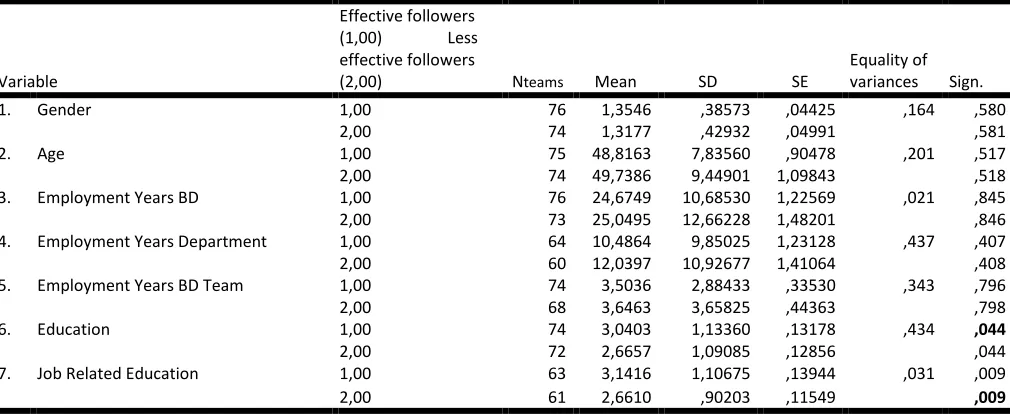
When examining appendix 9.5 table 5, regarding the biographical characteristics of followers, it seems that the means of both education level (sig. 0.044) and job-related education level (sig. 0.009) are significantly different for effective and less effective followers. Job related education reflects the highest level of follower education which is related to their current job. When examining the item statistics, we can note that the mean of the effective followers is 3.1416 which is between a degree from the
University of Applied Sciences and a Bachelor’s degree from a University. Less effective followers on the contrary have a mean score of 2.6610 which is between a degree from Intermediate Vocational
Education and a degree from the University of Applied Sciences. This finding would therefore indicate that a higher job related education level does differentiate effective followers from less effective ones. In sum, effective followers are significantly more satisfied with both their leader and their job than less effective followers. Moreover, effective followers distinguish themselves significantly by scoring high on the self-perceived items: self-enhancement, openness towards change, proactivity, competence, and goal setting. Finally, regarding biographical characteristics, effective followers score significantly higher on education than less effective followers.
4.3 The effective employee equation
20 In sum we found that the self-perceptions competence, self enhancement, workload sharing and job satisfaction determine 33.5% of the variance of follower effectiveness. Other variables that scored significantly in the independent t-test did not account for any further explanation of variance of the variable follower effectiveness. As for hypothesis 3, we must conclude while frequency of expressed behaviours does significantly differ between effective and less effective employees, this difference does not significantly add variance to the effective employee equation. Therefore we do not reject the null hypothesis in favour of the alternative hypothesis.
5. Discussion
Past studies have examined personality traits, characteristics and behaviour of followers (subordinates) in order to find out what determines follower effectiveness. To obtain insights, past research was mainly based upon a leader’s implicit images of effective followers. Barrick (2005) points out that the leader’s implicit images represent characteristics of follower effectiveness based on logical reasoning rather upon reality, thus claiming that implicit leader images are biased. Moreover, other research also indicated that the leader’s implicit image of an effective follower did not match the actual behavioural repertoire of an effective follower, which is in line with the notion that people have biased perceptions that do not reflect actual behaviour (Lord & Maher, 1993; Shondrick et al., 2010; Hoogeboom & Wilderom, 2015).
Nevertheless research has proven the positive effect of personality traits on job performance (Barrick, Mount & Judge, 2001; Judge & Ilies, 2002; Judge, Bono, Ilies & Gerhardt, 2002; Hogan & Holland, 2003). But while personality traits have been found to positively affect job performance, Barrick and Mount (2005) argue that people themselves need to be studied in order to find out to which extent personality predicts performance without the bias of implicit leader images. Therefore, this study focusses the actual behaviour and self-reflected personality traits of followers and aims to explain which behaviour and traits really result into follower effectiveness. Actual behaviour and self-reflected personality characteristics were obtained with the use of video-based coded data and survey data. Effective followers were selected based upon the effectiveness scores provided by their leaders. But instead of using implicit leader images of an effective follower, actual behaviour and self-perceived follower attributes are used to find the variables that determine follower effectiveness.
21 meeting (Romano & Nunamaker, 2001). Moreover, work teams are more task-focused, which could explain the high frequency of task-oriented behaviour expressed by followers (Sundstrom et al., 1990). Both factors could explain the high frequency of task-oriented behaviour in contrast to relation-oriented behaviour. Moreover, other empirical examinations of implicit follower theories (IFT’s) have found that effective followers mostly express relation-oriented behaviours (Carsten et al., 2010; Sy, 2010). But the higher frequency of relation oriented attributes within IFT’s might be biased since these attributes are often experienced far more consciously than task-oriented attributes, making them a vaster part of the implicit image (Hoogeboom & Wilderom, 2015). Hence, the higher frequency relation-oriented
attributes mentioned within IFT’s. This could be the reason for the found difference in frequency.
Another interesting finding was that this study did not find a significant difference in change-oriented behaviour between effective and less effective followers even though being change-oriented is regarded to be an important characteristic of an effective follower (Epitropaki et al., 2013).This might be the result of the overall frequency of exhibited change-oriented behaviour during the taped meetings being very low. Again, this might be the outcome of the main aim of the regular staff meetings, which tend to be more informative and about existing processes and work related issues rather than about discussing change related issues (Sundstrom et al., 1990). On the contrary, when examining the self-perceived attribute “openness towards change” we found a significant result within the independent t-test when comparing effective and less effective followers. Implying that effective followers are indeed, more open towards change. To a certain extent does this support the finding of Barrick et al. (2001) that openness to experience is a valid predictor of job performance within specific markets. Moreover, we found that the behaviour ‘agreeing’ was significantly expressed more often by followers that are considered to be effective. This is also in line with the research of Barrick et al. (2001) in which is stated that
agreeableness is a valid predictor of job performance within specific markets.
The results of this study are also in line with the research of Kelley (1992) who stated that effective followers score high on both independent thinking and active participation, also referred to as exemplary followers. This study found that effective followers express significantly more behaviour during meetings which could be considered as active participation. Also effective followers significantly experience an open voice climate during meetings, which indicates they extent to which individuals speak up, communicate opinions and suggest change (VanDyne & LePine, 1998, 2001, Morrison et al., 2011). To a certain extent this could be interpreted as independent thinking.
In addition to the behavioural repertoire of followers, this study also examined the effect of self-reflected personality characteristics of followers and compared the scores of effective followers to the scores of less effective followers in order to find out which characteristics are representative for effective followers without the influence of implicit follower images. The characteristics that scored significantly were included within the discriminant analysis to discover to which extent these characteristics added variance to follower effectiveness. Since behaviour is a reflexion of someone´s personality (Skinner, 1978), we expected that expressed behaviour would be of significant difference in the variance equation of employee effectiveness. Contrarily to these expectations, none of the
behaviours was included within the discriminant analysis.
In sum, results show that within the meta-categories task- and relation-oriented there are some
22 and less effective followers. Indicating that effective employees do positively differentiate themselves by showing more task-oriented behaviour, but also by specifically showing more agreeing, correcting, delegating, vision; own opinion, and intellectual stimulation behaviour. Regarding self-perceptions, effective followers are significantly more satisfied with both their leader and their job than less effective followers. Moreover, effective followers distinguish themselves by scoring significantly higher on the self-perceived items: self-enhancement, openness towards change, proactivity, competence, and goal setting. Regarding biographical characteristics, effective followers score significantly higher on education than less effective followers. As for the effective followership equation which represents the
combination of variables that determine follower effectiveness, we found that the self-perceptions competence, self enhancement, workload sharing and job satisfaction determine 33.5% of the variance of follower effectiveness.
5.1 Practical implications
With the use of video based data, it was possible to examine actual follower behaviour rather than leader’s implicit images of an effective follower. The main purpose of this research was to get a better understanding which variables determine follower effectiveness (effective follower equation) and to examine to which extent behaviour is a significantly contributes to this. This study shows significant differences between effective and less effective employees based on behaviour, self-perceptions, attributes, and biographical characteristics. Based on the results of this study, several practical implications can be drawn which organizations can use to detect and stimulate effective employees. First, the differences between effective and less effective employees could be used for the
identification, recruitment, and training of existing and new employees. The main difference regarding behaviour between effective and less effective employees is the frequency of all task-oriented
behaviour expressed during staff-meetings. Employees showing task-oriented behaviour more often scored significantly higher on effectiveness. When examining the behaviours labelled as ‘task-oriented’, providing own opinion, delegating and correcting behaviour did all show a significant difference
between effective and less effective followers. This indicates that employees that express these
behaviours more frequently score higher on employee effectiveness. Relation-oriented behaviours like intellectual stimulation; inviting other team-members to think along and creating involvement, and agreeing; showing compliant behaviour, were significantly associated with employee effectiveness. While change-oriented behaviour did not seem to significantly differ between effective and less effective followers, effective followers did score higher on the item openness to change, which was measured by four items in the employee questionnaire. All behaviours that showed a significant
difference between effective and less effective followers could all be related to the empowerment of co-workers, stimulating brain storming and creating employee engagement. Employee engagement is considered to be “the single most powerful lever that corporations have to improve productivity” (Macey, Schneider, Barbera & Young, 2011, p. 15). Therefore leaders should try to stimulate these behaviours that lead to employee engagement and are associated with employee effectiveness (Rich, Lepine & Crawford, 2010).
23 competence; the degree to which an employee considers himself qualified enough for the job, self enhancement; reflects a type of motivation that people use to remain a positive self-reflection and keep a high self-esteem, job satisfaction; the degree to which an employee is satisfied with his job; and sharing workload; the effective and equitable allocation of team tasks,explain 33.5% of the variance in employee effectiveness. Since one-third of employee effectiveness is determined by these four
variables, the leader or company should aim to stimulate the enhancement of these variables within the company. For instance, competence could be achieved by facilitating training and workshop for those interested. Job satisfaction could be achieved by stimulating employee engagement or creating a nice working environment.
5.2 Strengths, limitations, and future research directions
The up and foremost strength of this research is that is has adopted a mixed-method approach by using both objective and subjective methods and data sources. This method is in line with Uhl-Bien et al.’s (2014) recommendation to gain further insights in followership studies: to apply several research methods beyond solely using a survey. Also, the use of observation is not much applied within
organizational studies, but does become increasingly popular (Uhl-Bien et al., 2014). Finally, by using the classification of behaviour and traits according to Yukl’s taxonomy (2012) we allow future followership research to further extend while using universal terms. However, while this study has certain strengths, it also has a few limitations.
Firstly, all the data used within this study was obtained from one large Dutch public organization. Some researches state that there is a difference in behaviour between employees from public and private organizations (Perry and Wise, 1990; Brugha and Zwi, 1998; Bellante and Link, 1981). Apart from the sector, culture might also be of major influence for both the observed behavioural repertoire and what is perceived as effective or important (Hofstede, 1991; Den Hartog et al., 1999). The narrow context from which the data has been conducted could also have influenced the leaders’ perception of implicit follower images (Hanges, Lord & Dickson, 2000; Sy, 2010; Foti et al., 2008) and therefore influencing follower effectiveness since this is based upon effectiveness rates provided by their leaders. Leaders of a public Dutch company might experience an employee as ineffective while this same employee could be considered highly effective in a private organization in a different country. Therefore the outcome of this research is not generalizable to all types of organizations or industries. So while this company was selected due to its size and different hierarchical layers, future research should incorporate more types of organizations, cultures, sectors and other contextual factors in order to gain a further understanding on followership research.
Secondly, while the usage of the mixed method approach reduces the common source bias, the follower performance ratings were only measured by the perceptions of the leaders. Therefore the performance ratings were possibly influenced by IFT’s but also by leader-member exchange [LMX] (Gerstner & Day, 1997; Graen & Uhl-Bien, 1995). Theory on LMX states that “leaders and followers in these high-LMX relationships often report enhanced levels of satisfaction and effectiveness…” (Maslyn & Uhl-Bien, 2001, p. 697). This would suggest that leaders would overrate the performance of followers when higher rates of LMX are present. The selection of effective and less effective followers was only based on these performance ratings. So while using the weighted average of scores of performance rates of each team-member, there is a chance that some followers were wrongly selected as being effective or less