P a g e | 1303 Manyam Sukesh1, Dr.Challa Lokanatha Reddy2, Dr. Arvind Kumar Sharma3
1
Research Scholar, Department of Computer science, OPJS University, Rajasthan.
2 Professor, Computer Science Department, Dravidian University,Kuppam,A.P. 3Associate Professor in Computer Science, OPJS University, Rajasthan.
ABSTRACT:Modern vehicles are furnished with a wide variety of sensors, onboard computers and different devices supportive navigation andcommunication.In this paper, we exhibit howSoftware-Defined Networking (SDN), an emerging networkparadigm, can be used to offer the flexibility andprogrammability to networks and introduces new services andfunctions to today’s VANETs. We take the idea of SDN, whichhas specifically been designed for wired infrastructures, mainly inthe facts middle space, and propose SDN-based VANETarchitecture and its operational mode to evolve SDN to VANETenvironments. We also speak advantages of a Software-DefinedVANET and the offerings that can be furnished. We demonstratein simulation the feasibility of a Software-Defined VANET viaevaluating SDN-based routing with conventional MANET/VANETrouting protocols.
KEYWORDS-Software-Defined Networking; VANET; wireless networks.
I. INTRODUCTION
VANET or Vehicular Ad hoc Networks, like MANETs (mobile ad hoc networks) embody the objective of providing useful communications among an arbitrarily-formedcollections of vehicles that are geo-located. Informationshared in VANETs can be location specific as in the caseof information about local attractions, rest areas and fuelstations or it can originate from moving vehicles that detectevents such as road congestion or dangerous road conditions.Vehicles can be equipped with terminals intended to accessthe Internet. The models and techniques for addressing eachof these scenarios can be quite different. In this paper, wefocus on the propagation of local information originating invehicles that is useful for other vehicles in the system. Thistype of activity has been described as Information WarningFunctions (IWF), [1], [2].
Vehicular ad hoc networks (VANETs) are considered as a class of mobile ad hoc networks(MANETs), where mobile nodes are vehicles equipped with embedded computers, networkinterfaces and sensors. Vehicles can communicate with each other (V2V) or with stations (V2I) alongroads (to request information for example).
Figure 1. Example of a VANET network [4]
A. Communication in VANETs
The services offered in VANETs distinguish two possible types of communication, i.e. Vehicleto Vehicle Communication (V2V) and Vehicle to Infrastructure Communication (V2I), which aredescribed shortly in the following two subsections.
Figure 2. Inter-Vehicle Communication (Multi-Hop) [6]
Vehicle to Vehicle Communication (V2V):The purpose of the inter-vehicle communication is to
P a g e | 1304
transmit the relative information of thetraffic on multiple jumps to a group of receivers [5].
Figure 3. Vehicle to Infrastructure Communication (Single-Hop) [8]
Vehicle to Infrastructure Communication (V2I):
The Vehicle-to-Infrastructure communication represents a single-hop broadcast where theroadside unit (RSU) sends a broadcast message to all nearby equipped vehicles [5]. Figure 3illustrates the communications between Vehicles and road infrastructure.
The combination of these two types of
communication provides an interesting
hybridcommunication opportunity. Indeed, since the scopes of the infrastructure are limited, the use ofvehicles as relay makes it possible to extend this
communication range. For economic
purposes,avoiding multiplying the terminals at each street corner, the use of jumps by intermediate vehiclescan become very important [9].
Nowadays, interest is focused on smart mobility, which includes enhancing traffic conditions,travel efficiency, vehicle safety, and passengers comfort while on the road. These latter want toconnect to the Internet everywhere on the road, subscribe to a variety of services, and get real-timeinformation about traffic and facilities. These services are mainly provided by vehicular applications,which has to be able to deal with the high mobility of the network environment and consequently withthe unreliable connectivity, both in Vehicle-to-Vehicle (V2V) and Vehicle-to-Infrastructure (V2I)communication. Road Side Units (RSUs) are usually located only at a few critical intersection pointswith short radio communication ranges. Consequently, connectivity is
intermittent: it is often brokenand re-established in a different location.Hence, communication networks must be designed using a totally new approach, designing anew network paradigm that will be structured to minimize the impact of disconnections caused byvehicle mobility and improve reliability of communication in Vehicular Ad hoc NETworks (VANETs),promoting the development of smart mobility. The SDN paradigm is a suitable candidate, and it isexpected to result in a change from the way in which vehicular networks were classically operated.
Figure 4. Software-Defined VANET Communications [13]
SDN has emerged as a flexible way to control the network in a systematic way, with OpenFlowas the
most commonly used SDN protocol for
communication between the SDN control plane anddata plane [13]. The flexibility of SDN makes it an attractive approach that can be used to satisfy therequirements of VANET scenarios. Applying
SDN principles to VANETs will bring
theprogrammability and flexibility that is missing in
today’s distributed wireless networks,
whilesimplifying network management and enabling new V2V and V2I services.
II. BACKGROUND WORKS
P a g e | 1305 a. Central Control Mode: in this mode the SDN
controller controls all the actions of underlyingSDN wireless nodes and RSUs, it means that all the actions that the SDN data element performsare explicitly defined by the controller, the SDN controller will push down all the flow rules onhow to treat traffic.
Figure 5. Central Control Mode [13]
Distributed Control Mode: This is a mode where underlying SDN wireless nodes and RSUs donot operate under any supervision from the SDN controller during data packet delivery. Thiscontrol mode in essence is very similar to the original self-organizing distributed network withoutany SDN features, except that the local agent on each SDN wireless node controls the behaviourof each individual node (e.g., run GPSR routing).
Figure 6. Distributed Control Mode [13]
c. Hybrid Control Mode: This mode includes all the operational modes of a system where theSDN controller apply control anywhere between full and none. Figure 7 shows an example,where the SDN controller does not hold complete control, but instead can delegate control ofpacket processing details to local agents. Therefore, control traffic is exchanged between allSDN elements. One example would be that instead of sending complete flow rules, the SDN
controller sends out policy rules, which define general behaviour, while the SDN wireless nodesand SDN RSUs use local intelligence for packet forwarding and flow level processing. In specific,the SDN controller instructs SDN wireless nodes and RSUs to run a specific routing protocol withcertain parameters.
Figure 7. Hybrid Control Mode [13]
III. PROPOSEDWORK
In specific, this awareness allows a SoftwareDefined VANET to make better decisions based on thecombined information from multiple sources, not just
individual perception from each node. Also, dynamic andflexibility can react to sudden events, suitable for reacting toemergencies and changing requirements. In this section, wedescribe the benefits of Software-Defined VANETs, anddescribe several services that can be enhanced by utilizingthese benefits.
A. Software-Defined VANET benefits
We classify benefits of a Software-Defined VANET intothree individual areas:
• Path Selection: The awareness of SDN allows thesystem to make more informed routing decisions. For
example, in a VANET scenario, data traffic canbecome unbalanced, either because the shortest pathrouting results in traffic focusing on some selectednodes, or because the application is video dominantwhich occupy big bandwidth on the path. When thissituation is discovered by the SDN controller, it canstart a reroute traffic process to improve network utilityand reduce congestion.
P a g e | 1306
better coordination ofchannel/frequency used. For example, the SDNcontroller can dynamically decide at which time whattype of traffic will use which radio interface/frequency.
This can be used to reserve channels for emergencytraffic for VANET emergency services.
• Power selection: Because of the awareness, a SDNbased VANET will have the information to decidewhether changing the power of wireless interfaces, andtherefore its transmission range, is a logical choice. Forexample, the SDN controller gathers neighborinformation from SDN wireless nodes and determinesthat node density is too sparse and commands all nodesto increase power to achieve more reasonable packetdelivery and reduce interference.
B. Software-Defined VANET services
Based on the benefits that we described earlier, we present services that can be enhanced using a SoftwareDefined VANET.
• SDN Assisted VANET Safety Service:
Improvingroad safety through the use of V2V communications isone of the primary use cases of VANETs. We showhow a Software-Defined VANET can improve theservices when compared to traditional methods. SDNcan be used to reserve or limit specific frequencies sothat emergency traffic (or otherwise privileged traffic,such as security) uses this reserved path. Thedifference between this and traditional emergencychannels is that reservation in our architecture isconfigurable dynamically. The SDN controller canassign flows to these channels or remove them basedon current traffic conditions and applicationrequirements. This can also be used to offer differentlevel of services based on policies. The way this can bedone is by changing rules during an emergency period.Emergency traffic gets priority over the remainingtraffic.
• SDN-based On Demand VANET SurveillanceService: Surveillance service for emergency/authorityvehicles is another area in which a Software-DefinedVANET can be deployed. In traditional architectures, arequester (e.g. police car) must send out a request forthe surveillance data (or even a broadcast for the data ifthe holder of the data is unknown to the requester). In aSDN-based system, this request is done by the SDNcontroller. The SDN
controller simply inserts flowrules for the surveillance data to reach the requestingnodes. Also, when there are several requests for thesame surveillance data, such as when multiple policerequest for video surveillance feed, the SDN controllerinserts rules so that the same copy is sent to multipledestinations.
• Wireless Network Virtualization Service: Networkvirtualization services aims to provide abstract logicalnetworks over shared physical network resources. SDNhas already been used in data centers to providenetwork virtualization services, and we can apply thesame idea for Software-Defined VANETs. The idea isto let different flows choose different radios/interfacesusing different frequencies. If the radio frequenciesused by each individual network is different, individualnetwork’s traffic are isolated from each other and wehave thus effectively sliced the networks and createdvirtual wireless networks. One method would be thegrouping of wireless nodes and RSUs, so each RSUonly forwards traffic from a selected group of wirelessnodes.
Another more advance method would be
P a g e | 1307 A. Comparison of SDN vs Traditional Ad Hoc
Routing
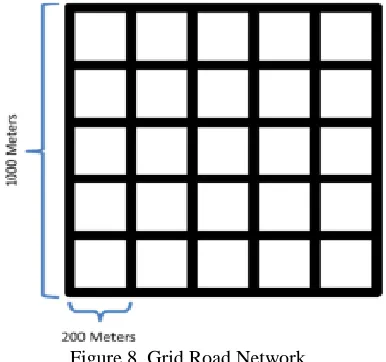
In this assessment we examine SDN-based totally routingcarried out for Software-Defined VANET and examine it totraditional Ad hoc routing. The simulation is finished over aSUMO [18] generated road network proven in Fig. 8, the roadcommunity is a grid kind network that spans an area of a 1000X1000m2, with every street section = 200m. Node density variesis 50 nodes inside the simulation. The SDN controller LTE get right of entry tois positioned inside the center of the simulation location in which it is inwireless variety of all SDN wi-fi nodes. Each SDN wirelessnode has multiple wi-fi interfaces; brief range using802.11with the Friis propagation loss model to limit thetransmission variety to 250m, and long range the usage of LTE. Eachsimulation run functions a couple of random nodes within the topologygoing for walks a NS3 echo patron-server streaming consultation, with apacket generation charge of 4 packets/s and packet size of 1024byte. Beacon message c programming language is 500ms. SDN wireless nodeswill replace neighbor statistics to the SDN controller atdurations of 1s Simulation parameters were selected primarily based onMANET contrast studies [19]. Each set of simulations isaveraged over 10 runs each going for walks for 5 mins.
Figure 8. Grid Road Network
Fig 9 shows the comparison of SDN-based VANET routing to other traditional MANET/VANET routing protocols,including GPSR, OLSR, AODV, and DSDV. We use thisevaluation to demonstrate the feasibility of a Software-DefinedVANET.
Figure 9. PDR comparison: SDN vs Traditional Ad hoc routing
We can see that our SDN-based routing outperforms theother traditional Ad hoc routing protocols. The aggregatedknowledge that the SDN controller has is the major reason. AsSDN wireless nodes update the SDN controller about neighborinformation, the SDN controller immediately detects that thereis topology change and sends out control messages as needed.Therefore our SDN-based system responds much faster totopology change.
B. Failure Recovery from SDN Controller Connection Loss
In this evaluation we demonstrate how fallbackmechanisms utilized by the local agent in SDN wireless nodescan still provide good packet delivery even whencommunication to SDN controller is lost. Once again, thesimulation is performed over the SUMO generated grid roadnetwork using the same experiment parameters. Fig 10 showsthe scenario where there is a controller failure for 100 seconds,as shown by the dash lines.
Figure 10. SDN controller failure
IV. CONCLUSION
P a g e | 1308
needed to deploy SDN inVANET, and we defined several diffrent operational modesand the services that may be furnished. We demonstrate insimulation numerous factors: (I) the feasibility of a SoftwareDefined VANET by using comparing
SDN-based totally routing withconventional
MANET/VANET routing protocols, (II) howfallback mechanism is a key function that must be supplied topractice the SDN idea into cell wi-fi situations, and (III)transmission strength adjustment as one of the feasible servicesthat can be furnished by means of Software-Defined VANET.
REFERENCES
[1] I. Boucetta, N. Djebrit, “Implémentation et amélioration d’un protocole de dissémination dans les VANETS,”USTHB, Algiers, 2013.
[2] Ku, I et al (2014). “Towards software-defined VANET: Architecture and services.” 2014 13th
Annual MediterraneanAd Hoc Networking
Workshop (MED-HOC-NET), pp. 103-110.
[3] “En.wikipedia.org. (2017). Software-defined
networking”. [online] Available
at:https://en.wikipedia.org/wiki/Software- defined_networking [Accessed Feb. 2017].
[4] Rasheed, Asim, et al. "Fleet & Convoy Management Using VANET." Journal of Computer Networks 1.1 (2013): pp.
[5] N. Houari et M. Delhoum, Sécurité routière & VANETs “ODP : Un Protocole Optimisé de Dissémination demessages d’urgence", USTHB, Algiers, 2011.
[6] Zeadally, S. et al (2010). “Vehicular ad hoc networks (VANETS): status, results, and challenges.Telecommunication Systems”, 50(4), pp. 217-241.
[7] H. Hartenstein et K. P. Laberteaux, “VANET Vehicular Applications and InterNetworking Technologies”, UnitedKingdom : Jhon Wiley and Sons Ltd., 2010.
[8] Varum, T. et al. (2011). “Microstrip antenna array for multiband dedicated short range communication systems.Microwave and Optical Technology Letters”, 53(12), pp. 2794-2796.
[9] A. Benaidja, « Les réseaux inter-véhiculaires : Application à la sécurité routière », USTHB, Alger, 2010.
[10] A. Ahizoune, “Un protocole de diffusion des messages dans les réseaux véhiculaires,” University of Montréal,Montréal, 2011.
[11] “Academic College Projects. (2017). Vanet Projects | Vanet Simulation | Vanet Projects in NS2”.
[online] Availableat:
https://academiccollegeprojects.com/vanet-projects/ [Accessed Feb. 2017].
[12] Cheng, Ho Ting et al. “Infotainment and road safety service support in vehicular networking from a communicationperspective.” (2010).
[13] Kreutz, D. et al (2015). “Software-Defined Networking: A Comprehensive Survey.” Proceedings of the IEEE, 103(1),pp.14-76.
![Figure 1. Example of a VANET network [4]](https://thumb-us.123doks.com/thumbv2/123dok_us/7775192.1281866/1.612.328.537.535.658/figure-example-vanet-network.webp)
![Figure 3. Vehicle to Infrastructure Communication (Single-Hop) [8]](https://thumb-us.123doks.com/thumbv2/123dok_us/7775192.1281866/2.612.77.278.113.257/figure-vehicle-to-infrastructure-communication-single-hop.webp)
![Figure 5. Central Control Mode [13]](https://thumb-us.123doks.com/thumbv2/123dok_us/7775192.1281866/3.612.82.280.455.587/figure-central-control-mode.webp)