Design of Digit-Serial FIR Filters Using GB Algorithm
*N.MANASA **V.VIJAYA ***G.BABU
*M.TECH Dept of ECE, VAAGDEVI COLLEGE OF ENGINEERING
**Asso. prof Dept of ECE, VAAGDEVI COLLEGE OF ENGINEERING
*
**Asso. prof Dept of ECE, VAAGDEVI COLLEGE OF ENGINEERINGAbstract:
Many efficient algorithms and architectures
have been introduced for the design of low
complexity bit-parallel Multiple Constant
Multiplications (MCM) operation which
dominates the complexity of many digital
signal processing systems. On the other
hand, little attention has been given to the
digit-serial MCM design that offers
alternative low complexity MCM
operations. In this paper, we address the
problem of optimizing the gate-level area
and delay in digit-serial MCM designs, for
that purpose we introduce high level CSE
and GB algorithms. Experimental results
show the efficiency of the proposed
optimization algorithms and of the
digit-serial MCM architectures in the design of
digit-serial MCM operations and finite
impulse response filters.
Index Terms—0–1 integer linear
programming (ILP), digit-serial arithmetic,
finite impulse response (FIR) filters, CSE
and GB algorithms, multiple constant
multiplications.
1.
INTRODUCTION
FINITE impulse response (FIR) filters are of
great importance in digital signal processing
(DSP) systems since their characteristics in
linear-phase and feed-forward
implementations make them very useful for
building stable high-performance filters [1].
These are mainly consists of multiplication
of a vector of input samples with a set of
constant coefficients is known as MCM
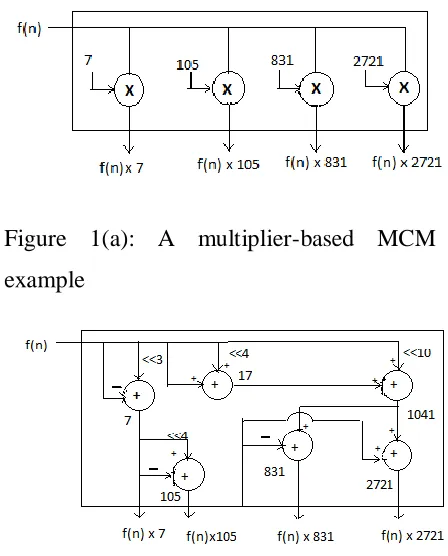
Multiple constant multiplications (MCM)
are typical operations in digital signal
processing (DSP) as well as in the design of
finite-impulse-response (FIR) filters, as
shown in Fig.1 (a).
Multiplications are expensive in terms of
area and power consumption, when
implemented in hardware. The relative cost
of an adder and a multiplier in hardware,
depends on the adder and multiplier
architectures. For example, a k x k array
multiplier has k times the logic (and area)
and twice the latency of the slowest ripple
carry adder. Since the values of the
coefficients are known beforehand, the full
flexibility of a multiplier is not necessary,
and it can be more efficiently implemented
by converting it into a sequence of
additions/subtractions and shift operations
are shown in fig.1 (b).
For the shift-adds implementation of
constant multiplications, a straightforward
method, generally
known as digit based recoding [2], initially
defines the constants in binary.
Figure 1(a): A multiplier-based MCM
example
Figure 1(b): A multiplierless-based MCM
example
Then, for each ―1‖ in the binary
representation of the constant, according to
its bit position, it shifts the variable and adds
up the shifted variables to obtain the result.
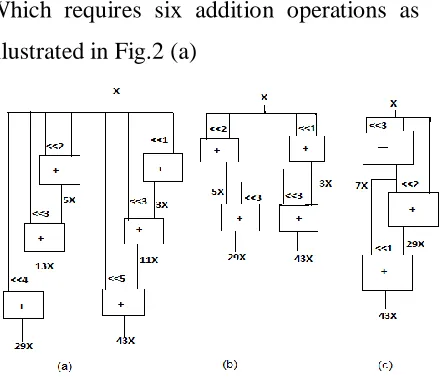
As a simple example, consider the constant
multiplications 29x and 43x. Their
decompositions in binary are listed as
follows:
29x = (11101)binx = x<<4 + x<<3 + x<<2 +
x
43x =(101011)binx = x<<5 + x<<3 + x<<1
Which requires six addition operations as
illustrated in Fig.2 (a)
Fig. 2. Shift-adds implementations of 29x
and 43x. (a) Without partial product sharing
[2] and with partial product sharing. (b)
Exact CSE algorithm [5]. (c) Exact GB
algorithm [8].
The algorithms designed for the MCM
problem can be categorized in two classes:
common sub expression elimination (CSE)
algorithms [3]–[5] and graph-based (GB)
algorithm [6]–[8].
The proposed algorithm that optimally
solves this maximal sharing problem. This
problem has been the subject of extensive
research in recent years. Two key strategies
have had a large impact in the optimization
of MCMs. One is to consider not only
adders, but also subtracter to combine partial
terms, thus increasing the opportunity for
the sharing of common sub expressions.
The second is the usage of the Canonical
Sign Digit (CSD) representation for the
coefficients. This representation minimizes
the number of non-zero digits; hence the
maximal sub expression sharing search
starts from a minimal level of complexity.
In a recent paper, Park [9] proposes the
usage of a Minimal Signed Digit (MSD)
representation for the coefficients. The MSD
representation is obtained from the CSD
representation by relaxing the requirement
that there cannot be two consecutive
non-zero digits. Under the MSD representation, a
given numerical value can have multiple
representations. However, in all of them, the
number of non-zero digits is the same as the
CSD representation. The algorithm proposed
in [9] exploits the redundancy of the MSD
representation by choosing the MSD
instance that leads to a maximal sharing in
the implementation of efficient FIR filters.
To the best of our knowledge, all previous
solutions to this problem have been
heuristic, providing no indication as to how
propose an exact algorithm that is feasible
for many real situations. We model this
problem as a Boolean network that covers
all possible partial terms which may be used
to generate the set of coefficients in the
MCM instance. The inputs to this network
are shifted versions of the value that serves
as input to the MCM operation. Each adder
and subtracter used to generate a given
partial term is represented as an AND gate.
All partial terms that represent the same
numerical value are ORed together. There is
a single output which is an AND over all the
coefficients in the MCM. We cast this
problem into a 0-1 Integer Linear
Programming (ILP) problem by requiring:
that the output is asserted,
meaning that all coefficients are covered by
the set of partial terms found; while
minimizing the total number of AND gates
that evaluate to one, i.e., the number of
adders/subtracters.
We have applied this algorithm to
coefficients represented in binary, CSD and
MSD representations. Note that the
redundancy of the MSD representation can
be readily incorporated in our model, where
the equivalent MSD representations are
simply new inputs to the OR gate that
generates a given coefficient.
Returning to our example in Fig. 2, the exact
CSE algorithm of [9] gives a solution with
four operations by finding the most common
partial products 3x = (11)binx and 5x =
(101)binx when constants are defined under
binary, as illustrated in Fig. 2(b). On the
other hand, the exact GB algorithm [6] finds
a solution with the minimum number of
operations by sharing the common partial
product 7x in both multiplications, as shown
in Fig. 2(c). Note that the partial product 7x
= (111)binx cannot be extracted from the
binary representation of 43x in the exact
CSE algorithm [5].
2.
Digit-Serial Arithmetic
In digit-serial arithmetic, data words are
divided into digits, with a digit size of d bits,
which are processed in one clock cycle. The
special cases of the digit-serial computation,
called bit-serial and bit-parallel processing,
occur when the digit size d is equal to 1 and
input data word length, respectively. The
role when the bit-serial implementations
cannot meet delay requirements and the
bit-parallel designs require excessive hardware.
Thus, an optimal tradeoff between area and
delay can be obtained by changing the digit
size parameter (d). The fundamental
digit-serial operations were introduced in [10].
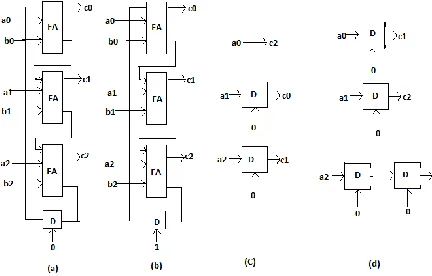
The digit-serial addition, subtraction, and
left shift operations are depicted in Figure 3
when d is equal to 3. Notice from Figure
3(a) that in a digit-serial addition operation,
in general, the number of required full
adders (FAs) is equal to d and the number of
necessary D flip-flops is always 1. The
subtraction operation (Figure 3(b)) is
implemented using 2’s complement,
requiring the initialization of the D flip-flop
with 1 and additional d inverter gates with
respect to the digit-serial addition operation.
Figure 3: The digit-serial operations when d
is 3: (a) addition operation; (b) subtraction
operation; (c) left shift by 2 times;(d)left
shift by 4 times.
Figure 4: Bit-serial realization of shift-adds
implementation of 29x and 43x given in
Figure 2(c).
As an example on digit-serial realization of
constant multiplications under the shift-adds
architecture, Figure 4 illustrates the bit-serial
implementation of 29x and 43x obtained by
the exact GB algorithm [8] given in Figure
2(c). The network includes 2 bit serial
additions, 1 bit-serial subtraction, and 5 D
flip-flops for all the left shift operations.
Observe from Figure 4 that at each clock
cycle, one bit of the input data x is applied to
the
network input and one bit of the constant
multiplication output is computed. Note that
the digit-serial design of the MCM operation
occupies significantly less area when
compared to its bit-parallel design and the
area of the design is not dependent on the
latency of the MCM computation is
increased due to the serial processing.
Suppose that x is a 16-bit input value. To
obtain the actual output of 29x and 43x in
the bit-serial network of Figure 4, 21 and 22
clock cycles are required respectively. Thus,
necessary bits must be appended to the input
data x, i.e., 0s, if x is an unsigned input or
sign bits, otherwise. Moreover, in the case of
the conversion of the outputs obtained in
digit-serial to the bit parallel format, storage
elements and control logic are required.
Note that while the sharing of
addition/subtraction operations reduces the
complexity of the digit-serial MCM design
(since each addition and subtraction
operation requires a digit-serial operation),
the sharing of shift operations for a constant
multiplication reduces the number of D
flip-flops, and consequently, the design area.
Observe from Figure 4 that two D flip-flops
cascaded serially to generate the left shift of
7x by two can also generate the left shift of
7x by one without adding any hardware cost.
3.
SIMULATION RESULTS
GB algorithm can be applied for any
coefficient pair combinations. Hence GB
algorithm is used and number of operations
is reduced drastically than other algorithms.
Fig5. Output for FIR filter with digit based
recoding algorithm
Four filter coefficient 29,43,59,89 values are
taken for digit serial FIR filter design. X(n)
is taken as a input sequence and Y(n) is
Fig6. Output for FIR filter with CSE
algorithm
Fig.5 shows 4 tap FIR filter with without
partial product sharing (Digit based
recoding) algorithm and Fig.6 displays 4 tap
filter with CSE algorithm.
Fig8. RTL schematic for FIR filter with GB
algorithm
Fig7. Output for FIR filter with GB
algorithm
Fig.7 displays 4 tap filter with GB
algorithm. This simulation result was
displayed by modelsim software. These are
the simulation results displayed by
modelsim software.
After completion of simulation process in
Modelsim tool, synthesis process is takes
place to calculate gate count and delay
report. Fig.8 shows the RTL schematic view
of FIR filter with MCM architecture.
3.1. FIR FILTER DEVICE
FIR filter with digit size d=4 was
synthesized separately for device utilization
in terms of gate count with each different
algorithms. Fig 9 and Fig.10 shows the
device utilization report of FIR filter with
GB algorithm. Table1
Fig 9. Device utilization report
explains that the FIR filter with GB
algorithm utilized less number of gate count
and delay than other two algorithms.
3.2. FIR FILTER DELAY SYNTHESIS
REPORT
Fig 10. Delay synthesis report
Table -1: Delay and Gate Count
Comparison
FIR Filter Delay DeviceUtilization
Normal
method
14.203 323
CSE
Algorithm
15.528 321
GB
Algorithm
12.875 299
4. CONCLUSION Thus the implementation of digit serial FIR
MCM architectures using GB algorithm.
Device utilization and delay values are
compared for hardware implementation.
Hence this MCM approach drastically
reduces the system complexity, area and
delay and FPGA hardware real time
implementation has performed with spartan3
version. Future enhancement of this paper is
to design MCM architecture with more
coefficient pairs for FIR filter
implementation.
REFERENCES
[1] L. Wanhammar, DSP Integrated Circuits.
New York: Academic, 1999.
[2] M. Ercegovac and T. Lang, Digital
Arithmetic. San Mateo, CA: Morgan
Kaufmann, 2003.
[3] R. Hartley, ―Subexpression sharing in
filters using canonic signed digit
multipliers,‖ IEEE Trans. Circuits Syst. II,
Exp. Briefs, vol. 43, no. 10, pp. 677–688,
Oct. 1996.
[4] I.-C. Park and H.-J. Kang, ―Digital filter
synthesis based on minimal signed digit
representation,‖ in Proc. DAC, 2001, pp.
468–473.
[5] L. Aksoy, E. Costa, P. Flores, and J.
Monteiro, ―Exact and approximate
algorithms for the optimization of area and
delay in multiple constant multiplications,‖
IEEE Trans. Comput.-Aided Design Integr.
Circuits
Syst., vol. 27, no. 6, pp. 1013–1026, Jun.
2008.
[6] A. Dempster and M. Macleod, ―Use of
minimum-adder multiplier blocks in FIR
digital filters,‖ IEEE Trans. Circuits Syst. II,
Exp. Briefs, vol. 42, no. 9, pp. 569–577,
Sep. 1995.
AUTHOR1:-
*N.MANASA completed her B.Tech
GANAPATHY ENGINEERIMG
COLLEGE in 2014 and M.Tech completed
in VAAGDEVI COLLEGE OF
ENGINEERING
AUTHOR2:-
**V.VIJAYA working as Assoc. prof in
Dept of ECE, VAAGDEVI COLLEGE OF
ENGINEERING
AUTHOR3:-
***MR.G.BABU working as Assoc. prof in
Dept of ECE, VAAGDEVI COLLEGE OF