WAVEGUIDE STRUCTURES FOR GENERATION OF TERAHERTZ RADIATION BY ELECTRO-OPTICAL
PROCESS IN GaAs AND ZnGeP2 USING 1.55µm FIBER
LASER PULSES
T. Yang, S. Song, H. Dong, and R. Ba
College of Precision Instruments and Opto-electronics Engineering Laboratory of Optoelectronics Information Technical Science Educational Ministry of China
Center for Terahertz Waves Tianjin University
China
Abstract—By discussing the basic schemes of the terahertz generation methods based on the 1550-nm ultrafast lasers briefly, GaAs and ZnGeP2 are likely to be promising nonlinear optical crystals for
terahertz waves generation by using optical rectification process. However, the mismatches of velocities between the terahertz waves and optical pulses are so large that the phase-matching coherent lengths are quite short, for example, the coherent length of 0.7 mm for GaAs and 0.5 mm for ZnGeP2 at 2 THz around, respectively. That
limited extremely the applications of these bulk excellent nonlinear optical crystals in terahertz regime. In this paper, we demonstrated theoretically that the dielectric planar waveguide could be used to enhance the coherent length of optical rectification process in THz regime. And for the first time, a dielectric planar THz waveguide that has potential applicable value in THz generation by optical rectification method was proposed. We predicted that the effective coherent length could be extended to 4 mm at 2 THz in a GaAs/ZnGeP2
dielectric planar waveguide during optical rectification process pumped by ultrafast optical pulses at wavelength of 1550 nm.
1. INTRODUCTION
such as material characterization, time-domain spectroscopy, and imaging. The THz emitter, based on ultrafast laser, is a potential candidate that has a wide THz bandwidth. But the Ti: Sapphire solid state laser that is currently being used as a pump source, is too expensive and bulky. Hence, developing a compact, low cost THz field source and detection technique, based on 1550-nm fiber laser, is a necessity. The present research trend suggests a shift of the pump wavelength from 810 to 1550 nm of ultrafast fiber laser to use cheaper components for optical communication wavelength [1]. And fiber laser also has the advantages of compact, low cost, free of water-cooling, etc. There exist two schemes for THz pulse generation by tabletop devices. These are photoconductive switches illuminated by ultrashort laser pulses, and optical rectification of ultrashort laser pulses in nonlinear crystals. To realize photoconductive switches operable with 1550-nm light, the band gap of the material should be reduced so as to enable efficient photoexcitation. Though low-temperature-grown (LTG) InxGa1−xAs (0.4 < x < 0.53) has been shown to work at
1560-nm excitation [2], there is no well established photoconductive material suitable for 1550-nm excitation yet. A nonresonant electro-optical (EO) process is the simplest method for both THz generation with optical rectification and detection using EO sampling methods because the optimization of nonlinear crystal is well established even in the long wavelength region. Optical rectification of femtosecond laser pulses in nonlinear crystals is a proven way to generate THz radiation. The earliest optical rectification experiments were performed by Yang et al. in a LiNbO3 nonlinear optical crystal. Later, other groups
applied the optical rectification technique to different nonlinear crystals such as LiTaO3, GaAs, GaSe and others, and used femtosecond laser
pulses to increase the generated THz bandwidth [3]. Recently, 10µJ ultrashort THz pulses have been generated by optical rectification in a lithium niobate crystal based on a 10 Hz Ti: sapphire laser [4]. However, there is rare successful examples of THz pulses generation by optical rectification in a nonlinear crystal based on an ultrafast fiber laser at a wavelength of 1550-nm. The main reason is that matching between the optical group velocity and THz phase velocity is crucial for efficient optical rectification. For a large set of well known nonlinear crystals with low absorption in THz band, such as GaAs, GaSe, GaP, ZnTe and ZnGeP2, their phase matching conditions are not satisfied at
There several groups have demonstrated the planar waveguide structures in THz generation. They all aimed on confining the THz radiation in a metallic planar waveguide effectively in which the THz field is forced to be a fundamental guide mode of transverse electromagnetic (TEM) mode [5–7]. The phase velocity of TEM mode in a metallic planar waveguide is the same as electromagnetic waves in free space. That means that the metallic waveguide structure would not be effective to narrow the velocity gap between the optical pulses and THz radiation. Normally, the phase velocity of THz wave is smaller than the group velocity of the near infrared ultrashort pulse in nonlinear optical crystals. In this paper, we try to establish a dielectric planar waveguide for THz waves in which the fundamental mode is transverse magnetic (TM) mode of which effective propagation velocity is larger than TEM mode in a metallic planar waveguide. This is the first time, to our knowledge, to establish a dielectric planar waveguide for THz waves to enhance the coherent length of optical rectification of ultrashort optical pulse at a wavelength of 1550-nm for THz wave generation.
2. COHERENT LENGTH
The phase matching condition for the optical rectification process (collinear difference frequency mixing) is given by
∆k=k(ωopt+ωTHz)−k(ωopt)−k(ωTHz) = 0 (1)
where ωopt and ωTHz are the optical and THz wave frequencies,
respectively, andωopt and (ωopt+ωTHz) lie within the spectrum of the
optical pulse. If we neglect dispersion in the optical spectral range, we can express the coherence length lc(=π/∆k) as
lc =
πc
ωTHz|nopt,phase−nTHz|
(2)
Here,cis the speed of light andnopt,phaseandnTHz are the optical
and THz wave refractive indexes of bulk crystals, respectively. For an ultrashort optical pulse, the dispersion in the optical refractive index may be used to obtain collinear, noncritical phase matching over a broad bandwidth in the THz band. For a medium with dispersion at optical frequencies, the phase matching condition of Eq. (1) may be rewritten as [8]
k(ωTHz)
ωTHz ≈
∂k ∂ω
opt
This relation implies that phase matching is achieved when the phase of the THz wave travels at the velocity of the optical pulse envelope (i.e., the optical group velocity, vg). The corresponding
coherence length for difference frequency mixing is now
lc =
πc
ωTHz|nopt,group−nTHz|
(4)
wherenopt,groupis the group index at the optical pump frequency in the
bulk nonlinear optical crystal and can be determined by the dispersion property of the optical crystal as following expression
nopt,group=nopt,phase−λopt
dnopt,phase
dλopt
λopt
(5)
where λopt is the center-wavelength of pumping ultrashort optical
pulse.
Using published values [9–11] for the relevant optical parameters, we have calculated thenopt,group at optical wavelength of 1550 nm and
nTHz at 2 THz for a set of well known nonlinear crystals. The results
are shown in Table 1.
Table 1. The group index at the optical pump frequency and the phase index at THz frequency of well known nonlinear crystals.
GaAs [9] ZnGeP2 [10, 11] GaP [11] ZnTe [9]
nopt,phase@ 1550 nm 3.3767 3.1697 3.0543 2.7330
nopt,group@ 1550 nm 3.5174 3.2745 3.1705 2.8065
nTHz@ 2 THz 3.61 3.420 3.3494 3.22
λopt,phase−maching
@ 2 THz [nm] 1330 1191 1000 800
lc@ 1550 nm [mm] 0.78 0.5155 0.42 0.1
From the Table 1 we can see that the coherent length is quite small for optical rectification process because of the difference between the nopt,group and nTHz, and nTHz is normally larger than nopt,group.
So we have to reduce the nTHz, or increase the phase velocity of
THz wave by introducing appropriate waveguide structure to enhance the coherence length if the nopt,group is kept unchangeable in that
3. DIELECTRIC PLANAR WAVEGUIDE FOR THZ WAVES
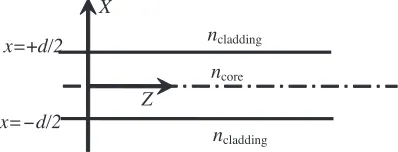
We set up a dielectric planar waveguide (See Fig. 1) for THz waves other than a metallic planar waveguide because the electromagnetic waves could travel faster in dielectric planar waveguides than in a bulk counterpart dielectric medium.
Z X
x=−d/2
x=+d/2 ncladding
ncladding ncore
Figure 1. Dielectric planar waveguide geometry.
The solution of TM modes for the electric field may be written [12]
Ex=Ey = 0, Ez=
− αx
iωn2 cladding
Be−αxxe−iβz x > d 2
− kx
iωn2 core
Asinkxxe−iβz |x|<
d 2
− αx
iωn2 cladding
Beαxxe−iβz x <−d 2
(6)
wherekxis the transverse propagation number andβis the longitudinal
propagation number which is equal to the propagation number of TM mode in the core range,αxis the transverse parameter of mode section,
ω is the angular frequency of electromagnetic field, ncore and ncladding
are the refractive indices of core medium and cladding medium of the planar waveguide, respectively.
By matching the boundary conditions at x = d/2, we can have the determinantal equation
kx
iωn2 core
tankxd
2 =
αx
iωn2cladding (7) The longitudinal propagation number, β, and the transverse propagation number of kx can be determined by combining the
relations (8) as following derived from wave equations with Eq. (7).
β2−α2x= ω2µ
0n2cladding=k2cladding
where kcore and kcladding are the propagation numbers in unbounded
mediums of which indices are ncore and ncladding, respectively.
The propagation number β is smaller than kcore, thus indicating
that the phase velocity of mode is greater than the speed of an infinite plane wave in a medium with a uniform index ncore. This situation
can not be happened in a metallic planar waveguide in which the fundamental mode is TEM mode which electric field can be written
Ex =
0 x > d
2
E0e−iβz |x|<
d
2, Ey = 0, Ez = 0
0 x <−d 2
(9)
whereβ is the propagation number of the TEM mode and is equal to the kcore if the medium with refractive index of ncore is sandwiched
between two metallic films or plates.
We finally choose two kinds of nonlinear optical crystals which have high effective nonlinear coefficients for optical rectification process and low absorption in THz regime, GaAs and ZnGeP2, after examining
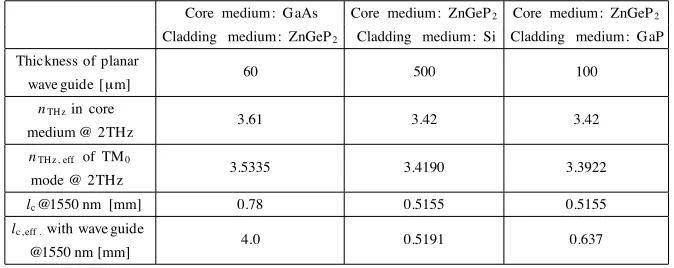
a large set of well known nonlinear crystals. We designed three different planar waveguide structures by using different crystals and calculated the propagation number β of TM0 mode, the fundamental mode, and
the effective index, nTHz,eff., at a frequency ω of 2 THz according to
the Eq. (10). The results are summarized in Table 2.
βT M2 0 =ω2µ0n2THz,eff. (10)
The coherence length for difference frequency mixing in waveguide configuration is becoming now
lc,eff.=
πc
ωTHz|nopt,group−nTHz,eff.|
(11)
where nopt,group could be still the group index at the optical pump
frequency in the bulk nonlinear optical crystal because the effects of waveguide are quite weak for optical wave of which optical wavelength is much smaller than the thickness of the planar waveguide. Thus we considered that optical pulses pass the waveguide in such a way that it travel in an unlimited uniform medium.
The best result is the GaAs/ZnGeP2 dielectric planar waveguide
in which the effective coherent length enhances to 4 mm from 0.78 mm without waveguide structure. For GaAs/ZnGeP2 waveguide, the
Table 2. Three different planar waveguide structures and their coherence lengths.
Core medium : GaAs Core medium : ZnGeP2 Core medium : ZnGeP2
Cladding medium : ZnGeP2 Cladding medium : Si Cladding medium : GaP
Thickness of planar
wave guide [µm] 60 500 100
nTH zin core
medium @ 2THz 3.61 3.42 3.42
nTH z , eff. of TM0
mode @ 2THz 3.5335 3.4190 3.3922
lc@1550 nm [mm] 0.78 0.5155 0.5155
lc , eff .with wave guide
@1550 nm [mm] 4.0 0.5191 0.637
4. CONCLUSIONS
In summary, we demonstrated theoretically that the dielectric planar waveguide could be used to enhance the coherent length of optical rectification process in THz regime. And for the first time, a dielectric planar THz waveguide that has potential applicable value in THz generation by optical rectification method was proposed. We predicted that the effective coherent length could be extended to 4 mm at 2 THz in a GaAs/ZnGeP2 dielectric planar waveguide during optical
rectification process pumped by ultrafast optical pulses at wavelength of 1550 nm.
ACKNOWLEDGMENT
This work is supported partly by the National natural science foundation of China (NSFC) under the project which number is 60578022.
REFERENCES
1. Gong, Y. D., M. Y. W. Chia, and B. Luo, “Terahertz spectroscopy technology trendy using 1550-nm ultrafast fiber laser,” Micro. Opt. Tech. Letts., Vol. 49, No. 2, 439–443, 2007.
low-temperature-grown InGaAs with 1.56µm pulse excitation,”Appl. Phy. Letts., Vol. 90, No. 17, 101119, 2007.
3. Planken, P. C. M, C. E. W. M. van Rijmenam, and R. N. Schouten, “Opto-electronic pulsed THz systems,” Semicond. Sci. Technol., Vol. 20, S121–S127, 2005.
4. Yeh, K.-L., M. C. Hoffmann, J. Hebling, and K. A. Nelson, “Generation of 10µJ ultrashort terahertz pulses by optical rectification,” Appl. Phy. Letts., Vol. 90, No. 17, 171121, 2007. 5. Mendis, R. and D. Grischkowsky, “Undistorted guided-wave
propagation of subpicosecond terahertz pulses,” Opt. Letts., Vol. 26, No. 11, 846–848, 2001.
6. Mendis, R., “Nature of subpicosecond terahertz pulse propagation in practical dielectric-filled parallel-plate waveguides,”Opt. Letts., Vol. 31, No. 17, 2643–2645, 2006.
7. Cao, H., R. A. Linke, and A. Nahata, “Broadband generation of terahertz radiation in a waveguide,” Opt. Letts., Vol. 29, No. 15, 1751–1753, 2004.
8. Nahata, A., A. Aniruddha, S. Weling, and T. F. Heinz, “A wideband coherent terahertz spectroscopy system using optical rectification and electro-optic sampling,” Appl. Phys. Letts., Vol. 69, No. 16, 2321–2323, 1996.
9. Nagaia, M., K. Tanaka, H. Ohtake, T. Bessho, T. Sugiura, T. Hirosumi, and M. Yoshida, “Generation and detection of terahertz radiation by electro-optical process in GaAs using 1.56 mm fiber laser pulses,” Appl. Phys. Letts., Vol. 85, No. 18, 3974–3976, 2004.
10. Kumbhakar, P., T. Kobayashi, and G. C. Bhar, “Sellmeier dispersion for phase-matched terahertz generation in ZnGeP2,”
Appl. Opt., Vol. 43, No. 16, 3324–3328, 2004.
11. Palik, E. D., Handbook of Optical Constants of Solids, Academic Press, London, 1985.